Uncontested Divorce in Alabama: Forms, Venue, the 30-Day Wait, and What It Costs
An uncontested divorce in Alabama is one where you and your spouse agree on every issue – grounds, property, debts, support, and parenting – so a Circuit Court judge can grant the divorce on the paperwork without a contested trial. You file a complaint on no-fault grounds in the right county, your spouse signs the response and waiver documents, and after a mandatory 30-day waiting period the judge can sign the final judgment. It is the fastest and cheapest way to end a marriage in Alabama when the agreement is genuine.
TL;DR: uncontested divorce in Alabama at a glance
- An uncontested divorce in Alabama works when both spouses agree on property, debts, support, and (if you have them) minor children. “Simple divorce in Alabama” is informal shorthand for the same thing – it is not a separate legal process.
- You file in the Circuit Court of the correct county: where the defendant lives, where you last lived together, or – if the defendant lives out of state – where you live (Ala. Code § 30-2-4).
- Alabama has a mandatory 30-day waiting period: no final judgment can be entered until 30 days after the summons and complaint are filed.
- The statewide statutory filing fee is $145, but counties add local charges, so the real total currently runs about $190 to $325 before service costs – always check your county’s fee chart.
- The state’s fill-in Alabama divorce forms (PS-08, PS-09, PS-10, PS-21) only cover a case with no minor children and no property or debts to divide. Everyone else follows their county’s divorce packet.
- PS-21 is a true Answer for a served defendant – not a waiver. An uncontested case uses a separate, county-supplied Answer, Waiver, and Agreement for Taking Testimony, notarized by both spouses.
- If you have children, Rule 32 requires the CS-41, CS-42 (or CS-42-S), and CS-43 child-support forms, plus an income-withholding order.
- Neither spouse may remarry anyone else until 60 days after the judgment (Ala. Code § 30-2-10).
1. What is an uncontested (or “simple”) divorce in Alabama?
Alabama has no statute called “simple divorce.” Lawyers, clerks, and self-help materials use that phrase loosely to describe a straightforward, fully agreed case, but the process is the ordinary uncontested divorce: both spouses agree on all issues, and the case moves through the Circuit Court of the county where you file without a contested hearing.
An uncontested case still has to satisfy the court. You must file a written complaint that alleges a legal ground for divorce, provide sworn testimony (usually in writing), and – if there are minor children – show the judge that child support and parenting arrangements meet Alabama’s guidelines. A signed settlement agreement makes the case suitable for an uncontested submission, but it does not force the judge to sign; the court keeps authority over the final judgment (Ala. Code § 30-2-1).
What “uncontested” really buys you is speed and cost: no discovery fight, no trial date, and often no court appearance at all. When spouses truly agree, an Alabama uncontested divorce can be finalized not long after the 30-day waiting period – though how quickly the judge and clerk actually process it varies by county.
2. Do you qualify? Residency, venue, and grounds
Three things decide whether your case can proceed as an Alabama simple divorce: whether an Alabama court has jurisdiction (residency), which county is the right one (venue), and whether you have a valid legal ground. Get these wrong and the clerk can reject the filing or the judge can dismiss it.
Residency: the six-month rule for an out-of-state spouse
If both spouses live in Alabama, you generally just need to file in the correct county. If your spouse (the defendant) lives in another state, Alabama law requires the filing spouse to have been a bona fide resident of Alabama for at least six months before the complaint is filed, and that fact must be stated in the complaint and proved (Ala. Code § 30-2-5). Courts read this strictly – if the six months isn’t met and proved, the court has no jurisdiction.
Venue: which county you file in
Venue is separate from residency. Under Ala. Code § 30-2-4, a complaint for divorce may be filed in the Circuit Court of:
- the county where the defendant resides;
- the county where the spouses lived together when they separated; or
- if the defendant is a nonresident, the county where the filing spouse resides.
In a cooperative case the couple often just agrees on a convenient county that fits one of these categories. Filing in the wrong county can lead to a transfer or dismissal, so confirm it before you pay the fee.
Grounds: the no-fault options
Alabama allows both fault and no-fault grounds, but uncontested cases almost always use a no-fault ground (Ala. Code § 30-2-1):
- Incompatibility of temperament – the differences between the spouses are so complete that they can no longer live together.
- Irretrievable breakdown of the marriage – the marriage is broken and further attempts at reconciliation would be impractical or futile.
With either ground, neither spouse has to prove the other did anything wrong. The complaint simply states the ground, and the plaintiff’s sworn testimony backs it up.
When an uncontested case is a good fit – and when it isn’t
An uncontested divorce in Alabama is a realistic fit when:
- the residency and venue rules are satisfied;
- you both agree to proceed on a no-fault ground;
- you can sign a written settlement (separation) agreement covering property, debts, and alimony;
- if you have minor children, you agree on custody, visitation, and a child-support figure that follows Rule 32; and
- your spouse will sign and notarize the response and waiver documents so the court can treat the case as uncontested.
It is not the right route if there is domestic violence, fear, or coercion; a significant power or financial imbalance; hidden assets or income; a serious dispute about the children; or complex finances such as a business, substantial retirement accounts, or multiple properties. In those situations, talk to a lawyer before you sign or file.
3. The Alabama divorce forms (and which set applies to you)
This is where most DIY filers get stuck, because Alabama does not publish one statewide fill-in packet for every divorce. There are two very different situations.
The state’s do-it-yourself forms: no children, no property
The Administrative Office of Courts publishes a small set of fill-in Alabama divorce forms – the “PS” series – through the state’s eForms catalog and AlabamaLegalHelp. They are written for one narrow case: an uncontested divorce with no minor children and no assets or debts for the court to divide.
- PS-08 – Complaint for Divorce: starts the case. Notarized signature required.
- PS-09 – Plaintiff’s Testimony (Divorce): the plaintiff’s sworn written testimony so the judge can decide on paper. It tells you to ask the clerk about local procedure.
- PS-10 – Request for Default Judgment: used if the defendant is served and does not answer.
- PS-21 – Answer to Divorce Complaint: the defendant’s response after being served. Read the next paragraph carefully – this form is widely misunderstood.
PS-21 is not an “answer and waiver.” The official PS-21 tells a served defendant that they must file the answer within 30 days and still go to court, and that the judge can enter a default judgment if they don’t. It contains no waiver of service and no agreement to have the case decided on testimony. In a genuinely uncontested case the defendant instead signs a separate Answer, Waiver, and Agreement for Taking Testimony that the filing county supplies, with both spouses’ signatures notarized. Any waiver or acceptance of service must be signed by the defendant and filed with the clerk (Alabama Rules of Civil Procedure, Rule 4).
Everyone else: your county’s divorce packet
If you have minor children, real estate, retirement accounts, debts to allocate, or an alimony claim, the PS forms do not fit. You need pleadings drafted for your facts – a Complaint, an Answer/Waiver/Agreement for Taking Testimony, a Separation Agreement, the Plaintiff’s Testimony, a proposed Final Judgment of Divorce, and the child-support forms – following the checklist published by your county Circuit Clerk’s domestic-relations division. Most Alabama counties post that checklist online; the exact documents and their names vary.
| Document | What it does | Who needs it |
|---|---|---|
| Complaint for Divorce (PS-08, or a county form) | Opens the case; states residency, venue, the ground, and the relief requested. | Everyone (PS-08 only if no children and no property/debts). |
| Answer, Waiver, and Agreement for Taking Testimony | Defendant answers, waives formal service, and agrees the case can be decided on written testimony. Both signatures notarized. | Every uncontested case. County-supplied – not PS-21. |
| Settlement / Separation Agreement | Divides property and debts, sets alimony (if any), and sets custody, visitation, and support. | Every case with property, debts, support, or children. |
| Plaintiff’s Testimony (PS-09, or a county form) | Sworn written testimony supporting the ground and the agreement. | Everyone. Notarized. |
| Proposed Final Judgment of Divorce | The order you want the judge to sign. | Everyone outside the bare PS-08/PS-09 track. |
| Certificate of Divorce (ADPH HS-16) | Vital-records form for the Alabama Department of Public Health / Center for Health Statistics. | Everyone – but see below on where to get it. |
| CS-41, CS-42 or CS-42-S, CS-43 | Rule 32 child-support income affidavit, guidelines worksheet, and notice of compliance. | Every case that sets or modifies child support. |
| CS-47 – Domestic Relations / Child Support Information Sheet | Party and case information for state recordkeeping (Appendix to Rule 32.1). | Required in every domestic-relations case in many counties, children or not. |
| CS-01 (plus CS-33 / CS-35) | Income-withholding order for child support; CS-33/CS-35 are used for immediate service on an employer. | Every case with a child-support obligation. |
The Certificate of Divorce (ADPH HS-16) is a local variable. It is always required, but some clerks hand you the form at the counter (Cullman County, for example, says the clerk’s office supplies it) while others expect an original Center for Health Statistics form rather than a downloaded copy. Ask your county which version they accept before you assemble the file.
Paper or electronic? Alabama has an e-filing system, AlaFile, but self-represented filers are not required to use it. You can register and file electronically, or file on paper at the clerk’s office – check your county’s instructions first.
4. Step-by-step: the uncontested divorce process in Alabama
The exact documents vary by county, but every Alabama uncontested divorce follows the same path through the Circuit Court.
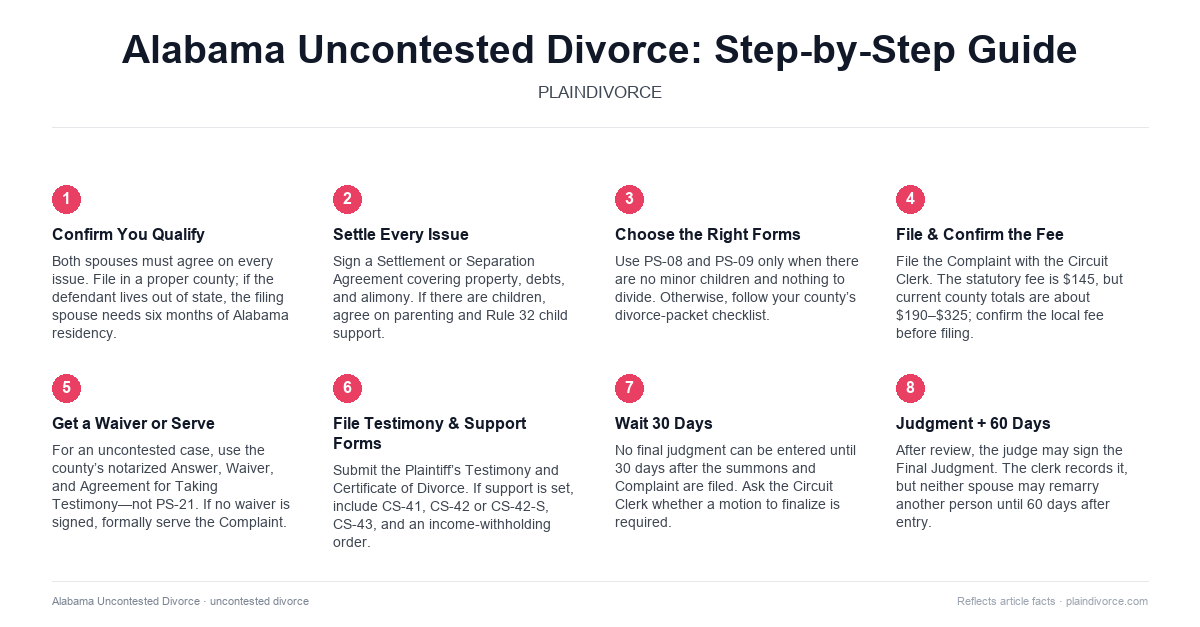
- Confirm eligibility. Check residency (the six-month rule if your spouse is out of state), pick the correct venue under § 30-2-4, and choose a no-fault ground. Locate your marriage information (date and place) for the complaint and the Certificate of Divorce.
- Put the agreement in writing. Draft and sign a Settlement / Separation Agreement covering property, debts, alimony, and – if you have minor children – custody, a parenting schedule, and a child-support amount calculated under Rule 32. The judge reviews this closely when children are involved.
- Assemble the right forms. Use the state’s PS-08/PS-09 set only if you have no children and nothing for the court to divide. Otherwise, follow your county’s divorce-packet checklist and prepare a proposed Final Judgment.
- File with the Circuit Clerk and pay the fee. File the complaint and supporting documents in the correct county and pay the filing fee (see section 7). The clerk assigns a “DR” case number and stamps your copies. Keep a complete copy of everything. This filing date starts the 30-day clock.
- Handle the defendant’s response. In an uncontested case the defendant signs and notarizes the county’s Answer, Waiver, and Agreement for Taking Testimony, which is filed with the court – no process server needed. If your spouse won’t sign, you must serve the complaint formally (sheriff or certified mail), and the case may stop being uncontested.
- File the testimony and any child-support forms. Submit the Plaintiff’s Testimony and, in a case with children, the CS-41, CS-42 (or CS-42-S), CS-43, the CS-47 information sheet, and an income-withholding order.
- Wait out the 30-day period. Under Ala. Code § 30-2-8.1, the court cannot enter a final judgment until 30 days after the summons and complaint were filed. The judge can still issue temporary orders (custody, support, use of the home) during that window. In many counties you must file a motion asking the court to finalize once the 30 days pass.
- The judge signs the Final Judgment of Divorce. If the paperwork is complete and consistent, the judge can sign without a hearing. The clerk enters the judgment, forwards the Certificate of Divorce to the Center for Health Statistics, and you can order certified copies for name changes, benefits, and records.
- Mind the 60-day remarriage bar. The judgment will order that neither spouse may marry anyone else until 60 days after it is entered, and if either spouse appeals within 60 days, neither may remarry during the appeal (Ala. Code § 30-2-10).
5. If you have children: child support, Rule 32, and income withholding
When there are minor children, the court scrutinizes your agreement to make sure the parenting plan works and child support follows Alabama’s guidelines. You cannot simply agree to skip support.
The Rule 32 child-support forms
Alabama child support is calculated under Rule 32 of the Rules of Judicial Administration (an income-shares model). Every action that establishes or modifies support must include:
- CS-41 – Child-Support-Obligation Income Statement/Affidavit, from each parent, with verified documentation of current and recent gross income (pay stubs or an employer statement) and the most recent tax return.
- CS-42 – Child Support Guidelines worksheet, or CS-42-S when the parents share physical custody.
- CS-43 – Child Support Guidelines Notice of Compliance.
All three are required even for a $0 order, which must state why support is zero. Many counties also require the CS-47 Domestic Relations / Child Support Information Sheet – captioned “Appendix to Rule 32.1,” and backed by the Child Support Reform Act of 1997 (Ala. Code § 30-3-190 et seq.) for state recordkeeping – in every divorce, whether or not there are children. Follow your county’s packet.
The income-withholding order
Any support order in Alabama comes with an income-withholding order (Ala. Code § 30-3-61). County packets call for form CS-01, and, when the order is to be served on the employer immediately, forms CS-33 and CS-35. Withholding takes effect immediately unless the court finds good cause not to, or the parents reach an alternative written arrangement that the judge approves. Skipping this form is one of the most common reasons a child-support divorce gets bounced back.
Practical tip: make sure the numbers match across every document – the CS-41 income figures, the CS-42 result, the Separation Agreement, and the proposed judgment. Inconsistent figures are a frequent cause of delay.
6. How long does an uncontested divorce take in Alabama?
There is one fixed minimum and several variables.
- The 30-day statutory minimum. No final judgment can be entered until 30 days after the summons and complaint are filed (§ 30-2-8.1). This cannot be waived or shortened.
- County processing time. After day 30, how fast the judge reviews and signs – and whether you must file a motion to prompt a final judgment – depends entirely on the county and the judge’s docket. Some sign within days; others take weeks.
- Paperwork quality. A missing notarization, an unsigned waiver, mismatched child-support numbers, or an incomplete Certificate of Divorce sends the file back and restarts the clock on the judge’s attention.
Alabama’s statute sets a floor, not a finish date. Rather than rely on a statewide “X to Y weeks” estimate, ask your county Circuit Clerk how uncontested divorces are processed there once the 30 days pass.
7. What does an uncontested divorce cost in Alabama?
The main fixed cost is the court filing fee. The statewide statutory domestic-relations docket fee is $145 (Ala. Code § 12-19-71), but each county adds authorized local charges, so the amount you actually pay at the window is higher. Recent published county figures:
| Item | Typical amount |
|---|---|
| Statutory domestic-relations docket fee (statewide) | $145 |
| Total filing fee – Marion County | $192 |
| Total filing fee – Escambia County (base docket fee) | $222 |
| Total filing fee – Cullman County | $224 |
| Total filing fee – Madison County | $324 |
| Service fee (if the case is not fully uncontested) | ~$30, or certified-mail cost |
| Motion for final judgment (some counties) | ~$50 |
| Income-withholding order (child-support cases) | ~$28 |
| Notary fees / certified copies | Small, per document |
So budget roughly $190 to $325 for the filing fee depending on the county, plus service and child-support add-ons where they apply. County charges change, so confirm the current figure with your Circuit Clerk before you file – most post a fee chart online.
If the fee is a hardship: you can ask the court to waive the docket fee by filing a verified Statement of Substantial Hardship (Ala. Code § 12-19-70). The fee can be waived initially and taxed as costs at the end of the case; if the court doesn’t rule on your request within 90 days, the hardship is deemed granted.
Download Our Alabama Uncontested Divorce Self-Help Kit
8. When a DIY divorce might not be right for you
Handling your own simple divorce in Alabama is usually a poor idea when any of these apply:
- domestic violence, threats, coercion, or fear of your spouse;
- hidden assets or income, or one spouse controlling all the money;
- major disagreement about custody, visitation, or support;
- complex finances – a business, significant retirement or pension accounts, several properties, or heavy debt;
- immigration, military (SCRA), tax, or bankruptcy issues tied to the divorce.
A “cheap divorce” gets expensive fast if you sign away a right you didn’t know you had. Even a single consultation with an Alabama family-law attorney can tell you whether your agreement is fair before you file.
9. Where a self-help divorce kit fits into the process
Most self-represented spouses aren’t unsure about the decision to divorce – they’re unsure about the sequence: which complaint applies, what the county needs beyond the PS forms, what the Answer/Waiver actually has to say, how the Rule 32 forms fit together, and when to ask the court to finalize. A well-built Alabama simple divorce kit helps by:
- explaining which form set applies to your situation – the state’s PS-08/PS-09 track, or a county packet;
- walking through the uncontested path: file, Answer & Waiver, testimony, 30-day wait, motion to finalize, judgment;
- giving you checklists so you don’t miss a notarization, the Certificate of Divorce, the CS-47 sheet, or the income-withholding order; and
- keeping the paperwork consistent so the judge can sign without sending it back.
- Confirm: residency (6-month rule if spouse is out of state), venue under § 30-2-4, no-fault ground
- Agree in writing: Settlement / Separation Agreement (property, debts, alimony, custody, support)
- Pick your form set: PS-08/PS-09 (no children, no property) or your county’s divorce packet
- File & pay: Complaint + supporting docs with the Circuit Clerk in the correct county (~$190–$325)
- Response: spouse signs and notarizes the Answer, Waiver, and Agreement for Taking Testimony
- Testimony & support: Plaintiff’s Testimony; CS-41, CS-42/CS-42-S, CS-43, CS-47, income-withholding order (if children)
- Vital records: Certificate of Divorce (ADPH HS-16) – get the version your county accepts
- Wait: 30 days from filing; then file a motion to finalize if your county requires it
- Judgment: judge signs the Final Judgment of Divorce → order certified copies
- After: no remarriage to anyone else for 60 days (§ 30-2-10)
10. Frequently asked questions
What is an uncontested divorce in Alabama?
An uncontested divorce in Alabama is one where both spouses agree the marriage is over and have settled every issue – property, debts, alimony, and any child custody and support – so the Circuit Court can grant the divorce on written testimony without a contested hearing. “Simple divorce” is an informal name for the same process; Alabama law does not define a separate simple-divorce track.
Who qualifies for an uncontested divorce in Alabama?
You generally qualify if an Alabama court has jurisdiction (if your spouse lives out of state, you must have been an Alabama resident for six months before filing and prove it), you file in a proper county under Ala. Code § 30-2-4, you proceed on a no-fault ground, and you and your spouse sign a written settlement agreement plus the notarized Answer and Waiver. Cases with abuse, coercion, hidden assets, or serious disputes are not a good fit.
What Alabama divorce forms do I need for an uncontested case?
If you have no minor children and no property or debts to divide, the state’s fill-in forms – PS-08 (Complaint), PS-09 (Plaintiff’s Testimony), and PS-10 (default) – cover it, with PS-21 as the defendant’s answer only after service. Everyone else needs their county’s divorce packet: a Complaint, an Answer/Waiver/Agreement for Taking Testimony, a Separation Agreement, the Plaintiff’s Testimony, a proposed Final Judgment, the Certificate of Divorce, and the CS child-support forms if there are children.
Is the PS-21 form an “answer and waiver”?
No. The official PS-21 “Answer to Divorce Complaint” is for a defendant who has already been served; it tells them to answer within 30 days and still appear in court, and it has no waiver-of-service or consent language. An uncontested case uses a separate document your county provides – usually titled “Answer, Waiver, and Agreement for Taking Testimony” – signed and notarized by both spouses.
What child support forms does Alabama require?
Under Rule 32, every case that sets or modifies child support must include a CS-41 income affidavit from each parent (with income documentation and the latest tax return), a CS-42 guidelines worksheet (or CS-42-S for shared custody), and a CS-43 notice of compliance. You also file an income-withholding order (form CS-01, plus CS-33/CS-35 for immediate service), and many counties require the CS-47 information sheet in every divorce.
How long does an uncontested divorce take in Alabama?
Alabama law sets a mandatory 30-day waiting period: no final judgment can be entered until 30 days after the summons and complaint are filed (Ala. Code § 30-2-8.1). That is a minimum, not a completion date – how quickly the judge signs after day 30, and whether you must file a motion to finalize, depends on the county. Ask your Circuit Clerk how uncontested cases are processed locally.
How much does an uncontested divorce cost in Alabama?
The statutory domestic-relations docket fee is $145 statewide (Ala. Code § 12-19-71), but counties add local charges. Recent published totals run from about $192 (Marion County) to $324 (Madison County), so budget roughly $190 to $325 for filing, plus service costs and child-support add-ons where they apply. Confirm the current figure with your county Circuit Clerk. If cost is a barrier, you can file a verified Statement of Substantial Hardship to ask the court to waive the fee.
Can I remarry right after my Alabama divorce?
Not immediately. Under Ala. Code § 30-2-10, the divorce judgment orders that neither spouse may marry anyone except each other until 60 days after the judgment is entered. If either spouse files an appeal within that 60-day window, neither may remarry while the appeal is pending. Marrying too soon can make the new marriage voidable.
When is a DIY divorce in Alabama not a good idea?
Avoid the DIY route if there is domestic violence, fear, or coercion; hidden assets or income; a serious dispute about children or support; complex finances such as a business, pensions, or multiple properties; or immigration, military, tax, or bankruptcy complications. Get legal advice before you sign or file in any of these situations.
11. Final thoughts and next steps
Whether you call it an uncontested divorce in Alabama or a simple divorce in Alabama, the sequence is the same: confirm residency and venue, agree on everything in writing, use the form set that matches your situation, file in the right Circuit Court, and plan around the 30-day waiting period and the 60-day remarriage bar.
- Check the six-month residency rule (if your spouse is out of state) and pick a proper county under § 30-2-4.
- Sign a complete Settlement / Separation Agreement, and calculate child support under Rule 32 if you have minor children.
- Use PS-08/PS-09 only for a no-children, no-property case; otherwise follow your county’s divorce packet and prepare a proposed Final Judgment.
- File, have your spouse sign the notarized Answer and Waiver, submit the testimony and any CS forms, wait out the 30 days, and ask the court to finalize.
Get the Alabama Uncontested Divorce Self-Help Kit
Disclaimer: PlainDivorce is not a law firm and does not give legal advice. This is general legal information only. Alabama statutes, court rules, the official forms, and county filing fees all change, and requirements vary from one county to the next. Confirm the current rules with your county Circuit Clerk or an Alabama family-law attorney before you file.
Sources and local rules can change. Use this guide as a plain-English organizer, then verify the current filing requirements with the official court or government source for your jurisdiction.

About Harry D
Expert contributor at PlainDivorce, helping Canadians and American navigate simple uncontested divorces with clarity and confidence.