Uncontested Divorce in Alaska: Dissolution Forms, Cost, and Timeline
An uncontested divorce in Alaska is normally handled as a Dissolution of Marriage – a joint case that both spouses file together in the Alaska Superior Court under Alaska Statutes 25.24.200–.260 and Civil Rule 90.1, after agreeing on every issue: property, debts, spousal support, and (if you have them) a parenting plan and child support. A dissolution decree has the same legal force as a divorce decree. It is Alaska’s agreed, non-adversarial route, but it still involves a court hearing and a set of forms most people underestimate.
You will still see the phrase “simple divorce in Alaska,” but once you are dealing with the Alaska Court System the words that matter are dissolution, the DR-series forms (DR-100, DR-105, DR-314, VS-401), the parent education requirement, and Civil Rule 90.3 for child support. This guide walks through each one in plain English.
TL;DR: If you and your spouse agree on everything, an uncontested divorce in Alaska is usually a joint Dissolution of Marriage filed in Superior Court.
- Use DR-100 (no minor children) or DR-105 (with children), plus the required DR-314 Information Sheet and VS-401 Certificate.
- There is no minimum residency period – at least one spouse must be domiciled in Alaska (living here with intent to stay).
- Once the first spouse signs the petition, you have 60 days to file it. The hearing is set automatically and is normally at least 30 days after filing, unless the court orders an earlier hearing for good cause (Civil Rule 90.1).
- If you have minor children, both parents must finish the parent education requirement before the court will grant the dissolution – this is the step people miss most.
- The filing fee is $250 (fee waiver via TF-920). Child support follows Civil Rule 90.3; use the shared-custody worksheet (DR-306) only when the children live with each parent at least 110 overnights a year.
1. What is an uncontested or simple divorce in Alaska?
In Alaska, a “simple” or “uncontested” divorce means both spouses agree on every issue, so there is nothing left for a judge to decide on the merits. Alaska gives you two ways to get there:
- Dissolution of Marriage – a joint case. Both spouses file together, sign the same petition, and present one agreed set of terms to the court. Governed by AS 25.24.200–.260 and Civil Rule 90.1. This is the route this guide focuses on.
- Divorce by complaint – one spouse files a complaint and serves the other. It can still end up fully agreed and “uncontested,” but it runs under the divorce statutes (AS 25.24.010–.180) with formal service and a response deadline. See Section 5.
A dissolution decree has the same force and effect as a divorce decree – the difference is procedure, not the legal result. If you are searching for “Alaska divorce papers,” what you usually need is the dissolution packet and the correct Alaska divorce forms in the DR series.
2. Who qualifies for an Alaska dissolution of marriage?
Most couples who genuinely agree on everything can use an Alaska dissolution of marriage. There is no separation period to wait out. What matters is your Alaska connection, the court’s authority over your children (if any), and whether your agreement is truly complete.
2.1 Residency and domicile in Alaska
Either spouse (or both) must be domiciled in Alaska – physically present in the state and intending to remain indefinitely. Unlike many states, Alaska sets no minimum number of days of residency before you can file. Domicile is about intent, not a waiting period.
There is one narrow exception for the military: a service member who does not claim Alaska residency may still file for dissolution after being continuously stationed at an Alaska base or installation for at least 30 days (AS 25.24.900).
2.2 If you have children: court authority and paternity
If you have minor children, residency is not the only jurisdiction question. The court also needs authority over the children under AS 25.30.300. The usual basis is that the children have lived in Alaska for at least six consecutive months and currently live here (or lived here within the six months before filing) – but that is one of several possible grounds, not the only one. If your family has recently moved between states, confirm which state has jurisdiction before you file.
Paternity can also block the joint packet. You cannot split off a paternity question inside a dissolution. If a spouse is pregnant and the other spouse is not the second parent, or if a child born during the marriage has a paternity issue that has not been resolved, you generally have to use a divorce case instead. If paternity for a child born during the marriage was already disestablished, you must attach proof (a signed and notarized DR-521, a prior court order, or a certified birth certificate showing the correct legal father).
2.3 What you and your spouse must agree on
To use dissolution, both spouses must agree that “incompatibility of temperament has caused the irremediable breakdown of the marriage” – Alaska’s no-fault standard. You must also agree on all of the following:
- Ending the marriage – both spouses want it, not just one.
- Property and debts – who keeps what and who pays what, including retirement benefits and jointly held debt.
- Spousal support (alimony), if any, and for how long.
- The tax consequences of the property, support, and parenting agreements.
- If you have children: a full parenting plan and schedule, visitation, and child support calculated under Civil Rule 90.3.
A signed agreement is not self-executing. At the hearing the judge independently checks that your property and spousal-support terms are fair and just under the factors in AS 25.24.160(a)(2) and (4), and that your parenting plan is in the children’s best interests under AS 25.24.150(c). The judge can change a term only if both spouses agree to the change, in writing or on the record.
If you cannot agree on one or more of these points, dissolution is not available yet. You would use the divorce-by-complaint process instead, and if the disagreement is real, get legal advice before you file or sign anything final.
3. Alaska dissolution forms and the requirements people miss
Alaska organizes dissolution paperwork into numbered packets built around DR-series forms: the DR-1 packet for couples with minor children (which contains DR-105) and the DR-2 packet for couples with none (DR-100). Most people know they need a petition. Fewer realize dissolution also has a parent education requirement and a 60-day filing deadline – and missing either one can stop a case cold.
3.1 The petition and required forms
| Form | What it is | Who needs it |
|---|---|---|
| DR-100 | Petition for Dissolution of Marriage (no minor children) | Couples with no children under 18 |
| DR-105 | Petition for Dissolution of Marriage (with children). Contains the financial information and child-support sections – there is no separate support worksheet by default. | Couples with minor children |
| DR-314 | Information Sheet – a mandatory case cover sheet | Every dissolution |
| VS-401 | Certificate of Divorce, Dissolution of Marriage, or Annulment – the vital-records report | Every dissolution |
| DR-306 / DR-307 / DR-308 | Shared / divided / hybrid custody child-support calculations | Only if your custody arrangement is not primary custody of all children to one parent |
| DR-475 | Parenting Plan – the court’s sample/detailed plan form | Attach when the instructions require a detailed plan (see below) |
A few specifics that trip people up:
- The 60-day clock. Both spouses sign every page of the petition. Once the first spouse signs, you have 60 days to file it (Civil Rule 90.1). Miss that window and the court will not accept it – you start over with fresh signatures.
- VS-401 has to be perfect. Use black ink, fill every field, and make no cross-outs – Alaska Vital Records rejects corrected forms. You must submit it so Vital Records can record the dissolution; the court warns that an unrecorded dissolution can later block a remarriage, a new license, or certain benefits.
- DR-475 is not automatic. The parenting agreement lives inside DR-105. You only need to attach a detailed written plan – DR-475 or your own – when you agree to any arrangement other than primary physical custody of all the children to one parent. Many parents attach one anyway because it prevents future conflict.
- What about “Form DR-305”? DR-305 is Alaska’s stand-alone Child Support Guidelines Affidavit. It is not part of the DR-1 dissolution packet – DR-105’s built-in sections replace it. You would see DR-305 in a divorce-by-complaint case or a later modification, not in a straightforward dissolution, unless a local court specifically asks for it.
3.2 Child support documents and worksheets
If you have children, the child-support math is calculated inside DR-105 under Civil Rule 90.3, and you must back it up with paperwork. Each spouse attaches:
- Their most recent federal tax return, including the W-2;
- At least their three most recent pay stubs; and
- Documentation of any allowable deductions not already shown on the return or pay stubs.
The court’s booklet DR-310, How to Calculate Child Support, walks through the formula. If you are dividing a retirement account by paying the other spouse a share of future benefits, you will usually also need a qualified domestic relations order (QDRO) accepted by the plan administrator. And if you want the court to order a reduced or zero support amount, be ready to make a clear showing under Civil Rule 90.3(c) – if the court will not allow it, you must accept the guideline amount or the decree will not be granted.
3.3 Parent education: the step people miss
If you have minor children, Alaska will not grant a dissolution until both parents complete a parent education requirement. Most courts require an approved video or online class. The exact requirement depends on your court location – the current list is published on the Alaska Court System’s parent education by location page. Start this early; the court will hold the decree until both parents are done.
3.4 E-filing through TrueFiling
TrueFiling is required only where it is available for your case type and court location – the court tells you to check availability first, then use it unless you qualify for an exemption. You are exempt if you are in a jail or correctional facility, have an ADA disability, lack safe access to a computer, internet, or email, cannot get the help you need to use TrueFiling, or have a language barrier. You do not have to prove an exemption, but you must claim it on your first filing; DR-105 has a space for that on the last page.
3.5 Notarizing the petition (and the TF-835 exception)
The signatures on the last page of the petition must be notarized – a court clerk can do this for free. If a party has no access to a court or a notary, that party files their own TF-835 instead. TrueFiling does not provide electronic notarization; whichever route you use, you are swearing under penalty of perjury that everything in the petition is true.
3.6 Other situational forms
- TF-920 – Request for Exemption from Payment of Fees, if you cannot afford the $250 filing fee.
- TF-710 – Request to Appear by Telephone (attend the hearing by phone).
- DR-110 – Request to Waive Appearance at Hearing (ask to be excused entirely for significant hardship; the court may still require you to be reachable by phone).
- DR-957 – Notice of Request to Restore Name. Restoring a name you had before the marriage is straightforward; DR-957 itself is only required in specific situations (a pending criminal charge, incarceration, felony probation or parole, or sex-offender registration).
- DR-955 – Request to Change to a New Name. Asking for a name you have never held before is a bigger step – see the FAQ on name changes below.
- DR-115 / DR-120 – Amendment of Agreement (both spouses agree to change a term) or Withdrawal of Agreement (either spouse cancels before the decree is signed, which dismisses the case).
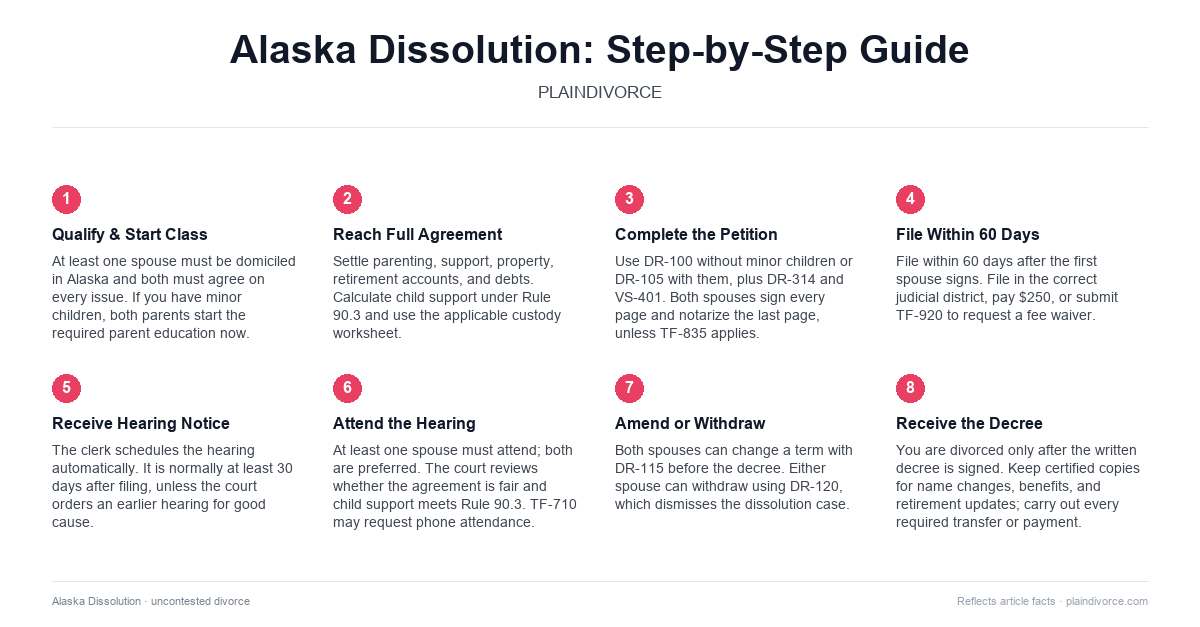
4. Step by step: how an Alaska dissolution works
Step 1 – Confirm you qualify, and start parent education
Check that at least one spouse is domiciled in Alaska, that the court has authority over your children under AS 25.30.300, and that you can agree on every issue. If you have minor children, both parents begin the parent education class or video required by your court location now – do not wait until the hearing is scheduled.
Step 2 – Reach complete agreements
Work out the parenting schedule, decision-making, holidays and travel; child support under Rule 90.3 (with the shared-custody worksheet if it applies); spousal support; and a full list of property, retirement accounts, and debts with who keeps and pays each. The clearer your agreement, the smoother the judge’s review.
Step 3 – Complete and notarize the petition
Fill out DR-100 or DR-105, DR-314, and VS-401, plus DR-306/307/308 and a detailed parenting plan if your custody arrangement calls for them. Attach the tax returns and pay stubs. Both spouses sign every page; notarize the last page (or file TF-835). Then file within 60 days of that first signature.
Step 4 – File with the Alaska Superior Court
File in the correct judicial district, through TrueFiling if it is available for your case and location (otherwise on paper). Pay the $250 filing fee or submit TF-920 for a waiver.
Step 5 – The hearing is scheduled
The clerk sets a hearing date automatically – you do not request one – and sends both parties a notice with the date, time, and location. The hearing is normally at least 30 days after the filing date; a court can set it sooner only if it orders that for good cause (Civil Rule 90.1).
Step 6 – Attend the hearing (or ask to appear by phone)
A dissolution hearing is not a rubber stamp. The judge – or, at some locations, a Superior Court Master – asks questions to confirm you understand the agreement, that it is fair and just, that the parenting plan serves the children’s best interests, and that child support complies with Rule 90.3. At least one spouse must attend (both is preferred). File TF-710 to appear by phone, or DR-110 to ask to be excused for significant hardship.
Step 7 – Amend or withdraw, if needed
After filing, both spouses can agree to change a term with DR-115. If either spouse wants out of the agreement before the decree is signed, that spouse files DR-120 to withdraw, and the case is dismissed.
Step 8 – Receive the Decree of Dissolution
If a judge presides and approves the paperwork, the decree can sometimes be signed the same day; more often it is entered a few days later. If a Master presided, the Master only recommends – a Superior Court Judge still reviews the report and signs. Do not assume you are divorced until you have the written decree. Keep certified copies for name changes, benefits, and retirement updates.
Step 9 – Carry out the decree, and modify it later if needed
You are responsible for doing what the decree requires – transferring titles, making payments, notifying retirement plan administrators. The court does not do it for you. If circumstances change significantly later, either parent can ask the court to modify the parenting plan or child support using the DR-700 Motion Packet.
5. If you cannot file jointly: DR-3 and divorce by complaint
A joint dissolution needs both spouses to cooperate. If that is not possible, Alaska has other agreed routes:
- DR-3 – one-spouse dissolution. A limited packet for a spouse whose partner cannot be located and where there is nothing to resolve about property, debt, or a parenting plan. It uses a diligent-inquiry affidavit to show the court you tried to find your spouse.
- Uncontested divorce by complaint. One spouse files a complaint and serves the other; the case then settles. The current self-help packets are DR-4 / Form DR-50 (with minor children), DR-5 / Form DR-55 (no minor children), and DR-6 / Form DR-60 (no property, no children, and a short marriage).
On the complaint route, procedure still matters. After the other spouse is properly served, they generally have 20 days to file an answer (30 days if served outside Alaska). If no answer is filed, the filing spouse can apply for a default and ask the court to grant what the complaint requested. This track makes sense when you cannot safely coordinate a joint filing, or when one spouse needs to control the initial paperwork.
6. Children: Rule 90.3, shared custody, PFDs, and CSED
Having children does not prevent an agreed dissolution, but it adds the parent education requirement and a closer look at your parenting plan and support numbers.
6.1 Shared custody and the 110-overnight rule
For child-support purposes, Alaska uses four custody categories, and the count is overnights, not daytime visits:
| Category | Overnight test | Worksheet |
|---|---|---|
| Primary | One parent has the children more than 70% of overnights (256+ per year) | Built into DR-105 |
| Shared | The children live with each parent at least 30% of overnights – 110 or more overnights each – during the year | DR-306 |
| Divided | Each parent has primary custody of at least one child, with no sharing | DR-307 |
| Hybrid | A mix of primary and shared across the children | DR-308 |
The key point people get wrong: shared custody is not simply “one child spends 110 nights with the other parent.” Each parent has to have the children for at least 110 overnights. If the actual, exercised schedule differs from what the agreement says, how the court treats it is fact-specific – describe the real schedule, not an aspirational one.
6.2 Permanent Fund Dividends (PFDs)
Two different PFD questions come up, and they are not the same thing:
- A parent’s own PFD is counted as income for the child-support calculation under Civil Rule 90.3, along with other interest and dividends. See the Commentary to Civil Rule 90.3.
- A child’s PFD is a parenting-plan question, not parental income. Your petition should say who applies for the children’s dividends and how the money is handled. If both parents apply, the Department of Revenue holds the dividend until a court order settles it or one parent withdraws their application.
6.3 CSED, income withholding, and ATAP
Alaska’s Child Support Services Division (CSED) can track and enforce payments. Using it is generally optional – you apply with DR-315 (or online) and read DR-316 for what it does – with two important exceptions:
- Income withholding is the default. Alaska law requires support to be withheld from the paying parent’s paycheck unless a specific statutory exception applies (a written alternative-payment arrangement, a good-cause finding that withholding is not in the children’s best interests, or Social Security/disability payments that already go to the children). Withheld money goes to CSED either way.
- ATAP changes the rules. If the parent receiving support gets Alaska Temporary Assistance Program benefits, payments must be made through CSED, and that parent cannot waive or reduce the support amount – the right to collect it has been assigned to the state.
7. How long does an Alaska dissolution take?
There is a legal floor and then a practical range that depends on your court.
The legal floor: under Civil Rule 90.1, a dissolution is normally not heard on the merits until at least 30 days after you file. A court can shorten that only by ordering an earlier hearing for good cause, which is not routine. So roughly a month is the fastest a clean case moves.
After that, it varies. The Alaska Court System does not publish average timelines, and how long your case takes depends on:
- Whether your packet is complete on the first pass – a missing form, a defective VS-401, or an unfinished parent education class can push the hearing back or require another one.
- Your court location’s hearing calendar.
- Whether the hearing is before a judge (who may sign the decree quickly) or a Master (whose recommendation still needs a judge’s signature).
- Whether both parents have finished parent education before the hearing – the court will not finalize until they have.
Remember the 60-day deadline runs the other way: once you sign and notarize, the clock is ticking to file, not just to be heard.
8. What does an Alaska dissolution cost?
The filing fee for a divorce or dissolution case is $250 under the Alaska Court System’s current fee schedule (effective May 1, 2023; confirm the amount before filing). If you cannot afford it, request a waiver with TF-920.
| Cost | Amount | Notes |
|---|---|---|
| Filing fee | $250 | Waivable with TF-920 |
| Certified copy of the decree | $10 first, $3 each additional | Per document, not per page. Only needed if an agency asks for a certified copy. |
| Regular (non-certified) copy | $5 first, $3 each additional | Per document, not per page |
| Notary | $0 at the courthouse | A court clerk notarizes for free; TF-835 covers you if you have no notary access |
| Parent education class | Varies by location | Some approved programs charge a fee; check your court’s list |
An agreed dissolution is one of the least expensive ways to end a marriage in Alaska, because there is no contested litigation and often no lawyer on either side. A structured Alaska dissolution kit or a one-time limited attorney review is an optional cost if you want a second set of eyes before you file.
9. Where a self-help dissolution kit fits in
Alaska publishes the DR forms for free, but the forms alone do not explain how the pieces connect, which attachments your specific custody arrangement triggers, or which requirements – parent education, the 60-day filing deadline, a clean VS-401 – have nothing to do with the petition itself yet can still get a case delayed. A structured kit helps you follow the right sequence and avoid the avoidable snags: a missing DR-314 or VS-401, the wrong child-support worksheet for a shared schedule, or filing after the 60-day signature deadline has passed.
Download Our Alaska Uncontested Divorce (Dissolution) Self-Help Kit
10. Alaska dissolution FAQ
What is an uncontested or simple divorce in Alaska?
In Alaska, an uncontested or “simple” divorce is usually a Dissolution of Marriage: a joint case both spouses file together in the Superior Court after agreeing on custody, support, property, and debts. A dissolution decree has the same legal effect as a divorce decree. If you cannot file jointly, you can reach the same result through a divorce by complaint that later settles.
How much does it cost to file for divorce in Alaska?
The filing fee for a dissolution or divorce in Alaska Superior Court is $250, and you can ask the court to waive it with form TF-920 if you cannot afford it. Certified copies of the decree cost $10 for the first and $3 for each additional, charged per document, not per page. A court clerk notarizes the petition for free.
What forms do I need for a dissolution in Alaska?
Every dissolution needs the petition – DR-100 (no minor children) or DR-105 (with children) – plus DR-314 (Information Sheet) and VS-401 (Certificate). With children, DR-105 already contains the financial and child-support sections, so a separate Form DR-305 is not part of the standard packet. Depending on your custody arrangement you may also attach DR-306, DR-307, or DR-308 and a detailed parenting plan.
How long does an Alaska dissolution take?
Under Civil Rule 90.1, the hearing is normally set at least 30 days after you file, unless the court orders an earlier hearing for good cause. Beyond that minimum, the total time depends on your court’s calendar, whether your packet is complete, whether a judge or a Master hears the case, and – if you have children – whether both parents have finished parent education. The Alaska Court System does not publish an average.
Does Alaska require parenting classes for divorce?
Yes, if you have minor children. Both parents must complete a parent education requirement before the court will grant the dissolution. Most courts accept an approved video or online class, and the specific requirement depends on your court location. The current list is on the Alaska Court System’s parent education page. Start early, because the court holds the decree until both parents finish.
Do we have to attend a hearing?
Generally yes. A hearing is scheduled automatically and at least one spouse must attend; both attending is preferred. If appearing in person is a genuine hardship, you can file TF-710 to appear by telephone or DR-110 to ask the judge to excuse your appearance. Granting either is up to the court, which may still require you to be reachable by phone.
When do we use the shared custody child support worksheet (DR-306)?
Use DR-306 only when the children live with each parent at least 30% of the year – 110 or more overnights with each parent. It is not enough for one child to spend 110 nights with the non-primary parent. Divided custody (each parent has primary of a different child) uses DR-307, and hybrid arrangements use DR-308.
Do PFDs count as income for Alaska child support?
A parent’s own Permanent Fund Dividend counts as income under Civil Rule 90.3. A child’s PFD is different – it is handled as part of the parenting plan, so your petition should state who applies for the children’s dividends and how the money is used. Deciding this in advance avoids a common source of later conflict.
Can I change my name as part of the dissolution?
Restoring a former name (one you had before the marriage) is simple – you check a box on the petition, and form DR-957 is only needed in specific situations such as a pending criminal charge or sex-offender registration. Requesting a brand-new name (DR-955) is a bigger step: it can add cost, make the hearing longer and later, may not be allowed inside a dissolution, requires a posting period and a hearing you cannot skip, and takes effect at least 30 days after the judgment is distributed. Many people do a new-name change in a separate case instead.
Disclaimer: PlainDivorce.com is not a law firm and this article is not legal advice. It is general legal information based on the Alaska Court System’s published forms, rules, and fee schedule as of September 2026. Court rules, form editions, and fees change, and some requirements depend on your court location. Always confirm current requirements at courts.alaska.gov or with an Alaska family-law lawyer before you rely on any summary here.
Sources and local rules can change. Use this guide as a plain-English organizer, then verify the current filing requirements with the official court or government source for your jurisdiction.

About Harry D
Expert contributor at PlainDivorce, helping Canadians and American navigate simple uncontested divorces with clarity and confidence.