Uncontested Divorce in Alberta: The Desk Divorce (Simple Divorce) Step-by-Step Guide
TL;DR: An uncontested divorce in Alberta, known as a Desk Divorce, lets spouses who agree the marriage is over end it without a courtroom hearing. You’ll need one year of Alberta residency, a ground for divorce (usually one year of separation), and settled parenting and support arrangements. File a Statement of Claim for Divorce (Form FL-01) or a Joint Statement of Claim for Divorce (Form FL-08) and pay the $310 commencement fee. Self-represented filers file by email or in person, not through the Court’s digital filing service, which is restricted to lawyers. If you have children under 18, both spouses complete the online Parenting After Separation course and file the certificate. Once the Central Registry clearance is on your file, you submit a final package with the Affidavit of Applicant for Divorce and the Request for Divorce form. A judge reviews the paperwork on file, signs the Divorce Judgment, and the divorce normally takes effect on the 31st day after judgment, provided no appeal is pending.
An uncontested divorce in Alberta, commonly called a Desk Divorce, is usually a simpler and less expensive way to end a marriage than a contested court fight. You and your spouse agree the relationship is over, and the case is decided on paper, with no courtroom hearing, as long as your paperwork is complete and your parenting and support arrangements (if any) are settled.
This guide explains the uncontested divorce in Alberta process in plain language: who qualifies, the exact Alberta Desk Divorce forms you’ll need (including the Statement of Claim for Divorce and the Affidavit of Applicant for Divorce, with form numbers), how self-represented filers actually get documents to the court, what changed in January 2026, and how long each stage takes, including the 31-day period after the Divorce Judgment is signed before the divorce takes effect.
1. What Is an Uncontested Divorce in Alberta (the Desk Divorce)?
Divorce in Canada is governed by the federal Divorce Act, but in Alberta the process runs through the Court of King’s Bench of Alberta. An uncontested divorce in Alberta is one where:
- the divorce itself is not opposed,
- parenting, decision-making, and support have already been settled (property division is handled separately and isn’t part of these forms), and
- the paperwork is filed correctly so a Justice can decide the case from the documents alone.
Desk Divorce is the everyday Alberta term for that paperwork-based review. You submit a final package, including sworn evidence, and a judge reviews it without you attending a hearing, unless something is missing or unclear.
Two paths into an uncontested divorce:
- Joint (cooperative) divorce: you and your spouse file together as joint applicants using a Joint Statement of Claim for Divorce (Form FL-08). Because you’re both already on the record, there’s no separate service step. Important limitation: the Court’s Desk Divorce Package Clerk Review Checklist states that for joint divorces, the only ground available is that the parties have been separated for one year or more. If you’re relying on adultery or cruelty, the joint route is closed to you and you’ll need to file a sole Statement of Claim instead.
- Sole (one spouse starts) uncontested divorce: one spouse files a Statement of Claim for Divorce (Form FL-01), has it personally served on the other spouse, and the case proceeds as uncontested if the other spouse doesn’t file a defence within the response window.
What the January 2026 family law changes mean for a Desk Divorce
On January 2, 2026, the Court of King’s Bench rolled out its Family Focused Protocol, a significant overhaul of how contested family matters move through the court, along with a revised set of family practice notes. If you’ve been reading about intake triage justices, mandatory dispute resolution, and mandatory disclosure and wondering whether any of it applies to you, here’s the short answer: mostly not.
The Protocol itself says that desk applications, including desk divorce applications, that aren’t specifically listed within it continue to use the existing desk application process. A genuinely uncontested divorce still runs the way it always has.
One 2026 change does reach Desk Divorces, and it’s an important one: the revised Family Practice Note 1 now applies where children under 18 are affected by the proceeding, rather than the old threshold of 16. Section 6 covers what that means in practice, including a wrinkle in the Court’s own paperwork you should know about.
2. Who Qualifies for an Uncontested Divorce in Alberta?
Residency requirement (Alberta)
You can start a divorce in Alberta if you are legally married and either you or your spouse has been habitually resident in Alberta for at least one full year immediately before the proceeding begins. “Habitually resident” is the wording used in section 3(1) of the Divorce Act; in everyday terms it means Alberta has genuinely been your home, not just an address you’ve kept. If neither of you has hit that one-year mark yet, you’ll need to wait.
Grounds for divorce (Canada)
Under section 8 of the Divorce Act there is one ground for divorce, breakdown of the marriage, and three ways to establish it: one year of separation, adultery, or cruelty. Most uncontested Alberta divorces rely on one year of separation, since it’s no-fault and doesn’t require proving anything about the other spouse’s conduct. A few things worth knowing about the separation route:
- You can file the Statement of Claim during the one-year separation period, but you can’t ask the court for the Divorce Judgment until the full year has passed.
- You’re allowed to attempt reconciliation and live together again for up to 90 days during the separation period without resetting the clock.
- If you separated but stayed in the same home for financial or family reasons, you’ll need to provide evidence (in your sworn affidavit) that you were genuinely living separate and apart.
- If you’re filing jointly, separation is your only option. Adultery and cruelty are available in a sole claim only.
What makes a case a good Desk Divorce fit?
- You both agree the marriage is over.
- You can prove your ground for divorce (commonly one year of separation).
- You have workable parenting arrangements, if you have children.
- Child support is calculated and agreed, if applicable.
- Spousal support is either agreed (yes or no, and on what terms) or not being pursued by either party.
- Property and debt aren’t being actively fought over in this court file. These forms don’t deal with property division at all; that’s typically handled in a separate Separation Agreement or Minutes of Settlement.
If there’s family violence, fear, a serious power imbalance, hidden assets, or complex finances (a business, significant pensions, multiple properties), pause and get legal advice before relying on a self-help process.
3. Alberta Desk Divorce Forms: Statement of Claim, Affidavit of Applicant, Request for Divorce
Alberta DIY filers often get stuck searching for a generic “Statement of Claim for Divorce Alberta template” instead of the actual Court of King’s Bench form names and numbers. Below is the full list of Alberta Desk Divorce forms you’ll actually encounter, current as of this writing (always download the live version from albertacourts.ca, since forms are updated periodically).
Note on numbering: the Court writes these with a leading zero, as FL-01 and FL-08. You’ll see them written as FL-1 and FL-8 all over the internet, but match the Court’s numbering on anything you file.
Starting the case
- The Statement of Claim for Divorce Alberta courts use is Form FL-01 (often searched as a “Statement of Claim for Divorce Alberta template”), the sole-start document
- Joint Statement of Claim for Divorce — Form FL-08, if filing together
- Notice of Withdrawal – Joint Divorce Proceedings — Form FL-09, used if a joint divorce stops being cooperative and one applicant steps out
Service and default (sole cases only)
- Affidavit of Service — in cases without children this is Form 49, the Affidavit of Service of Statement of Claim for Divorce (No Children). In cases with children the Court lists an unnumbered form simply called Affidavit of Service – Divorce. Make sure you grab the one that matches your situation.
- Noting in Default — Form 14, filed when the served spouse doesn’t respond in time
The final desk package
- The Request for Divorce form Alberta uses is Form FL-21, the formal request asking the court to review and grant the divorce (Form FL-22 is the joint version)
- The Affidavit of Applicant for Divorce — Form FL-23, your sworn evidence for the desk review (Form FL-24 is the Joint Affidavit of Applicants)
- Divorce Judgment — Form FL-25, the order a Justice signs to grant the divorce (Form FL-26, Divorce Judgment and Corollary Relief Order, is used instead when the judgment also deals with parenting or support)
- Desk Divorce Package Checklist — this one is required. The Court states that all desk divorce packages submitted must include it, along with copies of the previously filed materials it lists.
If you have children
- Child Support Data Sheet – For Self-Represented Parties — how you show the court your support numbers (lawyers use a separate Child Support Calculation Sheet)
- Notice of Mandatory Seminar — the Parenting After Separation notice you serve on your spouse along with the Statement of Claim
- Certificate of Parenting After Separation — issued when you finish the online course, or a court-granted exemption in its place
After the judgment
- Certificate of Divorce — requested through the Court’s online form after the 31-day period, often needed for remarriage or updating records
- Undertaking Not to Appeal Divorce Judgment — QB025, used only when asking the court to shorten the usual 31-day waiting period
One more resource, and a common mix-up. Separate from the required Desk Divorce Package Checklist, the Court publishes a Desk Divorce Package Clerk Review Checklist. These are not the same thing and are easy to confuse. The Clerk Review Checklist is a transparency document that shows you exactly what court clerks look at when they review a package, and the Court has explicitly said it is for information only and does not need to be submitted with your filing. Read it anyway; it is the single most useful free document available to an Alberta DIY filer, because it tells you in advance every reason your package might come back.
Formatting rule that catches people: the Court of King’s Bench does not accept handwritten Divorce Judgments at any judicial centre. Your Divorce Judgment must be typed.
Important: You have two ways to get these forms. Download them yourself, current version guaranteed, directly from the Court of King’s Bench of Alberta’s Divorce Forms and Instructions page, or save yourself the guesswork with our Alberta Uncontested Divorce Self-Help Kit, which bundles every form listed above with plain-English instructions and completed sample documents to work from. Either way, using an outdated form is one of the fastest ways to have a package rejected, so double-check whatever you use is current before you file.
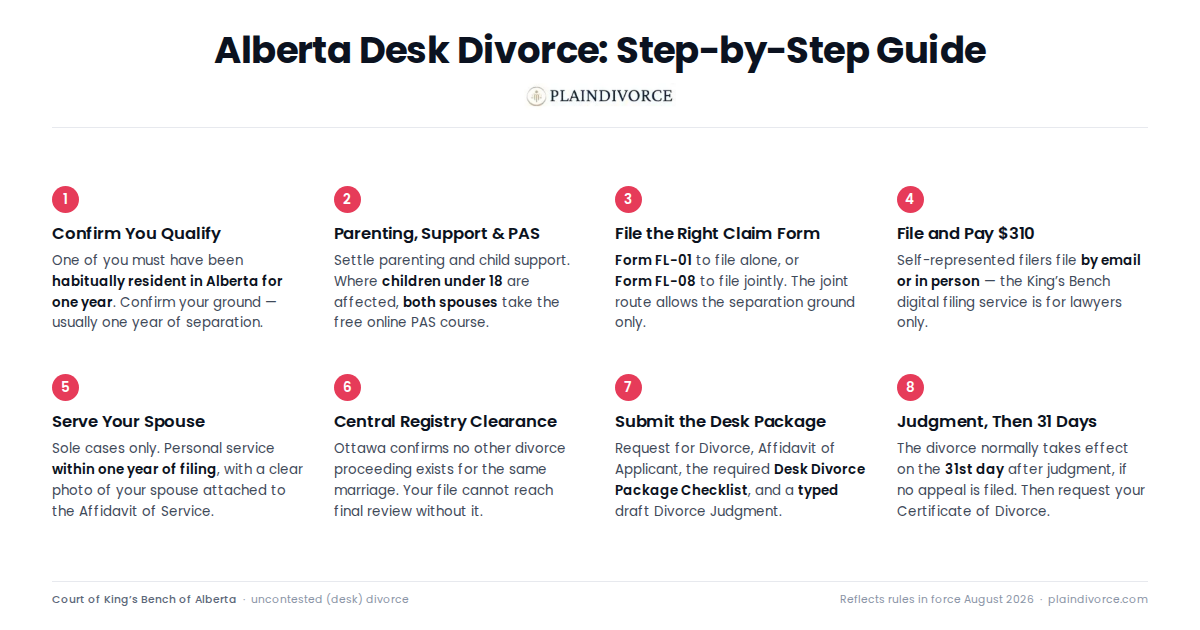
4. Step by step Desk Divorce process (Court of King’s Bench)
The steps below walk through a typical uncontested divorce in Alberta, start to finish. Your exact path depends on whether you file jointly or as a sole applicant, and whether you have children.
Step 1 – Confirm you qualify (before you touch forms)
- Confirm that one of you has been habitually resident in Alberta for at least one year.
- Confirm your ground for divorce (commonly one year of separation by the time the divorce is granted, though you can file before the year is up). Remember that a joint filing must use separation.
- Confirm you have the marriage certificate issued by the province or country where you married (not the decorative one handed to you at the ceremony). If you married in Alberta, order it from a registry agent; if elsewhere, check that jurisdiction’s vital statistics office.
Step 2 – Sort out parenting, support, and (if applicable) the PAS course
Even in a Desk Divorce, the judge must be satisfied that child support is calculated properly and parenting arrangements are clear. Many people document their agreement in a Separation Agreement or Minutes of Settlement (property division is often addressed there too).
If children under 18 are affected by the proceeding, both you and your spouse will need to complete the Parenting After Separation (PAS) course and file the certificate before the divorce can be granted. Practice Note 1 gives you three months after filing to do it, but there is no advantage in waiting: it’s a free three-hour online course, and getting it out of the way early takes it off your critical path entirely. See Section 6 for the details.
Step 3 – Start the case with the right claim form
- Joint divorce: file a Joint Statement of Claim for Divorce (Form FL-08). The only ground available on this route is one year of separation.
- Sole divorce: file a Statement of Claim for Divorce (Form FL-01). This is the route to use if you’re relying on adultery or cruelty.
Step 4 – File with the Court of King’s Bench and pay the commencement fee
The current commencement fee to file a Statement of Claim for Divorce (either version) is $310, which already includes the $10 fee to register your case with the federal Central Registry of Divorce Proceedings. Court fees do change periodically, so confirm the current amount on Alberta’s official court fees page before you pay.
How self-represented people actually file. This is where a lot of online guidance goes wrong. You may have read that you can file electronically through the King’s Bench Filing Digital Service. That service is restricted to qualifying lawyers with a Law Society of Alberta Bar ID, and the Court has said plainly that its digital filing requirements for family and divorce documents do not apply to filings by self-represented litigants. You have two routes instead:
- Email filing. The Court’s Email Filing Procedures expressly authorize self-represented litigants to file documents by email in all judicial centres, and the permitted categories include general divorce filings and the desk divorce package itself. You’ll need an email address, internet access, and a credit card, since fees are paid through the Government of Alberta Payment Application Service. Follow the Court’s naming conventions exactly; documents that don’t follow them get bounced.
- In person at a Court of King’s Bench registry, paying by cash, debit, Visa, or Mastercard.
Free accuracy check worth taking. If you’re representing yourself and your case involves children, the Court asks you to attend a Court and Justice Services office and have your Statement of Claim for Divorce with Children reviewed for accuracy before filing. Once staff confirm your application is satisfactory, you can file right there using Interac, Visa, or Mastercard. It costs nothing, it happens before the clerk review that would otherwise send your package back, and most people skip it without realising it exists.
Step 5 – Serve your spouse (sole cases only)
In a sole case, the Statement of Claim must be personally handed to your spouse by someone else who is over 18 (you can’t serve it yourself). Hiring a process server is the most reliable option; they’ll also give you a properly sworn Affidavit of Service. In a joint case, both spouses are already on the record, so service isn’t needed.
Three service requirements that surprise almost everyone:
- A photograph of your spouse. A clear photo of the Defendant must be attached to the Affidavit of Service as an exhibit, so the court can confirm the right person was served. Tape it to a plain sheet of paper and mark that page as Exhibit “A”. If more than one person appears in the photo, put a clearly visible X on your spouse.
- The seminar notice, if you have children. The Notice of Mandatory Seminar (Family Practice Note 1) is served alongside the Statement of Claim and attached to the Affidavit of Service as Exhibit “B”.
- A one-year deadline to serve. Under rule 3.26 of the Alberta Rules of Court, the Statement of Claim must be served on the Defendant within one year of the date it was filed. Filing early and then losing track of your spouse is a real way to lose a year of progress.
Once served, your spouse has 20 days to respond if served in Alberta, one month if served elsewhere in Canada, or two months if served outside Canada. If they don’t respond in time, you file a Noting in Default (Form 14) and move ahead.
Step 6 – Central Registry check
Every divorce filed in Canada must be registered with the federal Central Registry of Divorce Proceedings in Ottawa, which flags any other divorce proceeding already on file for the same marriage. The court is required to verify your registration and send it to the Registry within seven days of filing.
Why it matters to your timeline: your divorce cannot proceed to final review until the required Central Registry clearance is showing on the court file. Clerks check for it as part of reviewing your desk package, so if you submit the final package before it’s there, expect the package to be held or returned. There’s no published processing time, and it varies, so build in some patience rather than a specific number of weeks.
If you filed a long time ago: the registry clearance is valid for six years. If yours has expired because your file sat dormant, it has to be renewed before the divorce can be granted.
Step 7 – File your Desk Divorce final package for review
Once your matter is clearly uncontested (or started jointly), you submit the final package asking the judge to grant the divorce based on the paperwork alone. This package generally includes:
- the Request for Divorce form Alberta requires (FL-21, or FL-22 for joint)
- your sworn Affidavit of Applicant for Divorce (FL-23, or FL-24 for joint)
- the completed Desk Divorce Package Checklist, plus copies of the previously filed materials it lists
- a typed draft Divorce Judgment (FL-25, or FL-26 where parenting or support is included)
- in sole cases, your Affidavit of Service and Noting in Default
- if you have children, your child support calculation and both spouses’ Certificates of Parenting After Separation (or a court-granted exemption)
- two stamped, self-addressed envelopes, unless you’ve provided email addresses
Practical tip: Courts routinely return desk packages for missing items or small errors, and that’s normal, not a sign something has gone wrong. Treat this step like a checklist project; clean, complete packages move faster. Reading the Court’s Clerk Review Checklist before you submit is the cheapest insurance available.
Step 8 – Divorce Judgment is signed, then the 31-day period runs
When a Justice signs your Divorce Judgment, the divorce isn’t final yet. Under section 12(1) of the Divorce Act, a divorce normally takes effect on the 31st day after the judgment is granted, which leaves a 30-day window in which either spouse could file an appeal. Neither of you is free to remarry until that day arrives.
Two exceptions to the 31 days. If an appeal is actually filed, the divorce doesn’t take effect on day 31; it waits until the appeal process runs its course, and it never takes effect at all if the judgment is set aside. In the other direction, the court can order the divorce to take effect earlier, but only if the judge is satisfied special circumstances exist (immigration deadlines and terminal illness are the typical examples) and both spouses agree and undertake not to appeal, which is what the Undertaking Not to Appeal Divorce Judgment (Form QB025) is for. This is not automatic and isn’t appropriate for most cases; get legal advice if you’re trying to shorten the timeline.
After the 31 days pass, you can request your Certificate of Divorce through the Court’s online request form. Don’t submit the request before the 31 days have elapsed, because the certificate isn’t available until then. Processing takes up to 10 business days, excluding mailing time. There’s no fee for the certificate itself for divorces granted under the current Divorce Act; if you need it for use outside Canada, there’s a separate $25 authentication fee.
5. Special issues when you have children
If you have “children of the marriage,” the court focuses on two things:
- Parenting clarity: where the children live, parenting time, and how major decisions will be made.
- Reasonable child support: support amounts aligned with the Federal Child Support Guidelines and your actual financial information, which you can check against the federal child support table look-up. Self-represented parties set this out on the Child Support Data Sheet – For Self-Represented Parties, which is a separate download from the Court’s divorce forms page.
You’ll also need the Parenting After Separation certificates covered in the next section, and the Notice of Mandatory Seminar becomes part of your service package.
Children living outside Canada: the Parenting After Separation requirement doesn’t apply where the children are ordinarily resident outside Canada, and the Court publishes a separate instruction sheet for uncontested divorces with children living in another country. If that’s your situation, start with that sheet rather than the standard one.
If the paperwork doesn’t clearly address children and support, the court will request more information or return the package for correction.
6. Parenting After Separation (PAS) course requirement
Alberta requires separating parents to complete the Parenting After Separation (PAS) seminar. The course covers how separation affects children, communication, legal issues, and parenting plans. The rules changed on January 2, 2026, and a lot of guidance still online describes the old ones, so this section is worth reading closely even if you think you already know how it works.
Who has to take it. Family Practice Note 1 now applies where children under 18 are affected by the proceeding. The old threshold was 16.
A wrinkle worth knowing about. Several of the Court’s own divorce instruction booklets and checklists still say “children under 16,” because they haven’t been updated since the Practice Note changed. The Practice Note is the rule that governs. If your children are 16 or 17 and you encounter paperwork suggesting you’re exempt, complete the course anyway. It costs you an afternoon and removes a reason for your package to come back.
When it has to be done. This is the correction that matters most, because the old guidance had it backwards. You do not have to complete the course before filing. Under Practice Note 1:
- the plaintiff or applicant completes the online seminar within three months of filing the Statement of Claim;
- the defendant or respondent completes it within three months of being served.
That said, Alberta’s own PAS information page still tells people to take the course before filing, and as practical advice that’s sound. Your divorce cannot be granted until the certificate is on the court file, so completing it early simply removes a dependency. Treat three months as the deadline, not the plan.
Both of you have to do it. For a desk divorce, both parties must file proof of completion. That includes joint applicants. A single certificate is not enough.
Format and length. The seminar is delivered as a free online eCourse through the Resolution Services Learning Centre and takes roughly three hours. You can work through it in sections rather than all at once. A certificate is issued on completion, and that certificate is what gets filed with the Clerk of the Court.
Exemptions. There’s no requirement where all the children are 18 or over, or where the children are ordinarily resident outside Canada. Practice Note 1 also carves out urgent situations, including applications involving domestic violence, child abduction, or a unilateral change in de facto custody, and the court can grant exemptions in other extraordinary cases on application.
The two-year rule. If you’re applying for interim relief, Practice Note 1 requires that the online seminar have been taken within the previous two years. This is specific to interim applications; it isn’t a blanket expiry date on every certificate. If your certificate is older and you’re only completing a straightforward desk divorce, don’t assume you have to retake the course, but do check with the registry if you’re unsure.
If you and the other parent are in high conflict, a related course called Parenting After Separation for Families in High Conflict (PASHC) is available to parents who have completed PAS, and can be ordered by a judge.
7. How Long Does an Uncontested Divorce in Alberta Take?
There’s no reliable single answer, and you should be sceptical of any site that gives you one. Alberta doesn’t publish a target time from filing to judgment, workloads differ substantially between judicial centres, and the biggest variable is simply how clean your paperwork is. What you can plan around is the building blocks:
- Separation time: most people rely on one year of separation as their no-fault ground. You can file during that year, but the judgment can’t be granted until it’s complete, so for many people this is the longest single component by far.
- Preparing and filing: days to a couple of weeks, depending on organization and whether the case is joint or sole.
- Service and response window (sole cases): 20 days to two months after service, depending on where your spouse is served, and you have up to a year from filing to get them served.
- PAS course (if children under 18): about three hours online, but both spouses need to do it, and you can’t finish without both certificates.
- Central Registry clearance: no published timeframe, but the file can’t go to final review without it.
- Desk review: varies by judicial centre, and longer if corrections are needed.
- 31 days after Divorce Judgment: the divorce becomes effective, after which you can request a Certificate of Divorce (allow another 10 business days for processing, plus mailing).
Two things are within your control. The first is whether your separation year is already behind you when you file. The second is whether your package is complete the first time. Rejected packages that need to be corrected and resubmitted are the most common source of avoidable delay, and they’re the reason the Court’s Clerk Review Checklist is worth an hour of your attention.
8. What does an uncontested Desk Divorce cost?
The main fixed government cost is the $310 commencement fee (which includes the $10 Central Registry fee) paid when you file your Statement of Claim for Divorce or Joint Statement of Claim. There’s no separate court fee to file the Request for Divorce or the rest of the final desk package. Fee amounts do change, so confirm the current schedule on Alberta’s official court fees page before you file.
Other costs to plan for:
- a process server fee, typically in the range of $75 to $150, in a sole case (you can’t serve the Statement of Claim yourself),
- commissioner or notary fees for swearing your affidavits (court staff and Resolution Services can often act as a Commissioner for Oaths at no charge),
- a fee to obtain an original marriage certificate if you don’t already have one,
- a $25 authentication fee, but only if you need your Certificate of Divorce for use outside Canada.
What you won’t pay for: the Parenting After Separation course is free, and for divorces granted under the current Divorce Act there’s no mandatory search and no search fee attached to requesting your Certificate of Divorce. (A search fee does apply to older divorces granted under the former Divorce Act.)
9. When DIY might not be right
A Desk Divorce is best for cooperative cases. Consider getting legal help if:
- there is family violence, coercion, or a safety risk
- there are serious parenting disagreements or child safety concerns
- assets or debts are complex (a business, significant pensions, multiple properties, or concerns about hidden assets)
- one spouse doesn’t understand the finances, or a language barrier creates a real imbalance
- immigration or cross-border issues raise the stakes
PlainDivorce can’t tell you whether a particular agreement is fair or what you should accept. That’s legal advice, and it belongs with a qualified Alberta lawyer.
10. Where a self help kit fits
If your case is genuinely uncontested and you’re comfortable handling paperwork, a self-help kit can keep you organized with:
- a plain-language roadmap of the Desk Divorce process
- a “which Alberta Desk Divorce forms do I need?” checklist, by form number, for joint versus sole and with versus without children
- step by step filing and service checklists, including the photo-of-defendant and exhibit requirements
- reminders for Alberta-specific requirements like the Desk Divorce Package Checklist, Central Registry timing, and PAS certificates for both spouses
- document organization and common mistake prevention
Reminder: the official court forms and instructions always control. A kit is an organization and guidance tool, not legal advice and not a substitute for a lawyer.
Download Our Alberta Uncontested Divorce (Dissolution) Self-Help Kit
11. Alberta Desk Divorce FAQ
What is an uncontested or simple divorce in Alberta?
An uncontested divorce in Alberta is one where the divorce itself isn’t opposed and parenting, decision-making, and support are already settled. Many people call this a Desk Divorce because a judge can decide it from the paperwork without a hearing, as long as the package is complete.
What is the difference between a Statement of Claim and a Joint Statement?
A Statement of Claim for Divorce (Form FL-01) is used when one spouse starts the case alone (sole uncontested). A Joint Statement of Claim for Divorce (Form FL-08) is used when both spouses start the case together as joint applicants, which skips the service step. One important difference: on the joint route, the only available ground is one year of separation. If you’re relying on adultery or cruelty, you must use Form FL-01.
Can I file my Alberta divorce online?
Not through the King’s Bench Filing Digital Service, which is restricted to qualifying lawyers with a Law Society of Alberta Bar ID and doesn’t apply to self-represented filers. What you can do is file by email: the Court’s Email Filing Procedures authorize self-represented litigants to file in all judicial centres by email, including divorce pleadings and the desk divorce package, with fees paid through the Government of Alberta Payment Application Service. Filing in person at a Court of King’s Bench registry also remains available.
Do I have to go to court for a Desk Divorce?
Usually not. A Desk Divorce is designed to be decided by a judge reviewing your documents. Incomplete or unclear paperwork can trigger a rejection and request for corrections, and in some situations the court may require an appearance.
What is the Central Registry check and why does it matter?
Every divorce filed in Canada is registered with the federal Central Registry of Divorce Proceedings in Ottawa, which confirms there’s no other divorce case on record for the same marriage. Your file can’t move to final review until that clearance is showing, and clerks check for it when they review your desk package. The clearance is valid for six years and has to be renewed if it expires.
Is the Parenting After Separation course required?
Yes, where children under 18 are affected by the proceeding. Since January 2, 2026, Family Practice Note 1 has applied to children under 18 rather than under 16. The plaintiff completes the free online seminar within three months of filing, the defendant within three months of being served, and for a desk divorce both parties must file proof of completion, including joint applicants. There’s no requirement where all the children are 18 or over or are ordinarily resident outside Canada.
What goes in the Affidavit of Applicant for Divorce?
The Affidavit of Applicant for Divorce (Form FL-23) is your sworn evidence: it confirms your marriage, your Alberta residency, your ground for divorce, and exactly what you’re asking the court to grant. You sign it in front of a Commissioner for Oaths and attach your marriage certificate as an exhibit. Errors here are one of the most common reasons a Desk Divorce package gets sent back for correction.
My spouse won’t take the PAS course. Can I still get divorced?
Possibly. The Court’s Clerk Review Checklist allows a package to be accepted and referred to the judiciary where the Defendant has been noted in default or isn’t cooperating in completing the course. That’s a decision for the court rather than something you can assume, so complete your own certificate, document your attempts, and be ready for the file to take a little longer. If you’re in this position and the case involves anything beyond a straightforward divorce, this is a good point to get advice.
What is the 31-day period in Alberta?
Under section 12(1) of the Divorce Act, once the Divorce Judgment is signed, the divorce normally doesn’t take effect until the 31st day after. That window exists to give either spouse time to appeal. If an appeal is filed, the effective date is pushed out until the appeal is resolved. In rare cases with special circumstances, and where both spouses undertake not to appeal, the court can set an earlier date. Once the divorce takes effect, you can request a Certificate of Divorce.
Official Alberta and federal sources
Everything in this guide comes from the sources below. Court forms, fees, and procedures change, so if you’re about to file, check the original rather than relying on any article, including this one.
Court of King’s Bench of Alberta
- Desk Divorce Package Clerk Review Checklist (PDF) — what clerks actually check when they review your package
- Family Practice Notes, including Practice Note 1 – Parenting After Separation (PDF, effective January 2, 2026)
- Family Focused Protocol — the January 2026 family law process changes, including a resolution hub for self-represented litigants
- Email Filing Procedures & Naming Conventions — how self-represented filers file by email
- Certificate of Divorce information and the online request form
- Court of King’s Bench locations and sittings
Government of Alberta
- Court fees — the current commencement fee schedule
- Parenting After Separation (PAS) course and Resolution Services Learning Centre — free registration for the online seminar
- Parenting After Separation for Families in High Conflict (PASHC)
- Support in preparing court forms — court forms information coordinators, by location
- Order a marriage certificate
- Alberta Rules of Court (PDF, King’s Printer) — including rule 3.26 on time for service
Government of Canada
- Divorce Act — see s. 3 (jurisdiction), s. 8 (breakdown of marriage), and s. 12 (when a divorce takes effect)
- The Central Registry of Divorce Proceedings
- Federal Child Support Guidelines and the child support table look-up
PlainDivorce.com is a self-help service, not a law firm, and this article is legal information rather than legal advice. Court forms, fees, and procedures change; always confirm current requirements on the Court of King’s Bench of Alberta website before you file. Last reviewed against Court of King’s Bench materials, Alberta’s court fee schedule, and the federal Divorce Act in August 2026.
Sources and local rules can change. Use this guide as a plain-English organizer, then verify the current filing requirements with the official court or government source for your jurisdiction.

About Harry D
Expert contributor at PlainDivorce, helping Canadians and American navigate simple uncontested divorces with clarity and confidence.