Uncontested Divorce in Arizona (Dissolution of Marriage): A Plain-English 2026 Guide
An uncontested divorce in Arizona is one where you and your spouse agree on every issue—children, support, property, and debts—so a judge can end the marriage by reviewing your paperwork instead of holding a trial. On Arizona Superior Court forms it is called a Dissolution of Marriage. Expect a mandatory 60-day wait and a total timeline that depends on your court.
Arizona gives cooperative couples three ways to finish without a fight: a standard case that ends in a Consent Decree of Dissolution, a streamlined Summary Consent Decree for spouses who settle everything before filing, and a default when one spouse chooses not to participate. Most people who stay organized can complete a simple dissolution of marriage in Arizona without hiring a lawyer for full representation.
This guide walks through who qualifies, the step-by-step process, what a Consent Decree and an Arizona Rule 69 agreement actually do, realistic timelines and costs (including Arizona divorce filing fees for 2026), and where a self-help kit fits. It is written for people who want an affordable Arizona divorce and hope to handle a divorce without a lawyer—as long as the case stays genuinely uncontested.
TL;DR
- An uncontested divorce in Arizona skips a trial: you and your spouse agree on the major issues and the judge signs a Consent Decree of Dissolution (Arizona’s term for the final order) based on your paperwork.
- One spouse must have been domiciled in Arizona (or stationed here on active duty) for at least 90 days before filing, and you file in the county where the filing spouse lives (A.R.S. § 12-401(13)).
- Arizona law imposes a 60-day minimum waiting period. In a standard case it runs from service or acceptance of service; in a Summary Consent Decree case it runs from the filing date (A.R.S. § 25-329; § 25-314.01).
- Settlements are usually written as an Arizona Rule 69 agreement and then built into the decree. A Rule 69 agreement binds the parties only when it is a signed writing (or stated on the record); the court still has to approve it.
- The statewide filing fee is $261 for the petition and $172 for a response, before county surcharges. Real-world county totals in 2026 run higher—plan for roughly $320–$450 per spouse and check your county schedule (Arizona Superior Court filing fees).
- DIY works well for clean, low-conflict cases. It is a poor fit if there is domestic violence, coercion, hidden assets, or real disagreement about children or property.
1. What Counts as an Uncontested Divorce in Arizona?
An uncontested divorce in Arizona is a Dissolution of Marriage where the court never has to resolve a dispute, because you and your spouse agree on everything: legal decision-making and parenting time (if you have children), child support, spousal maintenance, and how to split community property and debts. The judge’s job is to confirm the paperwork is complete, consistent, and legal—then sign.
Arizona is a no-fault state, so you do not prove wrongdoing. The only ground for a non-covenant marriage is that the marriage is irretrievably broken, meaning there is no reasonable prospect of reconciliation. The court also has to find that the conciliation provisions in A.R.S. § 25-312 either do not apply or have been met. A covenant marriage has its own limited grounds and is usually not a good fit for a fully DIY approach.
An uncontested case reaches the finish line in one of three ways, covered in detail in section 3:
- Consent Decree of Dissolution. One spouse files a Petition, the other is served or signs an Acceptance of Service, and both sign a proposed Consent Decree that the judge enters after the 60-day wait—usually with no hearing. This is Arizona’s version of a settled decree.
- Summary Consent Decree. When you settle before any case is filed, you can file a single combined petition-and-response, waive service, and pay half the normal combined filing fee. The 60-day clock runs from the filing date (A.R.S. § 25-314.01).
- Default. One spouse files and properly serves the other, the other does not respond, and the filing spouse then files an Application and Affidavit for Default. The default takes effect 10 court days later, and the case proceeds to a decree.
People call any of these a “simple divorce” when the paperwork is clean and the couple agrees. The label is informal; the case type is always a Superior Court Dissolution of Marriage.
2. Do You Qualify for an Uncontested Dissolution of Marriage?
Before you spend hours on Arizona forms, confirm four things: residency, legal grounds, the right county, and whether your case is truly uncontested in practice.
Residency requirements (Arizona)
At least one spouse must be domiciled in Arizona—or stationed here on active-duty military service—for at least 90 days before the petition is filed (A.R.S. § 25-312). “Domiciled” means more than living here: physical presence plus the intent to make Arizona your home indefinitely.
Grounds for dissolution
For most marriages, alleging the marriage is irretrievably broken is all you need. If either spouse denies that, the court can pause the case for up to 60 days and order conciliation efforts. If you have a covenant marriage, you must prove one of the specific grounds in A.R.S. § 25-903, and those cases usually need a lawyer.
Where to file (venue)
File in the Superior Court of the county where the filing spouse (the Petitioner) resides when the action is filed—not the county where the other spouse lives (A.R.S. § 12-401(13)). County packets and local procedures differ—Maricopa County divorce forms are not identical to Pima or Coconino County’s—but the underlying case type is the same statewide.
What makes a case a good fit for “uncontested”
An Arizona case is a strong candidate for the uncontested route when:
- You both agree the marriage is over.
- You can agree on legal decision-making and parenting time for any minor children.
- You can agree on child support, and any deviation from the guideline amount is explained and still reasonable for the children.
- You can agree on spousal maintenance, if it applies at all.
- You can divide community property and debts by agreement, or you own and owe little enough that the split is simple.
It is the wrong fit if there is domestic violence, coercion, or fear; hidden assets or income; unresolved conflict over the children; or complex finances such as a business, multiple properties, or significant retirement accounts. In those situations, even a limited-scope consultation with an Arizona family lawyer is a reasonable safety step—see section 9.
3. Three Routes to an Uncontested Decree: Consent Decree, Summary Consent Decree, Default
Choosing the right route early saves time and money. Here is how the three compare.
| Feature | Consent Decree | Summary Consent Decree | Default |
|---|---|---|---|
| When it fits | You agree, but a case is already filed or one spouse prefers to file first | You fully agree before filing anything | The other spouse won’t participate but isn’t hiding |
| How it starts | Petition by one spouse | Combined petition and response, signed by both | Petition by one spouse |
| Service of process | Required (or Acceptance of Service) | Waived in the joint filing | Required, and must be proven |
| 60-day clock starts | Date of service or acceptance | Date of filing | Date of service |
| Filing fee | Full petition fee + full response fee | 50% of the combined petition + response fee, plus county assessments | Full petition fee (respondent pays nothing) |
| Extra step | Both sign the proposed decree | Final documents filed at filing or within 60 days | File an Application and Affidavit for Default; wait 10 court days |
The Summary Consent Decree is the newest and often the cheapest path for couples who have genuinely settled everything. Because service is waived and the fee is halved, it removes two of the most common friction points. The trade-off: you both have to sign the initial filing, so it only works when cooperation is real.
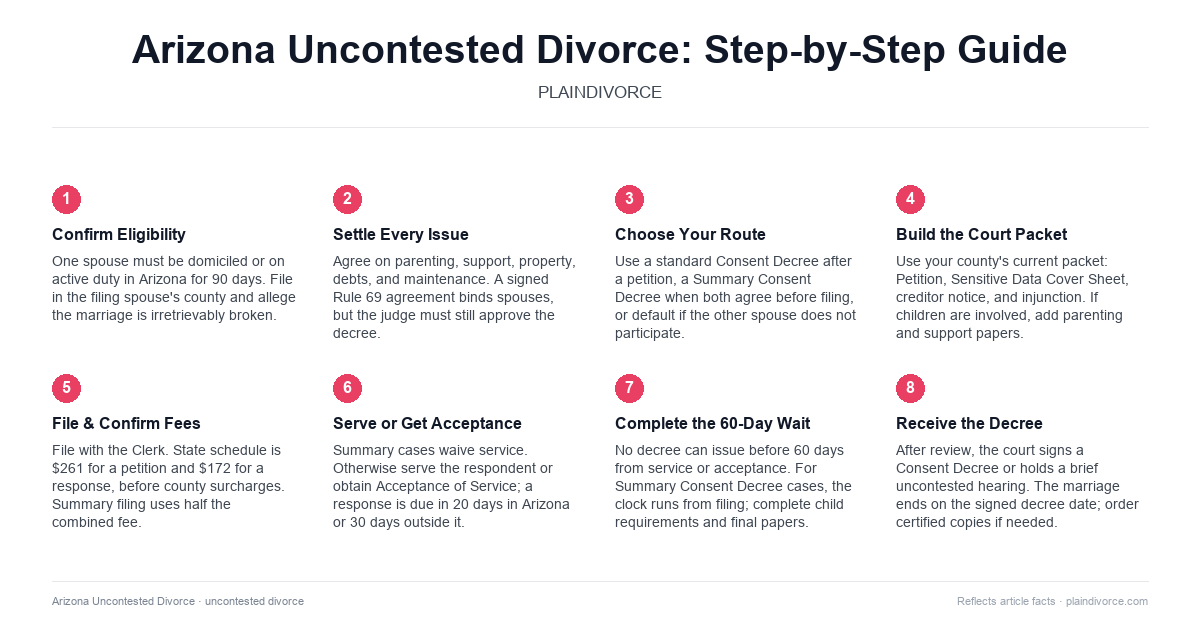
4. Step by Step: The Arizona Uncontested Dissolution Process
Exact packets vary by county, but the uncontested Dissolution of Marriage workflow follows the same structure everywhere. The most common DIY mistake is filing only the Petition and Summons and skipping the administrative forms that protect privacy and freeze assets.
Step 1 – Confirm eligibility and pick your route
- The 90-day Arizona residency requirement is met.
- Your marriage is not a covenant marriage—or you understand the special rules if it is.
- You are ready to allege the marriage is irretrievably broken.
- You know your route: Consent Decree, Summary Consent Decree, or default.
Step 2 – Settle the “big four” (children, support, property, debts)
Uncontested cases move fastest when the big issues are settled before filing, or early in the case:
- Children: legal decision-making (sole or joint), a detailed parenting-time schedule, holidays, transportation, and communication.
- Child support: guideline worksheet inputs, health insurance, uncovered medical costs, and any agreed deviation.
- Spousal maintenance: whether it applies, and if so the amount and duration.
- Community property and debts: the house (refinance or sale), vehicles, bank and retirement accounts, credit cards, and loans. Any decree that transfers or affects real estate must describe that property by its legal description (A.R.S. § 25-318).
To make the agreement stick, put it in an Arizona Rule 69 agreement. Under Rule 69 of the Arizona Rules of Family Law Procedure, a settlement is binding on the spouses only if it is (1) in writing and signed by the parties or their lawyers, (2) stated on the record in front of a judge, commissioner, or court reporter, or (3) recorded before a court-appointed mediator or settlement officer. Even then, it does not bind the court until the judge reviews and incorporates it into the decree. Signing—not filing—is what makes it enforceable between you.
One caution on debts: allocating a credit card or loan to one spouse in the decree is binding between the two of you, but it does not release the other spouse as to the lender unless the creditor agreed. A Notice Regarding Creditors in the packet spells this out.
Step 3 – Prepare the Arizona Superior Court starting packet
Arizona’s Self-Service Center publishes statewide packets (with and without children), and larger counties post their own versions—Maricopa County divorce forms, for example, come through the Clerk of the Superior Court and the Law Library Resource Center. A typical starting packet includes:
- Petition for Dissolution of Marriage (with or without children), or the combined petition and response for a Summary Consent Decree.
- Summons and service-related documents (not needed for a Summary Consent Decree).
- Sensitive Data Cover Sheet (confidential): private identifiers such as Social Security numbers and full birth dates go here instead of on the public Petition. Your county packet requires it.
- Notice Regarding Creditors: warns both spouses that they may still owe community debts to a lender even if the decree assigns those debts to one person.
- Preliminary Injunction: the automatic asset-and-conduct order, explained in section 6. It issues in every dissolution.
- A county cover sheet or information sheet, if your county’s packet includes one.
- If you have children: a Parenting Plan, child support worksheet, a proposed Child Support Order, a Current Employer (or Other Payor) Information form, a federal Income Withholding Order for Support, and proof of the parent education program (see section 5).
Note: exact form names and packet contents vary by county and are updated periodically. Always download the current packet for your county’s Superior Court rather than reusing an old one.
Step 4 – File with the Clerk of the Superior Court
Once your documents are complete and signed, file them with the Clerk of the Superior Court in your county and pay the filing fee—or request a fee deferral or waiver if you qualify. Filing methods vary: some counties require or allow electronic filing for family cases, while others accept in-person or mail filing. A Summary Consent Decree is filed jointly, and the fee is 50% of the combined petition-plus-response amount.
Step 5 – Serve the Respondent or use Acceptance of Service
Unless you filed a Summary Consent Decree (which waives service), the Petitioner must complete service of process on the Respondent. Common methods:
- A registered process server or the sheriff.
- Acceptance of Service signed by the Respondent—the usual choice in cooperative cases.
- Service by publication, only where the other spouse cannot be located and the court allows it.
After service, the Respondent has 20 calendar days to file a Response if served in Arizona, or 30 calendar days if served outside Arizona. If the Respondent signs an Acceptance of Service, the same 20/30-day split applies, measured from the day the acceptance is signed. If no Response is filed, the case does not default automatically—the Petitioner must file an Application and Affidavit for Default, mail a copy to the Respondent, and wait 10 court business days. If the Respondent still does not respond, the case proceeds by default.
Step 6 – The 60-day waiting period
Arizona law bars the court from hearing or considering a dissolution until 60 days after service of process or acceptance of service in a standard case (A.R.S. § 25-329). In a Summary Consent Decree case, the court may not enter the decree earlier than 60 days after the filing date (A.R.S. § 25-314.01).
Use the window to finish the paperwork so nothing stalls after day 60. Cooperative couples typically:
- Finalize the settlement, usually as a Rule 69 agreement or the county packet’s agreement form.
- Complete any child-related requirements, including the parent education program.
- Prepare the proposed Consent Decree and all supporting final documents.
- Assemble the Application and Affidavit for Default package if the Respondent did not respond.
Step 7 – Final orders: the Decree of Dissolution
After the waiting period, once your paperwork is complete, the court will typically either:
- Sign the Consent Decree based on the submitted documents (common in fully agreed cases), or
- Set a brief uncontested or default hearing where the judge asks a few questions before signing the Decree of Dissolution of Marriage.
Once the judge signs, the marriage ends as of the date on the decree. Most people then order certified copies from the Clerk for a name change, retirement-account division, and their own records.
5. Special Issues When You Have Children
If you have minor children, Arizona courts decide everything by the best interests of the child, and they use current terminology: legal decision-making and parenting time, not “custody” and “visitation.”
Legal decision-making and parenting time
Legal decision-making is the authority to make major decisions about education, health care, religion, and personal care—it can be joint or sole. Parenting time is the actual schedule. In an uncontested case you submit a written Parenting Plan, and the judge reviews it to confirm it is workable and consistent with the child’s best interests.
What an Arizona parenting plan must include
Under A.R.S. § 25-403.02, a proposed parenting plan must contain all of the following:
- A designation of legal decision-making as joint or sole.
- Each parent’s rights and responsibilities for personal care of the child and for decisions about education, health care, and religious training.
- A practical parenting-time schedule, including holidays and school vacations.
- A procedure for exchanges, covering location and who handles transportation.
- A procedure to mediate or resolve proposed changes, relocation disputes, and alleged breaches.
- A procedure for periodic review of the plan by the parents.
- A method and frequency for parent communication about the child.
- A signed statement that each parent has read, understands, and will follow the notification requirements in the statute.
Child support (guidelines, worksheets, and withholding)
Arizona calculates child support with guideline inputs—each parent’s income, the parenting-time schedule, health insurance, and childcare, among others. A worksheet alone is not the whole job. The final set also includes a proposed Child Support Order, a Current Employer (or Other Payor) Information form, and a federal Income Withholding Order for Support, because every child-support order carries an order of assignment (income withholding) under A.R.S. § 25-504. Even in an agreed case, all of the support paperwork has to be complete and consistent with the rest of the decree.
Parent education requirement
This is statewide, not optional by county. In any dissolution involving a common minor child, the court shall order both parents to complete the domestic-relations education program (A.R.S. § 25-352), subject to narrow exceptions—when the court finds it is not in the child’s or parties’ best interests, when a parent is already in a comparable program, or when a parent completed one before. The court sets the deadline. What varies by county is the logistics: the approved provider, the format, and the fee.
6. The Preliminary Injunction: The Automatic Order You Can’t Ignore
Every Arizona dissolution comes with a Preliminary Injunction—a court order that issues automatically in the case, not paperwork you can skip (A.R.S. § 25-315). It binds the Petitioner when the petition is filed and the Respondent on service or actual notice, and it stays in effect until the court orders otherwise or the decree is entered.
While it is in force, both spouses are generally prohibited from:
- Transferring, hiding, selling, or encumbering community property—except in the usual course of business, for the necessities of life, or to pay reasonable attorney fees and court costs in the case.
- Removing a child from Arizona without the other parent’s written consent or a court order.
- Removing the other spouse or the children from existing insurance (health, auto, life, disability), and each spouse must keep all coverage in full force.
- Harassing, molesting, disturbing the peace of, or assaulting the other spouse or the children.
The order does not generally stop you from changing a beneficiary designation, and it does not freeze ordinary living expenses—paying rent, buying groceries, or covering normal bills is fine. But selling a vehicle, draining an account, or moving the kids out of state can cause serious problems even in a case that was otherwise fully agreed.
7. How Long Does an Uncontested Dissolution Take in Arizona?
The only firm number is the 60-day minimum. Beyond that, timing depends on how fast you complete each step and how quickly your county’s court processes decrees—Arizona publishes no statewide average, so treat any “typical” figure with caution.
Three timing anchors shape most cases:
- Residency: the 90-day requirement must be satisfied before you file.
- Response deadline: 20 days if served in Arizona, 30 days if served outside Arizona; a default adds an Application and Affidavit for Default plus 10 court days.
- 60-day waiting period: from service or acceptance in a standard case, or from the filing date in a Summary Consent Decree case.
Because the 60-day clock alone is two months, and filing, service, parent education, and final-packet preparation stack on top, a cooperative case rarely finishes in less than about ten weeks and often takes longer. Delays cluster around slow service, postponed child-related steps, and final decree packets that come back for correction.
8. Arizona Divorce Filing Fees and Other Costs
Two court fees catch uncontested couples off guard: the Petitioner’s fee to open the case and the Respondent’s fee to file a Response or an Appearance. Both are real, and both spouses should budget for them unless you use a Summary Consent Decree (one combined, discounted fee) or a default (the non-filing spouse pays nothing).
Court filing fees (plan for both spouses)
- Statewide schedule amounts: $261 for a Petition for Dissolution of Marriage and $172 for a Response or initial appearance, set by Arizona Supreme Court Administrative Order 2024-210 (effective December 28, 2024). These are the state schedule totals—not the whole bill.
- County surcharges: each county’s Board of Supervisors adds local fees on top. In 2026, real petition totals commonly land in the $320–$450 range and response totals in the $230–$350 range, depending on the county. Maricopa County, for example, runs near the high end.
- Summary Consent Decree: 50% of the combined petition-plus-response amount, plus county assessments.
- Fee deferral or waiver: available through the Clerk if your income qualifies.
Always confirm the current number against the Arizona Superior Court filing fee schedule and your county’s Clerk of the Superior Court fee list before you file—these amounts change by administrative order and county resolution.
Other common costs
- Service of process: process-server or sheriff fees, or publication costs in limited cases (skipped with an Acceptance of Service or a Summary Consent Decree).
- Parent education program: a per-parent fee paid to the approved provider, required in any case with a minor child.
- Certified copies, notary, postage: small but real.
- Optional support: mediation, a legal document preparer, or a limited-scope attorney review for higher-risk pieces.
Even with the add-ons, an uncontested dissolution costs a fraction of a contested case with lawyers on both sides.
9. When a DIY Dissolution Is Not the Right Call
Get legal advice—even limited-scope advice—before you sign anything if:
- There is domestic violence, coercion, intimidation, or fear. If you are in danger, prioritize safety planning first; Arizona courts also have protected-address procedures so your address does not appear in the file. The National Domestic Violence Hotline (1-800-799-7233) and Arizona’s 2-1-1 line can connect you with local resources.
- You suspect hidden income, hidden assets, or financial manipulation.
- You cannot agree on legal decision-making or parenting time.
- You have complex community property: a business, multiple properties, pensions, or significant retirement accounts (which usually need a separate court order to divide).
- You are unsure whether your settlement terms are fair or enforceable.
You can still aim for a Consent Decree outcome—but a risky situation is worth a professional set of eyes before it becomes a signed court order.
10. Where a Self-Help Divorce Kit Fits
Arizona publishes public packets and instructions, but people still get stuck on the workflow: which route to choose, which packet applies, how the Sensitive Data Cover Sheet and Notice Regarding Creditors fit in, what the Preliminary Injunction actually restricts, how to keep the timeline aligned with the 60-day clock, and how to assemble a final Consent Decree packet that is consistent from first page to last.
A well-built Arizona uncontested dissolution self-help kit gives you structure by helping you:
- Choose between a Consent Decree, a Summary Consent Decree, and a default—and follow the right sequence for that route.
- Assemble a complete starting packet so a missing cover sheet or creditor notice does not send you back to the Clerk.
- Stay organized with checklists and a what-happens-when timeline built around the 60-day period and the parent education deadline.
- Use the same Arizona vocabulary the court packet uses: legal decision-making, parenting time, community property, Rule 69, Consent Decree.
You are still representing yourself, and PlainDivorce cannot tell you what to do in your specific case. But the right structure makes the paperwork side of an uncontested divorce in Arizona far more manageable.
Download Our Arizona Uncontested Divorce Self-Help Kit11. Frequently Asked Questions
What is an uncontested divorce in Arizona?
It is a Dissolution of Marriage in which you and your spouse agree on every issue—legal decision-making, parenting time, child support, spousal maintenance, and the division of community property and debts—so a judge can finalize it by reviewing your paperwork instead of holding a trial. It ends in a Consent Decree, a Summary Consent Decree, or a default decree.
What is a Consent Decree of Dissolution in Arizona?
A Consent Decree of Dissolution is Arizona’s final divorce order in a fully agreed case. Both spouses sign a proposed decree that sets out every term, and the judge enters it after the 60-day waiting period—often without a hearing. It has the same legal force as a decree entered after trial.
What is a Summary Consent Decree, and how is it different?
A Summary Consent Decree is a streamlined path for spouses who settle everything before filing. You file one combined petition and response together, formal service is waived, and the filing fee is 50% of the normal combined amount plus county assessments. The court cannot enter the decree until 60 days after the filing date (A.R.S. § 25-314.01).
How much are Arizona divorce filing fees?
The statewide schedule amounts are $261 to file the petition and $172 to file a response (Administrative Order 2024-210). Counties add local surcharges on top, so 2026 petition totals commonly run about $320 to $450 and response totals about $230 to $350, depending on the county. A Summary Consent Decree costs half the combined amount. Check the azcourts.gov fee schedule and your county Clerk’s list before filing.
How long does an uncontested divorce take in Arizona?
Arizona sets a 60-day minimum—measured from service or acceptance in a standard case, or from the filing date in a Summary Consent Decree case. There is no statewide average beyond that; total time depends on how fast you complete service, parent education, and the final decree packet, and on how quickly your county’s court signs decrees. Many cooperative cases run about three months or more.
What is an Arizona Rule 69 agreement?
Rule 69 of the Arizona Rules of Family Law Procedure governs settlement agreements in family cases. An agreement binds the spouses if it is in writing and signed by the parties or their lawyers, stated on the record before a judge or court reporter, or recorded before a court-appointed mediator or settlement officer. It is presumed valid, but the court still has to review it and incorporate it into the decree.
Do I have to go to court for an uncontested divorce in Arizona?
Often not. If you file a complete Consent Decree or Summary Consent Decree with all required signatures, many judges sign it in chambers without a hearing. Some counties or judges still set a short uncontested or default hearing, especially when there are children or spousal maintenance, where the judge asks a few basic questions before signing.
Where do I file for divorce in Arizona?
You file in the Superior Court of the county where the filing spouse (the Petitioner) lives at the time of filing, as long as the 90-day Arizona domicile requirement is met (A.R.S. § 12-401(13)). You do not file in the other spouse’s county. Each county publishes its own local packet and filing instructions.
12. Final Thoughts and Next Steps
Even an uncontested case can feel overwhelming at first, but Arizona’s process is built to let cooperative spouses finish without a trial once the agreements and paperwork are in order.
- Confirm the 90-day residency requirement and identify the correct county (where the Petitioner lives).
- Pick your route: Consent Decree, Summary Consent Decree, or default.
- Work out a complete agreement on children, support, community property, and debts, and put it in a signed Rule 69 agreement.
- Don’t miss the Sensitive Data Cover Sheet, Notice Regarding Creditors, Preliminary Injunction, and—if you have children—the Parenting Plan, child support order set, and parent education program.
- Budget for both spouses’ fees, or use a Summary Consent Decree for the discounted combined fee.
- Get limited-scope legal advice if safety, children, or major assets are involved.
Reminder: this guide is legal information only, not legal advice, and PlainDivorce is not a law firm. Verify current forms, fees, and county procedures with the Arizona courts and your county’s Clerk of the Superior Court before you file, because requirements change.
With realistic expectations, the right Arizona terminology, and organized paperwork, many couples complete an uncontested dissolution of marriage in Arizona with far less cost and conflict than a contested case. When you’re ready to start, our Arizona uncontested divorce kit walks you through each step in order.
PlainDivorce is not a law firm, and this guide is legal information, not legal advice. Forms, fees, and county procedures change—always confirm the current requirements with the Arizona courts and your county’s Clerk of the Superior Court.
Sources and local rules can change. Use this guide as a plain-English organizer, then verify the current filing requirements with the official court or government source for your jurisdiction.

About Harry D
Expert contributor at PlainDivorce, helping Canadians and American navigate simple uncontested divorces with clarity and confidence.