Uncontested Divorce in Arkansas: A Plain-English 2026 Guide
An uncontested divorce in Arkansas is one where you and your spouse agree on every issue—property, debts, custody, child support, and alimony—so a Circuit Court judge can end the marriage by reviewing paperwork instead of holding a trial. You still have to meet the residency clocks, prove a legal ground, and get corroboration for your residency, but there is no courtroom fight. Most cooperative couples can do it without hiring a lawyer for full representation.
“Uncontested” and “simple divorce” are not formal case types in Arkansas law. They are shorthand for a divorce in Arkansas Circuit Court where nothing is left for a judge to decide because the spouses have settled it all. Agreement makes the case faster and cheaper—it does not remove the requirement to prove your case and obtain a signed decree.
This guide walks through, in plain English, how an uncontested / simple divorce in Arkansas works in 2026: who qualifies, the Arkansas divorce witness requirement, the step-by-step Circuit Court process, timelines, Arkansas divorce filing fees, child support under Arkansas Administrative Order 10, and where a do-it-yourself approach fits. It is written for people who want to handle as much as possible themselves.
TL;DR
- An uncontested divorce in Arkansas runs through Circuit Court, but because both spouses agree on everything, there is no trial—the judge reviews the paperwork and signs the decree.
- Residency: one spouse must have lived in Arkansas 60 days before filing and 3 full months before the decree is signed, and no decree can be entered until at least 30 days after the complaint is filed (Ark. Code Ann. § 9-12-307). If your spouse never enters an appearance, the filing spouse must have kept an actual Arkansas residence for the full 3 months.
- Most agreed cases use general indignities as the ground instead of waiting out the 18-month separation ground (§ 9-12-301).
- Arkansas divorce witness requirement: in an uncontested case you do not need a witness for the grounds, but you do need one—by testimony or a sworn affidavit—for your residency (and for the separation, if you use the 18-month ground) (§ 9-12-306).
- Arkansas divorce filing fees are set statewide—about $165 to open the case—plus local service and certified-copy costs; some courts add a $20 e-filing fee. Confirm the current figure with your circuit clerk.
- Child support follows Arkansas Administrative Order 10, an income-shares formula based on both parents’ combined income, in effect since July 1, 2020 and updated in 2022.
1. What Is an Uncontested (Simple) Divorce in Arkansas?
Arkansas law does not use “uncontested divorce” or “simple divorce” as formal labels. They describe a Circuit Court divorce case where:
- Both spouses agree the marriage should end, and
- They have settled every issue—property, debts, custody, child support, and alimony—so a judge has nothing to try.
The case starts when one spouse files a Complaint for Divorce in Arkansas Circuit Court. It stays uncontested when the other spouse cooperates—usually by signing an Entry of Appearance and Waiver of Service and not disputing the requested terms. A case can also move forward by default if the defendant is properly served and never files an Answer. Even on a default, Arkansas courts still require proof of residency and grounds; a default does not make the complaint’s allegations automatically true.
This is different from a contested divorce, where the spouses disagree about grounds, custody, support, or property. Contested cases involve discovery, multiple hearings, and sometimes a trial—slower and more expensive at every step.
The Arkansas divorce witness requirement (corroboration)
The Arkansas divorce witness requirement—also called corroboration—trips up a lot of self-represented filers because it applies unevenly. Under Ark. Code Ann. § 9-12-306:
- Grounds: in an uncontested suit, “corroboration of the plaintiff’s grounds for divorce shall not be necessary or required.” You do not need a third party to back up your general-indignities claim.
- Residency: must be corroborated—in every case, uncontested or not.
- Separation: if you rely on the 18-month separation ground, the separation and its continuity without cohabitation must also be corroborated.
In an uncontested case, that corroboration can come from “either oral testimony or verified affidavit of persons other than the parties.” In practice this means a friend, relative, neighbor, or coworker over 18 who knows where you live signs a sworn statement (a “corroborating witness” or “resident witness” affidavit). Arkansas does not publish one statewide court form by a single title for this—the exact form comes from your county’s packet or a self-help interactive packet—but the requirement is real, and skipping it is a common reason a filing gets bounced back by the clerk or judge.
2. Who Qualifies for an Uncontested Divorce in Arkansas?
Residency: the 60-day, 3-month, and 30-day clocks
Ark. Code Ann. § 9-12-307 sets three separate timing rules that people routinely misread:
- 60 days to file: at least one spouse must have actually lived in Arkansas for 60 days immediately before the complaint is filed.
- 3 full months to finalize: the judge cannot sign the Decree of Divorce until at least one spouse has lived in Arkansas for 3 full months.
- 30 days after filing: separately, no decree can be granted until 30 days have passed since the complaint was filed.
So you may be able to file at 60 days but you cannot finalize until both the 3-month residency and the 30-day post-filing periods have run.
Two wrinkles that matter for DIY filers:
- If your spouse won’t participate: when personal service can’t be obtained or the defendant never enters an appearance, the statute requires the filing spouse—not just “either spouse”—to have maintained an actual Arkansas residence for the full 3 months before the decree. Residence here means genuine physical presence, not just a mailing address.
- The 30-day rule has exceptions. Under § 9-12-310, the 30-day wait does not apply if the spouses lived separate and apart for 12 months before the complaint was filed, if the defendant is served by warning order (publication), or if the action is for bigamy. The 30-day bar cannot be waived by agreement, though the parties can agree to submit the case “in vacation” (between court terms).
Grounds for divorce: why couples choose general indignities
Arkansas still requires a legally recognized ground for divorce (Ark. Code Ann. § 9-12-301). Two are common in agreed cases:
- General indignities: a fault-based ground defined as conduct by one spouse that “renders the condition of the other intolerable”—a course of rudeness, contempt, studied neglect, unmerited reproach, or open insult. Plain incompatibility or ordinary quarreling is not enough. It is a frequent choice in uncontested cases because it carries no waiting-out period.
- 18-month separation without cohabitation: Arkansas’s true no-fault ground. It requires living separate and apart, without cohabitation, for 18 continuous months—among the longer no-fault separation periods in the country. The statute grants the divorce “whether the separation was the voluntary act of one party or by the mutual consent of both parties or due to the fault of either party or both parties.”
The practical strategy: if both spouses want to move now, most agreed cases plead general indignities rather than wait 18 months. The ground still has to be supported by truthful testimony—courts can and do reject a poorly proved case, uncontested or not—but under the corroboration rule above, the ground itself needs no third-party witness when the case is uncontested. Your residency still does.
When an uncontested divorce is a good fit — and when it isn’t
An Arkansas case is usually a strong candidate for the uncontested route when:
- At least one spouse meets the residency clocks and can supply a corroborating witness;
- You can truthfully prove a ground (usually general indignities);
- You fully agree on dividing property and debts; on custody, parenting time, and child support if you have children; and on whether anyone pays alimony;
- Both spouses will cooperate—typically by signing an Entry of Appearance and Waiver of Service.
It is the wrong fit if there is domestic violence, threats, stalking, or coercion; if one spouse won’t share financial information or you suspect hidden assets; if your finances are complex (a business, multiple properties, large retirement accounts, significant debt); or if there is real disagreement about custody, relocation, or support. In those situations, even limited-scope advice from an Arkansas family lawyer or a legal aid office is a smart safety step—see section 7.
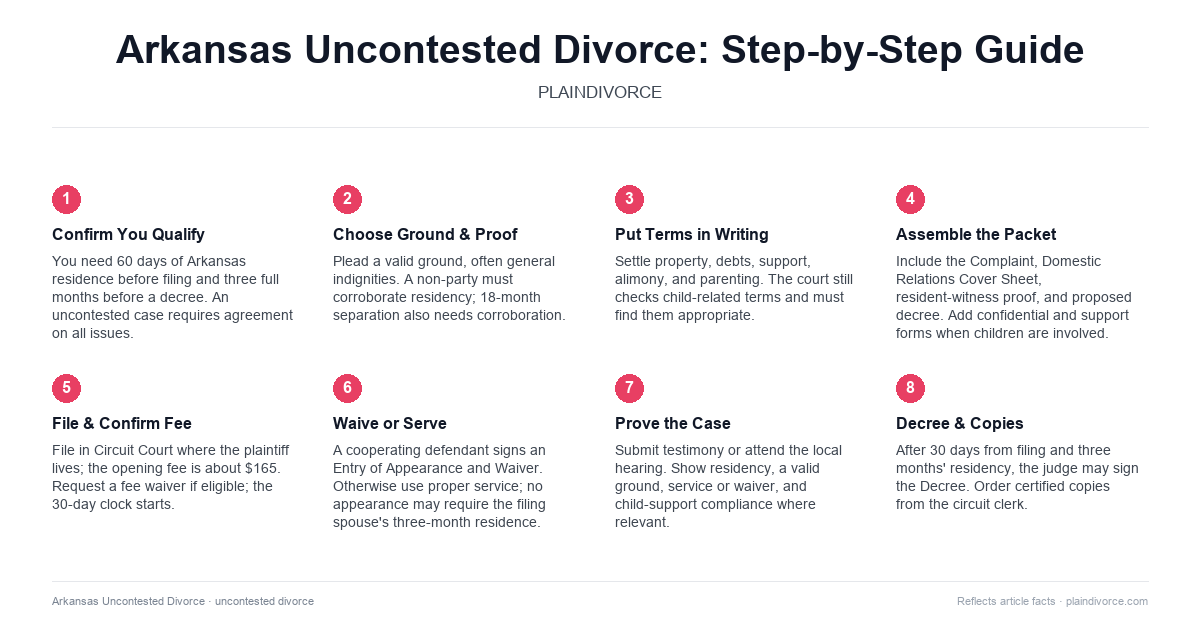
3. Step-by-Step: The Arkansas Uncontested Divorce Process
Exact form sets vary by county, but the uncontested workflow is the same statewide: qualify, agree in writing, assemble the packet, file, handle service, prove the case, and collect the decree.
Step 1 – Confirm you qualify
- Residency: you meet the 60-day, 3-month, and 30-day clocks and can corroborate the residency (and, if you never get an appearance from your spouse, the filing spouse holds the 3-month residence).
- Grounds: you can truthfully plead general indignities, or you have genuinely been separated 18+ continuous months and can corroborate it.
- Uncontested: your spouse will sign an Entry of Appearance and Waiver of Service and agree on all terms.
- Children: if you have minor children, expect extra paperwork for custody and child support.
Step 2 – Put your agreement in writing
The single biggest reason a case stops being “simple” is a disagreement that surfaces mid-process. Before filing, reach clear agreements on:
- Custody and parenting time: where the children live, the schedule, holidays, transportation, and who makes major decisions.
- Child support: the amount under Administrative Order 10 and the Family Support Chart, plus health insurance and uncovered medical costs. Any deviation from the chart amount must be explained in writing in the order.
- Property and debts: the home, vehicles, bank and retirement accounts, and who pays which debts.
- Alimony: whether any is paid, how much, and for how long.
Put the agreement in a written marital settlement agreement (also called a property settlement agreement), even one you draft yourselves. The judge usually incorporates a fair agreement into the decree—but the court can approve, modify, or reject terms, and must independently find that any custody and child-support terms are in the children’s best interest. A settlement you sign is a proposal to the court, not a self-executing order.
Step 3 – Assemble the Circuit Court filing packet
Form sets vary by county and situation, but most uncontested Arkansas cases include:
- Complaint for Divorce (opens the case);
- Summons (if you will serve formally);
- Entry of Appearance and Waiver of Service (when the defendant cooperates and you want to skip formal service);
- Domestic Relations Cover Sheet—required under Administrative Order No. 8 so the clerk can open and route the case;
- Confidential Information Sheet—required when the case involves custody or support of minor children; it keeps identifiers like Social Security numbers out of the public file;
- A corroborating (resident) witness affidavit, or the equivalent deposition testimony, covering residency—and, for the 18-month ground, the separation;
- Your testimony by deposition or an affidavit of the plaintiff, where your county allows the case to be proved on paper;
- A proposed Decree of Divorce for the judge to sign;
- If there are minor children or a support obligation: an Affidavit of Financial Means for each parent, a child-support worksheet consistent with Administrative Order 10, a proposed child-support order, and an income-withholding order (see section 4).
Why the administrative forms matter: in most counties the clerk cannot properly open a domestic-relations file without the cover sheet, and confidential identifiers should never go into a public pleading. Miss these and the filing can be rejected or delayed.
Arkansas Legal Services (a Legal Aid of Arkansas program) publishes a free interactive divorce packet that can generate the basic forms—complaint, summons, testimony by deposition, resident witness affidavit, and decree—for simple, uncontested cases with no minor children. Read the instructions carefully and confirm they match your county’s local practices.
Step 4 – File with the circuit clerk
File in the Circuit Court for the county where the filing spouse (the plaintiff) resides. Under Ark. Code Ann. § 9-12-303, the only exception is when the plaintiff is a nonresident of Arkansas and the defendant is an Arkansas resident—then you file where the defendant lives. It is not simply “the county where you or your spouse lives.”
At the circuit clerk’s office you:
- File the Complaint and the required starting documents (including the cover sheet, and the confidential information sheet if children are involved);
- Pay the filing fee, or request a fee waiver if you qualify;
- Get file-stamped copies for your records.
Once filed, the 30-day post-filing clock starts, and the 3-month residency requirement still has to be met before the judge can sign.
Step 5 – Service, or the Entry of Appearance and Waiver of Service
If your spouse cooperates, the standard move is for the defendant to sign an Entry of Appearance and Waiver of Service, which removes the delay and cost of sheriff or process-server service. If your spouse won’t sign, you need proper service—usually by the sheriff or a private process server. If you cannot locate your spouse, Arkansas allows service by warning order (publication) in limited circumstances, but those steps get technical fast and are worth reviewing with legal aid or an attorney. Remember that if there is no appearance and no personal service, the filing spouse must hold the full 3-month Arkansas residence before the decree.
Step 6 – Proof, corroboration, and the uncontested hearing
In an uncontested divorce, the court’s job is to confirm:
- You meet the residency rules, with proper corroboration;
- You have established a valid legal ground;
- The defendant was properly served or signed an Entry of Appearance and Waiver of Service;
- Any custody and child-support terms are lawful and consistent with Administrative Order 10.
How that proof is taken varies by circuit. Some judges hold a short uncontested hearing with brief live testimony. Many uncontested cases are finished on written testimony by deposition plus the corroborating witness affidavit, with no courtroom appearance—but whether your judge allows that is a local question. Confirm the procedure with your circuit clerk or the assigned judge before you assume you can skip the hearing.
Step 7 – The Decree of Divorce and certified copies
If everything is in order, the judge signs the Decree of Divorce. This order ends the marriage and sets the final terms for property, debts, custody, child support, and alimony.
Afterward, you will usually want to:
- Order certified copies of the decree from the circuit clerk—this is the document you need for a name change, dividing a retirement account, or any agency that wants the actual court order;
- Separately, if an agency asks for the vital record, order a divorce record from the Arkansas Department of Health, Division of Vital Records ($10 per copy, plus about $5 online processing and a $1.85 identity-verification fee for online orders). The Health Department record is an abstract, not a copy of the signed decree.
4. Children: Custody, Child Support, and Administrative Order 10
An uncontested divorce with children has more moving parts, but it can still avoid a court fight when both parents agree and the paperwork is complete.
Best interests and the parenting plan
Arkansas courts decide custody by the best interests of the child. Even in an agreed case, the judge checks whether your parenting plan is realistic, safe, and detailed enough to head off future conflict—covering:
- Schedules (weekdays, weekends, holidays, school breaks, summers);
- Transportation and exchanges;
- Decision-making and communication;
- How to handle changes and resolve disputes.
Arkansas courts may award joint custody or primary custody to one parent; since 2021 the statute expresses a preference for approaches that maximize each parent’s time with the child, consistent with the child’s best interest.
Child support and Arkansas Administrative Order 10
Even in an uncontested case, the court must confirm that child support follows—or reasonably deviates from—Administrative Order No. 10 (often called Arkansas Administrative Order 10) and the Family Support Chart. Since July 1, 2020 (with a further update in 2022), Arkansas uses an income-shares model: the court combines both parents’ gross income, finds the basic support obligation for that combined income and the number of children, and divides it in proportion to each parent’s share of the income.
The Arkansas Judiciary’s child-support calculator produces an estimate only—”the judge in your case has the final authority to determine the amount.” Any deviation from the guideline figure needs written findings in the support order explaining why.
A complete child-support package is more than a worksheet. Expect to file:
- An Affidavit of Financial Means for each parent—the sworn financial disclosure required in all family-support matters under Administrative Order 10. Both parents complete it, exchange it before any support hearing, file it with the court, and attach income documentation such as pay stubs and tax returns. It is not a one-line formality.
- A child-support worksheet showing how the chart was applied and explaining any deviation;
- A proposed child-support order; and
- An income-withholding order. Under Ark. Code Ann. § 9-14-218, every Arkansas order that provides for child support must direct the payor (usually an employer) to withhold support from the paying parent’s income. This applies even in a fully agreed case.
Parenting classes and local requirements
Under Ark. Code Ann. § 9-12-322, when divorcing parents have minor children the court may—before or after the decree—require the parties to complete at least two hours of classes on parenting issues faced by divorced parents, or to attend mediation on parenting, custody, and visitation. It is discretionary, not a fixed statewide mandate, and each party pays their own cost. Check your circuit’s standing orders and local rules early so a missed class doesn’t hold up your decree.
5. How Long Does an Uncontested Divorce Take in Arkansas?
There is no guaranteed timeline, and Arkansas publishes no statewide average—treat any specific “X days” figure with caution. What is fixed are the legal minimums:
- Residency: 60 days before filing; 3 full months before the decree can be signed.
- 30-day post-filing wait: no decree until 30 days after the complaint is filed, unless a § 9-12-310 exception applies (12-month pre-filing separation, warning-order service, or bigamy).
- Scheduling reality: how quickly your county sets uncontested hearings or reviews paper submissions.
In a cooperative case with clean paperwork, an uncontested divorce often finalizes not long after the legal minimums are met. Delays cluster around incomplete paperwork, missing service or waiver documents, and corroboration that wasn’t provided correctly.
6. Arkansas Divorce Filing Fees and Other Costs
Arkansas divorce filing fees and related costs depend mostly on whether you do the work yourself and whether you avoid formal service.
| Cost | Typical amount | Notes |
|---|---|---|
| Circuit Court filing fee | About $165 | Set by statute, uniform statewide to open a domestic-relations case. Confirm the current figure with your circuit clerk. |
| Electronic filing fee | $20 (where it applies) | Administrative Order 21 adds a $20 e-filing fee on new cases; pro se e-filing is generally limited to courts that have mandated it. |
| Service of process | $0–$100+ | Avoided entirely with an Entry of Appearance and Waiver of Service; otherwise sheriff or process-server fees, or publication costs. |
| Parenting class or mediation | Varies | Only if your circuit orders it; each parent pays their own cost. |
| Certified copies of the decree | Small per-copy fee | From the circuit clerk. |
| Divorce record (vital record) | $10 per copy | From the Arkansas Department of Health; add ~$5 processing and $1.85 identity verification for online orders. |
A fee waiver (in forma pauperis) is available from the clerk if your income qualifies. An uncontested divorce is generally the most affordable path compared with a fully contested case that has attorneys on both sides, though costs still vary with your county and circumstances.
7. When a DIY Divorce Isn’t the Right Call
A do-it-yourself uncontested divorce is not the best fit for every situation. Get legal advice—even a brief limited-scope consultation—before you sign anything if:
- There is domestic violence, stalking, threats, or fear of your spouse. If you are in danger, prioritize safety first; the National Domestic Violence Hotline (1-800-799-7233) and Arkansas’s 2-1-1 line can connect you with local resources.
- Your spouse is pressuring you to sign documents you don’t understand;
- You have substantial assets—a business, multiple properties, large retirement accounts—and aren’t sure what a fair split looks like;
- You suspect hidden income or assets;
- There are real disagreements about custody, parenting time, relocation, or support.
Dividing a retirement plan usually needs a separate qualified domestic relations order (QDRO), and getting that wrong is expensive to fix later. A professional set of eyes on the risky pieces is worth it even when the rest of the case is agreed.
8. Where a Self-Help Divorce Kit Fits In
Handling your own divorce doesn’t mean starting from a blank page. A self-help kit walks you through the workflow so you are less likely to miss an Arkansas-specific step—the cover sheet, the confidential information sheet, the waiver language, the corroboration rule, and the child-support package.
A good Arkansas DIY divorce kit helps you:
- Understand the Circuit Court process end to end (complaint → service or waiver → 30-day and 3-month waits → proof and corroboration → decree);
- Gather what you need before you start—dates, addresses, income, debts, and asset lists;
- Stay aligned with the documents Arkansas cases actually use;
- Stay organized with checklists and a timeline built around the residency and 30-day clocks;
- Avoid the mistakes that slow cases down—incomplete financial disclosures, a missing corroborating witness, or child-support paperwork that doesn’t match Administrative Order 10.
The PlainDivorce kit is built for people handling an Arkansas simple divorce themselves, using publicly available laws and procedures. It won’t replace legal advice in a complex or dangerous situation, but for a straightforward, agreement-based divorce it makes the process far more manageable.
9. Frequently Asked Questions
What is an uncontested or simple divorce in Arkansas?
It is a Circuit Court divorce where you and your spouse agree on every issue—property, debts, custody, child support, and alimony—so the judge can finalize it on the paperwork instead of holding a trial. The other spouse usually signs an Entry of Appearance and Waiver of Service to skip formal service. Agreement does not remove the requirement to prove residency and grounds and obtain a signed decree.
Do I need a witness for an uncontested divorce in Arkansas?
Yes—but only for residency. Under Ark. Code Ann. § 9-12-306, an uncontested case needs no third-party corroboration of the grounds, but your Arkansas residency must be corroborated by a non-party through oral testimony or a verified affidavit. If you use the 18-month separation ground, the separation must be corroborated too. Any adult who knows where you live can serve as the corroborating witness.
How much are Arkansas divorce filing fees?
The statutory Circuit Court filing fee to open a divorce case is about $165 statewide. Some courts add a $20 electronic filing fee. On top of that, budget for service costs (avoidable with a signed waiver), certified copies from the circuit clerk, and—if you need the vital record—$10 per copy from the Arkansas Department of Health. Confirm the current filing fee with your county circuit clerk before you file.
How long does an uncontested divorce take in Arkansas?
Arkansas sets minimums, not a fixed timeline: 60 days of residency before filing, 3 full months of residency before the decree, and at least 30 days between filing and the decree (with limited exceptions under § 9-12-310). There is no published statewide average. A clean, cooperative case often finalizes soon after those minimums are met; missing paperwork or corroboration is the usual cause of delay.
Which county do I file my Arkansas divorce in?
File in the Circuit Court for the county where the filing spouse (the plaintiff) lives. The only exception in Ark. Code Ann. § 9-12-303 is when the plaintiff lives outside Arkansas and the defendant is an Arkansas resident—then you file in the defendant’s county. Once one spouse files, any related action by the other spouse goes to the same county.
What is Arkansas Administrative Order 10?
Administrative Order No. 10 is the Arkansas Supreme Court order that governs child-support calculations. Since July 1, 2020 (updated in 2022) it uses an income-shares model built on both parents’ combined income and the Family Support Chart. It requires each parent to file an Affidavit of Financial Means and a support worksheet, and it treats the calculator result as a presumptive estimate the judge can adjust with written findings.
Do I have to go to court for an uncontested divorce in Arkansas?
It depends on your circuit. Some judges hold a brief uncontested hearing with short live testimony. Many uncontested cases are proved on written testimony by deposition plus the corroborating witness affidavit, with no appearance. There is no statewide rule guaranteeing a paper-only divorce, so confirm the procedure with your circuit clerk or the assigned judge.
What if my spouse won’t sign the waiver?
You can still proceed. Have the defendant served by the sheriff or a private process server; if they never file an Answer, the case can move forward by default—though you still have to prove residency and grounds. Note one catch: when there is no appearance and no personal service, the filing spouse must have kept an actual Arkansas residence for the full 3 months before the decree.
10. Final Thoughts and Next Steps
Starting a divorce—even an uncontested one—can feel overwhelming. Break it into steps and make sure you understand each before moving on.
If you are considering a simple divorce in Arkansas without a lawyer, you can:
- Confirm the 60-day, 3-month, and 30-day clocks—and, if your spouse may not participate, that the filing spouse holds the 3-month residence;
- Choose a valid ground and understand what proof and corroboration it needs;
- Reach full, written agreement on children, support, property, and debts;
- File in the correct county—where the plaintiff lives—and use your circuit clerk’s current local instructions;
- Include the administrative documents (Domestic Relations Cover Sheet, and the Confidential Information Sheet if children are involved) plus the full child-support package—worksheet, Affidavit of Financial Means, support order, and income-withholding order.
For many people, an uncontested divorce in Arkansas is a realistic way to end a marriage with less cost, fewer court appearances, and more control—as long as you follow the residency and corroboration rules and don’t miss the administrative forms.
Reminder: this guide is legal information, not legal advice, and PlainDivorce is not a law firm. Verify current statutes, forms, fees, and county procedures with the Arkansas Judiciary and your circuit clerk before you file.
When you’re ready to start, our Arkansas uncontested divorce kit walks you through each step in order.
Sources and local rules can change. Use this guide as a plain-English organizer, then verify the current filing requirements with the official court or government source for your jurisdiction.

About Harry D
Expert contributor at PlainDivorce, helping Canadians and American navigate simple uncontested divorces with clarity and confidence.