Uncontested Divorce in British Columbia: The Desk Order Divorce, Step by Step
If you and your spouse agree the marriage is over and neither of you wants a courtroom fight, an uncontested divorce in British Columbia is almost always handled as a Desk Order Divorce (also called an undefended divorce). Instead of a hearing, a Supreme Court judge reviews your paperwork “at the desk” and signs the order — as long as your package is complete, consistent, and shows that any child support is properly addressed.
Most cooperative couples want to file together to skip serving papers. Where that fits, the Notice of Joint Family Claim (Form F1) is the cleanest route: you start the case jointly and usually avoid personal service. If one spouse won’t sign joint paperwork but also won’t oppose the divorce, one spouse files a Notice of Family Claim (Form F3) instead.
This guide explains, in plain English, how a Desk Order Divorce works in BC: who qualifies, the BC Desk Order Divorce forms you actually need (F1 or F3, then F35, then the Affidavit — Desk Order Divorce (Form F38) and the Final Order (Form F52)), the federal registration step that quietly controls your timeline, what it costs, and where a DIY self-help kit fits in.
Not legal advice. PlainDivorce is not a law firm. This is general information about the BC process. Court rules, forms, and fees change — the Supreme Court Family Rules were last amended on January 19, 2026 (B.C. Reg. 152/2025, which replaced Forms F1, F37, and F38) — so always work from the current version of each form and check with a BC family lawyer if anything about your situation is uncertain.
TL;DR
- A Desk Order Divorce is BC’s process for an uncontested divorce in British Columbia that is usually decided on the paperwork, without a hearing (though a judge can still ask for more evidence).
- Either spouse must have been habitually resident in BC for at least one year before the case starts. Most couples rely on one year of separation as the basis for the divorce — you can file before the year is up, but the judge won’t grant the divorce until it has passed.
- The core BC Desk Order Divorce forms begin with Form F1 (joint) or Form F3 (sole), move through Form F35 to request the desk order, and rely on the Affidavit — Desk Order Divorce (Form F38) as your main sworn evidence. The judge signs the Final Order (Form F52).
- A federal Registration of Divorce Proceedings form and $10 fee go in with your claim. The court can’t grant the divorce until the Central Registry clearance comes back — and there is no published turnaround time, so leave a buffer.
- The divorce takes effect on the 31st day after the judgment is rendered (a court can order an earlier date in special circumstances if both spouses agree not to appeal).
- The standard paid court-fee total for a joint desk-order divorce is $290 ($200 + $10 + $80). The $200 filing fee can be waived at filing with a mediation certificate (Form F100), and a fee waiver is available for people who can’t pay without hardship.
1. What Is an Uncontested or Simple Divorce in British Columbia?
Divorce in BC runs on Canada’s federal Divorce Act, but the case is filed and decided in the Supreme Court of British Columbia — not Provincial Court. Even when everything is amicable, a judge still has to grant the divorce by signing an order.
An uncontested (or “simple”) divorce in BC generally means:
- one or both spouses start the case in the Supreme Court,
- the other spouse does not oppose the divorce, and
- parenting, support, and property and debt are already resolved — by a written agreement, by existing orders, or because they aren’t being raised in the case — so the judge doesn’t have to referee a dispute.
When people say “simple divorce,” they usually mean they’re only asking the court for the divorce order itself. Everything else is either settled or off the table.
2. What a Desk Order Divorce Is (and Why It Matters)
Desk Order Divorce is the BC term for an uncontested divorce that is decided on the documents, usually without anyone appearing in court. It applies once your file qualifies as an undefended family law case under the Supreme Court Family Rules — for example, no Response to Family Claim was filed, or every issue except the divorce is settled.
Treat “no hearing” as the common outcome, not a guarantee. A judge can still ask for more evidence or direct someone to attend before deciding. What the registry and the judge are looking for is a complete, consistent, judge-ready package that proves you qualify and — if there are children — shows that child support is properly addressed.
3. Who Qualifies for a Desk Order Divorce in British Columbia?
Residency requirement (BC)
Under section 3 of the Divorce Act, a BC court can hear your divorce if either spouse has been habitually resident in British Columbia for at least one year immediately before the case is commenced. Only one of you needs to meet it, so BC can still be the right court even if your spouse has moved away. If a divorce proceeding is already underway elsewhere, that can affect which court has jurisdiction — get advice if that applies.
Grounds for divorce (Canada)
Canada has one ground for divorce: breakdown of the marriage. Under section 8, you establish breakdown in one of three ways — one year of living separate and apart, adultery, or cruelty. Almost every uncontested BC divorce uses one-year separation because it’s no-fault and needs no proof beyond your own sworn evidence. You can start the case before the year is complete as long as you were separated when it began; the judge simply won’t grant the divorce until the year has passed.
When a Desk Order Divorce is usually a good fit
- You both agree the marriage is over.
- One of you meets the one-year BC residency requirement.
- You’ll have at least one year of separation by the time the court grants the divorce.
- You have a workable parenting plan (if you have children) and reasonable child support arrangements.
- Property and debt are not being fought in court — usually because a Separation Agreement already deals with them.
A Desk Order Divorce may not be a safe DIY project if there is family violence, intimidation, a serious power imbalance, hidden assets, or genuinely complex finances. You may still end up uncontested, but it’s worth getting legal advice before you file.
4. The BC Desk Order Divorce Forms and the Federal Registration Step
Generic guides say “file the petition.” BC doesn’t work that way. The BC Desk Order Divorce forms have specific letter-number codes, and starting a divorce also triggers a separate federal filing. Using the right form — in the right version — is the difference between an accepted package and a rejected one. The titles below match the Supreme Court’s current family-law form set.
| Form | Official title | What it does |
|---|---|---|
| F1 | Notice of joint family claim | Starts the case when spouses file together. Available only if all relief other than the divorce claim is by consent. |
| F3 | Notice of family claim | Starts the case when one spouse files (a sole claim). |
| F4 | Response to family claim | Filed by the other spouse in a sole case if they want to take part or oppose anything. |
| F15 | Affidavit of personal service | Proves the spouse was personally served (sole cases). |
| F35 | Requisition — undefended family law case | The formal request that moves your file to a judge for desk-order review. |
| F36 | Certificate of pleadings | A registrar’s certificate confirming the file and pleadings are in order. |
| F37 | Child support affidavit | Required when the pleadings identify a child of the marriage or child support is claimed — not only when it’s disputed. |
| F38 | Affidavit — desk order divorce | Your main sworn evidence: the marriage, the separation, and (if relevant) children and support. |
| F52 | Final order | The draft order the judge signs to grant the divorce. |
| F56 | Certificate of divorce | An optional certificate you can request after the divorce takes effect (see below). |
| F100 | Certificate of mediation | Filed with your claim to have the $200 commencement fee waived. |
| F101 | Affidavit — section 51 | The guardianship affidavit — needed only if the case asks the court to appoint someone as a child’s guardian under the Family Law Act. Not a routine divorce form. |
| F102 | Statement of information for corollary relief proceedings | Required from each party before a Divorce Act child support, spousal support, or parenting order is made. |
| Registration of Divorce Proceedings (federal form) — filed with your claim, plus a $10 fee. Sent to the federal Central Registry of Divorce Proceedings, which checks whether another divorce between the same spouses is already pending. The judge cannot grant your divorce until this clearance is received. | ||
Form currency: the Family Rules were last amended on January 19, 2026 by B.C. Reg. 152/2025, which replaced Forms F1, F37, and F38. Don’t rely on an old PDF — a superseded form is a common reason a package is bounced. Our British Columbia uncontested divorce kit is kept current with the latest form versions.
Download Our British Columbia Uncontested Divorce (Desk Order) Self-Help Kit
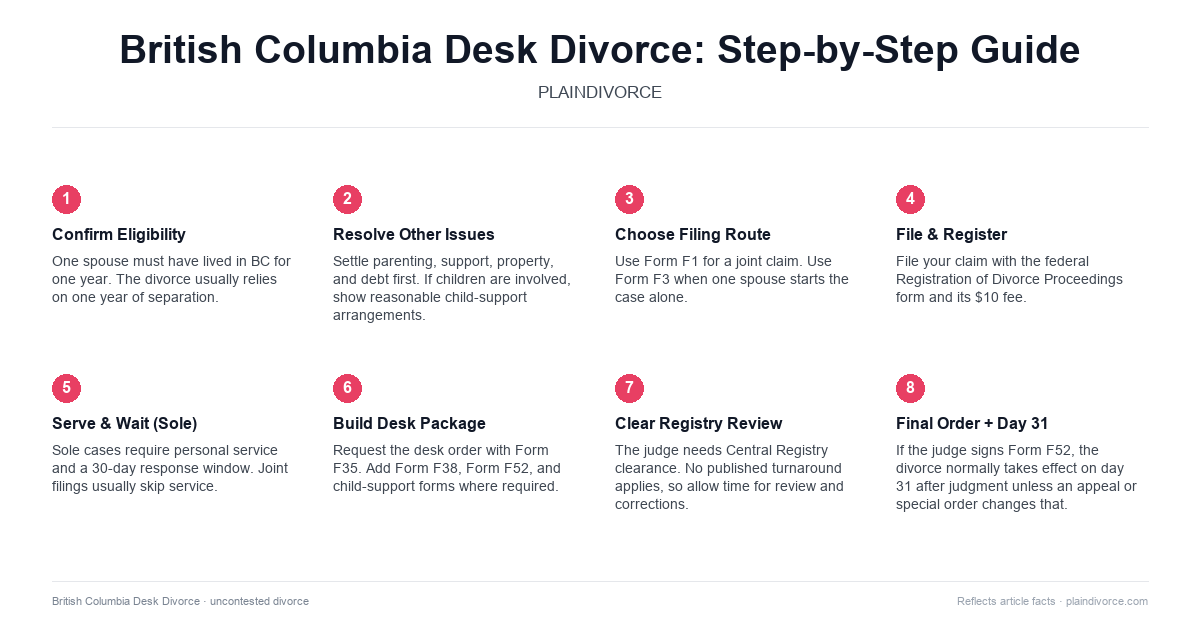
5. Step-by-Step: How a BC Desk Order Divorce Works
Here’s the usual flow. Your exact steps depend on whether the divorce is joint (you file together) or sole (one spouse starts), and whether you have children.
Step 1 – Confirm eligibility and choose joint vs. sole
- Confirm one of you has been habitually resident in BC for at least one year.
- Confirm your basis for the divorce (almost always one-year separation) and the date separation began.
- If you’re amicable and both willing to sign — and every issue other than the divorce is by consent — choose the joint filing (Form F1) route. It usually removes the service step entirely.
Practical reality: joint filing is the smoothest path because it avoids personal service. A sole filing (Form F3) is common when one spouse won’t sign joint paperwork but also won’t fight the divorce.
Step 2 – Settle any other claims first
For a clean desk-order outcome, resolve anything else you’d want a court to deal with — parenting, child support, spousal support, property and debt — before you file, usually through a written Separation Agreement or existing orders. A separate agreement isn’t required just to get the divorce order itself, but it’s strongly recommended for clarity and to head off future disputes. Remember that a joint claim (Form F1) is only available if all of that relief is by consent.
Important limitation trap: leaving financial claims out of the divorce does not preserve them indefinitely. Under section 198 of BC’s Family Law Act, married spouses generally have two years from the date of the divorce order to start a proceeding for division of family property and family debt, division of a pension, or spousal support under the Family Law Act. (Spousal support under the federal Divorce Act has no equivalent limitation period.) If any financial issue is unresolved, get legal advice before you finalize the divorce.
Step 3 – Start the case (Form F1 for joint, Form F3 for sole)
- Joint filing: file a Notice of Joint Family Claim (Form F1) together.
- Sole filing: file a Notice of Family Claim (Form F3).
Either way, you file in the Supreme Court of British Columbia and include proof of the marriage. Under the Family Rules, the first party in a divorce case files a certificate of the marriage or of the registration of the marriage — the official government-issued document, not the decorative certificate the officiant hands out at the ceremony. If you can’t file it at the start, you can explain why and undertake to file it before you apply for the divorce order, or explain why obtaining it is impossible; the registrar has to be satisfied. If you were married in BC, order the certificate from the BC Vital Statistics Agency (check the current fee); married elsewhere in Canada, contact that province or territory’s vital statistics office; married abroad, contact the marriage-records authority in that country. If the document isn’t in English, ask your registry whether it wants a certified translation.
Because you’re claiming a divorce, you also file the federal Registration of Divorce Proceedings form with the $10 registration fee. Under the Central Registry of Divorce Proceedings Regulations, the court registrar must send the details to the federal Central Registry of Divorce Proceedings within seven days; the registry checks for another pending divorce between the same spouses and sends a clearance notification back to the court. The judge can’t grant your divorce until that clearance is received. There is no published turnaround for it, so treat it as a wildcard in your timeline. (Once received, the clearance is valid for six years, which matters if a file stalls and has to be revived.)
Notice of Family Claim (Form F3): Filing Instructions
If you’re filing a sole claim, double-check these before you submit the Form F3: use your spouse’s full legal name exactly as it appears on the marriage certificate; give a BC address for service (yours, a friend’s, or your lawyer’s); state the basis for the divorce (usually one-year separation) and the date separation began; and check the box for a divorce order plus any other relief you’re actually seeking — don’t add property or support claims you’ve already settled. Sign and date the form, then file it with the marriage certificate and the federal registration form at your Supreme Court registry.
Step 4 – Serve your spouse (sole cases) and wait out the response period
In a sole case you must serve your spouse with the filed paperwork. The respondent then has 30 days after being served to file and serve a Response to Family Claim (Form F4). If they file one contesting an issue, the case may become defended. If they file nothing within 30 days, the case is undefended and you can move toward the desk order. You’ll prove service with an Affidavit of Personal Service (Form F15) (or another proof of service the registry accepts).
A joint filing (Form F1) skips this step — both spouses are already in the case.
Step 5 – Build the Desk Order package
This is where form accuracy matters most. A desk-order package usually includes:
- Affidavit — Desk Order Divorce (Form F38) — your sworn evidence about the marriage, separation, and (if relevant) children.
- Requisition — Undefended Family Law Case (Form F35) — the request asking the court to grant the divorce.
- Certificate of Pleadings (Form F36) — the registrar’s confirmation that the file is in order.
- Final Order (Form F52) — the draft order for the judge to sign.
- Child Support Affidavit (Form F37), and Form F102 from each party, if children or Divorce Act support/parenting orders are involved.
- Proof of service (sole cases), including Form F15.
Before the file goes to a judge, the registry needs the federal clearance from Step 3 back. The two most common DIY delays in BC are that federal clearance wait and packages returned for correction — wrong or inconsistent dates, missing signatures, a Form F38 that doesn’t line up with the Form F1 or F3, or child support proof that isn’t clear enough.
Step 6 – The judge signs the Final Order (Form F52)
If the judge is satisfied you meet the legal requirements — residency, marriage breakdown, federal clearance received — and that any children are properly supported, they sign the Final Order (Form F52) granting the divorce. If child support looks unclear or unreasonable without proof, the judge can refuse to grant the divorce until it’s fixed.
Step 7 – The 31-day rule: when the divorce takes effect
The divorce is not effective the moment the judge signs. Under section 12 of the Divorce Act, a divorce takes effect on the 31st day after the day the judgment is rendered — the appeal period. Two wrinkles: a court can order an earlier effective date in special circumstances if both spouses agree and undertake not to appeal; and if an appeal is filed, the divorce doesn’t take effect until the appeal is finished.
Once the divorce has taken effect, either spouse can request a Certificate of Divorce (Form F56) from the registry. BC’s divorce-certificate page sets the current cost at $40 in person or $50 by mail — more on whether you actually need one below.
6. Special Issues When You Have Children
If you have children of the marriage, the judge must be satisfied that reasonable arrangements for child support have been made before granting the divorce (Divorce Act, section 11). If support looks inadequate and unexplained, the court must stay the divorce until it’s sorted out.
- Explain the parenting arrangement clearly — where the children live and when they’re with each parent.
- Show the child support math. Be ready to provide the Federal Child Support Guidelines calculation and the income information behind it.
- Use the right forms. The Child Support Affidavit (Form F37) is required whenever a pleading identifies a child of the marriage or child support is claimed — not only when it’s disputed. If you’re seeking a child support, spousal support, or parenting order under the Divorce Act, each party also files a Statement of Information for Corollary Relief Proceedings (Form F102).
- Guardianship is separate. The Affidavit — Section 51 (Form F101) — the guardianship affidavit — is only needed if the case actually asks the court to appoint someone as a guardian under the Family Law Act. It is not a routine divorce filing just because divorcing spouses have children.
- Local practice varies. Some registries have detailed checklists for children and support — follow your local registry’s current instructions.
7. How Long Does a Desk Order Divorce Take in BC?
BC doesn’t publish a province-wide processing standard, so think in fixed building blocks rather than a single number:
- Separation requirement: the divorce won’t be granted until you have one full year of separation (you can file earlier).
- Service and response period (sole cases): time to serve your spouse, then a 30-day window for them to respond.
- Federal registration clearance: the court must have the Central Registry clearance before a judge can grant the divorce. No published turnaround — this is the least predictable part.
- Registry review: depends on workload and whether your package needs corrections.
- 31-day appeal period: after the judgment is rendered.
A complete, error-free file with cooperative spouses moves through steadily; a package that comes back for corrections, or a slow federal clearance, adds weeks. Ask your registry for a current estimate rather than relying on a fixed timeframe.
8. What Does an Uncontested Divorce Cost in British Columbia?
BC Supreme Court fees are set in Appendix C of the Supreme Court Family Rules and are adjusted for inflation every two years (most recently effective January 19, 2026). Here are the current fees for a typical desk-order file. Verify your exact total with your registry, especially if you’re e-filing or ordering extra copies.
| Step | Item | Current fee | Notes |
|---|---|---|---|
| 1. Start the case | Commencing a family law case (your F1 or F3) | $200 | Can be waived at filing if you provide a Certificate of Mediation (Form F100) from a qualified mediator. |
| 2. Federal divorce registration | Registration of Divorce Proceedings, filed with your claim | $10 | Not payable by a provincial legal-aid recipient whose provincial fees are waived. |
| 3. Request the desk order | Requisition — Undefended Family Law Case (Form F35) | $80 | Required. |
| 4. Swear affidavits | Commissioning an affidavit at the registry | $40 each | Only if done at the registry — a lawyer or notary may charge less or nothing. |
| 5. Certificate of Divorce | Form F56, requested after 31 days | $40 in person / $50 by mail (incl. $10 mailing fee) | Optional — not needed to finalize the divorce. |
| Add-on | Electronic filing package (Court Services Online) | $7 per package | Only if you e-file. |
The standard paid court-fee total for a joint desk-order divorce is around $290 — the $200 commencement fee, the $10 federal registration fee, and the $80 desk-order requisition fee. Everything else (affidavit commissioning, e-filing, a Certificate of Divorce) is variable or optional. Beyond court fees, the biggest cost difference between joint and sole cases is usually service: a joint filing avoids paying a process server.
If you can’t pay the court fees without hardship, you can apply for a fee waiver. The application generally includes a requisition, a draft Order to Waive Fees (Form F85), and an Affidavit in Support to Waive Fees (Form F86) setting out your income, expenses, and circumstances. A fee waiver covers the fees in the Family Rules schedule; the $10 federal fee has its own separate legal-aid exemption. Check current registry instructions for eligibility.
9. When DIY Might Not Be Right
A Desk Order Divorce is built for cooperative cases. Get legal advice before you file if there is family violence or intimidation, a serious power imbalance, suspected hidden assets, complex property or a business, a pension to divide, serious disagreement about parenting, or significant immigration or cross-border consequences. A short paid consultation now is far cheaper than reopening a finalized divorce later — and remember the two-year Family Law Act limitation clock starts on the date of the order.
10. Where a Self-Help Divorce Kit Fits
If your case is genuinely uncontested and you’re comfortable managing paperwork, a self-help kit can make the process easier by giving you:
- a plain-English roadmap of the BC Desk Order Divorce process, including the federal registration step;
- checklists to reduce the registry rejections that cause most DIY delays;
- a sequence to work through (start case → federal clearance → desk-order package → order → day 31);
- guidance on where each form fits (F1/F3, F4, F15, F35, F36, F37, F38, F52, F56, and F101/F102 where relevant) — alongside, not instead of, the official court instructions.
Download Our British Columbia Uncontested Divorce Self-Help Kit
PlainDivorce is not a law firm, and a kit isn’t legal advice. It’s a practical organization tool for straightforward, cooperative cases.
11. BC Desk Order Divorce FAQ
What is a Desk Order Divorce in BC?
It’s an uncontested divorce that a Supreme Court judge reviews on the paperwork — including the Affidavit — Desk Order Divorce (Form F38) — and grants by signing the Final Order (Form F52), usually without a hearing. A judge can still ask for more evidence or an appearance before deciding.
What forms do I need to file for divorce in BC?
A sole uncontested divorce typically uses the Notice of Family Claim (Form F3), the federal Registration of Divorce Proceedings form, the Affidavit of Personal Service (Form F15), the Requisition — Undefended Family Law Case (Form F35), the Certificate of Pleadings (Form F36), the Affidavit — Desk Order Divorce (Form F38), and the Final Order (Form F52). Add Form F37 and Form F102 if children or Divorce Act support/parenting orders are involved. A joint case swaps Form F3 for the Notice of Joint Family Claim (Form F1) and drops the service forms.
What court handles divorce in British Columbia?
The Supreme Court of British Columbia. Provincial Court can decide many family issues, but only the Supreme Court grants divorce orders.
What is the difference between Form F1 and Form F3?
Form F1 (Notice of Joint Family Claim) is used when spouses file together and all relief other than the divorce is by consent — it usually avoids personal service. Form F3 (Notice of Family Claim) is used when one spouse starts the case alone.
What form actually requests a desk order divorce?
The Requisition — Undefended Family Law Case (Form F35), filed once your case qualifies as undefended. It moves the file to a judge for desk-order review.
What is the federal Registration of Divorce Proceedings form, and why does it matter?
It’s a federal form filed with your claim, plus a $10 fee. The court sends the details to the Central Registry of Divorce Proceedings, which checks for another pending divorce between the same spouses. The judge can’t grant your divorce until the clearance comes back, and there’s no published timeframe for it — plan for a buffer.
Do I need a Certificate of Divorce to remarry?
Not necessarily. Your divorce is legally effective on day 31 whether or not you ever order a certificate. BC’s marriage-licence rules say only that a recently divorced person must wait until the divorce order takes effect before buying a licence — they don’t name a required proof document, and in Canada either the divorce order or the Certificate of Divorce (Form F56) can be used as proof. The certificate is optional but is clean, conclusive proof of the divorce and its date, which is why many people order one before remarrying. Confirm with the licence issuer which document they want.
How much does a divorce cost in BC?
The standard paid court-fee total for a joint desk-order divorce is about $290: a $200 commencement fee, a $10 federal registration fee, and an $80 desk-order requisition fee. Variable or optional costs on top can include affidavit commissioning ($40 at the registry, sometimes less elsewhere), a $7 e-filing fee, and $40 for a Certificate of Divorce ($50 by mail) if you order one. The $200 commencement fee can be waived with a mediation certificate (Form F100), and a hardship fee waiver is available.
When does a BC divorce become final?
The divorce takes effect on the 31st day after the judgment granting it is rendered — the appeal period. A court can set an earlier date in special circumstances if both spouses agree and undertake not to appeal, and a filed appeal postpones the effective date. After the divorce takes effect, either spouse can request a Certificate of Divorce (Form F56).
Can I file before we’ve been separated a full year?
Yes. You can start the case as long as you were living separate and apart when it began. The judge just won’t grant the divorce until the one-year separation is complete — so filing early lets you get the paperwork and federal clearance out of the way.
Final note. This guide is general information about the BC Desk Order Divorce process, checked against the Divorce Act, the Central Registry of Divorce Proceedings regulations, and the BC Supreme Court Family Rules and fee schedule as of August 2026. It is not legal advice. Forms and fees change — always work from the current version of each form, and speak with a BC family lawyer if anything about your finances, your children, or your safety is uncertain.
Sources and local rules can change. Use this guide as a plain-English organizer, then verify the current filing requirements with the official court or government source for your jurisdiction.

About Harry D
Expert contributor at PlainDivorce, helping Canadians and American navigate simple uncontested divorces with clarity and confidence.