Uncontested Divorce in California: A Plain-English 2026 Guide
An uncontested divorce in California is one where you and your spouse agree on every issue—property, debts, support, and, if you have children, custody and child support—so a judge can sign the judgment by reviewing your paperwork instead of holding a trial. California calls divorce a dissolution of marriage, and a standard case is filed in the Superior Court for the county where a spouse meets the residency rules. Agreement makes the case cheaper and calmer, but it does not remove California’s financial-disclosure requirement or the statutory six-month waiting period.
“Uncontested” and “simple divorce” are not formal case types in California law. They are shorthand for a dissolution where the court has nothing left to decide. As of January 1, 2026, California gives cooperative couples three ways to run that kind of case: a default with a written agreement, an uncontested case where the other spouse files a Response, or a brand-new joint petition that both spouses sign together. A separate, stricter shortcut called Summary Dissolution exists for short marriages with little property.
This guide walks through, in plain English, how each path works in 2026: who qualifies, the California divorce forms FL-100 and friends, the mandatory disclosures, current California divorce filing fees, the six-month clock, and where a do-it-yourself approach fits.
TL;DR
- An uncontested divorce in California means you and your spouse agree on everything and give the court a complete packet, so a judge signs off without a trial.
- A one-petitioner case starts with the California divorce forms FL-100 (Petition) and FL-110 (Summons), plus FL-105 (UCCJEA declaration) if you have children under 18. Since January 1, 2026 you can instead file a joint petition together on FL-700 and FL-710.
- Every route (except a straight Summary Dissolution) requires the Preliminary Declaration of Disclosure California law demands—FL-140, FL-150, and FL-142 or FL-160—exchanged with your spouse, with proof filed on FL-141.
- California divorce filing fees run about $435–$450 for a first appearance (Petition or Response); the joint petition costs $870. A fee waiver (FW-001) is available if you qualify.
- The case ends when a judge signs the FL-180 Judgment form and it is entered—but marital status cannot end until at least six months have run (from service or first appearance, whichever is first; from the filing date on the joint-petition route).
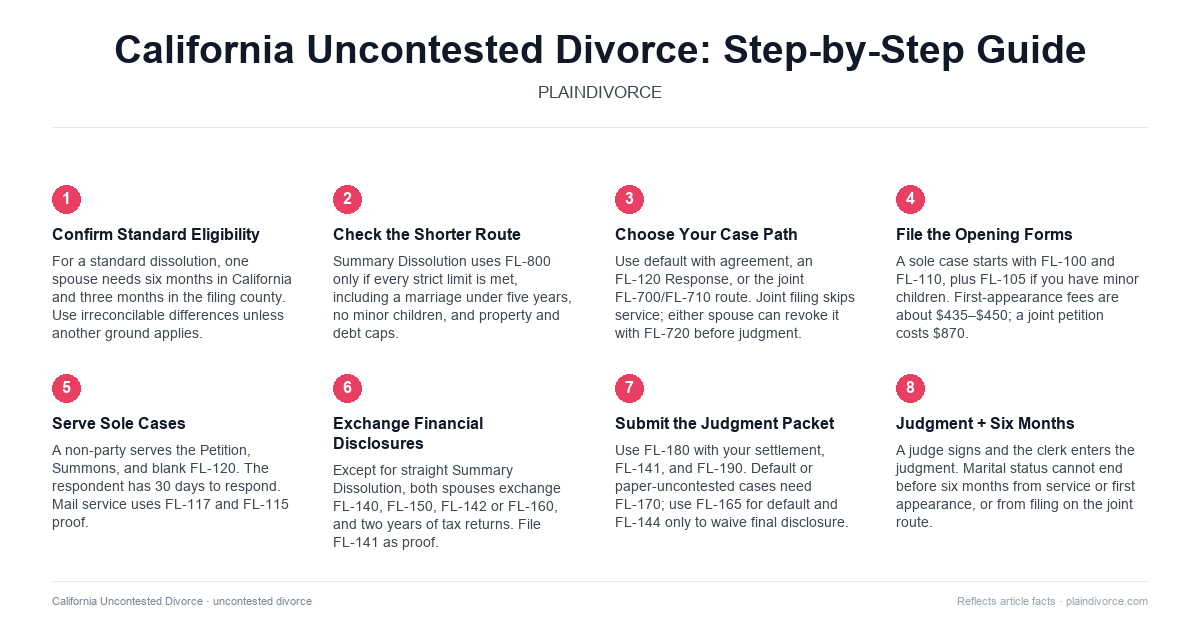
1. What Is an Uncontested or Simple Divorce in California?
A California dissolution is “uncontested” when the court does not have to resolve any dispute: you have agreed on the big issues and your paperwork is complete. The judge’s job shrinks to checking that the case meets the legal requirements and that any orders affecting children are lawful.
Even a fully agreed case still has hard requirements. You must meet residency, exchange financial disclosures, and wait out the statutory six-month period before your marital status can end. None of those can be skipped by agreement.
The four cooperative paths in 2026
- Default with agreement. One spouse files and serves the Petition. The other spouse does not file a Response, but both sign a written settlement agreement (the respondent’s signature notarized), and the court enters the respondent’s default and then the judgment. This avoids a second filing fee, so it is the common money-saver for cooperative couples.
- Uncontested case with a Response. The respondent files a Response (FL-120) and pays the first-appearance fee, then both spouses submit a complete settlement and judgment packet. This costs more but can be cleaner when both spouses want to be formally in the case.
- Joint petition (new January 1, 2026). Both spouses file one Petition together—Joint Petition (FL-700) and Summons—Joint Petition (FL-710)—as “Petitioner 1” and “Petitioner 2.” There is no service and no default. You still exchange disclosures and file a judgment, and either spouse can pull out before the judgment is final by filing a Notice of Revocation (FL-720). The six-month clock runs from the filing date.
- Summary Dissolution. A separate, streamlined procedure for couples who meet strict limits on marriage length, children, real estate, debt, and property (see below). It uses its own forms and its own judgment, and it still takes six months.
2. Who Qualifies for an Uncontested Divorce in California?
Residency requirements
For a standard dissolution, at least one spouse must have lived in California for 6 months and in the filing county for 3 months before you file. A few exceptions matter:
- Registered domestic partners: if you registered your partnership in California, you can file to end it here no matter where you live now—though if neither of you lives in California, the court may not be able to decide property, support, or custody.
- Married in California, living somewhere that won’t divorce you: if you married here and now live in a place that will not dissolve your marriage, you can file in the California county where you married, with the same limit on the court’s power over property, support, and children.
- Not there yet on time: you can file a legal separation now (no residency minimum) and amend it to a dissolution once you meet the 6-month and 3-month marks.
Grounds for divorce
California is a no-fault state. Under Family Code § 2310, a dissolution can be based on one of two grounds: irreconcilable differences that have caused the irremediable breakdown of the marriage, or permanent legal incapacity to make decisions. Virtually every uncontested case uses irreconcilable differences, and you do not have to prove wrongdoing by either spouse.
Do you qualify for Summary Dissolution instead?
Summary Dissolution is faster paperwork than a standard uncontested divorce, but only if all of the following are true as of your date of separation. Read the Summary Dissolution Information booklet (FL-810) first; the petition that actually starts the case is the Joint Petition for Summary Dissolution (FL-800).
- You have been married (or registered as domestic partners) less than 5 years.
- You have no minor children together (born or adopted before or during the marriage), and neither spouse is pregnant.
- Neither spouse owns or leases real estate, except a lease that ends within a year of filing and has no option to buy.
- You owe less than $7,000 together in community debts (car loans don’t count).
- Your community property is worth less than $57,000, and each spouse’s separate property is worth less than $57,000 (cars excluded). These caps adjust periodically—confirm the current figures in FL-810.
- Neither spouse will ever seek spousal support.
- You both sign an agreement dividing property and debts, and you both waive the right to appeal and to a new trial.
If even one item is not met, use the standard dissolution process in Section 3. Summary Dissolution has its own judgment (FL-825) and becomes final 6 months after you file; either spouse can stop it during that window by filing a Notice of Revocation (FL-830).
When an uncontested case is a good fit — and when it isn’t
Your case is usually a strong candidate when you can genuinely agree on how to divide property and debts, on spousal support (including none), and—if you have children—on custody, parenting time, and child support.
It is the wrong fit if there is domestic violence, threats, or coercion; if one spouse hides income or assets; if your finances are complex (a business, multiple properties, sizable retirement accounts); or if there is real disagreement about the children. In those situations, even a limited-scope consultation with a California family lawyer is a smart safety step—see Section 7.
3. Step-by-Step: Key FL Forms, Fees, and Deadlines
Exact packets vary by county, but the Superior Court workflow follows the same shape. Below are the forms people actually see, plus the “hard stop” items that commonly cause a judgment packet to be rejected.
Step 1 – Start the case (FL-100 and FL-110, or the FL-700 joint petition)
For a one-petitioner case, you open it by filing the core California divorce forms FL-100 (Petition—Marriage/Domestic Partnership) and FL-110 (Summons) in the Superior Court for your county. If you have children under 18, add the Declaration Under UCCJEA (FL-105).
For a joint petition, both spouses sign and file FL-700 and FL-710 together (plus FL-105 if you have minor children). There is no petitioner and respondent—just Petitioner 1 and Petitioner 2—and Step 2 does not apply because there is nobody to serve. You can read the court’s overview of the route on the California Courts joint-petition page.
Step 2 – Serve your spouse (one-petitioner cases only)
After filing, someone who is 18 or older and not a party to the case must serve the Petition, Summons, and a blank Response (FL-120) on your spouse. Your spouse then has 30 days to file a Response. The service (or first-appearance) date is what starts the six-month clock.
Uncontested-friendly option: in cooperative cases you can skip a process server by using service by mail with a Notice and Acknowledgment of Receipt (FL-117). Your non-party server mails the filed papers, a blank FL-120, the FL-117, and a stamped return envelope. Service is complete on the date your spouse signs the FL-117—not the mailing date—and the signed form is attached to a Proof of Service of Summons (FL-115). The petitioner cannot do this mailing personally.
Step 3 – Choose your uncontested path
This is one of the biggest cost decisions in the process. The routes differ mainly in filing fees and in whether anyone is “served.”
| Path | Court filing fees | Service? | Best when |
|---|---|---|---|
| Default with agreement | One first-appearance fee (about $435–$450) | Yes – petitioner serves; respondent files nothing | Fully cooperative; respondent will sign a notarized agreement |
| Uncontested with a Response | Two first-appearance fees (about $870–$900 total) | Yes – and respondent files FL-120 | Both spouses want to be formally in the case |
| Joint petition (FL-700/FL-710) | $870 (single joint filing) | No service – both spouses file together | Both spouses agree on all final terms up front |
| Summary Dissolution (FL-800) | About $435 | No service – joint petition | You meet every Summary Dissolution limit |
For a cooperative couple, Default with agreement is usually the cheapest because only one spouse pays a filing fee. That path has its own threshold requirements: at least 30 days must pass after service, the respondent must file no Response, the written agreement must cover every issue with the respondent’s signature notarized, and your disclosure and service proofs must already be on file. The final forms are Request to Enter Default (FL-165), FL-170, and the FL-180 Judgment form.
Step 4 – Complete the mandatory financial disclosures
California is strict about disclosure. The Preliminary Declaration of Disclosure California law requires—often shortened to the PDD—must be completed and exchanged in every dissolution except a straight Summary Dissolution, even when you agree on everything. Each spouse’s preliminary disclosure must include:
- Declaration of Disclosure (FL-140) – the cover declaration;
- Schedule of Assets and Debts (FL-142) or Property Declaration (FL-160) – a complete list of what you own and owe;
- Income and Expense Declaration (FL-150) – current income and monthly expenses;
- Your tax returns for the last two years.
The petitioner serves this package with the Petition or within 60 days of filing; the respondent has 60 days after filing a Response. Under Family Code § 2104, the parties can extend that window by written agreement or the court can extend it. You generally do not file the FL-142/FL-160 and FL-150 with the court—you exchange them and then file a Declaration Regarding Service of Declaration of Disclosure (FL-141) as proof.
The final-disclosure trap: California also calls for a Final Declaration of Disclosure later in the case unless both spouses waive it. Many uncontested couples waive it—but only with a Stipulation and Waiver of Final Declaration of Disclosure (FL-144). FL-144 waives only the final disclosure; it can never waive the preliminary one. If FL-144 is missing when you try to waive the final disclosure, your judgment packet comes back rejected.
Step 5 – Prepare and submit the final judgment packet
To finish, you submit paperwork telling the judge exactly what orders you want. The core form is the FL-180 Judgment form, but the rest of the packet depends on your route:
- Declaration for Default or Uncontested Dissolution (FL-170) – required on the default and on an uncontested case decided without a hearing. It works like a checklist telling the clerk and judge your file is ready.
- Request to Enter Default (FL-165) – default path only.
- Your written Marital Settlement Agreement, in the format your county requires.
- Notice of Entry of Judgment (FL-190), which the clerk uses to notify both spouses once the judgment is entered.
- FL-141 (disclosure proof) and, if you are waiving the final disclosure, FL-144.
- The children’s forms in Section 4 when custody or support orders are involved.
Copies and envelopes (a common hard stop): the court’s judgment-submission guidance says to bring three copies of the judgment paperwork plus two large stamped envelopes addressed to each spouse, and some courts want a third small envelope for the FL-190. Missing envelopes get the whole stack bounced. Run your county’s Judgment Checklist (FL-182)—a statewide Judicial Council form—plus any local checklist before you submit, and check whether your court accepts e-filed judgments. See California Courts – submit your judgment.
Retirement warning: if either spouse has a pension or retirement plan—a 401(k), a private pension, or a public plan like CalPERS or CalSTRS—the judgment alone usually will not divide it. Each plan administrator sets its own order requirements: a private plan typically needs a separate Qualified Domestic Relations Order (QDRO), and public systems use their own model orders and administrative processes. Talk to the plan administrator and get qualified legal help before you sign.
Step 6 – The California six-month waiting period
Family Code § 2339 sets the minimum. In a one-petitioner case, marital status cannot end until six months have run from the date of service of the summons and petition or the date the respondent first appears in the case, whichever is first. On the joint-petition route, the six months run from the filing date. The court can extend the period for good cause, but it cannot shorten it—even with perfect paperwork and full agreement.
Step 7 – Final proof of divorce
The judgment paperwork must be reviewed, signed by a judge, and entered by the clerk. The marital-status termination date shown in the final documents cannot be earlier than the end of the applicable waiting period. Once the judgment is entered, you can request certified copies from the Superior Court clerk for name changes, benefits, retirement processing, and record-keeping.
4. Special Issues When You Have Children
When minor children are involved, the court looks more closely at custody, parenting time, and child support—even when both parents agree. Your paperwork has to be detailed and consistent with California’s requirements.
Parenting plan and custody
Your agreement typically covers legal custody (decision-making), physical custody and the time-share schedule, holidays, transportation and exchanges, communication, and how you will resolve future disagreements. The judge decides custody by the best interests of the child and can adjust terms that do not fit that standard. Agreed custody and visitation orders are entered on the Child Custody and Visitation Order Attachment (FL-341).
Child support and the forms that go with it
California child support is guideline-based, calculated from each parent’s income and the time-share split. Even when you agree on a number, the court expects a complete support picture backed by your disclosures, and it can reject an agreed figure that departs from the guideline without a written explanation. A complete child-support judgment usually includes:
- Child Support Information and Order Attachment (FL-342) – the support order itself, attached to the FL-180.
- Notice of Rights and Responsibilities (FL-192) – attached to the judgment; it explains uninsured medical costs and how to ask for a change later.
- Child Support Case Registry Form (FL-191) – filed separately, not attached to the judgment.
- Income Withholding for Support (FL-195) – used whenever support will be taken from a paycheck.
5. How Long Does an Uncontested Divorce Take in California?
California publishes no statewide average, so treat any specific “X months” figure with caution. What is fixed is the six-month statutory minimum before marital status can end—measured from service or first appearance (whichever is first) in a one-petitioner case, or from the filing date on the joint-petition route, and extendable by the court for good cause.
Beyond that floor, total time depends on how quickly your county processes filings and reviews judgment packets, and on whether your packet is complete on the first pass. Packets commonly bounce back for a missing FL-144, missing envelopes, a disclosure step done out of order, or an agreed child-support number with no guideline explanation. Getting the packet right the first time is the part of the timeline you actually control.
6. California Divorce Filing Fees and Other Costs
California divorce filing fees and related court costs vary by county and by which path you take. The common buckets:
| Cost | Typical amount | Notes |
|---|---|---|
| First-appearance filing fee (Petition or Response) | About $435–$450 | Set by the Judicial Council; varies by county within that range. Confirm your county’s current schedule. |
| Joint petition (FL-700/FL-710) | $870 | One combined filing for both spouses. |
| Summary Dissolution (FL-800) | About $435 | One joint filing. |
| Service of process | $0 with FL-117; otherwise a local server or sheriff fee | FL-117 service by mail is free; a private process server is a market rate that varies by area. |
| Copies, notary, mailing | Small | Certified copies, the notarized agreement signature on the default path, and stamped envelopes for the FL-190. |
| Optional help | Varies widely | Mediation, a document preparer, a limited-scope attorney review, or a self-help kit. These are market prices, not court fees. |
A fully DIY case where one spouse files and the other defaults keeps court costs to a single filing fee plus small mailing and copy charges. Paying an attorney to handle even an uncontested divorce costs far more, because you are buying professional time rather than just court fees—get a written quote before you commit.
If you cannot afford the fees, California’s fee-waiver process uses Request to Waive Court Fees (FW-001). Per the California Courts fee-waiver guide, you qualify if you receive certain public benefits (Medi-Cal, CalFresh, SSI/SSP, CalWORKs, General Assistance, Tribal TANF, IHSS, or CAPI), if your household income is below the amount set in FW-001 item 5b, or if you cannot pay for your household’s basic needs and the court fees. A waiver covers the filing fee and other court costs, but it ordinarily expires 60 days after judgment is entered, the case is dismissed, or the judge makes a final decision.
7. When a DIY Divorce Might Not Be Right
A DIY uncontested divorce can be cost-effective, but it is not a good fit if there is abuse or coercion, serious financial dishonesty, complex assets, major disputes about children, or high-stakes immigration, tax, or bankruptcy concerns. Get legal advice before you sign anything—a one-time consultation is far cheaper than unwinding a bad agreement later.
If you are in danger, prioritize safety first. The National Domestic Violence Hotline (1-800-799-7233) and California’s 2-1-1 line can connect you with local resources, and the court can issue protective orders separately from the divorce.
8. Where a Self-Help Divorce Kit Fits
California’s public resources are strong, but most people still get stuck on the real workflow: how FL-100 (or the FL-700 joint petition) starts the case, how Default with Agreement works, how to stay on top of the disclosure requirements, and how to assemble a clean final packet—including easy-to-miss items like FL-170, FL-144, and the envelopes—that the Superior Court will actually accept.
A well-built kit keeps you organized with checklists, a timeline anchored to the six-month clock, and plain-English guidance, without replacing legal advice.
Download Our California Uncontested Divorce Self-Help Kit9. Frequently Asked Questions
Can we get divorced in California without going to court in person?
Usually, yes. In a true uncontested case—default with agreement, an uncontested Response, or a joint petition—the process is done on paper, and you generally do not need a hearing if your judgment packet is complete and correct. Some counties still require a brief hearing in certain situations, so confirm local practice with your Superior Court before you assume you can skip it.
What forms do I need to start an uncontested divorce in California?
For a one-petitioner case, you need the Petition (FL-100) and Summons (FL-110), plus the UCCJEA declaration (FL-105) if you have children under 18. Since January 1, 2026, spouses who agree on everything can instead file a joint petition together on FL-700 and FL-710. A Summary Dissolution starts with FL-800 (after reading the FL-810 booklet). Financial disclosures (FL-140, FL-150, FL-142 or FL-160) come next in every route except a straight Summary Dissolution.
How much are California divorce filing fees?
The first-appearance filing fee for a Petition (FL-100) or a Response (FL-120) is about $435–$450, depending on the county. The new joint petition (FL-700/FL-710) costs $870 for the combined filing, and a Summary Dissolution is about $435. If you cannot afford the fee, file a fee-waiver request (FW-001). Confirm the current amount with your Superior Court, since these figures change.
What is the 6-month waiting period in California?
Under Family Code § 2339, your marital status cannot end until six months have passed. In a one-petitioner case, the clock starts on the date of service or the date the other spouse first appears, whichever is first. On the joint-petition route, it starts on the filing date. You can finish the paperwork sooner, but the divorce is not final until the six months run, and the court can extend the period for good cause.
Do we both need our own lawyer?
No. Many uncontested couples use no attorney, one attorney for limited-scope document review, or a neutral mediator. One attorney cannot represent both spouses at once, but either or both of you can get independent advice without hiring full representation—which is worth doing before you sign an agreement dividing a home, a business, or a retirement account.
What if my spouse won’t sign anything?
A joint petition is off the table, but you can still file a one-petitioner case and serve your spouse. If they never file a Response within 30 days, you can proceed by default; if you also have a signed, notarized agreement, that is the “default with agreement” path. If your spouse actively disagrees, the case is contested and a consultation with a family lawyer is worth it before you invest more time.
Can we change our minds and stop the divorce?
Before judgment, yes. If no Response was ever filed, the petitioner can dismiss the case alone with a Request for Dismissal (CIV-110). Once a Response is on file, both spouses must sign the dismissal. On a joint petition, either spouse can file a Notice of Revocation (FL-720), and a Summary Dissolution can be revoked with FL-830. After judgment is entered, undoing it is much more limited—talk to a family law attorney.
Does an uncontested divorce affect our taxes right away?
Your federal filing status generally depends on your marital status on December 31 of the tax year. If your judgment is entered near year-end, timing can matter, and a parent who maintains a home for a child may qualify for head-of-household rather than single. This is a good question for a tax professional; see the IRS guidance on filing taxes after divorce or separation.
10. Final Thoughts and Next Steps
If you want the cleanest uncontested divorce in California, the must-hit targets are:
- Confirm residency (6 months in the state, 3 months in the county) and the right Superior Court—or use a residency exception or a legal separation if you are not there yet.
- Check whether you qualify for Summary Dissolution (FL-800), and whether the new joint petition (FL-700/FL-710) fits better than a default.
- File the right starting papers—Petition FL-100 and Summons FL-110—or the joint petition, and serve properly if there is a respondent.
- Complete the preliminary financial disclosures (FL-140, FL-150, FL-142 or FL-160, two years of tax returns) and file the FL-141 proof.
- If waiving the final disclosure, include FL-144 so your judgment packet is not rejected.
- Submit a complete judgment packet built on the FL-180 Judgment form, run the FL-182 checklist, and follow your county’s copy-and-envelope rules.
- Track the six-month clock, and get help if retirement division (a QDRO or a CalPERS/CalSTRS order) is part of your settlement.
For many California couples, an uncontested divorce is a realistic way to end a marriage with less cost, fewer court trips, and more control—as long as you follow the disclosure rules, respect the six-month wait, and submit a packet the clerk will accept the first time.
Reminder: this guide is legal information, not legal advice, and PlainDivorce is not a law firm. Verify current statutes, Judicial Council forms, filing fees, and county procedures with the California Courts Self-Help Guide and your Superior Court before you file.
When you’re ready to start, our California uncontested divorce kit walks you through each step in order.
Sources and local rules can change. Use this guide as a plain-English organizer, then verify the current filing requirements with the official court or government source for your jurisdiction.

About Harry D
Expert contributor at PlainDivorce, helping Canadians and American navigate simple uncontested divorces with clarity and confidence.