Uncontested Divorce in Colorado: Forms, Costs, and Timeline (2026 Guide)
An uncontested divorce in Colorado is a dissolution of marriage where both spouses agree on parenting, support, and property, so no judge has to decide anything at a trial. You file the Petition for Divorce or Legal Separation (JDF 1011), exchange financial disclosures, wait the mandatory 91 days, and submit a signed written agreement for a judge to approve.
The rest of the case is paperwork and deadlines, not arguing in front of a judge. This plain-English guide walks through who qualifies, the step-by-step process in Colorado district court, every form you file (including the Colorado divorce forms JDF 1101 question and the JDF 1115 Separation Agreement), what it costs, how long it takes, and where a do-it-yourself approach or a self-help kit fits in.
TL;DR: Uncontested Divorce in Colorado
- You or your spouse must have been domiciled in Colorado for at least 91 days before filing. Children generally must have lived in Colorado for 182 days (or since birth if under six months) for Colorado to make parenting orders.
- You start the case with the Petition for Divorce or Legal Separation (JDF 1011) plus the Case Information Sheet (JDF 1000). Older Colorado divorce forms JDF 1101 references point to this petition’s predecessor — use the current JDF 1011.
- Colorado’s 91-day waiting period has no exceptions. It runs from the later of joint filing, service, a signed waiver of service, or the other spouse’s appearance.
- Within 42 days of filing or being served, each spouse must file their own Sworn Financial Statement (JDF 1111) and Certificate of Compliance (JDF 1104).
- Current Colorado divorce filing fees are $260 to file and $146 for a Response. Filing jointly as co-petitioners avoids the Response fee.
- You document your deal in a Property and Financial Agreement (JDF 1115) — still often called a “separation agreement” — plus a Parenting Plan (JDF 1113) and Support Worksheet (JDF 1821) if you have children.
- The Affidavit for Decree without Appearance (JDF 1018) can finish a case with no hearing — but only if there are no minor children, or every party has a lawyer and a parenting plan is on file.
1. What Is an Uncontested Divorce in Colorado?
In Colorado, divorce is called dissolution of marriage. Colorado is a no-fault state, so the only legal ground is that the marriage is irretrievably broken (C.R.S. § 14-10-106). The court does not need proof of cheating or misconduct to grant the divorce.
People say uncontested divorce or simple divorce when:
- Both spouses agree the marriage should end;
- They have settled parenting (if they have children), child support, spousal maintenance, and how property and debts are divided; and
- No one is asking a judge to decide a disputed issue at trial.
You still open a full district court case. You file the Petition for Divorce or Legal Separation (JDF 1011) with the Case Information Sheet (JDF 1000), either as co-petitioners (both sign) or with one spouse filing first. When you have a full deal, you also file a signed Property and Financial Agreement (JDF 1115) covering property, debts, and maintenance. A contested divorce is the opposite — the spouses can’t agree, so the case may involve discovery, hearings, and sometimes a trial. A case that starts contested can still become uncontested if you reach a complete agreement later.
2. Who Qualifies for an Uncontested Divorce in Colorado?
Residency and domicile
To file for dissolution of marriage in Colorado, you or your spouse must have been domiciled in Colorado for at least 91 days before the case begins (C.R.S. § 14-10-106). The Judicial Branch’s plain-language guide phrases this as having “lived in Colorado for at least 91 days.”
If you have minor children and you want Colorado to enter parenting orders, the children generally must have lived in Colorado for at least 182 days (or since birth, if they are younger than six months), unless an exception applies under the interstate custody rules (the UCCJEA). Couples who entered a civil union in Colorado can use this process even if neither spouse still lives here.
When an uncontested divorce is a good fit
An uncontested divorce in Colorado usually works well when you can communicate well enough to exchange information and sign documents, and you have a clear agreement about:
- Parenting time and decision-making (if there are children);
- Child support and how the children’s expenses are shared;
- Whether spousal maintenance is paid, and if so how much and for how long; and
- How property and debts are divided — home, vehicles, bank and retirement accounts, credit cards, and loans.
When to slow down or talk to a lawyer
Even if you qualify to file in Colorado, a DIY uncontested divorce may not be the right call if there is domestic violence, stalking, or coercion; hidden assets; complex finances such as a business, several properties, or significant retirement or pension division; or a serious dispute about the children. In those situations, even a short consultation with a Colorado family-law attorney or a legal clinic is a smart safety step before you sign anything.
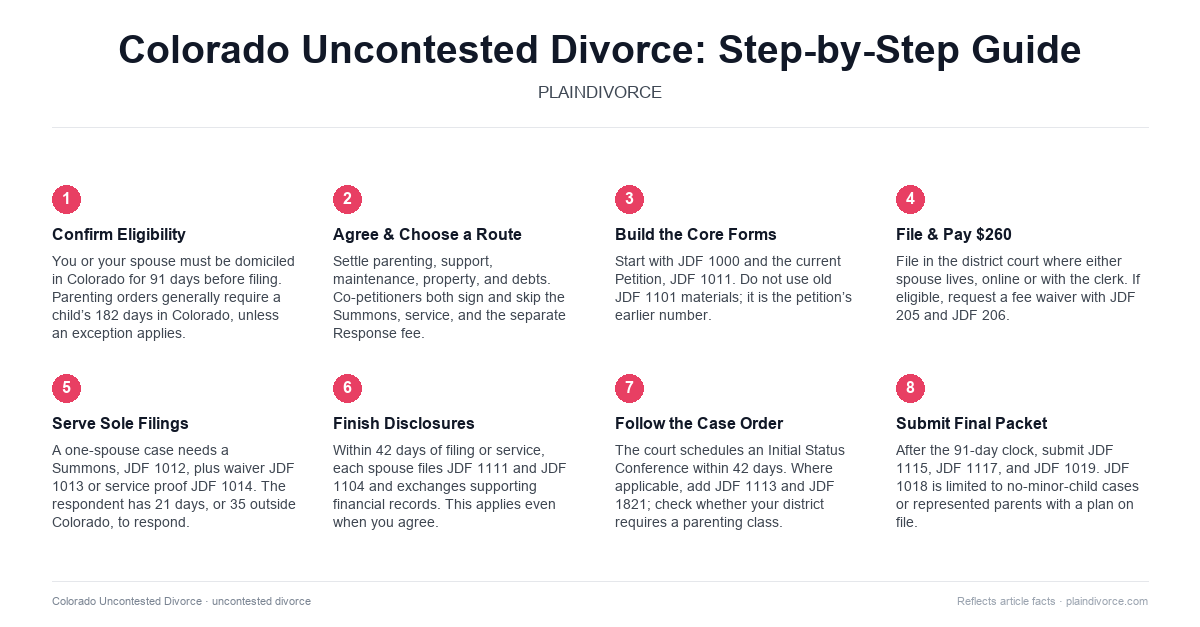
3. The Colorado Uncontested Divorce Process, Step by Step
Counties differ in the details, but an uncontested dissolution follows the same spine in every Colorado district court.
Step 1 – Choose your path: joint co-petitioners vs. one spouse files
Filing as co-petitioners keeps an uncontested case simplest. Both spouses sign the petition, so you skip the Summons (JDF 1012), skip formal service, and the second spouse never has to pay a $146 Response fee just to take part. If only one spouse files, the other becomes the respondent and must be served and given the chance to file a Response (JDF 1015).
| Step | Joint filing (co-petitioners) | One spouse files first |
|---|---|---|
| Who signs the petition | Both spouses | Petitioner only |
| Summons (JDF 1012) | Not needed | Required |
| Service on the other spouse | Not needed | Waiver (JDF 1013), personal service (proof via JDF 1014), or — with court permission — publication/certified mail |
| Response (JDF 1015) + $146 fee | Not needed | Due within 21 days of service (35 days if served outside Colorado) |
| Extra cost | $260 filing fee only | $260 filing fee + possible $146 Response fee + service costs |
Step 2 – Put your full agreement in writing
Uncontested cases move faster when you settle every major topic early:
- Children: parenting-time schedule, holidays, transportation, and decision-making.
- Child support: the guideline worksheet inputs and who pays which expenses.
- Spousal maintenance: whether it applies at all, and if so the amount and duration (guidelines are in C.R.S. § 14-10-114).
- Property and debts: home, vehicles, accounts, retirement, credit cards, and loans.
Colorado couples document property, debt, and maintenance in one Property and Financial Agreement (JDF 1115), signed by both spouses. This is the form people mean when they say “JDF 1115 Separation Agreement.” Parenting terms go in a Parenting Plan (JDF 1113), and support terms are captured in a Support Order (JDF 1117). If you can’t agree on the parenting plan or the financial agreement, the court can order mediation.
Step 3 – Build the JDF form stack
Colorado’s Judicial Branch publishes the official JDF forms. A typical uncontested dissolution uses:
- Case Information Sheet (JDF 1000) — part of every initial filing.
- Petition for Divorce or Legal Separation (JDF 1011).
- Summons (JDF 1012) — only if one spouse files first.
- Sworn Financial Statement (JDF 1111) — each spouse files their own.
- Certificate of Compliance with Mandatory Financial Disclosures (JDF 1104) — each spouse files their own.
- Property and Financial Agreement (JDF 1115).
- Support Order (JDF 1117) and Decree (JDF 1019) — standard final documents (you provide the caption; the judge signs).
- If you have children: a Parenting Plan (JDF 1113) and the Support Worksheet (JDF 1821), generated through the Judicial Branch’s online Child Support Calculator.
Do not skip the financial disclosures. Colorado is strict about financial transparency in domestic cases under C.R.C.P. 16.2(e). Even when you agree on everything, each spouse must exchange the required documents and file their own JDF 1111 and JDF 1104. Some supporting documents are exchanged between the spouses but not filed with the court; the certificate itself is signed under oath. Miss this and a judge generally will not review your decree.
Step 4 – File with the district court and pay the filing fee
File in the district court for the county where either spouse lives, online through Colorado Courts E-Filing or in person with the clerk. Pay the $260 filing fee, keep your case number, and use it on everything you file afterward. If you can’t afford the fee, file JDF 205 (Motion to File Without Payment, which includes your financial affidavit) and JDF 206 (the proposed Order — you complete only the caption). Filing also triggers the automatic temporary injunction described in Section 4.
Step 5 – Serve the other spouse (only if one spouse filed first)
If you filed as co-petitioners, skip this step. If only one spouse filed, the other must be given the Petition and Summons in one of these ways:
- Waiver of Service (JDF 1013) — the respondent signs to accept the papers. A waiver is not agreement with the petition; it just confirms receipt and keeps the right to respond and get notice of hearings.
- Personal service by a sheriff or private process server, with a Return of Service (JDF 1014) filed as proof.
- Publication or certified mail — only if the court grants permission because the respondent can’t be found. See JDF 1099 for the details.
The respondent then has 21 days (35 days if served outside Colorado) to file a Response (JDF 1015). If no response is filed, the court can move forward and decide the case without further notice to the respondent.
Step 6 – Finish the mandatory financial disclosures within 42 days
Within 42 days after filing the Petition (or after being served with it), each spouse must file their own Sworn Financial Statement (JDF 1111) and Certificate of Compliance (JDF 1104), and exchange the underlying documents (pay records, account statements, tax returns, debt statements, and the like). This deadline applies even in a fully agreed case. Getting it done early keeps your decree on schedule.
Step 7 – The Initial Status Conference and case management order
The court schedules an Initial Status Conference (ISC) within 42 days of filing and issues a procedural or case management order telling you what to file and when. Many divisions will vacate (cancel) the ISC if you have already filed a complete written agreement and all required forms — but that is local practice, not a statewide rule, so read your order and call the division if you’re unsure.
Step 8 – The Affidavit for Decree without Appearance in Colorado (JDF 1018)
The form many people search for is the Affidavit for Decree without Appearance — a Colorado form, JDF 1018, that asks a judge to sign the decree based on the paperwork alone, with no hearing. Both parties sign it under oath, confirming domicile, that service is complete, that they signed the JDF 1115 agreement, that the 91 days will have run, and that the marriage is irretrievably broken.
The children rule is strict. JDF 1018 can be used only when (a) there are no minor children and neither spouse is expecting a child, or (b) there are minor children and each party is represented by a lawyer with a Parenting Plan (JDF 1113) already on file. If you have minor children and you are self-represented, JDF 1018 is not an option — plan on a brief hearing (in person or by phone/video, depending on the county). A judge can also set a hearing in any case if something is missing or unclear.
Step 9 – Submit the final packet and get your decree
Once the 91 days have run and your file is complete, the judge reviews the paperwork (or holds the short hearing) and signs the Decree of Dissolution of Marriage (JDF 1019). That order legally ends the marriage. You can restore a prior name in the decree, and you can ask the clerk for certified copies ($20 each) for name changes, benefits, and record updates.
4. The Automatic Temporary Injunction: Rules That Apply the Day You File
The moment the Petition is filed — and the moment the respondent is served or receives it — both spouses are bound by an automatic temporary injunction under C.R.S. §§ 14-10-107 and 14-10-108. It applies even when you completely agree. You must not:
- Sell, transfer, hide, or borrow against marital property without the other spouse’s consent or a court order. You may keep spending in the ordinary course — usual business expenses and the necessities of life.
- Disturb the other spouse’s peace.
- Remove the children from Colorado without written consent from the other parent or a court order.
- Cancel or change insurance (health, homeowner’s, renter’s, auto, or life) that covers a spouse or child. Exception: you may change coverage with written consent or a court order, after giving at least 14 days’ notice.
5. Extra Steps When You Have Children
If you have children under 18, the court’s first priority is their best interests. Even a fully uncontested case needs clear parenting and support paperwork.
Allocation of parental responsibilities and parenting time
Colorado uses the term allocation of parental responsibilities for what many people call custody. Your Parenting Plan (JDF 1113) should spell out decision-making, the parenting-time schedule, holidays and school breaks, transportation and exchanges, and how the parents communicate.
Child support and the JDF 1821 Support Worksheet
Child support is set by the Colorado guideline in C.R.S. § 14-10-115 and calculated on the Support Worksheet (JDF 1821). As of March 2026, JDF 1821 is the single statewide support worksheet, with revised calculations — the older split between “Worksheet A” and “Worksheet B” (and the discontinued JDF 1820) no longer applies. Use the Colorado Judicial Branch’s official online Child Support Calculator to produce the current worksheet. If you agree on an amount that differs from the guideline, the judge must make written findings stating the presumed guideline amount and the specific reasons for the departure — it isn’t enough to simply note that you agreed.
Parenting classes
Many judicial districts require divorcing parents to complete an approved parenting-education class and file proof before final orders enter. Where it applies, both parents may need to file a completion certificate, and the court cannot waive the class provider’s fee. It is a local requirement, so check your county’s instructions early so it doesn’t hold up your decree.
6. How Long Does an Uncontested Divorce Take in Colorado?
The floor is fixed: Colorado has a mandatory 91-day waiting period under C.R.S. § 14-10-106, and the court cannot enter a decree until at least 91 days have passed since it acquired jurisdiction over the respondent. That clock starts on the later of:
- the date a joint petition is filed;
- the date the respondent is personally served;
- the date the respondent signs a waiver of service; or
- the date the respondent otherwise appears in the case.
There are no exceptions, even when both spouses fully agree. In practice most uncontested cases take longer than 91 days because you still have to finish the 42-day financial disclosures, clear the Initial Status Conference or case management order, complete any parenting class, and submit a final packet the court will accept. Court backlogs and county practice vary, so treat “about three to six months” as a rough planning estimate, not a promise — ask your division for its current timing.
7. What Does an Uncontested Divorce Cost in Colorado?
Costs vary by county and situation, but the Colorado divorce filing fees fall into a few predictable buckets.
Core court fees
| Item | Typical amount | Notes |
|---|---|---|
| Filing fee (petition for divorce, legal separation, or annulment) | $260 | Statewide, per the Colorado Judicial Branch fee schedule |
| Response fee | $146 | Only if the other spouse files a Response in a one-petitioner case |
| Certified copy of the decree | $20 each | For name changes, benefits, and records |
| Motion to modify (later) | $105 | Applies more than 60 days after final orders |
Insider tip: filing jointly as co-petitioners avoids the Summons, the service cost, and the $146 Response fee, because the second spouse is already in the case.
Other common costs
- Service fees — sheriff or private process server, only if one spouse filed first and no waiver is signed.
- Parenting class fees — if you have minor children and your district requires the class.
- Optional help — mediation, a limited-scope attorney review of your agreement, or a self-help kit.
Fee waivers (JDF 205 and JDF 206)
If the filing fee is a hardship, file JDF 205, the Motion to File Without Payment (it contains a financial affidavit), together with JDF 206, the proposed Order, where you fill in only the caption. A judge reviews your finances and can waive the court fees. Fee waivers do not cover a private process server or a parenting-class provider.
Colorado court filing fees rose statewide effective January 1, 2025 under House Bill 24-1286, and fees are set by statute and can change again. Confirm the current numbers on the Colorado Judicial Branch List of Fees or with your district court clerk before you file.
8. Colorado Divorce Forms: JDF 1101, JDF 1011, and the Full Stack
Search results and older articles still mention “Colorado divorce forms JDF 1101.” That number refers to the earlier version of the petition. The current form is the Petition for Divorce or Legal Separation (JDF 1011), last revised October 30, 2025. If a website or old document points you to “JDF 1101,” don’t file it — download the current JDF 1011 and its current instructions from the Colorado Judicial Branch. The petition’s purpose is the same, but the current form has later substantive updates, so the version matters.
| Form | What it does | When you need it |
|---|---|---|
| JDF 1000 | Case Information Sheet | Every initial filing |
| JDF 1011 | Petition for Divorce or Legal Separation (formerly JDF 1101) | Always — starts the case |
| JDF 1012 / 1013 / 1014 | Summons / Waiver of Service / Return of Service | Only if one spouse files first |
| JDF 1015 | Response | If the respondent chooses to respond |
| JDF 1111 | Sworn Financial Statement | Each spouse, within 42 days |
| JDF 1104 | Certificate of Compliance with Mandatory Financial Disclosures | Each spouse, within 42 days |
| JDF 1115 | Property and Financial Agreement (“separation agreement”) | When you have a full financial agreement |
| JDF 1113 | Parenting Plan | If you have minor children |
| JDF 1821 | Support Worksheet (child support & maintenance) | If child support or maintenance is ordered |
| JDF 1117 | Support Order | Standard final document |
| JDF 1018 | Affidavit for Decree without Appearance | To finish with no hearing (see the children rule) |
| JDF 1019 | Decree of Dissolution of Marriage | Standard final document — the judge signs it |
| JDF 205 / 206 | Motion and Order to file without paying the fee | If the filing fee is a hardship |
| JDF 1305 | Stipulated Motion to Dismiss | If both spouses decide to stop the divorce |
Get every form from the Colorado Judicial Branch’s official family-law forms page — that is the only source that is always current.
9. Where a Self-Help Divorce Kit Fits Into the Process
For most people the hard part of an uncontested divorce in Colorado isn’t the concept of no-fault dissolution. It’s keeping the paperwork organized, hitting the 42-day disclosure deadline, and assembling a final packet the court will accept. A good self-help kit gives you:
- A clear sequence: file → injunction applies → disclosures within 42 days → Initial Status Conference → 91-day wait → final packet.
- Checklists for the core JDF forms — JDF 1000, JDF 1011, JDF 1104, JDF 1111, JDF 1115, and JDF 1117.
- Timeline guidance tied to the 91-day waiting period and the correct start date.
- Organization help so your final submission is consistent and complete.
10. Frequently Asked Questions
Do you have to go to court for an uncontested divorce in Colorado?
Not always. If there are no minor children and your file is complete, a judge can enter the decree on the paperwork using the Affidavit for Decree without Appearance (JDF 1018), with no hearing. If you have minor children and you are self-represented, JDF 1018 is not available, so expect a short hearing — often by phone or video. A judge can also set a hearing in any case if something is missing or unclear.
How much does an uncontested divorce cost in Colorado?
The state filing fee is $260. A $146 Response fee applies only if the other spouse files a separate Response, which co-petitioner (joint) filing avoids. Beyond court fees, budget for possible service costs, a parenting class if you have children, and about $20 per certified copy of the decree. If the fee is a hardship, ask for a waiver with JDF 205 and JDF 206. Confirm current fees with your district court clerk before filing.
How long does an uncontested divorce take in Colorado?
The minimum is the mandatory 91-day waiting period, which runs from the later of joint filing, service, a signed waiver, or the respondent’s appearance — with no exceptions. Most cases take longer because of the 42-day financial disclosures, the Initial Status Conference, any parenting class, and court scheduling. Ask your division for its current timing rather than relying on a fixed estimate.
What form starts a Colorado divorce, and is JDF 1101 the same as JDF 1011?
You start the case with the Petition for Divorce or Legal Separation (JDF 1011), filed with the Case Information Sheet (JDF 1000) in the county where either spouse lives. “JDF 1101” is the old number for the petition; older materials may still use it, but you must file the current JDF 1011 and its current instructions from the Colorado Judicial Branch, because the form has since been revised.
What happens if you skip the financial disclosure paperwork?
Colorado requires each spouse to exchange specific financial documents and file their own Sworn Financial Statement (JDF 1111) and Certificate of Compliance (JDF 1104) within 42 days of filing or service. If those forms are missing, a judge generally will not review your decree, even if you agree on everything else. This is a mandatory step, not an optional one.
Can you use the Affidavit for Decree without Appearance if you have kids?
Only in one narrow situation: every party is represented by a lawyer and a Parenting Plan (JDF 1113) is already on file. Otherwise, JDF 1018 is limited to cases with no minor children and no pregnancy. Self-represented parents of minor children should plan on a brief hearing to finalize the divorce.
Do you need a lawyer for an uncontested divorce in Colorado?
Not necessarily, if your situation is straightforward and you both agree on parenting, support, and property. A self-represented party must follow the same rules and procedures a lawyer would. Get advice if there is domestic violence or coercion, hidden assets, a business or complex retirement division, or a real dispute about the children — even a limited-scope consultation can be worth it.
Can you stop the divorce after filing?
Yes, but do it in writing and do it promptly. If both spouses want to stop, file a Stipulated Motion to Dismiss (JDF 1305) right away. If you let a completed case sit without telling the court, a decree can still be entered. Before the decree, you can also amend a filed agreement or parenting plan with the court’s approval — another reason to settle everything before you submit the final packet.
11. Final Checklist and Next Steps
For the cleanest uncontested path in Colorado, hit these targets in order:
- Confirm 91-day Colorado domicile and file in the correct county district court.
- Decide whether to file jointly as co-petitioners using the Petition (JDF 1011) plus the Case Information Sheet (JDF 1000).
- Follow the automatic temporary injunction from day one.
- Exchange full financial disclosures and file your own JDF 1111 and JDF 1104 within 42 days.
- Put the deal in a signed Property and Financial Agreement (JDF 1115), with a Parenting Plan (JDF 1113) and Support Worksheet (JDF 1821) if you have children.
- Clear the Initial Status Conference or case management order, and finish any required parenting class.
- Track the 91-day waiting period from the correct start date, then submit the final packet (JDF 1117, JDF 1019, and JDF 1018 if it applies).
- Request certified copies once the decree is signed.
For the official process overview, see the Colorado Judicial Branch’s Divorce or Legal Separation self-help page, and review your tax filing status with the IRS guidance on filing taxes after divorce or separation. When you’re ready to keep the paperwork organized from start to finish, the Colorado uncontested divorce kit walks you through every form and deadline above.
PlainDivorce is not a law firm, is not a substitute for an attorney, and does not provide legal advice. This guide is general information about Colorado divorce procedure and may not reflect the most recent changes. Forms, fees, and local rules change — verify current requirements with the Colorado Judicial Branch or your district court, and consult a licensed Colorado family-law attorney about your specific situation.
Sources and local rules can change. Use this guide as a plain-English organizer, then verify the current filing requirements with the official court or government source for your jurisdiction.

About Harry D
Expert contributor at PlainDivorce, helping Canadians and American navigate simple uncontested divorces with clarity and confidence.