Uncontested Divorce in Connecticut: Forms, the Return Date, and 2026 Timeline
An uncontested divorce in Connecticut is a dissolution of marriage where you and your spouse agree on every issue—property, debts, support, and any parenting arrangements—so no judge has to decide a dispute. You start the case with the Connecticut divorce forms JD-FM-159 (the divorce complaint), a summons, and the automatic court orders, all built around a Return Date. Since Public Act 23-46 took effect on October 1, 2023, there is no longer a flat 90-day wait for an agreed divorce—the court can move forward shortly after the Return Date.
This guide explains, in plain English, how a simple divorce in Connecticut works: who qualifies, the exact forms and deadlines (including how the Return Date in a Connecticut divorce drives everything), realistic timelines and costs, and where a do-it-yourself approach fits. It covers the standard “divorce with an agreement” track, a default divorce when a spouse never responds, and Connecticut’s separate nonadversarial divorce for very simple cases.
TL;DR
- An uncontested divorce in Connecticut (dissolution of marriage) works when both spouses agree on every issue and no trial is needed. Most people use the standard “divorce with an agreement” track.
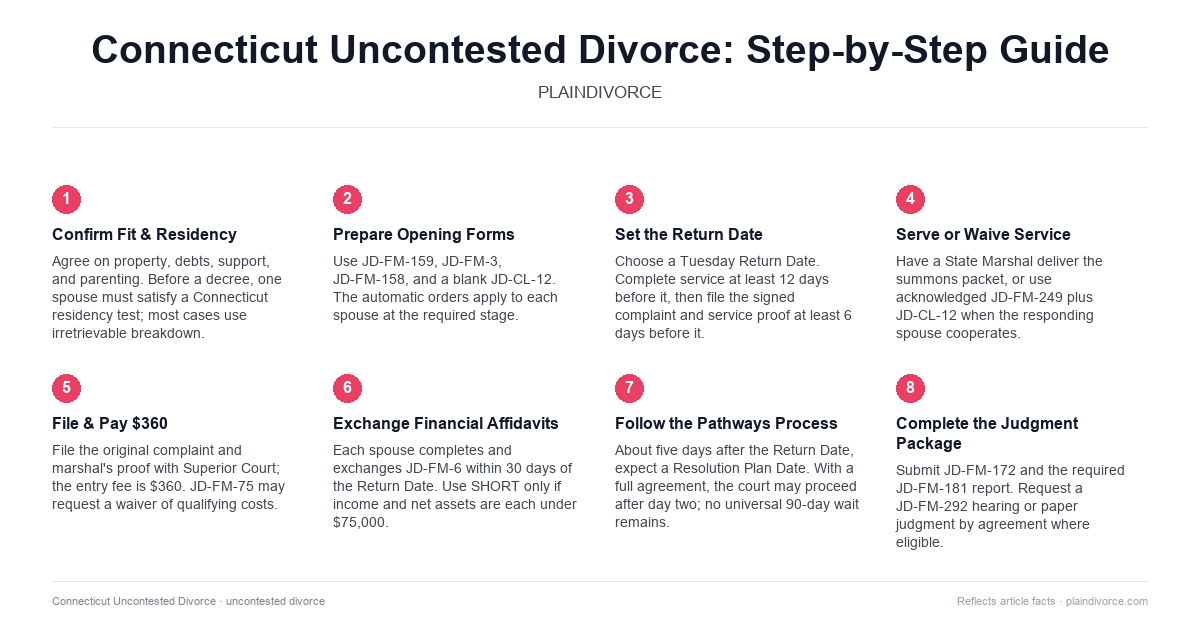
- You open the case with the Connecticut divorce forms JD-FM-159 (divorce complaint), JD-FM-3 (Summons – Family Actions), JD-FM-158 (Notice of Automatic Court Orders), and a blank Appearance (JD-CL-12)—all tied to your Return Date, a Tuesday that starts the clock, not a hearing date.
- Each spouse completes a Connecticut financial affidavit—form JD-FM-6, in a SHORT or LONG version (there is no form “JD-FM-106”).
- There is no longer a universal 90-day statutory wait. After the “Waive 90” rule was repealed in 2023, the court may proceed after the second day following the Return Date—and a couple with a complete written agreement can ask for judgment even before the Return Date.
- A separate nonadversarial divorce can finish in about 35 days or less with no court appearance, if you meet every eligibility rule.
- The court entry fee is $360. Skip to Section 8 for a self-help kit that walks through the paperwork step by step.
1. What Is an Uncontested or Simple Divorce in Connecticut?
In Connecticut, a divorce is legally called a dissolution of marriage, and it runs through the Connecticut Superior Court. People use “uncontested divorce,” “divorce with an agreement,” and “simple divorce” to describe the same basic situation: you and your spouse both want the marriage to end, you agree on every issue (children, child support, spousal support, property, and debts), and you are not asking a judge to hold a trial.
A contested divorce is the opposite—you disagree on one or more major issues and need a judge to decide after hearings or a trial. Contested cases are slower, more stressful, and more expensive. There are three routes that can end a Connecticut marriage without a fight, and it helps to know which one fits.
Divorce with an agreement (the usual uncontested track)
Most people use the regular divorce process and make it uncontested by signing a full written settlement before the case is finalized. The Judicial Branch calls this a divorce with an agreement. You still open a standard case with a complaint, a summons, and a Return Date, but instead of arguing, you file a signed agreement telling the judge exactly how you are handling children, support, property, and debts.
Default divorce (when your spouse does not respond)
If you file and serve your spouse and they never file an Appearance (JD-CL-12), the court can still finish the case as a default—you ask the court to enter judgment on the relief you requested. A default divorce is technically “uncontested” because no one is fighting, but it is not the same as a negotiated agreement. Timing is a little different, too: judgment on a default can be entered no sooner than 30 days after the Return Date if your spouse was served in person or at home, or after a hearing held at least 60 days after the Return Date if they were served another way.
Nonadversarial divorce (the streamlined joint petition)
Connecticut also offers a genuinely separate nonadversarial divorce under Connecticut General Statutes § 46b-44a. Instead of one spouse suing the other, both spouses sign a joint petition. When you meet every eligibility rule (see Section 2), you can usually obtain a divorce in about 35 days or less with no court appearance. It is only for short, low-asset marriages with no children, and the court can still schedule an appearance or move the case to the regular docket if it cannot make the required findings.
2. Who Qualifies for an Uncontested Divorce in Connecticut?
Residency requirements
Connecticut’s residency rule (C.G.S. § 46b-44) has two parts, and mixing them up is a common DIY mistake:
- To file: you can file the complaint at any time after either spouse has established residence in Connecticut.
- To finalize: before the court can enter a decree, at least one spouse must meet one of three tests—(1) has been a Connecticut resident for at least 12 months before the complaint was filed or before the decree, (2) was domiciled in Connecticut when you married, moved away, and returned intending to stay permanently before filing, or (3) the grounds for the divorce arose after either spouse moved to Connecticut.
If neither spouse clearly meets the 12-month test—or your situation involves military service, frequent moves, or spouses in different states—confirm which test applies before you file. It can affect whether the court has the power to grant the divorce at all.
Grounds for divorce
Connecticut allows both no-fault and fault-based divorces (C.G.S. § 46b-40). For an uncontested case, nearly everyone uses the no-fault ground of irretrievable breakdown—the marriage has broken down with no reasonable chance of reconciliation. Alleging fault only invites disagreement and slows things down.
When your case is a good fit for uncontested divorce
Your case is usually a good candidate for a Connecticut uncontested divorce if you both agree on:
- How to divide property and debts;
- Spousal support (alimony), if any; and
- If you have children: legal and physical custody, the parenting schedule, and child support.
DIY can be risky if there is domestic violence or coercion, hidden assets, complex finances (a business, multiple properties, significant retirement accounts), or a real disagreement about the children. In those situations, get legal advice before you sign anything—see Section 7.
Nonadversarial divorce eligibility checklist
The joint petition itself (form JD-FM-242) lists the conditions both spouses must attest are true when you file. You may use the faster nonadversarial divorce only if every item below is met:
- The marriage has broken down irretrievably;
- The marriage has lasted 9 years or less;
- Neither spouse is pregnant;
- No children were born to or adopted by the two of you before or during the marriage;
- Neither spouse has any interest or title in real property (real estate);
- The total combined fair market value of all property owned by either spouse, less any amount owed, is under $80,000;
- Neither spouse has a defined benefit pension plan;
- Neither spouse has a pending bankruptcy petition;
- There is no other pending action for dissolution, civil union dissolution, legal separation, or annulment—in Connecticut or any other jurisdiction;
- There is no restraining order (§ 46b-15) or protective order (§ 46b-38c) in effect between you; and
- At least one spouse meets the § 46b-44 residency rule described above.
Signing the joint petition also means both spouses waive a trial and any claim to alimony or an appeal. If even one box does not check—or you want to keep an alimony claim open—use the standard “divorce with an agreement” track in Section 3 instead.
3. Step by Step: Connecticut Divorce Forms, the Return Date, and Key Deadlines
This section walks through the standard uncontested divorce in Connecticut (“divorce with an agreement”). If you meet every item on the nonadversarial checklist in Section 2, you instead file a joint packet built around the Joint Petition – Nonadversarial Divorce (JD-FM-242), the Notice of Automatic Court Orders – Nonadversarial Divorce (JD-FM-260), a Financial Affidavit (JD-FM-6-SHORT or JD-FM-6-LONG) for each spouse, an Appearance (JD-CL-12) for each spouse, and, if you want your settlement built into the decree, the Agreement – Nonadversarial Divorce (JD-FM-243). Add the Certification of Notice (JD-FM-175) if either spouse ever received public assistance or HUSKY, and use the Notice of Revocation (JD-FM-245) if either spouse changes their mind before the decree.
Step 1 – Start the case (JD-FM-159 and the Return Date)
To open a standard case, you prepare four documents together:
- Divorce Complaint / Dissolution of Marriage (JD-FM-159) — the Connecticut divorce form JD-FM-159 is the complaint itself: who you are, the marriage, the children, and what you are asking the court to order.
- Summons – Family Actions (JD-FM-3) — the official notice to your spouse that a case has started.
- Notice of Automatic Court Orders (JD-FM-158) — standing orders that apply to you as soon as you sign the complaint and to your spouse once they are served (unless a prior court order says otherwise). They restrict things like moving children out of state, selling or hiding property, taking on unreasonable debt, and cancelling insurance, and they require both spouses to exchange sworn financial affidavits within 30 days of the Return Date.
- Appearance (JD-CL-12) — a blank copy goes out with the complaint and summons. The current JD-FM-159 and JD-FM-3 both require it.
The Return Date. Few things confuse self-represented filers more than the Return Date in a Connecticut divorce. It is not your hearing date—it is the date the clerk treats as “day zero” for the deadlines that follow. Two rules control it:
- The Return Date must fall on a Tuesday.
- Service on your spouse must be completed at least 12 days before the Return Date, and the signed original complaint plus the officer’s proof of service must be filed with the clerk at least 6 days before the Return Date.
Pick a Return Date that leaves enough room to complete service and filing within those windows, and check the exact dates against the summons instructions and the Practice Book. Your spouse is told to file an Appearance on or before the second day after the Return Date to stay informed of the case; the 30-day mark on the forms is only the point after which you could ask for a default judgment if they never appear.
About five days after the Return Date, the court sends notice of a Resolution Plan Date—more on that in Step 4.
Step 2 – Service, or the JD-FM-249 waiver of service
In most Connecticut divorces, the filing spouse pays a State Marshal to hand-deliver the summons, complaint, automatic orders, and blank Appearance to the other spouse. That is often the first real out-of-pocket cost.
If your case is truly cooperative, the responding spouse can instead sign a Certification of Waiver of Service of Process (JD-FM-249) and file an Appearance (JD-CL-12), which lets you skip the marshal’s fee. JD-FM-249 is a written waiver that must be signed and acknowledged before a court clerk, a Commissioner of the Superior Court, or a notary public—it is not sworn “under oath,” but do not sign it until you are in front of one of those officials, as the form directs.
Step 3 – The Connecticut financial affidavit (JD-FM-6 Short vs. Long)
Connecticut courts require financial disclosure even when you agree on everything. The automatic orders direct each spouse to complete and exchange a sworn Connecticut financial affidavit within 30 days of the Return Date; you then file it in connection with the hearing or the request for judgment.
The form is JD-FM-6, in two official versions. (If you have seen the number “JD-FM-106,” there is no such form—it is a mis-numbering of JD-FM-6.) The rule for which version to use:
- Use JD-FM-6-SHORT only if your gross annual income and your total net assets are each under $75,000.
- If either number is $75,000 or more, use JD-FM-6-LONG.
Because two spouses’ finances differ, one of you may file the short form while the other files the long form. That is normal.
Step 4 – The Resolution Plan Date and Connecticut’s waiting-period rules
Connecticut runs family cases through a case-management system called Pathways. Roughly five days after the Return Date, the court schedules a Resolution Plan Date, where you meet with Family Services to identify what is agreed, what is not, and how the case should move. Based on that meeting, the court assigns your case to a track—Track A for fully resolved cases, Track B or C for cases that still need court time. If you already agree on everything, a judge may be able to review and approve your agreement at the Resolution Plan Date itself. You can read the Judicial Branch’s overview of the Pathways process for the full picture.
The waiting period changed in 2023. For years, Connecticut imposed a flat 90-day wait after the Return Date, and couples with a full agreement filed a motion for a “waiver of the 90 day waiting period” (the “Waive 90” motion). Public Act 23-46, effective October 1, 2023, repealed that structure. Under the current C.G.S. § 46b-67:
- If you have a full agreement and ask the court to enter judgment before the Return Date, it can act on that.
- Otherwise, the court may proceed after the second day following the Return Date.
- The 90-day period now applies only to the start of a contested trial—not to an agreed divorce.
- Separate 30-day and 60-day minimums apply to default judgments, depending on how your spouse was served.
In practice, the limit on an uncontested case is now the court’s calendar and how quickly you file complete, correct paperwork—not a statutory clock. One thing that has not changed: under C.G.S. § 46b-53, either spouse (or counsel for a minor child) can ask for conciliation within 90 days of the Return Date, which pauses the case.
Step 5 – Your agreement (JD-FM-172), review, and judgment
To finish a standard uncontested case, you submit a signed written settlement—the Judicial Branch’s form is the Dissolution Agreement (JD-FM-172)—covering property, debts, and, if applicable, children and support. From there, Connecticut gives you two ways to reach judgment:
- Ask for an uncontested hearing. File a Caseflow Request (JD-FM-292) asking the court to schedule a short uncontested hearing, where a judge confirms the basics and enters your decree.
- Ask for judgment by agreement without a hearing. Where you meet the requirements, you can submit the full package and request that the court approve your agreement and enter the decree on the papers—no appearance needed.
Which option is available and fastest depends on your judicial district and whether you have children. If your case is genuinely simple and complete, the no-hearing route is often the quickest way to finalize.
Step 6 – The Dissolution of Marriage Report (JD-FM-181)
Every Connecticut divorce requires a Dissolution of Marriage Report (JD-FM-181), a statistical form the plaintiff completes for the state’s vital records office at the Department of Public Health. It has no effect on the outcome of your case, and it is a paper form even in an otherwise electronic file—but the clerk generally will not treat your file as complete without it. Put it on your checklist rather than treating it as an afterthought.
4. Special Issues When You Have Children
If you have minor children, a Connecticut uncontested divorce must include custody and child support orders the judge finds are in the best interests of the children. Even when you fully agree, the court needs extra child-related forms and, usually, parenting education. A children’s “divorce with an agreement” packet typically adds the Custody Agreement and Parenting Plan (JD-FM-284), the Affidavit Concerning Children (JD-FM-164), a Parenting Education Program Order/Certificate (JD-FM-149) for each parent, the Child Support and Arrearage Guidelines Worksheet (CCSG-1), and the Advisement of Rights Re: Income Withholding (JD-FM-71).
Parenting plan
Parents submit a written parenting plan covering the regular schedule, holidays and vacations, decision-making, communication, and how the children move between homes. In an agreed case, form JD-FM-284 gives you a standard structure to fill in.
Child support
Connecticut uses statewide child support guidelines. You complete the CCSG-1 worksheet to show the presumptive support amount, and you submit it in connection with the child-support determination at your hearing or final review. If you want to agree to a different number—including zero—the judge still needs to see the guideline figure first to decide whether the deviation is justified.
Parenting education
The automatic court orders direct both parents to enroll in a Parenting Education Program within 60 days of the Return Date in any case involving a minor child. Under C.G.S. § 46b-69b, the court must order the program whenever a minor child is involved unless (1) both parties agree to skip it and the court approves, (2) the court finds it unnecessary, or (3) you complete a comparable program instead. No one has to take it more than once. Plan for scheduling and a fee unless it is waived.
5. How Long Does an Uncontested Divorce Take in Connecticut?
There is no longer a fixed statutory wait for an agreed divorce. Three numbers frame the timing:
| Situation | Earliest the court can act |
|---|---|
| Full written agreement, submitted before the Return Date | The court can enter judgment before the Return Date |
| Uncontested case, no agreement filed early | After the second day following the Return Date |
| Default (spouse served in person / at home, never appears) | 30 days after the Return Date |
| Default (spouse served another way) | Hearing at least 60 days after the Return Date |
| Nonadversarial joint petition | About 35 days or less, no appearance |
| Contested trial | At least 90 days after the Return Date |
In real life, the time to finish an uncontested divorce depends on your court’s calendar, how fast you complete service, and whether your paperwork is right the first time. Delays usually come from Return Date math errors, missing proof of service, using the wrong financial affidavit, or an incomplete children’s packet—not from a waiting period.
6. What Does an Uncontested Divorce in Connecticut Cost?
Costs fall into three buckets: the court entry fee, service costs, and optional support such as mediation, document help, or a limited-scope legal review.
Court entry fee
Under C.G.S. § 52-259, the entry fee to open a civil case—including a dissolution of marriage—in Connecticut Superior Court is $360. That covers opening the case only. Certified copies of your judgment cost extra, and fees can change by legislative action, so confirm the current amount on the Judicial Branch fee schedule before you file.
Service and paperwork costs
State Marshal service is usually the next cost, and the fee varies by marshal and by how many attempts it takes. A signed JD-FM-249 waiver of service eliminates that cost when your spouse cooperates. Other possible costs:
- Notary fees for documents that must be acknowledged, such as JD-FM-249;
- Copies, mailing, and certified copies after judgment;
- Parenting education program fees, if you have minor children and do not qualify for a waiver.
Fee waivers
If you cannot afford the filing and service costs, you can ask the court to waive them using the Application for Waiver of Fees / Payment of Costs / Appointment of Counsel – Family (JD-FM-75). The form lets you request a waiver of the entry fee, other filing fees, the cost of service of process, and parenting-education costs. Filing it is a request—a judge or family support magistrate must review your finances and enter an order granting it. The Clerk’s Office and Court Service Centers can explain the procedure, though they cannot give legal advice.
7. When a DIY Divorce Might Not Be Right for You
A DIY divorce works well when both spouses are safe, informed, and cooperative. It is usually not a good fit if there is domestic violence or coercion, hidden assets, a family business, significant pensions or retirement accounts, major disputes about the children, or high-stakes immigration, tax, or bankruptcy questions. In any of those situations, get advice from a Connecticut family lawyer or a legal clinic before you file or sign an agreement. Even a single limited-scope consultation can catch a problem that is expensive to fix after judgment.
8. Where a Self-Help Divorce Kit Fits Into the Process
If your case is genuinely uncontested, the hard part is rarely “the law”—it is the workflow: counting the Return Date windows correctly, picking the right service and financial affidavit forms, assembling a complete children’s packet, and choosing between an uncontested hearing and judgment on the papers. A Connecticut uncontested divorce kit helps you stay organized and avoid the mistakes that send paperwork back.
Download Our Connecticut Uncontested Divorce Self-Help Kit
9. Frequently Asked Questions
Do I have to hire a lawyer for an uncontested divorce in Connecticut?
No. Connecticut allows self-represented (“pro se”) filers, and many uncontested cases finish without an attorney for either spouse. A lawyer’s review is still worth considering if you have children, real estate, retirement accounts, or any issue you have not fully resolved. Even a one-time limited-scope consultation can flag a problem before it is locked into your judgment.
What’s the difference between an uncontested and a nonadversarial divorce?
An uncontested divorce just means nobody is fighting—you still file a standard case with a complaint, a Return Date, service, and usually a short hearing or a request for judgment on the papers. A nonadversarial divorce is a separate, stricter process under C.G.S. § 46b-44a: both spouses sign one joint petition, the marriage must be 9 years or less with no children and limited assets, and it can finish in about 35 days with no appearance. Signing the joint petition also waives any alimony claim and the right to appeal.
Is there still a 90-day waiting period for divorce in Connecticut?
Not for an agreed divorce. Public Act 23-46, effective October 1, 2023, repealed the universal 90-day wait and the old “Waive 90” motion. Under the current C.G.S. § 46b-67, the court may proceed after the second day following the Return Date, and a couple with a complete written agreement can ask for judgment even before the Return Date. The 90-day period now applies only to the start of a contested trial. Separate 30-day and 60-day minimums still apply to default judgments.
What is the Return Date in a Connecticut divorce?
The Return Date is the date the clerk uses as “day zero” for your case—not a day you appear in court. It must fall on a Tuesday. Service on your spouse must be finished at least 12 days before it, and the signed complaint plus the officer’s return must be filed with the court at least 6 days before it. Your spouse is asked to file an Appearance by the second day after the Return Date, and the court sends notice of a Resolution Plan Date about five days after it.
Do we have to go to court if we agree on everything?
Often not. For a standard uncontested divorce you can either file a Caseflow Request (JD-FM-292) for a brief uncontested hearing, or ask the court to enter judgment by agreement without a hearing where you meet the requirements. Whether the no-hearing route is available depends on your judicial district and whether you have children. In a nonadversarial divorce, no appearance is required at all—though the court can still set one if it cannot make the findings it needs.
How much does an uncontested divorce in Connecticut cost?
The Superior Court entry fee to start a dissolution of marriage is $360 under C.G.S. § 52-259. On top of that, expect possible costs for State Marshal service (avoidable with a JD-FM-249 waiver), notary fees, certified copies of the decree, and parenting education if you have minor children. These are government-set fees and do not include any lawyer or mediation costs. If you cannot afford them, form JD-FM-75 lets you ask the court to waive them.
Where do I get the Connecticut divorce forms?
All current versions—JD-FM-159, JD-FM-3, JD-FM-158, JD-CL-12, JD-FM-6, JD-FM-249, JD-FM-172, and the nonadversarial forms—are published on the Connecticut Judicial Branch’s official forms library, and paper copies are available at any Clerk’s Office or Court Service Center. Always use the current version rather than one saved from an older article, since form numbers and instructions do get revised.
10. Final Thoughts and Next Steps
Connecticut’s uncontested divorce process is manageable for self-represented filers, but it is deadline-sensitive. To keep your case moving:
- Count the Return Date windows correctly: service at least 12 days before, filing at least 6 days before, and the Return Date itself on a Tuesday.
- Send a blank Appearance (JD-CL-12) with the complaint, summons, and automatic orders—the current forms require it.
- If your spouse cooperates, use the JD-FM-249 waiver of service to skip the marshal fee.
- Use the correct Connecticut financial affidavit: JD-FM-6-SHORT only if both income and net assets are each under $75,000, otherwise JD-FM-6-LONG.
- Don’t plan around a 90-day wait—it no longer applies to an agreed divorce. A complete agreement can be submitted for judgment at or even before the Return Date.
- Include the Dissolution of Marriage Report (JD-FM-181)—it is required in every case.
When you are ready to assemble the paperwork, a Connecticut uncontested divorce self-help kit gives you the checklist, the current forms, and step-by-step instructions so nothing gets missed.
Get the Connecticut Uncontested Divorce Kit
Disclaimer: PlainDivorce is not a law firm, and this guide is not legal advice. It is general information about Connecticut divorce procedure as of September 2026. Statutes, court rules, fees, and form numbers change, and how they apply depends on your specific facts. For advice about your situation, consult a licensed Connecticut family-law attorney, and verify every form and deadline with the Connecticut Judicial Branch or your local Clerk’s Office before filing.
Sources and local rules can change. Use this guide as a plain-English organizer, then verify the current filing requirements with the official court or government source for your jurisdiction.

About Harry D
Expert contributor at PlainDivorce, helping Canadians and American navigate simple uncontested divorces with clarity and confidence.