Uncontested Divorce in DC: The 2026 Step-by-Step Guide
An uncontested divorce in DC is a divorce where you and your spouse agree the marriage is over and agree on property, debt, support, and any parenting issues, so the judge only reviews and approves your paperwork instead of deciding a fight. Since a 2024 change in the law, the District no longer makes you live apart for six months or a year first: a divorce can be granted simply because one or both spouses say they no longer wish to be married.
This guide walks through how an uncontested case works in the D.C. Superior Court, Family Court (Domestic Relations Branch) for people filing without a lawyer: who can file, the three core forms (the Complaint for Absolute Divorce, the Consent Answer, and the Joint Request for Uncontested Divorce Hearing that people search for as the “uncontested praecipe form” in DC), how the hearing gets scheduled, what it costs, how long it takes, and when the “DC divorce separation under the same roof” idea still matters (short answer: it doesn’t anymore).
TL;DR
An uncontested divorce in DC is an Absolute Divorce handled cooperatively — you agree on everything and the judge reviews and approves it at a short hearing. The headline: since 2024, DC no longer requires any separation period at all. If you read a guide describing a six-month “separation under the same roof,” it’s out of date.
- No separation, no waiting period, no witness. A 2024 amendment to D.C. Code § 16-904 repealed the six-month and one-year requirements. A divorce is granted simply because one or both spouses assert they no longer wish to be married.
- Residency: one spouse must have lived in the District for six months before filing (§ 16-902). Narrow exception for same-gender couples married in DC whose home states won’t handle the divorce.
- Three forms run the case: the Complaint for Absolute Divorce (plaintiff), the Consent Answer (defendant), and the Joint Request for Uncontested Divorce Hearing — what people search for as the “uncontested praecipe form.”
- File the Complaint and Consent Answer together and you skip service entirely. That’s the biggest time-saver available to cooperative couples. Filed separately, you must serve, and the defendant gets 21 days to answer.
- Nothing gets scheduled until you file the Joint Request. This is the step self-represented couples most often forget — a case can sit on the docket indefinitely without it.
- Bring your marriage certificate — an original or certified copy, not a photocopy. The plaintiff needs it at the hearing.
- Usually only the plaintiff appears, and you can request to attend remotely. No notary needed on the three core forms — they’re signed under penalty of perjury.
- The order isn’t final when signed. It becomes final 30 days after entry — unless you both file a Joint Waiver of Appeal, which makes it immediate.
- With kids: the judge must ask about child support in every divorce, even if neither parent requested an order. Property division is equitable, not automatically 50/50 (§ 16-910).
- Cost: just $80 to file, plus a few dollars per certified copy. $0 for service if you file simultaneously. Fee waivers available.
1. What an Uncontested Divorce in DC Actually Means
In the District of Columbia, the court case that ends a marriage is an Absolute Divorce. That is why the first document is the Complaint for Absolute Divorce, not a “petition.” An uncontested divorce in DC is not a separate type of case; it is the same case handled cooperatively, so the judge confirms the legal requirements are met and signs off on the terms you have already worked out.
People usually mean a “simple” or uncontested divorce when all of the following are true:
- Both spouses want the divorce.
- You agree on how to divide property and debt, and on spousal support (or that there will be none).
- If you have children together, you agree on custody, parenting time, and child support.
- The other spouse cooperates by filing a Consent Answer instead of contesting the case.
1.1 The old “separation under the same roof” rule is gone
For years, D.C. required spouses to live “separate and apart” for six months (with mutual consent) or one year (without it) before a divorce could be granted, and many couples did that while still sharing a home, keeping separate bedrooms, meals, and finances. That was the “DC divorce separation under the same roof” workaround. A 2024 amendment to D.C. Code § 16-904 (D.C. Law 25-115) repealed those separation periods entirely. Today a divorce “may be granted upon the assertion by one or both parties that they no longer wish to remain married.” There is no required separation period and no corroborating witness. If you find an old packet or website describing a six-month same-roof test, it is out of date.
The same statute also allows a legal separation (based on one spouse’s assertion that they intend to live a separate life without divorcing). That is a different order from an absolute divorce, and it does not end the marriage. This guide covers the divorce.
2. Who Qualifies: Residency and the Current Grounds
Two questions decide whether an uncontested path is realistic: can you file in D.C., and is your case genuinely uncontested.
2.1 Residency (jurisdiction)
Under D.C. Code § 16-902, at least one spouse must have been a bona fide resident of the District for at least six months immediately before the case is filed. The current forms have you confirm this directly.
There is one narrow exception: a same-gender couple married in D.C. can file here even if neither spouse currently lives in the District, as long as neither one lives in a state or country whose courts will handle their divorce.
2.2 The legal grounds
As of 2024, the only thing you need to establish is that one or both of you no longer wish to remain married. You will still say this on the Complaint and confirm it briefly at the hearing, but you do not have to prove fault, a separation, or a date you stopped living as a couple.
2.3 When a case is a good fit for the uncontested path
- You both agree the marriage should end.
- You can exchange financial information honestly.
- You have a clear deal on property, debt, and (if relevant) support.
- The other spouse will sign a Consent Answer and the joint hearing request.
A DIY approach is a poor fit if there is domestic violence, coercive control, hidden assets, a large power imbalance, a serious dispute about the children, or complex finances (a business, several properties, or complicated retirement accounts). In those situations, even a couple that wants to settle usually benefits from at least a limited-scope consultation.
3. The Three Core DC Forms
Most uncontested cases run on three documents from the D.C. Courts, plus a short list of intake and records paperwork. Always download the current version from the court’s official forms library right before you file, because revision dates change.
| Form | Who signs it | What it does |
|---|---|---|
| Complaint for Absolute Divorce | Plaintiff (the spouse who files) | Starts the case; states residency, the grounds, and what you are asking the court to do. Attachments A (marital property/debt), B (custody), and C (child support) are added only if you are asking the court to decide that specific issue. |
| Consent Answer (Divorce) | Defendant (the other spouse) | Tells the court the defendant agrees to the divorce and wants an uncontested hearing. It also serves as the defendant’s response, so there is nothing left to “contest.” |
| Joint Request for Uncontested Divorce Hearing | Both spouses | The form both parties sign and date to ask the court to schedule the uncontested hearing. This is what people mean by the “uncontested praecipe form” in DC. |
You may also encounter a Cross Reference Intake Form (used to flag related court cases) and a Vital Records Form that the court routes to vital records after the divorce is granted so the District can record it. Requirements vary by situation, so follow the clerk’s current instructions and the checklist on the Family Court Self-Help Center page.
Note on signatures: the current Complaint, Consent Answer, and Joint Request are signed under penalty of perjury or by unsworn declaration. None of the three requires a notary, so budget for notary fees only if a specific form you are using actually calls for one.
4. Step-by-Step: The Uncontested Divorce Process
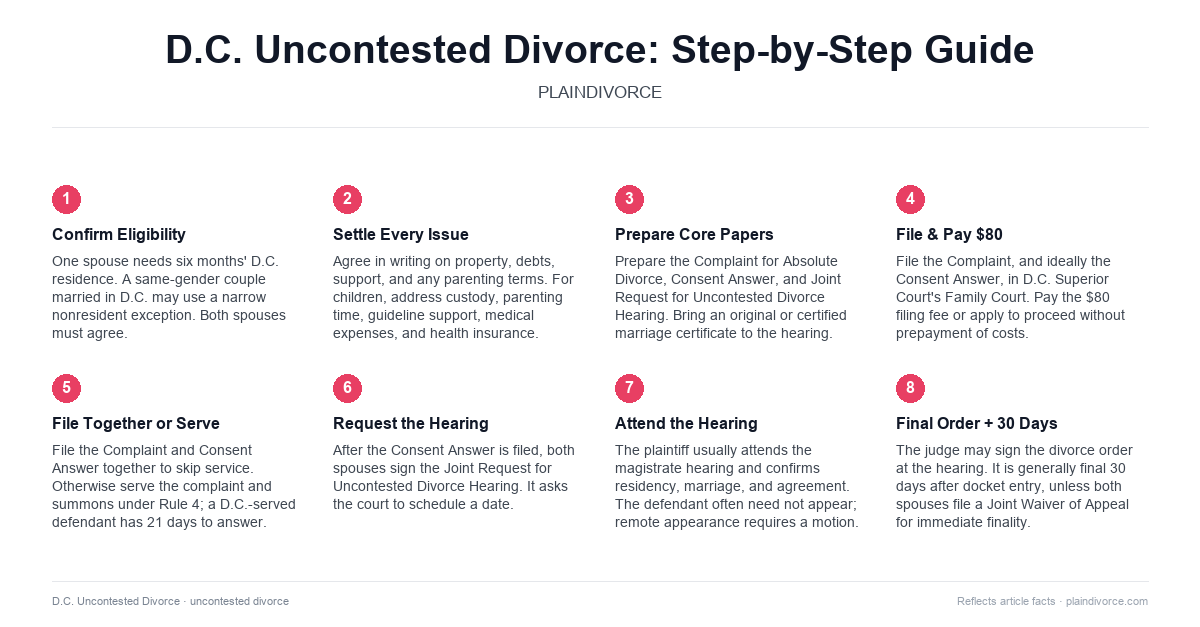
An uncontested case in the Domestic Relations Branch moves through a predictable sequence: agree → prepare forms → file → handle service (or skip it) → request the hearing → attend the hearing → final order.
Step 1 – Confirm you qualify
- Residency: at least one spouse has lived in D.C. for six months (or the same-gender-marriage exception applies).
- Cooperation: you expect a signed Consent Answer and a signed Joint Request.
- Paperwork: you can complete the forms consistently and truthfully.
Step 2 – Settle property, debt, support, and children in writing
Put the full deal on paper before you file:
- Property and debt: bank accounts, vehicles, retirement accounts, credit cards, loans, and household items. If the court is asked to divide marital property, it must do so in a way that is “equitable, just, and reasonable” under D.C. Code § 16-910 — equitable, not automatically 50/50. Separate property (owned before the marriage, or received by gift or inheritance) stays with its owner.
- Spousal support: whether it will be paid, how much, and for how long.
- Children: decision-making, the parenting schedule, and child support.
Many couples write a settlement agreement and ask the court to incorporate it into the final order.
Step 3 – Prepare the forms and gather your marriage certificate
The plaintiff completes the Complaint for Absolute Divorce, adding Attachment A, B, or C only for issues the court is being asked to decide. The defendant completes the Consent Answer. Fill in matching names, dates, and facts across every form.
Get your marriage certificate now: the plaintiff must bring an official original or certified copy (not a photocopy) to the hearing, or be ready to prove a common-law marriage through testimony and records.
Step 4 – File with the D.C. Superior Court (Family Court)
File the Complaint (and, ideally, the Consent Answer at the same time) with the Family Court. Pay the $80 filing fee or file a fee-waiver application. The clerk opens the case and, if needed, issues a summons.
Step 5 – Handle service (or skip it)
Here is the real cooperative shortcut: if you file the Complaint for Absolute Divorce and the Consent Answer together, the plaintiff does not have to serve the defendant at all. If the filings are not simultaneous, the plaintiff must serve the complaint and summons under Domestic Relations Rule 4 and file proof of service; the defendant then has 21 days to answer (when served in D.C.). Service problems are the single biggest source of delay, so simultaneous filing is usually the smoother route for cooperative couples.
Step 6 – Ask for the hearing with the Joint Request
Once the Consent Answer is on file and any settlement agreement is submitted, both spouses sign and date the Joint Request for Uncontested Divorce Hearing to ask the court to schedule the hearing. Both the Consent Answer and the Joint Request signal that the case is uncontested; the Joint Request is the one that formally asks for a date. Filing it promptly is the step self-represented couples most often forget, and a case can drift on the docket without it.
Step 7 – Attend the hearing and get the final order
The plaintiff attends a short hearing before a judicial officer (usually a magistrate judge) and testifies to the basics: identity, D.C. residency, the marriage (this is where the certificate comes in), that they no longer wish to be married, and that the terms are agreed. You can ask to appear remotely by filing a Motion to Appear Remotely; the defendant often does not have to appear. If everything is in order, the court signs the divorce order.
The order is not final the moment it is signed. It generally becomes final 30 days after it is entered on the docket, which is the appeal window. If you both agree not to appeal, you can file a Joint Waiver of Appeal and the divorce is final immediately. After it is final, request certified copies for a name change, benefits, or remarriage.
Download Our District of Columbia Uncontested Divorce Self-Help Kit
5. Children: Custody and Child Support
When minor children are involved, the judge has to be satisfied that the parenting and support terms work for the children, even when both parents agree.
5.1 Custody and parenting time
Under D.C. Code § 16-914, the child’s best interest is the primary consideration, and there is a rebuttable presumption that joint custody is in the child’s best interest (rebutted by evidence of an intrafamily offense, child abuse, neglect, or parental kidnapping). A custody arrangement the parents agree on must be entered unless clear and convincing evidence shows it is not in the child’s best interest. Your parenting plan should cover:
- Who makes major decisions (education, medical care, religion).
- The regular schedule plus holidays, school breaks, and summers.
- How exchanges and parent-to-parent communication will work.
Custody also needs its own jurisdictional basis (the court asks where the child has lived, under the UCCJEA, on Attachment B). A D.C. divorce residency statement alone does not settle custody jurisdiction.
5.2 Child support
In every divorce, the judicial officer must ask about child support — even if neither parent requested an order. D.C.’s child support guideline (D.C. Code § 16-916.01) is presumptive. If your agreed number differs from the guideline amount, the court needs a finding that the guideline result would be unjust or inappropriate, with written reasons. Every support order must also include terms for the child’s medical expenses and health insurance. Be ready to show the guideline calculation and how your agreement fits it.
If your situation involves special medical needs, safety concerns, or a possible move out of the area, a consultation before filing can prevent avoidable delays and re-filings.
6. How Long It Takes and the 30-Day Finality Rule
There is no guaranteed timeline. Because D.C. no longer requires a separation period, a clean uncontested case can move faster than people expect, but the pace still depends on service, paperwork, and the court’s calendar. The usual sticking points are:
- Service: avoided entirely if you file the Complaint and Consent Answer together; otherwise it can add weeks, more if the defendant is hard to locate.
- The Joint Request: the case is not scheduled until it is filed.
- The hearing date: set by the court’s calendar.
- Finality: 30 days after the order is entered, unless you file a Joint Waiver of Appeal for immediate finality.
Complete, consistent paperwork is the biggest thing within your control.
7. What an Uncontested Divorce Costs in DC
An uncontested divorce in DC costs far less than a contested case with two attorneys. Typical categories:
- Court filing fee: $80 to file the Complaint for Absolute Divorce. See the D.C. Courts family filing fees page for the current schedule.
- Certified copies of the final order: a small per-copy fee (commonly cited around $5; confirm the current amount when you order).
- Service of process: $0 if you file simultaneously with a Consent Answer; otherwise a process-server fee.
- Optional help: mediation, a limited-scope attorney review, or a self-help kit.
If the fee is a hardship, D.C. Courts has a fee-waiver process (an application to proceed without prepayment of costs).
8. When a DIY Divorce Is Not the Right Call
- Domestic violence, threats, stalking, or coercive control.
- Hidden assets or a spouse who will not share financial information.
- Complex assets: a business, several properties, or complicated retirement or stock compensation.
- A real dispute about the children or their safety.
- Significant immigration, tax, or public-benefits consequences.
In any of these situations, a consultation helps you understand the risks before you file, even if the goal is still to settle. Many people also find a DIY divorce harder than expected simply because of the paperwork and sequence — that is a general observation, not a legal rule, but it is worth planning for.
9. Where a Self-Help Divorce Kit Fits In
For most people the hard part of an uncontested divorce in DC is not the decision — it is the paperwork and the order of operations. A self-help kit keeps you organized so you do not miss steps like filing the Consent Answer with the Complaint or signing the Joint Request for Uncontested Divorce Hearing.
- Clarity: plain-English explanations of what each document is and when it is filed.
- Checklists: so signatures, attachments, and the filing sequence are all accounted for.
- Consistency: keeps names, dates, and statements matching across every form.
- Hearing prep: what the judge asks and how to avoid common rejections and delays.
Download Our District of Columbia Uncontested Divorce Self-Help Kit
10. FAQ: Fast Answers to Common DC Questions
What is an uncontested divorce in DC?
It is an Absolute Divorce where both spouses agree the marriage should end and agree on property, debt, support, and any parenting issues, so there is nothing for the judge to decide. The court reviews the paperwork, holds a brief hearing, confirms the legal requirements, and signs the divorce order. It is the same case as a contested divorce, just handled cooperatively.
Is there a separation period or waiting period for divorce in DC?
No. A 2024 amendment to D.C. Code § 16-904 repealed the six-month and one-year separation requirements. A divorce can now be granted because one or both spouses assert they no longer wish to be married. The main built-in wait is that the order becomes final 30 days after it is entered, unless both spouses file a Joint Waiver of Appeal.
Can I still get a divorce in DC if we lived together the whole time?
Yes. The old “DC divorce separation under the same roof” rule — separate bedrooms, meals, and finances for six months — no longer exists. You do not have to have lived apart, and you do not need a witness to confirm any separation. You only need to state that you no longer wish to remain married.
What is the Consent Answer in a DC divorce?
The Consent Answer (Divorce) is the form the defendant signs to tell the court they agree to the divorce and want an uncontested hearing. It counts as the defendant’s response to the Complaint. If you file it at the same time as the Complaint for Absolute Divorce, the plaintiff does not have to formally serve the defendant.
What is the “uncontested praecipe form” in DC?
“Uncontested praecipe” is an informal search term for the Joint Request for Uncontested Divorce Hearing. It is the form both spouses sign and date to ask the court to schedule the uncontested hearing once the Consent Answer and any settlement agreement are on file. Filing it is the step self-represented couples most often overlook.
Do we both have to go to court?
Usually only the plaintiff attends and testifies at a short hearing before a magistrate judge; the defendant often does not have to appear. You can ask to attend remotely by filing a Motion to Appear Remotely. Bring an original or certified copy of your marriage certificate.
What is the filing fee for a divorce in DC?
The initial fee to file the Complaint for Absolute Divorce is $80. Certified copies of the final order cost a small per-copy fee. If you cannot afford the fee, you can apply for a waiver (an application to proceed without prepayment of costs). Confirm current amounts on the D.C. Courts family filing fees page before you file.
How is child support handled in an uncontested DC divorce?
The judge must ask about child support in every divorce, even if neither parent requested an order. D.C.’s guideline is presumptive, so if your agreed amount differs the court needs written reasons that the guideline result would be unjust or inappropriate. Every support order must also address the child’s medical expenses and health insurance.
11. Final Thoughts and Next Steps
If you and your spouse are genuinely on the same page, an uncontested divorce in DC is very manageable. The law no longer forces you to separate first, the fee is modest, and cooperative couples can skip service entirely. The two things to get right are the paperwork (consistent facts, the correct attachments, your marriage certificate) and the sequence — especially filing the Joint Request for Uncontested Divorce Hearing so the court actually schedules you.
Your next steps:
- Confirm the six-month residency fact for at least one spouse.
- Reach a written agreement on property, debt, and (if relevant) children and support.
- Download the current Complaint for Absolute Divorce, Consent Answer, and Joint Request for Uncontested Divorce Hearing from the D.C. Courts.
- Locate your original or certified marriage certificate.
- Decide whether a self-help kit would help you stay organized, and get legal advice if anything feels unsafe, unfair, or complex.
This guide is information, not legal advice. For an authoritative overview, see the D.C. Bar Pro Bono Center’s Uncontested Divorce in D.C. fact sheet. With careful preparation and the right sequence, many D.C. couples finish an uncontested divorce without turning it into a court battle.
Sources and local rules can change. Use this guide as a plain-English organizer, then verify the current filing requirements with the official court or government source for your jurisdiction.

About Harry D
Expert contributor at PlainDivorce, helping Canadians and American navigate simple uncontested divorces with clarity and confidence.