Uncontested Divorce in Delaware: Forms, the 6-Month Rule, and the No-Hearing Path
An uncontested divorce in Delaware is available when one spouse has lived in Delaware for at least six months, the marriage is irretrievably broken, and neither spouse is asking a judge to decide a dispute. You start the case with the Petition for Divorce/Annulment (Form 442) and, in most cases, wait out a six-month separation before Family Court can grant the decree. Many couples finish on paperwork alone, without a court appearance.
TL;DR
- An uncontested divorce in Delaware needs one spouse with 6+ months of Delaware residence (or military stationing) and a marriage that is “irretrievably broken” with reconciliation improbable.
- The core paperwork is built around the Delaware divorce forms — Form 442 (Petition for Divorce/Annulment), plus Form 240, Form 441 or 441SS, an original or certified marriage certificate, and Form 400 (Request for Notice).
- Delaware has one basis for divorce — irretrievable breakdown — with four “characterizations.” Only the respondent’s misconduct characterization removes the six-month separation wait, and it must be proven with evidence.
- The Delaware divorce 6 month separation same house question: yes, separation can run while you share a home if you keep separate bedrooms and have no sexual relations — and a brief reconciliation attempt does not reset the clock as long as nothing happened in the 30 days before the hearing.
- People search for a “Motion to Proceed Without a Hearing” in Delaware, but the court’s form is the Request to Proceed without a Hearing (Form 446), filed with Form 447 within 20 days of the date on your Notice of Trial-Readiness.
- Have a written agreement? A Stipulation to Incorporate (Delaware divorce Form 443) is filed with the agreement so the court can enforce it — the court does not review it for fairness.
- The filing cost is $165 plus a $10 court security fee (about $175). Property division, alimony, and separation-agreement enforcement are “ancillary matters” at $90 each; custody and child support are separate cases.
1. What Is an Uncontested or Simple Divorce in Delaware?
An uncontested divorce in Delaware — often called a “simple divorce” — is one where the responding spouse does not fight the case. Delaware Family Court grants a divorce when it finds the marriage is “irretrievably broken” and reconciliation is improbable. In an uncontested case, that finding is largely a matter of filing complete, consistent paperwork and meeting the deadlines.
- Contested: the responding spouse files an Answer challenging something material — jurisdiction, the separation date, or the grounds. The case is then automatically scheduled for a hearing.
- Uncontested: the responding spouse either files no Answer within 20 days of receiving the petition, or files an Answer agreeing with the request for divorce. The petitioner can then ask the court to decide the case on the papers, with no court appearance, or ask for a hearing anyway.
Most Delaware cases open with the Petition for Divorce/Annulment (Form 442) plus required cover paperwork: the Information Sheet (Form 240), the Vital Statistics Sheet (Form 441, or 441SS for a same-sex marriage), an original or certified copy of the marriage or civil-union certificate, and the Request for Notice (Form 400), which tells the court how your spouse will be served.
If you and your spouse have a written agreement and want the judge to make it enforceable, Delaware Family Court uses the Stipulation to Incorporate Separation Agreement (Form 443), filed together with the agreement itself. And in an uncontested case, the court offers a paperwork-only route — the Request to Proceed without a Hearing (Form 446) — that lets a commissioner decide the divorce without either spouse coming to court.
One thing an uncontested divorce is not: automatic. Under Delaware law, the allegations in an uncontested petition are presumed true, but if your testimony or affidavit does not support an essential requirement, the commissioner can deny the petition or require more evidence.
2. Who Qualifies for an Uncontested Divorce in Delaware?
Before planning a DIY divorce in Delaware, confirm two things: (1) Delaware has authority over your case, and (2) your case genuinely fits an uncontested path — no dispute the court has to resolve.
2.1 Residency: The 6-Month Rule
Under Delaware’s divorce statute (13 Del. C. ch. 15), Family Court has jurisdiction when either spouse actually resided in Delaware — or was stationed in Delaware as a member of the U.S. armed forces — continuously for six or more months immediately before the case is filed.
There is a narrow exception for civil unions and marriages solemnized in Delaware: if neither spouse lives in Delaware and their home state will not dissolve the union, they may file in any Delaware county (or, if they once lived here, the county where they last resided). Form 442 includes a civil-union option.
2.2 The 6-Month Separation Requirement
Delaware’s “6-month rule” is not a post-filing waiting period. It is a separation requirement: the parties must have lived separate and apart for six or more months before the court rules on granting the divorce. You can file the petition as soon as the residency rule is met — the separation clock and the case can run at the same time — but a commissioner generally will not decide the case until six months of separation have passed. The one exception is a petition characterized by the respondent’s misconduct (see below).
The separation date you list on Form 442 drives the whole timeline, so pick it carefully and keep it consistent across every form and affidavit.
2.3 Grounds: One Basis, Four Characterizations
Delaware is a true no-fault state. There is one basis for divorce — the marriage is irretrievably broken and reconciliation is improbable. On the petition, you then pick one of four characterizations of that breakdown:
- Voluntary separation
- Separation caused by the respondent’s misconduct
- Separation caused by the respondent’s mental illness
- Separation caused by incompatibility
Almost every uncontested case uses voluntary separation or incompatibility, and both require the full six-month separation. Only a misconduct characterization (for example, abuse, adultery, or desertion) removes the separation period — and it comes with a real cost: you must prove the misconduct with evidence, older defenses like condonation and recrimination still apply, and the case usually stops being uncontested in practice. If safety is a concern, talk to an attorney or a domestic-violence advocate before filing.
2.4 “Separated Under One Roof” and the 30-Day Rule
One of the most common questions — often searched as “Delaware divorce 6 month separation same house” — is whether the separation clock can run while you still live together. It can. Delaware law allows separation to begin or continue under the same roof if, during that time, the spouses:
- occupy separate bedrooms, and
- do not have sexual relations with each other.
There is a second, less-known rule that helps couples who tried to work things out. A bona fide attempt at reconciliation — even one that briefly involved sharing a bedroom or resuming sexual relations — does not interrupt the separation period, as long as none of that happened in the 30 days immediately before the court hears the petition. The affidavit that supports a no-hearing request (Form 447) asks you to swear that you and your spouse have lived separate and apart for at least the 30 days before the court rules and will keep doing so until the decree. Because separation is proven through sworn statements, keep your dates and facts consistent everywhere.
2.5 Is an Uncontested Divorce a Good Fit for Your Case?
| An uncontested divorce usually works when… | Get legal advice first when… |
|---|---|
| Both spouses agree the marriage is over | There is domestic violence, intimidation, or a safety risk |
| Both can cooperate on forms and deadlines | One spouse hides finances or won’t share basic information |
| Any written agreement can be signed and notarized by both spouses | There is a real dispute about children, support, or property |
| Children-related forms and parent education can be completed | Assets are complex (a business, several properties, pensions) |
| Neither spouse needs the court to decide a contested issue | Immigration, bankruptcy, or major tax questions are in play |
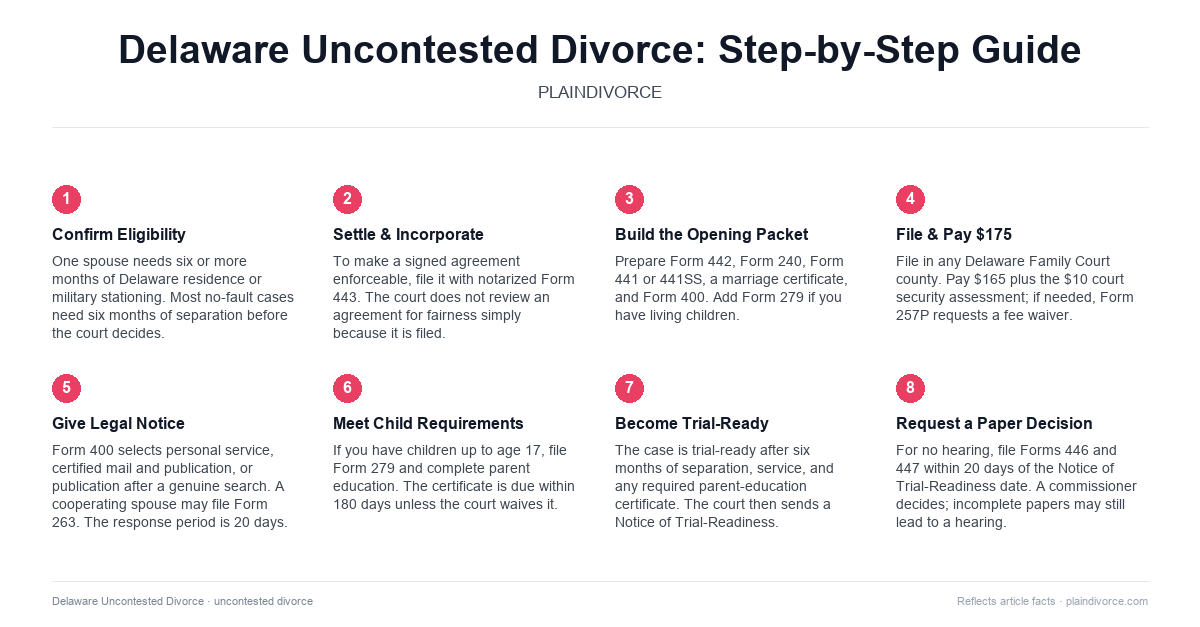
3. Step-by-Step: The Delaware Uncontested Divorce Process
Most uncontested divorce in Delaware cases follow the same flow: qualify → prepare forms → file → serve notice → complete parent education (if children) → wait out the separation → file the final paperwork → receive the decree.
Step 1 – Confirm Residency and Your Separation Date
- Residency: one spouse needs 6+ continuous months of Delaware residence (or military stationing) before filing.
- Separation: pin down the month, day, and year you separated. Count six months forward — that is roughly the earliest the court can decide the case unless you file on misconduct.
- Same roof: if you separated while living together, confirm you have met the separate-bedrooms / no-relations rule and the 30-day rule.
Step 2 – Handle Your Separation Agreement (Form 443)
A separation agreement is a written contract between spouses covering property, debts, and any other terms — it is not a court form. If you want the court to be able to enforce it, you file the agreement together with the Stipulation to Incorporate Separation Agreement (Form 443) — often searched as “Stipulation to Incorporate Delaware divorce.” Both spouses must sign the agreement and the stipulation in front of a notary. Two things to know: filing Form 443 by itself does nothing without the agreement attached, and the court will not review your agreement for fairness just because you submitted it. If a term is unclear to you, get advice before you sign.
Step 3 – Prepare the Core Delaware Divorce Forms
When people look up Delaware divorce forms — Form 442, they mean the Petition for Divorce/Annulment, the document that starts the case. Family Court will reject a filing that is missing any required form. File the original and one copy of each:
- Petition for Divorce/Annulment (Form 442) — a verified petition. Do not sign it until you are in front of a notary or authorized court staff. You must check that the marriage is irretrievably broken and that reconciliation is not probable, and pick at least one characterization.
- Information Sheet (Form 240)
- Vital Statistics Sheet (Form 441) — or Form 441SS for a same-sex marriage. Choose one.
- Original or certified copy of your marriage or civil-union certificate (a photocopy is not accepted without a court order).
- Request for Notice (Form 400) — how you want your spouse notified.
- Affidavit of Children’s Rights (Form 279) — required if you have living children of the marriage (see Section 4).
Want your former name back? Under Delaware law, the court may, on request by pleading or motion, order that you resume a maiden or former name as part of the divorce. Ask for it in Form 442 if you are the petitioner, or in your Answer if you are responding. You can only change your name, and only to a maiden or prior name. There is no separate name-change case and no extra filing fee for the request.
Step 4 – File in Delaware Family Court
You may file with Family Court in any Delaware county; the clerk transfers the paperwork to the county with jurisdiction. Filing is accepted in person or by mail, and most civil filings can also be emailed to the court. Fax filings are not accepted. Every filing needs the fee plus an original and one copy of each document. In person you can pay by cash, card, check, or money order; by mail, check or money order only; by email, credit card only. If the filing fee is a hardship, you can ask the court to waive it by filing an in forma pauperis affidavit (Form 257P) with proof of your finances — that is a request, not an automatic waiver.
Step 5 – Give Your Spouse Legal Notice (Form 400)
After filing, your spouse must get proper legal notice. The Request for Notice (Form 400) tells the court which method fits your situation:
- Spouse in Delaware, address known: ask for personal service — someone delivers the petition to your spouse.
- Spouse outside Delaware: ask for notice by certified mail and newspaper publication, at your expense.
- Address unknown: ask for publication and file an Affidavit that a Party’s Address is Unknown (Form 241) after a genuine search.
- Cooperating spouse: instead of being served, your spouse can file an Affidavit of Appearance and Waiver of Rights (Form 263).
Publication can be done free through the Family Court Legal Notices website; a newspaper notice, if you choose one or the court requires it, costs $75 in New Castle County or $25 in Kent or Sussex. A few more situational forms: Form 421 if you don’t know your spouse’s Social Security number; Form 405 (Affidavit of Non-Military Service) brought to any hearing if your spouse is not in the military; and if your spouse is in the military and doesn’t appear, answer, or sign Form 420 (a rights waiver under the Servicemembers Civil Relief Act), you must file a Motion to Appoint an Attorney for the Respondent — start that early, because the court won’t finish the divorce until it’s resolved. Your spouse has 20 days from service (or publication) to respond.
Step 6 – Parent Education and Trial-Readiness
Your petition becomes trial-ready once three things are true: the six-month separation is satisfied (or you filed on misconduct), your spouse was served, and — if you have children up to age 17 — the parent education certificate is on file. When the case is trial-ready, the court mails you a notice telling you how to finish.
Step 7 – The No-Hearing Request (Form 446) and the 20-Day Window
People search for a “Motion to Proceed Without a Hearing” in Delaware, but the court’s form is a Request, not a Motion: the Request to Proceed without a Hearing (Form 446), filed with the Affidavit in Support (Form 447). Use the exact title when you look it up.
- If you asked for a papers-only divorce, the court sends a Notice of Trial-Readiness. You then have 20 days from the date printed on that notice (not the date you received it) to file Forms 446 and 447, with a copy of the notice attached. File the original and mail a copy to your spouse. Miss the window and the case is set for a hearing.
- If the court already sent a Notice of Hearing, you can still switch to the papers route by filing Forms 446 and 447 plus a copy of the hearing notice at least 7 days before the hearing date, mailing a copy to your spouse and giving the court proof of mailing. File inside those 7 days and the hearing still happens.
- A commissioner then decides the divorce on the documents. If the paperwork doesn’t establish a requirement, the commissioner can deny the petition or set a hearing to take testimony.
Important: a papers-only divorce does not waive a judge’s hearing on contested property/debt division or alimony. That ancillary hearing cannot be waived unless you settle those issues first (see Section 7).
Get the Delaware Uncontested Divorce Self-Help Kit
4. Special Issues When You Have Children
If you have children of the marriage, Delaware Family Court adds requirements to protect their interests. An uncontested case can still move efficiently, but the paperwork is stricter.
4.1 Affidavit of Children’s Rights (Form 279) — Required, Not Optional
When there are living children of the marriage, Delaware law requires the petitioner to file a signed Affidavit of Children’s Rights (Form 279) with the petition, and a responding party to file one with the response. It confirms each parent has read or been advised of the children’s rights, including the right to a continuing relationship with both parents. It is not a “hidden” or optional form — a divorce with children is not complete without it from each side who files.
4.2 Custody, Visitation, and Child Support Are Separate Cases
A common misconception is that you can bolt custody, visitation, and child support onto the divorce for a small extra fee. You cannot. In Delaware, custody, visitation, and child support are their own petitions, each with its own forms, process, and filing fee — separate from the divorce. The divorce case itself handles only property division, alimony, and enforcement of a separation agreement as “ancillary matters.”
If parents agree on parenting, they can write those terms into a separation agreement and ask the court to incorporate it. If you need the court to decide custody or set support, file the separate petition. Child support is calculated with the current Delaware Child Support Formula (Form 509 / 509i), and a support order is normally collected through income withholding from the paying parent’s wages. Even when parents agree on an amount, the court needs to see the formula result before approving a different number — including an agreement to set support at zero.
4.3 Parent Education in Delaware
Delaware Family Court’s Parent Education Program (guide FAQ-1033, rev. 8/2026) is a 6–8 hour course to help parents cope with divorce or separation — it is not a class on how to raise children. Key points:
- Who: all parents in a divorce case with children up to age 17.
- Deadline: if the Certificate of Completion is not received within 180 days of the petition’s filing date, the petition will be dismissed — unless the court waives the requirement.
- Cost: each program sets its own fee, capped at $100 per parent; financial aid is available.
- Domestic-violence classes: both parents must attend separate DV classes if either has a criminal conviction for a crime against the other parent, or if there is or ever was a Protection From Abuse order between them.
- Waiver: the court may excuse the class for good cause, by motion; you can also ask the court to accept a comparable out-of-state program.
- Filing: give the court the original certificate (it can be mailed or emailed). The divorce cannot proceed until it is on file.
5. How Long Does an Uncontested Divorce Take in Delaware?
For most no-fault cases, the six-month separation requirement is the floor. You can file before the six months are up, but the court will not rule on granting the divorce until the separation period has run — unless you filed on the respondent’s misconduct, which has no set separation period but requires proof.
After separation is satisfied, timing depends on how quickly the file becomes complete and on the court’s workload:
- Separation clock: six months from your separation date in a voluntary-separation or incompatibility case.
- Case readiness: service completed, parent education filed (if children), and consistent dates across every form.
- No-hearing request: the 20-day window that runs from the date on your Notice of Trial-Readiness.
- Ancillary matters: if you requested property division or alimony, that piece continues after the divorce decree and adds its own timeline (see Section 7).
6. What Does an Uncontested Divorce Cost in Delaware?
Delaware Family Court publishes a Schedule of Assessed Costs (effective 7/20/2026). The main figures:
| Item | Cost |
|---|---|
| Civil filing – divorce (Form 442) | $165.00 |
| Court security assessment (initial civil filing) | $10.00 |
| Typical total to file | $175.00 |
| Ancillary matter – property division, alimony, or separation-agreement enforcement (per matter) | $90.00 |
| Separate petition (e.g., custody, child support) – civil filing | $90.00 (+ $10 security) |
| Newspaper publication – New Castle County | $75.00 |
| Newspaper publication – Kent or Sussex County | $25.00 |
| Publication via the Family Court Legal Notices website | $0.00 |
| Certified copy of the decree | $4.00 first page + $4.00 each additional page |
| Parent education program | up to $100.00 per parent |
An annulment filed alongside a divorce is a separate action with its own fee. Note that no ancillary-matter fee is charged on an answer or counterclaim if the petitioner already paid it for the same matter. Fee amounts and effective dates change, so check the current schedule before you file — and if paying is a hardship, ask about the in forma pauperis fee waiver.
7. Property Division and Alimony: The Ancillary Process
If you and your spouse settle everything in a separation agreement, you can skip this section — the agreement (with Form 443) does the work. If either spouse asks the court to divide marital property or debts or to award alimony, that is an ancillary matter, and it is handled after the divorce decree:
- You must request the ancillary relief in the petition, before the decree is entered — the court cannot consider it later on its own.
- After the decree, the spouse who requested relief has 30 days to complete their half of the Ancillary Financial Disclosure Report (Form 465), sign it before a notary, mail the original to the other spouse, and file an Affidavit of Mailing (Form 850).
- The other spouse then has 30 days from the mailing date to complete their portion and file the report with the court.
- A judge then holds an ancillary hearing. That hearing cannot be waived unless the spouses settle those issues first. Hiding assets or skipping the disclosure can lead to sanctions, including a default judgment.
Delaware divides marital property equitably (fairly, not always 50/50) and without regard to marital misconduct.
8. When a DIY Divorce Might Not Be Right for You
- Domestic violence, threats, stalking, or coercive control
- A large imbalance in financial information or bargaining power
- A serious dispute about parenting or child safety
- Complex or high-value property — a business, several properties, or pensions and retirement accounts that need a QDRO
- Immigration, tax, or bankruptcy questions tied to the divorce
If any of these apply, a settlement may still be possible, but legal advice before you file can prevent an expensive mistake.
9. Where a Self-Help Divorce Kit Fits Into the Process
For many DIY filers, the hard part is not the decision — it is matching the right Delaware paperwork to your situation and keeping dates, names, and requests consistent across every form. A Delaware uncontested divorce kit is built to help with:
- Process clarity: where each document fits and what happens next
- Form organization: a clean filing package (Form 442, 240, 441/441SS, and 400)
- Children-related steps: flagging Form 279 and the parent-education deadline early
- No-hearing timing: how the Form 446 window works off the Notice of Trial-Readiness
A kit is not legal advice and does not guarantee a result. If there are safety concerns or you are unsure about your rights, talk to a Delaware family-law attorney.
10. Delaware Uncontested Divorce FAQ
Is there a 6-month separation rule for divorce in Delaware?
Yes. In most Delaware divorces the spouses must live separate and apart for at least six months before the court can rule on granting the divorce. You can file the Petition for Divorce (Form 442) before the six months are up, as long as one spouse meets the six-month residency rule — the case and the separation period can run at the same time. The only exception is a petition based on the respondent’s misconduct, which has no fixed separation period but must be proven with evidence.
Can we skip the 6-month separation in Delaware?
Only by characterizing the breakdown as the respondent’s misconduct — for example abuse, adultery, or desertion. Delaware does not require a set separation period in a misconduct case, but you must prove the misconduct to the court, older defenses like condonation still apply, and the case usually becomes contested rather than a paperwork-only filing. For voluntary separation or incompatibility, the full six months applies.
Can we be “separated” while living in the same house in Delaware?
Yes. Delaware law lets separation begin or continue under one roof if the spouses occupy separate bedrooms and do not have sexual relations with each other. A short, good-faith attempt at reconciliation — even one that briefly included sharing a room — does not reset the clock, as long as nothing like that happened in the 30 days before the court hears the petition. Because separation is proven by sworn statements, keep your dates consistent across every form.
Do we have to go to court for an uncontested divorce in Delaware?
Often not. Delaware Family Court offers a papers-only route: the Request to Proceed without a Hearing (Form 446) with the Affidavit in Support (Form 447), filed within 20 days of the date on your Notice of Trial-Readiness. A commissioner then decides the divorce on the documents. But the commissioner can still set a hearing if the paperwork is incomplete, and a papers-only divorce does not waive a judge’s hearing on contested property division or alimony.
What forms do I need to start a divorce in Delaware?
The required opening package is the Petition for Divorce/Annulment (Form 442), the Information Sheet (Form 240), the Vital Statistics Sheet (Form 441, or 441SS for a same-sex marriage), an original or certified copy of your marriage or civil-union certificate, and the Request for Notice (Form 400). If you have living children of the marriage, add the Affidavit of Children’s Rights (Form 279). Family Court will reject a filing that is missing any required form.
What is a Stipulation to Incorporate in a Delaware divorce?
A Stipulation to Incorporate Separation Agreement (Form 443) is the Delaware Family Court form that asks the judge to fold your written separation agreement into the divorce decree. You file Form 443 together with the agreement, and both spouses must sign both documents before a notary. Once incorporated, the agreement’s terms become part of a court order the court can enforce. The court does not review the agreement for fairness just because you filed it.
How much does an uncontested divorce cost in Delaware?
The base cost to file is $165 plus a $10 court security fee, about $175 total, under the Schedule of Assessed Costs effective 7/20/2026. Asking the court to divide property or award alimony adds $90 per ancillary matter. Custody and child support are separate petitions with their own fees. Newspaper publication, if needed, is $75 in New Castle County or $25 in Kent or Sussex; publishing through the Family Court Legal Notices website is free. A fee waiver is available for filers who cannot afford the cost.
Can I get my former name back in the divorce?
Delaware law says the court may, on request by pleading or motion, order a party to resume a maiden or former name as part of the divorce. Ask for it in the Petition for Divorce (Form 442) if you are the petitioner, or in your Answer if you are responding. You can only restore your own name, and only to a maiden or prior name. There is no separate name-change case and no extra filing fee for the request.
11. Final Thoughts and Next Steps
A simple, uncontested divorce in Delaware is realistic for many couples once the state’s “local language” and deadlines are handled carefully — Form 442 to start, Form 400 for notice, Form 279 when there are children, Form 443 to incorporate an agreement, and the Form 446 timing tied to the Notice of Trial-Readiness.
- Confirm the six-month residency rule and count six months from your separation date (or decide whether misconduct applies).
- Review Delaware Family Court’s current divorce instructions and forms list before you file.
- If there are children, start parent education early and file Form 279 with your petition.
- If you want a paperwork-only finish, calendar the 20-day Form 446 window from the date on your Notice of Trial-Readiness.
- Keep property division and alimony in mind — those continue after the decree and cannot skip a judge unless you settle them.
This article is general legal information, not legal advice, and PlainDivorce is not a law firm. Delaware court rules, forms, and fees change; verify every form number, deadline, and dollar amount with the Delaware Family Court or a licensed Delaware family-law attorney before you act.
Sources and local rules can change. Use this guide as a plain-English organizer, then verify the current filing requirements with the official court or government source for your jurisdiction.

About Harry D
Expert contributor at PlainDivorce, helping Canadians and American navigate simple uncontested divorces with clarity and confidence.