Uncontested Divorce in Florida: Forms 12.901, the Simplified Track, and What It Costs
An uncontested divorce in Florida is one where you and your spouse agree the marriage is “irretrievably broken” and agree on every issue — property, debts, support, and any children — so there is nothing for a judge to decide. One spouse must have lived in Florida for at least six months before filing. Couples with no children together and no alimony claims may qualify for the streamlined Simplified Dissolution of Marriage (Form 12.901(a)); everyone else uses the regular dissolution forms on an uncontested basis.
TL;DR
- Uncontested means you and your spouse agree the marriage is over and agree on every issue — no trial, just a court review and a final hearing.
- Two tracks: Simplified Dissolution (Form 12.901(a)) if you meet all seven eligibility conditions, or the regular dissolution petitions (Form 12.901(b)(1), (b)(2), or (b)(3)) filed on an uncontested basis.
- You need 6 months of Florida residency for one spouse, corroborated proof of that residency, and the no-fault “irretrievably broken” ground.
- The Florida divorce forms 12.901 family is the core paperwork, supported by the Family Law Financial Affidavit (short form 12.902(b) or long form 12.902(c)), the Marital Settlement Agreement (Form 12.902(f)), the SSN notice (Form 12.902(j)), and, with children, the UCCJEA affidavit (12.902(d)), child support worksheet (12.902(e)), and a parenting plan (Form 12.995(a)).
- Expect a filing fee of roughly $408–$415 depending on your county (a simplified dissolution is sometimes priced differently), plus a mandatory 20-day wait between filing and final judgment. Everything after those 20 days depends on your county and how complete your file is.
- Minor children? Add a parenting plan, the child support guidelines worksheet, a separate income deduction order, and a mandatory parenting course. Abuse, hidden assets, a business, or immigration questions? Talk to a lawyer instead of going DIY.
1. What Is an Uncontested Divorce in Florida?
Florida calls a divorce a dissolution of marriage. You do not have to prove that anyone did anything wrong. For almost every uncontested case, the legal ground is simply that the marriage is “irretrievably broken” under section 61.052, Florida Statutes.
An uncontested divorce in Florida means you and your spouse:
- agree the marriage is irretrievably broken, and
- agree on every issue — time-sharing and parental responsibility for any children, child support, alimony, and how you divide property and debts.
A judge still reviews the case and holds a short final hearing, but there is no trial because nothing is in dispute. You are asking the court to approve an agreement you have already reached.
Simplified vs. Regular Dissolution: Which Track?
Florida has a streamlined procedure called a Simplified Dissolution of Marriage, which uses a specific form: the Joint Petition for Simplified Dissolution of Marriage (Form 12.901(a)). It is not just “a simpler divorce” — it is a distinct process with strict eligibility rules (see Section 2.3).
A regular case starts with a Petition for Dissolution of Marriage, and the Florida divorce forms 12.901 family gives you three regular petitions to choose from:
- Form 12.901(b)(1) — you have dependent or minor children (or the wife is pregnant).
- Form 12.901(b)(2) — you have property or debts to divide, but no dependent or minor children.
- Form 12.901(b)(3) — you have neither children nor property to divide.
Why the distinction matters: many couples are “uncontested” but do not qualify for the “simplified” track. If you file the wrong petition, you can lose time redoing paperwork.
| Question | Simplified Dissolution (Form 12.901(a)) | Regular Uncontested Dissolution (Form 12.901(b) series) |
|---|---|---|
| Minor or dependent children together, or wife pregnant or with a child born during the marriage? | Not allowed | Allowed — use Form 12.901(b)(1) |
| Either spouse wants to seek alimony? | Not allowed — neither spouse may seek alimony | Allowed (must be requested in writing before the final hearing) |
| Written division of assets and debts? | Required — and both spouses must be satisfied with it | Recommended — usually a Marital Settlement Agreement |
| Give up the right to trial and appeal? | Required — both spouses waive it | Not required |
| Service of the petition | Not needed — both spouses sign and file the joint petition | Required, unless the spouse accepts or waives service; a served spouse can then file Form 12.903(a) |
| Final hearing | Both spouses must attend together | Varies by circuit; often at least the petitioner attends |
2. Who Qualifies for an Uncontested Divorce in Florida?
2.1 The 6-Month Florida Residency Requirement (and How to Prove It)
At least one spouse must have lived in Florida for at least 6 months immediately before the petition is filed (section 61.021, Florida Statutes). There is no separate separation period — you do not have to live apart for any set time before filing.
The common DIY trap is proof. Florida law requires the residence to be corroborated — your own statement is not enough. Under the current Form 12.901(a) instructions, residency is proven by one of:
- a valid Florida driver’s license, Florida ID card, or voter registration card issued to one spouse at least 6 months before filing;
- the in-court testimony of another person who knows a spouse has lived in Florida for more than 6 months; or
- an Affidavit of Corroborating Witness (Form 12.902(i)), signed by that person in front of a notary or deputy clerk.
Have your proof ready before the final hearing. A missing or defective residency proof is one of the most common reasons a Florida final hearing gets reset.
2.2 Grounds: Irretrievably Broken or Mental Incapacity
Florida is a no-fault state. Section 61.052 gives two grounds for dissolution:
- The marriage is irretrievably broken. This is the ground in virtually every uncontested case. You do not show adultery, cruelty, or any other fault.
- Mental incapacity of a party. This is rare and demanding: the party must have been adjudicated incapacitated for a preceding period of at least 3 years, notice must be served on a nearest blood relative or guardian, and the court appoints a guardian ad litem if there is no guardian other than the petitioner. The court may also require the petitioner to pay alimony. This is not a DIY path.
One more thing to expect: if there is a minor child of the marriage, or if one spouse denies that the marriage is irretrievably broken, the court can order counseling or continue the case for up to 3 months to allow a reconciliation attempt before it rules.
2.3 Simplified Dissolution of Marriage Florida Requirements
The Simplified Dissolution of Marriage Florida requirements are a strict, all-or-nothing checklist. Under the current Form 12.901(a) instructions (rev. 06/25), you can use the simplified track only if every one of the following is true:
- You and your spouse agree the marriage cannot be saved.
- You have no minor or dependent children together, the wife has no minor or dependent children born during the marriage, and the wife is not now pregnant.
- You have divided your assets and debts by agreement and you are both satisfied with that division.
- Neither spouse is seeking alimony from the other — not “you already agree on alimony,” but neither of you asks for it at all.
- You are both willing to give up the right to trial and appeal.
- You have both signed the petition.
- You are both willing to attend the final hearing, at the same time.
Miss any one of these — a shared child, a pregnancy, an alimony request, a spouse who won’t appear — and you must use a regular Form 12.901(b) petition instead. You can still be fully uncontested on that track; you just use more paperwork.
2.4 Is an Uncontested Divorce a Good Fit for Your Case?
| An uncontested divorce usually works when… | Get legal advice first when… |
|---|---|
| Both spouses agree the marriage is over | There is domestic violence, stalking, or a safety concern |
| You can communicate calmly enough to finish paperwork and meet deadlines | One spouse controls all the money or information |
| You agree on parenting, support, and property, and can document how support was calculated | There is a real dispute about children, support, or property |
| Any written agreement can be signed and notarized by both spouses | Assets are complex — a business, several properties, large retirement accounts |
| Neither spouse needs the court to decide a contested issue | Immigration, tax, or bankruptcy questions are tied to the divorce |
This guide explains the general process. It cannot tell you what is fair or what you should agree to. If any of the right-hand column applies, a Florida family-law attorney or a legal aid clinic is the safer first stop.
3. Step-by-Step: How to File an Uncontested Divorce in Florida
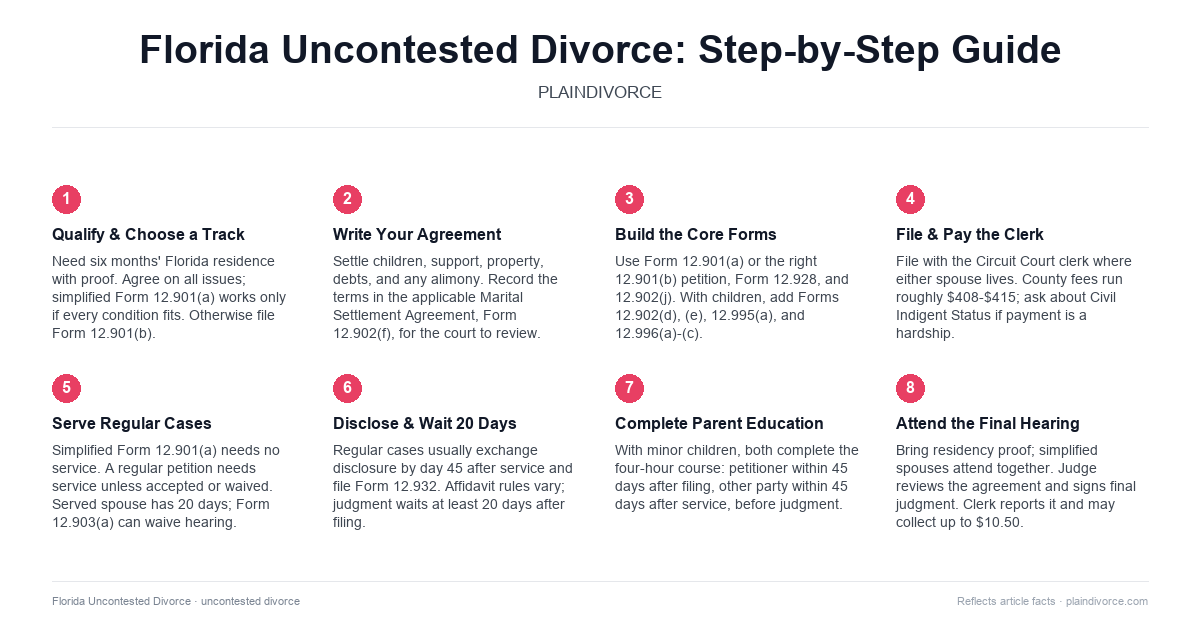
Most uncontested divorce in Florida cases follow the same flow: confirm you qualify → write your agreement → prepare the 12.900-series forms → file with the clerk → give your spouse notice → exchange financial disclosure → wait out the 20-day rule → complete parenting education (if children) → attend the final hearing → receive the Final Judgment.
Step 1 – Confirm You Qualify and Pick Your Track
- Has one spouse lived in Florida for the last 6 months, with proof (see Section 2.1)?
- Do you both agree the marriage is irretrievably broken?
- Can you resolve all issues — children, support, property, debts — without asking a judge to decide?
- Do you meet all seven Simplified Dissolution requirements (Section 2.3)? If yes, your paperwork is shorter. If no, choose the right regular petition — Form 12.901(b)(1), (b)(2), or (b)(3).
Step 2 – Put Your Agreement in Writing (Marital Settlement Agreement)
Florida courts expect a clear plan for time-sharing and parental responsibility; child support calculated under the statewide guidelines; whether there will be alimony (and if so, amount and duration); who keeps the home, vehicles, accounts, and retirement plans; and who pays which debts.
Most couples record these terms in a Marital Settlement Agreement (Form 12.902(f)). There are three versions of this Florida 12.902 Marital Settlement Agreement:
- Form 12.902(f)(1) — dependent or minor children.
- Form 12.902(f)(2) — property or debts, no dependent or minor children.
- Form 12.902(f)(3) — simplified dissolution cases.
In a simplified case you can either attach a signed Form 12.902(f)(3) or state on the joint petition that you have divided everything by oral agreement. In a regular case, the judge reviews your written agreement at the final hearing before approving it.
Step 3 – Prepare the Florida Divorce Forms (the 12.901 Series and Support Forms)
The exact set depends on your track, whether you have children, and your income. A common uncontested package looks like this:
- Petition — Form 12.901(a) (simplified) or the correct Form 12.901(b)(1)/(2)/(3) (regular).
- Family Court Cover Sheet (Form 12.928).
- Notice of Social Security Number (Form 12.902(j)) — required in dissolution cases; Florida court records are largely public, so SSNs are handled on this separate notice.
- Family Law Financial Affidavit — the short form (Form 12.902(b)) if your individual gross annual income is under $50,000, or the long form (Form 12.902(c)) if it is $50,000 or more. (See Step 6 for the narrow situations where no affidavit is required.)
- Marital Settlement Agreement (Form 12.902(f)(1), (f)(2), or (f)(3)) — your written agreement.
- Affidavit of Corroborating Witness (Form 12.902(i)) — if you are proving residency by witness affidavit.
- Certificate of Compliance with Mandatory Disclosure (Form 12.932) — in regular cases where mandatory disclosure applies (see Step 6).
If you have minor or dependent children, add:
- UCCJEA Affidavit (Form 12.902(d)) — the child’s residence history and any other custody cases.
- Child Support Guidelines Worksheet (Form 12.902(e)) — this must be filed at or before any hearing to establish or modify child support, and the parties cannot waive it.
- A Parenting Plan (Form 12.995(a)) — required in every time-sharing case, even a fully agreed one (see Section 4).
- An Income Deduction Order (Forms 12.996(a)–(c)) — the court must enter one with any non-temporary support order (see Section 4).
Use the current version of every form — several in this list were revised in 2025. Type or print in black ink, and sign sworn forms in front of a notary or deputy clerk. Self-represented filers may e-file through the Florida Courts E-Filing Portal but are not required to; if you elect electronic service, you must keep following those procedures and your circuit’s rules from then on.
Step 4 – File With the Clerk of the Circuit Court
File your completed, signed forms with the Clerk of the Circuit Court in the county where you or your spouse lives, and keep a copy of everything. Pay the filing fee (see Section 6). If you cannot afford the fee, ask the clerk for an Application for Determination of Civil Indigent Status; the clerk decides whether you qualify to have fees deferred or waived.
Step 5 – Serve Your Spouse (or Have Them File Form 12.903(a) After Service)
- Simplified Dissolution (Form 12.901(a)): no service. Both spouses sign the joint petition and file it together.
- Regular dissolution: the petition must be formally served on the other spouse — usually by the sheriff or a certified process server — unless that spouse voluntarily accepts or waives service under the applicable rules.
A cooperative spouse who has been served can then file the Answer, Waiver, and Request for Copy of Final Judgment (Form 12.903(a)). Filing it means admitting all the allegations in the petition, agreeing to the relief it requests, waiving notice of hearing and all future notices, waiving an appearance at the final hearing, and asking for a copy of the Final Judgment by mail. It is signed before a notary or deputy clerk. Form 12.903(a) does not replace service of the petition — it is what a served, agreeable spouse files afterward. The responding spouse has 20 days after service to respond.
Step 6 – Mandatory Disclosure, Financial Affidavits, and the 20-Day Rule
The 20-day rule. A Final Judgment generally cannot be entered until at least 20 days after the original petition is filed (section 61.19, Florida Statutes). A judge may shorten it only on a showing that the delay would cause injustice.
The Family Law Financial Affidavit. In most regular cases each spouse files one — the Family Law Financial Affidavit short form (12.902(b)) under $50,000 individual gross annual income, or the long form (12.902(c)) at $50,000 or more. Under the current Form 12.902(c) instructions, no financial affidavit is required when:
- you are filing a simplified dissolution and both parties have waived filing affidavits;
- you have no minor children, no support issues, and a written settlement agreement disposing of all financial issues; or
- the court lacks jurisdiction to decide any financial issue.
Spouses in a regular case can also file a joint verified waiver (Form 12.902(k)) under the mandatory disclosure rule. Outside those situations, the financial affidavit cannot be skipped just because both spouses agree.
Mandatory disclosure and Form 12.932. The mandatory disclosure rule applies to all regular dissolution cases except simplified dissolutions and cases where the respondent is served by publication and never answers. Each spouse must give the other a set of financial documents (tax returns, pay stubs, account statements, and more) within 45 days of service of the petition, then file a Certificate of Compliance with Mandatory Disclosure (Form 12.932). Important: only the certificate is filed with the court — the underlying documents are exchanged privately, not filed — except the financial affidavit, which is filed (unless a Form 12.902(k) waiver is on file). Spouses can agree to skip the document exchange, but not the financial affidavit.
Step 7 – Parenting Course (Cases With Minor Children)
In a dissolution case involving minor children, both parents must complete an approved Parent Education and Family Stabilization Course — a minimum 4-hour program (section 61.21, Florida Statutes). The deadlines:
- the petitioner completes it within 45 days after filing the petition;
- the other party completes it within 45 days after service;
- both must finish before the final judgment is entered.
The court can excuse a parent for good cause. File your certificate of completion; your clerk or the judge’s page lists approved providers. This requirement does not apply to a divorce with no minor children.
Step 8 – Final Hearing, Residency Proof, and the Final Judgment
At the final hearing the judge confirms the basics — that the marriage is irretrievably broken, that your agreement is voluntary, and that the court has jurisdiction — and, in a simplified case, both spouses attend together. Bring your residency proof; if the file does not already contain acceptable proof, the judge can require more evidence on the spot. If everything is in order, the judge signs the Final Judgment of Dissolution of Marriage.
State reporting (DH-513). Every Florida divorce is reported to the Department of Health. Under section 382.023, Florida Statutes, the clerk of the circuit court — not you — electronically transmits a record of each dissolution judgment, and the clerk may collect a fee of up to $10.50 when a final judgment of dissolution is filed. Local practice on paperwork varies, so ask your clerk what they need.
4. Special Issues When You Have Children
Children do not stop you from having an uncontested divorce in Florida, but they add required documents and one non-negotiable rule: the judge has the final say on anything affecting the child, and the standard is the best interests of the child.
Parenting Plans and Time-Sharing
A written parenting plan (Form 12.995(a)) is required in every case with a time-sharing schedule, even when both parents agree. An agreed plan is signed by both parents and must still be approved by the court. Under section 61.13, Florida Statutes, the plan must at a minimum:
- describe how the parents will share and be responsible for the daily tasks of raising the child;
- include a time-sharing schedule that specifies the time the child spends with each parent;
- designate who is responsible for health care, school-related matters (including the address used for school-boundary determination and registration), and other activities;
- describe the methods and technologies the parents will use to communicate with the child; and
- unless the parents agree otherwise in writing, designate where exchanges take place.
Child Support, the Guidelines Worksheet, and the Income Deduction Order
Florida sets child support with statewide guidelines (section 61.30) based on both parents’ incomes and the number of overnights with each parent. The support packet in an uncontested case usually includes:
- each parent’s Family Law Financial Affidavit (12.902(b) or (c));
- the Child Support Guidelines Worksheet (Form 12.902(e)) — required at or before any support hearing, and not waivable by the parents; and
- a separate Income Deduction Order (Forms 12.996(a)–(c)). Under section 61.1301, Florida Statutes, when the court enters a non-temporary order establishing, enforcing, or modifying child support or alimony, it must enter a separate income deduction order if one has not already been entered — even in an agreed case.
If both parents want a support amount that differs from the guideline figure, the court still needs to see the guideline calculation and a reason for the difference before it can approve it.
5. How Long Does an Uncontested Divorce Take in Florida?
There is no statewide timeline, and no Florida court or statute promises a completion window. What the law fixes is the 20-day floor: the court cannot enter a Final Judgment until at least 20 days after the original petition is filed, absent a showing of injustice.
Everything after that depends on:
- how long you take to negotiate and sign your agreement;
- whether service (in a regular case) is completed promptly;
- whether mandatory disclosure and the parenting course (if children) are done on time;
- your county’s process for scheduling uncontested final hearings; and
- whether your residency proof is in the file before the hearing.
Ask your clerk or the judicial assistant how uncontested final hearings are set in your circuit — that answer, not a generic estimate, is what tells you when your case can finish.
6. How Much Does an Uncontested Divorce Cost in Florida?
The one mandatory cost is the court filing fee, which each county clerk sets on its own schedule. There is no single statewide number, and a simplified dissolution is not always the same price as a regular one. Recent examples: the Volusia County Clerk lists $408 for a regular dissolution and $411.50 for a simplified dissolution; Broward and Miami-Dade list $409. Budget roughly $408–$415 and confirm the exact figure with your clerk before filing.
| Item | Typical cost | When it applies |
|---|---|---|
| Court filing fee | About $408–$415 (county-set; simplified may differ) | Every case |
| Summons issuance | Set by the clerk (often around $10 per summons) | Regular case where the petition is served |
| Process server or sheriff service | Local/provider rate — check your county | Regular case; skipped if the spouse accepts service or files Form 12.903(a) |
| Parenting course | Provider fee — varies by approved provider | Dissolution with minor children |
| Notary fees | Statutory cap per signature (deputy clerks are often free) | Sworn affidavits and agreements |
| Final-judgment reporting fee | Up to $10.50 | Collected by the clerk when the final judgment is filed |
| Certified copies of the Final Judgment | Per-page and per-certification fee set by the clerk | If you need certified copies |
If the filing fee is a hardship, file an Application for Determination of Civil Indigent Status with the clerk. All non-fee figures above are set locally or by the provider — always check your own county’s current schedule.
7. When a DIY Divorce Might Not Be Right for You
A Florida divorce without a lawyer can save real money, but it is not always the safe choice. Talk to an attorney or a legal aid clinic if:
- there is any domestic violence, stalking, or serious harassment;
- you are worried your spouse will hide assets or income;
- you own a business or significant investments together;
- you suspect hidden debts;
- one of you has immigration concerns tied to marriage-based status;
- you feel pressured to sign something you do not fully understand; or
- you are unsure whether your proposed settlement is reasonable.
Even a single consultation can flag a risk before it becomes an expensive mistake. PlainDivorce can help you understand the process and stay organized, but it cannot tell you what to accept.
8. Where a Self-Help Divorce Kit Fits Into the Process
For most DIY filers, the hard part of an uncontested divorce in Florida is not the concept — it is the paperwork detail: choosing the right track (simplified vs. regular), matching the correct 12.901 petition to your situation, remembering the child forms and the income deduction order, exchanging mandatory disclosure, and keeping dates and names consistent across every form.
A Florida self-help kit is built to help you:
- understand the whole process from filing to Final Judgment;
- stay organized with a checklist for each stage;
- track what must be signed, notarized, filed, served, or exchanged;
- avoid the small mistakes that cause rejected or delayed filings; and
- prepare for the final hearing — including residency proof.
PlainDivorce.com sells downloadable self-help kits for uncontested, agreement-based divorces. They are for people who want to keep costs down and are willing to follow instructions carefully. PlainDivorce is not a law firm and does not represent you, but a kit can work alongside your local clerk’s office and the Florida Courts self-help resources.
Download Our Florida Uncontested Divorce Self-Help Kit
9. FAQ: Uncontested Divorce in Florida
What is an uncontested divorce in Florida?
It means both spouses agree the marriage is irretrievably broken and agree on every issue — property, debts, alimony, and any children — so there is nothing for a judge to decide. The court still reviews the paperwork and holds a short final hearing before entering the Final Judgment. Couples who meet all seven Simplified Dissolution requirements can use Form 12.901(a); everyone else files a regular Form 12.901(b) petition on an uncontested basis.
What are the Simplified Dissolution of Marriage Florida requirements?
All seven must be true: you both agree the marriage cannot be saved; you have no minor or dependent children together, the wife has no child born during the marriage, and the wife is not pregnant; you have divided assets and debts by agreement and both are satisfied; neither spouse is seeking alimony; you both give up the right to trial and appeal; you have both signed the petition; and you are both willing to attend the final hearing together. Miss any one and you must use a regular Form 12.901(b) petition.
Do we both have to go to court?
In a simplified dissolution, both spouses must attend a short final hearing together. In a regular uncontested case, practice varies by circuit: often at least the petitioner appears, and a cooperative respondent who has been served can file Form 12.903(a) to waive their own appearance and future notices. Ask your clerk or the judicial assistant how uncontested final hearings are handled in your county.
What is the 20-day waiting period in Florida?
Section 61.19, Florida Statutes, prevents the court from entering a Final Judgment of dissolution until at least 20 days after the original petition is filed. A judge can shorten that only on a showing that the delay would cause injustice. There is no separate statewide rule for how long the rest of the case takes — that depends on your county and how complete your file is.
Do I need a Family Law Financial Affidavit for an uncontested divorce?
Usually yes, but not always. The current Form 12.902(c) instructions say no financial affidavit is required in a simplified dissolution where both parties waive it, in a case with no minor children and no support issues plus a written settlement agreement covering all financial issues, or where the court has no jurisdiction over financial issues. Spouses in a regular case can also file a joint verified waiver (Form 12.902(k)). Outside those situations, the affidavit cannot be waived just by agreement.
What’s the difference between the short form and long form Family Law Financial Affidavit?
The short form (Form 12.902(b)) is for a spouse whose individual gross annual income is under $50,000. The long form (Form 12.902(c)) is required at $50,000 or more, or when a party asks for it through interrogatories. Both disclose income, expenses, assets, and debts under oath. Where a financial affidavit is required, it is filed with the court even though most other disclosure documents are only exchanged between the parties.
What is a Marital Settlement Agreement (Form 12.902(f)) in Florida?
It is the written contract where you and your spouse spell out how you divide property and debts, handle any children, and whether there is alimony. Florida has three versions: Form 12.902(f)(1) for couples with dependent or minor children, 12.902(f)(2) for couples with property but no children, and 12.902(f)(3) for simplified dissolution cases. In a regular case, the judge reviews the agreement at the final hearing before approving it.
How long does an uncontested divorce take in Florida?
The only fixed rule is the 20-day minimum between filing and the Final Judgment. There is no statewide estimate beyond that. The real timeline depends on how quickly you finish your agreement, complete service in a regular case, exchange mandatory disclosure, finish the parenting course if you have minor children, and get on your county’s calendar for an uncontested final hearing.
How much does an uncontested divorce cost in Florida?
The filing fee is set by each county clerk and runs roughly $408 to $415; a simplified dissolution is sometimes priced differently from a regular one (for example, Volusia County lists $408 regular and $411.50 simplified). On top of that you may have service costs, a parenting-course provider fee if you have minor children, notary fees, a final-judgment reporting fee of up to $10.50, and certified-copy fees. If the filing fee is a hardship, ask the clerk about the civil indigent status application.
10. Final Thoughts and Next Steps
An uncontested divorce in Florida is realistic for many couples once the “local language” is handled with care — the right 12.901 petition, a clean financial affidavit, an approved parenting plan and income deduction order when there are children, and a residency proof that is in the file before the hearing.
- Confirm one spouse meets the 6-month residency rule and you have corroborated proof (a 6-month-old Florida license/ID/voter card or Form 12.902(i)).
- Decide whether you meet all seven Simplified Dissolution requirements or need a regular Form 12.901(b)(1), (b)(2), or (b)(3) petition.
- Talk honestly with your spouse about whether you truly agree on children, support, and property.
- Use the current Florida Courts family-law forms — several were revised in 2025 — and add the child forms (12.902(d), 12.902(e), Form 12.995(a), Forms 12.996(a)–(c)) if you have minor children.
- Confirm your county clerk’s filing fee, disclosure practice, and hearing procedure before you file.
This article is general legal information, not legal advice, and PlainDivorce is not a law firm. Florida court rules, forms, and fees change regularly — verify every form number, deadline, and dollar amount with the Florida Courts, your clerk of court, or a licensed Florida family-law attorney before you act.
Sources and local rules can change. Use this guide as a plain-English organizer, then verify the current filing requirements with the official court or government source for your jurisdiction.

About Harry D
Expert contributor at PlainDivorce, helping Canadians and American navigate simple uncontested divorces with clarity and confidence.