Uncontested Divorce in Georgia: The Forms, the 30-Day Rule, and Rule 24.6
An uncontested divorce in Georgia is one where you and your spouse agree the marriage is “irretrievably broken” and agree on every issue — property, debts, alimony, and, if you have children, custody, parenting time, and child support — so a judge only has to review and sign your paperwork. You file a Complaint for Divorce in the right county Superior Court, handle service (often with an Acknowledgement of Service), and wait out the statutory 30-day period after service before the court can grant the divorce. If both spouses sign a written consent, a Georgia court can hear the case as early as 31 days after service under Uniform Superior Court Rule 24.6.
TL;DR
- An uncontested divorce in Georgia works when you and your spouse fully agree on property, debts, alimony, and (if you have kids) custody, parenting time, and child support before you file.
- You file a Complaint for Divorce — the first of the core Georgia divorce forms — in the correct county Superior Court, with a signed Settlement Agreement and, in most financial cases, a Domestic Relations Financial Affidavit (DRFA).
- Two timelines matter: O.C.G.A. § 19-5-3(13) bars a no-fault decree until at least 30 days after service, and Uniform Superior Court Rule 24.6 then sets when the case can be heard — 31 days by written consent, 46 days if unanswered with no children, 61+ days by publication.
- Cooperative spouses can sign a written consent to a hearing 31 days after service (the Rule 24.6 track). Whether your county also lets you finalize on paper with a Motion for Judgment on the Pleadings in Georgia is a local question — ask the assigned judge’s staff.
- Georgia divorce filing fees generally run about $200–$230, set by each county (recent examples: Fulton $220, Chatham $218, DeKalb $217), plus roughly $50 for sheriff service. A full fee waiver is available by Poverty Affidavit if the court finds you qualify.
- Children add a parenting plan, a child support worksheet, a separate Income Withholding Order, and (in most circuits) a parenting seminar. Abuse, coercion, hidden assets, a business, or immigration or tax questions? Talk to a lawyer instead of filing DIY.
1. What Is an Uncontested (Simple) Divorce in Georgia?
In Georgia, every divorce is handled in the Superior Court of the county with proper venue. The case begins when one spouse (the plaintiff) files a Complaint for Divorce — the first of the required Georgia divorce forms — against the other spouse (the defendant).
Georgia law lists thirteen grounds for divorce, but the one used in almost every cooperative case is the no-fault ground that the marriage is “irretrievably broken” under O.C.G.A. § 19-5-3(13). Only one spouse has to swear the marriage is irretrievably broken with no hope of reconciliation; neither of you has to prove the other did anything wrong.
A case is treated as an uncontested divorce in Georgia when:
- both spouses agree the marriage should end, and
- you have already agreed on every major issue — property, debts, alimony, and, if you have children, custody, parenting time, and child support — before asking the judge to sign the Final Judgment and Decree.
That agreement is written up as a Settlement Agreement (sometimes called a marital settlement agreement or separation agreement). In a true uncontested case the judge’s job is mostly to confirm the court has jurisdiction and that the paperwork meets Georgia requirements — especially where children are involved, because agreement does not remove the court’s duty to review child support and custody.
“Simple divorce in Georgia” is not an official court label. People use it to mean the same thing: an uncontested, paperwork-driven case with a cooperative spouse who will sign a Settlement Agreement and, usually, an Acknowledgement of Service.
2. Who Qualifies for an Uncontested Divorce in Georgia?
2.1 Residency and Venue
Before anything else, a Georgia court has to be able to hear your case. Under O.C.G.A. § 19-5-2, residency is jurisdictional — the court cannot grant a divorce at all if the rule is not met. One of the following must be true:
- You have been a bona fide resident of Georgia for at least 6 months before filing, or
- You are a nonresident filing against a spouse who has been a Georgia resident for at least 6 months, or
- You have lived at a U.S. Army post or military reservation in Georgia for at least one year, which lets you file in an adjacent county under the statute’s special rule.
Venue (which county) is generally the county where the defendant lives. It can be the plaintiff’s county if the defendant is a nonresident, recently moved out of the county that was the marital home, or does not object in time. Venue is technical, so confirm it with your local clerk’s instructions or legal aid before filing — a venue error can mean re-filing.
2.2 Grounds and the 30-Day Rule After Service
Most uncontested cases use the no-fault ground that the marriage is irretrievably broken. The key timing rule sits in the same statute: O.C.G.A. § 19-5-3(13) says that “under no circumstances shall the court grant a divorce on this ground until not less than 30 days from the date of service on the respondent” (or the date your spouse signs and files an Acknowledgement of Service).
That 30-day statutory bar is a floor, not a finish line. Separately, Uniform Superior Court Rule 24.6 governs when an uncontested case can actually be heard — see Section 5 for the three tracks. After service, your spouse also has 30 days to file an answer under Georgia’s civil procedure rules.
2.3 When an Uncontested Divorce Is a Good Fit
| An uncontested divorce usually works when… | Get legal advice first when… |
|---|---|
| Both spouses agree the marriage is over | There is domestic violence, stalking, or a safety concern |
| You agree on property, debts, and alimony and can put it in a Settlement Agreement | One spouse controls all the money or information, or you suspect hidden assets or debts |
| You agree on custody, parenting time, and guideline child support, and can show how support was calculated | There is a real dispute about children or support |
| Both spouses will sign and (where required) notarize the paperwork | Assets are complex — a business, several properties, large retirement accounts |
| Neither spouse needs the judge to decide a contested issue | Immigration, tax, or bankruptcy questions are tied to the divorce |
If a spouse simply will not participate, a case can still move forward after proper service if there is no answer within 30 days, but a default-style divorce is more sensitive and county instructions matter. If anything in the right-hand column applies, a Georgia family-law attorney or a legal aid clinic is the safer first stop.
3. Step-by-Step: How to File an Uncontested Divorce in Georgia
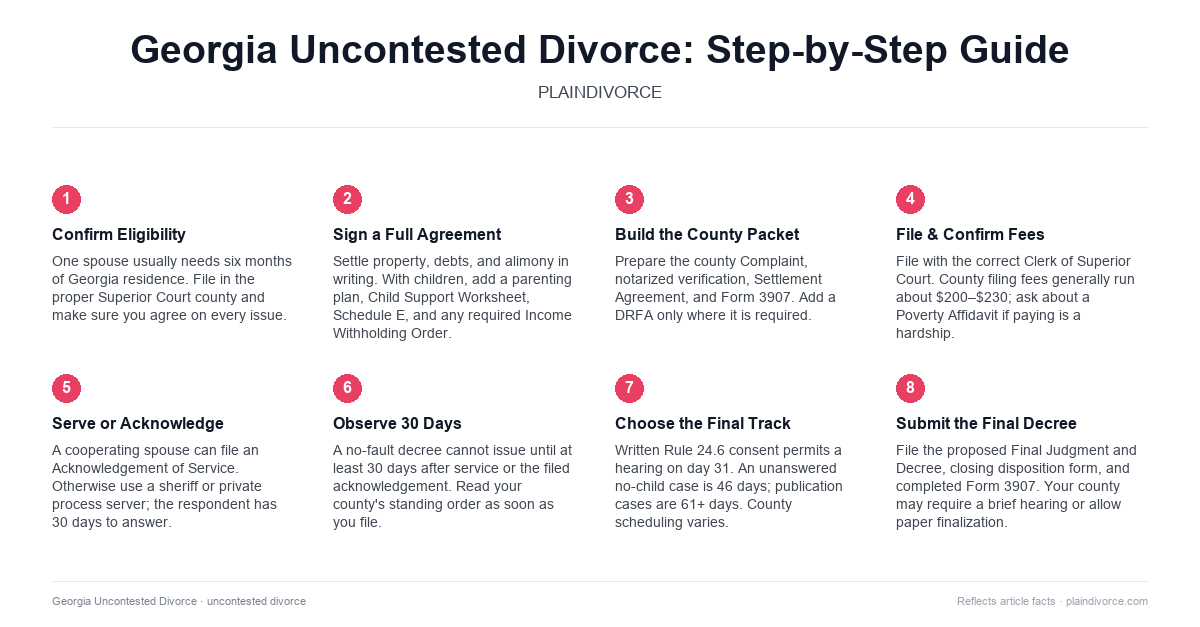
- Confirm residency, venue, and a full agreement
- Sign the Settlement Agreement (and child-related terms if needed)
- Prepare the Complaint for Divorce and county packet, including the Form 3907 vital-records report
- File with the Clerk of Superior Court and pay the fee (or file a Poverty Affidavit)
- Serve your spouse, or file an Acknowledgement of Service
- Wait the 30-day statutory period after service
- Finalize by hearing, by written consent 31 days after service, or (if your county allows) on paper
Step 1 – Confirm You Qualify
- Residency: does at least one spouse meet Georgia’s 6-month rule (or the military-post exception)?
- Venue: are you filing in the correct county Superior Court?
- Agreement: do you truly agree on everything — children, support, property, and debts?
If any of these is shaky, expect delays later from re-filing or venue corrections.
Step 2 – Finalize Your Settlement Agreement
Almost every uncontested case runs on a signed Settlement Agreement covering property, debts, and alimony. This is the core contract in a Settlement Agreement Georgia divorce, and the judge incorporates it into the Final Judgment and Decree. If you have children, you also need a parenting plan and child support paperwork — including Georgia’s Child Support Worksheet and Schedule E — that matches the guideline requirements in O.C.G.A. § 19-6-15. The agreement must state each parent’s gross and adjusted income.
Step 3 – Prepare the Georgia Divorce Forms (Complaint and Packet)
Your exact packet depends on your county and whether you have children. Georgia does not have one statewide divorce packet — the filing county’s forms control — but most uncontested cases include these core Georgia divorce forms, starting with the Complaint:
- Complaint for Divorce plus the required verification (signed before a notary).
- Settlement Agreement resolving property, debts, alimony, and any child issues.
- Domestic Relations Financial Affidavit (DRFA) — generally required under Uniform Superior Court Rule 24.2 in cases with financial issues, and served before any contested hearing. Exception: when you file a complete Settlement Agreement resolving every issue but the divorce itself, the parties are usually not required to file DRFAs unless the court orders them. In child support cases, a completed Worksheet and Schedule E must be attached to the proposed final judgment either way.
- Acknowledgement of Service — used in cooperative cases to avoid sheriff service and start the clock (see Step 6).
- Proposed Final Judgment and Decree of Divorce for the judge to sign.
- Clerk tracking sheets: a General Civil and Domestic Relations Case Filing Information Form to open the file and a Final Disposition form to close it. Names and versions vary by county.
- Form 3907, Report of Divorce, Annulment or Dissolution of Marriage. Under O.C.G.A. § 31-10-22 this is your document: the petitioner prepares it on the state registrar’s form and presents it to the clerk with the petition, and a completed record is a prerequisite to the final decree. The clerk later transmits the records to the State Office of Vital Records. Don’t leave this one for the end.
Redact protected identifiers. Do not put full Social Security numbers or full financial-account numbers in documents you file; use the last four digits, and give a birth year rather than a full date of birth in financial filings.
Why the DRFA still trips people up: when it is required, DIY cases stall because it is missing, incomplete, or inconsistent with the settlement terms. Because it is sworn, errors can draw questions from the judge, not just the clerk.
Step 4 – File With the Clerk of Superior Court
- File your Complaint for Divorce and attachments with the Clerk of the Superior Court and keep stamped or e-filed copies of everything.
- Pay the filing fee (see Section 6) or file a Poverty Affidavit / Affidavit of Indigence under O.C.G.A. § 9-15-2 if you cannot afford the costs.
E-filing: the Judicial Council’s e-file directory currently lists three providers — Odyssey eFileGA, PeachCourt, and GreenFiling/InfoTrack — and which one your county uses varies. Statewide e-filing standards require courts to let self-represented (pro se) filers file on paper, so e-filing is not mandatory for you even in counties where attorneys must e-file. Confirm your county’s accepted filing method before you file.
Step 5 – Read Your County’s Standing Order
In many counties, filing a divorce automatically triggers a Domestic Relations Standing Order (sometimes called an Automatic Domestic Standing Order). It typically binds the plaintiff when the case is filed and the defendant once served, and sets ground rules during the case — for example, no hiding or transferring marital assets, and limits on moving children out of state. The terms and even the existence of a standing order vary by county, so find and read yours the day you file.
Step 6 – Handle Service (or File an Acknowledgement of Service)
Your spouse must be legally notified. In cooperative cases the simplest route is an Acknowledgement of Service, signed (often notarized, per local rules) and then filed with the clerk. It avoids sheriff service fees. Under Rule 24.6, the consensual timeline is measured from service or from the date the acknowledgment is filed — so file it promptly, before or at the same time as any written consent, rather than signing it and holding onto it.
If your spouse will not sign an acknowledgement, you will need sheriff service or a private process server. After service, your spouse has 30 days to file an answer.
Step 7 – Observe the 30-Day Statutory Period
O.C.G.A. § 19-5-3(13) prohibits the court from granting a no-fault divorce until at least 30 days after service (or the filed acknowledgement). This is the statutory minimum. How soon after day 30 your case is actually decided depends on which Rule 24.6 track applies and how busy the court’s calendar is — see Section 5.
Step 8 – Finalize: Hearing, Written Consent, or a Motion for Judgment on the Pleadings
Counties finalize uncontested cases differently:
- Short uncontested hearing. Some judges want a brief hearing where the plaintiff answers basic questions under oath.
- Written consent to a hearing 31 days after service (Rule 24.6). If both spouses sign a written consent to a hearing — waiving a jury and agreeing the case can be heard as soon as 31 days after service — the court can grant the divorce on that schedule instead of waiting for a regular trial calendar. This is the “speed button” many DIY filers miss.
- Paper finalization with a Motion for Judgment on the Pleadings. In some counties an uncontested case can be finalized without a hearing by filing a Motion for Judgment on the Pleadings in Georgia with a proposed decree, asking the judge to sign on the paperwork alone. Whether this is available is a local question — confirm it with the assigned judge’s staff before you count on it.
Final clerk processing: most counties need the case-closing disposition form and a completed Form 3907 on file before the clerk can issue certified copies of your decree.
Download Our Georgia Uncontested Divorce Self-Help Kit
4. Special Issues When You Have Children
Children do not stop you from having an uncontested divorce in Georgia, but they add required documents and closer judicial review. Agreement does not remove the court’s duty to check that support and custody terms meet Georgia law.
Parenting Plan and Custody Terms
Georgia expects a written parenting plan with a clear parenting-time schedule and decision-making terms (legal and physical custody, holidays, transportation, and how disputes are handled). If a plan is vague or does not appear to serve the children’s best interests, the judge can require changes even in an uncontested case.
Child Support, the Worksheet, and the Income Withholding Order
Georgia child support is guideline-based under O.C.G.A. § 19-6-15, using both parents’ incomes and the state’s Child Support Worksheet and schedules. The Georgia Child Support Commission’s online calculator produces the worksheet you file. Expect the court to require:
- a completed Child Support Worksheet and Schedule E attached to the proposed final judgment;
- a written finding of each parent’s gross income in the decree, plus the court’s determination of adjusted income, health-insurance cost, and work-related child-care cost; and
- a separate Income Withholding Order (formerly the Income Deduction Order; renamed by SB 520 effective July 1, 2024). Under Uniform Superior Court Rule 24.11, a separate wage-withholding order is required in every case where child support is ordered, signed by the judge and filed with the clerk, unless an exception applies (for example, a written agreement for an alternative payment arrangement, or a good-cause finding). It is a separate document from the decree, and DIY filers routinely forget it.
A negotiated support figure that lacks the required findings must be rejected, so keep your numbers, your worksheet, and your agreement consistent.
Parenting Seminar (Circuit-Specific)
Uniform Superior Court Rule 24.8 authorizes each judicial circuit to run a program educating parents about the effects of divorce on children, and lets the assigned judge require any or all parties to attend a seminar of no more than four hours. Most circuits with a program do require divorcing parents of minor children to complete it before the decree, but the details — who must attend, the deadline, whether an online or out-of-state option is allowed, and when attendance can be waived — are set by local standing order, not statewide law. Read your county’s standing order and confirm its parenting-seminar rule as soon as you file.
5. How Long Does an Uncontested Divorce Take in Georgia?
The only firm numbers are the 30-day statutory bar after service and the Rule 24.6 tracks that follow it. Georgia has no statewide “average” completion time, and how fast your case reaches a judge after the minimum period depends entirely on your county’s calendar and how complete your file is.
| Situation | Earliest the divorce can be granted | Authority |
|---|---|---|
| Any no-fault case (the floor) | 30 days after service or the filed acknowledgement | O.C.G.A. § 19-5-3(13) |
| Both spouses sign a written consent to a hearing | 31 days after service or after filing the acknowledgement | Uniform Superior Court Rule 24.6 |
| Defendant is served, files no answer, no children | 46 days after service (unless the response time is extended) | Uniform Superior Court Rule 24.6 |
| Defendant served by publication | 61 or more days after the first newspaper publication | Uniform Superior Court Rule 24.6 |
Without a written consent, an uncontested case still has to wait for a spot on a regular civil or domestic calendar, which in some counties runs well past the legal minimum. Most delays are self-inflicted: an incomplete or inconsistent DRFA or worksheet, service problems, missing signatures or notarizations, missing clerk cover sheets, or a forgotten Income Withholding Order or Form 3907. Ask your clerk or the judge’s staff how uncontested cases are scheduled in your county — that answer, not a generic estimate, tells you when yours can finish.
6. Georgia Divorce Filing Fees and Other Costs
The biggest mandatory cost is the court filing fee. Georgia divorce filing fees are set by each county and generally fall between about $200 and $230. Recent published examples: the Fulton County clerk lists divorce filing at $220 plus a $50 sheriff service fee per service; Chatham County lists General Civil and Domestic at $218 plus service; and DeKalb County raised its divorce filing fee to $217 effective July 1, 2024. These change — confirm the current figure with your county clerk before filing.
| Item | Typical cost | When it applies |
|---|---|---|
| Court filing fee | About $200–$230 (county-set) | Every case |
| Sheriff service | Around $50 per service (plus copy costs) | When you can’t use an Acknowledgement of Service |
| Notary fees | Statutory cap per signature (bank/clerk notaries are often free) | Verification, affidavits, acknowledgement |
| Certified copies of the decree | Per-page and per-certification fee set by the clerk | When you need certified copies |
| Parenting seminar fee | Provider fee — varies by circuit and provider | Cases with minor children, where the circuit requires it |
| E-filing portal fee | Provider convenience fee, where applicable | If you choose to e-file |
If paying the fee would be a real hardship, Georgia allows a full fee waiver by Poverty Affidavit (Affidavit of Indigence) under O.C.G.A. § 9-15-2. Households at or below roughly 125% of the federal poverty guidelines are commonly screened as eligible, but this is a court determination, not an automatic entitlement — the judge weighs household size and ability to pay, and an interested party can contest the affidavit. If approved, it typically waives both the filing fee and sheriff service costs.
Even with these costs, a truly uncontested DIY case is generally far less expensive than a contested divorce with multiple hearings and attorney time. Always check your county clerk’s current fee schedule before filing.
7. FAQ: Uncontested Divorce in Georgia
What is an uncontested or simple divorce in Georgia?
It means both spouses agree the marriage is irretrievably broken and have already settled every issue — property, debts, alimony, and, if applicable, custody, parenting time, and child support — so the judge can approve the paperwork without a trial. The case still starts with a Complaint for Divorce in the county Superior Court, and the court still reviews the file, especially child support and custody terms.
How long is the waiting period for a divorce in Georgia?
O.C.G.A. § 19-5-3(13) bars a no-fault decree until at least 30 days after service. Uniform Superior Court Rule 24.6 then sets when the case can be heard: 31 days after service if both spouses sign a written consent to a hearing, 46 days in an unanswered case with no children, and 61+ days if service was by publication. Without a written consent, the case waits for a regular calendar slot, which can run longer.
Can we finalize a Georgia divorce without going to court?
Sometimes. Some counties let an uncontested case finish on the paperwork alone — for example, through a Motion for Judgment on the Pleadings with a proposed decree — while other counties require a short hearing. It depends on the county and the assigned judge’s preferences, and is more likely to require a hearing when children are involved. Confirm your county’s practice with the clerk or the judge’s staff.
Do we have to use a sheriff or process server?
Not if your spouse cooperates. A signed, notarized Acknowledgement of Service, filed with the clerk, avoids sheriff service fees and starts the Rule 24.6 clock. If your spouse will not sign one, you will need sheriff service or a certified private process server, and your spouse then has 30 days to answer.
How much does it cost to file for divorce in Georgia?
Georgia divorce filing fees are county-set and generally run about $200–$230 — recent examples include Fulton at $220, Chatham at $218, and DeKalb at $217. Add roughly $50 for sheriff service if you can’t use an Acknowledgement of Service, plus notary and certified-copy fees. Confirm the current amount with your county clerk before filing.
Can I get the Georgia divorce filing fee waived?
Often, yes. Georgia lets you file a Poverty Affidavit (Affidavit of Indigence) under O.C.G.A. § 9-15-2 instead of paying. Households around or below 125% of the federal poverty guidelines are commonly eligible, but the judge decides based on household size and ability to pay, and an interested party can challenge the affidavit. If granted, it usually covers the filing fee and sheriff service.
What is a Settlement Agreement in a Georgia divorce?
It is the written contract where you and your spouse resolve property division, debts, alimony, and — if you have children — custody, parenting time, and child support before asking the judge to finalize the divorce. In a Settlement Agreement Georgia divorce, the agreement is filed with the Complaint and incorporated into the Final Judgment and Decree, so it must be complete, consistent with your DRFA and child support worksheet, and state each parent’s gross and adjusted income where support is involved.
Do we have to take a parenting class if we have children?
Usually, but it is a local rule, not statewide law. Uniform Superior Court Rule 24.8 lets each circuit run a parenting seminar and lets the assigned judge require attendance (up to four hours). Most circuits with a program require divorcing parents of minor children to finish it before the decree, but who attends, the deadline, and any online or waiver options are set by your county’s standing order. Check it as soon as you file.
What Georgia divorce forms do DIY filers most often miss?
The usual gaps are the clerk cover sheets (case filing information and final disposition), the Domestic Relations Financial Affidavit when it is required, the vital-records Form 3907 (which the petitioner must file with the petition), and — in child support cases — the completed worksheet and the separate Income Withholding Order. Counties also commonly require a signed standing-order acknowledgement and county-specific attachments.
8. When a DIY Divorce Might Not Be Right for You
Be cautious about a DIY uncontested divorce in Georgia if there is domestic violence, intimidation, or coercion; hidden assets or debts; a business or complex finances; major immigration, tax, or bankruptcy consequences; or pressure to sign a settlement you do not fully understand. In those situations, even a single consultation with a Georgia family-law attorney or a legal aid clinic can flag a problem before it becomes an expensive, hard-to-undo mistake.
9. Where a Self-Help Divorce Kit Fits Into the Process
If your case is genuinely uncontested and reasonably straightforward, a Georgia uncontested divorce kit can keep you organized around the state’s most common procedural hurdles: the Complaint for Divorce filing sequence, the Acknowledgement of Service, the 30-day statutory period and the Rule 24.6 tracks, and making sure your DRFA (where required), settlement terms, child support worksheet, Income Withholding Order, Form 3907, and clerk cover sheets are all consistent and complete.
A well-structured kit can help you:
- understand the typical Georgia timeline from filing to final decree;
- stay organized with checklists and the right filing order;
- avoid the small mistakes that trigger clerk or judge rejections; and
- prepare for a short hearing, a written-consent hearing, or a paperwork-only finalization where your county allows it.
PlainDivorce kits are DIY information tools. They do not replace a lawyer, do not represent you in court, and cannot guarantee outcomes. If cooperation breaks down, it is safer to pause and consider legal help before moving forward.
10. Final Thoughts and Next Steps
If you can cooperate and fully agree, an uncontested divorce in Georgia is usually faster, cheaper, and less stressful than a contested case. The work is in getting the procedure right and using your county’s specific requirements correctly.
- Confirm residency and venue.
- Prepare a complete Settlement Agreement (and parenting plan plus child support worksheet if you have children).
- Complete the DRFA where it is required, and keep it consistent with the settlement.
- Use the simplest valid service method — usually a filed Acknowledgement of Service.
- Plan around the 30-day statutory period, and sign a written consent to a hearing 31 days after service under Rule 24.6 to avoid extra calendar delay.
- Don’t forget the clerk “hard stops”: the case filing and final disposition forms, Form 3907, and — in child support cases — the separate Income Withholding Order.
This article is general legal information, not legal advice, and PlainDivorce is not a law firm. Georgia court rules, forms, and fees change, and county practice varies — verify every form number, deadline, and dollar amount with your county Clerk of Superior Court, the Georgia Courts self-help resources, or a licensed Georgia family-law attorney before you act.
Sources and local rules can change. Use this guide as a plain-English organizer, then verify the current filing requirements with the official court or government source for your jurisdiction.

About Harry D
Expert contributor at PlainDivorce, helping Canadians and American navigate simple uncontested divorces with clarity and confidence.