Uncontested Divorce in Guam: The Consent Divorce, Step by Step (2026)
An uncontested divorce in Guam is one where both spouses agree to end the marriage and agree on how to divide property and debt, so the Superior Court of Guam reviews and approves your paperwork instead of deciding a dispute. Guam law lets one spouse file after just seven days of residency — but only when both spouses consent in writing and that consent is notarized. Without written consent, the ordinary rule is 90 days.
This guide covers who can file, the Judiciary of Guam’s Uncontested Divorce packet and the forms in it, the step-by-step process in the Superior Court of Guam, the interlocutory-judgment-then-final-decree structure, the six-month rule and how it gets shortened, realistic timelines and costs, and where a self-help kit fits if you handle the case yourselves.
TL;DR
Guam calls its agreed divorce a consent divorce, and the Judiciary publishes an Uncontested Divorce packet for it. The island’s famous feature: you can file after just seven days of residency — but only with written, notarized consent from both spouses, and only if you have no minor children.
- 7 days vs. 90 days: with both spouses consenting in writing, one spouse needs only seven days of Guam residency before filing (19 GCA § 8318(b)). Without that written consent, it’s 90 days — and 90 days of physical presence is a conclusive presumption.
- The 7-day rule only speeds up when you can FILE. It doesn’t finish the case in a week — the two-step judgment and six-month rule still apply.
- The packet is for couples with NO minor children. Both the Complaint and the settlement agreement state this in writing. Parents need case-specific paperwork and usually legal help.
- Notarization is mandatory, not optional (§ 8319(b)). Signed in the US? A notary. Signed abroad? A U.S. consular officer, or a foreign notary authenticated by one. An off-island spouse cannot just sign and mail it.
- Consent replaces service, not jurisdiction. The defendant signs the notarized Appearance and Waiver instead of being served — but residency must still be pleaded, proved, and found by the court. If residency wasn’t actually met, the divorce can be challenged later.
- Two-step judgment: an Interlocutory Judgment first (after which neither spouse can dismiss alone), then the Final Decree that actually ends the marriage. Both must include the parties’ Social Security numbers.
- The six-month rule runs from the filing date, not the interlocutory step (§ 8322). The court may shorten it for cause, and the packet is written to request exactly that — but it’s discretionary, not automatic.
- Guam is community property, so your notarized Marital Settlement Agreement should divide everything acquired during the marriage — the judge adopts it as the court’s own decision.
- Cost: $300 for the first paper, plus notary fees (free at military legal assistance for eligible members) and about $1 per page for certified copies. Fee waiver available.
- Build in extra time if a spouse lives off-island — the consular notarization requirement and the court’s calendar (six weeks or more to a scheduled appearance) are the usual delays.
1. What a Consent (Uncontested) Divorce in Guam Means
The Judiciary of Guam calls its self-help packet the Uncontested Divorce packet. In everyday speech, and in Guam’s divorce statute, this is often described as a divorce granted “upon the consent of the Defendant” — a consent divorce. It is not a separate kind of case. It is an ordinary divorce (a “dissolution of marriage”) handled cooperatively, so the judge confirms the legal requirements and approves the deal you have already reached.
An uncontested divorce in Guam generally means all of the following are true:
- One spouse (the plaintiff) files a Complaint for Divorce in the Superior Court of Guam.
- The other spouse (the defendant) signs and notarizes the packet’s Appearance and Waiver form, agreeing the case can be decided without a fight.
- You both sign a notarized Marital Settlement Agreement dividing your community property and community debts.
- There are no minor children of the marriage — the published packet is built only for that situation (see section 7).
The legal ground is irreconcilable differences under 19 GCA § 8219 — defined as reasons the court finds substantial enough that the marriage should not continue. You do not have to prove fault. “Written consent” is about residency and jurisdiction, not the ground; you still plead irreconcilable differences in the Complaint.
2. Guam Divorce Residency Requirements: 7 Days vs. 90 Days
Guam’s residency rule is what makes the island unusual. Under 19 GCA § 8318:
- Seven-day path (§ 8318(b)): if both parties consent in writing to the divorce, it may be granted when one spouse has resided in Guam for at least seven days immediately before the Complaint is filed.
- Ordinary path (§ 8318(a)): without written mutual consent, one spouse must have been a Guam resident for at least 90 days before filing. A U.S. military member assigned to a Guam unit or a Guam-home-ported ship for 90 days counts as a resident, and 90 days of physical presence creates a conclusive presumption that the requirement is met.
Two practical points from 19 GCA § 8319:
- Residency must be pleaded and proved in every Guam divorce, and in a consent case the court is required to make findings about residency. Your Complaint states your residency dates, and you should be ready to back them up (a lease, ID, orders, utility records) if the judge asks.
- Consent does not create jurisdiction. The Superior Court is not assumed to have power over the case just because the defendant agreed. Only the parties or the court can raise the jurisdiction question — but if residency was not actually met, the divorce can be challenged later.
The seven-day rule speeds up when you can file. It does not, by itself, mean the whole case finishes in a week (see section 6).
3. Who Qualifies, and When This Path Is Not a Fit
A consent divorce in Guam realistically fits when:
- One spouse meets the 7-day (with written consent) or 90-day residency rule.
- The defendant will sign and notarize the Appearance and Waiver form.
- You agree on everything: division of community property, assignment of community debts, spousal support (or none), and any name change.
- You have no minor children together.
It is not a good fit if there is domestic violence, intimidation, or coercive control; if a spouse is hiding assets or refuses to share financial information; if you have a business, multiple properties, or complex retirement accounts to divide; or if you have minor children and need custody and support orders. In any of those situations, get advice before you file — even if you still hope to settle. For a plain-language overview of Guam divorce basics, see WomensLaw.org’s Guam divorce pages.
4. The Forms in Guam’s Uncontested Divorce Packet
The Judiciary of Guam publishes a self-represented-litigant Uncontested Divorce packet for cases with no minor children. It is a single download of blank forms and instructions from the Judiciary of Guam’s self-help forms page. The core documents are:
| Form | What it does | Signing |
|---|---|---|
| Complaint for Divorce | Opens the case; states residency (§ 8318), pleads irreconcilable differences (§ 8219), lists community property and debts, and asks the court to shorten the six-month wait under § 8322. | Plaintiff signs a verification under penalty of perjury |
| Appearance and Waiver of Notice and Waiver of Rights Under the Soldiers’ and Sailors’ Civil Relief Act of 1940 | The defendant acknowledges receiving the Complaint and Summons, enters an appearance, waives formal service and further notice, consents to a default hearing, and waives Servicemembers Civil Relief Act protections. | Defendant signs before a notary |
| Marital Settlement Agreement | Your written deal on community property and debts; filed as a stipulation under Superior Court Local Rule 3.1(a). It is incorporated into the Interlocutory Judgment as the court’s decision. | Both spouses sign before a notary |
| Interlocutory Judgment of Divorce | The first court order — the judge finds the divorce should be granted and adopts your settlement agreement. Must include the Social Security numbers of both parties and any children (§ 8321). | Signed by the judge |
| Final Decree of Divorce | Makes the interlocutory judgment final, restores both parties to single status, and (if requested) restores a former name. Must include the same Social Security numbers (§ 8322). | Signed by the judge |
| Summons, Notice of Hearing, Domestic Docket Sheet, Non-Criminal Case Cover Sheet | Case-opening and scheduling paperwork the clerk needs. | Plaintiff / clerk |
Notarization is not optional. Under 19 GCA § 8319(b), every consent to a divorce must be acknowledged or verified before a notary or other officer authorized to give oaths if signed in the United States; before a U.S. consular officer if signed abroad; or by a foreign notary whose act is authenticated by a U.S. consular officer. A spouse living off-island cannot just sign and mail the form — the acknowledgment has to be done correctly for where they are.
Because forms and revision dates change, download the current packet directly from the Judiciary of Guam’s official self-help forms page rather than reusing an old copy.
5. Step-by-Step: Filing a Consent Divorce in the Superior Court of Guam
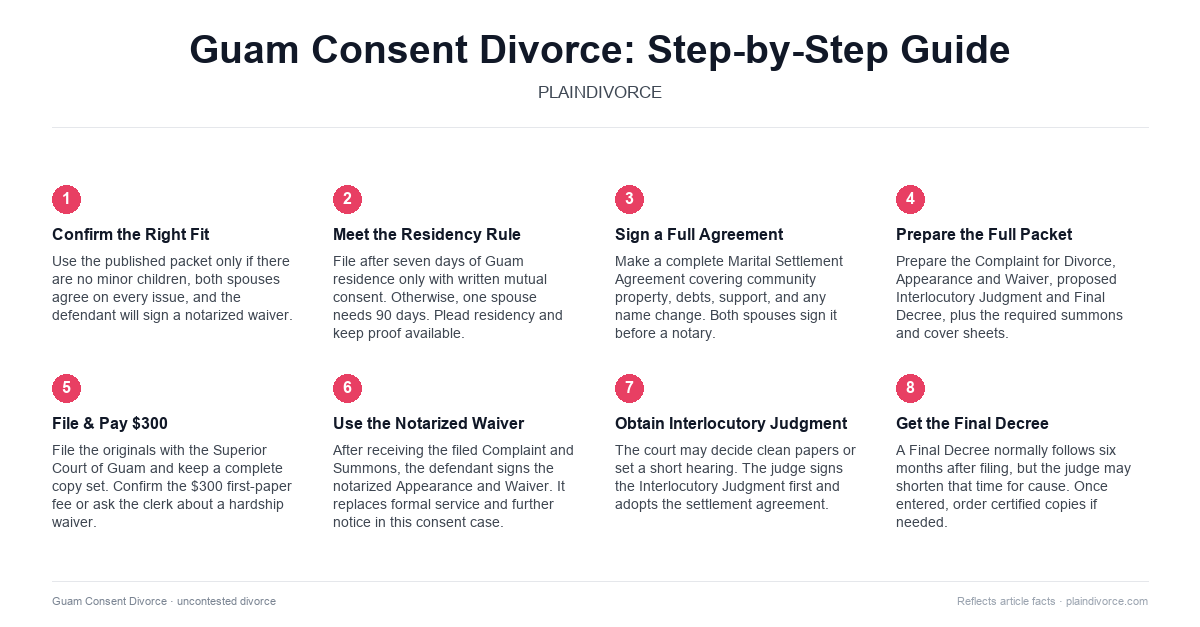
Consent divorce flow: confirm residency → write the settlement agreement → prepare the packet → file the Complaint → defendant signs the notarized Appearance and Waiver → interlocutory judgment → final decree.
Step 1 — Confirm your residency path
Decide whether you are using the 7-day written-consent rule or the 90-day rule, and gather proof of the filing spouse’s physical presence dates. Remember the court must make residency findings even in a consent case.
Step 2 — Write your Marital Settlement Agreement
Guam is a community property jurisdiction, so the agreement should clearly divide property and debts acquired during the marriage and address spousal support. Both spouses sign it before a notary. This is the document the judge adopts as the court’s own decision, so make it complete and specific.
Step 3 — Prepare the full packet
Fill in the Complaint for Divorce, the Appearance and Waiver, the proposed Interlocutory Judgment and Final Decree, and the cover sheets. Keep names, dates, and property descriptions identical across every form. The Complaint pleads irreconcilable differences under § 8219 and asks the court to shorten the six-month wait under § 8322.
Step 4 — File with the Superior Court of Guam
- Make at least one full copy set for your records.
- File the originals with the Clerk of the Superior Court of Guam (120 West O’Brien Drive, Hagåtña, or the Northern Court Satellite in Dededo).
- Pay the filing fee (see section 9) or apply for a fee waiver if it is a hardship.
Step 5 — The defendant signs the Appearance and Waiver
In a non-consent case you would have to formally serve the other spouse. Here, the defendant instead signs the notarized Appearance and Waiver, which says they received the filed Complaint and Summons, enter an appearance, and give up formal service and further notice. The Summons still exists and the defendant still receives the Complaint — the waiver just removes the service-of-process step and lets the case be heard as a default (uncontested) matter.
Step 6 — Interlocutory judgment, then final decree
The court may decide a clean consent case on the papers or set a short hearing at which the plaintiff briefly confirms the facts. Under 19 GCA § 8320, the judge may grant an uncontested divorce on the verified Complaint when it serves the interests of justice, and any extra proof the court wants must be by sworn affidavit. The judge signs the Interlocutory Judgment first, then the Final Decree (section 6).
Step 7 — Get certified copies
Once the Final Decree is entered, order certified copies from the clerk. You will need them for a name change, Social Security, immigration, benefits, or remarriage.
6. Interlocutory Judgment, the Six-Month Rule, and the Final Decree
Guam uses a two-step divorce judgment:
- Interlocutory Judgment of Divorce (§ 8321): the court’s decision that a divorce should be granted. Once it is entered, neither spouse can dismiss the case without the other’s consent. It must contain the Social Security numbers of both parties and all children.
- Final Decree of Divorce (§ 8322): the order that actually ends the marriage and restores both people to single status so they can remarry.
The six-month rule. Under 19 GCA § 8322, the Final Decree can be entered only after (1) an interlocutory decree has been entered and (2) six months have passed since the initial Complaint was filed. The clock runs from the filing date, not from the interlocutory step. The court may shorten that six-month period on a party’s application showing cause — and Guam’s Uncontested Divorce packet is written to request exactly that: the Complaint, the settlement agreement, and the proposed Final Decree all ask the court to shorten the wait. Many cooperative cases are finalized well before six months, but shortening is at the judge’s discretion, not automatic. If either spouse files an appeal, the Final Decree cannot be entered until the appeal is resolved.
7. If You Have Minor Children
The Judiciary of Guam’s published Uncontested Divorce packet is a no-minor-children packet. Its Complaint and its Marital Settlement Agreement both state, in writing, “there are no minor children of the marriage.” You cannot simply bolt custody and child-support language onto it.
If you have minor children, you need case-specific domestic-relations paperwork and, in most cases, legal help. Guam law still governs the outcome: under 19 GCA § 8404, custody is awarded according to the best interest of the child, and under § 8403 the court may make — and later modify — orders for the care, education, maintenance, and support of the children. A parenting plan you both agree on is given weight, but it is not automatically adopted; the judge still has to be satisfied it serves the children. Talk to the Family Court self-help resources or a Guam family-law attorney before filing.
8. How Long a Consent Divorce Takes in Guam
There is no guaranteed timeline. The seven-day residency rule affects only how soon you can file. After that, the pace depends on:
- Your paperwork: a complete, internally consistent packet with proper notarization is the biggest thing within your control.
- The defendant’s Appearance and Waiver: getting it signed and correctly notarized, especially if that spouse is off-island.
- Clerk review and the court’s calendar: a military legal-assistance handout notes that the gap between filing and a scheduled appearance can be six weeks or more.
- The two-step judgment and the six-month rule: even with a request to shorten the wait, the interlocutory judgment comes first and the final decree follows.
A cooperative, no-children case with clean paperwork and a granted request to shorten the waiting period can finish in a matter of weeks to a few months. Build in extra time if a spouse lives abroad.
9. What a Consent Divorce Costs in Guam
- Court filing fee: $300 for the first paper in a divorce or dissolution, on the Judiciary of Guam Schedule of Fees (dated August 1, 2019 and still posted as current). Confirm the amount with the Clerk of the Superior Court before you file.
- Notary fees: required for the Appearance and Waiver and the Marital Settlement Agreement. A military legal assistance office can notarize for eligible service members and dependents at no charge.
- Certified copies of the Final Decree: roughly $1 per page plus a certification fee on the same schedule.
- A paper fee for the other spouse: the fee schedule lists a separate charge for a first paper filed on behalf of an adverse party; ask the clerk whether it applies to the Appearance and Waiver in a consent case.
- Optional help: a limited-scope attorney review of your settlement agreement, or a self-help kit.
If the filing fee is a hardship, ask the clerk about the Superior Court’s fee-waiver (in forma pauperis) process.
10. When a DIY Divorce Is Not the Right Call
- Domestic violence, threats, stalking, or coercive control.
- A spouse hiding assets or refusing to share financial information.
- Complex property: a business, multiple properties, military or civilian pensions, or stock compensation.
- Minor children, or any real dispute about custody or support.
- Significant immigration, tax, or benefits consequences — common when one spouse is a foreign national or lives off-island.
- You feel pressured to sign terms you do not understand.
In any of these situations, a consultation before filing helps you understand the risks — even if the goal is still to settle.
11. Where a Self-Help Divorce Kit Fits In
For most cooperative couples, the hard part of an uncontested divorce in Guam is not the decision — it is the paperwork and the order of operations: the right residency path, a complete settlement agreement, the correctly notarized Appearance and Waiver, and proposed orders that match. A self-help kit keeps that organized.
- Clarity: plain-English explanations of what each Guam form is and when it is filed.
- Checklists: so signatures, notarizations, attachments, and the filing sequence are all accounted for.
- Consistency: keeps names, dates, and property descriptions matching across every form.
- Hearing prep: what to expect if the judge sets a short appearance.
PlainDivorce kits provide structured information and tools, not legal advice. They do not replace a lawyer, but they can make a genuinely cooperative case easier to manage.
12. FAQ: Fast Answers to Common Guam Questions
What is a consent divorce in Guam?
It is an uncontested dissolution of marriage where both spouses agree to the divorce and to how property and debts are divided. The defendant signs a notarized Appearance and Waiver instead of being served, the couple files a notarized Marital Settlement Agreement, and the Superior Court of Guam grants the divorce on the ground of irreconcilable differences without a contested trial. The published packet is for couples with no minor children.
How long do you have to live in Guam before filing for divorce?
If both spouses consent in writing, one spouse only needs seven days of Guam residency immediately before filing (19 GCA § 8318(b)). Without written mutual consent, one spouse must have been a Guam resident for at least 90 days. Military assignment to a Guam unit or ship for 90 days counts, and 90 days of physical presence is a conclusive presumption. Residency must be pleaded and proved in every case.
Does the consent form have to be notarized?
Yes. Under 19 GCA § 8319(b), every consent to a Guam divorce must be acknowledged or verified before a notary or other authorized officer if signed in the United States, before a U.S. consular officer if signed abroad, or by a foreign notary authenticated by a U.S. consular officer. The packet’s Appearance and Waiver and the Marital Settlement Agreement both include notary blocks. An unnotarized signature is not enough.
What is the Consent to Divorce waiver form actually called?
In the Judiciary of Guam packet it is the “Appearance and Waiver of Notice and Waiver of Rights Under the Soldiers’ and Sailors’ Civil Relief Act of 1940.” The defendant signs it to acknowledge receiving the Complaint and Summons, enter an appearance, waive formal service and further notice, and waive Servicemembers Civil Relief Act protections so the case can be heard as an uncontested default.
How long does an uncontested divorce take in Guam?
By statute the final decree cannot be entered until an interlocutory decree has been entered and six months have passed since the Complaint was filed (19 GCA § 8322). The court can shorten that six-month wait for cause, and the Uncontested Divorce packet is written to request it. A clean, cooperative, no-children case can finish in weeks to a few months; expect longer if a spouse lives off-island.
How much does it cost to file for divorce in Guam?
The Judiciary of Guam Schedule of Fees lists $300 for the first paper in a divorce or dissolution. That schedule is dated August 1, 2019 and is still posted as current, so confirm the amount with the Clerk of the Superior Court before filing. Add notary fees and, later, a small per-page fee for certified copies of the decree. A fee waiver is available for hardship.
Can we use the Uncontested Divorce packet if we have children?
No. The packet’s Complaint and Marital Settlement Agreement both state that there are no minor children of the marriage. Parents need case-specific custody and child-support paperwork, and usually legal help. Guam law decides custody by the best interest of the child (19 GCA § 8404) and lets the court make and modify support orders (§ 8403).
What is the difference between the interlocutory judgment and the final decree?
The Interlocutory Judgment of Divorce is the court’s ruling that the divorce should be granted and that your settlement agreement is adopted; once it is entered, neither spouse can dismiss the case alone. The Final Decree of Divorce actually ends the marriage and restores both people to single status. Both must include the parties’ and any children’s Social Security numbers (19 GCA §§ 8321, 8322).
13. Final Thoughts and Next Steps
If you and your spouse are genuinely on the same page and have no minor children, an uncontested divorce in Guam is manageable without a lawyer. The seven-day written-consent residency rule is a real advantage, the filing fee is modest, and the notarized Appearance and Waiver keeps the case cooperative. The things to get right are the paperwork (consistent facts, proper notarization, Social Security numbers in the decrees) and the sequence.
Your next steps:
- Confirm the residency path and gather proof of the filing spouse’s presence dates.
- Reach a written, notarized agreement on community property, debts, and support.
- Download the current Uncontested Divorce packet from the Judiciary of Guam’s official self-help forms page.
- Have the defendant sign the Appearance and Waiver before a notary (or a U.S. consular officer if abroad).
- Decide whether a self-help kit would help you stay organized, and get legal advice if anything feels unsafe, unfair, or complex — or if you have children.
This guide is information, not legal advice. Confirm the current statute language in 19 GCA Chapter 8 (Dissolution of Marriage) and current fees with the Superior Court of Guam before you file. With careful preparation and the right sequence, many Guam couples finish a consent divorce without turning it into a court battle.
Sources and local rules can change. Use this guide as a plain-English organizer, then verify the current filing requirements with the official court or government source for your jurisdiction.

About Harry D
Expert contributor at PlainDivorce, helping Canadians and American navigate simple uncontested divorces with clarity and confidence.