Uncontested Divorce by Affidavit in Hawaii: How the No-Hearing Path Works
An uncontested divorce by affidavit in Hawaii is a cooperative, no-fault case where you and your spouse agree on everything and the judge finalizes the divorce by reviewing your paperwork instead of holding a courtroom hearing. You file a Complaint for Divorce in the Family Court of the circuit where you are domiciled, your spouse signs an Appearance and Waiver, you both complete sworn financial statements, and you file a sworn Affidavit of Plaintiff that stands in for live testimony. If your packet is complete and your case qualifies, most filers never have to appear in court.
TL;DR
- What it is: a no-fault, fully agreed divorce where a judge reviews your written packet and signs the Divorce Decree without making you testify at a hearing.
- Where you file: the Family Court of the circuit where you are domiciled when you file (First/Oʻahu, Second/Maui County, Third/Hawaiʻi Island, Fifth/Kauaʻi). There is no statutory “three months in the circuit” rule for divorce, but the court generally looks for about six months of Hawaii domicile before finalizing.
- Core Hawaii divorce forms: the Complaint for Divorce; Automatic Restraining Order; Summons, a Matrimonial Action Information form, an Asset and Debt Statement (Hawaii form), an Income and Expense Statement, the Affidavit of Plaintiff for Divorce Hawaii uses in place of testimony, and a proposed Divorce Decree. Your circuit’s checklist controls the exact set.
- Cooperative spouse: a signed, notarized Appearance and Waiver form (Hawaii) means you don’t need a process server — but your spouse still has to receive the filed documents and, in most packets, sign the decree first.
- Cost: $215 filing fee with no minor children, $265 if either spouse has a minor child from any relationship (a $50 parent-education surcharge). Fee waivers are available.
- Timeline: circuit-specific. The First Circuit tells filers to expect a decision within 6–10 weeks of the judge’s review; the Second Circuit says about two weeks to review and sign. An incomplete packet is the main delay you control.
- Kids involved? Expect a parent-education class (Kids First, Children First, or Children in Transition, by circuit), a Child Support Guidelines Worksheet, and either a wage-withholding order or a notarized direct-payment affidavit.
1. What an Uncontested Divorce by Affidavit in Hawaii Really Is
Every divorce in Hawaii goes through the Family Court of one of the state’s four judicial circuits. A case is uncontested when both spouses agree the marriage is over and have already settled every issue — property, debts, spousal support, and, if there are children, custody, time-sharing, decision-making, and child support — before the judge is asked to sign anything.
The phrase “uncontested divorce by affidavit in Hawaii” points to how these cases finish. Instead of testifying in a courtroom, the filing spouse (the plaintiff) submits a sworn Affidavit of Plaintiff that gives the judge the facts the law requires — residency, the grounds for divorce, and confirmation that the agreement is fair. The judge reviews that affidavit and the rest of the packet on paper. When everything is complete and the case qualifies, the judge grants the divorce without requiring anyone to appear.
How that “no appearance” outcome is reached depends on your circuit. In the First Circuit (Oʻahu), filing the proposed Divorce Decree with the signed Appearance and Waiver and Affidavit of Plaintiff automatically sets your documents for the judge’s review. In the Second Circuit (Maui County), you file a separate Request for Non-Hearing Uncontested Divorce. Either way, the affidavit is the piece that lets the judge rule on the paperwork alone — it is a court procedure, not an automatic statutory right, so follow your circuit’s checklist exactly.
Hawaii does not use “simple divorce” as an official category. Most simple cases are no-fault: one spouse states that the marriage is irretrievably broken, meaning it cannot be repaired. You do not have to prove adultery, cruelty, or any other wrongdoing.
One thing many DIY filers don’t expect: the moment you file the Complaint, an Automatic Restraining Order under Hawaiʻi Revised Statutes § 580-10.5 takes effect. It binds you when you file and your spouse when they are served or otherwise accept service. Until the decree is entered, neither spouse may sell, transfer, hide, or dispose of property (everyday living expenses, ordinary business, attorney’s fees, a written agreement, or a court order aside); take on debt that burdens the other’s credit; change the beneficiary of a life insurance policy, pension, or retirement plan; or drop existing insurance coverage. Neither parent may move a minor child out of the child’s current home or school. It is routine, not a sign of conflict, and the defendant can ask the court to modify it.
2. Who Qualifies: Domicile, Grounds, and Full Agreement
Before you think about forms, confirm three things: you can file where you want to file, you have a valid ground, and you have a genuine agreement.
2.1 Where you file: domicile and circuit
Under HRS § 580-1, the Family Court that can hear a divorce is the one for the circuit where the applicant is domiciled at the time the application is filed. “Domiciled” means Hawaii is your true, fixed home — where you live and intend to stay — not just where you happen to be. The statute’s separate “physically present for a continuous period of at least three months” language applies to annulment and separation, not divorce, so the older “3 months in your circuit” shorthand is not the divorce rule.
There is still a durational element: Hawaii courts, following case law under the statute, generally expect about six months of Hawaii domicile before the divorce is finalized (not before you file). A narrow exception in HRS § 580-1(b) lets some couples proceed when the marriage was performed in Hawaii and neither spouse lives anywhere that recognizes it. If your residency is borderline, ask your circuit’s Family Court how it applies the domicile rule before you file.
Hawaii’s four divorce circuits are:
- First Circuit – Oʻahu
- Second Circuit – Maui, Molokaʻi, Lānaʻi
- Third Circuit – Hawaiʻi Island
- Fifth Circuit – Kauaʻi
Why the circuit matters: each circuit publishes its own uncontested-divorce checklist, its own form numbers, and its own local filing and mailing rules. Always start from the packet for your circuit and your case type (with or without minor children).
2.2 Grounds for divorce in Hawaii
Nearly every uncontested case uses the no-fault ground that the marriage is irretrievably broken. That is the usual ground for this guide, but it is not the only one. HRS § 580-41 also allows a divorce after the spouses have lived apart under a decree of separation whose term has expired, after two years apart under a decree of separate maintenance, or after a continuous two-year separation, as long as a decree would not be harsh or oppressive. For a cooperative case, “irretrievably broken” is almost always the simplest route.
2.3 When the affidavit path is a good fit
| The affidavit path usually works when… | Get legal advice first when… |
|---|---|
| Both spouses agree the marriage is over | There is domestic abuse, coercion, or a safety concern |
| You agree on property, debts, and spousal support and can write it down | One spouse controls the money or information, or you suspect hidden assets |
| If you have children, you agree on custody, time-sharing, and guideline child support | There is a genuine dispute about the children or support |
| Both spouses will sign and notarize the paperwork, including the decree | Finances are complex — a business, several properties, large retirement accounts |
| Neither spouse needs the judge to decide a contested issue | Immigration, tax, or bankruptcy consequences are tied to the divorce |
If anything in the right-hand column applies, talk to a Hawaii family-law attorney or a legal aid clinic before you sign or file.
3. Step by Step: Filing an Uncontested Divorce by Affidavit in Hawaii
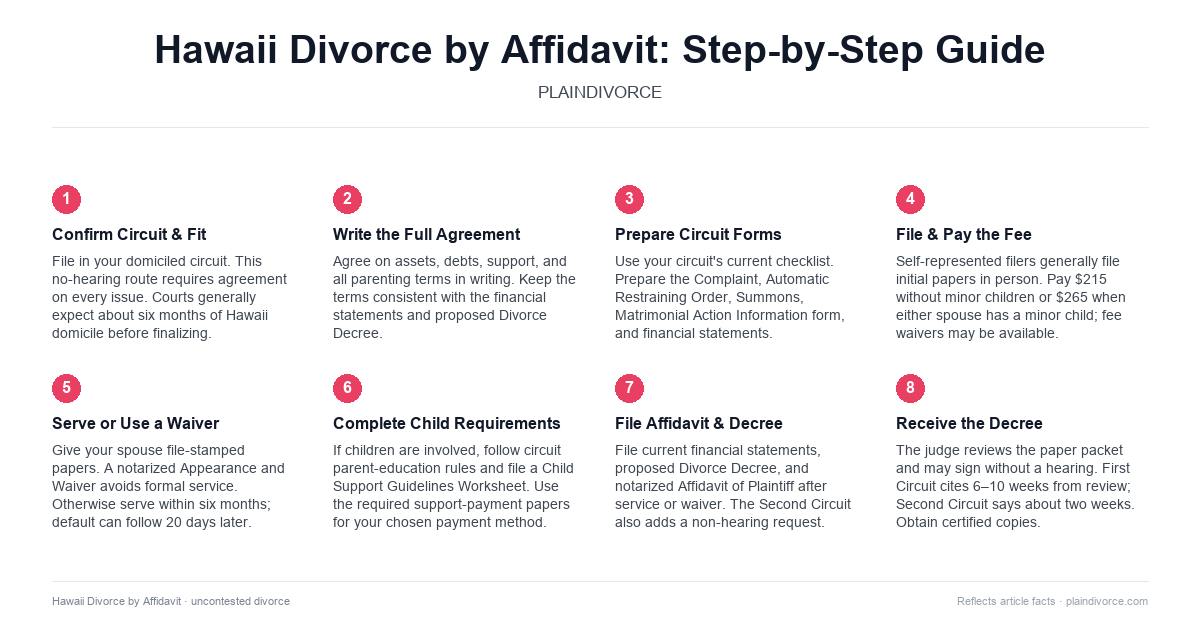
- Confirm your circuit, domicile, and a full agreement
- Prepare your circuit’s Complaint packet and the required cover forms
- File the initial documents in person and pay the fee (or request a waiver)
- Serve your spouse, or have your spouse sign the Appearance and Waiver
- Attend the parent-education class if it applies to you
- File the financial statements, the proposed decree, and the Affidavit of Plaintiff
- The judge reviews the packet and signs the Divorce Decree — usually with no hearing
Step 1 – Confirm your circuit and eligibility
- Are you domiciled in the circuit where you plan to file (First, Second, Third, or Fifth)?
- Have you lived in Hawaii long enough that the court will finalize — generally about six months of domicile?
- Is your case genuinely uncontested, with full agreement on every issue?
Step 2 – Put your agreement in writing
Before you touch a form, make a clean, shared list of:
- Assets — home, vehicles, bank accounts, retirement, personal property
- Debts — credit cards, loans, mortgages
- Who keeps what, and who pays what going forward
- Spousal support terms, if any, and all child-related terms if you have children
Hawaii’s forms ask for the same financial information in several places, and the proposed Divorce Decree has to match your financial statements. Inconsistent numbers are a common reason a judge sends a packet back for correction.
Step 3 – Prepare your circuit’s Hawaii divorce forms
There is no single statewide packet. Start from your circuit’s current uncontested-divorce checklist and instructions (the First Circuit’s were last revised in April 2024) and use the version for your case type. Across circuits, an uncontested packet built around the Complaint generally includes:
- Complaint for Divorce; Automatic Restraining Order; Summons to Answer Complaint — the single filing that starts the case and triggers the restraining order.
- Matrimonial Action Information form — the case-data cover sheet the clerk needs to open the file.
- Notice of Confidential Information, and, where children are involved, a Notice to Attend Kids First (the First Circuit’s without-children packet also requires the Kids First notice if either spouse has a minor child from a prior relationship).
- Asset and Debt Statement (Hawaii form) and Income and Expense Statement — sworn financial disclosures. The plaintiff’s are required; the defendant’s are not required in a default or if the defendant refuses (you explain that in the Affidavit of Plaintiff). One combined Asset and Debt Statement can cover both spouses if both sign.
- Child Support Guidelines Worksheet (child cases) — signed by both parties, or by the plaintiff alone in a default.
- Appearance and Waiver form (Hawaii) — the defendant’s notarized acknowledgement of the filed documents (see Step 5). Not used in a default.
- Affidavit of Plaintiff for Divorce (Hawaii) — the sworn statement that replaces testimony. It is completed last, after everything else, including the proposed decree, is ready.
- Proposed Divorce Decree — the order the judge signs, plus (in the Second Circuit) a Request for Non-Hearing Uncontested Divorce.
Circuit note: form titles, numbers, and required extras differ. The First Circuit child packet adds the Notice to Attend Kids First, the Notice of Confidential Information, and the Child Support Guidelines Worksheet; the Second Circuit adds the Request for Non-Hearing Uncontested Divorce and a Kids First Information Sheet; the Third Circuit has its own set. Use your circuit’s checklist as the master list.
Step 4 – File the initial documents (in person)
In the First Circuit, self-represented plaintiffs must file the initial documents in person at a courthouse and pay the filing fee; the Judiciary Electronic Filing and Service System (JEFS) accepts initial filings only from attorneys. After you file, you can register for a JEFS account to file later documents electronically. Other circuits also take self-represented filings in person — the Second Circuit at the Legal Documents Branch in Wailuku, for example. Do not assume a statewide online or mail-in option.
When you file in person you get file-stamped originals back immediately. Keep copies of everything. If the Matrimonial Action Information form is missing, the clerk may not be able to open the case.
Step 5 – Service, or the Appearance and Waiver form Hawaii uses
Your spouse must be given the filed documents. The Appearance and Waiver form (Hawaii) is the cooperative route: after your spouse receives a file-stamped copy of the Complaint, Automatic Restraining Order, and Summons — and, in the current First and Second Circuit packets, signs the proposed Divorce Decree — your spouse signs the Appearance and Waiver before a notary. It is your spouse’s acknowledgement of the filed papers and acceptance of the case. It means you don’t need a process server; it does not skip your spouse receiving the documents.
If your spouse won’t sign, you must complete formal service:
- A spouse who lives on the same island is personally served by any adult who is not you (a process server or another responsible person).
- A spouse on another island or out of state must be served under a court-approved ex parte motion for service by mail or personal service — file that motion with your initial documents.
- The file-stamped initial documents must be served within six months of filing, or the case is dismissed.
- If your spouse files no answer and does not contact you within 20 days of receiving the Complaint and Summons, you may proceed by Uncontested Divorce by Default. In a default, your spouse’s financial statements and signatures are not required, and direct payment of child support is not an option.
Confirm your spouse’s military status on the Affidavit of Plaintiff; a servicemember defendant has extra protections under the federal Servicemembers Civil Relief Act.
Step 6 – File financial disclosures and the Affidavit of Plaintiff
After service (or the signed waiver), file the Income and Expense Statement and the Asset and Debt Statement (Hawaii form). The First Circuit wants the information current within the past six months; the Second Circuit wants it dated within 60 days of the date your case goes on the calendar — another reason to check your circuit’s rule.
Then complete the Affidavit of Plaintiff for Divorce Hawaii requires. This is the sworn document that carries your case: it confirms residency and grounds, describes the agreement, and explains anything unusual (for example, why a defendant’s financial statement is missing). You sign it in front of a notary, and it is filed with the proposed decree and the signed Appearance and Waiver.
Step 7 – The judge reviews your packet (usually no hearing)
This is the step the phrase “by affidavit” is about. In the First Circuit, filing the proposed Divorce Decree automatically sets your uncontested documents for the judge’s review. In the Second Circuit, your Request for Non-Hearing Uncontested Divorce asks for the same thing. If the packet is complete and the terms are acceptable, the judge signs the decree without scheduling an appearance. If something is missing, the judge returns the file with written instructions, and you fix and resubmit.
Step 8 – Receive your Divorce Decree
Once the judge signs and the court files it, the Divorce Decree is your proof the marriage has ended. How you get your certified copies depends on how you filed:
- Filed in person: in the First Circuit, if you want the decree mailed you bring two self-addressed, stamped envelopes at least 9″ x 12″ with enough postage — one for you, one for your spouse. Otherwise you can pick the decree up at the courthouse.
- Filed through JEFS (attorneys): certified copies are available to download.
Check status through eCourt Kokua on the Judiciary website; the court will not give case status by phone. You can request additional certified copies later for name changes and benefits updates.
4. Children: Kids First, Child Support, and Income Withholding
Children don’t stop you from having an uncontested divorce, but they add documents and closer review. Agreement does not remove the court’s duty to check that support and custody terms meet Hawaii law.
Parent education (Kids First and its counterparts)
Two separate things get confused here. The $50 parent-education surcharge is added to the filing fee by statute whenever either party has a minor child from this marriage or any other relationship. The class itself is run by each circuit’s program, and attendance rules and any excusal are local:
- Kids First – First Circuit (Oʻahu), Second Circuit (Maui County), Fifth Circuit (Kauaʻi)
- Children First (Kona) and Children in Transition (Hilo) – Third Circuit (Hawaiʻi Island)
In the First Circuit, attendance is mandatory when it applies, you are assigned a class date after you file, you cannot self-schedule, and proof of completion must be in the file before the judge signs. The court can excuse attendance in some situations; there is no single statewide exemption form, so ask your circuit how to request one. School-age children who lived with the family may also have to attend unless the court excuses them. Confirm the current program name, format, and fee for your circuit before you file.
Child support, the worksheet, and how support is paid
Hawaii child support is guideline-based. You must file a Child Support Guidelines Worksheet — signed by both parents, or by the plaintiff alone in a default — using the current Hawaiʻi Child Support Guidelines. The court expects the guideline amount unless there is a valid reason to deviate, explained in writing.
How support is paid drives the paperwork:
- Through the Child Support Enforcement Agency (CSEA): you prepare an Order/Notice to Withhold Income for Child Support. It is file-stamped after the judge signs the decree, and you then mail certified copies to CSEA and to the paying parent’s employer, with a Statement of Mailing filed back with the court.
- Directly between parents: instead of a withholding order, the paying parent signs a notarized Supplemental Affidavit Re: Direct Payment of Child Support. This is not available in a default, and not available if a child receives public assistance.
So a withholding order is not automatically required in every child case — only when support runs through CSEA.
Parenting plan and custody terms
Your paperwork must spell out physical and legal custody, a time-sharing schedule, decision-making, holidays, and transportation. If a plan is vague or does not appear to serve the children’s best interests, the judge can require changes even in an uncontested case.
5. How Long an Uncontested Divorce by Affidavit Takes in Hawaii
There is no statewide “average.” Timelines are set by each circuit, and the biggest variable you control is whether your packet is complete. The court’s own current estimates:
| Circuit | Published estimate | Measured from |
|---|---|---|
| First Circuit (Oʻahu) | Confirmation of grant or denial within 6–10 weeks; certified copies mailed within 6–10 weeks of the judge’s approval | The judge’s review date |
| Second Circuit (Maui County) | About two weeks for the judge to review and sign | Submission of the final packet |
| Third / Fifth Circuits | Not published statewide — ask the circuit | — |
Note the First Circuit’s 6–10 weeks runs from the judge’s review to mailed copies — it is not a review period plus a separate mailing period. Common delay drivers are a missing Matrimonial Action Information form, missing signatures or notarizations, financial statements that don’t match the decree, service problems, an unmet parent-education requirement, or missing child-support paperwork.
6. What an Uncontested Divorce Costs in Hawaii
Per the Hawaiʻi State Judiciary’s court filing-fee schedule (effective June 17, 2022), the divorce filing fee is:
- $215 if neither party has minor children
- $265 if either party has a minor child from this marriage or any other relationship (adding the $50 parent-education surcharge)
| Item | Typical cost | When it applies |
|---|---|---|
| Court filing fee | $215 / $265 | Every case |
| Service fees | Process-server or certified-mail cost | When the defendant won’t sign an Appearance and Waiver |
| Notary fees | Per signature (banks and some agencies are free) | Affidavit of Plaintiff, Appearance and Waiver, direct-payment affidavit |
| Parent-education class | Program fee, varies by circuit | Cases where the class requirement applies |
| Certified copies / postage | Per-copy fee plus envelopes and postage | To have the decree mailed or to get extra copies |
If the fee is a hardship, you can ask the court to waive it through your circuit’s fee-waiver (in forma pauperis) procedure; a granted waiver can also cover the parent-education surcharge. Legal Aid Society of Hawaiʻi and Volunteer Legal Services Hawaiʻi may be able to help you prepare the request, though neither can guarantee assistance. Fee schedules change — confirm the current amount with your circuit before filing.
7. When a DIY Divorce Might Not Be Right for You
The affidavit path is built for cooperative, low-conflict cases. Be cautious about going fully DIY if there is domestic violence or coercion, hidden assets, complex finances (a business, multiple properties, large retirement accounts), immigration consequences, or serious tax or bankruptcy issues. In those situations, get legal advice before you sign or file anything — even one consultation can catch a costly, hard-to-undo mistake.
8. Where a Self-Help Divorce Kit Fits Into the Process
If your case is truly uncontested, a Hawaii-focused self-help kit can keep you organized around the local steps that trip people up: filing the Complaint with the Matrimonial Action Information form, using the Appearance and Waiver form correctly, keeping the Asset and Debt Statement (Hawaii form) and Income and Expense Statement consistent with the decree, and completing the Affidavit of Plaintiff for Divorce Hawaii uses so the judge can rule on the paperwork alone.
If you have children, a kit can also help you track the gatekeeper items — parent-education completion, the Child Support Guidelines Worksheet, and either the withholding order or the direct-payment affidavit — that are common reasons cases stall.
Download Our Hawaii Uncontested Divorce Self-Help KitPlainDivorce kits are DIY information tools. They do not replace a lawyer, do not represent you in court, and cannot guarantee outcomes. If cooperation breaks down, pause and consider legal help before moving forward.
9. Frequently Asked Questions
What is an uncontested divorce by affidavit in Hawaii?
It is a fully agreed, no-fault divorce where the filing spouse submits a sworn Affidavit of Plaintiff and the rest of the packet for a judge’s review instead of testifying at a hearing. If the paperwork is complete and the case qualifies, the judge signs the Divorce Decree without requiring anyone to appear. Each circuit has its own procedure for reaching that no-hearing outcome.
What are the residency rules for a Hawaii divorce?
Under HRS § 580-1, you file for divorce in the Family Court of the circuit where you are domiciled when you file — Hawaii is your true, fixed home. The “three months of physical presence” language in the statute applies to annulment and separation, not divorce. Case law under the statute points to about six months of Hawaii domicile before the divorce is finalized. If your residency is borderline, ask your circuit’s Family Court how it applies the rule.
What financial forms are required for a Hawaii divorce?
Hawaii Family Court generally requires an Income and Expense Statement and an Asset and Debt Statement (Hawaii form). The plaintiff’s are always required; the defendant’s are not required in a default or if the defendant refuses to provide them, and one combined Asset and Debt Statement can cover both spouses if both sign. Child cases also need a Child Support Guidelines Worksheet. Currency rules differ by circuit.
What does the Appearance and Waiver form do in Hawaii?
After your spouse receives a file-stamped copy of the Complaint, Automatic Restraining Order, and Summons — and, in most current packets, signs the proposed Divorce Decree — your spouse signs the Appearance and Waiver before a notary. It is your spouse’s acknowledgement of the filed documents and acceptance of the case, so you don’t need a process server. It does not remove your spouse’s right to receive the documents.
How long does an uncontested divorce take in Hawaii?
It is circuit-specific. The First Circuit tells filers to expect confirmation of a grant or denial within 6–10 weeks of the judge’s review, with certified copies mailed in that same window. The Second Circuit says about two weeks to review and sign. Missing forms or signatures are the most common cause of delay.
How much does an uncontested divorce cost in Hawaii?
The statewide filing fee is $215 if neither spouse has minor children, or $265 if either spouse has a minor child from any relationship (a $50 parent-education surcharge). Add notary, service, certified-copy, and any parent-education class fees. Fee waivers are available through your circuit’s fee-waiver procedure. Confirm current amounts before filing.
If I have children, do I have to take a parenting class?
Usually, yes, when either spouse has a minor child. The class is called Kids First on Oʻahu, Maui, and Kauaʻi, and Children First (Kona) or Children in Transition (Hilo) on Hawaiʻi Island. In the First Circuit it is mandatory when it applies, the court assigns your class date, and proof of completion must be filed before the judge signs. The court can excuse attendance in some cases; ask your circuit how to request that.
Do I need a lawyer for an uncontested divorce in Hawaii?
No, a lawyer is not required to file. But talk to one if there is domestic violence, coercion, hidden assets, complex finances, immigration consequences, or serious tax or bankruptcy issues — a fully DIY approach is best suited to cooperative, low-conflict cases.
10. Final Thoughts and Next Steps
If you and your spouse are on the same page, an uncontested divorce by affidavit in Hawaii lets a judge finalize your case on the paperwork, built around the Affidavit of Plaintiff so you usually never appear in court. The work is in getting your circuit’s procedure right.
- File in the circuit where you are domiciled, and expect the court to look for about six months of Hawaii domicile before finalizing.
- Start from your circuit’s current uncontested-divorce checklist — there is no statewide packet.
- File the initial documents in person, and don’t skip the Matrimonial Action Information form.
- Use the Appearance and Waiver form (Hawaii) when your spouse cooperates; otherwise serve within six months, or proceed by default after 20 days.
- Keep the Asset and Debt Statement (Hawaii form), the Income and Expense Statement, and the decree consistent, and complete the Affidavit of Plaintiff last.
- With children: plan for parent education, the Child Support Guidelines Worksheet, and either a withholding order (CSEA) or a notarized direct-payment affidavit.
This article is general legal information, not legal advice, and PlainDivorce is not a law firm. Hawaii court rules, forms, and fees change, and procedures differ by circuit — verify every form name, deadline, and dollar amount with your circuit’s Family Court Self-Help Center or a licensed Hawaii family-law attorney before you act.
Start With the Hawaii Uncontested Divorce KitSources and local rules can change. Use this guide as a plain-English organizer, then verify the current filing requirements with the official court or government source for your jurisdiction.

About Harry D
Expert contributor at PlainDivorce, helping Canadians and American navigate simple uncontested divorces with clarity and confidence.