Uncontested Divorce in Idaho: A Plain-English Guide to the CAO Forms and Timeline
An uncontested divorce in Idaho is a case where both spouses agree on everything — property, debts, support, and any parenting terms — so a judge can sign the Decree of Divorce by reviewing your paperwork instead of holding a trial. You file a Petition for Divorce using the free Idaho Court Assistance Office (CAO) forms, your spouse either signs a stipulation or is served, you wait out a short statutory period, and the court finalizes. Under Idaho Code § 32-716, no final decree can be entered until at least 21 days after you both file and serve.
TL;DR
- An uncontested divorce in Idaho means both spouses agree, so the judge signs the Decree of Divorce without a contested hearing.
- You use the standard Idaho divorce forms (CAO), starting with the Petition for Divorce — CAO D 1-5 (with minor children) or CAO D 1-6 (no minor children).
- Cooperative couples finalize with the Sworn Stipulation for Entry of Divorce Decree (CAO D 6-8), which lets the Respondent skip filing a separate Response.
- There is no “20-day” rule. Idaho Code § 32-716 bars a final decree until at least 21 days after both the case is filed and your spouse is served. The Summons also gives the Respondent 21 days to answer — a separate deadline that measures a different thing.
- Filing costs $207; a Response costs $136 (usually skipped on the stipulation route). With minor children, add a parenting plan, child support worksheet, CSS 809 transmittal form, an income-withholding order, and a parent-education class.
- The HWH-611 Certificate of Divorce is a preprinted form you get in person from a Court Assistance Officer or the clerk — it is filed with the Petition, and the clerk cannot finalize without it.
1. What Counts as an Uncontested (or “Simple”) Divorce in Idaho?
Idaho law has no special statutory label like “simple divorce.” What matters is whether your case is contested or uncontested — that is, whether the judge has to resolve a dispute or just review an agreement.
An uncontested divorce in Idaho is usually a case where:
- One spouse (the Petitioner) files a Petition for Divorce;
- The other spouse (the Respondent) cooperates and does not fight the requested terms; and
- You have already worked out arrangements for any children, support, property, and debts, so the court does not need a trial.
In a cooperative case, the goal is to hand the court a complete packet — ideally including the Sworn Stipulation for Entry of Divorce Decree — so the judge can sign the Decree of Divorce on the paperwork alone.
Idaho divorces are filed in the District Court for the appropriate county and are heard in the Magistrate Division. Most self-represented filers use the free Idaho divorce forms (CAO forms) published by the Idaho Court Assistance Office at courtselfhelp.idaho.gov, which put your documents in the format the court expects. For divorces with no minor children, the CAO also offers Idaho Guide and File, a free guided online questionnaire that helps you file, respond to, or finalize a divorce and assembles the paperwork for you. Cases with minor children are not yet covered by that tool.
2. Who Qualifies for an Uncontested Divorce in Idaho?
Residency requirements
Under Idaho Code § 32-701, a divorce must not be granted unless the spouse who files has been an Idaho resident for at least six (6) full weeks immediately before the action begins. If you do not meet that requirement when you file, the court cannot grant your divorce.
Which county you file in depends on where you and your spouse live. As a general rule, you file in the district court for the county where you or your spouse resides. If you are unsure which county is correct — for example, if your spouse lives out of state or you have recently moved — ask the district court clerk before you file.
Grounds for divorce
Idaho allows both fault and no-fault divorces. Idaho Code § 32-603 lists eight causes, including adultery, extreme cruelty, and felony conviction. Almost every uncontested case uses irreconcilable differences — the no-fault ground, defined in Idaho Code § 32-616 as substantial reasons the marriage should not continue. You do not have to prove wrongdoing.
Agreement on the big issues
Your case works as an uncontested divorce only if you both agree on:
- How to divide property and debts;
- Spousal support (maintenance), if any; and
- If you have minor children: a parenting plan and child support.
If there is domestic violence, intimidation, hidden assets, or a real dispute about children or money, get legal advice before relying on a DIY uncontested approach.
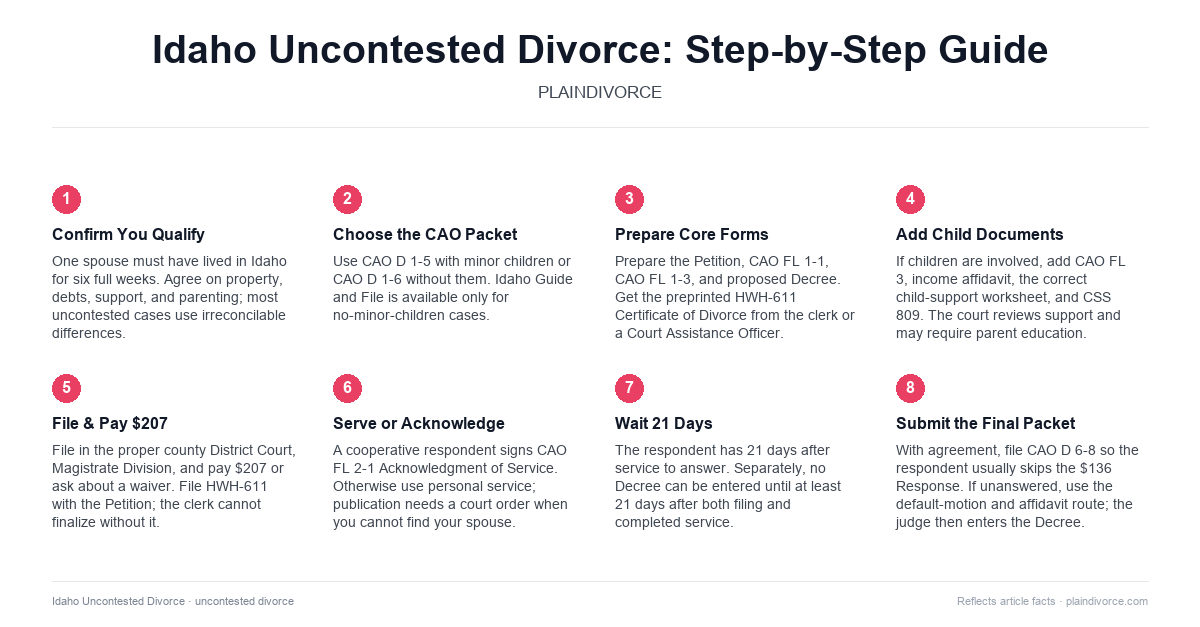
3. Step-by-Step: The Idaho Uncontested Divorce Process With CAO Forms
Every case is different, but most uncontested Idaho divorces follow this pattern of preparing and filing Idaho divorce forms (CAO). Always read the current CAO packet instructions and your county’s local rules first, because forms and steps are updated periodically.
Step 1 – Confirm you qualify and pick the right CAO packet
- Have you met the six-week Idaho residency rule?
- Are you filing on irreconcilable differences in a cooperative case?
- Are you using the correct packet? The CAO publishes separate form sets for divorces with minor children and without minor children.
If you have no minor children, the CAO’s Idaho Guide and File tool can build this paperwork for you through a guided questionnaire, instead of filling out the PDF forms by hand.
Step 2 – Write down your agreement
Uncontested cases move faster when your agreement is clear and consistent across every form. Write down who keeps which assets, who pays which debts, whether either spouse pays maintenance, and — if children are involved — the parenting schedule and the child support numbers. The proposed Decree has to match what your other forms say; mismatched figures are a common reason a judge sends a packet back.
Step 3 – Prepare the core Idaho divorce forms
The exact set varies by case type, but Idaho self-represented filers using a stipulation commonly need these CAO documents:
- Petition for Divorce (Idaho form) — CAO D 1-5 (with minor children) or CAO D 1-6 (no minor children); this starts the case.
- Family Law Case Information Sheet (CAO FL 1-1) — the required cover sheet for family law filings.
- Summons (CAO FL 1-3) — tells the Respondent they have 21 days to respond, and carries the checkbox for an order to attend a parent-education program.
- Acknowledgment of Service (CAO FL 2-1) — a cooperative service option that avoids sheriff or process-server fees.
- Sworn Stipulation for Entry of Divorce Decree (CAO D 6-8) — the statewide “we agree” document. Both spouses sign it as a certification that the information is true, subject to the penalty of perjury. It is not notarized. Signing it lets a cooperative Respondent finalize without filing a Response.
- Decree of Divorce — CAO D 8-1 (with children) or CAO D 8-3 (no children); the final order the judge signs. On the stipulation route you check the box stating that “Respondent and Petitioner have agreed and signed a written Sworn Stipulation to the entry of this Decree.”
- Vital Statistics Certificate of Divorce (HWH-611) — see the note below.
With minor children, add the Parenting Plan (CAO FL 3), the Affidavit Verifying Income (CAO FL 1-11), the correct Child Support Worksheet (CAO FL 1-13 for standard custody, or CAO FL 1-12 for shared, split, or mixed custody), and the Child Support Order Transmittal Form (CSS 809). If you are finalizing by default instead of stipulation, you will also use the Motion and Affidavit for Entry of Default (CAO FL 7-1) and the Affidavit in Support of Default Divorce (CAO D 7-6 without children, or CAO D 7-7 with children).
The HWH-611 hard stop: Idaho law requires a completed Certificate of Divorce to be prepared and submitted with the new petition or complaint, and the clerk cannot finalize a divorce without it. The real certificate is a preprinted form furnished to the court by the State Registrar — you cannot download a usable copy. You get it in person from a Court Assistance Officer or directly from the court clerk. Ask for it when you go to file.
Step 4 – File with the district court
Take your completed forms to the district court clerk in the correct county and pay the $207 filing fee (or ask about a fee waiver). Family law cases are heard in the Magistrate Division. Keep file-stamped copies of everything for your records, and pick up the HWH-611 Certificate of Divorce while you are there if you have not already.
Step 5 – Service, or the Acknowledgment of Service shortcut
Your spouse has to receive a copy of the filed Petition and Summons. Your options:
- Acknowledgment of Service (CAO FL 2-1) — the cooperative route. Your spouse signs to confirm they received the documents, and you file it with the court. No server fee.
- Personal service by the sheriff or a private process server — used when your spouse will not sign the acknowledgment.
- Service by publication — a court-approved procedure for when you genuinely cannot find your spouse. You need a court order first.
The date of service (or the date the Acknowledgment of Service is signed) starts the clock for both the 21-day response deadline and the 21-day statutory waiting period in Step 6.
Step 6 – The 21-day waiting period and the two tracks to finalize
Two 21-day periods run at the same time and are easy to confuse, because they measure different things:
- The response deadline: the Summons gives the Respondent 21 calendar days from service to file a written Response. Miss it, and the Petitioner can ask for default.
- The statutory waiting period: under Idaho Code § 32-716, no final decree can be entered until at least 21 days after both the case is filed and service of process is complete. This applies even when you agree on everything. (The statute has a narrow exception when both parties appear in person or through counsel at a trial on the merits — not something that applies to a paper, no-hearing stipulation.)
Stipulation track: if the Respondent signs the Sworn Stipulation for Entry of Divorce Decree (CAO D 6-8), they do not file a Response at all. You attach the signed stipulation and the proposed Decree, file them with the clerk along with the Acknowledgment of Service, the original Summons, the HWH-611, the CSS 809 (if there are children), and stamped return envelopes. The clerk sends the file to the judge; a hearing is set only if the judge specifically wants one.
Default track: if you serve your spouse and they do nothing within 21 days, you file the Motion and Affidavit for Entry of Default and your final paperwork for the judge’s review. This route is usually slower than a clean stipulation.
If a Response is filed and either spouse wants terms different from what was requested, the Idaho Rules of Family Law Procedure generally require both sides to exchange mandatory financial disclosures within 35 days of the Response, unless the case settles first by default or stipulation. Missing that deadline can delay finalization. See the Idaho Rules of Family Law Procedure for the current rule.
Step 7 – The judge signs the Decree of Divorce
When the judge approves the packet, the court signs and enters the Decree of Divorce — your proof the marriage is legally over. Ask the clerk how to get certified copies for name changes, benefits, retirement plans, or a future marriage. In an uncontested stipulation case, the clerk typically mails each spouse a copy in the envelopes you provided.
4. Extra Steps When You Have Minor Children
Minor children do not stop you from having an uncontested divorce in Idaho, but they add forms and closer review. Even when you agree, the court checks that your plan serves the best interests of the child.
- Parenting plan (CAO FL 3): a clear weekly schedule, holiday plan, and decision-making structure.
- Child support: calculated under the Idaho Child Support Guidelines using both parents’ income. Your packet includes the Affidavit Verifying Income (CAO FL 1-11) and either the Standard Child Support Worksheet (CAO FL 1-13) or the Shared, Split, or Mixed Custody Worksheet (CAO FL 1-12).
- Child Support Order Transmittal Form (CSS 809): the statewide stipulation packet requires this form whenever the Decree orders child support. You bring it to the clerk with the signed Decree.
- Income withholding: under Idaho Code § 32-1204, the court must order income withholding in every support order, effective the date of the order, unless it grants an exception — a specific written good-cause finding, or a qualifying written alternative payment agreement. The worksheet alone does not finish the support side of your case.
- Parent education: in cases with children under 18, the court orders both parents to complete a parent-education program — Idaho’s statewide course is Focus on Children (about $35). The order comes through the checkbox on the Summons or a separate order, and proof of completion generally has to be in the file before the judge signs. Confirm your district’s current program, format, fee, and deadline.
5. How Long Does an Uncontested Divorce Take in Idaho?
There is no statewide timeline, because local court workload and judge review calendars vary by county. But one floor applies to every case: Idaho Code § 32-716‘s 21-day minimum between filing/service and the earliest a decree can be entered. The Respondent’s 21-day response window runs in parallel.
| Track | How it works | Relative speed |
|---|---|---|
| Stipulation | Respondent signs CAO D 6-8; no Response filed. File the complete final packet (Decree, HWH-611, CSS 809 if applicable). Judge reviews on paper. | Fastest — limited mainly by the 21-day wait and the judge’s review calendar |
| Default | Respondent is served and does nothing for 21 days. Petitioner files for default, then submits the final paperwork. | Slower — extra motion and review steps |
Beyond the 21-day floor, how quickly the judge signs depends on your county and whether your packet is complete. Delays are common when service is done incorrectly, forms are missing or inconsistent, mandatory disclosures are skipped, or the parent-education class is not finished on time. For a realistic estimate in your county, ask the district court clerk.
6. What Does an Uncontested Divorce Cost in Idaho?
Per the Idaho Court Assistance Office’s statewide divorce forms and fees page, the two fees DIY filers care about most are:
- Petitioner filing fee: $207 (the same with or without children).
- Respondent response fee: $136, only if the Respondent files a Response.
The stipulation saving: a Respondent who signs the Sworn Stipulation for Entry of Divorce Decree generally does not file a Response, so many cooperative couples avoid the $136 fee.
| Cost | Amount | When it applies |
|---|---|---|
| Filing fee | $207 | Every case |
| Response fee | $136 | Only if the Respondent files a Response |
| Service | Sheriff or process-server fee | If your spouse won’t sign the Acknowledgment of Service |
| Parent-education class | About $35 (Focus on Children) | Cases with children under 18 |
| Certified copy of the Decree | $1.00 for the seal plus $0.50 per page if you supply the copy; $1.00 per page if the clerk makes it | When you need certified copies |
Fees can change and some steps carry small extra charges, so confirm the current total with your district court clerk before filing. If the fees are a hardship, ask the clerk about Idaho’s fee-waiver process.
7. When a DIY Divorce Might Not Be Right for You
| A DIY uncontested divorce usually works when… | Get legal advice first when… |
|---|---|
| Both spouses agree the marriage is over | There is domestic violence, coercion, or a safety concern |
| You agree on property, debts, and support and can write it down | One spouse controls the money or information, or you suspect hidden assets |
| Any parenting and child support terms are settled | There is a genuine dispute about the children or support |
| Your finances are straightforward | There is a business, several properties, or large retirement accounts to divide |
| Neither spouse needs the judge to decide anything | Immigration, tax, or bankruptcy consequences are tied to the divorce |
If anything in the right-hand column applies, talk to an Idaho family-law attorney or a legal aid clinic before you sign or file. Even a single consultation can catch a costly, hard-to-undo mistake.
8. Where a Self-Help Divorce Kit Fits Into the Process
Idaho’s official CAO forms are free, and the Guide and File tool can walk no-children filers through the paperwork. But the process still trips people up — especially around service, the 21-day waiting period, mandatory disclosures, the HWH-611 you can only get in person, and the child-support items (the CSS 809 transmittal form and the income-withholding order) the clerk needs before closing a case. A self-help kit keeps you organized with checklists, filing order, and a step-by-step roadmap, including for cases with minor children that the state’s online tool does not yet cover.
Download Our Idaho Uncontested Divorce Self-Help KitPlainDivorce kits are DIY information tools. They do not replace a lawyer, do not represent you in court, and cannot guarantee outcomes. If cooperation breaks down, pause and consider legal help before moving forward.
9. Frequently Asked Questions
What is a Sworn Stipulation for Entry of Decree in Idaho?
It is Idaho’s statewide “we agree” form (CAO D 6-8). Both spouses sign it, certifying under penalty of perjury that the information is true and that they want the judge to enter the attached Decree of Divorce. Because the Respondent signs the stipulation, they do not have to file a separate Response, which also means they usually avoid the $136 response fee. It is a certification, not a notarized document.
Is there a 20-day waiting period for divorce in Idaho?
No. Idaho’s waiting period is 21 days, not 20. Idaho Code § 32-716 says no final decree can be entered until at least 21 days after both the case is filed and your spouse is served. There is no separate “21 days only for default” rule — the 21-day minimum applies to every case, including a fully agreed one. Separately, the Summons gives the Respondent 21 days to file a Response; that is a deadline to answer, not the waiting period.
Do I have to take a parenting class for divorce in Idaho?
If you have children under 18, expect to. Idaho courts order both parents to complete a parent-education program — the statewide course is Focus on Children, which costs about $35 and is usually taken online. The order comes through a checkbox on the Summons or a separate court order, and proof of completion generally must be filed before the judge signs the Decree. Check your judicial district for its current program and deadline.
How much does it cost to file for divorce in Idaho?
The Petitioner’s filing fee is $207, the same whether or not you have children. A Response costs the other spouse $136, but only if they file one — on the stipulation route they usually do not. Add service fees if your spouse will not sign an Acknowledgment of Service, about $35 for the parent-education class if you have minor children, and certified-copy fees ($1.00 for the seal plus $0.50 per page if you supply the copy). Ask the clerk about a fee waiver if cost is a barrier.
What is the HWH-611 Certificate of Divorce, and where do I get it?
The HWH-611 Vital Statistics Certificate of Divorce is a state reporting form the clerk needs to record and finalize your divorce. Idaho law requires it to be submitted with your Petition, and the clerk cannot finalize without it. It is a preprinted form supplied by the State Registrar — you cannot download a usable version. Get it in person from a Court Assistance Officer or directly from your court clerk, ideally when you go to file.
What is the residency requirement for an Idaho divorce?
Under Idaho Code § 32-701, a divorce cannot be granted unless the spouse who files has been an Idaho resident for at least six full weeks immediately before the case begins. If you do not meet that when you file, the court cannot grant the divorce. File in the district court for the county where you or your spouse lives; ask the clerk if you are not sure which county is correct.
Can I get an uncontested divorce in Idaho without a lawyer?
Yes. Many Idaho couples finalize an uncontested divorce using the free CAO forms, and the Guide and File tool helps with no-children cases. Get legal advice, though, if there is domestic violence, coercion, hidden assets, a business or complex finances, a real dispute about the children, or immigration, tax, or bankruptcy issues tied to the divorce.
10. Final Thoughts and Next Steps
The smoothest path to a simple uncontested divorce in Idaho is usually:
- Confirm you meet the six-week residency rule.
- Reach full agreement with your spouse and write it down.
- Use the exact CAO forms the court expects — Petition for Divorce, Family Law Case Information Sheet, Summons, and Acknowledgment of Service.
- Finalize with the Sworn Stipulation for Entry of Divorce Decree so your spouse does not have to file a Response.
- Pick up the HWH-611 Certificate of Divorce in person, and with children, don’t forget the CSS 809 transmittal form, the income-withholding order, and the parent-education class.
- Expect the 21-day statutory waiting period before the judge can sign.
This article is general legal information, not legal advice, and PlainDivorce is not a law firm. Idaho court rules, forms, and fees change, and some steps vary by county and judicial district — verify every form name, deadline, and dollar amount with your district court clerk, the Idaho Court Assistance Office, or a licensed Idaho family-law attorney before you act.
Start With the Idaho Uncontested Divorce KitSources and local rules can change. Use this guide as a plain-English organizer, then verify the current filing requirements with the official court or government source for your jurisdiction.

About Harry D
Expert contributor at PlainDivorce, helping Canadians and American navigate simple uncontested divorces with clarity and confidence.