Uncontested Divorce in Illinois: A Plain-English Guide to the Statewide Forms, Prove-Up, and Costs
An uncontested divorce in Illinois is a case where both spouses agree the marriage is over and agree on every major issue — property, debts, maintenance, and any parenting and child support terms — so a judge can end the marriage by reviewing your paperwork instead of holding a trial. You file a Petition for Divorce using the free Illinois Supreme Court approved statewide forms, notify (or file jointly with) your spouse, submit a complete packet with a written settlement agreement, and finish with a short final hearing many courts still call a prove-up. There is no fault to prove and, in most cases, no separate waiting period beyond the 90-day residency rule.
TL;DR
- An uncontested divorce in Illinois means both spouses agree the marriage should end and agree on property, debts, and (if applicable) parenting time and support.
- The only ground is irreconcilable differences. Illinois has been pure no-fault since 2016, and living separate and apart for six months creates an irrebuttable presumption that this ground is met.
- You use the free Illinois Supreme Court approved statewide forms — often searched for as the Illinois standardized divorce forms PDF — starting with the Petition for Divorce (the current title for what people still call the Petition for Dissolution of Marriage in Illinois).
- Short, low-asset marriages with no children of the relationship may qualify for the faster Joint Simplified Dissolution of Marriage under 750 ILCS 5/452.
- Most agreed cases end with a brief final hearing — many courts still call it a prove-up — where you answer a short, scripted set of questions under oath before the judge signs the Judgment.
- With children, you also file a Parenting Plan covering Allocation of Parental Responsibilities in Illinois plus child support paperwork (Order for Support, Support Information Sheet, Income Withholding for Support).
- Filing fees are set by each county, not the state. DuPage County charges $350 (fee book revised January 12, 2026); other counties differ, so confirm yours with the Circuit Clerk.
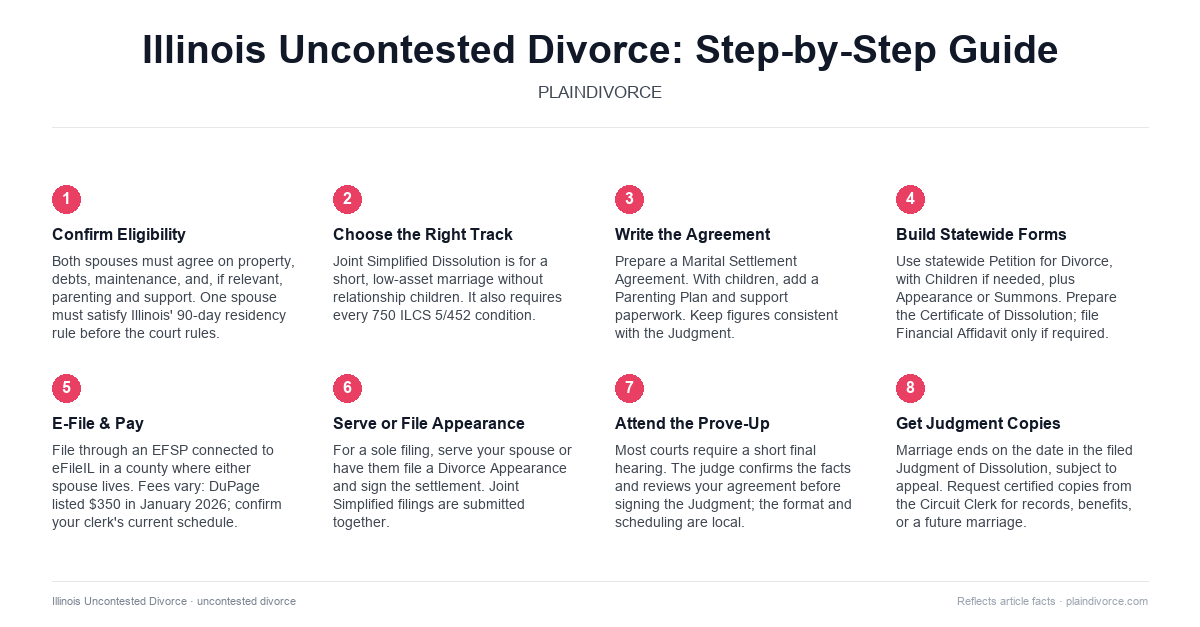
1. What Is an Uncontested or “Simple” Divorce in Illinois?
Illinois has no official court category called “simple divorce.” People use uncontested divorce or simple divorce to describe a case where both spouses agree the marriage (or civil union) should end and agree on every major issue: how to divide property and debts, whether anyone pays maintenance, and, if there are children, parenting time and child support. When nothing is left for a judge to decide, the case moves on the paperwork rather than through a contested trial.
The legal ground is irreconcilable differences — the marriage has broken down and can’t be repaired. Under 750 ILCS 5/401, Illinois has been a pure no-fault state since 2016, so you never have to prove adultery, cruelty, or any other wrongdoing. If the spouses have lived separate and apart for a continuous period of at least six months before the judgment, the law treats the irreconcilable-differences requirement as conclusively met.
Illinois terminology note. Since 2016, child-related issues are described as Allocation of Parental Responsibilities (decision-making) and parenting time (the schedule), not “custody” and “visitation.”
Divorces are filed in the Circuit Court for a county where either spouse lives, and there is no jury trial in any Illinois dissolution case. Most self-represented filers use the free Illinois Supreme Court approved statewide forms, which every circuit court must accept. Illinois also runs a free guided interview called Guide & File through its e-filing system for some divorce case types.
2. Who Qualifies for an Uncontested Divorce in Illinois?
Residency requirements
Under 750 ILCS 5/401, at least one spouse must have been an Illinois resident — or stationed in Illinois with the armed forces — for 90 days before either the case is filed or the court makes its finding. In practice this means you can file the petition before 90 days is up, as long as the residency is satisfied by the time the judge is ready to rule. Only one spouse needs to meet it.
You file in the Circuit Court of a county where either spouse resides. Under 750 ILCS 5/104, venue is not jurisdictional and the statute has a waiver route if neither spouse lives in the filing county, but choosing the right county up front avoids delay.
Grounds for divorce
Illinois recognizes only one ground: irreconcilable differences. There is no fault option and no mandatory statewide “cooling-off” period after filing. The six-month separation period is not something you must wait out — it is simply a shortcut that makes the ground automatic. Spouses who have been separated for less time can still testify that irreconcilable differences exist.
Agreement on the big issues
Your case works as an uncontested divorce in Illinois only if you and your spouse agree on:
- How to divide marital property and debts;
- Spousal maintenance — the amount and duration, or a mutual waiver; and
- If you have children: allocation of parental responsibilities, parenting time, and child support.
If there is domestic violence, coercion, hidden assets, a business or complex finances, or a real dispute about children or money, get legal advice before relying on a DIY approach.
The Joint Simplified Dissolution track
Illinois has a streamlined option, the Joint Simplified Dissolution of Marriage, set out in 750 ILCS 5/452. Both spouses file together, and every one of these conditions must be true:
- The marriage lasted 8 years or less;
- At least one spouse meets the Section 401 residency (or military-presence) requirement, and the irreconcilable-differences requirement is met;
- No children were born of the relationship or adopted during the marriage, and the wife, to her knowledge, is not pregnant by the husband;
- Neither spouse has any interest in real property, and any retirement benefits are held only in IRAs with a combined value under $10,000;
- The total fair market value of all marital property, after debts, is under $50,000;
- Combined gross annualized income from all sources is under $60,000, and neither spouse’s gross annualized income exceeds $30,000;
- Both spouses waive maintenance;
- Both spouses have disclosed to each other all assets, all liabilities, and their tax returns for every year of the marriage; and
- They have a written agreement dividing all assets worth more than $100, allocating every debt, and allocating ownership of and responsibility for any companion animals.
If any condition fails, you use the regular uncontested process instead — which can still be fully agreed. Work through the joint petition form line by line before you rely on this track; a single missed clause disqualifies the case.
3. Step-by-Step: The Uncontested Illinois Divorce Process
An uncontested divorce is still a formal court case. The smoothest outcomes come from using the current Illinois Supreme Court approved statewide forms and following your county Circuit Clerk’s instructions exactly. Courts routinely reject filings that use unofficial templates or outdated form versions.
Step 1 – Confirm your track
Decide whether you qualify for the Joint Simplified Dissolution using the checklist above. If not, plan on a regular uncontested divorce, where one spouse files a Petition for Divorce and the other cooperates by filing an Appearance and signing the settlement.
Step 2 – Put your agreement in writing
Most uncontested cases rely on a written Marital Settlement Agreement (MSA), and cases with children add a Parenting Plan. Under 750 ILCS 5/502, the agreement should be in writing (an oral agreement is allowed only for good cause with the court’s approval). The judge will enforce your property and maintenance terms unless they are unconscionable, while child support and parental-responsibility terms get separate review for the children’s best interests. Keep every number consistent across the MSA, the financial disclosures, and the proposed Judgment — mismatched figures are a common reason a packet comes back.
Step 3 – Prepare the Illinois standardized divorce forms
The Illinois standardized divorce forms PDF set — officially the Illinois Supreme Court Approved Statewide Forms for Divorce, Child Support, and Maintenance — is free to download from the state court website and most county Circuit Clerk sites. Note that the state renamed several forms in its March 2025 revision, so use the current titles:
- Petition for Divorce or Petition for Divorce with Children — the current title for what many people still search for as the Petition for Dissolution of Marriage in Illinois. A joint version exists for spouses filing together. This opens the case.
- Divorce Summons — if one spouse files and the other must be formally served.
- Divorce Appearance — the responding spouse’s official notice that they are participating in the case. Filing it submits that spouse to the court’s jurisdiction, so it is more than a formality; it does not replace reading the Summons and checking local instructions.
- Financial Affidavit (Family & Divorce Cases) — a sworn statement of income, assets, and debts, backed by supporting records. Its own instructions say not to file it with the clerk unless a local rule or court order requires filing, so treat it as an exchange-and-bring-to-court document unless told otherwise.
- Marital Settlement Agreement — your written deal on property, debts, and maintenance.
- If you have children: a Parenting Plan, plus, when support is ordered, an Order for Support, a Support Information Sheet, and Income Withholding for Support.
- Judgment of Dissolution of Marriage/Civil Union (or the with Children version) — the final order the judge signs.
- Certificate of Dissolution of Marriage/Civil Union — the state reporting form described below.
About the Certificate of Dissolution. Under 750 ILCS 5/707, the person filing the petition must prepare this certificate and present it to the judge before the final order; the Circuit Clerk then completes the remaining entries and forwards it to the Illinois Department of Public Health. Prepare it — it is a required step and clerks will ask for it — but know that the statute expressly says a failure to comply does not invalidate the divorce judgment.
Step 4 – File through eFileIL
Illinois has required electronic filing for civil cases, including divorce, since 2018. eFileIL is the single statewide electronic filing manager; you actually file through one of about 17 certified electronic filing service providers (EFSPs) that connect to it. Odyssey eFileIL is the most widely used, but you are not required to use any particular one, and counties are not divided up by provider.
A self-represented filer who genuinely can’t e-file — for example, no computer or internet access, difficulty reading or writing English, or a sensitive case such as an order of protection — can file a paper Certification for Exemption from E-Filing (the current statewide form under Illinois Supreme Court Rule 9(c)). Check how your county handles exemptions.
Step 5 – Service, or the Appearance
If only one spouse files, the other must be properly notified. That can happen through sheriff service, a licensed process server, or — in most cooperative cases — the other spouse simply files a Divorce Appearance and signs the settlement, which avoids formal service. Joint Simplified filings are submitted together, so service is usually a non-issue.
Step 6 – The final hearing (“prove-up”)
Most agreed Illinois divorces end with a short final appearance. Some courts call it a prove-up, others a final hearing or default hearing; the format is set locally and can depend on the assigned judge, so confirm with your court. Whatever the label, the judge confirms the basic facts, reviews your agreement, and — if everything is in order — signs the Judgment.
Petitioners typically follow a short prove-up hearing script in Illinois, answering brief questions under oath such as:
- Do irreconcilable differences exist that have caused the irretrievable breakdown of the marriage?
- Have past efforts at reconciliation failed, and would future attempts be impracticable and not in the family’s best interests?
- Do you have any minor or dependent children, and is either spouse currently pregnant?
- Have you read, and do you understand and voluntarily agree to, the Marital Settlement Agreement (and Parenting Plan, if any)?
- Do you believe the agreement is fair?
Practice your answers, bring a copy of your agreement, and expect possible follow-up questions. The judge must be satisfied the property and maintenance terms are not unconscionable, and that any child terms serve the children’s best interests, before signing.
Step 7 – Get your Judgment and certified copies
Once the judge signs and the clerk files your Judgment of Dissolution, the marriage ends on the date stated in that order. Under 750 ILCS 5/413, the judgment is final when entered, subject to appeal. Request certified copies from the Circuit Clerk for name changes, benefits, retirement plans, or a future marriage.
4. Special Issues When You Have Children
Minor children don’t prevent an uncontested divorce in Illinois, but they add forms and closer review. Even when you agree, the court checks that your parenting and support terms serve the children’s best interests.
Allocation of Parental Responsibilities in Illinois
Allocation of Parental Responsibilities in Illinois is the term for what used to be called legal custody: who has decision-making authority over a child’s education, health, religion, and extracurricular activities. Your Parenting Plan should set out that allocation along with the parenting time schedule, holidays, transportation, and how the parents communicate.
Child support. Illinois uses an income-shares calculation under 750 ILCS 5/505. The guideline amount is a rebuttable presumption: a court can order a different amount, but any deviation must come with written findings stating the reason and the presumed guideline amount. When support is ordered, your packet includes the Order for Support, the Support Information Sheet, and Income Withholding for Support.
Parent education. Under 750 ILCS 5/404.1, a court may order both parents to complete an education program on the effects of divorce on children when it finds that doing so is in the children’s best interests. Many circuits — including several of the largest — require the class by local rule, so check your circuit’s requirements and deadline early so your case doesn’t stall at the end.
5. How Long Does an Uncontested Divorce Take in Illinois?
There is no statewide timeline, because scheduling and local filing practices vary by county. Uncontested cases often finish within a few months of filing, but that is an estimate, not a rule — ask your Circuit Clerk what is realistic in your county. Two things set the earliest possible finish: at least one spouse must satisfy the 90-day residency requirement by the time the judge rules, and, if you are relying on it, the six-month separation presumption.
| What slows an uncontested case down | How to avoid it |
|---|---|
| E-filing rejected for a formatting or fee error | Follow the EFSP prompts carefully; keep the confirmation |
| Incomplete or inconsistent financial disclosures | Reconcile every figure across the MSA, affidavit, and Judgment |
| Missing Certificate of Dissolution or child support forms | Build a packet checklist before you file |
| Parent-education class not finished in time | Register right after filing; file the completion certificate |
| Crowded court calendar | Ask the clerk how prove-up dates are scheduled locally |
A Joint Simplified Dissolution can be quicker when you qualify, since the process is designed to be streamlined, though the final-hearing format still depends on your court.
6. What Does an Uncontested Divorce Cost in Illinois?
Illinois has no statewide filing fee. Each county Circuit Clerk sets its own schedule, and the amounts change — sometimes more than once a year. As a dated example, DuPage County’s fee book (revised January 12, 2026) lists $350 to file a dissolution, whether or not children are involved. Cook County’s fee is higher, around $390. Always confirm your county’s current fee directly with the Circuit Clerk before you file.
| Cost | Rough amount | When it applies |
|---|---|---|
| Court filing fee (petitioner) | Set by county; e.g. $350 in DuPage | Every case |
| Appearance / response fee | Set by county | When the other spouse files an Appearance |
| Service of process | Sheriff or process-server fee | If your spouse won’t file an Appearance |
| EFSP or card convenience fee | A few dollars | Depends on the provider and payment method |
| Certified copies of the Judgment | Per-page clerk fee | For name changes, benefits, and proof |
| Parent-education class | Modest, varies by circuit | Many cases with children |
If the fee is a hardship, ask the clerk about an Application for Waiver of Court Fees. Optional costs — mediation, document review, or a limited-scope consultation with an attorney — can still be worth it even in an agreed case.
7. When a DIY Divorce Might Not Be Right for You
| A DIY uncontested divorce usually works when… | Get legal advice first when… |
|---|---|
| Both spouses agree the marriage is over | There is domestic violence, coercion, or a safety concern |
| You agree on property, debts, and maintenance and can write it down | One spouse controls the money or information, or you suspect hidden assets |
| Any parenting and child support terms are settled | There is a genuine dispute about the children or support |
| Your finances are straightforward | There is a business, several properties, pensions, or a QDRO to divide |
| Neither spouse needs the judge to decide anything | Immigration, tax, or bankruptcy consequences are tied to the divorce |
If anything in the right-hand column applies, talk to an Illinois family-law attorney or a legal aid clinic before you sign or file. Even one consultation can catch a costly, hard-to-undo mistake.
8. Where a Self-Help Divorce Kit Fits Into the Illinois Process
Illinois’s approved statewide forms are free, and Guide & File can walk some filers through the paperwork. But the process still trips people up — especially around mandatory e-filing, using the current form titles, financial disclosure, the Certificate of Dissolution, and the child support items the court needs before it will sign. A self-help kit keeps you organized with checklists, filing order, and the common “gotchas,” including for cases with children.
Download Our Illinois Uncontested Divorce Self-Help KitPlainDivorce kits are DIY information tools. They do not replace a lawyer, do not represent you in court, and cannot guarantee outcomes. You are always responsible for checking the latest county rules, approved forms, e-filing requirements, and fees before you file. If cooperation breaks down, pause and consider legal help.
9. Frequently Asked Questions
What is an uncontested divorce in Illinois?
It is a dissolution case where both spouses agree the marriage is over and agree on property, debts, maintenance, and any parenting time and child support. The ground is irreconcilable differences, and no fault is alleged. Because nothing is left for a judge to decide, the case moves on the paperwork and usually ends with one short final hearing rather than a contested trial.
What is a Joint Simplified Dissolution of Marriage in Illinois?
It is a streamlined track under 750 ILCS 5/452 for short, low-asset marriages. Both spouses file together and must meet every statutory condition: a marriage of 8 years or less, no children of the relationship, no real estate, retirement savings only in IRAs under $10,000 combined, marital property under $50,000, combined income under $60,000 (neither spouse over $30,000), a maintenance waiver, full financial disclosure, and a written property and debt agreement. Miss one condition and you use the regular process.
What forms do I need for an uncontested divorce in Illinois?
Use the Illinois Supreme Court approved statewide forms, often searched for as the Illinois standardized divorce forms PDF. The core set is the Petition for Divorce (the current name for the Petition for Dissolution of Marriage), a Divorce Appearance or Summons, a Financial Affidavit, a Marital Settlement Agreement, the proposed Judgment of Dissolution, and the Certificate of Dissolution. With children, add a Parenting Plan and the child support forms. Do not use generic online templates — courts reject them.
Is there a waiting period for divorce in Illinois?
There is no mandatory statewide cooling-off period after you file. The two timing rules that matter are the 90-day residency requirement, which at least one spouse must satisfy before the judge can rule, and the six-month separation period. Six months of living separate and apart creates an irrebuttable presumption that irreconcilable differences exist, but spouses separated for less time can still testify to the ground and finish sooner.
How much does it cost to file for divorce in Illinois?
There is no statewide fee; each county Circuit Clerk sets its own. DuPage County charges $350 to file a dissolution as of its January 2026 fee book, and Cook County is around $390. Add a possible Appearance fee for the other spouse, service costs if your spouse will not file an Appearance, small e-filing convenience fees, and per-page charges for certified copies. If cost is a barrier, ask the clerk about an Application for Waiver of Court Fees.
Do I have to go to court for an uncontested divorce in Illinois?
Usually yes, for one short hearing. Many Illinois courts still hold a prove-up (also called a final hearing or default hearing) where the filing spouse answers a brief, mostly yes-or-no set of questions under oath and the judge reviews the settlement before signing the Judgment. The exact format is set by local rule and the assigned judge, and some courts handle simple agreed cases with limited or no live testimony, so confirm with your court.
What is Allocation of Parental Responsibilities in Illinois?
Since 2016 Illinois no longer uses “custody.” Allocation of Parental Responsibilities in Illinois covers significant decision-making for a child — education, health, religion, and extracurricular activities — while parenting time covers the schedule. Both are set out in a Parenting Plan that the court reviews for the child’s best interests, even in an agreed divorce.
Can I get an uncontested divorce in Illinois without a lawyer?
Yes. Many Illinois couples finalize an uncontested divorce using the free approved statewide forms and eFileIL. Get legal advice, though, if there is domestic violence, coercion, hidden assets, a business or complex finances, a pension or retirement account to divide, a real dispute about the children, or immigration, tax, or bankruptcy issues tied to the divorce.
10. Final Thoughts and Next Steps
If you and your spouse are on the same page, an uncontested divorce in Illinois is usually more predictable, cheaper, and less stressful than a contested case. The keys are:
- Confirm the 90-day residency rule and file in the right county Circuit Court.
- Decide whether you qualify for a Joint Simplified Dissolution under 750 ILCS 5/452.
- Use the current approved statewide forms — Petition for Divorce, Divorce Appearance, Financial Affidavit — not generic templates.
- Put the full agreement in a written Marital Settlement Agreement, and add a Parenting Plan and child support forms if you have children.
- File through eFileIL with a certified EFSP, or file a Certification for Exemption from E-Filing if you qualify.
- Prepare the Certificate of Dissolution, expect a short prove-up, and get certified copies of the Judgment afterward.
This article is general legal information, not legal advice, and PlainDivorce is not a law firm. Illinois court rules, forms, and fees change, and some steps vary by county and judicial circuit — verify every form name, deadline, and dollar amount with your county Circuit Clerk or a licensed Illinois family-law attorney before you act.
Start With the Illinois Uncontested Divorce KitSources and local rules can change. Use this guide as a plain-English organizer, then verify the current filing requirements with the official court or government source for your jurisdiction.

About Harry D
Expert contributor at PlainDivorce, helping Canadians and American navigate simple uncontested divorces with clarity and confidence.