Uncontested Divorce in Indiana: A Plain-English 2026 Guide
An uncontested divorce in Indiana (the state calls it a dissolution of marriage) is a divorce where you and your spouse agree on everything: ending the marriage, dividing property and debts, and any custody, parenting time, and child support. You file a Verified Petition for Dissolution of Marriage, wait out Indiana’s mandatory 60-day period, submit signed agreements, and in most agreed cases the judge signs your decree without a hearing. It is the fastest, cheapest way to divorce in Indiana when there is no real dispute.
This guide explains how a simple, agreed divorce works for self-represented (“pro se”) filers in Indiana: who qualifies, what “uncontested” means, the step-by-step process, the forms, the timeline, the costs, and where a self-help kit fits. Every legal specific below was checked against Indiana statutes, the Indiana Child Support Guidelines, and the state’s official self-help resources as of September 2026. Local courts still vary, so confirm the details with your county clerk.
TL;DR
- At least one spouse must have lived in Indiana for 6 months, and in the filing county for 3 months, before filing (being stationed at a U.S. military installation in Indiana, or in that county, also counts). Indiana Code § 31-15-2-6.
- You file a Verified Petition for Dissolution of Marriage in the county Circuit or Superior Court, almost always on the no-fault ground of irretrievable breakdown.
- The Indiana divorce 60-day waiting period is a floor, not a promise: no decree can be signed until at least 60 days after filing (Indiana Code § 31-15-2-10). Real cases often take longer.
- In an agreed case, after 60 days the court may enter a summary decree with no hearing if both spouses file verified, signed pleadings that include a written Waiver of Final Hearing and either a “no contested issues” statement or a signed settlement agreement (Indiana Code § 31-15-2-13).
- With minor children, a completed Child Support Obligation Worksheet, signed by both parents under penalties for perjury, is mandatory, and the decree sets up immediate income withholding for support.
- Budget the civil filing fee (a $157 statewide base; some counties add roughly $20 for an alternative dispute resolution fund) plus small extras. Confirm the exact figure with your county clerk.
1. What Is an Uncontested or Simple Divorce in Indiana?
In Indiana, divorce is formally a dissolution of marriage. The law has no special category called “simple divorce,” but people use “simple,” “uncontested,” or “agreed” to describe a case where the spouses settle every issue and do not ask the judge to decide a dispute. The judge’s job is to check that the legal requirements are met and that any agreement about children is reasonable, then sign the final order, the Decree of Dissolution of Marriage.
An uncontested divorce in Indiana usually means:
- Both spouses agree the marriage is over and want a dissolution.
- They file on the no-fault ground: irretrievable breakdown of the marriage.
- They agree in writing on how to divide property and debts.
- If they have minor children, they agree on custody, parenting time, and child support calculated under the Indiana Child Support Guidelines.
Sometimes both spouses sign every document together. Other times one spouse files and the other cooperates by signing a service waiver and the settlement paperwork. Either way, as long as there is no live dispute for the judge to resolve, it stays an agreed case. Indiana publishes two statewide self-help packets for this, Divorce With Children When Spouses Agree and Divorce Without Children When Spouses Agree, plus a separate Waiver of Service packet.
2. Who Qualifies for an Uncontested Divorce in Indiana?
Before the paperwork, confirm two things: that you can file in Indiana at all, and that your situation is genuinely a fit for an agreed case.
2.1 Residency requirements
Under Indiana Code § 31-15-2-6, at least one spouse must, immediately before the petition is filed, have been:
- a resident of Indiana for 6 months, or stationed at a U.S. military installation in Indiana for those 6 months; and
- a resident of the filing county for 3 months, or stationed at a U.S. military installation in that county for those 3 months.
If you recently moved to Indiana or changed counties, you may have to wait until you meet both periods. Indiana divorce cases are filed in the county Circuit or Superior Court, depending on the county.
2.2 Grounds for divorce
Indiana law (Indiana Code § 31-15-2-3) recognizes only four grounds: irretrievable breakdown of the marriage; a felony conviction of either spouse after the marriage; impotence existing at the time of the marriage; and incurable insanity of either spouse for at least two years. For an agreed dissolution, nearly everyone uses irretrievable breakdown. You do not have to prove fault, blame your spouse, or explain what went wrong; a verified statement that the marriage is broken and cannot be repaired supports the finding.
2.3 When an agreed Indiana divorce is a good fit
- You both want to end the marriage.
- You can reach a written agreement on property and debts.
- If you have children, you can agree on custody, parenting time, and guideline-based child support.
- Both of you are willing to disclose your finances honestly.
2.4 When an uncontested divorce may not work well
- There has been domestic violence, intimidation, or coercive control.
- One spouse won’t share financial information, or you suspect hidden assets.
- You own a business or farm, hold multiple properties, or have large or complex retirement accounts and are unsure of the trade-offs.
- There are significant immigration, tax, or bankruptcy questions.
- You genuinely disagree about the children.
In these situations, relying only on DIY information is risky. Even one paid strategy session with an Indiana family-law attorney, or a call to legal aid, can prevent an expensive mistake.
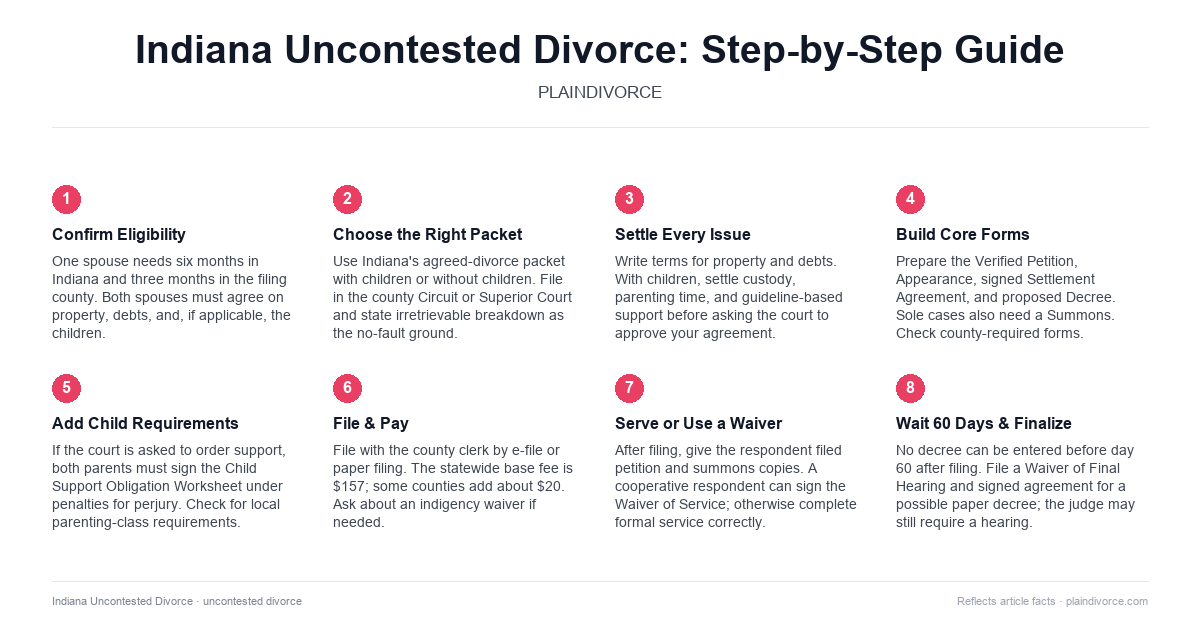
3. Step-by-Step: The Uncontested Divorce Process
Counties have their own local rules and packet requirements, but most agreed dissolutions in Indiana follow this path.
Step 1 – Confirm you qualify and pick the right court
- Residency: 6 months in Indiana and 3 months in the county (or the military-stationing equivalent).
- Ground: irretrievable breakdown of the marriage.
- Court: your county’s Circuit or Superior Court. If you have minor children, use the “with children” packet; if not, the “without children” packet.
Step 2 – Reach agreements early (property, debts, children)
Settle the substance before you finalize forms:
- Property and debts: house, vehicles, bank and retirement accounts, credit cards, loans.
- Spousal maintenance, if any (Indiana awards it only in limited situations).
- If you have children: custody (legal and physical), a parenting-time schedule, and child support run through the Indiana Child Support Guidelines.
In Indiana’s statewide agreed packets, your terms go into the Settlement Agreement and Decree of Dissolution of Marriage, the document the judge signs to become your final order. Some counties label it slightly differently, so match your local packet. Property terms settled by agreement generally cannot be changed later except as the agreement allows or both parties consent (Indiana Code § 31-15-2-17), so get this right the first time.
Step 3 – Prepare the Verified Petition for Dissolution of Marriage and the other forms
Paperwork is where most of the work happens, starting with the Verified Petition for Dissolution of Marriage, the form that opens your case. Indiana’s statewide agreed packets (through your county clerk or Indiana Legal Help) typically include:
- Appearance by Self-Represented Person in a Civil Case, which tells the court how to reach you. In a case involving child support, the Social Security numbers of the parents and any minor children go on a separate confidential attachment (filed as confidential / on green paper), not on the public Appearance form.
- Verified Petition for Dissolution of Marriage. “Verified” means you sign it affirming the facts are true under penalties for perjury, as the form directs; it is not automatically notarized unless a specific form or local court requires it.
- Summons, when one spouse files and the other must be notified.
- Waiver of Service of Divorce Forms (the form’s full title is longer). The respondent signs it after the petitioner has filed the petition and summons and given the respondent those filed copies. It records that the respondent received the filed papers, so you can skip paying for sheriff or process-server delivery; it does not replace filing the case.
- Financial Declaration Form, if your county requires it by local rule. It is not part of the uniform statewide agreed packet, so check your county’s local family-law rules.
- Settlement Agreement and Decree of Dissolution of Marriage, the proposed final order. Each spouse signs this one before a notary.
- If you have children: parenting-plan terms and a completed Child Support Obligation Worksheet (see section 5.2).
Clerks can tell you which forms are required and how to file, but they cannot tell you what to write in them. If your finances or custody situation are complicated, book a short consultation before you sign.
Step 4 – File with the clerk
File your forms with the clerk of the proper county court and pay the filing fee (or file a fee-waiver request). E-filing is available statewide, and self-represented filers can use the free portal at efile.incourts.gov, but you are encouraged, not required, to e-file; conventional paper filing at the clerk’s office is still allowed. Local cover sheets and procedures vary, so follow your county’s instructions.
Step 5 – Service, or the Waiver of Service shortcut
If both spouses agree, the petitioner files first, hands or mails the respondent the filed petition and summons, and the respondent signs the Waiver of Service of Divorce Forms. That avoids paying for sheriff service (about $28) or a private process server (cost varies by provider). If your spouse will not sign, you must complete formal service correctly, because service controls case deadlines and errors cause delay.
Step 6 – Wait out the Indiana divorce 60-day waiting period
Every Indiana dissolution is subject to the 60-day waiting period: a final hearing (or, in an agreed case, a summary decree) cannot happen earlier than 60 days after the petition is filed (Indiana Code § 31-15-2-10). Treat 60 days as the earliest possible date, not the finish date. Use the time to finalize your settlement, exchange any required financial disclosures, and complete child-related requirements.
Step 7 – The judge signs the decree
Once residency is shown, the forms are complete, and any agreement about children is reasonable, the judge signs the Decree of Dissolution of Marriage. When it is signed and entered, your divorce is final at the county level. Indiana does not route dissolutions through a separate statewide reporting form, but follow the current statewide packet and your local clerk’s checklist, because a county can require extra local documents before it will finalize.
If you need official proof later (a name change, remarriage, a benefits claim), ask the clerk in the county where you filed for a certified copy of the decree. There is a per-copy fee that varies by clerk.
4. The DIY Shortcut: Waiver of Final Hearing for Your Indiana Divorce
If you are searching “how to get divorced in Indiana without going to court,” the phrase that matters is Waiver of Final Hearing.
Under Indiana Code § 31-15-2-13, at least 60 days after the petition is filed, the court may enter a summary dissolution decree with no hearing if both spouses file verified pleadings, signed by both parties, that contain:
- a written waiver of final hearing, and
- either a statement that there are no contested issues, or a written settlement agreement that resolves every issue.
Important: the statute says the court “may,” not “must.” Some courts still set a brief hearing in certain cases, especially where children are involved, and some require extra local paperwork. Knowing the term “Verified Waiver of Final Hearing” helps you ask the clerk the right question and pull the correct agreed-case packet.
5. Special Issues When You Have Children
Children do not stop you from having an uncontested divorce in Indiana, but the court reviews your agreement more closely, because the judge has to protect the children’s best interests even when both parents agree.
5.1 Parenting time and decision-making
Indiana uses the Indiana Parenting Time Guidelines as the reference point for a parenting plan. Your plan should cover the regular weekly schedule, holidays, school breaks and vacations, transportation and exchanges, communication between the parents and with the children, and how major decisions (school, non-emergency health care, religion) get made. If you want help understanding the guidelines before you lock in a schedule, the Indiana Parenting Time Helpline (844-836-0003) offers free education from licensed attorneys on weekdays from noon to 5 p.m. Eastern. It is education, not legal advice about your case.
5.2 Child support and the worksheet hard stop
Indiana child support is set by the Indiana Child Support Guidelines. The most common reason an agreed packet is rejected or delayed is a missing or incomplete support calculation.
- Child Support Obligation Worksheet (CSOW): in every case where the court is asked to order support, including an agreed order, the worksheet must be completed, filed, and signed by both parents (not their attorneys) under penalties for perjury. If you agree to a number that differs from the guideline result, the court must state the reason for the deviation in the decree.
- Immediate income withholding: the statewide proposed decree provides for the court to order support paid by income withholding that takes effect right away through the paying parent’s employer or income payor. Immediate withholding is generally required unless the court approves an alternative arrangement that the law allows.
- Medical support: under Child Support Guideline 7, the court must order health-care coverage that is accessible and reasonable in cost from one or both parents (or cash medical support if none is available), and uninsured or ordinary medical expenses are normally divided between the parents in proportion to their incomes. Spell this out in your paperwork rather than leaving it vague.
Indiana’s official child support calculator and the current worksheet are on the Indiana Judicial Branch Self-Service Legal Center; the Child Support Rules and Guidelines spell out how the numbers are built.
5.3 Parenting classes and local requirements
Many counties require divorcing parents to finish a parenting-education program before the judge enters a final order, but this is a county/court-specific rule, not a statewide dissolution requirement. Check your local court’s website or ask the clerk about parent education, local financial-disclosure rules, and any local forms.
6. How Long Does an Uncontested Divorce Take in Indiana?
No one can promise a specific date, but the rules are clear:
- Legal minimum: 60 days from filing before any decree can be signed (Indiana Code § 31-15-2-10). This applies to every case.
- After day 60: in an agreed case with complete paperwork and a waiver of final hearing, the court can enter the decree on the documents. How soon after day 60 depends entirely on the county’s docket and review process.
- If a hearing is required: add time for the court to schedule it.
Typical sequence: file petition → deliver filed papers and sign Waiver of Service → 60-day wait (finalize settlement, worksheet, disclosures) → file Waiver of Final Hearing and proposed decree → judge reviews and signs → request certified copies.
7. What Does an Uncontested Divorce Cost in Indiana?
A DIY agreed dissolution is the closest thing to an affordable divorce in Indiana. Most filers pay the filing fee plus a few small extras.
| Cost | Typical amount (2026) | Notes |
|---|---|---|
| Civil filing fee | ~$157 statewide base | A county with a Supreme Court-approved alternative dispute resolution (ADR) plan adds roughly $20. Confirm the exact figure with your county clerk. |
| Sheriff service of process | $28 | Avoided if your spouse signs the Waiver of Service of Divorce Forms. |
| Private process server | Varies by provider | Only needed if the sheriff isn’t used and there’s no signed waiver. |
| Notary | Low / sometimes free | The Settlement Agreement and Decree is signed before a notary; many banks and libraries notarize free. |
| Certified copies of the decree | Per-copy fee, varies by clerk | Order at least one or two for name changes, benefits, remarriage. |
| Parenting class | Varies by provider | Only if your county requires it. |
If the filing fee is a hardship, ask the clerk about a fee waiver. Indiana law (Indiana Code § 33-37-3-2) lets a filer who cannot afford court costs file a sworn statement of indigency; if granted, the waiver covers the filing fee, sheriff service, and other court costs. Filing the waiver request itself is free.
8. When a DIY Divorce Might Not Be Right for You
Some situations call for individual legal advice. Think hard before going fully DIY if:
- There is a history of domestic violence, stalking, or threats.
- One spouse is pressuring the other to sign quickly without explanation.
- There are high-value or complex assets: a business, a farm, multiple properties, stock options, pensions, or large retirement accounts.
- Either spouse has immigration status that a divorce could affect.
- There are real concerns about a child’s safety or well-being.
- One spouse is hiding assets or refusing to disclose finances.
Even a single low-cost consultation, or limited-scope help with just the settlement agreement, can protect you from costly mistakes while you still handle most of the paperwork yourself.
9. Where a Self-Help Divorce Kit Fits Into the Process
If your situation is straightforward and you want an Indiana divorce without a lawyer, a well-built self-help kit keeps you organized around the forms and deadlines that trip people up: the Verified Petition for Dissolution of Marriage, the Waiver of Service of Divorce Forms, the Waiver of Final Hearing, the Settlement Agreement and Decree, and the Child Support Obligation Worksheet.
A kit is not legal advice and does not replace your county’s official instructions. But it can help you:
- Understand the whole uncontested divorce process in Indiana before you start.
- Stay on schedule with checklists built around the 60-day waiting period.
- Gather the financial and parenting information you need to complete the forms.
- Avoid the mistakes that get filings rejected: missing signatures, a missing worksheet, a missing Appearance or confidential attachment.
10. Frequently Asked Questions
What is an uncontested or simple divorce in Indiana?
An uncontested (or “simple”) divorce in Indiana is a dissolution of marriage where both spouses agree on every issue: ending the marriage, dividing property and debts, and, if they have minor children, custody, parenting time, and child support. Because there is no dispute for a judge to decide, the court reviews the signed paperwork and enters the decree instead of holding a trial.
What is a Verified Petition for Dissolution of Marriage?
It is the Indiana court form that opens a divorce case. It states basic facts: residency, the ground for divorce (usually irretrievable breakdown), the date of marriage and separation, and whether there are minor children. “Verified” means you sign it affirming those facts are true under penalties for perjury, as the form directs; notarization is required only if a particular form or local court calls for it.
What is a Waiver of Final Hearing in an Indiana divorce?
It is a document both spouses sign in an agreed case asking the judge to finalize the divorce on the paperwork without a courtroom appearance. Under Indiana Code § 31-15-2-13, at least 60 days after filing the court may enter a summary decree if both parties file verified, signed pleadings that include the written waiver plus either a “no contested issues” statement or a signed settlement agreement. Some courts still hold a short hearing, especially with children.
How long does an uncontested divorce take in Indiana?
Indiana law sets a mandatory 60-day waiting period from the date the petition is filed before a judge can sign the decree (Indiana Code § 31-15-2-10). That 60 days is the earliest possible finish, not a typical one. Actual timing depends on your county’s docket, whether the court requires a hearing, and how complete your paperwork is when you submit it.
What are the residency requirements for an Indiana divorce?
At least one spouse must have lived in Indiana for the 6 months immediately before filing and in the filing county for the preceding 3 months (Indiana Code § 31-15-2-6). Being stationed at a U.S. military installation in Indiana counts toward the 6-month requirement, and being stationed at an installation in the filing county counts toward the 3-month requirement.
Is a Financial Declaration Form required in every Indiana divorce?
Not statewide. The Financial Declaration Form is not part of Indiana’s uniform agreed-divorce packet. Some counties require it by local rule, even in agreed cases, so check your county clerk’s local family-law rules before you file. Where it applies, both spouses list income, assets, and debts so the court can confirm the split is fair.
How much does an uncontested divorce cost in Indiana?
The main cost is the civil filing fee: a roughly $157 statewide base, with about $20 more in counties that fund an alternative dispute resolution program. Add $28 if the sheriff serves your spouse (skipped when your spouse signs the Waiver of Service), plus small fees for certified copies and, in some counties, a parenting class. Confirm the current filing fee with your county clerk, and ask about a fee waiver if cost is a barrier.
Do we have to go to court for an agreed divorce in Indiana?
Often not. If your case is fully settled and 60 days have passed, filing a Waiver of Final Hearing with your signed settlement agreement lets many Indiana courts enter the decree without either spouse appearing. It is not guaranteed: the judge “may” grant it, and some counties still schedule a brief hearing, particularly when children are involved or the paperwork raises a question.
11. Final Thoughts and Next Steps
Starting a divorce is hard even when you agree. The good news is that an uncontested divorce in Indiana is built to be more straightforward when spouses cooperate and follow the rules.
- Confirm the 6-month Indiana and 3-month county residency requirements.
- Reach a clear written agreement on property, debts, and, if applicable, the children.
- Use the correct current packet (“with children” or “without children”) and the Waiver of Service when your spouse will sign.
- Plan around the 60-day minimum, and expect the county’s process to add time.
- With children, complete and sign the Child Support Obligation Worksheet, set the medical-support terms, and finish any local parenting class early.
- Ask your clerk about local rules, such as a Financial Declaration Form or parenting-education requirement.
- After the decree is signed, order certified copies from the county clerk for future proof.
If your case is straightforward and you are ready to move, our Indiana uncontested divorce kit walks you through the forms and deadlines in order.
Disclaimer: PlainDivorce is not a law firm and does not provide legal advice or representation. This guide is general information about Indiana dissolution of marriage procedure, current as of September 2026, and may not reflect recent changes or your county’s local rules. Using a self-help kit does not create an attorney-client relationship. For advice about your situation, consult a licensed Indiana family-law attorney or a legal aid organization.
Sources and local rules can change. Use this guide as a plain-English organizer, then verify the current filing requirements with the official court or government source for your jurisdiction.

About Harry D
Expert contributor at PlainDivorce, helping Canadians and American navigate simple uncontested divorces with clarity and confidence.