Uncontested Divorce in Iowa: A Plain-English 2026 Guide
An uncontested divorce in Iowa (the state calls it a dissolution of marriage) is a divorce where you and your spouse agree on everything: ending the marriage, dividing property and debts, and any custody, parenting time, and child support. You file a Petition for Dissolution of Marriage with the correct form set, serve your spouse, wait out Iowa’s mandatory 90-day period, file a signed Settlement Agreement, and the judge signs your decree. It is the fastest and cheapest way to divorce in Iowa when there is no real dispute.
This guide explains how a simple, agreed divorce works for self-represented filers in Iowa: who qualifies, which forms to use, the step-by-step process, the 90-day timeline, the costs, and where a self-help kit fits. Every legal specific below was checked against chapter 598 of the Iowa Code, the Iowa Child Support Guidelines, and the Iowa Judicial Branch’s official self-help materials as of September 2026. Counties and judicial districts still vary, so confirm the details with your clerk of court.
TL;DR: Uncontested Divorce in Iowa
- Iowa is a no-fault state; an uncontested divorce in Iowa just means you and your spouse agree on every issue and are not asking a judge to decide a dispute.
- Unless your spouse is an Iowa resident who is personally served, you must have lived in Iowa in good faith for the year before filing (Iowa Code § 598.5). You file in the county where either spouse lives.
- Iowa has two statewide form sets: one for cases with no minor or dependent adult children (Rule 17.100, the “100-series”) and one for cases with children (Rule 17.200, the “200-series”). Pregnancy, a child born or adopted during the marriage, or an adult child who still needs support all put you in the 200-series.
- Your written deal goes in the Settlement Agreement (Form 128 or 228) — the document many people search for as a stipulation form for an Iowa divorce.
- The Iowa divorce 90-day waiting period is a floor, not a promise: no decree can be entered until 90 days after the latest of service, final publication, a filed waiver or acceptance of notice, or completion of court-ordered conciliation (Iowa Code § 598.19).
- If your case involves custody or visitation, both parents must complete a court-approved parenting course — the Children in the Middle class Iowa requirement many districts use — within 45 days of service, unless the court waives it (Iowa Code § 598.15).
- Budget the filing fee. The Iowa Judicial Branch currently lists $285 for a dissolution petition (it includes docketing the decree); confirm the current amount with your clerk.
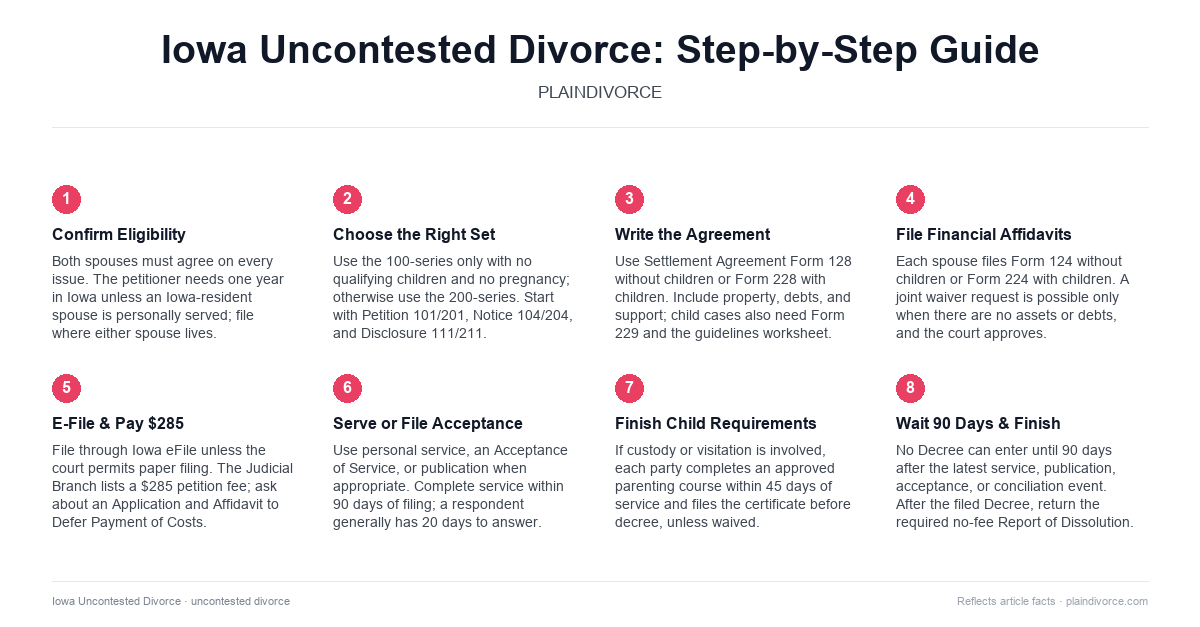
1. What Is an Uncontested or Simple Divorce in Iowa?
In Iowa, the legal term for divorce is dissolution of marriage. Iowa is a no-fault state: you do not have to prove that either spouse did anything wrong. The case rests on a sworn statement that the marriage has broken down so badly that there is no reasonable likelihood it can be preserved (Iowa Code § 598.5).
Iowa has no separate “simple divorce” track. When people say simple divorce in Iowa, they mean a standard dissolution that is:
- Uncontested — both spouses want the divorce and neither is asking the judge to decide a disputed issue, and
- Documented — the paperwork is complete and consistent, and gives the court enough to approve the outcome.
One caution worth stating early: “uncontested” does not switch off the court’s rules. The petition still has to be verified (signed under penalty for false statements), and its allegations must be established by competent evidence, usually a short affidavit or testimony. Even when you and your spouse agree, the judge still reviews the terms, and for children the judge must be satisfied the plan is reasonable. When everything checks out, the court enters the final order: the Decree of Dissolution of Marriage.
2. Who Qualifies for an Uncontested Divorce in Iowa?
2.1 Residency and venue
Iowa’s residency rule has two parts (Iowa Code § 598.5):
- If your spouse is an Iowa resident and is personally served with the divorce papers here, there is no residency waiting period for you.
- Otherwise, the petitioner must have been an Iowa resident for the year before filing — a residence maintained in good faith, not just to get a divorce — counting time in the state after deducting any absences.
Venue is separate from residency. You file in the county where either spouse resides (Iowa Code § 598.2). If you recently moved to Iowa or between counties, confirm both points with the clerk before you file.
2.2 When a case is truly uncontested
- Both spouses agree the marriage is over and want a dissolution.
- Both will cooperate with deadlines and paperwork.
- You agree on how to divide property and debts, and — if you have children — on custody, parenting time, and child support.
- No one is hiding income, assets, or debts.
- There is no intimidation, coercion, or domestic violence affecting the decisions.
Iowa is an equitable-distribution state: the court divides property acquired before or during the marriage (gifts and inheritances are generally set aside), aiming for a fair — not automatically 50/50 — split. If you want your former name back, ask for it in the petition and the court can include it in the decree.
3. Which Iowa Divorce Form Set Do You Use?
Iowa divorce is form-driven. The statewide self-help forms are in chapter 17 of the Iowa Court Rules, and there are two complete sets. Picking the right one is the first real decision in an uncontested divorce in Iowa.
- No minor or dependent adult children (Rule 17.100, the “100-series”). Use this set only if there are no children under 18 who are children of both spouses, no adult children who still need support, and neither spouse is pregnant.
- With children (Rule 17.200, the “200-series”). Use this set if a spouse is pregnant, a child was born or adopted during the marriage, there is a minor child of both spouses, or an adult child still needs support (for example, still in high school or college, or because of a disability).
The parallel form numbers are:
| Document | No children (Rule 17.100) | With children (Rule 17.200) |
|---|---|---|
| Petition for Dissolution of Marriage | Form 101 | Form 201 |
| Original Notice (for service) | Form 104 | Form 204 |
| Protected Information Disclosure | Form 111 | Form 211 |
| Financial Affidavit | Form 124 | Form 224 |
| Settlement Agreement (the “stipulation”) | Form 128 | Form 228 |
| Agreed Parenting Plan | — | Form 229 |
Use the correct current set so the clerk can process your case without follow-up. The Iowa Judicial Branch publishes a plain-language Guide for Representing Yourself in an Iowa Divorce for each set — read the one that matches your situation before you fill anything in.
4. Step-by-Step: The Uncontested Divorce Process in Iowa
Step 1 – Confirm you qualify and pick the correct packet
- Confirm residency (the one-year rule, unless your spouse is an Iowa resident who is personally served) and the county where you file.
- Decide whether your case is with children or no minor or dependent adult children, using the test in section 3, and pull that form set.
- Every Iowa dissolution starts with the Petition for Dissolution of Marriage (Form 101 or 201), filed with the Original Notice (Form 104 or 204) and the Protected Information Disclosure (Form 111 or 211).
Step 2 – Put your agreement in writing (the stipulation form)
In an uncontested case, the written agreement is the backbone of the decree. Iowa’s form is the Settlement Agreement:
- No children: Settlement Agreement (Form 128). You cannot use Form 128 if there are minor children or adult children who still need support.
- With children: Settlement Agreement (Form 228), which is only for spouses who agree, filed with a parenting plan.
This is where you spell out the actual deal: how property and debts are divided, whether either spouse pays spousal support, and (with children) the parenting and child-support terms. If you searched for a stipulation form for an Iowa divorce, this is the document. Iowa’s official name is “Settlement Agreement,” not “Stipulation,” but it does the same job: it is the written contract that tells the judge exactly what you and your spouse have agreed to.
Step 3 – Complete the Protected Information Disclosure (Form 111 or 211)
Iowa keeps Social Security numbers, financial account numbers, and other sensitive identifiers out of the public court file. You leave them off (or redact them from) your regular filings and instead put the full information on the Protected Information Disclosure — Form 111 without children, Form 211 with children — which is filed as a confidential document. File the version that matches your case type along with the petition and Original Notice.
Step 4 – Complete the Financial Affidavit (Form 124 or 224)
Even in an agreed case, each spouse must complete a Financial Affidavit — Form 124 without children, Form 224 with children. The Iowa self-help guides are direct about it: you will not get a decree until both affidavits are filed. The only exception is that spouses with no assets and no debts to divide can jointly file a motion asking the court to waive the requirement; the court has to approve it. This form is the math behind the case — it supports the property division and any support figure and shows the judge the settlement makes sense.
Step 5 – File through Iowa eFile and serve your spouse
You must file electronically through Iowa’s EDMS / eFile system unless the court authorizes you to file on paper. Registration is free. Pay the filing fee at the time you file, or file an Application and Affidavit to Defer Payment of Costs if you cannot afford it.
After filing, the petition and Original Notice must reach the respondent. Your options:
- Personal service by the sheriff or a private process server;
- the respondent signs an Acceptance of Service (common in a cooperative case); or
- service by publication if your spouse genuinely cannot be found.
Two deadlines matter here. You have 90 days after filing to complete service or the court may dismiss the case. And once served, the respondent generally has 20 days to file an answer; if none is filed, the petitioner can move ahead by default. Service also starts the clock that controls the waiting period.
Step 6 – Wait out the Iowa divorce 90-day waiting period
No Iowa decree can be entered until 90 days have passed. Under Iowa Code § 598.19, the 90 days runs from whichever of these is latest:
- the day the Original Notice is served,
- the last day of publication (if served by publication),
- the date a waiver or acceptance of the Original Notice is filed, or
- the completion of any court-ordered conciliation.
Treat 90 days as the earliest possible date, not the finish date. A judge may shorten it, but only on a written motion supported by an affidavit showing a genuine emergency or necessity. Use the waiting period to finalize and sign the Settlement Agreement, exchange financial disclosures, and complete any parenting course.
Timeline (plain English): file → serve (or file acceptance) → 90-day period → submit signed Settlement Agreement and proposed decree → judge reviews and signs.
Step 7 – File the Report of Dissolution of Marriage after the decree
Iowa uses a vital-records form called the Report of Dissolution of Marriage or Annulment, issued by the Iowa Department of Health and Human Services. It is required by state law and has no fee. The sequence, per the court’s guides: after the judge files your decree, the petitioner gets the form from the clerk, completes it (leaving items 18–22 blank for the clerk), and returns it. Do not skip this step — it is part of finishing the case, not an optional extra.
Step 8 – The judge signs the Decree of Dissolution of Marriage
When the judge is satisfied that residency is shown, the forms are complete, and any agreement about the children is reasonable, the court enters the Decree of Dissolution of Marriage. You are not divorced until a judge signs and files the decree — approving a settlement is not the same as ending the marriage. You will receive the signed decree through the eFile system. After it is entered, order certified copies from the clerk if you need proof for a name change, insurance or retirement paperwork, or remarriage.
5. Special Issues When You Have Children
Children do not stop you from having an uncontested divorce in Iowa, but the court looks harder at your agreement, because the judge has to protect the best interests of the child even when both parents agree.
5.1 Parenting plan
When parents agree, they file the Agreed Parenting Plan (Form 229) with the Settlement Agreement. (If the parents do not agree, each files a Proposed Parenting Plan, Form 230, and the judge decides.) A good plan covers legal custody and physical care, the regular schedule, holidays and school breaks, exchanges and transportation, communication, and how major decisions about school, health care, and religion get made.
5.2 Child support and the guidelines worksheet
- Guidelines worksheet. Iowa child support is set by the Iowa Child Support Guidelines. Before a support order is entered, the parties must file a Child Support Guidelines Worksheet (Rule 9.27 Form 1, or Form 2 by agreement). The guideline number is a rebuttable presumption; a different amount requires the court to explain why.
- How payments are made. Support must be paid through the clerk of the district court or the Iowa Collection Services Center. Payments made directly to the other parent do not legally count as support (Iowa Code § 598.22).
- Income withholding. The paying parent’s income is generally subject to immediate income withholding through their employer, unless the court finds good cause or the parties reach a court-approved written alternative (Iowa Code § 252D.8).
- Health and medical costs. The current settlement form breaks these into medical support (health-insurance coverage), uncovered medical expenses, and cash medical support. Fill in each field rather than leaving the terms vague.
5.3 The Children in the Middle class Iowa requirement
Under Iowa Code § 598.15, any action involving custody or visitation requires each party to complete a court-approved parenting course within 45 days of service of the notice and petition. Key points:
- Each judicial district certifies its own approved courses. “Children in the Middle” is a common provider course used in several districts, but it is not the statewide statutory title — check which course your district accepts.
- The court can waive or delay the course for good cause, including a default or proof that a party already took an equivalent course.
- It is not required in a termination-of-parental-rights proceeding.
- Each party must file a completion certificate before the decree unless the requirement is waived. Each party arranges and pays for their own course.
6. How Long Does an Uncontested Divorce Take in Iowa?
- Legal minimum: 90 days, measured from the latest of service, final publication, a filed waiver or acceptance of notice, or completion of court-ordered conciliation (Iowa Code § 598.19).
- After day 90: in an agreed case with complete paperwork, the court can enter the decree on the documents. How soon depends on the county’s docket and review process.
- Common causes of delay: using the wrong form set, a missing Financial Affidavit or guidelines worksheet, an incomplete Protected Information Disclosure, or an unfinished parenting course.
7. What Does an Uncontested Divorce Cost in Iowa?
| Cost | Amount (2026) | Notes |
|---|---|---|
| Court filing fee | $285 | The Iowa Judicial Branch’s current fee schedule and divorce page list $285 for a dissolution petition, including docketing the decree. (The 2026 Iowa Code text of § 602.8105 still prints $265, so confirm the amount your clerk is charging.) |
| Service of process | Varies | Sheriff or private process-server fee if your spouse is personally served. Avoided if your spouse signs an Acceptance of Service. Confirm the current amount with the clerk or sheriff. |
| Parenting course | Varies by provider | Only if your case involves custody or visitation. Each parent pays for their own. |
| Certified copies of the decree | $50 certificate + $0.50/page | Order at least one or two for name changes, benefits, and remarriage. |
| Fee deferral | $0 to apply | File an Application and Affidavit to Defer Payment of Costs if you cannot afford the filing fee. |
Attorney fees are the biggest variable. Some couples keep costs down by staying uncontested and buying only a one-time review of the Settlement Agreement rather than full representation.
8. When a DIY Divorce Might Not Be Right for You
A do-it-yourself Iowa divorce is not always the right call. Strongly consider legal advice if:
- there is a history of domestic violence, threats, or controlling behavior, or you do not feel safe negotiating directly;
- there is a family business, a farm, or significant retirement assets or pensions;
- immigration status, disability benefits, or major tax issues could be affected;
- you believe your spouse is hiding income, assets, or debts; or
- you genuinely disagree about the children.
PlainDivorce cannot tell you whether a particular settlement is fair or what you should agree to — those are legal-advice questions. Even one paid strategy session, or limited-scope help with just the Settlement Agreement, can prevent an expensive mistake.
9. Where a Self-Help Divorce Kit Fits Into the Iowa Process
An Iowa uncontested divorce kit is not a replacement for Iowa’s official court forms or for legal advice. A good kit works alongside the official process so you stay organized and avoid the common Iowa hold-ups:
- choosing the right set — no minor or dependent adult children vs. with children;
- filing the Petition for Dissolution of Marriage with the Original Notice (Form 104/204) and Protected Information Disclosure (Form 111/211);
- completing the Financial Affidavit (Form 124/224) and, with children, the guidelines worksheet;
- using the correct Settlement Agreement (Form 128 vs 228) and, with children, the Agreed Parenting Plan (Form 229);
- completing service within 90 days and planning around the Iowa divorce 90-day waiting period;
- not forgetting the post-decree Report of Dissolution of Marriage.
You are still responsible for checking the latest rules, local requirements, official forms, and fees before filing.
Download Our Iowa Uncontested Divorce Self-Help Kit10. Frequently Asked Questions
What is an uncontested or simple divorce in Iowa?
An uncontested divorce in Iowa is a dissolution of marriage where both spouses agree on every required issue — property, debts, and, if applicable, custody, parenting time, and child support — so the court can finalize the case without a trial. The judge still reviews the paperwork, the petition must be verified, and for children the parenting and support terms must be reasonable before the decree is entered.
How does the Iowa divorce 90-day waiting period work?
Iowa Code § 598.19 bars any decree until 90 days have passed. The 90 days runs from whichever is latest: the date the Original Notice is served, the last day of publication, the date a waiver or acceptance of notice is filed, or the completion of court-ordered conciliation. A judge can shorten it only on a written motion supported by an affidavit showing emergency or necessity. Most uncontested cases take longer than 90 days once court review is added.
What is the Petition for Dissolution of Marriage in Iowa?
It is the court form that opens a divorce case — Form 101 for a case with no minor or dependent adult children, Form 201 for a case with children. It states residency, the marriage and separation facts, whether there are children, and asks the court to dissolve the marriage on the no-fault ground. It must be verified (signed as true), and it is filed with the Original Notice and the Protected Information Disclosure.
What is a stipulation form in an Iowa divorce?
Iowa’s version of a stipulation is the Settlement Agreement — Form 128 without children, Form 228 with children. It is the written contract, signed by both spouses, that sets out the terms you want the court to approve: property and debt division, spousal support, and, if applicable, parenting and child-support terms. Form 128 cannot be used if there are minor children or adult children who still need support.
Do I have to take the Children in the Middle class for an Iowa divorce?
If your case involves custody or visitation, Iowa Code § 598.15 requires each party to complete a court-approved parenting course within 45 days of service, and to file a completion certificate before the decree. “Children in the Middle” is a common provider course used in several judicial districts, but districts certify their own approved courses, so confirm which one yours accepts. The court can waive or delay the course for good cause, and it is not required in a termination-of-parental-rights case.
How much does an uncontested divorce cost in Iowa?
The main cost is the court filing fee, which the Iowa Judicial Branch currently lists at $285 for a dissolution petition (it includes docketing the decree). Add service-of-process costs if your spouse is personally served, a parenting-course fee if children are involved, and about $50 plus $0.50 per page for certified copies of the decree. If you cannot afford the filing fee, file an Application and Affidavit to Defer Payment of Costs. Confirm the current filing fee with your clerk of court.
Do we have to go to court for an uncontested divorce in Iowa?
Often not. If your case is fully settled, your paperwork is complete, and the 90-day period has passed, many Iowa judges enter the decree on the documents without a hearing. It is not guaranteed — some judges or judicial districts still set a short hearing, especially when children are involved — and you are not divorced until the judge signs and files the decree.
11. Final Thoughts and Next Steps
Starting a divorce is hard even when you agree. The good news is that an uncontested divorce in Iowa is built to be manageable when both spouses are organized and cooperative. Use this checklist to stay grounded:
- Confirm residency (the one-year rule unless your spouse is an Iowa resident who is personally served) and file in the county where either spouse lives.
- Pick the correct set: no minor or dependent adult children, or with children (pregnancy and adult children who still need support count as “with children”).
- File the Petition for Dissolution of Marriage with the Original Notice (Form 104/204) and Protected Information Disclosure (Form 111/211).
- Complete the Financial Affidavit (Form 124/224) — and, with children, the Child Support Guidelines Worksheet and Agreed Parenting Plan (Form 229).
- Complete service within 90 days of filing, then plan around the 90-day waiting period.
- If your case involves custody or visitation, finish the court-approved parenting course early and file the certificate.
- Use the Settlement Agreement (Form 128 or 228) as your written deal, sign it, and submit it with a proposed decree.
- After the judge files the decree, complete the Report of Dissolution of Marriage and order certified copies.
If your case is straightforward and you are ready to move, our Iowa uncontested divorce kit walks you through the forms and deadlines in order.
Disclaimer: PlainDivorce is not a law firm and does not provide legal advice or representation. This guide is general information about Iowa dissolution of marriage procedure, current as of September 2026, and may not reflect recent changes or your county’s local rules. Using a self-help kit does not create an attorney-client relationship. For advice about your situation, consult a licensed Iowa family-law attorney or a legal aid organization.
Sources and local rules can change. Use this guide as a plain-English organizer, then verify the current filing requirements with the official court or government source for your jurisdiction.

About Harry D
Expert contributor at PlainDivorce, helping Canadians and American navigate simple uncontested divorces with clarity and confidence.