Uncontested Divorce in Kansas: A Plain-English 2026 Guide
An uncontested divorce in Kansas is a regular divorce case in which you and your spouse agree on every issue — ending the marriage, dividing property and debts, and any parenting and support terms — so no judge has to decide a dispute. You file a Petition for Divorce, give your spouse notice (usually through a signed Voluntary Entry of Appearance), both spouses file a Domestic Relations Affidavit, you wait out the Kansas divorce 60-day waiting period, and the judge signs your Decree of Divorce. It is the fastest and cheapest way to divorce in Kansas when there is genuine agreement.
This guide explains how a simple, agreed divorce works for self-represented filers in Kansas: who qualifies, the step-by-step process, the exact Kansas terms and forms you will see, the 60-day timeline, the costs, and where a self-help kit fits. Every legal specific below was checked against the Kansas Statutes Annotated, Kansas Supreme Court Rule 139, and Kansas Judicial Branch and state agency materials as of September 2026. Counties still set their own local practices, so confirm the details with your Clerk of the District Court.
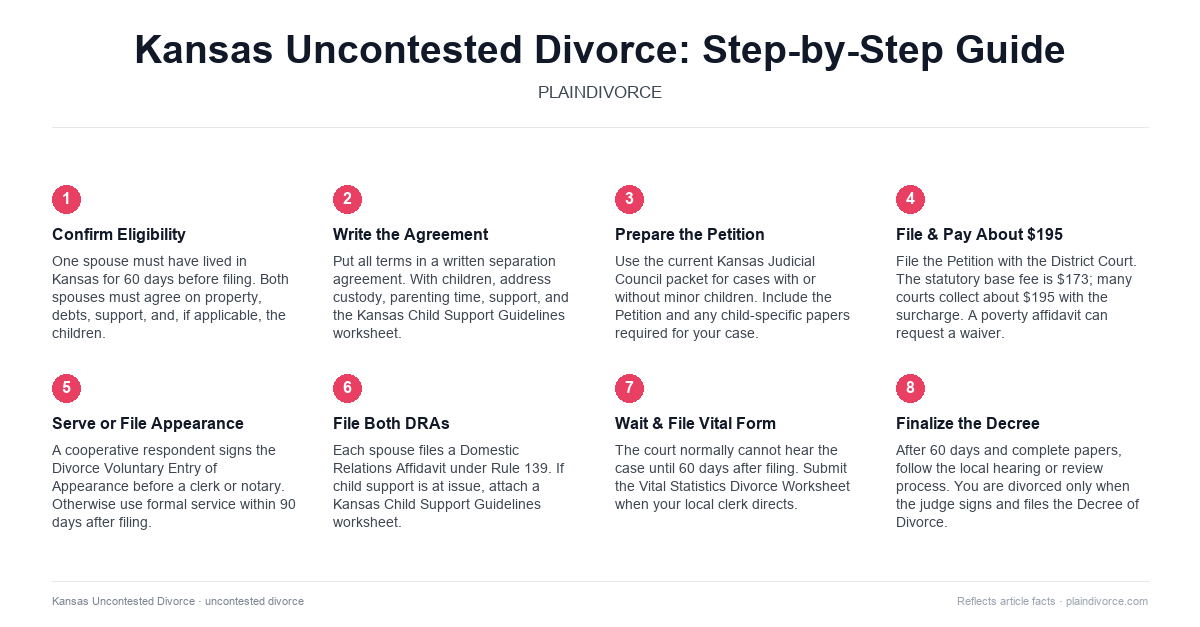
TL;DR: Uncontested Divorce in Kansas
- What it is: Kansas has no separate “simple divorce” category. It is a standard divorce where both spouses agree on everything, usually on the no-fault ground of incompatibility (K.S.A. 23-2701).
- Residency: The petitioner or the respondent must have been an actual Kansas resident for 60 days immediately before the petition is filed (K.S.A. 23-2703). A military member who has been a resident of, or stationed at, a U.S. post or military reservation in Kansas for 60 days may file in any adjacent county.
- Timeline: A divorce “shall not be heard until 60 days after the filing of the petition” (K.S.A. 23-2708). Treat 60 days as a floor; the actual finish depends on your county’s docket.
- Cost: The statewide district-court docket fee is set by statute at $173 (K.S.A. 60-2001); with the Supreme Court surcharge authorized by 2026 legislation, many courts collect about $195. Confirm the current amount with your clerk. A poverty affidavit can waive it.
- Forms to know: the Petition for Divorce, the Domestic Relations Affidavit (DRA) that every party must file under Rule 139, a notarized Divorce Voluntary Entry of Appearance, your written separation agreement, the Vital Statistics Divorce Worksheet, and the final Decree of Divorce.
- Kids: Even in an agreed case, the judge reviews your parenting plan and the Kansas Child Support Guidelines worksheet, and support normally routes through the Kansas Payment Center.
- Not a fit if: there is domestic violence, hidden assets, a business or farm to value, or pressure to sign — talk to an attorney or legal aid first.
1. What Is an Uncontested or Simple Divorce in Kansas?
Kansas law has no special “simple divorce” shortcut. The court calls the case a divorce (sometimes “dissolution of marriage”), and it follows the same rules whether or not the spouses agree. When people say uncontested divorce in Kansas, they mean a case where:
- one spouse files a Petition for Divorce,
- the other spouse does not fight the divorce, and
- both spouses agree on the important issues — children, support, property, and debts.
Most agreed couples write their deal into a separation agreement (many people call it a marital settlement agreement). Under K.S.A. 23-2712, the court incorporates that agreement into the decree only if it finds the agreement “valid, just and equitable” — and any terms about custody, parenting time, support, or education of the children stay under the court’s control. When the judge approves everything, the court enters the final order: the Decree of Divorce.
“Uncontested” does not switch off the court’s review. A contested divorce — where you disagree about the house, the parenting schedule, or the support number — means more hearings, more paperwork, and more legal fees. An uncontested case skips the fight, not the forms.
2. Who Qualifies for an Uncontested Divorce in Kansas?
2.1 Kansas residency rule (not the same as the waiting period)
To file a divorce in Kansas, the petitioner or the respondent must have been an actual resident of the state for 60 days immediately preceding the filing of the petition (K.S.A. 23-2703). There is one military alternative: a person who “has been a resident of or stationed at a United States post or military reservation within the state for 60 days immediately preceding the filing” may file in any county adjacent to the post or reservation. Either way, the 60-day clock still has to be met.
This residency test is separate from the Kansas divorce 60-day waiting period in Step 6. Residency is about how long you have lived in Kansas before filing; the waiting period is about how long the court must wait after filing.
2.2 Grounds for divorce (most uncontested cases use incompatibility)
Under K.S.A. 23-2701, a Kansas court may grant a divorce on any of three grounds: incompatibility; failure to perform a material marital duty or obligation; or incompatibility by reason of mental illness or incapacity (which requires specific findings and is rarely used). Almost every uncontested couple uses incompatibility — the no-fault ground. You do not have to prove that either spouse did anything wrong; a sworn statement that the marriage is incompatible is the usual basis for the decree.
2.3 When a case is a good fit
- You both agree the marriage is over and want the divorce.
- You can communicate enough to exchange information and sign documents.
- You can each fully disclose your finances — income, assets, and debts — on a Domestic Relations Affidavit.
- You have a workable agreement on children (if any), support, and how to split property and debts.
2.4 When uncontested may not work
- There is domestic violence, threats, intimidation, or coercive control.
- One spouse controls the money and will not share financial details.
- You suspect hidden assets or dishonest disclosures.
- You strongly disagree about where the children live or the parenting schedule.
- There are serious immigration, tax, bankruptcy, or complex-asset issues.
- One spouse feels pressured to sign without understanding what they are giving up.
In any of these situations, talk with a Kansas family-law attorney or a legal aid office before you rely on a DIY approach.
3. Step-by-Step: The Uncontested Divorce Process in Kansas
Every county has its own local practices, but most uncontested divorces follow the same path. Here is the roadmap using the terms you will actually see in Kansas Judicial Council instructions and form packets.
Step 1 – Reach agreement (your separation agreement)
A truly simple Kansas divorce starts with a clear, complete agreement on:
- Children (if any): legal custody, the parenting-time schedule, holidays, transportation, communication, and decision-making.
- Child support: an amount supported by the Kansas Child Support Guidelines and worksheet.
- Spousal maintenance: whether it is paid, how much, and for how long (if at all).
- Property and debts: the home, vehicles, bank and retirement accounts, credit cards, loans, and other obligations.
Put the deal in writing as a separation agreement. This is a document you and your spouse draft, not a mandatory statewide court form. The judge can incorporate it into the Decree of Divorce if the court finds it valid, just, and equitable (K.S.A. 23-2712). The decree, not the agreement, is the order that ends the marriage.
Step 2 – Prepare the Petition for Divorce
The case starts when the filing spouse (the petitioner) submits a Petition for Divorce to the District Court in the proper county. The Kansas Judicial Council publishes statewide divorce form packets and instructions — one set for divorce without minor children and one for divorce with minor children. Ask your Clerk of the District Court for the current packet, or get it from the Judicial Council’s official legal-forms library; use the current version so the clerk can process your case without follow-up.
The core documents filed at or near the start of an agreed case usually include the Petition for Divorce, a Domestic Relations Affidavit (see Step 5), the Vital Statistics Divorce Worksheet (see Step 7), and, when there are children, a proposed parenting plan and child support worksheet.
Step 3 – File and pay the docket fee
You file the petition with the Clerk of the District Court and pay the docket fee. This fee is set statewide by statute, not by each county: K.S.A. 60-2001 puts the base docket fee at $173, and 2026 legislation adds a Supreme Court surcharge on top, so many Kansas district courts are collecting about $195 as of 2026. Confirm the exact figure with your clerk. What genuinely varies locally is service, copying, and payment-processing charges — not the docket fee itself.
If you cannot afford the fee, you can file a poverty affidavit asking the court to let you file without payment. Kansas does not use a fixed income cutoff for this: under K.S.A. 60-2001(b), a person who cannot pay “by reason of poverty” files a sworn affidavit, and the judge reviews it and decides whether the fee must be paid.
Step 4 – Service or the Voluntary Entry of Appearance
After filing, the other spouse must get official notice of the case. In a cooperative Voluntary Entry of Appearance Kansas divorce, the respondent signs a Divorce Voluntary Entry of Appearance instead of being formally served. Key points:
- The respondent signs the form in front of a notary public or the clerk — not alone at home. A form signed without the proper acknowledgment can be rejected, and the case stalls.
- The respondent should also receive a copy of the petition and the other initial papers.
- The completed form is filed with the court as proof of notice. Under K.S.A. 60-203, “the filing of an entry of appearance has the same effect as service.”
If your spouse will not sign, you must use a formal service method (often sheriff service or another method your county allows). Timing matters: if service or first publication happens within 90 days after the petition is filed, the case is treated as commenced on the filing date; the court can grant one additional 30-day extension for good cause (K.S.A. 60-203).
Step 5 – The Domestic Relations Affidavit (DRA)
If DIY filers get stuck anywhere, it is here. The Domestic Relations Affidavit Kansas form is the sworn financial disclosure required by Kansas Supreme Court Rule 139. All parties must prepare and file one — the petitioner and the respondent each complete a separate DRA. When child support is at issue, a child support worksheet must accompany the DRA.
In plain English, the DRA covers:
- your income (pay, self-employment, other sources)
- your monthly living expenses
- your assets (accounts, vehicles, real estate, retirement)
- your debts (loans, credit cards, other obligations)
- information that supports any child support or maintenance calculation
Tip: before you start, gather recent pay stubs, tax returns, bank statements, and a list of debts. Use the current Judicial Council version of the DRA, and ask your clerk how many copies they want. If a section is confusing, consider limited-scope legal help — paying a lawyer just to review your disclosures.
Step 6 – The Kansas divorce 60-day waiting period
K.S.A. 23-2708 says an “action for divorce shall not be heard until 60 days after the filing of the petition.” In plain English, the court generally cannot hold the final hearing or sign the decree until at least 60 days have passed since the petition was filed. The clock starts on the filing date, not the date your spouse is served or signs the appearance.
There is a narrow emergency exception, and it is not a simple “the judge shortens it.” To hear the case sooner, the judge must enter an order that states the precise nature of the emergency, the substance of the evidence that supports it, and the names of the witnesses who gave that evidence. The request is made by pleading or motion, it cannot be heard before the answer period ends unless that is waived, and non-defaulting parties get at least seven days’ notice. If the judge finds a genuine emergency, “the divorce and all issues pertaining thereto may be heard immediately.” This is rare in an ordinary uncontested case.
Step 7 – The Vital Statistics Divorce Worksheet
Kansas divorce packets include a Vital Statistics Divorce Worksheet — the form that reports the divorce to the Kansas Department of Health and Environment (KDHE) Office of Vital Statistics (names, marriage date, divorce date, and similar basic facts). The Judicial Council lists this worksheet in both initial divorce packets (with and without minor children), so it is a filing-stage document, not a post-decree afterthought. Some clerks want it submitted with the petition; others collect it near the end. Follow your clerk’s local instructions on when and how to turn it in.
Why it matters: this worksheet is how the state’s vital records get updated. Getting it right keeps a later request for a certified Divorce Certificate from KDHE straightforward.
Step 8 – Finalize with the Decree of Divorce
Once the 60 days have passed and your paperwork is complete, the court either schedules a short final hearing or follows local procedures for reviewing the file. If the judge is satisfied that residency, notice, any child-related terms, support, and property division are legally acceptable, the judge signs the Decree of Divorce. You are not divorced until the judge signs and files it.
After that, there are two different records you may need, from two different offices — do not mix them up:
- Certified copy of the Decree of Divorce: request it from the Clerk of the District Court in the county where you filed. This is the full court order, often needed for a name change or to divide retirement accounts.
- Certified Divorce Certificate: request it from the KDHE Office of Vital Statistics. It contains only basic facts (names, marriage date, divorce date). The $20 fee is a five-year record search fee (one certified copy is issued if the record is found; the fee is kept if it is not). Internet and telephone orders add a $15 expedited fee; the mobile app adds $5.
Kansas 60-Day Waiting Period Timeline
Day 60 is a floor, not a guarantee — actual scheduling depends on your county’s docket and whether your paperwork needs corrections. Service must be completed within 90 days of filing.
4. Special Issues When You Have Children
Uncontested or not, Kansas judges must protect the best interests of the children, and the court “shall make provision for the support and education of the minor children” (K.S.A. 23-3001). Even when you agree, the court reviews your parenting plan and support paperwork.
4.1 Parenting plan (temporary vs permanent)
Kansas packets distinguish a temporary parenting plan (used early in a case, if needed) from a permanent parenting plan (the one you want the judge to approve in the final decree). If you are fully agreed, focus on the permanent plan that matches your settlement: legal custody, residency and parenting time, holidays, transportation, communication, and how major decisions get made.
4.2 Child support, the worksheet, and the Kansas Payment Center
- The worksheet controls. Kansas uses statewide Child Support Guidelines and a worksheet. Even in an agreed case, the judge may ask questions if your number is far from the guideline result, and Rule 139 requires the worksheet to accompany the DRA when support is at issue.
- Payments route through the Kansas Payment Center. Under K.S.A. 23-3004, a support order must be paid through the state’s central unit — the Kansas Payment Center — unless the parties have a written agreement for direct payment that the court does not find contrary to the child’s best interests. A Kansas Payment Center information form is normally attached to the support order.
- Income withholding is usually immediate. New or modified support orders must provide for immediate issuance of an income withholding order, subject to statutory exceptions — for example, a written agreement for an alternative arrangement or a good-cause finding in a non-IV-D case (K.S.A. 23-3103).
- Medical support. Your order should address health-insurance coverage and how uncovered medical costs are shared.
4.3 Parenting class or mediation (county-specific)
Under K.S.A. 23-3214, a court may require parents to attend parent education classes, and may require mediation unless mediation is inappropriate for the case — neither is automatic statewide. Some counties do require a class or mediation when minor children are involved. Separately, the statute says parents must receive information about preparing a parenting plan, the effect of family breakup on children, domestic-abuse resources, and alternative dispute resolution. Ask your local court or self-help center what your county requires.
5. How Long Does an Uncontested Divorce Take in Kansas?
- Legal minimum: 60 days from the date the petition is filed, because the case “shall not be heard until 60 days after the filing of the petition” (K.S.A. 23-2708).
- After day 60: in an agreed case with complete paperwork, the court can move to a final hearing or a decree on the documents. How soon depends on your county’s docket and review process.
- No published statewide average. Kansas does not publish an official “typical” completion time, so plan for at least 60 days plus your county’s scheduling time, and expect corrections to add weeks.
- Common causes of delay: an outdated or incomplete DRA, a missing child support worksheet, a Voluntary Entry of Appearance that was not notarized, or an unfiled Vital Statistics Divorce Worksheet.
6. What Does an Uncontested Divorce Cost in Kansas?
| Cost | Amount (2026) | Notes |
|---|---|---|
| District court docket fee | ~$195 | Base fee is $173 by statute (K.S.A. 60-2001); a 2026-authorized Supreme Court surcharge brings the total many courts collect to about $195. It is statewide, not county-set. Confirm the current amount with your clerk. |
| Service of process | Varies | Sheriff or process-server fee if your spouse is formally served. Avoided if your spouse signs a notarized Voluntary Entry of Appearance. Ask the clerk or sheriff for the current charge. |
| Notary | Small per-signature fee | For the Voluntary Entry of Appearance and any notarized affidavits. Often free at your bank. |
| Parenting class or mediation | Varies by provider | Only if your county requires it. Each parent pays for their own; confirm the cost with the approved provider. |
| Certified Decree of Divorce | Per-page clerk fee | From the Clerk of the District Court. Order one or two for name changes and retirement paperwork. |
| Certified Divorce Certificate (KDHE) | $20 search fee (+$15 expedited) | $20 is a five-year record search fee; internet/phone orders add $15, the mobile app adds $5. |
| Fee waiver | $0 to apply | File a sworn poverty affidavit under K.S.A. 60-2001(b); the judge decides whether the fee must be paid. |
Attorney fees are the biggest variable. Many couples keep costs down by staying uncontested and paying only for a one-time review of the separation agreement or the DRA, rather than full representation.
7. When a DIY Divorce Might Not Be Right for You
A do-it-yourself Kansas divorce is not the right call for everyone. It can be risky to rely only on online information or a kit if:
- you feel unsafe or there is a history of domestic violence;
- your spouse pressures you to sign quickly without time to think or get advice;
- you do not understand the finances and worry something is being hidden (the DRA is your main disclosure tool);
- you own a business, farm, or other hard-to-value assets, or have significant retirement or pension accounts;
- there are serious immigration, tax, or bankruptcy issues tied to the marriage.
In these situations, a cheap divorce can become an expensive one later. PlainDivorce cannot tell you whether a settlement is fair — that is a legal-advice question. Consider a one-time consult with a Kansas attorney, or Kansas Legal Services if you qualify.
8. Where a Self-Help Divorce Kit Fits Into the Kansas Process
Handling a Kansas uncontested divorce without a lawyer means managing deadlines, signatures, and a stack of forms — especially the Domestic Relations Affidavit and the notarized Voluntary Entry of Appearance. A self-help kit is not a substitute for the official Kansas Judicial Council forms or for legal advice; it works alongside them so you stay organized and avoid the common hold-ups. A good kit helps you:
- follow the roadmap: Petition for Divorce → service or Voluntary Entry of Appearance → 60-day waiting period → Decree of Divorce;
- gather your information for the DRA and, if you have children, the child support worksheet;
- draft and organize a clear separation agreement;
- track easy-to-miss items like the Vital Statistics Divorce Worksheet and the Kansas Payment Center form;
- avoid the filing mistakes that cause delays.
You are still responsible for checking the current rules, local requirements, official forms, and fees before you file.
Download Our Kansas Uncontested Divorce Self-Help Kit
9. Frequently Asked Questions
What is the Domestic Relations Affidavit (DRA) in Kansas?
The Domestic Relations Affidavit is the sworn financial disclosure required by Kansas Supreme Court Rule 139 in divorce cases. All parties must prepare and file one, so the petitioner and the respondent each complete a separate DRA covering income, monthly expenses, assets, and debts. When child support is at issue, a child support worksheet must be filed with it. Use the current Kansas Judicial Council version and give the clerk the number of copies they ask for.
How long does an uncontested divorce take in Kansas?
The legal minimum is 60 days: K.S.A. 23-2708 says a divorce “shall not be heard until 60 days after the filing of the petition,” measured from the filing date. A judge can hear the case sooner only after entering a detailed emergency order. Kansas publishes no official average finish time, so plan for at least 60 days plus your county’s scheduling time, and expect paperwork corrections to add a few weeks.
What is a Voluntary Entry of Appearance in a Kansas divorce?
It is a document the non-filing spouse signs to accept notice of the divorce instead of being formally served by a sheriff or process server. In Kansas the spouse must sign it in front of a notary public or the clerk, and should also receive a copy of the petition. The completed form is filed with the court, and under K.S.A. 60-203 a filed entry of appearance “has the same effect as service.” A form signed at home without proper acknowledgment can be rejected.
What are the residency requirements for divorce in Kansas?
Under K.S.A. 23-2703, the petitioner or the respondent must have been an actual resident of Kansas for 60 days immediately before the petition is filed. There is a military alternative: a person who has been a resident of, or stationed at, a U.S. post or military reservation within Kansas for those 60 days may file in any county adjacent to the post or reservation. This 60-day residency test is separate from the 60-day waiting period after filing.
How much does an uncontested divorce cost in Kansas?
The main cost is the district court docket fee. The statutory base is $173 (K.S.A. 60-2001), and with the 2026-authorized Supreme Court surcharge many courts collect about $195. Add service costs if your spouse is formally served, a small notary fee, a parenting-class fee if your county requires one, per-page charges for a certified decree, and a $20 KDHE search fee for a Divorce Certificate. If you cannot pay, file a sworn poverty affidavit and the judge decides whether the fee is waived. Confirm current amounts with your clerk.
Do I have to go to court for an uncontested divorce in Kansas?
It depends on your county. After the 60-day waiting period, some Kansas courts hold a short final hearing where the petitioner testifies briefly, while others review a fully documented agreed case on the papers. Ask your Clerk of the District Court how uncontested divorces are finalized locally. Either way, you are not divorced until a judge signs and files the Decree of Divorce.
What is the difference between a Decree of Divorce and a Divorce Certificate in Kansas?
The Decree of Divorce is the full court order that ends the marriage and sets the terms; you get certified copies from the Clerk of the District Court in the county where you filed. The Divorce Certificate is a short vital-records document with basic facts only (names, marriage date, divorce date), issued by the KDHE Office of Vital Statistics for a $20 record search fee. You may eventually need one, the other, or both.
10. Final Thoughts and Next Steps
Feeling overwhelmed is normal, especially when you hit an intimidating form like the Domestic Relations Affidavit. The good news is that many people finish an uncontested divorce in Kansas on their own when the situation is straightforward and both spouses cooperate. Use this checklist to stay grounded:
- Confirm the 60-day Kansas residency requirement before you file (K.S.A. 23-2703).
- Get the current Kansas Judicial Council packet that matches your case — with or without minor children.
- Plan around the 60-day waiting period from the filing date (K.S.A. 23-2708), and complete service within 90 days.
- Have both spouses complete a current DRA, plus a child support worksheet if support is at issue.
- If you use a Voluntary Entry of Appearance, sign it in front of a notary or the clerk.
- Ask the clerk about the Vital Statistics Divorce Worksheet and when they want it.
- Know the difference between a certified Decree of Divorce (District Court Clerk) and a certified Divorce Certificate (KDHE Vital Statistics).
- Stay organized with checklists, timelines, and copies of everything you file.
If your case is straightforward and you are ready to move, our Kansas uncontested divorce kit walks you through the forms and deadlines in order.
Disclaimer: PlainDivorce is not a law firm and does not provide legal advice or representation. This guide is general information about Kansas divorce procedure, current as of September 2026, and may not reflect recent changes or your county’s local rules. Using a self-help kit does not create an attorney-client relationship. For advice about your situation, consult a licensed Kansas family-law attorney or a legal aid organization such as Kansas Legal Services.
Sources and local rules can change. Use this guide as a plain-English organizer, then verify the current filing requirements with the official court or government source for your jurisdiction.

About Harry D
Expert contributor at PlainDivorce, helping Canadians and American navigate simple uncontested divorces with clarity and confidence.