Uncontested Divorce in Kentucky: Forms, Costs, and the 2026 Process
An uncontested divorce in Kentucky is a dissolution of marriage where both spouses agree on every issue — property, debt, spousal support, and any child custody and support — so no judge has to decide anything. You still meet the 180-day residency requirement, wait out the 60-day separation period, file a sworn Petition for Dissolution of Marriage, and submit the state VS-300 vital-records form, but a cooperative case can often finish on paper without a court appearance.
Kentucky law calls divorce a dissolution of marriage. There is no separate “simple divorce” statute — “uncontested” just describes a case the spouses have already settled. This guide walks through who qualifies, the exact forms, the 2026 filing costs, how to finish without a hearing, and where a Kentucky uncontested divorce kit fits in.
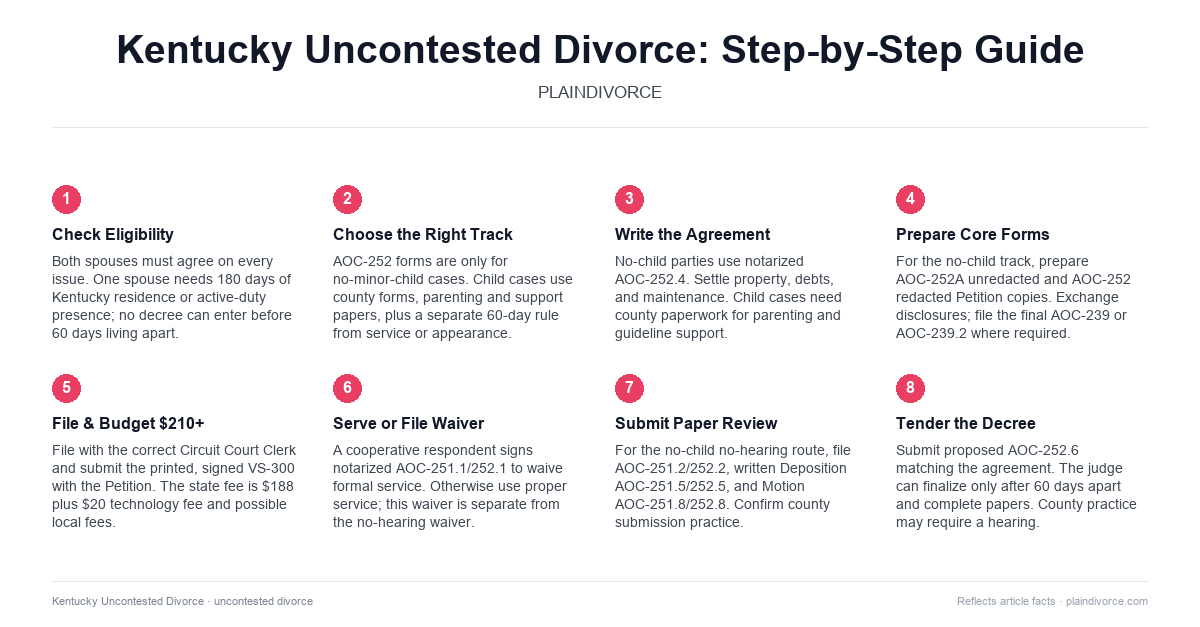
TL;DR
- An uncontested divorce in Kentucky works when both spouses agree on property, debt, maintenance, and (if you have kids) custody, parenting time, and child support.
- At least one spouse must have kept a Kentucky residence (or active-duty military presence) for 180 days before filing, and the court cannot enter a decree until the spouses have lived apart 60 days. Neither period can be waived by agreement.
- The statewide petition is AOC-252 / AOC-252A, “Petition for Dissolution of Marriage (without children under 18).” Kentucky does not publish a matching downloadable petition for cases with minor children — those filers use their county’s local forms or get legal help.
- A cooperative spouse signs an Entry of Appearance and Waiver (Waiver of Service, AOC-251.1/252.1) before a notary to skip formal service.
- The VS-300 form is a state vital-records document. You generate it online, print it, sign it, and file it with the petition; the court cannot issue a final decree until that information is on file.
- As of July 1, 2026 the Circuit Court civil filing fee is a flat $188, plus a $20 technology fee and other required local fees; service costs are separate.
- Many uncontested cases finish without a hearing when the right waivers, a Deposition of Petitioner, a Motion to Submit, and a proposed Decree are all filed and consistent with the separation agreement.
1. What an Uncontested Divorce in Kentucky Actually Is
Under Kentucky law, divorce is a dissolution of marriage, and the statutes create no separate “simple” or “summary” track. An uncontested divorce in Kentucky is simply a dissolution where the spouses have already agreed on everything, so the judge’s job is limited to confirming the paperwork and signing the decree.
In practice, an uncontested Kentucky case usually means:
- Both spouses state under oath that the marriage is irretrievably broken with no reasonable prospect of reconciliation.
- They sign a written separation agreement covering property, debt, and maintenance — for couples with no children under 18, this is the AOC-252.4 Separation Agreement, which both parties sign before a notary.
- They agree whether anyone pays maintenance (spousal support), and if so how much and for how long. Under KRS 403.180, the property and maintenance terms bind the court unless it finds them unconscionable.
- If there are minor children, the parents agree on custody, parenting time, and guideline child support — but the court still reviews those terms for the children’s best interest and is not bound by the parents’ deal.
- The financial disclosure statements (Preliminary AOC-238 / AOC-238.1 and Final AOC-239 / AOC-239.1) are exchanged and, where required, filed.
A contested divorce, by contrast, is one where the spouses disagree on at least one major issue and the court has to resolve it through motions, hearings, or a trial. Contested cases take longer and cost more. Most couples who are cooperative, safe, and financially honest with each other are good candidates for the uncontested path.
2. Who Qualifies: Residency, Venue, and the 60-Day Rule
2.1 The 180-day residency requirement
Under KRS 403.140, a Kentucky court can enter a decree only if at least one spouse has maintained a Kentucky residence — or an active-duty military presence in Kentucky — for the 180 days immediately before the petition is filed. That 180 days has to be complete when you file; a petition filed too early can be dismissed. The residency requirement cannot be waived, even if both spouses agree.
You file in Circuit Court — a Family Court division in the counties that have one — in the county where the husband or wife usually resides (KRS 452.470). Not every county has a separate Family Court, so check how your county is organized and what its local clerk requires.
2.2 No-fault grounds and the 60-day separation rule
Kentucky is a no-fault state. The only ground for dissolution is that the marriage is irretrievably broken, which the statute defines as no reasonable prospect of reconciliation.
Here is the detail that trips up DIY filers: under KRS 403.170, no decree may be entered until the parties have lived apart for at least 60 days, and this cannot be shortened by agreement or by the court. The statute also says “living apart” includes living under the same roof without sexual cohabitation — that is the statute’s wording, not an automatic finding for every household, so be prepared to explain your living arrangement honestly if the court asks. You can file the petition before the 60 days are up; you just cannot finalize until they have passed.
If you have minor children of the marriage, a second clock applies. KRS 403.044 bars the court from taking any testimony (other than on temporary motions) until 60 days have elapsed from the earliest of: service of summons, appointment of a warning-order attorney, or the respondent’s entry of appearance or responsive pleading. So a child case effectively has to satisfy both the 60-days-living-apart rule and this 60-days-from-service rule.
| Requirement | Rule | When it must be met |
|---|---|---|
| Residency / military presence | One spouse, 180 days in Kentucky (KRS 403.140) | Before you file |
| Grounds | Marriage irretrievably broken (KRS 403.170) | Stated in the petition and deposition |
| Living apart | 60 days, all cases, not waivable (KRS 403.170) | Before the decree is entered |
| Child-case testimony bar | 60 days from first service/appearance (KRS 403.044) | Cases with minor children only |
| Venue | County where either spouse usually resides (KRS 452.470) | At filing |
2.3 When an uncontested divorce is a good fit
- You both want the divorce and can communicate safely and reasonably.
- You can exchange honest financial information — income, debts, property, retirement.
- You can put your agreement in writing and follow it.
- If you have children, you can agree on a parenting plan and guideline support a judge can approve.
2.4 When to think twice
- Domestic violence, stalking, threats, or serious intimidation.
- Hidden income or assets, refusal to disclose, or pressure to sign quickly.
- A business, multiple real-estate parcels, or significant retirement or pension assets that need valuation or a QDRO.
- Serious disputes about custody, relocation, or a child’s safety.
- Immigration, disability, or tax consequences tied to the divorce terms.
In those situations, talk to a Kentucky family-law attorney or a legal aid office before you try to handle everything yourself.
3. The Kentucky Uncontested Divorce Process, Step by Step
Step 1 – Confirm you qualify and start both clocks
- Does at least one spouse meet the 180-day residency rule?
- Have you already lived apart 60 days, or will you before you ask for the decree?
- Do you have full agreement on property, debts, support, and — if applicable — children?
- Do you have minor children together under 18 (or still in high school)? That determines which forms you can use and adds the KRS 403.044 timing rule.
Step 2 – Write your separation agreement
A signed written agreement is the backbone of an uncontested case. Couples without minor children use the AOC-252.4 Separation Agreement (without children under 18), which both spouses sign in front of a notary. Cover, at minimum:
- Property – house, vehicles, bank accounts, retirement, personal property.
- Debts – credit cards, loans, medical bills, taxes, and who holds the other harmless.
- Maintenance – whether either spouse pays, and the amount and duration.
- Children, if any – a parenting-time schedule, decision-making, and guideline child support.
Under KRS 403.180, the judge reviews the property and maintenance terms only for whether they are unconscionable (grossly unfair). Child terms are reviewed separately and must serve the children’s best interest.
Step 3 – Prepare the Kentucky divorce forms
You can download the current Kentucky divorce forms PDF set for free from the Kentucky Court of Justice’s official legal-forms library rather than paying a third-party site. For an uncontested case with no children under 18, the core set is:
- Petition for Dissolution of Marriage (without children under 18) — AOC-252A is the sworn, unredacted copy the petitioner keeps; AOC-252 is the redacted version filed in the public court record.
- Waiver of Service and Entry of Appearance (AOC-251.1/252.1) when the respondent cooperates — the form most people search for as “Entry of Appearance and Waiver Kentucky.”
- Separation Agreement (AOC-252.4), signed by both parties before a notary.
- Preliminary and Final Verified Disclosure Statements (AOC-238 / AOC-239, or the simplified AOC-238.1 / AOC-239.1 for combined income and assets each under $100,000). The preliminary statement is usually exchanged between spouses within 45 days of service, not filed, unless the court or a local rule requires filing; the final statement (or an AOC-239.2 Affidavit of No Change) is the one filed.
- The VS-300 form — officially the “Certificate of Divorce, Dissolution of Marriage or Annulment.” This is a state vital-records form, not an AOC court form. Under KRS 213.116, the petitioner (or the petitioner’s attorney) must file the VS-300 information concurrently with the petition, and that information is a prerequisite to the court issuing a final decree. You complete it on the Cabinet for Health and Family Services Office of Vital Statistics portal, then download, print, and sign the generated PDF and hand it to the Circuit Court Clerk with your filing. Many DIY filers miss it because it lives outside the usual Kentucky divorce forms PDF packet.
- The court’s Certificate of Dissolution of Marriage (AOC-250) — a short internal certificate the clerk completes after the decree. This is separate from the VS-300.
If you have minor children together, the picture is different. The statewide forms library publishes the petition, separation agreement, and decree only in the “without children under 18” versions (AOC-252/252A, AOC-252.4, AOC-252.6). There is no matching downloadable “AOC-251” petition packet for cases with children — the “251” you see on the combined waiver, deposition, and motion forms is only the case-type code. If you have minor children, use your county Circuit Court’s current local forms and instructions, or get help from legal aid or an attorney, and do not use the no-child AOC-252.4 or AOC-252.6 forms.
Step 4 – File with the Circuit Court Clerk and file the VS-300
- File the petition (redacted and unredacted copies) with the Circuit Court Clerk in the correct county.
- Pay the filing fee, or file AOC-026, Motion for Waiver of Costs and Fees and to Proceed In Forma Pauperis, if you cannot afford it. The court decides whether to grant it — a waiver is not automatic.
- Bring the printed, signed VS-300 to file with the petition — not later.
- Get your case number and use it on every later document.
- Keep a complete copy of everything you file.
Step 5 – Service, or the Entry of Appearance and Waiver
If your spouse cooperates, they sign the Waiver of Service and Entry of Appearance (AOC-251.1/252.1) before a notary or the circuit clerk. It tells the court the respondent received the petition, waives formal service, and submits to the court’s jurisdiction — saving time and sheriff or certified-mail fees. If your spouse will not sign, you must arrange proper service of process (sheriff service, certified mail, or another method the rules allow).
Step 6 – Disclosures and any court-ordered education
During this stage you finish exchanging the disclosure statements and any supporting documents (recent pay stubs, tax returns). If you have minor children, the court may order both parents to complete a divorce- or parent-education program before the decree — but whether it is required, which provider is accepted, how long it takes, and what it costs are set locally and case by case. Ask your clerk or check your county’s family-court rules; do not assume a class is or is not required.
4. How to Finish Without a Court Hearing
“How do I get divorced in Kentucky without going to court?” is one of the most common searches. The answer for an uncontested case without children: you do not just “request” a paper review — you file a specific bundle of documents, in the right order, and only then will a judge sign the decree.
The second waiver: Waiver of Notice of Deposition and Final Hearing (AOC-251.2/252.2)
This is a separate document from the Entry of Appearance and Waiver. In it, the respondent gives up the right to a final hearing, agrees the petitioner’s written deposition can stand in for live testimony, and waives notice of when the case is submitted. It must be signed and acknowledged before a notary. Without this second waiver on file, the no-hearing path generally does not work.
The proof: Deposition of Petitioner (AOC-251.5/252.5)
The Deposition of Petitioner is sworn testimony in written form, given in place of an in-person hearing. It confirms the marriage is irretrievably broken, that the residency and 60-day requirements are satisfied, and that a separation agreement has been filed.
The trigger: Motion to Submit for Entry of Decree (AOC-251.8/252.8)
Filing the petition and agreement is often not the last step — many DIY cases stall because nothing tells the court the file is ready. The Motion to Submit for Entry of Decree of Dissolution of Marriage, and Order asks the judge to take the case under submission and certifies that every prerequisite is in place: 60 days lived apart; a response or the Waiver of Service on file; the Waiver of Notice of Deposition and Final Hearing on file; the separation agreement filed; the Deposition of Petitioner filed; and no material change in circumstances since the deposition.
The order the judge signs: Findings of Fact, Conclusions of Law, and Decree (AOC-252.6)
This is the piece DIY filers most often overlook. The Motion to Submit does not itself dissolve the marriage — the judge signs a separate proposed order, the Findings of Fact, Conclusions of Law, and Decree of Dissolution of Marriage (AOC-252.6, “without children under 18 and with separation agreement”), which you generally prepare and tender with (or shortly after) the motion. If this proposed decree is missing, incomplete, or inconsistent with your separation agreement, your case can sit un-decided even though everything else was filed correctly.
Practical tip: procedures vary by county. Some counties route uncontested cases through a domestic-relations commissioner and some judges add steps. Ask the clerk exactly what your court needs to submit an uncontested case for final action.
5. Extra Steps When You Have Minor Children
When there are minor children of the marriage, the court’s job is to make sure the arrangements serve the children’s best interest — true even in an uncontested case. You are also working from a different form set (your county’s local child forms, not the statewide no-child AOC-252 series), and the KRS 403.044 timing rule applies. Plan for:
- A parenting plan – a clear schedule for weekdays, weekends, holidays, transportation, and exchanges, plus how major decisions (school, health, religion, activities) are made.
- Child support on the guidelines. You calculate it on the Child Support Worksheet (CS-71 / CS-71.1) using each parent’s income. Under KRS 403.211, the guideline amount is a rebuttable presumption — any deviation requires a written or specific on-the-record finding of the reason.
- A formal support order on AOC-152 (Uniform Child Support Order and/or Wage/Income Withholding Order). It must set the guideline amount, assign health-care coverage when it is reasonable in cost (no more than 5% of the paying parent’s gross income) and accessible, allocate the first $250 per child per year of medical costs and share extraordinary medical expenses in proportion to income, and route payments through the Kentucky child-support disbursement unit.
- Income withholding. Kentucky support orders take effect by immediate wage withholding unless the court finds good cause or the parents have a qualifying written alternative arrangement. In a private (non-IV-D) case, the parties must serve the employer with a federal Income Withholding for Support order (OMB 0970-0154).
- Any court-ordered parent education, if your county requires it.
| Item | No children under 18 | Minor children of the marriage |
|---|---|---|
| Petition | AOC-252 / AOC-252A (statewide) | County local forms; no statewide packet |
| Settlement | AOC-252.4 Separation Agreement | Parenting plan + support; county forms |
| Decree | AOC-252.6 (statewide) | County local decree forms |
| Support order | Not applicable | CS-71 worksheet + AOC-152 order + income withholding |
| Timing rules | 60 days lived apart | 60 days lived apart and 60 days from first service (KRS 403.044) |
| Education class | Rarely ordered | Possible, if the court requires it |
6. How Long a Kentucky Uncontested Divorce Takes
Kentucky timelines confuse people because different rules apply at different points:
- 180-day residency – must already be satisfied before you file.
- 60 days lived apart – must be satisfied before the decree, all cases.
- 60 days from first service or appearance – a separate bar on testimony in cases with minor children (KRS 403.044).
Because the 60-day living-apart clock usually runs alongside the paperwork, the earliest a cooperative, well-prepared case can finish is roughly two months after filing. The realistic timeline depends heavily on your county’s docket and on whether every document is complete. Cases slow down when disclosures are missing, the separation agreement has gaps, the VS-300 was never filed, the proposed decree (AOC-252.6) is missing or inconsistent with the agreement, or the court’s calendar is backed up. For a current local estimate, ask your Circuit Court Clerk.
7. What an Uncontested Divorce Costs in 2026
Effective July 1, 2026, the Kentucky Supreme Court set the Circuit Court civil filing fee at a flat $188.00 statewide (Supreme Court Order 2026-15, amending Civil Rule 3.02). On top of that you pay a $20.00 court technology fee and any other required fees, such as a court facility fee or library fee. Budget roughly $210 or more for filing before any service costs, and confirm your county’s exact total with the clerk. Common expenses:
- Filing fee – $188 plus the $20 technology fee and other required local fees.
- Service costs – sheriff, process server, or certified mail, usually avoided when the respondent signs the Waiver of Service and Entry of Appearance.
- Notary and copies – several forms require notarized signatures and multiple copies.
- Certified copies of the final decree.
- Parent-education fee, only if your county orders a class — the provider and price are set locally.
- Commissioner-related fees in the counties that route uncontested cases through a domestic-relations commissioner — ask your clerk whether this applies.
If you cannot afford court costs, file AOC-026 and ask the court to let you proceed in forma pauperis; the judge grants it only if you qualify as a “poor person” under KRS 453.190.
8. When DIY Is Not the Right Call
Handling your own uncontested divorce is reasonable when the case is genuinely simple. Get legal help if:
- There is domestic violence, stalking, threats, or serious emotional abuse.
- You feel afraid or pressured to sign paperwork or accept terms quickly.
- You believe your spouse is hiding income, assets, or debts.
- You own a business, multiple homes, or complex investments together, or need to divide a retirement plan.
- There are major immigration, disability, or tax issues tied to the terms.
- You are being asked to sign a one-sided settlement you do not fully understand.
Kentucky legal aid offices and many county bar associations offer low-cost consultations. For background reading, see PlainDivorce’s family-law guides.
9. Where a Kentucky Divorce Kit Fits
A self-help Kentucky uncontested divorce kit is not legal advice, but it can make the process clearer and less stressful for people who are good candidates for the uncontested path. A well-built kit helps you:
- Track the two clocks — 180-day residency and 60 days lived apart — and the extra KRS 403.044 clock if you have children.
- Use the right forms from the start — the AOC-252 series when you have no children under 18, or a clear pointer to county resources when you do.
- Stay organized with checklists for the petition, waivers, disclosures, VS-300, deposition, motion to submit, and proposed decree.
- Avoid the common stalls — missing notarizations, an unfiled VS-300, inconsistent financial figures, or a proposed decree that does not match the separation agreement.
10. Frequently Asked Questions
Which Petition for Dissolution of Marriage does Kentucky use?
The Kentucky Court of Justice publishes one statewide petition: AOC-252 / AOC-252A, “Petition for Dissolution of Marriage (without children under 18).” AOC-252A is the sworn unredacted copy you keep; AOC-252 is the redacted copy filed in the public record. There is no matching statewide petition for cases with minor children — those filers use their county Circuit Court’s local forms or get help from legal aid or an attorney.
Can I get an uncontested divorce in Kentucky without going to court?
Often yes, in a no-child case. The respondent signs both the Waiver of Service and Entry of Appearance and the Waiver of Notice of Deposition and Final Hearing before a notary, and you file a written Deposition of Petitioner, a Motion to Submit for Entry of Decree, and a proposed Decree (AOC-252.6). If the bundle is complete and consistent, the judge can sign without a hearing. Local practice varies, so confirm the steps with your clerk.
What is the VS-300 form in a Kentucky divorce, and is it the same as the decree?
No, they are different. The VS-300 is a state vital-records form required by KRS 213.116. You generate it on the Office of Vital Statistics portal, print it, sign it, and file it with your petition; that information is a prerequisite to the court issuing a final decree. The decree is the court order that actually ends the marriage. A missing VS-300 can hold up an otherwise-finished case.
Can the 60-day separation period be waived if we both agree?
No. Under KRS 403.170, the court cannot enter a decree until the spouses have lived apart for at least 60 days, and this applies to every Kentucky divorce, contested or not. It cannot be shortened by agreement of the parties or by the court. “Living apart” can include living under the same roof without sexual cohabitation.
Do we have to take a parenting class in Kentucky?
Maybe. Kentucky’s family-court rules list a divorce-education certificate among dissolution filings only “if required by the court,” so whether a class is ordered, which provider is accepted, and what it costs are decided locally and case by case. If you have minor children, ask your Circuit Court Clerk or check your county’s family-court rules; do not assume a class is or is not required.
What does it cost to file an uncontested divorce in Kentucky in 2026?
As of July 1, 2026 the Circuit Court civil filing fee is a flat $188, plus a $20 court technology fee and any other required local fees, so plan on about $210 or more before service costs. Service is extra unless your spouse signs the Entry of Appearance and Waiver. If you cannot afford the fees, file AOC-026 to ask the court to waive them.
What is an Entry of Appearance and Waiver in Kentucky?
It is the document the non-filing spouse (the respondent) signs before a notary to say they received the divorce petition, do not contest it, waive formal service by a sheriff, and submit to the court’s jurisdiction. On the statewide form it is the Waiver of Service and Entry of Appearance (AOC-251.1/252.1). Signing it lets an uncontested case move forward without paying for service.
11. Key Takeaways and Next Steps
An uncontested divorce in Kentucky is manageable without full attorney representation when the spouses are cooperative, honest about finances, and careful with the paperwork. Your next steps:
- Confirm the 180-day residency is met and identify your county’s venue and whether it has a Family Court division.
- Start tracking the 60-days-lived-apart clock (and, with children, the KRS 403.044 clock).
- Decide whether you have children under 18 — that determines whether you can use the statewide AOC-252 forms or need county forms.
- Draft and notarize a complete separation agreement, and gather financial documents for the disclosure statements.
- Generate, print, sign, and file the VS-300 with your petition.
- Ask your clerk exactly what your county needs to submit an uncontested case — the waivers, Deposition of Petitioner, Motion to Submit, and proposed decree.
- If anything feels unsafe or complex, talk to a Kentucky attorney or legal aid office first.
When you are ready to move, the PlainDivorce Kentucky uncontested divorce kit gives you the checklists and step-by-step instructions to keep the process on track.
PlainDivorce is not a law firm, and this guide is not legal advice. It is general information about Kentucky dissolution procedure as of September 2026. Verify every fee, form number, and local rule with your Circuit Court Clerk or a licensed Kentucky attorney before you file.
Sources and local rules can change. Use this guide as a plain-English organizer, then verify the current filing requirements with the official court or government source for your jurisdiction.

About Harry D
Expert contributor at PlainDivorce, helping Canadians and American navigate simple uncontested divorces with clarity and confidence.