Uncontested Divorce in Louisiana: Article 102 vs. 103, Separation Periods, and Parish Rules (2026)
An uncontested divorce in Louisiana is an ordinary no-fault divorce in which neither spouse fights the case. You still file a petition, meet the domicile and venue rules, live separate and apart for 180 days (no minor children) or 365 days (minor children of the marriage), give your spouse formal notice, and have a judge sign a Judgment of Divorce. What you skip is the trial. There is no shortcut statute — “simple” or “uncontested” just describes a case you and your spouse have already settled.
The single decision that shapes everything is Article 102 versus Article 103 of the Louisiana Civil Code. This guide explains both routes, who qualifies, the step-by-step process, the deadlines self-filers miss most often, how children and community property change things, and roughly how long it takes and what it costs.
TL;DR — the short version
- “Uncontested” is not a separate procedure. It is a normal divorce case where nobody contests anything. Every filing rule and deadline still applies.
- Louisiana has two no-fault routes. Article 103: finish the separation period first, then file. Article 102: file now, finish later with a separate rule to show cause. Choosing the wrong one is a common reason a self-filed case stalls.
- The separation period is 180 days with no minor children of the marriage and 365 days when there are minor children of the marriage, measured when the Article 102 rule is filed or the Article 103 petition is filed (La. C.C. art. 103.1). It must be continuous and without reconciliation.
- Under Article 102 the period runs from the later of two dates: service of the petition (or a signed waiver) and the day you actually started living apart. Being served while still living together does not start the clock.
- Article 102 has a 90-day service deadline. You must request service of the petition within 90 days of filing unless your spouse waives it (La. C.C.P. art. 3955).
- Parish matters. File where a spouse is domiciled or in the parish of the last matrimonial domicile. A judgment from the wrong parish is an absolute nullity (La. C.C.P. art. 3941).
- A divorce judgment ends the marriage; it does not divide your property. It does terminate the community regime retroactively to your filing date (La. C.C. art. 159).
1. What an Uncontested “Simple” Divorce in Louisiana Actually Is
An uncontested divorce in Louisiana is a normal divorce case in which your spouse does not oppose anything. You file a petition, a judge signs a Judgment of Divorce, and every deadline still applies. What you skip is a contested trial, not the paperwork or the waiting period.
In practice, a Louisiana divorce is “simple” when all of the following are true:
- You meet Louisiana’s domicile requirement and file in the correct parish (Louisiana has parishes, not counties).
- You use a no-fault ground based on living separate and apart, not a fault ground such as adultery or abuse.
- You and your spouse agree on children, support, and property and debts — or agree to handle those separately, later.
- Your spouse does not contest the divorce in court.
Louisiana gives you two no-fault routes. Under Article 103, you wait out the separation period first and file once you already qualify. Under Article 102, you file first and the separation period runs during the case, ending with a separate motion. Both routes end in the same judgment. They differ in timing, paperwork, and how many times your spouse must be notified.
2. Do You Qualify? Domicile, Parish, and Grounds
Three fundamentals come before any paperwork: domicile, the right parish, and the right ground.
2.1 Domicile: one spouse must call Louisiana home
A Louisiana court that is otherwise competent has jurisdiction over your divorce if, at the time the petition is filed, one or both spouses are domiciled in Louisiana (La. C.C.P. art. 10). Domicile is not just an address — it is your true, permanent home, the place you intend to return to.
There is a helpful shortcut. If a spouse has established and maintained a residence in a Louisiana parish for six months, there is a rebuttable presumption that the spouse is domiciled in that parish. It is a presumption, not an absolute six-month waiting rule, and the other side can rebut it — but it is the cleanest way to show domicile.
2.2 Parish: filing in the wrong one can void the divorce
A Louisiana divorce must be filed in the district court for a parish where either spouse is domiciled, or in the parish of the last matrimonial domicile (the last parish where you lived together as spouses). That is the entire list of options.
Do not skip this
Venue in a divorce or annulment may not be waived, even if both spouses agree, and a judgment rendered by a court of improper venue is an absolute nullity — legally, it never happened (La. C.C.P. art. 3941). Filing in a convenient parish instead of a correct one can leave you believing you are divorced when you are not. If you are not certain which parish is correct, ask your Clerk of Court or a Louisiana attorney before you file.
2.3 Grounds: Louisiana divorce laws on living separate and apart
Louisiana allows fault grounds (adultery; a felony conviction with a death or hard-labor sentence; physical or sexual abuse of the spouse seeking divorce or a child; or a protective order issued during the marriage) and no-fault grounds. Simple uncontested cases almost always use the no-fault route, and the Louisiana divorce laws on living separate and apart are what make that route work.
The correct term is separation period, not “waiting period,” because you must actually live separate and apart during it. Under La. C.C. art. 103.1:
- 180 days where there are no minor children of the marriage.
- 365 days where there are minor children of the marriage at the time the rule to show cause is filed (Article 102) or the petition is filed (Article 103).
Two details trip people up. First, whether the 180- or 365-day period applies is fixed at that filing moment — when the rule is filed under Article 102, or when the petition is filed under Article 103. Second, the separation must be continuous and without reconciliation. Under La. C.C. art. 104, “the cause of action for divorce is extinguished by the reconciliation of the parties.” Whether a brief return to living together counts as a reconciliation is fact-specific; if you resumed cohabitation at any point, get advice before relying on your original separation date.
If you have a covenant marriage, none of this applies to you. Covenant-marriage divorce has its own exclusive grounds under La. R.S. 9:307 — adultery, a felony hard-labor sentence, abandonment for one year, physical or sexual abuse, or living separate and apart continuously without reconciliation for two years (or one year, or 18 months with a minor child, after a judgment of separation from bed and board) — and counseling is generally required except in abuse cases. Get legal advice before filing.
2.4 Agreement on the issues that keep a case uncontested
To keep a case uncontested, you need more than agreement that the marriage is over. You need a plan for:
- Children: custody, decision-making, and a workable parenting schedule.
- Child support: the amount, consistent with Louisiana’s guidelines, and how it will be paid.
- Spousal support: whether either of you will claim it, and on what terms.
- Property and debts: how you will divide them in a community property state (see Section 7).
3. Article 102 vs. Article 103: The Choice That Drives Everything
Decide this before you print a single form. It determines when you file, what you file, how many times your spouse must be notified, and how long the case takes.
- Article 103 — wait first, then file. You must already have lived separate and apart continuously for the full 180 or 365 days on the date the petition is filed. Typically one petition leads to one judgment, though an uncontested Article 103 case may still proceed by a default or waiver route with its own local proof requirements, and some courts require a brief hearing.
- Article 102 — file first, then wait. You can file even before you separate (in fact, even if you still live together). But the case finishes in two stages, and the separation period does not simply start when you file.
The Article 102 clock: the mistake almost everyone makes
Under La. C.C. art. 102, a divorce is granted only after the requisite 180 or 365 days have elapsed from the service of the petition (or the execution of a written waiver of service) and the spouses have lived separate and apart continuously for at least that same period before the rule to show cause is filed. In plain terms, the period runs from the later of: (1) the service or waiver date, and (2) the day you actually began living apart.
If you were still living together on the day your spouse was served, the service date alone does nothing — your separation clock starts when you physically separate. A judgment granted before both requirements are met is an absolute nullity.
| Article 103 | Article 102 | |
|---|---|---|
| When you file | After the separation period is already complete | Any time, even before you separate |
| When the period runs | Before filing — you already qualify on the filing date | From the later of service/waiver and the date you began living apart |
| Filings needed | Petition, then final proof (default, affidavits, or hearing per local rule) | Petition, then a separate rule to show cause after the period elapses |
| Notice to spouse | Once (the petition) | Twice — the petition and, later, the rule to show cause |
| 180 vs. 365 days fixed | When the petition is filed | When the rule to show cause is filed |
| Service deadline | General rules apply | Request service within 90 days of filing unless waived (La. C.C.P. art. 3955) |
| Hard deadline | None once filed | Action is abandoned if the rule is not filed within 2 years of service or waiver |
| Best for | Already separated long enough | Wanting the case — and the community property clock — started now |
Practical takeaway: if you have already been separated long enough, the Article 103 divorce Louisiana forms route is the simpler one-track path and usually the better choice. The Article 102 divorce Louisiana process exists for people who need to start the case now — often because filing the petition also terminates the community property regime as of that date (see Section 7).
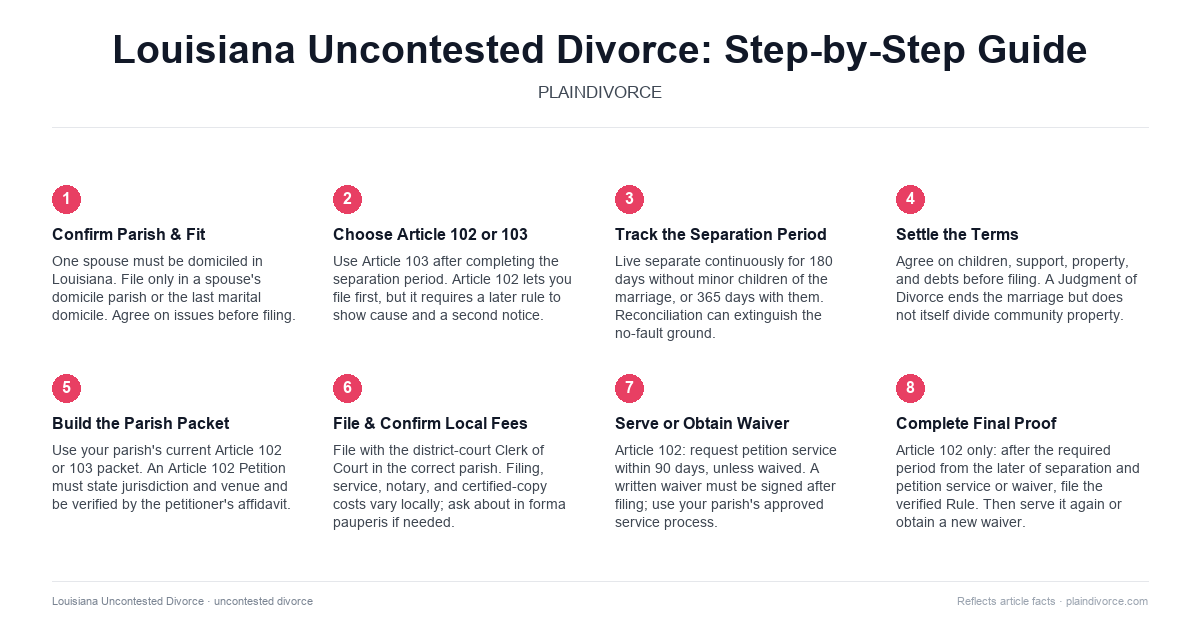
4. The Article 102 Divorce Louisiana Process, Step by Step
Every parish has its own local rules and preferred packets, but the roadmap for an Article 102 case is consistent statewide. (For the Article 103 route, see Section 5.)
Step 1 — Confirm your route and your parish
Article 102 or Article 103 (Section 3), and the correct parish (Section 2.2). Everything downstream depends on these two answers, and a mistake on either is expensive to fix.
Step 2 — Settle the substance before you draft
Nail down children, support, and property and debts. If you have meaningful assets, retirement accounts, or a house with a mortgage, a single flat-fee attorney review before you sign anything is usually money well spent. Community property mistakes are hard to undo.
Step 3 — Prepare the forms from your parish’s current packet
Parishes commonly publish separate packets for Article 102 and Article 103, and separate versions for cases with and without children. In plain English, you are usually preparing:
- A Petition for Divorce. An Article 102 petition must contain allegations of jurisdiction and venue and be verified by the affidavit of the petitioner (La. C.C.P. art. 3951). An Article 103 petition’s form and verification requirements are set by your parish’s current procedure.
- Supporting allegations most parishes expect: jurisdiction and venue, that this is not a covenant marriage, that you have not reconciled, the names and ages of any children, and whether your spouse is in the military (federal law protects servicemembers from default judgments).
- A Waiver of Service and Citation, if your spouse will cooperate and your packet allows it (see Step 5 for timing).
- A proposed Judgment of Divorce for the judge to sign.
- Any local civil or domestic cover sheet. Many clerks will not open a case without one — ask what yours requires.
Which documents must be sworn, notarized, or signed in a particular order is set by the current court forms and local rules, not by one statewide standard. Follow your packet’s instructions exactly.
If you are searching for a Petition for Divorce Louisiana template, start with your own parish’s current packet rather than a generic form you found elsewhere. A template that does not match local requirements is one of the fastest ways to get a filing bounced.
Download Our Louisiana Uncontested Divorce Self-Help Kit
Step 4 — File with the Clerk of Court
You file your completed paperwork with the Clerk of Court for the correct parish. You will typically pay the filing fee, receive a case or docket number, and be told what the clerk needs next.
If you cannot afford the fee, ask the clerk about applying to proceed in forma pauperis (often called pauper status), which lets qualifying filers defer or waive court costs. Legal aid offices can help with the application.
Step 5 — Request service within 90 days, or get a valid waiver
Louisiana requires formal notice to your spouse. In an Article 102 case, you must request service of the petition within 90 days of filing unless your spouse waives that requirement in writing (La. C.C.P. art. 3955). If your spouse is an absentee, timely requesting appointment of an attorney to represent them satisfies the rule. Miss the deadline and your spouse can move to have the action dismissed.
Your service options are usually sheriff service in the parish where your spouse is located, a private process server where the parish permits it, or a signed waiver. Two special situations:
- Still living together when the petition was filed? The Article 102 evidence rules call for a sheriff’s return showing personal service on your spouse in that circumstance — not just a mailed citation.
- Spouse out of state or overseas? Service is handled under Louisiana’s long-arm statute (La. R.S. 13:3201 et seq.) or by appointment of a curator for an absentee. Ask the Clerk of Court how your parish wants nonresident service done.
Waiver timing: sign too early and it is worthless
A written waiver of service in an Article 102 case must be executed after the petition has been filed and made part of the record (La. C.C.P. art. 3957). A waiver signed before a case number exists can be rejected — and the separation clock runs from that waiver date, so a bad waiver can cost you months.
Article 102 filers: there are two separate waivers. The first waives service of the petition. The second waives service of the rule to show cause and must be signed after the rule is filed. Skipping the second one is a common reason judges refuse to sign.
Step 6 (Article 102) — File the rule to show cause
This is the step Article 103 filers skip and the step Article 102 filers most often get wrong. Once the separation period has fully elapsed, either spouse may move for the divorce by filing a rule to show cause asking the court to grant it (La. C.C. art. 102).
Two different affidavits are involved, and people confuse them:
- The rule itself is verified by the mover’s affidavit and must allege that the petition was properly served, that the required time has elapsed under Article 103.1, and that the spouses have lived separate and apart continuously for the required period (La. C.C.P. art. 3952).
- A separate mover’s affidavit, executed after the rule is filed, must also state that the spouses have lived apart continuously for the requisite period, are still living apart, and that the mover wants a divorce (La. C.C.P. art. 3956).
- The rule must be served on your spouse again, or waived by that second written waiver.
- If the rule is never filed within two years of service or waiver, the action is abandoned and can be dismissed (La. C.C.P. art. 3954).
Step 7 — Final evidence and the Judgment of Divorce
To close out an Article 102 case, the record generally needs (La. C.C.P. art. 3956):
- The verified petition.
- Proof of service of the petition, or the first written waiver — plus a sheriff’s return showing personal service if you were living together when you filed.
- The verified rule to show cause.
- Proof of service of the rule, or the second written waiver.
- The mover’s post-filing affidavit described in Step 6.
- The proposed Judgment of Divorce, plus any child support or custody documents and any parish checklist or local certification.
Whether your parish decides the case on the papers or sets a short hearing is set by that court’s rules and the route you used; some Louisiana courts allow Article 102 divorces to be granted by affidavit under specified conditions, while the Article 103 default rules can require a self-represented filer to appear in open court. Your packet or Clerk of Court can tell you which applies. Once the judge signs, order certified copies — and get one whenever an agency you deal with (Social Security, the OMV, a bank, a retirement plan administrator) asks for proof of the divorce.
5. Article 103 Divorce Louisiana Forms and the One-Filing Route
If you have already lived separate and apart continuously for the full 180 or 365 days, Article 103 lets you file once you qualify. The Article 103 divorce Louisiana forms are usually a single parish packet, because there is no second stage and no rule to show cause.
The route still varies by parish. An uncontested Article 103 case typically moves forward one of two ways:
- By waiver and affidavit. Your spouse signs a waiver of service (after filing), you submit affidavits proving the separation dates and no reconciliation, and the judge signs without a hearing where local rules allow it.
- By default. Your spouse is served, does not answer within the delay, and you confirm the default with the required documentary evidence or testimony. Some courts require the filing spouse to appear in open court for a default divorce.
Because the documentary proof and hearing requirements differ from parish to parish, use your court’s current Article 103 procedure rather than assuming it is a pure paper process everywhere.
6. What Changes When You Have Children
Children do not prevent an uncontested divorce. They do extend the separation period to 365 days (when there are minor children of the marriage at the filing moment), add paperwork, and invite closer review from the judge, who must decide custody by the best interest of the child even when both parents agree. La. C.C. art. 134 lists the factors, and “the potential for the child to be abused” is the primary consideration.
In an uncontested case with minor children, expect the court to look for:
- A custody and parenting plan specific enough to actually follow — schedules, holidays, exchanges, and decision-making.
- Child support calculated with Louisiana’s guidelines. Each party must provide a verified income statement showing gross and adjusted gross income, with documentation of current and past earnings (La. R.S. 9:315.2). Agreeing to a number that deviates from the guideline amount requires specific reasons stated in the record (La. R.S. 9:315.1).
- No obvious safety concerns or lopsided terms.
Income assignment. A new child support order that is not being enforced by the Department of Children and Family Services must include an immediate income assignment (wage withholding) unless the parties have a written agreement otherwise or the court finds good cause (La. R.S. 9:303). Where income assignment applies, payments generally route through the Louisiana state disbursement unit rather than being paid spouse-to-spouse (La. R.S. 46:236.11).
Retroactivity. An initial final child support judgment is effective the date it is signed if an interim support allowance is already in place; if there is no interim award, it is retroactive to the date of judicial demand, absent good cause (La. R.S. 9:315.21). Either way, raise support in writing early rather than sorting it out informally.
Some parishes require a parenting or co-parenting class in custody cases. Your Clerk of Court or parish court website will say whether yours does.
7. Property and Debts: What a Divorce Judgment Does and Doesn’t Do
Louisiana is a community property state, and this is where self-filers lose the most money. A Judgment of Divorce ends the marriage. On its own, it does not divide your property.
7.1 The community ends retroactively to your filing date
When the divorce is granted, the community property regime terminates retroactively to the date the petition was filed (La. C.C. art. 159). Income and debts each spouse takes on after that date are generally separate. One qualification: the retroactive termination is without prejudice to the rights of third persons validly acquired between filing and recordation of the judgment — so a creditor or buyer who dealt with one spouse in that window may still be protected. Filing early to stop the community clock is a real reason some people choose Article 102 even though the divorce itself finishes later.
7.2 Settle it now, or partition later
After the community terminates, co-ownership rules apply to former community property, and either spouse may demand partition at any time — an agreement to give up that right is absolutely null (La. C.C. art. 2369.8). So a divorce judgment that says nothing about property does not forfeit your right to divide it.
That said, most uncontested couples still either sign a written community property settlement or expressly reserve the partition claim in the judgment. A clear settlement is usually worth the effort: it avoids a second lawsuit and is often required to divide a retirement account or pension (which typically needs a separate qualified order).
7.3 The Sworn Detailed Descriptive List
If you ask the court to partition community property under La. R.S. 9:2801, the procedure is mandatory. Each spouse must file a Sworn Detailed Descriptive List of all community assets, their fair market value and location, and all community debts — within 45 days of being served with the partition motion, unless the court extends that time for good cause.
If one spouse does not file on time, the other can ask the court to treat their own list as the judicial determination of what the community contains, with no traversal allowed. That is a serious consequence for a missed deadline. If your parish packet handles property purely by agreement, you may not need a descriptive list at all — follow your packet.
7.4 Spousal support has its own deadline
The right to claim final periodic spousal support after divorce is subject to a three-year peremption under La. C.C. art. 117 — once it runs, the right is gone permanently, not merely time-barred. The three years run from the latest of: the date the divorce judgment is signed; the date a judgment terminating a prior support award is signed (if rendered before or within three years of the divorce); or the date of the last voluntary support payment made within those periods. Final periodic support also requires proof of need and freedom from fault. Talk to a lawyer before signing away or ignoring a support claim.
8. How Long Does an Uncontested Divorce in Louisiana Take?
Two clocks run: the statutory separation period, and your parish’s processing time.
- Separation period: 180 days without minor children of the marriage, 365 days with them. This cannot be shortened, waived, or agreed around.
- Processing time: preparing forms, completing service, and waiting on a judge’s signature. This varies widely by parish and by route.
Under Article 103, you already satisfied the separation requirement before filing, so what remains is service plus court processing.
Under Article 102, budget more time than you expect. The period runs from the later of service (or waiver) and actual separation; then you file the rule to show cause; then your spouse must be served again. Each step adds days, and the 90-day service deadline is a trap if you delay.
Treat any timeline you read online, including this one, as general information. Backlogs, local procedure, and paperwork errors all move the date. Your Clerk of Court can usually tell you what current turnaround looks like in your parish.
9. What Does It Cost?
Cost depends on your parish, how you serve your spouse, and whether children or property are involved. Filing fees and service charges are set locally, so confirm current amounts with your Clerk of Court. Typical line items:
- Court filing fee to open the divorce case — set by each parish.
- Service costs — sheriff or process-server fees. An Article 102 case involves two rounds of notice (the petition and the rule), so you may pay service more than once.
- Notary fees — several documents must be sworn.
- Certified copies of the signed judgment.
- Optional legal review — a flat-fee consult on a parenting plan or property settlement.
If cost is the barrier, ask the clerk about proceeding in forma pauperis before you give up on filing.
10. When DIY Is Not the Right Call
A DIY uncontested divorce works well for many cooperative couples. It is the wrong tool if:
- There is domestic violence, threats, stalking, or coercive control.
- You feel pressured to sign documents you do not fully understand, or you do not have a clear picture of the finances.
- You disagree about children, support, or property and debts.
- You have a covenant marriage.
- There are high-stakes assets: a business, multiple properties, significant retirement accounts, a military or government pension, or a separate-versus-community property dispute.
- Immigration, tax, or bankruptcy issues are tied to the marriage.
- Your spouse cannot be located, or lives out of state or overseas.
If any of these apply, talk to a Louisiana family lawyer or a legal aid office before you file — even if you still expect to settle. We can give you information; only a lawyer who knows your facts can give you advice.
If you are dealing with abuse or feel unsafe, the Louisiana Coalition Against Domestic Violence and the National Domestic Violence Hotline (1-800-799-7233) can connect you with local help, including help with protective orders.
11. Where a Self-Help Divorce Kit Fits In
Even a straightforward Louisiana divorce involves several documents, strict service timing, and parish-by-parish variation. A self-help kit is an organizer, not a lawyer. A good one helps you:
- Choose between Article 102 and Article 103 with clear eyes.
- Track the dates that matter — separation date, filing date, service date, waiver date, the 90-day service deadline, and the rule-to-show-cause window.
- Work through a document checklist so nothing is missing when you walk into the clerk’s office.
- Avoid the usual rejection triggers: unsigned or unnotarized affidavits, a waiver dated too early, a missing second service or second affidavit in an Article 102 case, or the wrong packet for your route.
A kit cannot guarantee an outcome and does not replace legal advice. Many people use one as their primary organizer and pay a local attorney for a single review of the documents that carry the most risk — usually anything involving children or property.
Download Our Louisiana Uncontested Divorce Self-Help Kit
12. Frequently Asked Questions
What is the difference between an Article 102 and an Article 103 divorce in Louisiana?
Both are no-fault divorces that end in the same judgment. Under Article 103, you must already have lived separate and apart for the full 180 or 365 days on the day the petition is filed — usually one filing. Under Article 102, you file first and the separation period runs during the case, but you must then file a separate rule to show cause and notify your spouse a second time. Article 103 is simpler when you already qualify; Article 102 lets you start the case — and the community property clock — now.
How long do you have to be separated to get a divorce in Louisiana?
Under La. C.C. art. 103.1, the separation period is 180 days when there are no minor children of the marriage and 365 days when there are minor children of the marriage — measured when the Article 102 rule is filed, or when the Article 103 petition is filed. The separation must be continuous and without reconciliation. A reconciliation extinguishes the cause of action for divorce, so a resumed cohabitation can undo your progress.
When does the Article 102 separation period actually start?
Not simply when you file. Under La. C.C. art. 102, the 180 or 365 days must have run from the later of two dates: the day your spouse is served with the petition (or signs a written waiver of service), and the day you actually began living separate and apart. You must also have been continuously separated for the full period before you file the rule to show cause. A judgment granted before both requirements are met is an absolute nullity.
What is a Waiver of Service and Citation, and when can it be signed?
It is a written document in which your spouse gives up formal service, which saves time and sheriff fees. In an Article 102 case it must be executed after the relevant document is filed and made part of the record — a waiver signed before filing can be rejected (La. C.C.P. art. 3957). There are two waivers: one for the petition, and a second for the rule to show cause, which must be signed after the rule is filed.
Can I file for divorce in any Louisiana parish?
No. A divorce must be filed in a parish where either spouse is domiciled, or in the parish of the last matrimonial domicile. This venue rule cannot be waived, even by agreement, and a divorce judgment rendered by a court of improper venue is an absolute nullity (La. C.C.P. art. 3941). Confirm the correct parish before filing.
Does a Judgment of Divorce divide our property?
No. The judgment ends the marriage; it does not partition community property. It does terminate the community property regime retroactively to the date the petition was filed (La. C.C. art. 159), subject to third-party rights acquired before the judgment is recorded. After termination, either spouse may demand partition at any time (La. C.C. art. 2369.8), so a judgment silent on property does not forfeit that right — but a written settlement is usually still worth doing.
Do I have to go to court for an uncontested divorce in Louisiana?
It depends on your parish and your route. Some Louisiana courts allow an Article 102 divorce to be granted by affidavit, with no appearance, when specified conditions are met. The Article 103 default rules can require a self-represented filer to appear in open court. Your parish packet or Clerk of Court can tell you which applies to your case.
How much does an uncontested divorce cost in Louisiana?
It varies by parish. Expect a court filing fee, service costs if you use the sheriff (an Article 102 case involves two rounds of notice), notary fees, and a charge for certified copies of the judgment. Filing fees and service charges are set locally, so confirm current amounts with your Clerk of Court, and ask about proceeding in forma pauperis if you cannot afford them.
Can I use a generic Petition for Divorce Louisiana template?
Start with your own parish’s current packet instead. An Article 102 petition must allege jurisdiction and venue and be verified by the petitioner’s affidavit (La. C.C.P. art. 3951), and most parishes expect specific allegations — that this is not a covenant marriage, that there has been no reconciliation, the names and ages of any children, and the military status of your spouse. A generic template that omits a local requirement is a common reason filings get rejected.
13. Next Steps
Starting a divorce is a big step, and the first look at a parish packet is genuinely overwhelming for most people. That reaction is normal, and it is not a sign you cannot do this.
If you and your spouse can cooperate, an uncontested Louisiana divorce is a realistic, lower-conflict path. Two things determine whether it goes smoothly: choosing the correct legal route, and following your parish’s service and filing rules exactly so the judge can sign without sending you back.
A short checklist to start:
- Confirm which parish is legally correct for your filing.
- Write down the date you began living separate and apart, and count forward 180 or 365 days.
- Decide Article 102 or Article 103 based on that date.
- Get your parish’s current packet for that route.
- Call the Clerk of Court and ask what they require to open a case — cover sheets, copies, and fees.
Download Our Louisiana Uncontested Divorce Self-Help Kit
PlainDivorce is not a law firm and does not provide legal advice. This guide is general information about Louisiana divorce procedure as of September 2026. Verify every statute citation, fee, form, and local rule with your Clerk of Court or a licensed Louisiana attorney before you file.
Sources and local rules can change. Use this guide as a plain-English organizer, then verify the current filing requirements with the official court or government source for your jurisdiction.

About Harry D
Expert contributor at PlainDivorce, helping Canadians and American navigate simple uncontested divorces with clarity and confidence.