Uncontested Divorce in Maine: Forms, Steps, Costs, and Timeline
An uncontested divorce in Maine is a no-fault divorce in which you and your spouse agree on the major issues — or your spouse does not fight the case — so a court can grant the divorce on the paperwork without a trial. You file in the District Court (Family Division), use the state’s free forms, and wait a minimum of 60 days after your spouse is served before the case can be finalized.
This guide walks through the process in plain English: who qualifies, the steps in the order the court expects them, the full list of Maine divorce forms (all free PDF downloads from the state, plus the one you cannot download), how children and real estate change things, and what it costs. Every legal specific below was checked against the Maine Rules of Civil Procedure, Title 19-A of the Maine statutes, and the current Judicial Branch fee schedule.
TL;DR — Maine uncontested divorce in 60 seconds
- The self-help packet has you serve first, then file. Complete your forms → serve your spouse → file everything with the court within 20 days of service. Maine also lets you commence by filing first (with proof of service due within 90 days), but the state’s packet uses the serve-first order and so does this guide.
- One form you can’t download. The Family Matter Summons and Preliminary Injunction (FM-038) must come from a clerk — $5 in person, $10 by mail. Order it first; everything else waits on it.
- Core starting packet: Family and Probate Matter Summary Sheet (FM-002), Complaint for Divorce (FM-004, notarized), Social Security Number Disclosure (CV-CR-FM-PC-200), plus the Child Support Affidavit (FM-050) if you have minor children. Same Complaint form either way.
- Pick the right financial form. Agree on property, support, and fees? File FM-042. Disagree? Both of you file FM-043. Either way it is sworn — sign in front of a notary. Most truly uncontested cases use FM-042.
- Two forms that come due later. FM-056 if either of you has any interest in real estate (due 7 days before the hearing), and FM-052 if your spouse never appears in the case.
- Timing: a 60-day minimum before the case is in order for a final hearing, measured from the date your spouse is served (M.R. Civ. P. 113). Most cases run longer; add a 21-day window to object or appeal after judgment.
- Cost floor: $120 filing fee + $5 summons. Two-session mediation is $160, shared. Fee waivers are available.
1. What an Uncontested Divorce in Maine Actually Is
When people ask about a “simple divorce in Maine,” they usually mean a no-fault, uncontested divorce based on irreconcilable marital differences. In plain English: the marriage has broken down and cannot be repaired, and no one has to prove wrongdoing. An uncontested divorce in Maine uses the same court, the same forms, and the same track as any other divorce — what makes it “uncontested” is that there is nothing left for a judge to decide.
No-fault divorce and irreconcilable differences
Maine law lists several grounds for divorce — adultery, cruel and abusive treatment, desertion, and others — but nearly every uncontested case uses irreconcilable marital differences, at 19-A M.R.S. § 902. It keeps the case about ending the marriage rather than assigning blame.
One wrinkle: if one spouse alleges irreconcilable differences and the other denies it, the court “may continue the case and require both parties to receive counseling by a qualified professional counselor.” The statute then says a denying spouse’s failure or refusal to be counseled “without good reason is prima facie evidence that the marital differences are irreconcilable.” In an agreed case this almost never comes up, but it is the reason a spouse cannot block a divorce simply by objecting.
Uncontested vs. contested: why it is not a separate court track
In a contested divorce, the spouses disagree about children, support, or property, and the court schedules conferences, mediation, and sometimes a trial. In an uncontested divorce, either:
- both spouses reach a full written agreement and present it to the court; or
- one spouse files and properly serves the papers and the other spouse does not appear or contest the case.
A point worth understanding early: “uncontested” describes your case, not a separate procedure you sign up for. Every Maine divorce is filed the same way with the same forms. If you are in full agreement, have passed the 60-day mark, and the court approves your agreement, the case is resolved at an uncontested final hearing. If you are not in agreement, the case simply continues into the normal process.
If your spouse does not respond, you do not automatically “win” by default. A Maine divorce cannot be entered by the clerk on a default; the court still holds a hearing, the plaintiff still has to prove the basics, and — because the other side has not appeared — the plaintiff must file the Federal Affidavit (FM-052) about military service before the judgment can be signed. What “uncontested” buys you is a short, one-sided hearing, not a skipped one.
2. Who Qualifies for an Uncontested Divorce in Maine
Two separate things have to be true: you must meet Maine’s legal eligibility rules, and you need the practical ability to keep the case uncontested.
Residency and jurisdiction: the 6-month rule and three alternatives
Under 19-A M.R.S. § 901(1), you can file for divorce in the Maine District Court if any one of these is true:
- the plaintiff has resided in good faith in Maine for 6 months before the action is commenced; or
- the plaintiff is a Maine resident and the parties were married in Maine; or
- the plaintiff is a Maine resident and both parties lived in Maine when the cause of divorce accrued; or
- the defendant is a Maine resident.
That last one matters more than people expect. If you recently moved out of state but your spouse still lives in Maine, you do not have to wait six months — you can file in Maine now, because the defendant is a Maine resident.
You file in the District Court (Family Division) for the area where you or your spouse lives. If you are not sure which courthouse that is, the Judicial Branch publishes a Courthouse Locations by Town list.
Agreement on the big-ticket issues
Your case is likely to stay uncontested if you and your spouse have no serious disagreement about:
- parental rights and responsibilities and parent-child contact (if you have children);
- child support (if children are involved);
- spousal support (alimony), if any;
- division of property and debts, including real estate and retirement accounts.
Whether you agree on these items also decides which financial form you file — see Section 5. If you have safety concerns, suspect hidden assets, or have a real disagreement on any of them, talk to a Maine family lawyer or legal aid before relying on a DIY approach.
3. Two Clocks: 6-Month Residency vs. the 60-Day Minimum Before a Final Hearing
DIY filers mix these up because both are “time rules.” They do completely different jobs.
Clock 1
“Can I file in Maine at all?”
Residency & jurisdiction — 19-A M.R.S. § 901
Any ONE of these qualifies you:
- Plaintiff lived in Maine in good faith for 6 months
- Plaintiff is a Maine resident + married in Maine
- Plaintiff is a Maine resident + both lived here when the cause of divorce accrued
- The defendant is a Maine resident
Affects: whether you can start the case.
Clock 2
“When can it be finalized?”
The 60-day minimum — M.R. Civ. P. 113
The sequence:
- Complete and notarize your forms
- Serve your spouse
- File everything with the court (within 20 days of service)
- 60-day minimum clock — runs from the date of service
- Initial case management conference
- Uncontested final hearing → divorce judgment
Affects: the earliest possible finish date.
The rule that controls the second clock is Maine Rule of Civil Procedure 113: “An action for divorce or annulment shall not be in order for final hearing until 60 days or more after service of the summons and complaint.” The Judicial Branch’s public divorce information page paraphrases this loosely as a wait “between the filing of all the necessary divorce paperwork and the final hearing,” but the operative trigger in the rule is service, not filing, and it is a court-rule minimum rather than a statutory one. Because Maine’s self-help packet has you serve first and file within 20 days, the service date and the filing date are usually close together anyway.
The practical takeaway is the same either way: the clock does not start when you decide to divorce, and it does not start when you download the forms. It starts when your spouse is served. Time spent hunting for a missing form is time the 60 days has not begun.
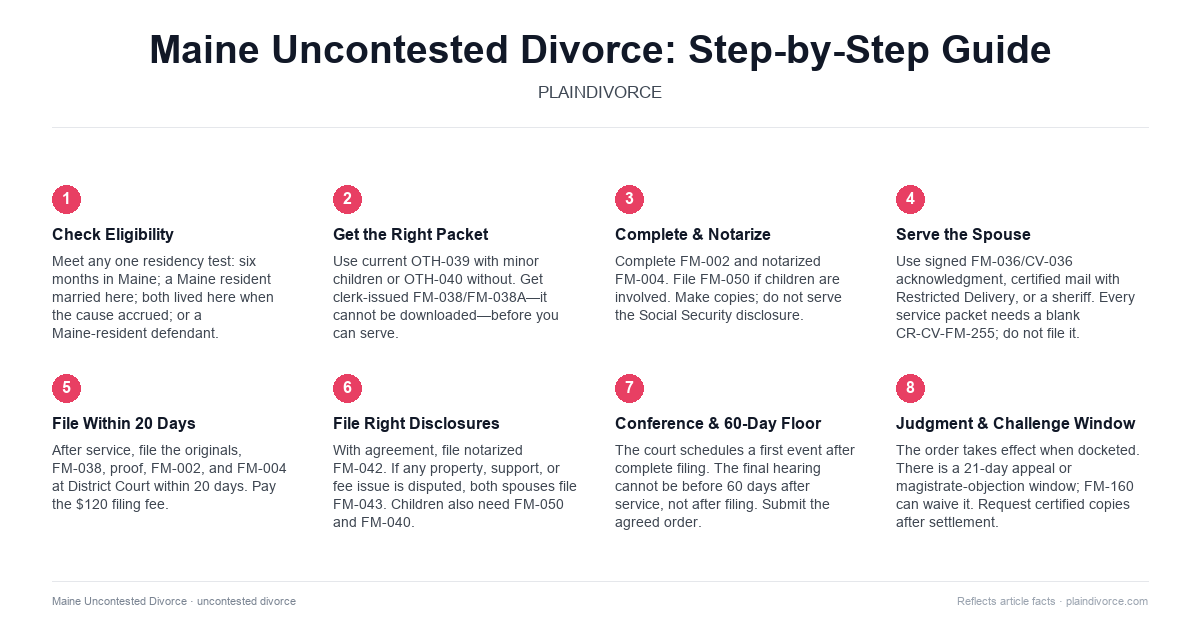
4. Step-by-Step: The Uncontested Divorce Process in Maine
Read this first: Maine’s self-help order can surprise people
In many states you file first and serve second. Maine’s do-it-yourself packet has you do the reverse. Its instruction sheets say: Step One, fill out the forms. Step Two, serve the forms on your spouse. Step Three, file the forms with the court — within 20 days after serving. Maine’s rules technically also allow commencing a case by filing the complaint first (with proof of service due within 90 days under M.R. Civ. P. 3), but the assembled packets and this guide use the serve-first sequence because it is simpler to keep straight.
Step 1 — Confirm you qualify and pull the right packet
Maine publishes two assembled divorce packets:
- OTH-039 — forms to file a Complaint for Divorce with minor children
- OTH-040 — forms to file a Complaint for Divorce without minor children
Every Maine divorce form is a free PDF on the Maine Judicial Branch’s official court-forms pages, and paper copies are free at any clerk’s office. You can download a whole packet or look up individual forms by number in the Judicial Branch’s searchable forms list. The packets differ in what is bundled — the with-children packet adds the Child Support Affidavit — but the Complaint itself is the same form either way.
Before you fill anything in, confirm that you meet one of the four residency tests, that you are using the no-fault ground, and that you have a workable agreement on children, support, property, and debts.
Use the current version — old forms get returned
The Judicial Branch is blunt: if a required court form is submitted in an outdated version, “it will not be docketed and will be returned as incomplete.” A PDF someone posted on a forum three years ago is one of the easiest ways to lose a month. Pull every form fresh from courts.maine.gov the week you file.
Step 2 — Get the one form you can’t download (FM-038)
The Family Matter Summons and Preliminary Injunction (FM-038 / FM-038A) is not in the OTH-039 or OTH-040 packet and cannot be printed from the website. It has to carry the clerk’s original signature and the court’s seal. The instruction sheet: “You must use the original form you got from the clerk… You cannot use a photocopy or on-line version of this form.”
How to get it:
- In person: any Maine District Court clerk’s office, $5. It does not have to be the court where you will file — but tell the clerk which court you will file in so the right address is printed on it.
- By mail: send a written request with a check for $10 to any Maine District Court ($5 for the form, $5 mail-handling fee).
Order it early. Everything downstream — service, filing, the 60-day clock — waits on this one piece of paper.
Step 3 — Fill out and notarize your Maine divorce forms
Work through the packet’s instruction sheet (FM-080 for cases with children, FM-081 for cases without). A few things that trip people up:
- The Complaint for Divorce (FM-004) must be signed in front of a notary public. So must the Child Support Affidavit (FM-050) if you have children, and so must whichever financial form you file (FM-042 or FM-043). You can use a notary at a bank, a legal services office, your town office — or the court clerk, free of charge for documents being filed with the court.
- Check the “Title to Real Estate Involved” box on the Complaint if either of you owns a house or land — even if the deed is only in one name.
- When in doubt, check the box under “Plaintiff requests.” The Judicial Branch’s own advice: “If you are not sure, check the box; you can drop that request later.”
- Make your copies before you file — one for you and one for the other party. The court clerk cannot make copies for you.
Step 4 — Serve your spouse
The self-help packet gives you three routes to serve divorce papers. You must file proof of service for each party. (Maine’s rules also let the court authorize other personal service or, on a showing that ordinary service cannot be made with due diligence, an alternate method — but for a cooperative uncontested case one of these three is what you will use.)
| Method | How it works | Proof you file |
|---|---|---|
| Acknowledgment (service by mail) Best for cooperative spouses |
Mail or hand-deliver the complaint, summons, and (in child cases) the Child Support Affidavit, plus two copies of the Acknowledgment of Receipt (FM-036 / CV-036), a blank Notice Regarding Electronic Service (CR-CV-FM-255), and a stamped self-addressed envelope. Your spouse signs and returns one Acknowledgment within 20 days. | The signed Acknowledgment |
| Certified mail | Send by certified mail with Return Receipt AND Restricted Delivery. Both are required — plain certified mail is not enough. Include the blank CR-CV-FM-255. | The green card from the post office |
| Sheriff Most reliable if your spouse may not cooperate |
Send the sheriff in the county where your spouse lives the complaint, the original summons plus a copy, the Child Support Affidavit if applicable, and the blank CR-CV-FM-255. Give a home address, or a work address if home is unreliable. There is a county-set fee. | The summons returned with the deputy’s signature on page two |
About the Notice Regarding Electronic Service (CR-CV-FM-255): a blank copy has to go in every service packet — it is part of “process” served with the summons and complaint. Agreeing to accept filings by email is optional; if you want to opt in, you also include a completed copy. Either way, you do not file CR-CV-FM-255 with the court.
Do not serve these on your spouse: the Social Security Number Disclosure form (CV-CR-FM-PC-200) and, if you are requesting one, the fee-waiver Application (CV-067) and Affidavit (CV-191). Those go to the court only.
If the Acknowledgment does not come back within 20 days, don’t wait it out — switch to certified mail or the sheriff. Separately, once served, your spouse has 21 days to file an appearance and answer if they want to participate formally (M.R. Civ. P. 105).
Step 5 — File with the District Court within 20 days of service
Mail or hand-deliver the signed originals, with proof of service, to the District Court, along with the $120 filing fee. Your filing bundle is:
- Family and Probate Matter Summary Sheet (FM-002)
- Complaint for Divorce (FM-004), notarized
- Social Security Number Disclosure (CV-CR-FM-PC-200)
- Child Support Affidavit (FM-050) — cases with minor children
- The Summons — required regardless of how you served, with the deputy’s signature if you used a sheriff
- Your proof of service (signed Acknowledgment, or the green card)
The summons line catches people. Even if your spouse signed an Acknowledgment and the summons was never formally “used,” it still gets filed. You must file at least one type of proof of service for each party.
The clerk stamps your forms and assigns a docket number. Once the court has a complete filing, it schedules your first court event.
Step 6 — File the right financial form (FM-042 or FM-043)
See Section 5 for the full explanation. The short version:
- If you agree on personal property, real estate, spousal support, and attorney’s fees → file the Certificate in Lieu of Financial Statement (FM-042).
- If you disagree on any of those → file the full Financial Statement (FM-043), and your spouse must file one too.
Both forms are sworn — sign in front of a notary. In a genuinely uncontested divorce, FM-042 is usually the correct form. A court order in your case sets the filing deadline (generally within 21 days of the scheduling order, or three business days before mediation, whichever is earlier).
Step 7 — The initial case management conference
Once the court has your complete filing, it schedules a first event — an initial case management conference (some older Judicial Branch materials still call the no-children version a “pre-trial conference”):
- Cases with minor children: a case management conference with a family law magistrate (or judge). You are notified within about 14 days after your proof of service is filed, and the conference is held after the 21-day answer period.
- Cases without children: an initial case management conference with a judge, set “on the first available date no sooner than 60 days from the receipt of proof of service.”
Usually nobody testifies at this event; the court’s job is to find out what, if anything, is actually in dispute. The part worth planning around: if you and your spouse have a complete written agreement, you can file a certificate for an uncontested final hearing along with your proposed agreed order. In a divorce, the court has authority to hold the uncontested hearing 60 days or more after service. When everything lines up — full agreement, the 60 days elapsed, financial forms filed — the court may hold the final hearing at that first event or schedule it shortly after. Walking in with a signed, complete agreement is what keeps the number of court dates small.
Step 8 — The uncontested final hearing
An uncontested final hearing is short. The court typically asks the plaintiff a handful of questions: when and where you were married, your spouse’s name, whether the marriage is irretrievably broken, and whether you can explain the terms of your agreement. The court also confirms that you are agreeing willingly and have not been pressured or threatened.
Then the divorce judgment is signed — by a judge, or, in an eligible uncontested case involving minor children, by a family law magistrate (Maine’s rules let magistrates issue divorce judgments in uncontested proceedings). The clerk may hand you a copy that day or mail it. The order takes effect when the clerk enters it on the docket — often the same day.
Step 9 — After the judgment: the 21-day objection and appeal window
The step many guides skip
After the judgment is entered there is a 21-day window to challenge it, and your divorce is not fully beyond challenge until it closes. If a judge signed the judgment, that window is for an appeal to the Maine Supreme Judicial Court (the Law Court). If a family law magistrate signed it, the challenge is an Objection to Magistrate Final Order (FM-071), filed within 21 days, which sends the matter to a judge. If you both are satisfied, you can sign a Waiver of Right to Object and Waiver of Appeal (FM-160) and the judgment is settled as of that date — useful if you are remarrying, refinancing, or changing benefits on a deadline.
Once the judgment is settled, request certified copies if you will need proof for a name change, benefits, or remarriage.
5. The Complete Maine Divorce Forms Checklist (Free PDFs)
Here is every form a typical uncontested Maine divorce touches, in the order you will need it. All are free PDF downloads from the Maine Judicial Branch except FM-038, which the clerk issues.
Forms you file at the start
| Form | What it is | Watch out for |
|---|---|---|
| FM-002 | Family and Probate Matter Summary Sheet Formerly the “Family Matter Summary Sheet” |
The clerk cannot open your case without it. You do not give a copy to your spouse. If you are searching for the Family Matter Summary Sheet Maine form and coming up empty, it is the same document under its newer name. |
| FM-004 | Complaint for Divorce | Must be notarized. The same form is used with or without minor children — there is no separate “with children” complaint. |
| FM-038 / FM-038A | Family Matter Summons and Preliminary Injunction | Cannot be downloaded. $5 from a clerk, $10 by mail. Photocopies are not accepted. |
| CV-CR-FM-PC-200 | Social Security Number Disclosure | Required by state and federal law. Kept confidential in the file. Do not serve it on your spouse. |
| FM-050 | Child Support Affidavit | Cases with minor children only. Must be notarized. List last year’s earned income and this year’s expected earned income separately; other income and fringe benefits go in their own sections. |
| FM-036 / CV-036 | Acknowledgment of Receipt of Summons and Complaint | You need two copies. Used only if you serve by mail; must come back within 20 days. |
| CR-CV-FM-255 | Notice Regarding Electronic Service | A blank copy must go in every service packet. A completed copy too, only if you want to accept filings by email. Never filed with the court. |
| CV-067 + CV-191 | Application to Proceed Without Payment of Fees + Affidavit | Optional. If the waiver is denied you must pay the filing fee within 7 days. Not served on your spouse. |
| FM-057 | Affidavit of Confidential Address | Optional safety form. If you use it, mark your address “confidential” everywhere else. |
Forms that come due after filing
These are the ones that surprise people close to the final hearing. Whenever you file any of them, send a copy to your spouse.
| Form | When it’s required |
|---|---|
| FM-042 Certificate in Lieu of Financial Statement |
When there is no dispute about personal property, real estate, spousal support, or attorney’s fees. Sworn/notarized. This is the form most truly uncontested cases use. |
| FM-043 Financial Statement |
When you and your spouse disagree about property division, spousal support, or attorney’s fees. Sworn/notarized. Both parties must file one; a court order sets the deadline. Parties also file updated statements 7 days before a contested trial. |
| FM-056 Certificate Regarding Real Estate |
In every divorce where a party has an interest in real estate. Each party files it at least 7 days before the final hearing, with the street address, deed date and names, Registry of Deeds book and page number, date of marriage, and whether the property came by gift or inheritance. |
| FM-052 Federal Affidavit |
When your spouse has not appeared or entered an appearance by the final hearing. A sworn statement that they are not on active military duty (per the Servicemembers Civil Relief Act), or a signed SCRA waiver from them. |
| FM-040 Child Support Worksheet |
In cases with children: parties exchange a completed worksheet before mediation and file it with the court, and the court can order it at any time. Pair it with FM-050. |
| FM-020 Entry of Appearance |
Filed by the defendant spouse who wants to participate without filing a full answer. |
The vital records form (VS-300): why you probably don’t file it
You will see the “Certificate of Absolute Divorce (VS-300)” listed as a required filer form on many divorce websites. In Maine that is not how it works. Under 22 M.R.S. § 2803, the court clerk files a record of each divorce judgment with the State Registrar of Vital Statistics within 45 days, on forms the registrar supplies — and that record does not become part of the official court file. VS-300 appears in neither the OTH-039 nor the OTH-040 packet.
If a clerk in your county asks you to complete a vital-records form, do it. But don’t spend a week hunting for a download that doesn’t exist.
6. The Preliminary Injunction: What You Can’t Do Once the Case Starts
That $5 summons you bought from the clerk is not just a summons. It is a court order that binds both spouses, and many people never read it.
Under 19-A M.R.S. § 903 and Rule 104, the preliminary injunction takes effect against the plaintiff when the action is commenced (by filing or by service) and against the defendant when they are served with both the complaint and the injunction. Unless you both agree in writing or the court orders otherwise, it prohibits each of you from:
- Transferring, encumbering, concealing, selling, damaging, or disposing of any property either of you owns or claims — regardless of whose name is on it. This explicitly includes borrowing against a life insurance policy’s cash value and withdrawing from or borrowing against retirement, pension, profit-sharing, IRA, or Keogh accounts.
- Destroying personal property, including electronically stored materials, communications, and financial records.
- Removing the other spouse or a child from health, dental, or disability insurance — and you must meet renewal deadlines to keep those policies alive.
- Cancelling or changing a casualty, life, or motor vehicle policy, including changing a beneficiary.
- Opening, destroying, deleting, or withholding the other’s mail, email, or texts.
- Signing the other’s name on any check, negotiable instrument, tax refund, security deposit, insurance payment, or dividend.
What you can still do. A 2023 amendment added express carve-outs. The injunction does not stop you from accessing funds or incurring debt to: run an ongoing business as usual; pay for necessities of life including housing, utilities, food, transportation, school, child care, and medical expenses; retain an attorney for the divorce; or make regular or required minimum retirement withdrawals.
The injunction stays in force until the court modifies it, the final judgment is entered, or the case is dismissed. Violating it can mean a contempt finding and paying the other side’s attorney’s fees.
The friendly-divorce trap
Amicable couples can violate this without meaning to — selling the second car, cashing out a small 401(k) to pay down a card, taking an ex off the car insurance. If you both genuinely agree on something the injunction covers, put the agreement in writing before you act. The statute allows it: “unless the parties otherwise agree in writing.”
7. Special Issues When You Have Children
Having children does not prevent an uncontested divorce in Maine, but it adds review, paperwork, and usually a magistrate.
What changes:
- You’ll appear before a family law magistrate, not a judge, at your case management conference — and a magistrate can enter the divorce judgment if the case is uncontested.
- The Child Support Affidavit (FM-050) is required from both parents and must be notarized. Under 19-A M.R.S. § 2004, the parties must exchange income-and-asset affidavits with supporting documentation of current income (pay stubs, tax returns, employer statements) and a completed Child Support Worksheet (FM-040) before mediation, and file the affidavits and worksheet with the court at least 3 days before any hearing, contested or uncontested. Failing to exchange these can trigger economic sanctions or an imputed-income finding.
- Child support follows Maine’s guidelines. The guideline (table) amount is presumptively correct. You can agree to a number, but the court reviews it against the parental-support obligation, and any deviation needs a legally supported basis with written findings. See 19-A M.R.S. § 2005.
- Every child support order is subject to immediate income withholding. Under 19-A M.R.S. § 2651, wages are withheld for support automatically unless the court finds good cause or approves a written alternative arrangement — true even in a fully agreed divorce.
- Mediation is required in most cases with children if you are not in full agreement.
- You may be ordered to attend a parent education program for divorcing or separating parents.
- You’ll need more information up front: each child’s name, address, and date of birth; their Social Security numbers; everyone they have lived with in the past five years; any other court cases involving them; any DHHS public assistance; your income for this year and last; child care costs; and the cost of health insurance per child.
Come to the case management conference ready to discuss interim arrangements — where the children live, parent-child contact, health insurance, interim child support, who pays which periodic debts, and interim spousal support. An order can be entered at that conference even if nobody filed a motion for it. If you don’t show up, the court can enter an interim order or proceed in your absence.
If anything about children or support feels uncertain, a single consult with a Maine family lawyer or a legal aid clinic before you sign is money well spent.
8. Special Issues When You Own Real Estate
Real estate creates obligations at three points in the case:
- At filing: check “Title to Real Estate Involved” on the Complaint (FM-004), even if the deed names only one of you.
- At least 7 days before the final hearing: each party files a Certificate Regarding Real Estate (FM-056). Gather the deed details ahead of time — you will need the Registry of Deeds book and page number.
- After judgment (only if the judgment divides or transfers the real estate): record an Abstract of Divorce Decree (FM-171) with the Registry of Deeds so the chain of title reflects the divorce.
Under Rule 114A, every divorce judgment that distributes real estate includes a real estate order naming who is responsible for recording the abstract and paying the Registry fee. If your judgment does not distribute real estate — say the house was already sold, or one spouse keeps it with no transfer of title — there may be nothing to record.
Recording the Abstract of Divorce Decree (FM-171)
The Judicial Branch publishes a best-practices sheet (FM-261) for this, and the guidance is specific:
- The abstract must state the number of judgment pages attached, the date of the judgment, and whether any party changed their name.
- Do not attach the entire divorce judgment. Attach only the page(s) detailing the real estate award.
- The clerk will not redact for you — redact anything unrelated to the real estate before you record it at the Registry.
- Include page 2 of FM-171 both when you submit for clerk certification and when you record. The Registry may reject the abstract without it.
- The clerk will not take your recording payment and will not mail the abstract to the Registry. The certified abstract comes back to you, and you record it yourself and pay the Registry’s fee.
Budget $10 for the court’s abstract fee, plus the Registry’s own recording fees. If you need a short proof of divorce for other purposes, the Short-Form Certificate of Judgment of Divorce (FM-170) costs $5 for preparation, signature, and attestation.
9. How Long Does an Uncontested Divorce Take in Maine?
Sixty days after service is the floor, not the finish line. The Maine Judicial Branch confirms the 60-day minimum and warns that cases “may take longer,” but it does not publish a statewide average, so treat any single number with caution. A realistic uncontested case moves through these phases:
| Phase | What drives the length |
|---|---|
| Gather info, get the summons from the clerk, complete and notarize forms | How fast the clerk issues FM-038; how quickly you gather deed and income details |
| Service | Fastest by acknowledgment if your spouse cooperates; slower by certified mail or sheriff |
| File with the court (within 20 days of service) | Same week — once your papers are complete |
| 60-day minimum from the date of service | Fixed by M.R. Civ. P. 113 |
| Wait for the court’s conference/hearing date | Varies by county and court calendar; in no-children cases the first event is itself set 60+ days out from proof of service |
| 21-day objection/appeal window (waivable if you both sign FM-160) | 0–21 days |
Most uncontested cases run past the 60-day minimum — often to several months — but the exact timing depends heavily on your county’s court calendar. What tends to add time:
- Ordering the FM-038 summons late, which blocks service, which blocks filing.
- An Acknowledgment of Receipt that never comes back, forcing you to re-serve.
- An incomplete filing — the clerk doesn’t schedule your first event until the filing is complete.
- Missing FM-056 or FM-052 discovered close to the final hearing.
- Required mediation and parent education in cases with children.
- Court scheduling and backlog, which vary between counties.
10. What Does an Uncontested Divorce Cost in Maine?
Court fees come from Administrative Order JB-05-26, the fee schedule effective March 9, 2026. These are the individual court charges; your total depends on your service method, whether you mediate, how many certified copies you need, and your county Registry’s recording fees.
| Item | Cost | Notes |
|---|---|---|
| Entry of a Family Matter Action (filing fee) | $120 | Waivable via CV-067 + CV-191 |
| Summons (form with court seal / clerk signature) | $5 | $10 if requested by mail (adds the $5 mail-handling fee) |
| Sheriff service | Varies | Set by each county, not by the court. Call the sheriff’s office where your spouse lives. |
| Certified mail, return receipt + restricted delivery | Varies | USPS rates; restricted delivery adds cost |
| Initial mediation, pre-judgment family matter (two sessions) | $160 | Shared by the parties. Additional sessions are $160 each. |
| Certified (attested) copy of a document | ~$2 + ~$1/page | $2 attestation per document plus about $1 per page for the copy |
| Short-Form Certificate of Judgment of Divorce (FM-170) | $5 | Preparation, signature, and attestation |
| Abstract of Divorce Decree (FM-171) | $10 | Court fee only — Registry of Deeds recording fees are separate |
| Name change as part of the divorce | No fee | No separate charge when requested within the divorce |
For a case with no children, no real estate, and no mediation, the unavoidable court charges are the $120 filing fee plus the $5 summons, with service costs on top. Mediation, certified copies, and a recorded abstract each add to that. The Judicial Branch does not publish a single “typical total,” so build your own estimate from the rows above.
Fee waivers
If you can’t afford the fees, ask the clerk for an Application to Proceed Without Payment of Fees (CV-067) and the accompanying Affidavit (CV-191), and file them with your other papers. A judge reviews your finances and decides. Two things to know: if the waiver is denied, you must pay the filing fee within 7 days; and you do not serve the waiver paperwork on your spouse.
11. Seven Mistakes That Slow Down “Simple” Maine Divorces
- Ordering the FM-038 summons late. It can’t be downloaded, and service can’t happen without it. Get it from the clerk first.
- Printing the summons off the internet. FM-038 needs the clerk’s original signature and seal. A photocopy is rejected.
- Leaving the blank CR-CV-FM-255 out of the service packet. A blank Notice Regarding Electronic Service must be served with the summons and complaint — but never filed with the court.
- Not filing the summons because you served by acknowledgment. The summons is filed regardless of how service happened.
- Filing FM-043 when you needed FM-042. The full Financial Statement is for cases with a dispute. Agreed cases file the Certificate in Lieu — and both forms are sworn.
- Forgetting FM-056 seven days before the hearing. If either of you has any interest in real estate, both of you file it.
- Forgetting FM-052 when your spouse never appears. Without the Federal (military) Affidavit, the court can’t finalize a no-response case.
12. When a DIY Divorce Isn’t Right for You
Get legal help if:
- There is domestic abuse, stalking, or a serious safety concern. Bring any Protection from Abuse case or history of domestic violence to the court’s attention at or before your first appearance — the court can decide mediation isn’t appropriate or arrange for you to meet the mediator separately. Also ask about the Affidavit of Confidential Address (FM-057).
- One spouse is hiding assets or refusing financial disclosure.
- You don’t understand the long-term impact of the support or property terms you’re being asked to sign.
- Your finances are complex — business interests, large retirement accounts needing a QDRO, multiple properties, significant debt.
- Your spouse has hired a lawyer and you haven’t.
PlainDivorce cannot tell you what terms you should accept. That’s legal advice, and only a lawyer representing you can give it. Maine has free and low-cost options, including Pine Tree Legal Assistance and the Volunteer Lawyers Project.
13. Where a Self-Help Divorce Kit Fits In
If your case truly is uncontested — or likely to become uncontested — a Maine self-help divorce kit makes the process more manageable by:
- Walking you through the sequence in the order Maine’s packet uses: complete → serve → file → wait → hearing.
- Flagging the form you can’t download (FM-038) and the ones that come due later (FM-042 or FM-043, FM-056, FM-052, FM-040).
- Giving you a service-method decision guide and a proof-of-service checklist that includes the blank CR-CV-FM-255.
- Providing a timeline anchored to the date of service, so you can see which deadlines are yours and which belong to the court.
- Reminding you about the post-judgment steps — the objection/appeal window, the FM-160 waiver, certified copies, and recording the FM-171 abstract when the judgment divides real estate.
Download Our Maine Uncontested Divorce Self-Help Kit
14. Frequently Asked Questions
What is an uncontested divorce in Maine?
An uncontested (or “simple”) divorce in Maine is a no-fault divorce where you and your spouse agree on the major issues — or your spouse does not contest the case — and you complete the required court forms so the court can issue the divorce judgment on the paperwork. It uses the same forms and the same court track as any other Maine divorce; “uncontested” describes the case, not a separate procedure.
Do I file first or serve my spouse first in Maine?
Maine’s self-help divorce packet has you complete the forms, serve your spouse, then file everything with the court within 20 days after service — so most DIY filers serve first. Maine’s rules also allow starting a case by filing the complaint first, with proof of service due within 90 days. Either way, the 60-day minimum before a final hearing is measured from the date your spouse is served, not from filing.
Where do I get Maine divorce forms as PDFs?
All Maine divorce forms are free PDF downloads from the Maine Judicial Branch’s official court-forms pages, and paper copies are free at any clerk’s office. You can download a pre-assembled packet (OTH-039 with minor children, OTH-040 without) or look up individual forms by number in the Judicial Branch’s searchable forms list. Two cautions: download fresh rather than reusing an old or third-party PDF, because outdated required forms are returned as incomplete — and the FM-038 summons is not available as a PDF at all.
What is the Family Matter Summary Sheet, and is it still called that?
It’s the cover sheet that puts your case and party details into the court’s records, and the clerk cannot open your action without it. In Maine it is form FM-002. If you are searching for the “Family Matter Summary Sheet” Maine form and getting conflicting results, that is because the current version is titled the Family and Probate Matter Summary Sheet — same form, newer name. File it with your Complaint; you do not give your spouse a copy.
What is the Complaint for Divorce (FM-004) and does it need to be notarized?
FM-004 is the document that starts your Maine divorce — it names the parties, states your ground, flags whether real estate is involved, and lists what you are asking the court to order. Yes, it must be signed in front of a notary public. A court clerk can notarize it free of charge for papers being filed with the court. Two tips: check “Title to Real Estate Involved” even if the deed names only one spouse, and under “Plaintiff requests,” check any box you are unsure about — dropping a request later is easy, adding one is harder.
Who has to file the Child Support Affidavit (FM-050) in Maine?
Both parents, in any Maine divorce with minor children — including uncontested ones where you have already agreed on a support figure. It must be notarized. Under 19-A M.R.S. § 2004 the parties also exchange income affidavits with supporting documentation (pay stubs, tax returns) and a completed Child Support Worksheet (FM-040) before mediation, and file the affidavits and worksheet with the court at least 3 days before any hearing. The court checks your agreed number against Maine’s child support guidelines, where the table amount is presumptively correct.
Which Maine divorce form can’t I download?
The Family Matter Summons and Preliminary Injunction (FM-038 / FM-038A). It requires the clerk’s original signature and the court seal, so photocopies and online versions are not accepted. It costs $5 at any District Court clerk’s office, or $10 if you request it by mail.
Is there a different Complaint form if we have children?
No. Maine uses the same Complaint for Divorce (FM-004) whether or not minor children are involved — the instruction sheets state this explicitly. What changes is the additional paperwork: cases with children add the Child Support Affidavit (FM-050) and the Child Support Worksheet (FM-040).
Do I need to file the Financial Statement (FM-043)?
Only if you and your spouse disagree about dividing property, spousal support, or attorney’s fees. If there is no dispute about personal property, real estate, spousal support, or attorney’s fees, you file the Certificate in Lieu of Financial Statement (FM-042) instead. Most genuinely uncontested cases use FM-042. Both forms are sworn — sign in front of a notary.
When does the 60-day clock start in a Maine divorce?
On the date your spouse is served. Maine Rule of Civil Procedure 113 says a divorce “shall not be in order for final hearing until 60 days or more after service of the summons and complaint.” The Judicial Branch’s public page paraphrases this as a wait tied to filing, but the rule’s trigger is service. It is a court-rule minimum, not a statutory one, and it does not start when you decide to divorce or download forms.
Can I still be divorced in Maine if I moved away?
Possibly. One of the four bases for filing in Maine is simply that the defendant is a Maine resident — no waiting period required. You can also qualify if you are a Maine resident and were married here, or if you are a Maine resident and both of you lived here when the cause of the divorce accrued.
My spouse won’t sign anything. Can I still get divorced?
Yes. A spouse cannot block a Maine divorce by refusing to participate. If they won’t sign the Acknowledgment of Receipt, serve by certified mail with restricted delivery or by sheriff. If they never appear, you file the Federal Affidavit (FM-052) confirming they aren’t on active military duty before the court can finalize. And if they deny irreconcilable differences, the court can order counseling — refusing it without good reason is treated as evidence that the differences really are irreconcilable. The clerk cannot enter a divorce by default; the court still holds a short hearing.
How do I change my name back after a Maine divorce?
Request it in your divorce — check the box on the Complaint under “Plaintiff requests.” There is no separate court fee when a name change is part of a divorce. Get certified copies of the judgment to update Social Security, your license, and financial accounts.
Is my divorce final the day the judge signs it?
Not entirely. The order takes effect when the clerk enters it on the docket, but there is then a 21-day window to challenge it — an appeal to the Law Court if a judge signed the judgment, or an Objection to Magistrate Final Order (FM-071) if a family law magistrate did. If neither of you intends to challenge it, sign the Waiver of Right to Object and Waiver of Appeal (FM-160) and the judgment is settled as of that date.
If we own a house, do we have to record an Abstract of Divorce Decree?
Only when the divorce judgment divides or transfers the real estate. In that case the judgment names who records the Abstract of Divorce Decree (FM-171) with the Registry of Deeds ($10 court fee plus Registry recording fees). Attach only the judgment pages covering the real estate award, include page 2 of the form, redact unrelated details, and record it yourself after the clerk certifies it. If the judgment doesn’t touch the real estate, there may be nothing to record.
15. Final Thoughts and Next Steps
An uncontested divorce in Maine feels overwhelming because of paperwork sequencing, not because the underlying idea is complicated. The cases that drag out usually trace back to one of a few avoidable stumbles: a summons ordered too late, forms filed out of order, a blank CR-CV-FM-255 left out of the service packet, or a form nobody flagged until the week of the hearing.
If you take four things from this guide:
- Order the FM-038 summons from the clerk first. Everything else waits on it.
- Serve, then file within 20 days — and remember the 60-day minimum runs from service.
- Know which financial form your case needs — FM-042 if you agree, FM-043 if you don’t — and notarize it.
- Calendar the late-breaking forms now — FM-056 seven days before the hearing if there’s real estate, FM-052 if your spouse never appears.
Use the Maine Judicial Branch’s current packets, download every form fresh, and treat the 60-day minimum as a real requirement you can’t shorten. If your case involves safety risks, real disagreement, or complex finances, get professional legal help before you sign anything.
Official Maine sources used in this guide
- Maine Judicial Branch — Divorce
- Maine Judicial Branch — Court Process in a Family Matters Case
- Maine Rules of Civil Procedure (Rules 3, 4, 104, 105, 108, 110A, 110B, 113, 114, 114A)
- Administrative Order JB-05-26 — Court Fees Schedule, effective March 9, 2026
- 19-A M.R.S. § 901 — Action for divorce; procedures
- 19-A M.R.S. § 902 — Grounds; defenses
- 19-A M.R.S. § 903 — Preliminary injunction
- 19-A M.R.S. § 2004 — Child support affidavits and worksheets
- 19-A M.R.S. § 2005 — Child support guidelines; presumption
- 19-A M.R.S. § 2651 — Immediate income withholding
- 22 M.R.S. § 2803 — Records of divorces and annulments
- Pine Tree Legal Assistance
Last verified against Maine Judicial Branch and Maine Legislature sources: September 2026.
Sources and local rules can change. Use this guide as a plain-English organizer, then verify the current filing requirements with the official court or government source for your jurisdiction.

About Harry D
Expert contributor at PlainDivorce, helping Canadians and American navigate simple uncontested divorces with clarity and confidence.