Uncontested / Simple Divorce in Manitoba: Trial on Affidavit Evidence Step-by-Step Guide
An uncontested divorce in Manitoba is a divorce that neither spouse opposes and that the court can decide on paperwork alone, with no hearing and no court appearance. You file sworn written evidence instead of testifying, a judge reviews the file “at the desk,” and the divorce takes effect 31 days after the judgment is signed. This is the simplest, cheapest way to end a marriage when you both agree it is over.
Manitoba keeps some older terminology that other provinces have dropped. You file a Petition for Divorce (not an “application”), the case goes through the Court of King’s Bench, and the uncontested route is often called a trial on affidavit evidence — a paper process built around the Affidavit of Petitioner’s Evidence. This guide walks through how it works: who qualifies, the exact Manitoba divorce forms and their numbers, the step-by-step filing sequence, timelines, costs, and where a DIY self-help kit fits.
TL;DR
- An uncontested divorce in Manitoba is normally decided on affidavit evidence — sworn paperwork, no hearing. A judge can still ask for more evidence or an appearance.
- Either spouse must have been habitually resident in Manitoba for at least one year before the case starts. Most people rely on one year of separation as the ground; you can file before the year is up, but the divorce is not granted until it has passed.
- You start with the Petition for Divorce (Form 70A), or the Joint Petition for Divorce (Form 70A.1) if you file together. You then file the Affidavit of Petitioner’s Evidence (Form 70M, or 70M.1 for joint filers) and a draft Divorce Judgment (Form 70O for a sole petition, Form 70O.1 for a joint petition).
- The court applies to the federal Central Registry of Divorce Proceedings on filing and cannot finish your divorce until the clearance comes back — roughly 6–8 weeks.
- Mandatory court fees are about $210 to file ($200 petition fee + $10 federal registry fee), plus $30 later for a Certificate of Divorce. A no-fee exception applies if you receive Legal Aid Manitoba services.
- The divorce takes effect on the 31st day after the judgment is rendered. A judge can order an earlier date in special circumstances if both spouses agree not to appeal.
- Realistically, budget 4–6 months from a complete filing to an effective divorce, once your year of separation is met.
1. What is an uncontested or simple divorce in Manitoba?
An uncontested divorce in Manitoba is a divorce where the divorce itself is not opposed and the court does not have to resolve an active fight about parenting, support, or property. The divorce is granted under Canada’s federal Divorce Act, but the procedure and the forms are Manitoba’s, handled through the Court of King’s Bench.
In practice, “uncontested” means all three of these are true:
- one spouse starts the case, or you file together as joint petitioners;
- the other spouse does not file an Answer that turns the case into a dispute; and
- parenting, child support, and usually property and debt are already settled — by a separation agreement or existing orders — or you are asking the court for a divorce only.
If that describes your situation, you almost certainly do not need a courtroom, a lawyer on the record, or a trial in the usual sense.
2. The Manitoba paper process: affidavit evidence instead of a hearing
The defining feature of an uncontested Manitoba divorce is that the court decides it on sworn written evidence rather than live testimony. Once your file qualifies as undefended, you ask the registry to set the matter down for determination without an oral hearing, and a judge reviews the paperwork and signs the judgment.
The central document is the Affidavit of Petitioner’s Evidence. In Manitoba, that is Form 70M for a sole petition or the Joint Petitioner Affidavit (Form 70M.1) when both spouses file together. It sets out the sworn facts the court needs: the marriage details, the separation date, Manitoba residency, and information about any children and child support.
Two things to keep in mind about the “paper trial”:
- Sole petitions only reach this stage after default is noted. If you filed alone, your spouse’s time to respond has to run out (and default has to be noted at the registry) before the case can be decided on affidavit evidence.
- The judge keeps discretion. If the affidavit evidence is thin, inconsistent, or raises a concern about children, the court can require more evidence or direct that the matter be heard in person.
Download Our Manitoba Uncontested Divorce (Dissolution) Self-Help Kit
3. Who qualifies for an uncontested divorce in Manitoba?
Residency
Under section 3 of the Divorce Act, a Manitoba court can hear your divorce if either spouse has been habitually resident in Manitoba for at least one year immediately before the case is started. Only one of you needs to meet it, and it does not matter where you were married.
Grounds for divorce
Canada has one legal ground for divorce — breakdown of the marriage — proven in one of three ways under section 8: one year of living separate and apart, adultery, or cruelty. Almost every uncontested file uses the no-fault one-year separation route. A few points that trip people up:
- You must have been living separate and apart when the case began, and separated for a full year by the time the divorce is determined. You can file the petition before the year is complete.
- You can be “separate and apart” while living under the same roof, if you have stopped functioning as a couple.
- A reconciliation attempt totalling 90 days or less does not reset the clock — the separation period continues to run.
- Adultery and cruelty can support an earlier divorce but require proof and are more complex; most self-represented petitioners stick with the one-year ground.
When uncontested is usually a good fit
An uncontested file works best when both spouses agree the marriage is over and have already settled parenting and support — and usually property and debt — in a written separation agreement or existing court orders. If money and parenting are resolved, the divorce itself is largely a paperwork exercise.
4. Key Manitoba court forms (70A, 70A.1, 70I, 70M, 70M.1, 70O, 70O.1, 70P, 70D)
Generic guides just say “file the petition.” In Manitoba, using the right form number is how you avoid registry delays. The Form 70 series is published free on the Court of King’s Bench forms page — most forms have a fill-in Microsoft Word version as well as a PDF, though a few (for example the Certificate of Divorce) are PDF only. Always download the current version rather than reusing an old copy.
| Form | Name | What it does |
|---|---|---|
| 70A | Petition for Divorce | Starts a sole divorce case (one spouse is the petitioner). |
| 70A.1 | Joint Petition for Divorce | Starts the case with both spouses as petitioners; usually avoids service. |
| 70I | Affidavit of Service | Proves your spouse was served (sole cases only). |
| 70M | Affidavit of Petitioner’s Evidence | The sworn evidence that supports an uncontested decision in a sole case. |
| 70M.1 | Joint Petitioner Affidavit | The equivalent sworn evidence when both spouses file a Joint Petition. |
| 70O | Divorce Judgment | The draft judgment a judge signs to grant the divorce in a sole petition. |
| 70O.1 | Divorce Judgment on Joint Petition for Divorce | The draft judgment for a joint petition — a different form from 70O. |
| 70P | Certificate of Divorce | The certificate you can request once the divorce is effective (often needed to remarry). |
| 70D | Financial Statement | Required when the petition claims child support, spousal support, or division of family property. Form 70D.1 (Demand for Financial Information) is used to get the other spouse’s financials. |
You will also fill out a Requisition (Form 4E) at the registry when you are ready to set the divorce down for determination — that is the request that moves your file to a judge.
Watch the judgment form. The single most common mix-up in Manitoba DIY files is using Form 70O for a joint petition. Sole petition → Form 70O. Joint petition → Form 70O.1.
5. Step by step: the uncontested divorce process in Manitoba
The exact steps vary depending on whether you file jointly or solely and whether you have children, but most Manitoba uncontested files follow this sequence.
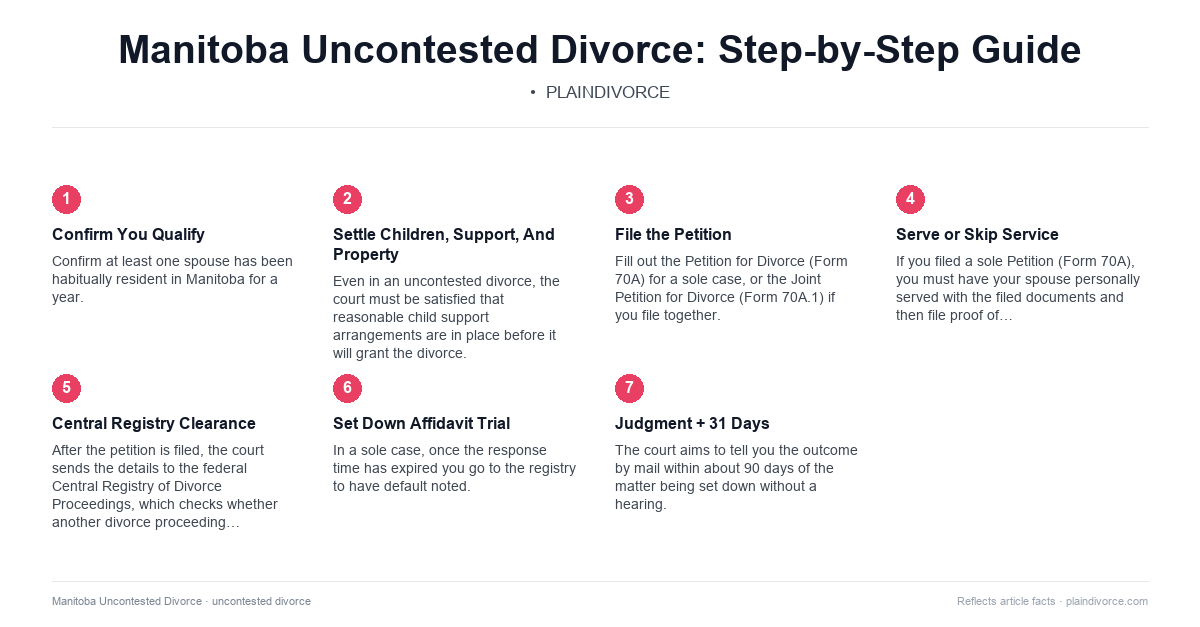
Step 1: Confirm you qualify
- Confirm at least one spouse has been habitually resident in Manitoba for a year.
- Confirm your ground — usually one year of separation — and pin down the separation date.
- Confirm the case is truly uncontested: no active dispute that needs a hearing.
- Decide sole vs. joint. A Joint Petition (Form 70A.1) is the cleaner route when both spouses will sign, because it removes the service step.
Step 2: Settle children, support, and property (and file the financial forms)
Even in an uncontested divorce, the court must be satisfied that reasonable child support arrangements are in place before it will grant the divorce. A written separation agreement or existing order is the cleanest proof.
If your petition asks for child support, spousal support, or a division of family property, you also file a Financial Statement (Form 70D). A child support claim additionally requires the income disclosure the Federal Child Support Guidelines call for (recent tax returns, notices of assessment, pay information). If you are only asking for a divorce and everything else is already settled by agreement, you usually do not need Form 70D.
Step 3: Prepare and file the Petition (Form 70A) or Joint Petition (Form 70A.1)
Fill out the Petition for Divorce (Form 70A) for a sole case, or the Joint Petition for Divorce (Form 70A.1) if you file together. The Form 70A instructions call for good-quality 8½ × 11 paper, double-spaced lines, a left margin of about 1½ inches (40 mm), printing on one side only, and size-14 font for any affidavit portions. Follow the formatting — non-conforming documents can be sent back.
Order your marriage certificate from the vital-statistics office where you were married (in Manitoba, Manitoba Vital Statistics); allow several weeks. If it is not in English or French, have it translated by a certified translator. File the marriage certificate together with your petition. Take extra copies of the petition when you file, and pay the fee (see costs). The court applies for the Central Registry search on your behalf when you file.
Step 4: Service (sole cases) or no service (joint cases)
If you filed a sole Petition (Form 70A), you must have your spouse personally served with the filed documents and then file proof of service — usually the Affidavit of Service (Form 70I). Many petitioners hire a process server for this. Your spouse then has a set time to respond; if they file nothing, the case proceeds as undefended.
If you filed a Joint Petition (Form 70A.1), there is no service — you are both petitioners.
Step 5: Wait for the Central Registry clearance (Ottawa)
After the petition is filed, the court sends the details to the federal Central Registry of Divorce Proceedings, which checks whether another divorce proceeding is on record for the same marriage and sends a clearance certificate back to the court. Your divorce cannot be finished until that clearance arrives — expect about 6–8 weeks. You can call the registry or check online to see whether it has come in.
Step 6: Note default, then set the divorce down on affidavit evidence
In a sole case, once the response time has expired you go to the registry to have default noted. Then (or, for a joint petition, once the clearance is in) you set the matter down for determination without an oral hearing. At the registry you fill out a Requisition (Form 4E) and bring:
- three copies of the completed Divorce Judgment — Form 70O for a sole petition, or Form 70O.1 for a joint petition; and
- two stamped envelopes, one addressed to each spouse, so the signed judgment can be mailed out.
At the same time you file the Affidavit of Petitioner’s Evidence — Form 70M (sole) or Form 70M.1 (joint). Court staff cannot help you complete your forms, so check everything before you go.
Practical tip: uncontested files are almost always delayed by something missing or inconsistent — attachments, dates that don’t match between the petition and the affidavit, signatures, child support details, or the marriage certificate. Treat it as a checklist project and aim for a clean filing the first time.
Step 7: Divorce Judgment is granted, then the 31-day period runs
The court aims to tell you the outcome by mail within about 90 days of the matter being set down without a hearing. If the judge is satisfied on the affidavit evidence, they sign the Divorce Judgment; one copy is mailed to each spouse, and court staff include information about applying for a Canada Pension Plan credit split.
Under section 12 of the Divorce Act, the divorce takes effect on the 31st day after the judgment is rendered. A court can order an earlier effective date in special circumstances if both spouses agree and undertake not to appeal; a filed appeal pushes the date back. Once the divorce is effective, you can request a Certificate of Divorce (Form 70P) for $30.
6. Special issues when you have children
Having children does not stop an uncontested divorce, but it raises the court’s scrutiny. Under section 11 of the Divorce Act, the judge must be satisfied that reasonable arrangements for child support have been made, having regard to the applicable guidelines — and must stay the divorce until they are, if they have not.
- Explain the parenting arrangement — where the children live and the time they spend with each parent.
- Show the child support math. Give the guideline table amount for the payor’s income, and the income documents behind it. If the amount is lower than the guideline figure, explain why (for example, shared parenting or an offsetting arrangement).
- File the financial forms. A child or spousal support claim, or a family-property claim, triggers the Financial Statement (Form 70D) and guideline income disclosure.
- Follow your registry’s checklist. Practices around children and support vary between judicial centres.
7. How long does an uncontested divorce take in Manitoba?
Manitoba does not publish a province-wide processing standard, so think in building blocks rather than one number:
- Before filing: your one year of separation, plus the time to reach agreement on parenting, support, and property. You can file the petition during the separation year.
- Service and response (sole cases): time to serve your spouse, then their window to respond.
- Central Registry clearance: about 6–8 weeks, and the file cannot finish without it. This is the least predictable part.
- Set-down to decision: the court aims to respond by mail within roughly 90 days of the matter being set down.
- After judgment: the 31 days before the divorce takes effect.
A complete, consistent file with two cooperative spouses commonly runs about 4–6 months from filing to an effective divorce, once the separation year is met. A package returned for corrections, or a slow clearance, adds weeks. Ask your registry for a current estimate rather than relying on a fixed timeframe.
8. What does an uncontested divorce cost in Manitoba?
Court fees are set in Manitoba’s Court Services Fees Regulation (M.R. 150/2021). Fees change, so confirm the current amounts with your registry before filing.
| Item | Fee | Notes |
|---|---|---|
| Petition for Divorce / Joint Petition (filing) | $200 | Paid once, at filing. |
| Central Registry of Divorce Proceedings fee | $10 | Federal fee, collected by the court at filing. So you pay about $210 to file. |
| Certificate of Divorce (Form 70P) | $30 | Optional; order it 31+ days after the divorce is granted. |
| Answer | $50 | Only if the case becomes contested. |
| Commissioner / notary for swearing affidavits | Varies | Often free at the registry or through Legal Aid; a lawyer or notary may charge. |
| Process server (sole petitions only) | Varies | Not needed for a Joint Petition. |
| Replacement marriage certificate | Varies | From the vital-statistics office where you married. |
Fee relief: the regulation provides a no-fee exception for people receiving services under The Legal Aid Manitoba Act. The $10 Central Registry fee is also waived only for legal aid recipients. There is no general “hardship” filing-fee waiver in the Manitoba schedule — if cost is a barrier, contact Legal Aid Manitoba.
9. When a DIY divorce might not be right for you
Get legal advice — even limited-scope “unbundled” advice — before filing an uncontested divorce in Manitoba if any of these apply:
- family violence, coercion, or a serious power imbalance;
- significant conflict about parenting;
- concerns that a spouse is hiding assets or income;
- complex finances — a business, a farm, a large pension, multiple properties, or cross-border assets.
A low-cost divorce can turn expensive if someone signs an unfair agreement or gives up a right they did not know they had. A short paid consultation now is cheaper than fixing it later.
10. Where a self-help divorce kit fits
If your case is genuinely uncontested and you are comfortable with paperwork, a Manitoba-specific self-help kit can help you:
- understand the affidavit-evidence process before you start;
- work through a forms-and-evidence checklist (70A or 70A.1, 70I, 70D, 70M or 70M.1, Form 4E, 70O or 70O.1, 70P);
- avoid the omissions that cause registry returns; and
- track the timing — the Central Registry clearance, note-of-default step, set-down, and the 31-day period.
Download Our Manitoba Uncontested Divorce Self-Help Kit
PlainDivorce is not a law firm. A kit is an information and organization tool, not legal advice, and it does not replace the official court forms or current registry instructions.
11. Manitoba uncontested divorce FAQ
What is the Affidavit of Petitioner’s Evidence?
It is a sworn document that replaces oral testimony in a Manitoba uncontested divorce. It lets a judge review the facts of the marriage, the separation, and any child-support arrangements without a hearing. A sole petitioner uses Form 70M; spouses filing a Joint Petition use the Joint Petitioner Affidavit (Form 70M.1).
What forms do I need for a divorce in Manitoba?
A standard sole uncontested divorce uses the Petition for Divorce (Form 70A), the Affidavit of Service (Form 70I), the Affidavit of Petitioner’s Evidence (Form 70M), a Requisition (Form 4E), and the draft Divorce Judgment (Form 70O). Add a Financial Statement (Form 70D) if you claim support or a property division. A joint case swaps in the Joint Petition (Form 70A.1), the Joint Petitioner Affidavit (Form 70M.1), and the Divorce Judgment on Joint Petition (Form 70O.1), and drops the service form.
Is there a “Divorce Judgment Form 70N” in Manitoba?
No. Some older guides refer to a Divorce Judgment Form 70N, but in Manitoba Form 70N is titled “Order” — a general form for court orders. The divorce judgment is Form 70O for a sole petition and Form 70O.1 for a joint petition. If a template or checklist tells you to file “Form 70N” as your divorce judgment, it is out of date.
What is a Joint Petition in Manitoba?
A Joint Petition (Form 70A.1) is where both spouses sign the Petition for Divorce together as co-petitioners. It signals cooperation to the court and removes the need — and cost — of serving documents on the other spouse. Joint petitioners file the Joint Petitioner Affidavit (Form 70M.1) and the joint Divorce Judgment (Form 70O.1).
What is Form 70A in Manitoba divorce?
Form 70A is the Petition for Divorce used to start a sole divorce proceeding in Manitoba’s Court of King’s Bench. The Form 70A instructions require 8½ × 11 paper, double spacing, a left margin of about 1½ inches, one-sided printing, and size-14 font for affidavit portions. Spouses filing together use Form 70A.1 instead.
What is trial on affidavit evidence in Manitoba?
It is a process where your evidence is given in writing, under oath, instead of in person. In an uncontested divorce, the Affidavit of Petitioner’s Evidence (Form 70M, or 70M.1 for joint petitions) is the sworn evidence that supports the Petition, and a judge can grant the divorce without anyone attending court. The judge can still require more evidence or an oral hearing if something is unclear.
How much does an uncontested divorce cost in Manitoba?
About $210 in court fees to file — the $200 petition fee plus the $10 federal Central Registry fee — and $30 later for a Certificate of Divorce. On top of that you may pay a process server (sole cases only), a commissioner or notary to swear affidavits, and the cost of a replacement marriage certificate. People receiving Legal Aid Manitoba services qualify for a no-fee exception.
When does a Manitoba divorce become final?
The divorce takes effect on the 31st day after the Divorce Judgment is rendered. In special circumstances a judge can order an earlier effective date if both spouses agree and undertake not to appeal, and a filed appeal delays it. Once the divorce is effective, you can request a Certificate of Divorce (Form 70P), which is the document most often needed to remarry.
Final note. This guide is general information about the Manitoba uncontested divorce process, checked against the Divorce Act, the Court of King’s Bench Rules (M.R. 553/88), the Court Services Fees Regulation (M.R. 150/2021), and the Central Registry of Divorce Proceedings as of 2026. It is not legal advice. Forms, fees, and registry practices change — always work from the current version of each Court of King’s Bench form, and speak with a Manitoba family lawyer if anything about your finances, your children, or your safety is uncertain.
Sources and local rules can change. Use this guide as a plain-English organizer, then verify the current filing requirements with the official court or government source for your jurisdiction.
About Harry D
Expert contributor at PlainDivorce, helping Canadians and American navigate simple uncontested divorces with clarity and confidence.