Uncontested Divorce in Maryland: How to Get a Mutual Consent Divorce (Plain-English Guide)
An uncontested divorce in Maryland is one where you and your spouse agree the marriage is over and agree on every issue — property, debts, alimony, and anything about the children — so there is nothing left for a judge to decide. The fastest route is a mutual consent divorce: it has no separation period, so you can file the day your written settlement agreement is signed.
This guide walks through how an uncontested divorce in Maryland actually works as of 2026 — mutual consent first, with the 6-month separation and irreconcilable differences grounds as backups. You will get the current Maryland Judiciary form numbers, the deadlines that trip up self-filers, and what to expect at the short hearing. This is general information, not legal advice, and PlainDivorce is not a law firm.
TL;DR — Uncontested Divorce in Maryland, in 60 Seconds
- Three no-fault grounds only. Since October 1, 2023: mutual consent, 6-month separation, and irreconcilable differences. Every fault ground is gone, and so is limited divorce.
- Mutual consent is the only ground with no waiting period. You can file the day your agreement is signed, even if you still live together.
- The Maryland Mutual Consent divorce requirements are strict: a signed written settlement agreement covering alimony, all property and debts, and every child issue; a child support guidelines worksheet if support is being paid; no pleading filed to set the agreement aside before the hearing; and a court finding that the child terms are in the children’s best interests.
- Core filing packet: Complaint for Absolute Divorce CC-DR-020 + Civil-Domestic Case Information Report CC-DCM-001, plus the signed Marital Settlement Agreement (CC-DR-116, Rev. 10/2025) for mutual consent, plus the applicable financial statement (CC-DR-030 or CC-DR-031), plus a Notice Regarding Restricted Information (MDJ-008) on anything with financial or confidential details.
- You cannot serve your spouse yourself. Use the Sheriff, a private process server, or certified mail restricted delivery sent by someone else — then file proof of service.
- Filing fee is $165 statewide (confirm with your clerk). Can’t afford it? File CC-DC-089, “Request for Waiver of Costs,” with your first papers.
- You will have a short hearing. At least one spouse testifies under oath. No corroborating witness needed since October 1, 2016.
- Two easy-to-miss items: the clerk-issued Report of Absolute Divorce or Annulment of Marriage (handed in at the hearing — your decree will not be released without it), and following up on scheduling with CC-DR-059 if your case goes quiet.
- You are not divorced at the hearing. You are divorced when a judge signs the Judgment of Absolute Divorce.
1. What Is an Uncontested (or “Simple”) Divorce in Maryland?
Maryland courts do not use the label “simple divorce.” The Judiciary’s own term is an uncontested divorce case: neither spouse disagrees with the divorce, and there is nothing left for the court to decide about children, money, or property.
In practice, that means all three of these are true:
- You both agree the marriage should end.
- You agree on every major issue: custody and parenting time, child support, alimony, property, and debts.
- Neither spouse is asking a judge to resolve a dispute.
Since October 1, 2023, Maryland is a purely no-fault state. Legislation that year repealed every fault ground — adultery, desertion, cruelty, and the rest — and eliminated limited divorce entirely. A court can now grant an absolute divorce on exactly three grounds under Md. Code, Family Law § 7-103:
- Mutual consent — no waiting period, but you need a complete signed settlement agreement.
- 6-month separation — you must already have lived separate and apart for 6 months before you file.
- Irreconcilable differences — based on the reasons you give for permanently ending the marriage.
“Uncontested” describes how the case behaves. The ground is a separate choice, and you can check more than one on the complaint. The rest of this guide helps you pick the one that fits.
2. Mutual Consent Divorce: Requirements and Forms
Mutual consent is the ground most DIY filers are looking for, because it has no separation requirement at all. You can still be living in the same house on the day you file. What it demands instead is a settlement agreement that leaves nothing open.
2.1 Maryland Mutual Consent Divorce Requirements (All Four Must Be Met)
Family Law § 7-103(a)(3) lists the Maryland Mutual Consent divorce requirements. There are four, and you need every one:
- A written settlement agreement signed by both spouses that resolves alimony, distribution of property (including any monetary award, the family home, and family-use personal property), and the care, custody, access, and support of any minor or dependent children.
- A completed child support guidelines worksheet attached to the agreement if the agreement provides for child support.
- Neither spouse files a pleading to set aside the agreement before the divorce hearing.
- The court is satisfied that any terms about minor or dependent children are in those children’s best interests.
Note the third one carefully. It is not enough that your spouse “still agrees” in a general sense — the ground fails only if someone actually files paperwork asking the court to set the agreement aside. If that happens, you would need to proceed on a different ground.
2.2 The Marital Settlement Agreement Maryland Provides (CC-DR-116)
- Marital Settlement Agreement (CC-DR-116, Rev. 10/2025) — Maryland’s standardized agreement form. You are not required to use it, but for most self-filers it beats drafting a contract from scratch. A signed copy must be attached to your complaint.
- Child Support Guidelines Worksheet A (CC-DR-034) for primary physical custody, or Worksheet B (CC-DR-035) for shared physical custody — required whenever the agreement provides for child support.
- Notice Regarding Restricted Information (MDJ-008) — file this with any submission that contains information made confidential by statute, rule, or court order (Social Security numbers, financial account details, and so on), and check the “Restricted Information” box on the form itself. List only the last four digits of account and ID numbers.
The complaint form is blunt about this: if you do not provide a signed agreement, the court cannot grant a mutual consent divorce. This is the single most common reason a mutual consent filing stalls.
One more detail people miss: if you have no marital property to divide, you still need a signed written agreement saying exactly that. “Nothing to divide” is not the same as “no agreement needed.”
Pick Your Maryland No-Fault Ground
Do you have a signed settlement agreement covering everything — property, debts, alimony, and all child issues?
Yes → File on mutual consent. No separation period required.
No → Ask: have you already lived separate and apart for 6 months?
• Yes → File on the 6-month separation ground.
• No → Consider irreconcilable differences, or finish the 6 months first.
You may check more than one ground on Form CC-DR-020. Hearing timing varies by county Circuit Court.
3. Backup Grounds: 6-Month Separation and Irreconcilable Differences
If you cannot finalize a complete written agreement, Maryland still offers two no-fault paths.
3.1 6-month separation
You and your spouse must have lived separate and apart for 6 months without interruption before you file. The clock has to finish running first — filing early on this ground does not work.
Helpfully, § 7-103(b) says spouses “who have pursued separate lives” are deemed to have lived separate and apart even if they still reside under the same roof, or if the separation is under a court order. That matters for couples who cannot afford two households yet.
3.2 Irreconcilable differences
This ground rests on the reasons you state for permanently ending the marriage. There is no separation period and no settlement-agreement requirement to use the ground itself — but any issue you have not agreed on is still an issue the judge has to decide, which is what turns a case contested.
Bottom line: mutual consent is the cleanest path when you can meet its requirements, because a complete agreement is what makes the hearing short and the outcome predictable.
4. Who Qualifies: Residency, Venue, and an “Uncontested” Reality Check
4.1 Residency: it depends on where the ground happened
Maryland’s residency rule is narrower than most guides suggest. Under Family Law § 7-101, the 6-month residency requirement applies only when the grounds for divorce occurred outside Maryland. In that case, one spouse must have lived in Maryland for at least 6 months before the complaint is filed. If the grounds happened in Maryland, there is no fixed months-of-residency threshold — but at least one spouse still has to actually live here.
Form CC-DR-020 asks you to check which applies: how long you have lived in Maryland, how long your spouse has, whether the grounds occurred in Maryland, or whether they occurred elsewhere and the 6-month residency is met.
4.2 Venue: which Circuit Court to file in
File your divorce in the Circuit Court for the county (or Baltimore City) where you live, or where your spouse lives or works. The Judiciary’s own instructions phrase it that way, and the venue statute also allows the county where the plaintiff resides. If more than one court is available to you, pick based on convenience — court-by-court scheduling speed is real but unpredictable, and not a sound basis for choosing where to file.
4.3 When a DIY uncontested divorce is a bad idea
Talk to a lawyer before you sign or file if any of these apply:
- Domestic violence, intimidation, or a serious power imbalance between you.
- You suspect hidden assets, or you do not have a clear picture of the household finances.
- There is a pension or retirement account to divide. These usually need a separate domestic relations order (a QDRO or similar), drafted to the plan’s specifications.
- A long marriage, real estate, a business, or a meaningful alimony question.
- You cannot locate your spouse to serve them.
Two decisions are hard to reopen later, so make them deliberately: alimony and property division. Raise both before the judgment of absolute divorce is entered. A court can sometimes reserve alimony for the future, but if you neither request it nor reserve it, coming back for it later can be difficult or impossible. Property claims and any monetary award generally have to be resolved as part of the divorce. Get legal advice on any waiver or reservation before you sign.
Free help exists and is worth using. The Maryland Court Help Center (410-260-1392) is staffed by lawyers who give brief advice by phone or chat, and the Family Law Hotline (1-800-845-8550) is free to low-income callers. Neither can represent you, but both can tell you whether your plan is sound.
5. Step-by-Step Process (With Maryland Form Numbers)
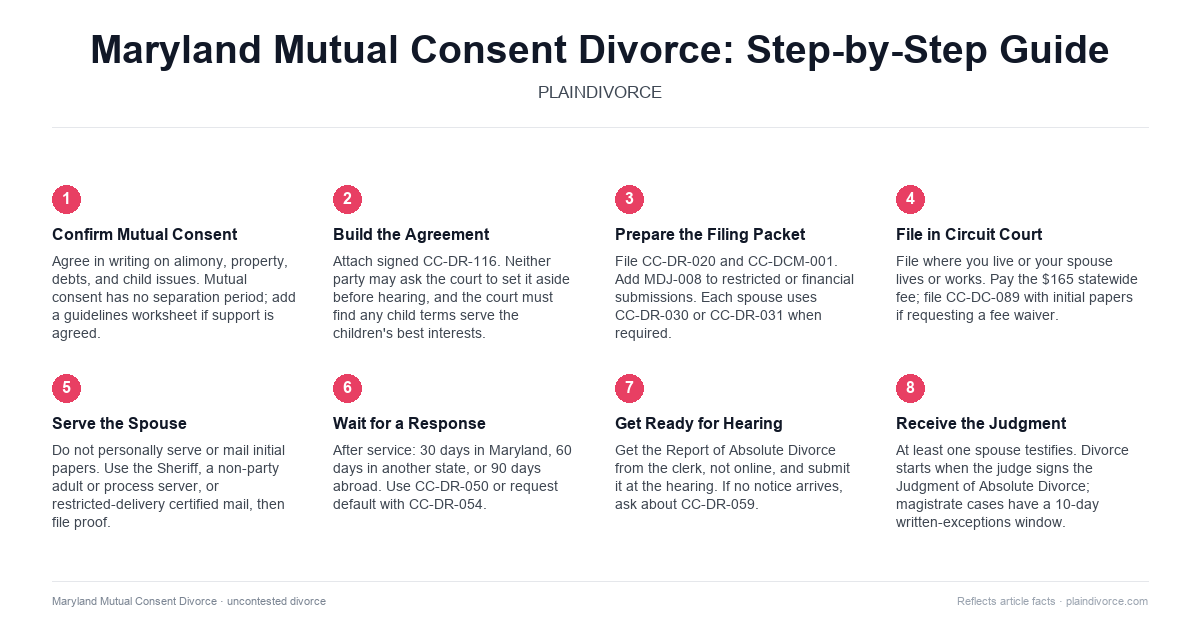
Local Circuit Court practice varies, but nearly every uncontested case runs through the same eight steps.
Step 1 — Finalize the Marital Settlement Agreement (Mutual Consent Cases)
The agreement is the case. Everything downstream depends on it being complete and signed. Use the standardized Marital Settlement Agreement (CC-DR-116) unless you have a reason not to, and read every clause before signing — including whether alimony can be modified later, and whether the agreement is incorporated but not merged into the judgment (which keeps it enforceable as a contract as well as a court order).
Step 2 — Prepare Your Packet, Starting With the Complaint for Absolute Divorce (CC-DR-020)
The Complaint for Absolute Divorce, CC-DR-020 (Rev. 08/2024), is the document that opens your case, and it does more work than people expect: it captures your residency basis, your children’s five-year residence history, your parenting and support requests, your property and alimony claims, your name-restoration request, any request for use and possession of the family home for the children (up to three years), and the ground you are filing on. Everything else in the packet supports it.
Every uncontested divorce needs the first two forms below. The rest depend on your situation.
| Form | Name | When you need it |
|---|---|---|
| CC-DR-020 | Complaint for Absolute Divorce | Always — this opens the case |
| CC-DCM-001 | Civil-Domestic Case Information Report | Always — helps the court schedule your case |
| MDJ-008 | Notice Regarding Restricted Information (Rule 20-201.1) | Any submission containing confidential or financial information |
| CC-DR-116 | Marital Settlement Agreement | Mutual consent cases (attach signed copy) |
| CC-DR-030 | Financial Statement (Child Support Guidelines) | Child support is the only financial issue, and combined gross monthly income is $30,000 or less |
| CC-DR-031 | Financial Statement (General) | You seek alimony or a monetary award, or combined gross monthly income exceeds $30,000 |
| CC-DR-034 / CC-DR-035 | Child Support Guidelines Worksheet A / B | A for primary physical custody, B for shared |
| CC-DR-109 | Maryland Parenting Plan Tool | You have minor children and have agreed on a plan (instructions: CC-DRIN-109) |
| CC-DR-110 | Joint Statement Concerning Decision-Making Authority and Parenting Time | You have minor children and have not fully agreed on a plan |
| CC-DC-089 | Request for Waiver of Costs | You cannot afford the filing fee |
| CC-DR-033 | Joint Statement Concerning Marital and Non-Marital Property | Either party seeks a division or transfer of marital property or a monetary award — due at least 10 days before trial unless the court sets another date |
Who files a financial statement: under Maryland Rule 9-203, each spouse files the applicable financial statement whenever the court is asked to decide child support, alimony, or a property award — not just the spouse who filed the complaint. CC-DR-030 is the short form; CC-DR-031 is the long form. Use the long form if you are asking for alimony or a monetary award for property — even if child support is also involved. If child support is the only financial issue, the short form works when combined gross monthly income is $30,000 or less. In a fully settled mutual consent case the court may not require both statements, but ask the clerk rather than assume.
Step 2b — “Financial Statement Form A” in Maryland: What People Actually Mean
This search comes up constantly, so let’s clear it up: Maryland has no court form named “Financial Statement Form A.” If someone told you to file one, they almost certainly meant one of two different documents that get confused with each other.
- The short-form financial statement — CC-DR-030, “Financial Statement (Child Support Guidelines).” This is your income and expenses. Some courts and self-help materials informally call it the “A” or short form because it pairs with Worksheet A. File it when child support is the only financial issue and combined gross monthly income is $30,000 or less.
- Child Support Guidelines Worksheet A — CC-DR-034. This is the actual calculation, and it is genuinely called “Worksheet A.” Use it for primary physical custody arrangements. Its counterpart, Worksheet B (CC-DR-035), is for shared physical custody — generally where the child spends more than 25% of overnights with each parent.
In a mutual consent case with child support, you will typically need both: a financial statement (CC-DR-030 or CC-DR-031) filed with your complaint, and a completed Worksheet A or B attached to your settlement agreement. Filing one and skipping the other is a common reason a packet comes back.
If your combined gross monthly income exceeds $30,000, or you are seeking alimony or a monetary award, the long form CC-DR-031, “Financial Statement (General),” replaces the short form entirely — you do not need to file both.
Privacy tip: whenever a form carries financial or otherwise confidential details, file a Notice Regarding Restricted Information (MDJ-008) with it, check the “Restricted Information” box at the top of the form, and list only the last four digits of any account or ID number. This is a statewide requirement under Maryland Rule 20-201.1, not a county-specific practice.
Step 3 — File in the Circuit Court and pay the filing fee
Make at least two copies of everything before filing: one to serve on your spouse, one for your records. The Circuit Court filing fee for a Complaint for Absolute Divorce is $165 statewide as of 2026 — check the current Circuit Court fee schedule or ask your clerk to confirm, and check accepted payment methods, since some clerks do not take personal checks.
If you cannot afford it, file CC-DC-089 (Request for Waiver of Costs) with your initial papers. Do not serve that form on your spouse. Your case will not be docketed until a judge rules on it, and if the request is denied you have 10 days to pay. A granted prepayment waiver is not always forgiveness — you may be asked to pay outstanding “open costs” at the end of the case, and if you still cannot afford them you can ask the court to waive them at the final hearing or by filing CC-DC-090 (Request for Final Waiver of Open Costs).
Step 4 — Serve your spouse and file proof of service
Once the case is docketed, the clerk issues a Writ of Summons. Then service has to be done correctly, and this is where DIY cases most often stall.
You may not serve your spouse yourself, and you may not mail it yourself. The ordinary methods are:
- Sheriff — the clerk forwards the papers for a fee; the Sheriff files the return of service.
- Private process — a process server, or any adult over 18 who is not a party to the case. They complete CC-DR-055 (Affidavit of Service — Hand Delivery/Private Process); you may file it, but you cannot fill it out.
- Certified mail, restricted delivery — sent by someone other than you. Your spouse must personally sign the return-receipt card. That person completes CC-DR-056, and the original receipt card is attached.
If service repeatedly fails or you cannot locate your spouse, you can ask the court for permission to use another method: file a Motion for Alternate Service and Affidavit (CC-DR-070) with a Notice — Alternate Service (CC-DR-072), attaching proof of your attempts. A judge decides whether to allow it.
Step 5 — Wait out the response window (or request a default)
After proof of service is filed, your spouse has 30 days to respond if served in Maryland, 60 days if served in another state, and 90 days if served in another country.
In a friendly case, the usual response is an Answer (CC-DR-050) agreeing with the complaint. If nothing is filed by the deadline, file a Request for Order of Default (CC-DR-054) — you will also need to show the other party is not on active military duty. If the court enters the order, the clerk issues a Notice of Default, and your spouse then has 30 days to ask the court to vacate it. Only after that window closes does the case move forward without their participation, so a default adds a step and several weeks, not just a signature.
Step 6 — Get the vital records form from the clerk
Maryland requires a Department of Health form, Report of Absolute Divorce or Annulment of Marriage, that tracks divorce statistics. Two things catch people out:
- It is not a downloadable PDF like the CC-DR forms. Get a blank copy from the clerk’s office or the courtroom clerk.
- You complete it and hand it in at the end of your hearing. Your divorce decree will not be released to you until it is filed.
Ask for it when you file, not the morning of your hearing.
Step 7 — Get on the hearing calendar
The court schedules your case after an Answer or an Order of Default is docketed, and you will get notice by mail. If a reasonable amount of time passes with no word, call the clerk and ask whether you should file a Request for Hearing or Proceeding (CC-DR-059).
Do not just wait. A case sitting unscheduled in the queue is a common — and preventable — source of delay in an otherwise clean uncontested divorce.
Step 8 — Judgment of Absolute Divorce
If the judge or magistrate is satisfied that your ground is proven, your paperwork is complete, and any terms about children are in their best interests, the court grants the divorce. You are not divorced on the day of the hearing — you are divorced when a judge signs the Judgment of Absolute Divorce.
- Before a judge: the judge signs the final order; you receive it at the hearing or by mail.
- Before a magistrate: you get a Report and Recommendations. A judge reviews it, and after a 10-day window for written exceptions, signs the order and it is mailed to both sides.
6. The Uncontested Divorce Hearing: What to Expect
Uncontested hearings are short. In a mutual consent case, at least one spouse must appear and testify under oath. The other spouse does not have to attend.
Expect to confirm, on the record:
- Your identity and the date and place of your marriage.
- That at least one of you lives in Maryland.
- The facts supporting your ground — for 6-month separation, the date you separated and that it was uninterrupted.
- That you signed the settlement agreement voluntarily, and that neither of you has asked the court to set it aside.
You do not need a corroborating witness. Since October 1, 2016, Maryland courts are no longer prohibited from entering a Judgment of Absolute Divorce without corroborating testimony. You still have to prove your ground through your own sworn testimony and complete paperwork — the witness requirement is simply gone.
Arrive early enough to clear security and find your courtroom. Bring three copies of anything you plan to show the court. If you filed the case and do not show up, it can be dismissed. Maryland also applies strict evidentiary rules to children testifying in a divorce or custody case; if you think a child’s testimony is necessary, talk to a lawyer about how to raise it.
7. Extra Requirements When You Have Children
Children raise the bar. Even when both parents fully agree, the court has an independent duty to check that the arrangements serve the children’s best interests — it will not simply rubber-stamp your agreement.
What you will need:
- A parenting plan. A parenting plan is required in any Maryland case involving custody of a minor child. If you agree, use the Parenting Plan Tool (CC-DR-109) with instructions at CC-DRIN-109. If you cannot agree on all of it, each parent completes the Joint Statement Concerning Decision-Making Authority and Parenting Time (CC-DR-110) instead, and the court decides the open pieces.
- A child support guidelines worksheet — CC-DR-034 for primary physical custody, CC-DR-035 for shared — attached to your agreement whenever child support is being paid.
- A financial statement from each parent (CC-DR-030 or CC-DR-031, per the rule in Section 5), with the income figures backed by documentation such as pay stubs and tax returns — the guidelines run on verified income, not stated income.
- Custody history details on the complaint: where the children have lived for the past five years, who they lived with, and any other case involving them.
A few things about agreed child support that self-filers underestimate:
- The guidelines are a rebuttable presumption. The amount the guidelines produce is presumed correct. A court that approves a different number must make a written finding (or a finding on the record) giving the guideline amount, how your order differs, and why the difference is in the children’s best interest. Be ready to explain any departure at the hearing.
- A support order is an immediate earnings-withholding order. By statute, child support generally comes out of the paying parent’s wages automatically from the start, unless a narrow exception applies.
- Health insurance and medical costs for the children have to be addressed in the order where applicable.
8. How Long Does an Uncontested Divorce Take in Maryland?
Two things drive the timeline: which ground you use, and how fast your county schedules uncontested hearings. Only the first is in your control.
- Mutual consent — the fastest start. You can file the day your agreement is signed and your packet is ready.
- 6-month separation — add 6 months of living separate and apart before you can file at all.
- Irreconcilable differences — no waiting period to file, but unresolved issues can pull the case out of the uncontested track.
After filing, the fixed elements are the same on every path: service, the 30/60/90-day response window, scheduling, the hearing, and the signed judgment. If a magistrate hears the case, add the 10-day exceptions window before a judge signs. The stretch between service and the hearing date is the one that varies most by county, and it is largely outside your control.
Maryland Timeline: Mutual Consent vs. 6-Month Separation
Track A — Mutual Consent
No waiting period before filing
- Sign settlement agreement
CC-DR-116, plus worksheet if child support - File complaint
CC-DR-020 + CC-DCM-001, agreement attached - Serve & file proof
Sheriff, private process, or certified mail - Answer or default
30 / 60 / 90 days depending on where served - Uncontested hearing
One spouse testifies; hand in vital records form - Judgment of Absolute Divorce
Signed by a judge — this is the date you are divorced
Track B — 6-Month Separation
Same steps, preceded by a hard 6-month wait
- Live separate and apart — 6 months
Can count even under one roof if you pursue separate lives - File complaint
CC-DR-020 + CC-DCM-001 - Serve & file proof
Same three service methods - Answer or default
30 / 60 / 90 days - Uncontested hearing
Testify to the separation date and no interruption - Judgment of Absolute Divorce
Signed by a judge
Where delays usually happen: between service and the hearing date. Scheduling varies by county Circuit Court, and a magistrate’s recommendation adds a 10-day exceptions window before the judgment is signed.
9. What Does an Uncontested Divorce Cost in Maryland?
A DIY uncontested divorce has a small number of predictable costs:
- Circuit Court filing fee — $165 statewide as of 2026, prepaid. Confirm on the current fee schedule or with your clerk.
- Service of process — a Sheriff’s fee, a private process server’s fee, or postage for certified mail with restricted delivery.
- Certified copies of the final judgment. You may be asked for one to change your name, retitle property, or update accounts — requirements vary by agency, so confirm with whoever is asking before you order extras.
- Optional but often worth it: a mediator to close the last gaps in your agreement, or a one-time attorney review before you sign.
If money is tight, file CC-DC-089 (Request for Waiver of Costs) with your initial papers. A granted waiver usually covers the Sheriff’s service fee too. One caveat: a prepayment waiver is not always forgiveness — you may be asked to pay open costs at the end of the case, and if you still cannot afford them, you can ask the court to waive them at your final hearing or by filing CC-DC-090 (Request for Final Waiver of Open Costs).
10. Where a Self-Help Divorce Kit Fits
The Maryland forms are free and public. What self-filers actually run short on is sequencing: which form goes with which situation, what has to be attached to what, and which deadline is about to pass.
Our Maryland uncontested divorce kit is built around the mutual consent roadmap — agreement, file, serve, respond, schedule, hearing, judgment — with checklists for the specific items that most often delay DIY cases: the CC-DR-116 attachment, the MDJ-008 restricted-information notice, choosing between CC-DR-030 and CC-DR-031, the CC-DR-034/035 worksheet, correct service and proof of service, and the clerk-issued vital records form.
Download Our Maryland Uncontested Divorce Self-Help Kit
Our kits do not replace legal advice and cannot guarantee outcomes. They are for organized, self-represented people who want to follow the process correctly and avoid preventable delays.
11. Uncontested Divorce in Maryland: FAQ
What are the Maryland mutual consent divorce requirements?
Four things, all required: a written settlement agreement signed by both spouses resolving alimony, all property and debts, and every issue about minor or dependent children; a completed child support guidelines worksheet attached if the agreement provides for support; no pleading filed by either party to set the agreement aside before the hearing; and a court finding that any terms about children are in the children’s best interests. There is no separation period.
Where do I get the Complaint for Absolute Divorce (CC-DR-020)?
Free from the Maryland Judiciary’s forms page at mdcourts.gov/forms, or from any Circuit Court clerk’s office. Clerks can hand you the form but are not permitted to tell you which forms to file or how to complete them. The current version is Rev. 08/2024.
Is there a “Financial Statement Form A” in Maryland?
No form carries that exact name. People using the phrase usually mean either CC-DR-030, the short-form Financial Statement (Child Support Guidelines), or CC-DR-034, Child Support Guidelines Worksheet A for primary physical custody. They serve different purposes, and a child support case often needs both. See Step 2b above.
Do I have to use Maryland’s Marital Settlement Agreement form (CC-DR-116)?
No — any written agreement signed by both spouses that resolves alimony, property, and all child issues can satisfy the statute. But CC-DR-116 is free, court-issued, and structured around exactly what a Maryland judge will look for, which is why most self-filers use it. The current version is Rev. 10/2025.
Can we get a mutual consent divorce if we still live together?
Yes. Mutual consent has no separation requirement. What it requires is a complete written settlement agreement signed by both of you.
Do both spouses have to go to the hearing?
No. In a mutual consent case, at least one spouse must appear and testify under oath. The other spouse is not required to attend.
Do I need a witness to corroborate my testimony?
Not since October 1, 2016. Maryland courts can grant an absolute divorce without corroborating witness testimony. You still have to prove your ground yourself, under oath.
Can I serve the divorce papers on my spouse myself?
No. You cannot hand-deliver or mail the summons and initial filing yourself. Use the Sheriff, a private process server (or any adult over 18 who is not a party), or have someone else send it by certified mail with restricted delivery.
Which financial statement do I file — CC-DR-030 or CC-DR-031?
Use CC-DR-031 (the long form) if you are seeking alimony or a monetary award for property, or if combined gross monthly income exceeds $30,000. Use CC-DR-030 (the short form) when child support is the only financial issue and combined gross monthly income is $30,000 or less. Under Maryland Rule 9-203, each spouse files the applicable statement when the court is asked to decide support, alimony, or property.
Can I go back to my maiden name?
Yes — ask for it on the complaint, and it costs nothing. If you do not, you can file a Motion for Restoration of Former Name (CC-DR-097) in the same case for up to 18 months after the judgment of absolute divorce is entered; there is no filing fee. After 18 months, you would need a separate name-change case. The restoration cannot be for a fraudulent purpose, such as avoiding creditors.
Am I divorced on the day of my hearing?
No. You are divorced when a judge signs the Judgment of Absolute Divorce. If a magistrate heard your case, a judge reviews the recommendation and signs the order after a 10-day window for written exceptions.
What happens if my spouse changes their mind?
Mutual consent fails only if a party files a pleading to set aside the settlement agreement before the hearing. If that happens, you would need to proceed on 6-month separation or irreconcilable differences instead.
12. Final Thoughts and Next Steps
The whole decision comes down to one question: can the two of you write down a complete agreement and sign it? If yes, mutual consent is the most direct route Maryland offers, and the standardized CC-DR-116 takes most of the drafting burden off your shoulders. If not, the 6-month separation ground is still available — it just costs you time up front.
Your checklist:
- Confirm residency and venue, then pick your ground.
- Finish the settlement agreement and gather financial documents early.
- File CC-DR-020 and CC-DCM-001, with the applicable financial statement, an MDJ-008 on anything confidential, and, for mutual consent, the signed agreement attached.
- Attach the child support worksheet (CC-DR-034 or CC-DR-035) if support is involved, and a parenting plan (CC-DR-109, or CC-DR-110 if not fully agreed).
- Serve correctly — never yourself — and file proof of service.
- Track the 30/60/90-day response window; file CC-DR-054 if no answer comes, and expect the extra Notice-of-Default step.
- Ask the clerk for the Report of Absolute Divorce or Annulment of Marriage form before hearing day.
- Follow up on scheduling; file CC-DR-059 if your case goes quiet.
And the most important line in this guide: if you feel unsafe, pressured, or unsure whether the deal is fair, stop. Call the Maryland Court Help Center at 410-260-1392 or talk to a Maryland attorney before you sign anything. A signed agreement is very hard to undo. This guide is general information, not legal advice, and PlainDivorce is not a law firm.
Sources and local rules can change. Use this guide as a plain-English organizer, then verify the current filing requirements with the official court or government source for your jurisdiction.

About Harry D
Expert contributor at PlainDivorce, helping Canadians and American navigate simple uncontested divorces with clarity and confidence.