Uncontested Divorce in Massachusetts: Forms, the Nisi Period, Costs, and Timeline
An uncontested divorce in Massachusetts is the no-fault Section 1A joint divorce: both spouses agree the marriage has irretrievably broken down, sign a notarized separation agreement that resolves every issue that applies to them, and file a Joint Petition for Divorce (CJD-101A) together. There is no summons, no service, and no trial — but there is one short hearing and a built-in waiting period before you are actually divorced.
This guide covers how a 1A divorce works, how it differs from a 1B divorce, exactly which Probate and Family Court forms you file and when, what happens at the hearing, and how the Judgment of Divorce Nisi sets your real final date. Every legal specific below was checked against Chapter 208 of the Massachusetts General Laws, the Supplemental Rules of the Probate and Family Court, and the court’s current filing-fee schedule and standing orders.
TL;DR — Uncontested divorce in Massachusetts
- File a 1A if you truly agree. Section 1A is the joint, no-fault route. It needs a signed, notarized separation agreement resolving property and debts, plus custody, parenting time, child support, and alimony where those apply. If a real issue is still open, it is a 1B.
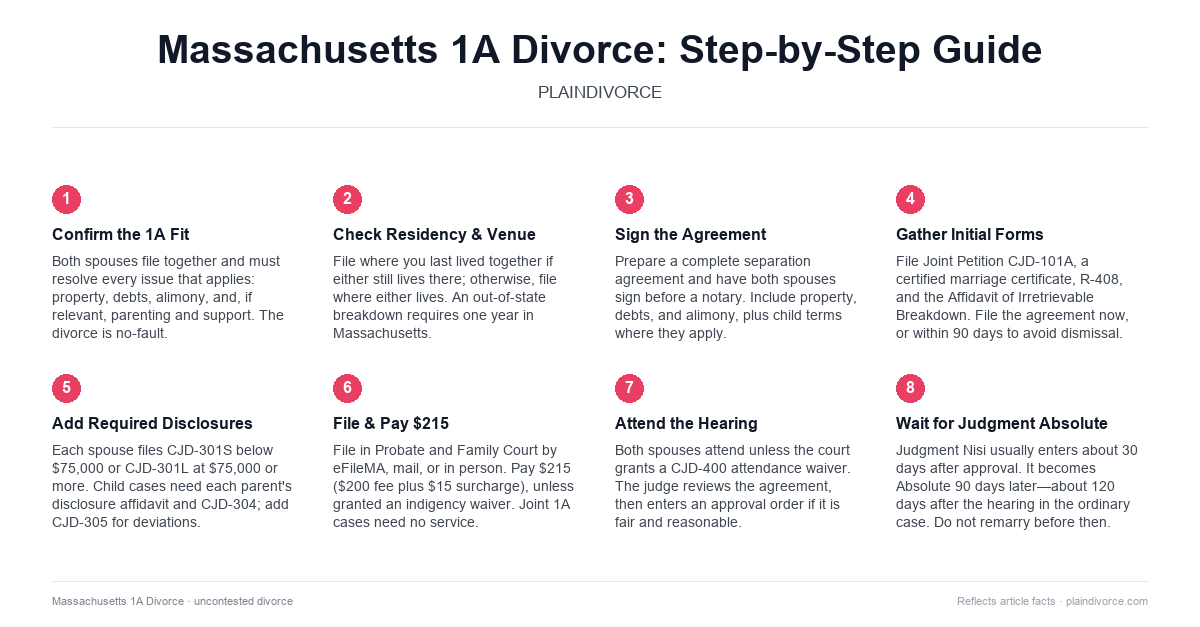
- Core packet: Joint Petition for Divorce (CJD-101A), a certified copy of your marriage certificate, the Report of Absolute Divorce or Annulment (R-408), the Affidavit of Irretrievable Breakdown, and your notarized separation agreement.
- A Financial Statement from each spouse. Short form (CJD-301S) if your income is under $75,000; long form (CJD-301L) at $75,000 or above. Figures are reported weekly.
- Cost to file: $215 ($200 filing fee + $15 surcharge). A 1B adds a $5 summons charge. Fee waivers are available through an Affidavit of Indigency.
- The Nisi period is the timing trap. You are not divorced at your hearing. In the usual path a judgment of divorce nisi enters automatically about 30 days after the court approves your agreement, and the divorce is final 90 days after that — the court’s guidance puts the final date at 120 days from the judgment. You cannot remarry before then.
- Filing triggers an automatic financial restraining order (Rule 411): neither spouse may sell, hide, borrow against, or give away property, or change insurance and retirement beneficiaries, outside a short list of exceptions, until the judgment enters.
- With children: each parent files a Child Care or Custody Disclosure Affidavit, plus a Child Support Guidelines Worksheet (CJD-304) in any case where a support order may be set. The “Two Families Now” co-parenting course is not automatically required in a 1A, though a judge can still order it.
- Realistic timeline: the mandatory wait from hearing to final judgment is about four months; how fast you reach the hearing depends on your county and how clean your packet is.
1. What an Uncontested Divorce in Massachusetts Actually Is
Massachusetts has no divorce type officially called “simple” or “uncontested.” When people use those words, they almost always mean a no-fault divorce under G.L. c. 208, § 1A: both spouses swear the marriage has suffered an irretrievable breakdown, and they file together with a complete, signed, notarized written agreement.
“Complete” has a specific meaning. To file a 1A, your separation agreement has to make proper provision — where each one applies to your family — for:
- Division of marital assets and debts
- Alimony (including a knowing waiver, if that is the deal)
- Child custody — legal and physical (only if you have minor children)
- Parenting time (only if you have minor children)
- Child support (only if you have minor children)
A couple with no minor children simply has no custody, parenting-time, or child-support terms to resolve — those categories drop out. What cannot drop out is a clear, honest resolution of property, debt, and alimony. If any issue that does apply to you is unresolved, you don’t have a 1A case yet. You have a 1B case, or a 1A that isn’t ready to file.
One decision is worth understanding before you sign anything: your separation agreement can either survive the divorce as an independent contract, or merge into the divorce judgment. Terms that merge can generally be modified later by a court. Terms that survive are much harder to change. Different provisions in the same agreement can be treated differently — for example, child-related terms almost always remain modifiable regardless of the label. This is one of the few places in a DIY divorce where a short consultation with a lawyer usually pays for itself.
2. Section 1A vs. Section 1B: The Choice That Shapes Everything
This is the main fork in the road, and it changes your forms, your fees, your service obligations, and your timeline.
| Section 1A (joint / uncontested) | Section 1B (no-fault, one-party start) | |
|---|---|---|
| Who files | Both spouses together as co-petitioners | One spouse (the plaintiff) |
| Core form | Joint Petition for Divorce (CJD-101A) | Complaint for Divorce (CJD-101B) |
| Agreement required up front? | Yes — signed, notarized separation agreement (may be filed within 90 days of the petition) | No |
| Service on spouse | Not required | Required (summons and service of process) |
| Filing cost | $215 ($200 + $15 surcharge) | $220 ($200 + $15 + $5 summons) |
| Earliest hearing | When the court schedules it | Generally not sooner than 6 months after filing, unless the court waives that |
| Nisi timing | Judgment nisi enters automatically about 30 days after the court approves the agreement; absolute 90 days after that | Judgment nisi enters when judgment enters; absolute 90 days later |
A 1B case can settle, and many do. But it starts as a one-party filing with service and an answer, and the six-month wait before a hearing is a real cost. If you and your spouse can genuinely cooperate and sign a full agreement, 1A is usually faster and cheaper.
What happens if you start a 1B and then settle? You are not stuck on the contested track. Section 1B says that once the parties file the § 1A statement and the dissolution agreement before judgment enters, “said action for divorce shall proceed under said section one A.” In practice, the case’s filing date and your county’s scheduling still shape how quickly you get a hearing — you don’t rewind the clock — but the categorical idea that a 1B “can’t become a 1A” is wrong.
The honest test for choosing 1A: can both of you sit down, disclose your finances accurately, and sign the same documents in front of a notary? If yes, file 1A. If that sentence made you uneasy, plan for 1B and read section 10 before you file anything.
3. Can You File in Massachusetts? Residency and County
Skipped by most guides, and a genuine reason filings get bounced.
Residency. The Probate and Family Court’s plain-language rule is that you can file if you have lived in Massachusetts for one year, or the reason the marriage ended happened in Massachusetts while you lived here as a couple. The underlying statute, G.L. c. 208, § 5, is a little more precise:
- If the cause of the breakdown occurred in Massachusetts and the plaintiff is living here when the action begins, there is no fixed durational requirement.
- If the cause occurred outside Massachusetts, the plaintiff must have lived in the state for one year before filing.
- A divorce will not be granted if you moved to Massachusetts mainly to obtain one.
In a joint 1A petition both spouses are petitioners, so if either of you meets one of these tests you can generally proceed — but if your circumstances are unusual (a recent move, a marriage and separation both outside Massachusetts), confirm your basis with the Probate and Family Court before filing.
Which county. File in the Probate and Family Court for the county where you and your spouse last lived together, as long as one of you still lives there. Otherwise, file where either spouse lives now. A case can be transferred to another county for hardship or inconvenience if the party seeking the move lives there.
4. The 1A Forms Checklist: Filing vs. Before the Hearing
Most DIY guides give you one long undifferentiated list. That’s why people show up with the wrong packet. The Probate and Family Court actually splits 1A paperwork into what is required at initial filing and what should be filed before the hearing is scheduled, and the distinction matters.
Required at initial filing
- Joint Petition for Divorce (CJD-101A) — the case-opening document for a § 1A divorce. It has carried an October 2007 revision date for years; that is current.
- Certified copy of your marriage certificate. A photocopy or a keepsake certificate is not enough — you need a certified copy from the city or town clerk where the marriage was recorded, in English or with a certified translation. If you can’t get it in time, the court’s guidance is to file a Motion (CJD-400) asking to file it late.
- Report of Absolute Divorce or Annulment (R-408) — the vital-records form. Often searched as the “Certificate of Absolute Divorce.”
- Affidavit of Irretrievable Breakdown — the sworn statement supporting the no-fault basis. Section 1A allows this affidavit to be executed jointly or separately by the petitioners; the current court form is a single joint form calling for both signatures.
- Notarized separation agreement. Best practice is to file it with the petition. If you don’t, it must be filed within 90 days of the petition or the case is subject to dismissal.
- Child Care or Custody Disclosure Affidavit — required in any case involving the care, custody, visitation, or name change of a child. Each petitioner completes and signs their own. With more than four children, add the Supplemental Child Care or Custody Disclosure Affidavit.
Automatic financial restraining order (Rule 411)
The court’s official Joint Petition instructions state that “an automatic restraining order applies to both parties in a complaint for divorce” and cite Supplemental Probate and Family Court Rule 411. From the moment the case is filed, neither spouse may sell, transfer, hide, borrow against, or give away property; run up debt that burdens the other’s credit; change the beneficiary on any life insurance, pension, or retirement account; or drop the other spouse or the children from health, dental, life, auto, or disability coverage. The exceptions are narrow: reasonable living expenses, the ordinary course of business or investing, reasonable attorney’s fees, written agreement of both parties, or a court order. It is automatically vacated when the divorce judgment enters.
Naming update: OCAJ-1
Many older guides and downloadable packets still call the child disclosure form the “Affidavit Disclosing Care or Custody Proceeding (OCAJ-1).” The Probate and Family Court now publishes it as the Child Care or Custody Disclosure Affidavit under Trial Court Rule IV. Same purpose — telling the court about any other open or closed case involving your children — but download the current version from the court, not an OCAJ-1 PDF from a forms site.
Before your hearing is scheduled
- Financial Statement for each petitioner. Use the Short Form (CJD-301S) if your annual income is less than $75,000 before taxes; use the Long Form (CJD-301L) if your income equals or exceeds $75,000. (Exactly $75,000 means the long form.) Add Schedule A if you are self-employed or own a business, and Schedule B for rental income.
- Child Support Guidelines Worksheet (CJD-304) — required in every case where a child support order may be established or modified, regardless of income, including when the court is asked to approve an agreed support figure. The current version reflects the 2025 Child Support Guidelines, effective December 1, 2025.
- Findings and Determinations for Child Support and Post-Secondary Education (CJD-305) — required whenever a deviation from the guideline amount is agreed to or requested, or when any other section of that form applies (for example, college-cost provisions).
The court’s guidance calls financial statements “best case practice, to be filed prior to scheduling,” but do not read that as optional. Supplemental Probate and Family Court Rule 401 requires a financial statement from each party in any domestic-relations case where financial relief is sought, and a 1A case will not be marked ready for hearing until a financial statement from each spouse is on file. Treat it as mandatory.
Special circumstances
- Affidavit of Indigency — if you can’t afford the filing fees. If the court waives your filing fees, you can also have the co-parenting course fee waived if that course is ordered.
- Motion (CJD-400) — used to file a marriage certificate late, to request temporary orders while you wait for the hearing, or to ask the court to waive one spouse’s attendance at the hearing. A motion for temporary orders needs a supporting affidavit and a proposed order.
Financial Statement CJD-301S instructions: the parts people get wrong
The financial statement is the document a judge leans on hardest to decide whether your agreement is fair and reasonable, and it is signed under the pains and penalties of perjury (the long form is also notarized). A few instructions DIY filers routinely miss:
- Everything is reported weekly, not monthly. To convert a monthly figure, divide by 4.3, not by 4. Using 4 understates income and expenses by about 7%.
- Answer every line on every page. Blank lines get the form kicked back. If a line doesn’t apply, write “none” or “0.”
- The weekly-expenses section should be a realistic household picture — not an aspirational budget and not a padded one.
- The assets section is broader than people assume. It covers business interests, interests in trusts, inheritances, remainder interests in real estate, life insurance, vehicles, furniture, jewelry, boats, and pending personal-injury claims — alongside bank accounts, 401(k)s, pensions, and brokerage accounts. Joint owners list only their own interest.
- Attach your W-2s and 1099s. Add Schedule A for self-employment or business income and Schedule B for rental property.
- Check your math, date it, and file the original with the court.
On the $75,000 line: Rule 401 sends anyone whose income equals or exceeds $75,000 to the long form. If you are right at the threshold or your income fluctuates around it, file the CJD-301L — nobody is penalized for over-disclosing, and filing the short form when you needed the long one means doing it twice. Inaccurate or incomplete statements can draw monetary sanctions and give your ex a basis to reopen the judgment later.
Affidavit of Irretrievable Breakdown: what a sample looks like
People search for an “Affidavit of Irretrievable Breakdown sample” expecting a long legal document. It isn’t one. In a 1A case it is typically a single page with only three things to supply:
- The approximate date the irretrievable breakdown began (“on or about” a month and year is fine).
- A short, plain explanation of why the marriage has irretrievably broken down.
- Signatures, dated, under the penalties of perjury, with each petitioner’s printed name and address. The court’s joint form is signed by both spouses; the statute also permits separately executed affidavits.
The explanation is where people overthink it. Massachusetts is a no-fault state under § 1A — you are not proving anything against your spouse, and the judge is not grading the wording. A few neutral sentences about growing apart, irreconcilable differences, or a breakdown in communication is the norm. Resist the urge to litigate the marriage on that page: accusations invite disagreement and questions at a hearing whose entire advantage is that nothing is contested.
Version warning. Court forms are revised on their own schedule — CJD-101A carries a 2007 date while the child support worksheet was updated for 2025. Always download from the official Probate and Family Court forms list rather than reusing a PDF from an older packet.
5. Step by Step: How a 1A Uncontested Divorce Works
Step 1 – Reach a complete written agreement
You and your spouse prepare a separation agreement covering property and debts and, if they apply, parenting, child support, and alimony. Both parties sign it, and it must be notarized. You can negotiate directly, use a mediator, or each hire a lawyer to review. The Probate and Family Court publishes a sample separation agreement that is a reasonable starting point for structure.
Step 2 – Gather your paperwork
Work through the “required at initial filing” list above. Start on the certified marriage certificate first — it is the item with an outside dependency and the one most likely to add weeks.
Step 3 – File with the Probate and Family Court
File in the correct county, in person, by mail, or electronically through eFileMA. Fees can be paid by bank check or money order payable to the Commonwealth of Massachusetts, by cash, or by credit card. If both parties are indigent, request a fee waiver.
Step 4 – Attend the uncontested hearing
The court sets a hearing date and mails you notice. Both spouses attend unless the court has allowed a motion waiving one spouse’s attendance in advance.
At the hearing the judge confirms the marriage has irretrievably broken down, then reviews the separation agreement to decide whether it covers the issues that apply and is fair and reasonable to both people. Expect questions about anything in the agreement that looks lopsided, and — if there are children — closer scrutiny of the parenting and support terms. If the judge accepts the agreement, an order enters that day.
Step 5 – Wait out the Nisi period
Here is the part that surprises people: you do not walk out of the hearing divorced. In the usual path the judgment of divorce nisi enters automatically about 30 days after the court approves your agreement, and the divorce becomes final 90 days after that. You do not file anything during this window — it runs on its own. Section 6 walks through the timing in detail.
6. The Massachusetts Divorce Nisi Period Explained: When Are You Actually Divorced?
“Nisi” is Latin for “unless.” A Judgment of Divorce Nisi is a judgment that becomes final unless something happens to stop it. In plain English:
- Judgment of Divorce Nisi: the court has approved your divorce, but it is provisional for a set waiting period.
- Judgment Absolute: the divorce is final. This is the date you are actually divorced.
The 1A timeline in the ordinary case:
- Day 0: the 1A hearing. The judge finds the marriage has irretrievably broken down and approves the agreement; an order enters.
- About day 30: the Judgment of Divorce Nisi enters automatically, 30 days after the court’s initial approval.
- About day 120: the judgment becomes Absolute, 90 days after the nisi entered. The Probate and Family Court’s own guidance states the divorce “becomes final 120 days after the judgment date.”
Timeline: Massachusetts 1A Nisi to Absolute
1A hearing and approval (Day 0) → Judgment of Divorce Nisi enters automatically (about Day 30) → 90-day nisi period → Judgment Absolute (about Day 120, divorce final)
Key takeaway: you are not divorced until the judgment becomes Absolute — about 120 days after your hearing in the normal case. You cannot remarry before then.
Two caveats to the “30 + 90” math. First, under § 1A the court has up to 30 days after the hearing to make its required finding of irretrievable breakdown and give initial approval, so the 30-day nisi clock occasionally starts a little after your hearing date. Second, G.L. c. 208, § 21 says a judgment nisi becomes absolute after 90 days “unless the court within said period, for sufficient cause, upon application of any party to the action, otherwise orders.” The 90-day period is the default, not an unbreakable rule — but you cannot simply opt out of it, and nothing you file speeds up the ordinary path.
The nisi period is not a casual “change your mind” window. Before the judgment nisi enters, the spouses can withdraw a 1A petition by agreement. Once the nisi has entered, ending or altering the case — a discontinuance, or a request to change the ordinary absolute date — is controlled by the court under § 21. The waiting period exists partly so a party who later discovers the other misrepresented assets can raise it before the divorce is final, but that is a court process, not a unilateral do-over.
Practical consequences. Until the judgment is absolute you are still legally married. That affects remarriage, how you may file your taxes for the year, beneficiary designations, and health-insurance coverage. Don’t book a wedding, change a beneficiary, or assume a filing status based on your hearing date.
The 1B contrast. A 1B case has no 30-day preamble — the 90-day nisi period runs from the date judgment enters. But a 1B hearing generally can’t be held sooner than six months after filing, so the 1A route usually has the far shorter road to judgment even with its longer nisi math.
7. If You Have Children: Disclosure Affidavit, CJD-304, and Two Families Now
With minor children, the judge reviews your agreement more closely. Courts want clear, workable terms on parenting time, decision-making, and support — vague language is a common reason an otherwise agreed case gets sent back.
Child Care or Custody Disclosure Affidavit (formerly OCAJ-1)
Required under Trial Court Rule IV in any case involving the care, custody, visitation, or name change of a child. It discloses any other open or closed case involving your children — 209A abuse-prevention orders, DCF matters, guardianships, or prior custody cases in another state. Each parent completes and signs their own copy. More than four children means you also file the Supplemental version.
Child Support Guidelines Worksheet (CJD-304)
You file this in every case where a child support order may be established or modified, regardless of your income — including when you already agree on a number and are asking the court to approve it. Its job is to show the judge what the 2025 Child Support Guidelines would produce. If your agreed amount departs from the guideline figure, that is a deviation, and you must file CJD-305 with written reasons. “We just agreed on it” is not a sufficient explanation for a deviation.
A Massachusetts child support order also has required components that a worksheet alone doesn’t capture. Under G.L. c. 119A, § 12, every support judgment must include an order for health-care coverage (if available at reasonable cost) and a provision for immediate income withholding, unless the court suspends withholding for good cause with written findings. In cases handled through the Department of Revenue’s Child Support Enforcement Division, payments route through the state rather than spouse to spouse.
The co-parenting course: what actually applies to a 1A
This is where a lot of Massachusetts divorce content is out of date, in both directions. The current course is the four-hour online program “Two Families Now” (offered in Spanish as Ahora Somos Dos Familias), governed by Probate and Family Court Standing Order 3-23.
The key point for uncontested filers: Standing Order 3-23’s automatic attendance rule expressly excludes complaints filed under G.L. c. 208, § 1A. If you file a joint petition, you are not automatically ordered to take the course. That said, the standing order also states that “nothing herein shall limit a judge from ordering parents in any domestic relations case type involving minor children” to attend — so a judge retains discretion, and is more likely to use it if your parenting or custody terms look unsettled at the hearing.
If a judge does order the course, or you choose to take it voluntarily, the mechanics are: register within 30 days of the order (the standing order’s 30-day-from-service deadline is written for served complaints, not joint petitions), complete it within 30 days of registering, and file your Certificate of Completion within 14 days of finishing. The cost is $49 per parent, payable to the provider and waivable if your court fees were waived. You request a waiver of a court-ordered course with the Motion to Waive Attendance at Two Families Now Co-Parenting Education Course (CJD-444), with a copy to the other parent; a written custody and parenting-time agreement on file is one of the enumerated grounds.
8. How Long Does an Uncontested Divorce in Massachusetts Take?
Two clocks, and only one is under your control.
- Clock 1 — filing to hearing (variable). Depends on how fast you assemble a correct, complete packet and how backed up your county’s court is. This is the part you influence. A packet returned for a missing certified marriage certificate or an unsigned disclosure affidavit adds a return trip.
- Clock 2 — hearing to final (about four months). Roughly 30 days for the nisi to enter plus the 90-day nisi period. In the ordinary case nothing you file shortens this, and the § 21 “sufficient cause” exception is not something to count on.
Massachusetts does not publish a statewide “average” for uncontested divorce, and county-to-county scheduling varies. A reasonable planning assumption for a cooperative couple with a clean packet is several months from filing to final judgment, with the last four months being mandatory waiting. Anyone promising a Massachusetts divorce in a few weeks is describing a possible hearing date, not a final divorce.
9. What Does an Uncontested Divorce in Massachusetts Cost?
| Cost | Amount | Notes |
|---|---|---|
| Divorce filing fee | $200 | Waivable via Affidavit of Indigency |
| Divorce filing surcharge | $15 | Waivable |
| 1A total at filing | $215 | A 1B adds a $5 summons charge ($220) |
| Certified marriage certificate | Varies by city/town clerk | Order early; confirm the current fee with the clerk |
| Notary | Varies | Many banks and credit unions notarize free for customers |
| “Two Families Now” course | $49 per parent | Only if ordered or taken voluntarily; waivable |
| Certified copy of the judgment | Set by the court | For a specific agency that requires proof of divorce |
The court’s published fee schedule supports the $200 fee plus the $15 surcharge (plus $5 for a 1B summons). The other line items above are real costs but vary by location and provider, so treat any total as an estimate and confirm the pieces before you file. Mediation or a lawyer to review your agreement is extra — and often money well spent on a complex asset or retirement split.
When you need certified proof of the divorce afterward — for a name change with an agency, a benefits application, or a future remarriage — the Probate and Family Court issues a Certificate of Divorce Absolute and certified copies of the judgment for a set fee. Identify the specific document the agency you’re dealing with wants rather than ordering a stack “just in case.”
10. Mistakes That Delay or Sink a 1A Filing
- Filing without a certified marriage certificate. Order it from the clerk’s office the week you decide to file. If it won’t arrive in time, file the CJD-400 motion to submit it late rather than holding the whole packet.
- An unnotarized separation agreement. Signatures alone aren’t enough for a 1A. Both parties, in front of a notary.
- Missing the 90-day agreement deadline. If you filed the petition without the agreement, you have 90 days before the case is subject to dismissal.
- Only one parent signing the disclosure affidavit. Each petitioner files their own. A shared copy gets rejected.
- Documents that don’t reconcile. If your financial statement lists an asset your agreement never divides, or your income figures don’t square with your CJD-304, expect questions. Line the three documents up before you file.
- Choosing the wrong financial statement. $75,000 exactly, or above, means the long form. Filing a short form when your income requires the long one means redoing it.
- Breaking the automatic restraining order without realizing it. Moving money out of a joint account, cashing out a retirement plan, or changing a life-insurance beneficiary after filing can be a Rule 411 violation and a contempt exposure.
11. Frequently Asked Questions
What is the difference between a 1A and a 1B divorce in Massachusetts?
A Section 1A divorce is a joint, no-fault petition: both spouses file together using the Joint Petition for Divorce (CJD-101A) with a signed, notarized separation agreement resolving every issue that applies to them. A Section 1B divorce is started by one spouse filing a Complaint for Divorce (CJD-101B), requires formal service, costs $5 more, and generally cannot be heard sooner than six months after filing. A 1B case that later settles can proceed under Section 1A once the parties file the Section 1A statement and agreement before judgment.
What is the Nisi period in a Massachusetts divorce?
It is the mandatory waiting time between the court approving your divorce and the divorce becoming final. In a 1A case the Judgment of Divorce Nisi enters automatically about 30 days after the court approves your agreement, and the judgment becomes Absolute 90 days after that — the court’s guidance states the divorce is final 120 days after the judgment date. In a 1B case the 90-day nisi period runs from the date judgment enters. You don’t file anything during this window.
Do both spouses have to attend the 1A hearing?
Yes, unless the court has allowed a waiver. One spouse can file a motion (CJD-400) asking the court to excuse their attendance, and you should get that ruling before the hearing date rather than assuming it. The hearing itself is short, but it is not optional — a judge has to review and approve your separation agreement in person.
Can I get divorced in Massachusetts without going to court?
No. Even a fully agreed 1A divorce requires a hearing where a judge reviews and approves your separation agreement. The court may allow one spouse’s attendance to be waived by motion in advance, but the case cannot be finalized on paperwork alone.
When can I remarry after a Massachusetts divorce?
Not until the judgment is absolute. In a 1A case the court’s guidance is that you cannot remarry until 120 days from the entry date of the order approving the divorce. Remarrying before the judgment is absolute creates serious legal problems, because you are still legally married until that date.
Do I still need a financial statement if we have no assets and no support?
Almost certainly yes. Supplemental Probate and Family Court Rule 401 requires a financial statement from each party wherever financial relief is at issue, and a separation agreement dividing property or waiving alimony qualifies. A 1A case will not be marked ready for hearing until a financial statement from each spouse is on file, and the judge needs them to decide whether the agreement is fair and reasonable.
Can I switch from a 1B to a 1A divorce if we settle?
Yes. Section 1B says that once the parties file the Section 1A statement and the dissolution agreement before judgment enters, the action proceeds under Section 1A. You don’t necessarily need to dismiss and refile. What you can’t do is undo the time already spent on the 1B track — the original filing date and the court’s schedule still govern how soon you get a hearing.
Is the Two Families Now course required in every 1A case with children?
No. Standing Order 3-23’s automatic attendance rule expressly excludes complaints filed under G.L. c. 208, § 1A, so a joint petition does not trigger the course by default. A judge can still order it at their discretion in any case involving minor children, and is more likely to if your parenting terms look unsettled. If the course is ordered, you can request a waiver with form CJD-444 when a written custody and parenting-time agreement is on file.
What is the difference between a separation agreement that survives and one that merges?
A merged agreement becomes part of the judgment and can generally be modified by a court later. A surviving agreement stays an independent contract and is much harder to change. Different provisions in the same agreement can be treated differently — child support and parenting terms remain modifiable regardless of the label. Decide this deliberately, ideally with a lawyer’s input, before you sign.
12. Where a Self-Help Divorce Kit Fits
Massachusetts is paperwork-driven. The people who get through a 1A cleanly aren’t the ones who understand divorce law best — they’re the ones whose packet was complete and internally consistent on the first try.
A Massachusetts-specific kit helps you:
- Confirm whether your case is genuinely 1A (joint) or actually a 1B situation, before you spend the filing fee.
- Work a checklist that separates required at filing from required before the hearing — the distinction most guides blur.
- Track the outside dependencies with real lead times: the certified marriage certificate and, if a judge orders it, the co-parenting course certificate.
- Keep CJD-101A, the CJD-301S/L financial statements, CJD-304, and your separation agreement consistent with each other.
- Plan around the Nisi-to-Absolute timeline so you know your real final date.
Download Our Massachusetts Uncontested Divorce Self-Help Kit
Our kits don’t replace legal advice and can’t guarantee results. They give you structure, clarity, and a checklist for a typical uncontested filing.
13. Final Thoughts and Next Steps
Start with the one question that determines everything else: is this a true 1A joint divorce? If both of you will sign a complete, notarized agreement, you’re working with the Joint Petition (CJD-101A), a certified marriage certificate, the R-408, the Affidavit of Irretrievable Breakdown, your separation agreement, and the correct Financial Statement (CJD-301S or CJD-301L) for each of you — plus the child forms if they apply.
Your checklist before filing:
- Confirm your residency basis under G.L. c. 208, § 5 and identify the correct county.
- Order your certified marriage certificate now — it’s the longest-lead item.
- Get the separation agreement signed and notarized by both parties, covering property, debts, and alimony, plus parenting and child support where they apply.
- Pick the right financial statement ($75,000 and above = long form) and reconcile it against your agreement and, if applicable, your CJD-304.
- If you have children: a signed Child Care or Custody Disclosure Affidavit from each parent, a CJD-304, a CJD-305 if you’re deviating from the guideline amount, and a health-coverage and income-withholding provision in the support terms.
- Know that filing triggers the Rule 411 automatic restraining order — no moving, hiding, or borrowing against property, and no beneficiary changes, until the judgment.
- Download every form fresh from the official Probate and Family Court forms list.
- Do not schedule a wedding, change beneficiaries, or assume a tax filing status based on your hearing date. Wait for the judgment absolute.
- If there’s intimidation, hidden or complex assets, or pressure to sign — stop and get legal help. A 1A only works when both people are negotiating freely and disclosing honestly.
Sources and local rules can change. Use this guide as a plain-English organizer, then verify the current filing requirements with the official court or government source for your jurisdiction.

About Harry D
Expert contributor at PlainDivorce, helping Canadians and American navigate simple uncontested divorces with clarity and confidence.