Last reviewed: September 2026. Michigan court rules, SCAO form revision dates, and county practice change often — Michigan Court Rules Chapter 3 was itself updated effective September 1, 2026. Confirm the current requirements with your Circuit Court clerk before you file.
An uncontested divorce in Michigan is a normal no-fault divorce that both spouses agree on, so it ends with a judge signing a written judgment instead of a trial. There is no separate “simple divorce” statute. You still meet the residency rule, wait out a statutory period (60 days, or 6 months if you have minor children), and appear briefly in open court. Agreeing with your spouse removes the fight — it does not remove the procedure.
This guide covers what a “simple” Michigan divorce actually means, who qualifies, the court steps in order, the Michigan-specific forms, and realistic timing and cost — with the governing statute or court rule cited so you can verify everything yourself.
TL;DR: Uncontested Divorce in Michigan at a Glance
The essentials, in ten lines
- What it is: a standard no-fault divorce that ends in a signed judgment instead of a trial. Michigan has no shorter “simple divorce” case type.
- Residency: either spouse must have lived in Michigan 180 days and in the filing county 10 days before filing (MCL 552.9).
- Grounds: no-fault only. Your complaint must use the exact statutory sentence and nothing else (MCL 552.6).
- Waiting period, no minor children: no proofs before 60 days from filing. Narrow statutory exceptions only.
- Michigan divorce waiting period with a child: no proofs before 6 months from filing (MCL 552.9f). A judge may shorten it for unusual hardship, but never below 60 days.
- Summons: it expires 91 days after it is issued (MCR 2.102(D)). Serve early.
- Core forms: Summons (MC 01), a Complaint for Divorce, DCH-0838, plus the Friend of the Court forms (Verified Statement FOC 23, Uniform Child Support Order FOC 10, FOC 100) when minor children or support are involved.
- Court fees: about $175 with no minor children; about $255 with — and the $80 Friend of the Court fee is often waived when you file a consent order up front (MCL 600.2529(6)).
- Final step: a short “pro confesso” proof hearing where the filing spouse testifies, then the judge signs the Judgment of Divorce.
- Typical timeline: often a few months with no minor children; usually six months or more with.
1. What an Uncontested or Simple Divorce in Michigan Actually Is
Michigan is a pure no-fault divorce state. Nobody has to prove cheating, cruelty, or abandonment. You file by stating that the marriage has broken down and cannot be repaired — and under MCL 552.6(1), you are actually forbidden from putting any other explanation in the complaint.
“Uncontested” is not a separate case type. There is no shorter, simpler divorce statute in Michigan. It is the same case as any other divorce, resolved without a fight. In practice that means:
- One spouse files a Complaint for Divorce as the plaintiff,
- The other spouse either agrees to the terms or does not formally oppose the case, and
- The judge signs a Judgment of Divorce (JOD) after a brief hearing instead of a trial.
Michigan courts and self-help materials generally split divorces into two tracks, because the timing and paperwork shift depending on whether there are minor children:
- Without minor children — the shorter 60-day proof restriction, and fewer Friend of the Court forms.
- With dependent minor children under 18 — a 6-month proof restriction, a Friend of the Court file, and a mandatory child-support order calculated under the state formula.
One clarification the two-track shorthand hides: the Friend of the Court paperwork is not driven by children alone. A Verified Statement (FOC 23) is required “in an action involving a minor, or if child support or spousal support is requested” (MCR 3.206(C)). So a childless couple that asks for spousal support still triggers a Friend of the Court filing. “Minor children” here means children of the marriage under 18 — including children born during the marriage even if the parties separated years ago.
2. Who Qualifies for an Uncontested Divorce in Michigan
2.1 Residency: 180 days in Michigan, 10 days in the county
Under MCL 552.9(1), a Michigan court cannot grant a divorce unless either the complainant or the defendant has:
- Resided in Michigan for 180 days immediately before the complaint is filed, and
- Resided in the county where you file for 10 days immediately before filing.
Only one of you needs to satisfy this, so you can still file in Michigan if your spouse has moved out of state. The statutory test is 180 days of residence; a short trip away with no intention of leaving Michigan for good is generally not treated as breaking residence, but if you have recently moved or spent long stretches elsewhere, confirm your eligibility with the clerk or a lawyer before filing.
There is one narrow exception to the 10-day county rule in MCL 552.9(2): you may file in any Michigan county if the defendant was born in or is a citizen of another country, you have a minor child together, and there is information suggesting the child is at risk of being taken abroad and kept there.
Overlooked trap: the out-of-state spouse rule
MCL 552.9f adds a requirement most people never hear about. If your spouse was not domiciled in Michigan when you filed, or was not domiciled here when the cause for divorce arose, the court cannot grant the divorce unless you also prove one of two things: that the two of you actually lived and cohabited as spouses in Michigan at some point, or that you personally resided in Michigan in good faith for one full year before filing. If you married and lived entirely in another state and only you moved to Michigan, raise this with a lawyer before you file.
2.2 Grounds: the one sentence the statute lets you use
Michigan’s no-fault grounds are a fixed statutory formula. Your complaint must allege — and at your hearing you will testify to — this language from MCL 552.6(1):
“There has been a breakdown of the marriage relationship to the extent that the objects of matrimony have been destroyed and there remains no reasonable likelihood that the marriage can be preserved.”
The statute is explicit: “the plaintiff shall make no other explanation of the grounds for divorce than by the use of the statutory language.” Do not add a list of grievances to the complaint. In practice, courts want the statutory sentence and nothing more, and a complaint that editorializes is a common reason for a rejection or a request to amend.
Your spouse cannot block the divorce by disagreeing. Under MCL 552.6(2) the defendant may admit or deny the grounds, but an admission “is not binding on the court’s determination.” Under MCL 552.6(3) the court enters the judgment once evidence of the breakdown “is presented in open court” — and in an agreed case that evidence is routinely the filing spouse’s short testimony.
2.3 What you and your spouse must actually agree on
To stay uncontested, you need alignment (or no opposition) on:
- Legal custody, physical custody, and a written parenting-time schedule,
- Child support, health-care coverage, and how uninsured medical costs are split,
- Spousal support — including an explicit waiver if neither of you wants it, and
- Division of property, retirement accounts, vehicles, and debts.
Spousal support deserves a specific mention. Under MCR 3.211(B)(4), a Michigan judgment must contain “a provision reserving or denying spousal support, if spousal support is not granted” — and “a judgment silent with regard to spousal support reserves it.” Reserving support keeps the door open for a future claim, which is usually the opposite of what a couple who considers everything settled actually wants. If you both intend to close the issue for good, the judgment has to say so — that support is forever barred for each of you.
The judgment also has to resolve issues people forget are automatic. Under MCL 552.101, a divorce judgment must determine each spouse’s rights in the other’s life-insurance, endowment, or annuity policies and in any pension, annuity, or retirement benefits. If the judgment is silent, the statute supplies a default you may not want.
3. The Michigan Divorce Waiting Period: 60 Days, or 6 Months With a Child
This is the biggest source of Michigan timing confusion, and the wording of the statute explains why. MCL 552.9f does not say “you cannot get divorced” — it says no proofs or testimony shall be taken until the period runs. The clock controls when you are allowed to have your hearing, and it starts on the filing date, not the day you separated.
The short answer most people are searching for: with dependent minor children under 18, the Michigan divorce waiting period with a child is 6 months from the filing date. With no minor children it is 60 days. Agreeing with your spouse does not change either number.
| Your situation | Earliest proofs may be taken | Can a judge move it up? |
|---|---|---|
| No minor children | 60 days from filing | Generally no. The statute names only two narrow exceptions (below). |
| Dependent minor children under 18 | 6 months from filing | Sometimes — on a hardship petition — but never earlier than 60 days. |
The 60-day rule is close to absolute, but not literally so. MCL 552.9f itself allows proofs to be taken sooner “where the cause for divorce is desertion,” and it allows testimony to be “taken conditionally at any time for the purpose of perpetuating such testimony” (for example, a witness who is seriously ill or leaving the country). Neither exception applies to a typical agreed divorce, so plan on the full 60 days.
To shorten the 6-month period you must file a motion and show “unusual hardship or such compelling necessity as shall appeal to the conscience of the court.” That is a high bar, judges vary widely in applying it, and each motion carries a $20 fee. Even when granted, the earliest hearing is still 60 days after filing.
The practical takeaway: the waiting period is dead time you cannot buy your way out of, so use it. Finalize your judgment language, complete your Friend of the Court paperwork, and get your hearing on the calendar before the clock expires. Filers who wait until day 60 to start scheduling routinely lose another few weeks.
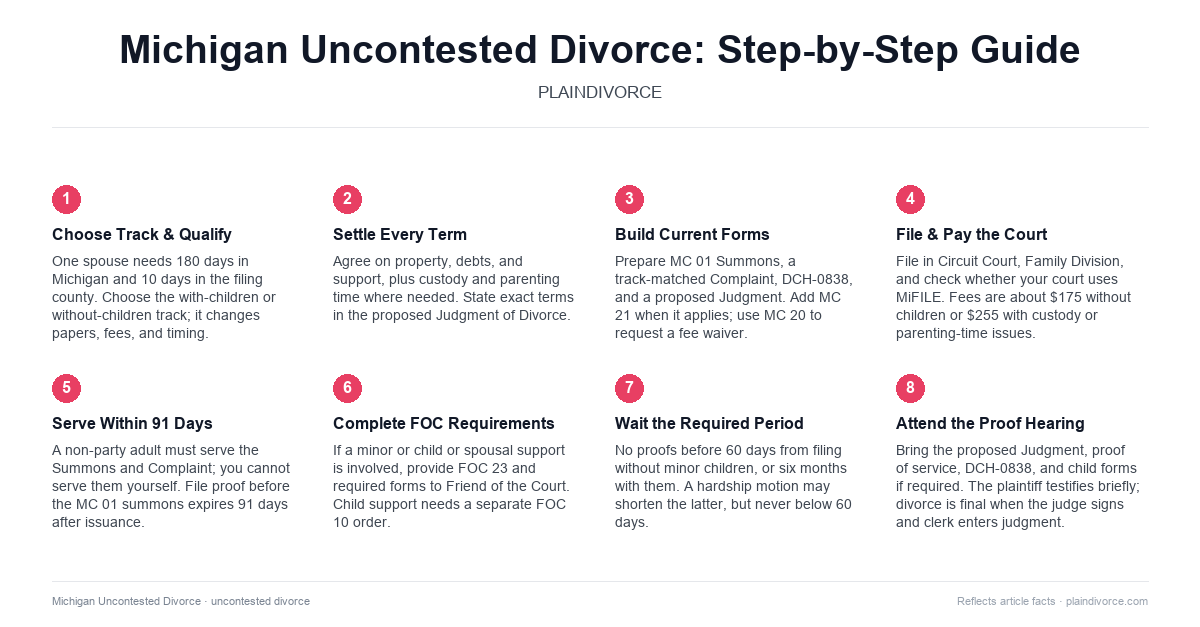
4. Step-by-Step: The Uncontested Divorce Process in Michigan
Local practice varies by county, but the skeleton is the same everywhere.
Step 1 — Choose your track: with minor children or without
Do this before you write a word. The track determines your proof restriction (60 days or 6 months), which version of the Complaint for Divorce you use, your fees, and whether the Friend of the Court opens a file. Michigan even assigns different case-type codes: DM for a divorce with minor children, DO for a divorce with none.
Step 2 — Settle every term in writing, in detail
In Michigan, most agreed terms end up inside the Judgment of Divorce itself (child- and spousal-support numbers go on a separate order — see Step 5 and Section 5). Vague language is the number one reason a judge sends a DIY couple home to redo the paperwork. Be specific about:
- The exact parenting-time schedule, holidays, and exchange logistics,
- Who carries health-care coverage and how uninsured costs are divided,
- Which spouse takes which debt, by account, with a deadline for any refinance or transfer,
- How the house is handled — sale, refinance, or transfer — with dates,
- Each spouse’s rights in the other’s pension, retirement accounts, and life insurance (required by MCL 552.101), and
- Whether any retirement account is being divided — that usually needs a separate Qualified Domestic Relations Order (QDRO); the judgment alone does not move the money.
Step 3 — Prepare your forms: is there a Complaint for Divorce Michigan SCAO form?
This trips people up, so here is the direct answer. Michigan uses statewide SCAO-approved forms for most court documents — the summons, the Friend of the Court forms, the fee-waiver request. But there is no single fill-in-the-blank Complaint for Divorce Michigan SCAO form the way there is an MC 01 summons. The complaint is normally generated from a county self-help packet or a guided interview such as Michigan Legal Help’s Do-It-Yourself tools, in a version matched to your track.
So when you search for a “Complaint for Divorce Michigan SCAO form” and come up empty, nothing is wrong — you are looking for a document SCAO does not publish as one universal form. A typical uncontested filing includes:
- Summons (MC 01) — the document that starts the clock on service,
- Complaint for Divorce — separate versions for cases with and without minor children,
- Record of Divorce or Annulment (DCH-0838) — the MDHHS vital-records form the petitioner must file with the petition so the state can register the divorce (MCL 333.2864(3)),
- Confidential Case Inventory (MC 21) — required with the initiating document when you know of any pending or past family-division or tribal-court case involving either of you or a family member; it is confidential and not served (MCR 3.206(A)(3)),
- Judgment of Divorce — the final order the judge signs,
- Fee Waiver Request (MC 20) — only if you cannot afford the filing fee.
Cases with minor children or a custody or parenting-time dispute add more — see Section 5. If custody or parenting time is to be decided, the filing party must also file a UCCJEA Affidavit (MC 416) under MCR 3.206(B) and MCL 722.1209.
Tip: Download every form fresh from the Michigan Courts website the week you file. SCAO revises forms regularly — the Uniform Child Support Order, for instance, carries an 11/25 revision date — and clerks reject outdated revision dates. If your county publishes a packet or checklist, follow it exactly; local cover sheets are a common rejection reason.
Step 4 — File in the Circuit Court, Family Division
Divorce is a Circuit Court matter, filed in the county where you meet the 10-day residency rule. Most Michigan circuit courts are now live on MiFILE, the state e-filing system; once a court is live, attorneys must e-file and self-represented filers may be required or encouraged to. Check your court’s status on the Michigan Courts MiFILE / E-Filing information pages before you drive downtown with paper.
The clerk assigns a case number and the case is assigned to a judge. One privacy point worth knowing: under MCL 552.6a, your Complaint for Divorce is not made available to the public until the proof of service is filed.
Step 5 — Serve your spouse and watch the 91-day summons
Your spouse must be formally served with the summons and complaint. You cannot serve them yourself; service must be made by a legally competent adult who is not a party to the case (MCR 2.103(A)).
Deadline DIY filers miss: the summons expires in 91 days
Under MCR 2.102(D), “a summons expires 91 days after the date the summons is issued.” When you e-file, the summons usually issues the same day the complaint is filed, so people think of it as 91 days from filing — but the date on the summons is what controls. If your spouse has not been served and no proof of service is on file when it expires, the case is dismissed as to that spouse. Within the 91 days, on a showing of due diligence, the judge may order a second summons — but the reliable fix is to serve early.
In a cooperative case there is a cheaper path than a process server: your spouse can sign an acknowledgment or acceptance of service, or simply file an Answer or appearance. Any of these puts them before the court voluntarily. Filing mechanics and the accepted form vary by county, so ask your clerk which method they take and what proof they want on file. Then file your Proof of Service — the case does not move without it.
Once the defendant has been served or has appeared, MCR 3.206(C)(2) generally requires each party to serve a Verified Financial Information Form (CC 320) within 28 days and file a proof of service. It is not filed with the court. That requirement is waived if you both sign a settlement agreement or consent Judgment of Divorce at the time of filing — one reason a genuinely agreed couple benefits from having the judgment ready up front.
Step 6 — Wait out the statutory period
No proofs are taken during this window (60 days, or 6 months with minor children). Use it to finish the judgment, complete the Friend of the Court paperwork if you have children or a support request, and get on the docket.
Step 7 — The final proof hearing (the pro confesso)
Michigan will not grant a divorce on paperwork alone. MCL 552.6(3) requires that evidence of the marriage breakdown be “presented in open court,” which is why even a fully agreed divorce ends with a hearing.
Courts commonly call this a pro confesso hearing — “pro con” for short, from the Latin for “as though confessed.” Strictly, pro confesso describes a case where the defendant never answered and a default was entered. If your spouse did answer and simply agrees, your court may call it an uncontested or consent-judgment hearing instead. It is the same short proof hearing either way.
It is usually brief. The judge or your attorney walks you through a standard set of questions:
- Confirming your Michigan and county residency,
- Confirming the allegations in your complaint were true when you signed it,
- The statutory breakdown sentence, and that there is no reasonable chance of reconciliation,
- Whether there are minor children of the marriage and whether the wife is currently pregnant,
- That you have read and voluntarily approve the proposed judgment, and that the property division is fair.
What to bring: your proposed Judgment of Divorce, the proof of service, the DCH-0838, and — if children are involved — the FOC 100 and a Uniform Child Support Order ready for signature. Some Michigan courts hold these hearings by video; ask when you schedule.
Your divorce is final when the judge signs and the clerk enters the judgment — not when the hearing ends. Order at least two certified copies; you will likely need them for the Secretary of State, Social Security, financial institutions, or an employer.
5. Minor Children: Friend of the Court, Support, and the Verified Statement
When minor children are involved, the Friend of the Court (FOC) office becomes part of your case, administering custody, parenting time, and support. This is where most “uncontested” DIY filings stall — not because anyone is fighting, but because the FOC file is incomplete.
Expect these requirements:
- Verified Statement, Friend of the Court (FOC 23) — under MCR 3.206(C), in an action involving a minor, or where child support or spousal support is requested, the party seeking relief must give the Verified Statement to the Friend of the Court and serve a copy on the other party. It collects identifying details, income, and health-care coverage information. It is the form DIY filers most often forget, and the FOC file does not open without it.
- Uniform Child Support Order (FOC 10) — when child support is ordered, it goes on this standalone SCAO order, not inside the Judgment of Divorce (MCR 3.211(D)). Use FOC 10a only if an order exempting your case from Friend of the Court services has already been entered; otherwise the form itself directs you to FOC 10.
- Domestic Relations Judgment Information (FOC 100) — served on the FOC with the first custody, parenting-time, or support order and again with any final proposed judgment, with a proof of service filed (MCR 3.211(F)).
- UCCJEA Affidavit (MC 416) — filed by the filing party whenever custody or parenting time of a minor is to be determined or modified (MCR 3.206(B); MCL 722.1209).
Two points that surprise people:
- You cannot simply agree to zero child support. Under MCL 552.605, support is set by the Michigan Child Support Formula based on both parents’ incomes and overnights. A court can deviate, but only after putting in writing the formula amount, how the order departs from it, and why the formula result would be unjust or inappropriate — an agreement alone is not enough.
- Support comes with income withholding. Under MCL 552.604, every support order must provide for income withholding, and it takes effect immediately unless the court finds good cause on the record or you file a written alternative-payment arrangement that the court enters. The Uniform Child Support Order builds this in.
If the FOC or the judge finds anything missing — income figures, health-care coverage details, childcare costs, the overnight count, a complete parenting schedule — your hearing gets adjourned until the file is clean.
6. How Long an Uncontested Divorce Takes in Michigan
The statutory wait is the floor. Service and scheduling stack on top, and both depend on your county’s docket.
| Statutory minimum | Common real-world experience | |
|---|---|---|
| No minor children | 60 days from filing | Often a few months, once service and a hearing date are added |
| With minor children | 6 months from filing | Usually six months or more, longer if the FOC file needs work |
What pushes a case toward the long end: delayed or defective service, an expired summons, a missing Verified Statement or FOC 100, a support order that does not match the formula, judgment language the judge will not sign, and county docket backlogs. What keeps it short: serving in the first two weeks, finishing the judgment during the waiting period, and calling the clerk to schedule before you are eligible rather than after.
7. What an Uncontested Divorce Costs in Michigan
Court fees in Michigan are set by statute, so the filing cost is fairly predictable statewide.
| Item | Amount | Authority |
|---|---|---|
| Civil filing fee | $150 | MCL 600.2529(1)(a) |
| Electronic filing system fee (charged whether or not you e-file) | $25 | MCL 600.1986(1)(a) |
| Subtotal — no minor children | $175 | |
| Custody and parenting-time fee | $80 | MCL 600.2529(1)(d)(i) |
| Total — with custody/parenting time | $255 |
Money-saving rule most filers never hear about
Under MCL 600.2529(6), the court shall waive or suspend the $80 custody and parenting-time fee (or the $40 support fee) if the final judgment or order is submitted with the initial filing as a consent judgment or order. That is exactly the posture of a genuinely agreed divorce. Ask your clerk about it when you file.
Beyond the filing fee, budget for:
- Service — a sheriff or process server charges a modest fee; $0 if your spouse signs an acknowledgment of service,
- Certified copies of the Judgment of Divorce — small per-copy fee, and you will usually need more than one,
- Motion fees — $20 each if you file anything mid-case, such as a motion to shorten the 6-month period,
- A QDRO — if you are dividing a retirement plan, it is usually drafted separately and can add a few hundred dollars,
- Local add-on fees — some counties charge a judgment-entry or similar fee; ask before your hearing.
If you cannot afford the fees, file a Fee Waiver Request (MC 20) under MCR 2.002. If the court waives the civil filing fee because you are indigent or unable to pay, it must also waive the $25 electronic filing system fee (MCL 600.1986(3)).
8. Five Mistakes That Delay Michigan DIY Divorces
- Letting the summons expire. Ninety-one days from issuance goes fast when you are avoiding a hard conversation. Serve in the first two weeks.
- Explaining your grounds. MCL 552.6 allows the statutory sentence and nothing else. Extra narrative gets your complaint bounced.
- Burying child support in the judgment. Support needs its own Uniform Child Support Order (FOC 10), and it has to match the state formula.
- Leaving spousal support unaddressed. A silent judgment reserves spousal support (MCR 3.211(B)(4)). State whether it is awarded, reserved, or forever barred.
- Waiting for the clock to run out before scheduling. Ask the clerk about hearing availability early — in busy counties the next opening can be weeks out.
9. When a DIY Divorce Is Not the Right Call
Get legal advice — even a single paid consult — if any of these apply:
- There is domestic violence, stalking, threats, or coercive control. Agreement reached under pressure is not agreement, and you may need a personal protection order alongside the divorce.
- One spouse is hiding assets or income, or will not share financial documents.
- You have complex assets: a business, multiple properties, stock compensation, or pensions requiring a QDRO.
- There is any real dispute about custody, relocation out of Michigan, or child safety.
- Immigration status, an active or looming bankruptcy, or significant tax consequences are in the picture.
- Your spouse is on active military duty, or you cannot locate your spouse at all.
Michigan also has Friend of the Court dispute-resolution services and county self-help centers. A consult is not a commitment to a large retainer — many family lawyers will review a proposed judgment for a flat fee.
10. Where a Self-Help Divorce Kit Fits
Michigan gives you the forms — through the SCAO forms library, county packets, and Michigan Legal Help’s free Do-It-Yourself tools. What those do not give you is the sequence: which packet, in what order, what the judge will actually ask, and what the Friend of the Court needs before it signs off.
A Michigan-specific self-help kit helps you:
- Pick the correct track and the correct forms the first time,
- Track the 60-day, 6-month, and 91-day deadlines on one calendar,
- Complete the Friend of the Court requirements — the Verified Statement (FOC 23), FOC 10, and FOC 100 — without a rejection round-trip,
- Start from a Judgment of Divorce Michigan template that already covers the clauses judges look for — custody, parenting time, the spousal-support election, property and debt by name, and the MCL 552.101 insurance and retirement provisions — and
- Walk into your pro confesso hearing with a clean, internally consistent package and know what you will be asked.
Get the Michigan Uncontested Divorce Self-Help Kit
Our kits are not legal advice and cannot guarantee a result. They give you structure, checklists, and plain-English guidance for an agreed Michigan case. If your situation is on the list in Section 9, see a lawyer first.
11. Frequently Asked Questions
Can we get divorced in Michigan without going to court at all?
Almost never. MCL 552.6(3) requires evidence of the marriage breakdown to be presented in open court, so at least the filing spouse normally appears at a short hearing. Some courts allow that appearance by video, which is the closest Michigan gets to a no-courtroom divorce. A pure paperwork-only divorce is not available.
How long is the divorce waiting period in Michigan?
Under MCL 552.9f, no proofs or testimony may be taken until 60 days after you file if you have no minor children, or 6 months after you file if you have dependent minor children under 18. The 6-month period can sometimes be shortened on a motion showing unusual hardship or compelling necessity, but never to earlier than 60 days. Agreeing with your spouse does not shorten either period.
Does my spouse have to appear at the hearing?
Usually not. In a typical uncontested case only the plaintiff testifies, and the defendant’s signature on the judgment is what the court needs from them. Confirm with your court, since some judges prefer both parties present when minor children are involved.
Can my spouse stop the divorce by refusing to sign?
No. Michigan is no-fault, and the court decides whether the marriage has broken down regardless of whether your spouse agrees. If your spouse is served and never answers, you proceed by default. Refusing to participate slows the case down; it does not prevent a divorce.
Is there a Complaint for Divorce Michigan SCAO form?
Not as a single universal form. SCAO publishes the MC 01 summons, the fee-waiver request, and the Friend of the Court forms, but not one fill-in-the-blank Complaint for Divorce. The complaint is drafted from a county self-help packet or a guided interview such as Michigan Legal Help’s Do-It-Yourself tool, in a version matched to whether you have minor children. If your search comes up empty, that is expected.
Is there an official Judgment of Divorce Michigan template?
There is no single statewide fill-in JOD form, but Michigan Legal Help runs a free statewide Do-It-Yourself Judgment of Divorce interview that generates the judgment and the forms that go with it. Some counties also publish a sample. Whatever Judgment of Divorce Michigan template you start from, it must state custody and parenting time, address spousal support explicitly (awarded, reserved, or forever barred), divide property and debts by name, cover the MCL 552.101 insurance and retirement provisions, and — if there are minor children — be paired with a separate Uniform Child Support Order.
What is the Verified Statement for the Friend of the Court?
The Verified Statement (FOC 23) is an SCAO form the party seeking relief must file with the Friend of the Court, and serve on the other party, in any action involving a minor or a request for child or spousal support (MCR 3.206(C)). It provides each person’s identifying details, income, and health-care coverage information so the FOC can set up the support and enforcement file. A missing Verified Statement is a common reason an otherwise agreed case stalls.
What is a pro confesso hearing?
It is the short final hearing in an uncontested Michigan divorce. The filing spouse testifies briefly to residency, the statutory breakdown of the marriage, and approval of the proposed judgment, and the judge then signs the Judgment of Divorce. Courts also call it an uncontested or consent-judgment hearing. The divorce is final when the judgment is signed and entered, not when the hearing ends.
Do we have to split everything 50/50?
No. Michigan requires an equitable division, which often looks roughly equal but does not have to be. In an uncontested case the judge will generally approve what you agreed to, as long as it is not obviously one-sided and both of you understood it.
When can I remarry?
Once the Judgment of Divorce is entered, you are divorced and free to remarry. Michigan has no additional waiting period to remarry — but get certified copies of the judgment first, because you will need proof.
12. Final Thoughts and Next Steps
Michigan’s no-fault system means you do not have to prove anyone did anything wrong. It does not mean the process is casual. The rules are procedural, rigid, and enforced by clerks who see hundreds of filings a week.
If you remember four things about an uncontested divorce in Michigan:
- Pick your track early — 60 days with no minor children, 6 months with dependent minor children under 18.
- Serve your spouse fast; the summons expires 91 days after it is issued.
- If children or support are involved, the Friend of the Court file — starting with the Verified Statement — has to be complete before a judge will sign.
- Expect a short pro confesso hearing at the end, and show up with a clean judgment in hand.
Get those right and an uncontested Michigan divorce is a calmer, cheaper, and far more predictable way to move on. If you want the sequence mapped out for you, the Michigan Uncontested Divorce Self-Help Kit is built for exactly this.
Sources and further reading
- MCL 552.6 — Complaint for divorce; grounds; open-court proof
- MCL 552.6a — Complaint not public until proof of service is filed
- MCL 552.9 — Residency requirement
- MCL 552.9f — Waiting period before proofs may be taken
- MCL 552.101 — Insurance and retirement provisions in a divorce judgment
- MCL 552.604 — Income withholding in support orders
- MCL 552.605 — Child support formula and deviation findings
- MCL 600.2529 — Circuit court fees; consent-order fee waiver
- MCL 333.2864 — Report of divorce (DCH-0838) filing duty
- MDHHS — Record of Divorce or Annulment (DCH-0838)
- Michigan Legal Help — Do-It-Yourself Judgment of Divorce
- Michigan Courts — MiFILE e-filing information
Sources and local rules can change. Use this guide as a plain-English organizer, then verify the current filing requirements with the official court or government source for your jurisdiction.

About Harry D
Expert contributor at PlainDivorce, helping Canadians and American navigate simple uncontested divorces with clarity and confidence.