Uncontested Divorce in Mississippi: The Irreconcilable Differences Guide (2026)
An uncontested divorce in Mississippi means both spouses agree to end the marriage on the ground of irreconcilable differences and sign a written agreement settling property, debts, and anything involving the children. The complaint must sit on file for 60 days before a chancellor can act, one spouse must have lived in Mississippi for six months, and the case is filed in Chancery Court. Because Mississippi has no one-sided no-fault divorce, your spouse has to cooperate for this path to work.
Mississippi is a genuinely tricky state to divorce in, and most people learn that the hard way: rejected paperwork, or a chancellor sending them home from a hearing. The rules are knowable, though. This guide covers the Irreconcilable Differences divorce requirements in MS in plain English, walks the process step by step, explains where the Mississippi divorce forms actually come from, and flags the specific mistakes that stall do-it-yourself filings.
TL;DR: Uncontested Divorce in Mississippi
The whole guide in seven bullets
- Both spouses must agree. Mississippi has no unilateral no-fault divorce. If your spouse will not participate, irreconcilable differences is off the table and you are looking at fault grounds.
- Six months of residency. At least one spouse must have been an actual, bona fide Mississippi resident for six months before filing.
- You need a complete written agreement. A signed settlement agreement covering property, debts, and any children is what the chancellor reviews and folds into the judgment. The court must find its terms “adequate and sufficient.”
- 60 days minimum. The complaint must be on file 60 days before the court can hear it. It cannot be shortened or waived.
- Rule 8.05 financial disclosure is an exchange between the spouses, not a form you drop in the court file. Each side gives the other a detailed statement plus tax returns, then files a Certificate of Compliance.
- New for custody (July 1, 2026). HB 1662 creates a rebuttable presumption of joint custody with equal parenting time in initial custody orders. A fully agreed parenting plan rebuts it, but the chancellor still applies the best-interest standard.
- Often no hearing. A properly filed, fully agreed irreconcilable-differences case can be “taken as proved” and finalized on the paperwork, though some chancellors still set a short appearance.
Hard numbers: 60-day statutory floor from filing, and about $140 in statutory filing components before process fees and any local charge. Everything else — total timeline, whether there is a hearing — depends on your chancery district. Confirm the current fee with your Chancery Clerk.
1. What an Uncontested Divorce Actually Means in Mississippi
Every Mississippi divorce goes through Chancery Court, and the judge is called a chancellor. You start the case by filing a Complaint for Divorce with the Chancery Clerk in the correct county. There is no separate “family court” in Mississippi; chancery handles divorce, custody, and support.
Bill of Complaint for Divorce in Mississippi: still the right name?
You will still hear Mississippi lawyers, clerks, and form packets say Bill of Complaint for Divorce, and plenty of people search for it that way. It is a holdover from chancery practice before the Mississippi Rules of Civil Procedure. The statute and the rules both say complaint.
Practically, clerks understand the older phrase and the current term interchangeably. But Complaint for Divorce, or Joint Complaint for Divorce when both spouses file together, is the modern label and the one you will see if you go read the statute.
When people say “simple” or “uncontested” divorce in Mississippi, they almost always mean a divorce on the ground of irreconcilable differences, Mississippi’s no-fault option under Miss. Code § 93-5-2. “Uncontested” means neither spouse is fighting the divorce and you have agreed on the substantive issues, so the chancellor does not have to decide them for you.
What agreeing has to cover
- Ending the marriage on irreconcilable differences (both spouses must consent)
- Property and debts: who keeps what, who pays what
- Alimony, if any, or a clear waiver of it
- If you have minor children: custody, parenting time, child support, and health insurance
Section 93-5-2 does not require the agreement to carry a particular title. It has to be a written agreement that provides for the custody and maintenance of any children and settles the property rights between you, with terms the court can find adequate and sufficient. Most people put all of that in one document and call it a Property Settlement Agreement.
The middle path most guides skip
Mississippi allows something between “fully agreed” and “full-blown fault trial.” Under § 93-5-2(3), spouses who agree the marriage is over but cannot agree on one or two issues can sign a written consent letting the chancellor decide only those specific issues. The consent must be signed personally by both parties, must identify the issues being submitted, and must state that the court’s decision will be a binding and lawful judgment.
This is a real option if you are stuck on, say, who keeps the house. It is not a do-it-yourself project, though. Once the court starts hearing the matter you cannot withdraw that consent without the court’s permission, and you are handing a chancellor the power to decide a major part of your financial life or your parenting schedule. Talk to a lawyer before going this route.
2. Irreconcilable Differences Divorce Requirements in MS: Residency, Venue, and Consent
2.1 Residency: six months, and it has to be genuine
Under Miss. Code § 93-5-5, at least one spouse must have been an actual bona fide resident of Mississippi for six months immediately before the case is filed.
- “Bona fide” means real domicile, not just a mailing address. If the proof shows a residence was acquired in Mississippi in order to get a divorce here, the statute directs the court to decline jurisdiction and dismiss the case at the filer’s cost.
- Military exception: a servicemember stationed in Mississippi and residing here with their spouse counts as a bona fide resident, provided they were residing in the state when the parties separated.
2.2 Venue: which county
Miss. Code § 93-5-11 gives irreconcilable-differences cases their own venue rule, and it is friendlier than the rule for fault divorces:
- Both spouses live in Mississippi: file in the county where either one of you resides.
- Only one spouse lives in Mississippi: file in the county where the Mississippi resident lives.
Fault-based divorces follow a different and stricter rule tied to where the defendant lives or where the parties last lived together, so do not rely on general “where to file for divorce” advice for an irreconcilable-differences case.
2.3 Consent: the requirement that stops most people
Mississippi is one of the few states with no unilateral no-fault divorce. Your spouse has to be on board. And § 93-5-2 goes further: a court cannot grant an irreconcilable-differences divorce where there has been a contest or denial, unless the contesting party withdraws it by leave of court.
Practical warning: consent can evaporate
A spouse who has signed a settlement agreement can still change course before the judgment is entered. That is one reason Mississippi practitioners push to get the paperwork complete and the case in front of the chancellor promptly once the 60 days runs. Momentum matters.
2.4 A quick self-check
You are likely a good fit for the uncontested path if all of these are true:
- One of you has lived in Mississippi for at least six months.
- Both of you want the divorce and will sign paperwork.
- You can write down who gets what, who owes what, and what happens with the kids, without a fight.
- You both have a clear picture of the other’s income, accounts, and debts.
- There is no fear, pressure, or safety issue in the room when you talk about it.
3. The Three Legal Ways to Start the Case
This is where a lot of do-it-yourself filings go wrong. Section 93-5-2 allows an irreconcilable-differences divorce to be “taken as proved” in exactly three situations. Pick one deliberately.
| Route | How it works | Best when |
|---|---|---|
| Joint complaint | Both spouses sign and file the complaint together as joint plaintiffs. No service of process needed. | You are cooperating and both available to sign. Cleanest and cheapest option. |
| Personal service | One spouse files; the sheriff or a process server personally serves the other with the summons and complaint. | Your spouse agrees to the divorce but will not sign the complaint or a waiver. |
| Written waiver of process | One spouse files; the other signs a written Entry of Appearance and Waiver of Process. | Your spouse will sign, but you want a single filer on the paperwork. |
The waiver timing trap
Under Mississippi Rule of Civil Procedure 4(e), a waiver of process must be executed after the day the complaint is filed. A waiver your spouse signed last week, or on the same day you walked the complaint into the clerk’s office, can be treated as ineffective.
The waiver also has to be in writing, dated, and either sworn or acknowledged (notarized), or have the signature proven by two witnesses before someone authorized to administer oaths. A plain signature on a printed form is not enough. It then has to be filed and noted on the docket.
If one spouse files alone and does not use a waiver, Rule 4(h) gives you 120 days from filing to serve the other spouse. Miss that window without good cause and the court dismisses the case without prejudice, and you start over.
The safe sequence for a single-filer case: file first, get the file-stamped copy, then have your spouse sign the waiver in front of a notary, then file the waiver.
4. The Two Documents That Decide Everything: Settlement Agreement and Rule 8.05
4.1 The Property Settlement Agreement
Section 93-5-2 is the whole ballgame for an agreed divorce. If the parties provide by written agreement for the custody and maintenance of any children and for the settlement of property rights between them, and the court finds those provisions adequate and sufficient, the agreement may be incorporated into the judgment and later modified like any other divorce judgment.
Read that again: the chancellor is not rubber-stamping. The court has to affirmatively find your agreement adequate and sufficient. An agreement that is vague, incomplete, or internally contradictory gives the chancellor a reason to send you back.
Your agreement should leave no open questions on:
- Real property: who keeps the house, who refinances and by when, who signs the deed, who pays the mortgage in the meantime
- Vehicles: title transfers, remaining loans, insurance
- Accounts and retirement: bank accounts, 401(k)s, pensions, IRAs (dividing an employer retirement plan usually needs a separate qualified domestic relations order)
- Debts: each credit card, loan, and tax liability assigned to one spouse by name
- Personal property: at minimum, a clean catch-all provision
- Alimony: amount, duration, and modifiability, or an express waiver by both parties
- Children: legal and physical custody, a dated parenting-time schedule, child support, health insurance, uninsured medical costs, and how the tax dependency is claimed
Section 93-5-2 itself does not spell out how the agreement must be signed. In practice, the self-help instructions published by the Mississippi Access to Justice Commission use notarized signatures, and many chancellors expect an acknowledged agreement. Sign it in front of a notary, and confirm your district’s expectation with the clerk. Vague language like “the parties will divide the furniture fairly” reads fine at the kitchen table and causes a contempt motion two years later.
Using a Property Settlement Agreement Mississippi template
Mississippi courts do not publish an official statewide settlement-agreement form, so most people start from a Property Settlement Agreement Mississippi template. That is a reasonable starting point, with two cautions.
- Check that it is written for Mississippi. Generic multi-state templates often reference community property, waiting periods, or filing steps that do not exist here. Mississippi is an equitable-distribution state, and its 60-day rule and consent requirement are unusual.
- Delete nothing you do not understand, and leave nothing blank. A template with an unaddressed retirement clause or an empty parenting-time schedule is exactly the incomplete agreement a chancellor sends back.
Treat the template as a checklist of things you must decide, not as a document that is finished once you fill in your names.
4.2 The Rule 8.05 financial disclosure
Uniform Chancery Court Rule 8.05 (rules revised and amended effective April 18, 2024) applies to each party in a domestic case involving economic issues or property division. It is widely misunderstood, so here is what it actually requires.
- It is a disclosure to the other side, not a court filing. Each party gives the other party or their attorney a detailed written statement of actual income and expenses and all marital and nonmarital assets and liabilities, in substantially the form of Rule 8.05 Form 1.
- Tax returns come with it. Copies of the preceding year’s federal and state income tax returns as filed, or W-2s if the return has not been filed yet, plus a statement of employment history and earnings.
- You file a Certificate of Compliance. After providing the statement, the party files that certificate with the Chancery Clerk. The financial statement itself goes into the record only if the court orders it or a local rule requires it.
- Timing. The plaintiff discloses by the earlier of the temporary-relief hearing or the date the answer is due. The defendant discloses by the appearance or answer date, but no later than 45 days from the filing of the commencing pleading.
- It can be excused or waived. The court can excuse it by order, or the parties can waive it — by either or both parties — if the court allows. Some chancellors routinely allow a waiver in a fully agreed case; others do not.
- Ongoing duty to supplement if your numbers change, and options to file documents with personal identifiers under seal or through a sealed reference list.
Two things people get wrong: the statement carries the weight of sworn testimony, so material omissions can support a contempt finding and can unravel a property division later; and if you are paid weekly, do not multiply by four — multiply by 52 and divide by 12, or your monthly income is understated.
Call your Chancery Clerk and ask two questions: does this district require Rule 8.05 disclosures in an agreed irreconcilable-differences case, and does the district use a specific form or accept a written waiver? Those two answers will save you a trip.
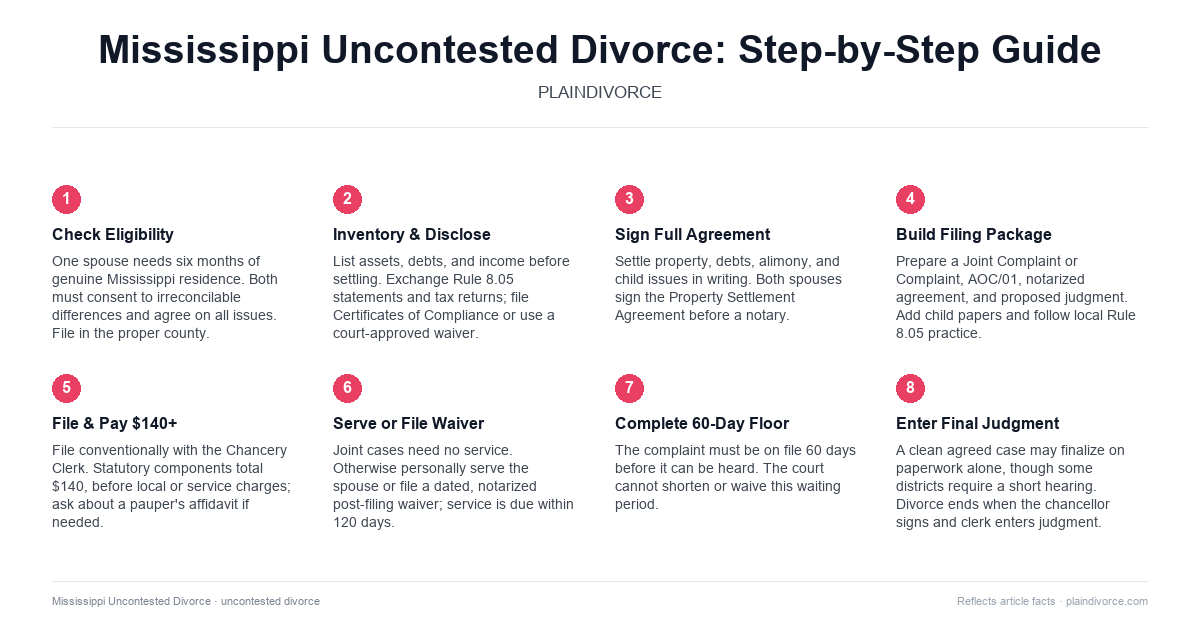
5. Step-by-Step: Filing in Chancery Court
Step 1 – Confirm eligibility and pick your filing route
Verify six-month residency, confirm your spouse consents, choose the right county, and decide between joint complaint, personal service, or waiver. Doing this before you draft anything prevents most rework.
Step 2 – Inventory everything, then negotiate
List every asset, every debt, and every account before you start dividing. Most unfair settlements come from someone not knowing what existed, not from someone being outmaneuvered. Filling out your Rule 8.05 statement first is a useful forcing function here.
Step 3 – Draft and sign the settlement agreement
Both spouses sign in front of a notary. If you are not sure the deal is fair, or you do not understand a term’s long-term effect, this is the single best place to spend money on an hour of a lawyer’s time.
Step 4 – Assemble the filing package
- Joint Complaint for Divorce (or a Complaint plus your service or waiver plan)
- Civil Case Filing Form (AOC/01), the statewide cover sheet the clerk uses to open and report the case; if child support is contemplated, it routes you to provide child-support information
- Property Settlement Agreement, signed and notarized
- Rule 8.05 disclosures exchanged between the spouses, plus each party’s Certificate of Compliance — or the waiver your district accepts
- Proposed Final Judgment of Divorce for the chancellor to sign
- For cases with children: any child-support worksheet or information sheet the district wants, an income-withholding order if the chancellor requires one, and a parenting-class certificate where the district requires it
There is no single statewide uncontested-divorce packet in Mississippi. Local practice genuinely varies, particularly on Rule 8.05 handling and child-support paperwork. Ask the clerk what this district expects before you finalize the package.
Where to find Mississippi divorce forms (PDF)
This is the part that frustrates people most. Mississippi has no official state-issued do-it-yourself divorce packet that covers every situation, so searching for Mississippi divorce forms PDF turns up a mix of official court documents, individual chancery-district forms, and commercial products. Here is how to tell them apart.
- Official and statewide: the Civil Case Filing Form (AOC/01) from the Administrative Office of Courts. It is genuinely uniform across Mississippi.
- Official self-help resources: the Mississippi Access to Justice Commission, working with the University of Mississippi School of Law, publishes a free irreconcilable-differences divorce instruction sheet, a Rule 8.05 financial statement form, Rule 4 and Rule 81 summonses, and an automated online interview (hosted on LawHelp Interactive) that generates a divorce packet. That automated packet is limited to cases with no minor children and no property.
- Official but local: some chancery districts post their own Rule 8.05 form or a local waiver. Check the local chancery rules directory on the state judiciary site, then the district’s own page.
- No official fill-in version: for cases with children or property, the complaint, the settlement agreement, the waiver, and the proposed judgment have no statewide fill-in-the-blank form. Every PDF you find for those comes from a law firm, a self-help publisher, or a form vendor.
Two rules of thumb: be skeptical of any “Mississippi divorce forms PDF” that is not clearly built for Mississippi chancery practice, and always call your Chancery Clerk to confirm which forms your district actually wants before you fill anything out.
Step 5 – File with the Chancery Clerk
Submit the package to the Chancery Clerk in the proper county and pay the filing fee. The clerk opens the case and assigns a cause number.
Note on “online divorce”: a new civil case is initiated conventionally — the complaint and cover sheet are filed in person or by mail. In courts that have implemented the Mississippi Electronic Courts (MEC) system, later documents may be filed electronically, but the opening complaint is not e-filed. Services that advertise a fully online Mississippi divorce are selling you document preparation, not electronic filing.
Step 6 – Handle service or the waiver
If you filed jointly, there is nothing to do here. If one spouse filed, either get the other personally served or get a properly dated, notarized waiver signed after the filing date and file it. Remember Rule 4(h): absent good cause, a defendant not served within 120 days of filing is dismissed without prejudice. Missing or defective service paperwork is one of the most common reasons an agreed case sits.
Step 7 – Wait out the 60 days
Use the time. Confirm every document the court needs is actually in the file — the signed agreement, the certificates of compliance or the waiver order, the proposed judgment — not sitting in your folder at home.
Step 8 – Get the judgment entered
Section 93-5-2 says that a joint complaint, or one where the defendant was personally served or entered a written waiver, for divorce solely on irreconcilable differences “shall be taken as proved and a final judgment entered thereon… without proof or testimony in termtime or vacation.”
In plain terms: a clean, fully agreed case can often be finalized on the paperwork alone, with no court appearance. Whether that happens in your case depends on your chancellor and district — some set a brief hearing anyway, particularly where children are involved, and some do a “desk review” of the file. Ask the clerk how your district handles it.
Once the chancellor signs and the clerk enters the Final Judgment of Divorce, you are divorced. Order certified copies right away. You will need them for name changes, benefits, refinancing, and a future marriage license.
6. The 60-Day Waiting Period Explained
How the 60 days actually works
Section 93-5-2: complaints for divorce on the ground of irreconcilable differences must have been on file for sixty (60) days before being heard. The clock runs from the filing date, not from your separation date, not from the day you agreed to divorce. Courts cannot shorten or waive it.
- Day 0: Complaint filed with the Chancery Clerk. Clock starts.
- Days 1–59: Get the waiver (if any) signed and filed. Exchange the Rule 8.05 disclosures and file the certificates, or get the waiver approved. Confirm the signed agreement is in the file.
- Day 60 onward: The case can be heard or, in a clean agreed case, submitted for entry of judgment.
Sixty days is a floor, not a schedule. A case with missing paperwork on Day 60 does not finalize on Day 60.
7. What Changes When You Have Children (Including the 2026 Custody Law)
Parental agreement does not bind the chancellor on child issues. The court applies the best interests of the child standard and can reject terms it considers inadequate, even when both parents signed.
New: HB 1662, effective July 1, 2026
Mississippi added a rebuttable presumption that joint custody with equally shared parenting time is in the child’s best interest, amending Miss. Code § 93-5-24. It applies only to initial temporary and final custody orders entered after July 1, 2026 — not to modifications of earlier orders.
The presumption is rebutted, among other ways, when the parents have reached an agreement on all custody issues. So a fully agreed parenting plan does not force a 50/50 split — but the chancellor still reviews the plan against the best-interest standard. A court that does not order equal time has to document its reasons, unless both parents petition for a different arrangement.
HB 1662 also adds a child-support method for equally shared parenting time: run the § 43-19-101 guideline for each parent as if that parent were the payor, then the higher-income parent pays the difference between the two figures to the lower-income parent (unless the court finds a deviation is in the child’s best interest).
Two areas draw the most scrutiny in an agreed case:
- Child support. Under Miss. Code § 43-19-101, guideline support is a rebuttable presumption set as a percentage of the paying parent’s adjusted gross income: 14% for one child, 20% for two, 22% for three, 24% for four, and 26% for five or more. If your agreed number departs from the guideline, the court has to make a written finding explaining why. The court also makes a separate written finding on reasonableness when adjusted gross income is below $10,000 or above $100,000. A missing or sloppy Rule 8.05 statement causes real trouble here, because the court cannot check the math.
- The parenting-time schedule. “Reasonable visitation as the parties agree” is a common do-it-yourself choice and a weak one: it is hard to enforce precisely because it is not specific. Put dates and times in writing — the regular schedule, holidays, summer, birthdays, transportation, and who does the exchanges and where. A detailed schedule is easier for a court to enforce if the relationship sours.
Also address health insurance (who carries it, who pays the premium), how uninsured medical expenses are split, and how the two of you will communicate about school and emergencies. Child-support orders in Mississippi also carry income-withholding requirements under Miss. Code § 93-11-103; ask the clerk whether your district wants an income-withholding order entered with the judgment.
Some chancery districts require divorcing parents to complete a parenting or co-parenting class before the judgment is entered. Ask your clerk early, because class availability can add weeks.
8. How Long It Takes
The only hard number is the statutory floor: 60 days on file before the case can be heard. Everything around it varies.
| Stage | What controls it |
|---|---|
| Reaching agreement and drafting the settlement | Entirely up to you and your spouse |
| Statutory waiting period | 60 days from filing, non-negotiable |
| Getting the judgment signed and entered | Your chancellor’s docket and whether a hearing is set |
There is no reliable statewide statistic for total disposition time, so anyone who quotes you a precise range is guessing. The practical levers you control are how fast you finish a complete, accurate package and how promptly you submit it after Day 60. Ask your Chancery Clerk how the local chancellors are currently handling agreed divorces.
Remember the six-month residency requirement sits before all of this. If you recently moved to Mississippi, your real timeline starts when your six months is up.
9. What It Costs
The main hard cost is the Chancery Court filing fee. Miss. Code § 25-7-9 (the version in effect through December 31, 2027) sets the statutory components for a civil filing:
| Component | Amount |
|---|---|
| Base civil-case fee to the chancery clerk | $85.00 |
| Civil Legal Assistance Fund fee | $5.00 |
| Comprehensive Electronic Court Systems Fund fee | $10.00 |
| Judicial System Operation Fund fee | $40.00 |
| Statutory components | $140.00 |
On top of that, you may owe an actual process-service charge and any local assessment the county is authorized to add, so the number on the check is usually somewhat higher than $140. Fees change over time and by county — confirm the current total with your Chancery Clerk before you file.
Other costs you may hit:
- Service of process, if your spouse will not sign a waiver (sheriff or private process server)
- Notary fees for the settlement agreement and the waiver
- Certified copies of the final judgment — the statute sets a $1 certification fee per filed document, with copy charges and local practice on top
- Parenting class, where the district requires one
- Deed preparation or a QDRO, if you are transferring real estate or splitting a retirement plan. Budget for these; they are commonly overlooked and usually need a professional.
If the filing fee itself is out of reach, ask the clerk about filing a pauper’s affidavit to proceed without prepayment of costs. Whether it is granted is up to the chancellor.
A contested Mississippi divorce with lawyers on both sides costs far more — often many thousands of dollars — because the expense scales with the fight. Cooperation is the biggest cost lever you control.
10. Seven Mistakes That Get Mississippi Filings Rejected
- A waiver signed before the complaint was filed. Rule 4(e) requires it to be executed after the case is commenced. File first, then sign.
- An unsworn waiver. It must be dated and either sworn or acknowledged, or the signature proven by two witnesses. Get it notarized.
- An incomplete settlement agreement. The chancellor has to find the terms adequate and sufficient. Silence on debts, retirement, or a parenting-time schedule invites a rejection.
- Skipping Rule 8.05 without a waiver on the record. Assuming your district excuses the disclosure because everyone agrees is a common and costly guess. Exchange the statements and file the certificates, or get the waiver approved.
- Counting the 60 days from the wrong date. It runs from filing, not separation, not service.
- Wrong county. Irreconcilable differences has its own venue rule under § 93-5-11; do not use the fault-divorce rule.
- Missing the AOC/01 cover sheet, the child-support information the cover sheet calls for, or a local form the district requires. One phone call to the clerk avoids this.
11. When DIY Is Not the Right Call
Doing it yourself saves real money, and for a lot of couples it is the sensible choice. It is the wrong choice when:
- There is domestic violence, stalking, threats, or you are afraid of your spouse
- You are being pressured to sign something you do not understand or have not read
- You suspect hidden income or assets, or you cannot get access to financial records
- There is a business, professional practice, pension, or significant retirement account in the mix
- Immigration status, bankruptcy, military benefits, or major tax consequences are involved
- Your spouse will not cooperate at all, which means irreconcilable differences is unavailable and you are looking at fault grounds
PlainDivorce provides legal information and self-help tools only. We cannot tell you whether a settlement is fair to you or what you should accept. If you are unsure about your rights or your safety, contact a Mississippi family-law attorney or a legal aid office before you sign or file anything. Many attorneys offer a flat-fee consultation to review a settlement agreement, which is a fraction of the cost of fixing a bad one later.
12. Where a Self-Help Kit Fits In
A delayed uncontested Mississippi divorce usually comes down to the same thing: something was missing, mis-dated, or too vague. Not a legal fight, just paperwork.
Our Mississippi kit is built around that problem. It helps you:
- Work through the Chancery Court process in the right order, with the right terminology
- Find and organize the Mississippi divorce forms your chancery district actually wants, instead of guessing from a generic PDF
- Build a complete Property Settlement Agreement for Mississippi, with prompts for the clauses templates usually leave blank
- Inventory property, debts, and accounts so nothing gets left out of your agreement
- Track the sequence that trips people up: file, then sign the waiver, then notarize, then file the waiver
- Prepare for the Rule 8.05 disclosure instead of scrambling the week of your hearing
- Stay on schedule through the 60-day period and finalization
Get the Mississippi Uncontested Divorce Self-Help Kit
The kit is not a substitute for a lawyer and is not a guarantee of court approval. It is structure and clarity for an uncontested divorce in Mississippi where both spouses are cooperating.
13. Frequently Asked Questions
Can I get a divorce in Mississippi if my spouse will not sign?
Not on irreconcilable differences. That ground requires mutual consent, and the court cannot grant it where there is a contest or denial unless the objection is withdrawn by leave of court. Without your spouse’s cooperation you would need to prove one of Mississippi’s fault grounds, which is a contested case and generally requires an attorney.
Do I have to go to court for an uncontested divorce in Mississippi?
Often, no. Section 93-5-2 allows a properly filed, fully agreed irreconcilable-differences case to be taken as proved and a final judgment entered without proof or testimony. Whether that happens is up to your chancellor and district: some finalize on the paperwork, some do a desk review, and some set a short appearance, especially when children are involved. Ask your Chancery Clerk what your district does.
What is the waiting period for divorce in Mississippi?
Sixty days. Section 93-5-2 requires a complaint for divorce on the ground of irreconcilable differences to be on file for 60 days before it can be heard. The clock runs from the filing date, not from your separation date. It cannot be shortened or waived, even with total agreement and perfect paperwork.
Where do I file for divorce in Mississippi?
In Chancery Court. For a divorce based solely on irreconcilable differences, § 93-5-11 says you file in the county where either spouse resides if you are both Mississippi residents, or in the resident spouse’s county if only one of you lives here. Fault-based divorces follow a different, stricter venue rule, so do not rely on general divorce advice.
Do I need a Property Settlement Agreement in Mississippi?
For a fully agreed irreconcilable-differences divorce, you need a complete written agreement resolving property rights and the custody and maintenance of any children. Section 93-5-2 lets the court incorporate it into the judgment once it finds the terms adequate and sufficient. It does not have to be titled “Property Settlement Agreement,” but that is the usual format, and without a complete written agreement there is nothing for the chancellor to approve.
Do we both have to file a Rule 8.05?
Rule 8.05 applies to each party in a domestic case involving economic issues or property division, but it is a disclosure exchanged between the spouses, followed by a Certificate of Compliance filed with the clerk — not the statement itself dropped in the court file. The court can excuse it by order, or either or both parties can waive it if the court allows. Many chancellors do not allow a waiver. Check your district’s practice and preferred form with the clerk.
Can I file for divorce online in Mississippi?
You can prepare documents online, and the Mississippi Access to Justice Commission offers a free automated interview for simple cases with no children and no property. But a new civil case is initiated conventionally: the complaint and cover sheet are filed with the Chancery Clerk in person or by mail, with the filing fee. In courts using the MEC system, later documents may be filed electronically.
What if we agree on everything except one issue?
Section 93-5-2(3) lets you consent in writing to a divorce on irreconcilable differences while asking the chancellor to decide the specific issues you cannot resolve. The consent must be signed personally by both spouses, must identify those issues, and must acknowledge the court’s decision will be binding. Get legal advice before using this route.
Where do I get Mississippi divorce forms in PDF?
The AOC/01 Civil Case Filing Form is statewide and official. The Mississippi Access to Justice Commission publishes a free irreconcilable-differences instruction sheet, a Rule 8.05 form, summonses, and an automated packet for cases with no children and no property. For a case with children or property, there is no official statewide fill-in complaint, settlement agreement, waiver, or judgment — those PDFs come from private publishers. Confirm with your Chancery Clerk which versions your district accepts.
Is there an official Property Settlement Agreement template for Mississippi?
Mississippi courts do not publish a standalone settlement-agreement form. A Property Settlement Agreement Mississippi template can be a useful starting point, but make sure it is written for Mississippi law rather than a generic multi-state form, and fill in every section. The chancellor has to find your agreement adequate and sufficient, and blanks or boilerplate that does not match your situation are a common reason cases get sent back.
Do I file a Bill of Complaint for Divorce in Mississippi?
You will see the phrase Bill of Complaint for Divorce used in Mississippi all the time, and clerks understand it. It is an older chancery term. The statute and the Mississippi Rules of Civil Procedure use Complaint for Divorce, or Joint Complaint for Divorce when both spouses file together.
Does the 2026 joint-custody law affect our agreed parenting plan?
HB 1662 (effective July 1, 2026) creates a rebuttable presumption of joint custody with equally shared parenting time in initial custody orders. When parents agree on all custody issues, that agreement rebuts the presumption, so you are not forced into a 50/50 schedule. The chancellor still reviews your plan under the best-interest standard and can ask for changes. The presumption does not apply to modifications of custody orders that already exist.
How soon can I remarry?
Mississippi sets no statutory waiting period to remarry once the final judgment is entered. If there is any chance either spouse will appeal, wait until the 30-day appeal window closes. Get certified copies from the Chancery Clerk, since you will typically need one to obtain a new marriage license.
14. Next Steps
If you want the uncontested route in Mississippi, work the process the way the Chancery Court does:
- Confirm the basics first: six months of residency, mutual consent, correct county.
- Make the agreement complete. The chancellor must find it adequate and sufficient before it goes into your judgment.
- Do not guess on Rule 8.05. Ask the clerk whether your district requires the disclosure and what form to use, then exchange it and file the certificates.
- Respect the order of operations. File, then sign the waiver, then notarize, then file the waiver.
- Call the Chancery Clerk before filing to confirm the current fee and any local forms. It is a five-minute call that prevents weeks of delay.
Start With the Mississippi Divorce Kit
This guide is legal information, not legal advice. If you have safety concerns, complicated finances, or any doubt about whether your agreement is fair to you, talk with a Mississippi family-law attorney or legal aid office before you sign or file.
Sources
- Miss. Code § 93-5-2 — Divorce on ground of irreconcilable differences (60-day rule, written agreement, consent, taken as proved)
- Miss. Code § 93-5-5 — Residence requirements for divorce
- Miss. Code § 93-5-11 — Where the complaint is filed (venue)
- Miss. Code § 93-5-24 — Custody, as amended by HB 1662 (2026)
- HB 1662, 2026 Regular Session — Joint-custody / equal-parenting-time presumption, effective July 1, 2026
- Miss. Code § 43-19-101 — Child-support guideline percentages
- Miss. Code § 93-11-103 — Income-withholding orders for support
- Miss. Code § 25-7-9 — Chancery clerk fees (effective through Dec. 31, 2027)
- Uniform Chancery Court Rules — Rule 8.05 financial disclosure and Rule 9.01 costs (revised and amended effective April 18, 2024)
- State of Mississippi Judiciary — local chancery rules directory
Sources and local rules can change. Use this guide as a plain-English organizer, then verify the current filing requirements with the official court or government source for your jurisdiction.

About Harry D
Expert contributor at PlainDivorce, helping Canadians and American navigate simple uncontested divorces with clarity and confidence.