An uncontested divorce in Missouri is one where both spouses agree the marriage is over and agree on the terms — property, debt, and any parenting and child support. When you agree, you can do it yourselves: Missouri publishes a complete statewide set of dissolution forms for exactly this situation, and no lawyer is required. What trips people up is the vocabulary and the paperwork, not the law.
Missouri does not call it a divorce — it calls it a dissolution of marriage. It does not happen in District Court — it happens in Circuit Court. Your packet runs to roughly ten forms, each with a code like CAFC001 or GN320, plus a required online course before you can file. Leave a piece out and the clerk sends the packet back.
This guide walks through the whole process in plain English: who qualifies, every form you need, what each step involves, how long the wait really is, and the specific mistakes that push DIY filers to the back of the line. It reflects Missouri law as of September 2026, including the equal-parenting-time presumption added in 2023.
TL;DR — Missouri uncontested divorce in 60 seconds
- Who qualifies: one spouse has been a Missouri resident (or a service member stationed in Missouri) for the 90 days before filing, you both consider the marriage irretrievably broken, and you agree on property, debt, and any parenting and support.
- Where: the Circuit Court in the county where you or your spouse lives — not District Court.
- Core forms: Petition for Dissolution of Marriage (CAFC001), Statement of Income and Expenses (CAFC050; CAFC050-R for the respondent), Statement of Property and Debt and Proposed Separation Agreement (CAFC040), Certificate of Dissolution of Marriage (CAFC065), plus the confidential and redaction sheets your circuit uses (commonly FI-10 and GN320). With unemancipated children, add Parenting Plan (CAFC501, Parts A and B) and Form 14.
- Required first: the free statewide Litigant Awareness Program certificate. No certificate, no filing.
- Timeline: 30 days minimum by statute (RSMo § 452.305); after that it depends on your circuit’s docket and any local timing rules.
- Cost: a Circuit Court filing fee (set locally — ask your clerk for the current amount), plus service, any parenting class, and certified copies.
- Ends with: a judge signing the Judgment and Decree of Dissolution of Marriage (CAFC070), which is then subject to the ordinary 30-day finality window.
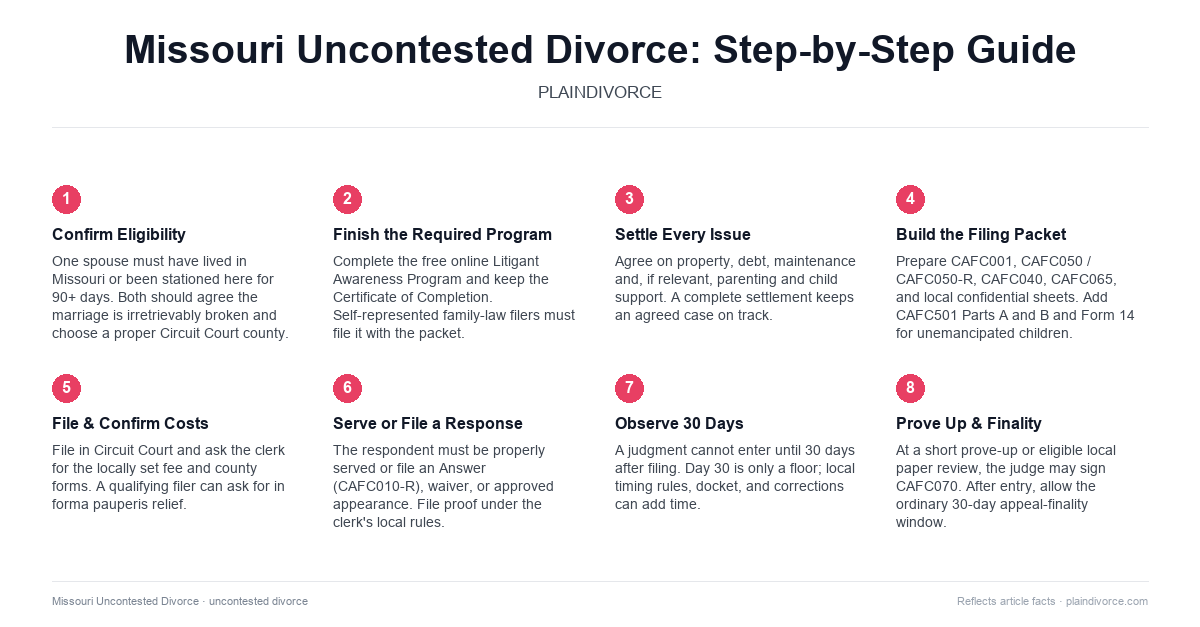
1. What an Uncontested Divorce in Missouri Really Means
Missouri’s legal term for divorce is dissolution of marriage. To grant one, a Circuit Court judge has to find that the marriage is irretrievably broken — that there is no reasonable likelihood it can be preserved (RSMo § 452.305).
Missouri is a no-fault state. You do not have to prove your spouse did anything wrong, and proving it would not speed anything up or change the property and support rules.
Contested vs. uncontested
A contested divorce means you disagree about something the judge has to decide: custody, child support, maintenance (alimony), or how property and debt are split. These cases run through multiple hearings and sometimes a trial.
An uncontested divorce in Missouri takes one of two forms:
- Agreed case. You both sign off on the terms and hand the judge a finished package to review and approve. This is what Missouri’s statewide forms are built for.
- Default case. Your spouse is properly served, never responds, and the case moves ahead without them. The judge still reviews what you are asking for and will not approve terms that are unreasonable or, for a separation agreement, unconscionable.
Either way, the final order is a Judgment and Decree of Dissolution of Marriage (CAFC070), signed by a Circuit Court judge.
2. Do You Qualify? Residency, Grounds, and County
2.1 The 90-day residency rule
Under RSMo § 452.305, a judge may enter a dissolution judgment only if one spouse has been a Missouri resident — or a member of the armed services stationed in Missouri — for the 90 days immediately before the proceeding is commenced, and at least 30 days have elapsed since the petition was filed. Only one spouse needs to meet the residency test. The same statute requires the court to make provision for child custody, child support, maintenance, and property division before the judgment can enter.
The spouse who files is the Petitioner; the other is the Respondent.
2.2 Grounds: an irretrievably broken marriage
In an agreed case, both spouses state that the marriage is irretrievably broken, and after hearing the evidence the judge makes that finding. That is the whole standard.
If your spouse denies under oath that the marriage is irretrievably broken, the case is no longer uncontested. Under RSMo § 452.320, the court then considers all relevant factors — including the prospect of reconciliation — and the petitioner must satisfy the court of one or more of these facts:
- the respondent committed adultery and the petitioner finds it intolerable to live with the respondent;
- the respondent behaved in a way that the petitioner cannot reasonably be expected to live with;
- the respondent abandoned the petitioner for a continuous period of at least six months;
- the spouses lived separate and apart by mutual consent for a continuous period of 12 months; or
- the spouses lived separate and apart for a continuous period of at least 24 months before the petition was filed.
Alternatively, the court can continue the case for further hearing not less than 30 days and not more than six months later. That is why an agreed statement from both spouses matters: it keeps you on the simple path.
2.3 Which county you file in
Under RSMo § 452.300, a dissolution proceeding shall be commenced in the county where the petitioner resides or the county where the respondent resides. If you file where the petitioner lives, the respondent can move — before answering — to transfer the case to the respondent’s county when that county was the children’s home for the 90 days before filing, or when the children and a parent have a significant connection there and the substantial evidence about the children is located there. Filing in the wrong county wastes the fee, so if you and your spouse live in different counties, confirm the choice with the clerk first.
2.4 Is your case actually a good fit?
An uncontested divorce works when all of these are true:
- You both agree the marriage is over.
- You can cooperate on signatures, deadlines, and paperwork without a fight.
- You are both willing to disclose your finances honestly and in writing, under oath.
- You agree on how to divide property and debt.
- If you have children: you agree on a parenting plan and can complete the Form 14 child support calculation together.
If even one of these is shaky, read section 9 before you file anything.
If there is domestic violence, hidden money, a genuine dispute about the children, or a large gap in who understands the finances, talk to a lawyer before you sign. A settlement you agree to now is very hard to undo later.
3. The Missouri Divorce Forms Checklist
Missouri’s court system publishes a statewide dissolution forms packet designed specifically for spouses who agree. Every one is a free, fillable Missouri divorce forms PDF on the state courts site — you do not need to buy them anywhere. Search the official forms library by the CAFC code to reach the current version. Here is what the packet contains and what each piece does.
| Form | Name | What it does |
|---|---|---|
| CAFC001 | Petition for Dissolution of Marriage | Opens your case. Verified (signed under oath). |
| CAFC010-R | Respondent’s Answer to Petition for Dissolution of Marriage | How an agreeing spouse responds — often avoids the cost of formal service |
| CAFC050 / CAFC050-R | Statement of Income and Expenses (Respondent uses the -R version) | Each spouse’s sworn financial disclosure: income and monthly expenses |
| CAFC040 | Statement of Property and Debt and Proposed Separation Agreement | Lists all assets and debts and contains your actual settlement terms |
| CAFC065 | Certificate of Dissolution of Marriage | Vital-statistics record for the Department of Health and Senior Services. Not your judgment. Part of the filing packet. |
| CAFC070 | Judgment and Decree of Dissolution of Marriage | The final order the judge signs |
| CAFC501 | Parenting Plan, Parts A and B | Required when the case decides custody, support, or visitation for an unemancipated child |
| Form 14 | Child Support Amount Calculation Worksheet | Required in any case with a child support determination |
| CAFC721 | Notice of Hearing | Used to get your case on the docket |
| — | Certificate of Completion, Statewide Litigant Awareness Program | Required for self-represented family-law filers |
| FI-10 | Confidential Case Filing Information Sheet | Keeps Social Security numbers and other identifiers off the public file. The statewide packet says most courts require it. |
| GN320 | Redaction Certification | Certifies you removed protected identifiers from documents in the public file |
| — | Motion and Affidavit for Leave to Proceed In Forma Pauperis | Optional — asks the court to waive the filing fee |
Circuits vary in the confidential and cover-sheet forms they require and in how many copies of CAFC065 they want. Missouri’s own instructions tell you to check with your Circuit Clerk about county-specific forms — do that before you print anything.
The Petition for Dissolution of Marriage (Missouri Form CAFC001)
The Petition for Dissolution of Marriage in Missouri is the document that opens your case, and under RSMo § 452.310 it must be verified — signed under oath. It states your residency, names both spouses, gives the date and place of the marriage and the date of separation, identifies any children and where they have lived for the past 60 days, states whether the wife is pregnant, asks the court to find the marriage irretrievably broken, and lists the relief you want — including restoration of a former name, if you want one. The petition and the answer each carry only the last four digits of every Social Security number; full numbers go on a separate confidential filing under § 509.520.
Whatever you ask for here sets the ceiling for what the judge can award in a default case. Be specific, and do not leave the property and custody requests vague on the theory that you will sort them out later.
The Statement of Property and Debt form (Missouri Form CAFC040)
This is the most misunderstood form in the packet. The full title of the Statement of Property and Debt form in Missouri is Statement of Property and Debt and Proposed Separation Agreement — it is not just an inventory. It is your settlement.
You list every asset and debt, mark each as marital or non-marital, assign a value, and say who gets it. Under RSMo § 452.325, the terms of a separation agreement about property, support, and maintenance are binding on the court unless the court finds the agreement unconscionable after looking at both spouses’ economic circumstances. Terms about child custody, support, and visitation are never binding on the court. Filers who treat CAFC040 as a rough worksheet end up with judgments that are unclear, unenforceable, or simply wrong about who owes the car loan.
Practical note: the statewide financial forms are executed under oath. Save each PDF to your computer and open it in a dedicated PDF reader before you type — some browser previews do not keep your entries.
The Litigant Awareness Program certificate
Do not skip the Litigant Awareness Program
It is statewide, not local. If you represent yourself in a Missouri family-law case, you complete a free online program at selfrepresent.mo.gov, print the Certificate of Completion, and file it with the Circuit Clerk. See the Missouri Courts Litigant Awareness Program page for details. Clerks check for the certificate before they accept a family-law filing.
4. Step-by-Step: Filing an Uncontested Divorce in Circuit Court
County procedures differ in the details, but the arc is the same everywhere. Your goal is a packet complete enough that the clerk accepts it and the judge signs it — without a round of “fix this and refile.”
Step 1 – Confirm you are eligible
- One of you has been a Missouri resident (or stationed here in the armed services) for 90+ days.
- You know which county’s Circuit Court to use under § 452.300.
- You both consider the marriage irretrievably broken.
- You either agree on the terms, or you understand what a default case means.
Step 2 – Complete the Litigant Awareness Program
Do this early. It is free and online. When you finish, print the Certificate of Completion — it carries a certificate number — and keep it with your packet to file alongside the petition.
Step 3 – Agree on the money before you touch a form
Settle these at the kitchen table, not in the PDF:
- The house — who keeps it, who pays the mortgage and taxes, and whether the other name comes off the loan
- Vehicles and auto loans
- Bank accounts and personal property
- Retirement accounts — splitting a 401(k) or pension usually needs a separate court order (a QDRO), so flag it early
- Credit cards and other debt
- Whether either of you pays maintenance, or you both waive it permanently
Under RSMo § 452.330, the court first sets apart each spouse’s non-marital property, then divides the marital property and marital debts in the proportions it finds just after weighing statutory factors — economic circumstances, each spouse’s contribution, the value of separate property, conduct during the marriage, and custody arrangements. “Equitable” is the shorthand; it is not an automatic 50/50 split, and the court still reviews your agreement.
Step 4 – Fill out the packet
Work through the checklist in section 3. The Petition (CAFC001) is the anchor; the financial disclosures (CAFC050 / CAFC050-R and CAFC040) are where most of the work lives, and they are signed under oath. Include CAFC065 and the confidential/redaction sheets your circuit requires — for most circuits that means FI-10 and GN320. Ask the clerk which cover sheets your county adds.
Step 5 – File with the Circuit Clerk and pay the fee
The clerk opens your file and assigns a case number. The filing fee is set locally, so ask for the current amount when you call. If you cannot afford it, ask about the In Forma Pauperis motion at the same time — not after.
Step 6 – Give your spouse legal notice
An informal understanding is not legal notice. The Respondent must be served under the applicable rules or must properly enter an appearance or file a response. Your options:
- Respondent files an Answer (CAFC010-R). The cleanest route in a cooperative case — your spouse responds and you skip paid service.
- Waiver or entry of appearance, where your court allows it and in the form the clerk specifies.
- Sheriff or a private process server, which costs money and takes time.
Botched service is one of the most common reasons a simple case stalls. Follow the clerk’s instructions exactly, and file proof of whatever method you use.
Step 7 – Wait out the 30 days
Missouri’s 30-day waiting period, plainly
Under RSMo § 452.305, a judge cannot enter a dissolution judgment until 30 days have elapsed since the petition was filed. The clock starts at filing — not at service, and not when you both signed the agreement. Full agreement does not shorten it.
- Day 0: Petition filed; notice to your spouse under way.
- Day 30: The earliest a judgment can be entered — if your circuit’s own timing rules are also satisfied.
- After that: a short hearing, or a paper submission where your county allows it.
Day 30 is a statutory floor, not a guaranteed date. Circuits can add their own service and appearance timing rules, and dockets and clerk corrections routinely push the real date later.
Step 8 – Finalize the judgment
Many uncontested cases end with a short hearing — often called a prove-up — where the judge confirms residency, confirms the marriage is irretrievably broken, and checks that the agreement is conscionable and that any child provisions serve the child. It is usually brief and not adversarial. If everything holds up, the judge signs the Judgment and Decree (CAFC070).
About “divorce by affidavit”: some Missouri circuits let fully agreed cases finalize on sworn statements without anyone appearing. Whether it is available, and on what conditions, is set locally — ask your Circuit Clerk rather than assuming.
A dissolution judgment is final when entered, subject to the right of appeal (RSMo § 452.360), and under the court rules it is generally subject to a 30-day window after entry before it is final for appeal purposes, absent a timely authorized after-trial motion. The judge’s signature is not automatically the last event. Once the judgment is entered, order certified copies — you will need them for a name change, Social Security, retirement transfers, refinancing, and remarriage. An appeal that does not challenge the breakdown finding does not delay the part of the judgment that dissolves the marriage, so either spouse may remarry once that provision is final.
Not sure your packet is complete?
Our Missouri uncontested divorce kit walks you through every form above in filing order — with a clerk-ready checklist, the Form 14 inputs worked out step by step, and the county questions to ask before you file.
5. If You Have Children: Parenting Plan (CAFC501) and Form 14
Judges review custody and support carefully even when parents agree — the court’s duty runs to the child, not to your settlement. Under RSMo § 452.375, there is now a rebuttable presumption that equal or approximately equal parenting time is in the child’s best interests (added by Senate Bill 35, effective August 28, 2023). Reaching a full written agreement on custody is one of the ways that presumption is rebutted.
The parenting plan (CAFC501)
Missouri’s parenting plan is Form CAFC501, in a Part A and a Part B — you need both. Under § 452.375, every custody judgment must include a specific written parenting plan, and under RSMo § 452.310 each party files a proposed plan within 30 days after service. This applies whenever the case decides custody, support, or visitation for an unemancipated child — not only for children under 18.
A plan that gets approved without questions covers:
- A specific weekday and weekend schedule — not “as agreed between the parties”
- Holidays, school breaks, and summer
- Exchange times and locations
- How you communicate and how you make major decisions (legal custody)
- Health insurance for the children and how you split uninsured and extraordinary medical costs
- How child support is paid and, where required, routed through the Family Support Payment Center
Vague plans get sent back for revision. They also become useless the first time you disagree — which is the moment a plan is supposed to earn its keep.
Form 14: the Missouri child support calculator
Missouri calculates child support with Form 14 (Child Support Amount Calculation Worksheet) under Supreme Court Rule 88.01. If you have been searching for a Form 14 child support calculator for Missouri, this worksheet is it — the official one, and the version a Missouri judge will expect. Third-party online calculators can give you a ballpark, but you still file a completed Form 14.
It is the single hardest piece of a DIY Missouri divorce, because it needs accurate numbers for:
- Each parent’s gross monthly income
- Work-related child-care costs
- The children’s health insurance premium
- Support paid or received for other children
- An overnight-based parenting-time adjustment
Under RSMo § 452.340 and Rule 88.01, a correctly calculated Form 14 amount is a rebuttable presumption — the judge is expected to order that number. You can agree to a different amount, but the court must make a written finding, or a specific finding on the record, that the guideline amount is unjust or inappropriate, detailing the specific factors. The Form 14 the court accepts as the presumed calculation is attached to and incorporated in the written judgment. Come prepared to explain any deviation in writing.
Missouri publishes a Schedule of Basic Child Support Obligations and a directions-and-examples document alongside Form 14. Use both. Guessing at the inputs is the fastest way to a continued hearing. See the Missouri Courts Presumed Child Support Amount (Rule 88.01) page for the rule and directions.
Parenting education and UCCJEA information
Under RSMo § 452.605, the court shall, except for good cause and unless a local rule provides otherwise, order the parties to attend educational sessions about the effects of custody and dissolution on children. Good cause expressly includes the parties having agreed on custody and visitation, and safety concerns for a party or child. Whether a class applies to your agreed case, and what it costs, is set by your circuit — ask the clerk.
Each party’s first pleading (or an attached affidavit) must also include the UCCJEA information required by RSMo § 452.780 — where each child has lived for the past five years and any other custody cases involving the child.
On payment: for support orders entered on or after October 1, 1999, income withheld for child support is paid through the Family Support Payment Center under RSMo § 452.350. Withholding is presumptively immediate for most orders, but the parties can agree in writing to a different arrangement, or the court can delay it for good cause; either way, withholding becomes mandatory once a payer falls one month behind.
6. How Long Does an Uncontested Divorce Take in Missouri?
Thirty days after filing is the statutory minimum before a judgment can be entered (RSMo § 452.305). There is no reliable statewide average beyond that. How much longer your case takes depends on your circuit’s docket, any local service-and-appearance timing rules, whether the packet is accepted the first time, and — after the judgment — the ordinary 30-day finality window.
- Faster: complete packet accepted the first time, spouse files an Answer instead of requiring service, a light county docket, no children.
- Slower: missing confidential forms or the Litigant Awareness certificate, service problems, Form 14 errors, an unfinished parenting class, or a busy metro docket.
Most avoidable delay traces back to an incomplete first filing. Time spent getting the packet right is time you do not spend waiting for a second hearing date. Ask your clerk what the current turnaround looks like in your county.
7. What Does an Uncontested Divorce Cost in Missouri?
Missouri’s official materials say court costs vary by case and by court and tell filers to ask the local clerk for the current figure. There is no statewide filing fee to quote. Budget for these categories and confirm each amount with your Circuit Clerk:
| Cost | Notes |
|---|---|
| Circuit Court filing fee / court cost deposit | Set by the circuit. Ask the clerk for the current amount for a dissolution with — or without — minor children. |
| Service of process | Sheriff or private server fee. Often avoidable if your spouse files an Answer or a waiver. |
| Parenting education class | Charged where a class applies. Ask the clerk whether your agreed case needs one and what the provider charges. |
| Certified copies of the judgment | Per-copy fee set by the clerk. Order two or three. |
| Notary | Several forms are signed under oath. Many banks notarize free for account holders. |
If money is tight, ask about the Motion and Affidavit for Leave to Proceed In Forma Pauperis, which asks the court to waive the filing fee based on your income.
8. Mistakes That Delay Missouri Divorces
- Skipping the Litigant Awareness Program. It is a statewide requirement for self-represented family-law filers, and clerks check for the certificate.
- Leaving out the confidential or redaction sheets your circuit requires. Most circuits want FI-10 and GN320; the petition and judgment themselves also carry last-four Social Security digits. Ask what your county requires.
- Treating CAFC040 as a worksheet. It contains your Proposed Separation Agreement. Vague entries become vague, unenforceable orders.
- Guessing on Form 14. Wrong income figures or a made-up overnight count will get flagged, and a deviation needs a written finding.
- Writing “as the parties agree” into the parenting plan. Judges want a schedule that works even after you stop getting along.
- Relying on an informal agreement instead of proper service. The Respondent must be served, or must file an Answer or a waiver the court accepts.
- Ignoring retirement accounts. Dividing a 401(k) or pension usually takes a separate qualified domestic relations order. Discovering that after the judgment is expensive.
- Not asking about county-specific forms and timing. Missouri’s own instructions tell you to check. One call to the clerk saves weeks.
9. When a DIY Divorce Is the Wrong Call
Doing it yourself saves real money. It also removes the person whose job is to notice what you are giving up. Get a lawyer if:
- There is domestic violence, threats, stalking, or coercive control
- You suspect your spouse is hiding assets or income
- There is a business, multiple properties, or a large retirement account in play
- You disagree about the children, or you have safety concerns about them
- Immigration status, bankruptcy, or significant tax questions are involved
- Your spouse has a lawyer and you do not
- One of you handled all the finances and the other genuinely does not know what exists
A single paid consultation can catch a problem that would cost far more to fix after the judgment is entered. Missouri also has legal aid organizations that serve income-eligible residents.
10. Frequently Asked Questions
How fast can you get divorced in Missouri?
No sooner than 30 days after the petition is filed — that is the statutory minimum in RSMo § 452.305, and full agreement does not shorten it. Beyond the 30 days, the timeline depends on your circuit’s docket, any local service or appearance timing rules, and whether the clerk accepts the packet the first time. There is no reliable statewide average, so ask your Circuit Clerk what current turnaround looks like.
Can you get divorced in Missouri without a lawyer?
Yes. Missouri’s court system publishes a full statewide forms packet for self-represented spouses who agree on the terms. Before you file, you must complete the free online Litigant Awareness Program at selfrepresent.mo.gov and file the Certificate of Completion with the Circuit Clerk. A lawyer is still worth a consultation if children, a business, or a large retirement account are involved.
Where can I get Missouri divorce forms as PDFs?
The Missouri courts website publishes the statewide dissolution packet as free, fillable PDFs — search the official forms library by the CAFC code (for example, CAFC001 for the petition). Save each PDF and open it in a dedicated PDF reader before typing, since some browser previews do not keep your entries. Then ask your Circuit Clerk whether your county requires any local forms on top of the statewide set.
What is the Statement of Property and Debt in Missouri?
It is Missouri Form CAFC040, and its full title is “Statement of Property and Debt and Proposed Separation Agreement.” You use it to list every asset and debt, mark each marital or non-marital, assign a value, and state who receives it. Because it doubles as your proposed settlement, its property and debt terms bind the court unless the court finds the agreement unconscionable — it is not a scratch worksheet.
Is there an official Form 14 child support calculator in Missouri?
Yes — Form 14, the Child Support Amount Calculation Worksheet under Supreme Court Rule 88.01, is the official calculator. Missouri also publishes a Schedule of Basic Child Support Obligations and a directions-and-examples document. Unofficial online calculators are fine for a rough estimate, but the court needs a completed Form 14 filed in your case, and it is attached to and incorporated in the judgment.
Do both spouses have to agree to a divorce in Missouri?
No. One spouse can file, and the case can proceed even if the other never responds, as long as the other spouse is properly served. But if a spouse denies under oath that the marriage is irretrievably broken, the petitioner must prove one of the statutory facts in RSMo § 452.320, or the court can continue the case for 30 days to six months. Agreement is what keeps it fast and cheap.
Do we have to go to court?
Usually one spouse attends a short prove-up hearing. Some circuits allow fully agreed cases to finalize on sworn statements with no appearance, but that option and its conditions are set locally. Ask your Circuit Clerk what your county allows.
Is Missouri a 50/50 divorce state?
No. Under RSMo § 452.330, Missouri sets apart each spouse’s non-marital property, then divides the marital property and marital debts in the proportions the court finds just after weighing statutory factors. The result often lands near even, but the standard is fairness, not arithmetic, and the court reviews your agreement.
Which county do we file in?
Under RSMo § 452.300, the Circuit Court for the county where the petitioner resides or the county where the respondent resides. If the case is filed where the petitioner lives, the respondent can move to transfer it to the respondent’s county under the child-focused conditions in the statute. If you live in different counties, confirm the choice with each clerk before filing.
Can I change my name back in the divorce?
Yes — request restoration of your former name in the petition. It is much simpler to include it now than to file a separate name-change case later.
What is the difference between the Certificate of Dissolution and the Judgment?
The Certificate of Dissolution of Marriage (CAFC065) is a vital-statistics form that reports the dissolution to the Department of Health and Senior Services; it is part of the filing packet, and your circuit sets how many copies it wants and when. The Judgment and Decree (CAFC070) is the actual court order that ends your marriage. You need both, and they are not interchangeable.
11. Next Steps
If you and your spouse agree, Missouri’s system genuinely lets you finish an uncontested divorce in Missouri without a courtroom fight. The work is administrative: right court, right forms, right order, right county rules.
Your Missouri filing checklist
- Confirm the 90-day residency rule and the 30-day statutory wait under RSMo § 452.305.
- Complete the Litigant Awareness Program and print your certificate.
- Call your county Circuit Clerk: current filing fee, county-specific and confidential forms, parenting class, and whether a no-appearance option exists.
- Agree on property, debt, and maintenance before you open a PDF.
- Prepare CAFC001, CAFC050 / CAFC050-R, CAFC040, CAFC065, and the confidential/redaction sheets your circuit uses.
- With unemancipated children: add CAFC501 Parts A and B, Form 14, and the UCCJEA information.
- File, pay the fee (or apply in forma pauperis), and serve your spouse or file their Answer or waiver.
- Wait the 30 days, attend the prove-up, and get CAFC070 signed.
- After entry, mind the 30-day finality window and order certified copies.
Do it once, do it right
The Missouri Uncontested Divorce Kit turns this guide into a working file: every form in filing order, a Form 14 input worksheet, parenting-plan language judges accept, and the exact questions to ask your Circuit Clerk.
PlainDivorce is not a law firm and does not provide legal advice. This guide is general information about the uncontested divorce process in Missouri and is current as of September 2026; statutes, court rules, forms, and local requirements change. Confirm the current rules with your Circuit Clerk or a licensed Missouri family-law attorney before you file.
Sources and local rules can change. Use this guide as a plain-English organizer, then verify the current filing requirements with the official court or government source for your jurisdiction.

About Harry D
Expert contributor at PlainDivorce, helping Canadians and American navigate simple uncontested divorces with clarity and confidence.