Uncontested Divorce in Montana: The Plain-English Guide to MP-Series Forms (2026)
If you and your spouse both agree the marriage is over, Montana lets you finish the paperwork yourselves for about $250 in court fees — usually without hiring a lawyer and usually without a second court appearance. In Montana, divorce is called dissolution of marriage, and self-represented couples use the Montana Supreme Court-approved MP-Series forms, which the state publishes free.
TL;DR — Uncontested Divorce in Montana
- The forms. Agreeing couples file a Joint Petition for Dissolution: the Montana joint dissolution forms MP-115 (no minor children) or MP-116 (with minor children).
- File it all at once. Petition + financial disclosures (MP-500 and MP-510) + hearing request (MP-701) + proposed hearing order + your proposed decree, in one trip to the Clerk of District Court.
- Kids? Add the Proposed Parenting Plan MP-300 and a child support calculation.
- Cost: about $250 — $200 to file, $50 to enter judgment. Fee waivers available.
- Timeline: roughly 4 to 12 weeks. There is no general Montana divorce waiting period on a joint filing — the 20-day rule people search for applies only to summary dissolution, and 21 days applies only after service on a sole filing.
- Court: usually one short hearing where the judge signs the decree.
- Forms are free at courts.mt.gov.
Looking for a “Declaration of Assets and Debts”? Montana doesn’t use that name — see what it’s actually called.
This guide walks through who qualifies, exactly which forms go in your packet, what the judge will ask, what it costs, and the specific mistakes that send self-filed cases back to the end of the line.
1. What Counts as an Uncontested Divorce in Montana?
Montana law doesn’t use the phrase “uncontested divorce.” What people mean by it is a dissolution of marriage where nobody fights — you and your spouse have already settled every issue the judge would otherwise have to decide:
- Ending the marriage. Montana is no-fault; the legal ground is an irretrievable breakdown.
- Property and debt. Who keeps the house, the vehicles, the accounts, and who pays which balances.
- Maintenance. Montana’s term for spousal support or alimony — including agreeing that neither of you pays any.
- Children, if you have them. A written parenting plan plus child support calculated under Montana’s guidelines.
When you agree on all of that, Montana lets you file as co-petitioners on a single joint petition instead of one spouse suing the other. That’s the cheapest, fastest path, because nobody has to be served with a summons.
Three paths, briefly
| Path | Best for | Starting form |
|---|---|---|
| Joint dissolution | You agree on everything and will both sign | MP-115 or MP-116 |
| Sole filing | You agree in principle but your spouse won’t co-sign, or you can’t file together | MP-112 or MP-113 |
| Summary dissolution | Short marriage, no real estate, small estate, no maintenance | See section 6 |
A sole filing can still be uncontested. If your spouse signs an acknowledgment of service (MP-403.12 or MP-403.22) and simply doesn’t fight, the case moves much like a joint one — it just takes longer and costs a bit more.
2. Do You Qualify? Residency, Grounds, and Fit
2.1 The 90-day residency rule
Under MCA § 40-4-104(1)(a), at least one spouse must have been domiciled in Montana for the 90 days immediately before filing. Active-duty service members stationed in Montana for 90 days meet the same test even if their legal domicile is elsewhere.
This is jurisdictional. A Montana judge cannot dissolve your marriage without it, and the filing fee is not refundable if you get it wrong.
Which county? File in the county where you or your spouse lives. If you have children, the county where the children live also works.
2.2 The grounds — and the detail most guides skip
Montana is a no-fault state. You never have to prove adultery, cruelty, or anything else. But “irretrievably broken” isn’t a magic phrase you just write down — the statute requires the finding to be supported by evidence of one of two things:
- You have lived separate and apart for more than 180 days before the case was filed; or
- There is serious marital discord that has affected one or both of your attitudes toward the marriage, with no reasonable prospect of reconciliation.
You only need one. Your petition has to state which one applies, and the judge will likely ask you about it at the hearing. Couples who are still under the same roof use the second option — that’s exactly what it’s there for.
2.3 Signs you’re a good fit for the joint track
- You both want the divorce, or at least both accept it’s happening.
- You can sit down together, exchange honest financial information, and complete MP-500 and MP-510.
- You’ve settled property, debt, and maintenance without a mediator or a fight.
- If you have kids, you agree on a schedule you can write down in MP-300.
- Both of you are willing to sign the petition and show up to one hearing.
2.4 Red flags — talk to a lawyer first
- Domestic violence, threats, stalking, or any safety concern
- You suspect hidden assets or unreported income
- A serious power imbalance — one spouse controlled all the money or all the information
- A business, a ranch, multiple properties, or a pension or retirement account that needs a QDRO to divide
- Disagreement about parenting, or one parent planning to move out of state
- Immigration status, tax debt, or a pending bankruptcy tied to the marriage
If you feel pressured to sign something you don’t understand, stop and get advice. A consultation is far cheaper than reopening a decree later — and some decree terms, particularly property division, are very hard to undo.
3. Pick Your Track: Which MP Forms Do You Need?
Montana publishes every one of these free at courts.mt.gov/forms, along with instructional cheat sheets and short videos for the trickiest ones. Here’s the whole map in one place.
Montana joint dissolution forms: MP-115 and MP-116 packets
If you’re searching for Montana joint dissolution forms MP-115, this is the set that goes with it. The MP-115 packet (no minor children) and the MP-116 packet (with minor children) share most of their contents — the difference is the parenting and child support layer.
| Form | Name | Joint, no kids | Joint, with kids |
|---|---|---|---|
| MP-115 | Joint Petition for Dissolution Without Children | ✓ | — |
| MP-116 | Joint Petition for Dissolution With Minor Children | — | ✓ |
| MP-300 | Proposed Parenting Plan | — | ✓ |
| MP-500 | Financial Disclosure and Proposed Property Distribution | ✓ | ✓ |
| MP-510 | Income and Expenses (each spouse completes their own) | ✓ | ✓ |
| MP-701 | Request for Hearing and Statement of Compliance with Financial Disclosure | ✓ | ✓ |
| MP-702 | Order Granting Hearing on Dissolution With Children | — | ✓ |
| MP-714 | Order Granting Hearing on Dissolution Without Children | ✓ | — |
| MP-703 | Dissolution Decree With Children | — | ✓ |
| MP-713 | Dissolution Decree Without Children | ✓ | — |
| MP-704 | Notice of Entry of Decree | ✓ | ✓ |
| MP-730 | Consent to Entry of Decree (only if one spouse can’t attend) | optional | optional |
| MP-404 | Notice and Acknowledgement to CSED and Attorney General | — | if Title IV-D |
| MP-407 | Notice to Person Not Named | — | if applicable |
| — | Vital Statistics Reporting Form (DPHHS) | ✓ | ✓ |
Filing alone instead? Use MP-112 (no children) or MP-113 (with children) as your petition, plus MP-400 (Summons and Automatic Economic Restraining Order) and whichever service form fits — MP-401 for sheriff service, MP-403.12 or MP-403.22 if your spouse will sign for it voluntarily, or the MP-402 series if you have to serve by publication.
Attachments exist for almost everything
If you run out of room on a form, Montana has a lettered attachment for it: MP-500-A through MP-500-D for extra property, vehicles, accounts, and debts; MP-510-A and MP-510-B for extra income and expenses; MP-113-B through MP-113-E for extra children, residences, custody claimants, and court cases; and MP-300-B, MP-300-C, and MP-300-G for holidays, limited parenting time, and medical coverage. Cramming everything onto one page is a common reason forms get kicked back.
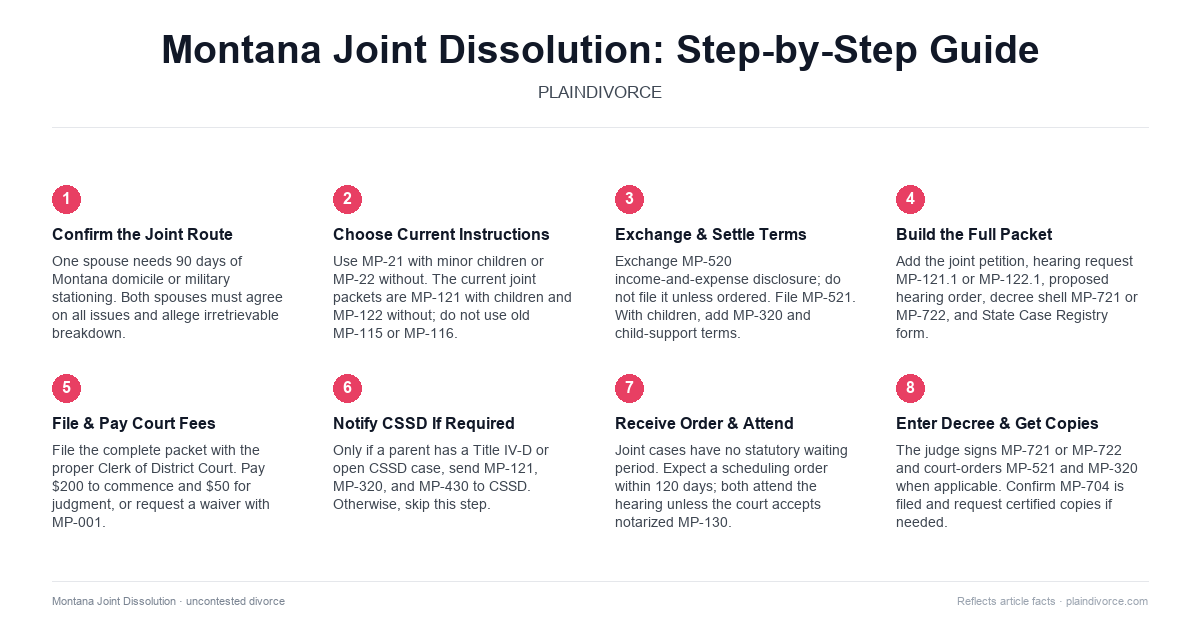
4. Step-by-Step: Filing a Joint Dissolution
The thing most people get wrong
In Montana’s joint packets you do not file the petition, wait, and then ask for a hearing later. You file the petition, the disclosures, the hearing request (MP-701), the proposed hearing order (MP-702 or MP-714), and your unsigned proposed decree (MP-703 or MP-713) all at once, on day one. The judge reviews the whole package and schedules your hearing from it.
Step 1 — Read the state’s introduction and fill out your forms
Montana publishes an Introduction to Family Law in Montana alongside the packets. It’s worth the twenty minutes because it flags the decisions you’re about to make permanent. Download the complete packet for your track — joint without children or joint with children — and work through it in order.
Step 2 — Exchange financial disclosures with your spouse
You and your spouse each complete your own MP-510 (Income and Expenses) and then physically exchange them. Together you prepare one MP-500 (Financial Disclosure and Proposed Property Distribution) showing every asset and debt and who gets what.
Your joint petition contains a sworn statement that this exchange happened, and MP-701 repeats the certification. Judges take it seriously: incomplete or inconsistent disclosures are the single most common reason an agreed case gets held up.
Two practical notes. First, whether MP-510 gets filed or only exchanged varies — the with-children packet is internally inconsistent on this point, so ask your clerk. Second, anything you file containing account numbers must comply with the privacy protections in Rule 5.2 of the Montana Rules of Civil Procedure, so redact accordingly.
“Declaration of Assets and Debts” in Montana — what it’s actually called
People search for a Declaration of Assets and Debts in Montana and come up empty, because Montana has no form by that name. That title comes from other states — California, for instance, uses a Schedule of Assets and Debts.
In Montana, the same job is split across two MP-Series forms:
- MP-500 — Financial Disclosure and Proposed Property Distribution. This is Montana’s assets-and-debts declaration. You list real property, vehicles, bank and retirement accounts, personal property, and every debt, then say who gets what. Attachments MP-500-A through MP-500-D give you extra room for additional real property, vehicles, accounts, and debts.
- MP-510 — Income and Expenses. Your monthly cash flow. Each spouse fills out their own, and you exchange them.
So if a form, a lawyer, or an out-of-state guide tells you to file a declaration of assets and debts, reach for MP-500. Once the judge signs it, it’s attached to your decree as a court-ordered exhibit — which is exactly why the numbers need to be accurate and match everything else in the packet.
Step 3 — Make your copies
Without children: 2 copies plus the original (3 sets). With children: 3 copies plus the original (4 sets), because one goes to Child Support Enforcement. The clerk keeps the original; you and your spouse each keep one.
Step 4 — File everything with the Clerk of District Court
Bring the whole stack to the Clerk of District Court in your county and pay the $200 filing fee. If you can’t afford it, ask for the Affidavit of Inability to Pay Filing Fee — it’s free, it’s available at the counter, and clerks hand it out routinely.
Your filing packet:
- Joint petition — MP-115 or MP-116, signed by both spouses
- Parenting plan MP-300 and any attachments (children only)
- Property distribution MP-500
- Income and expenses MP-510 for each spouse
- Request for hearing MP-701
- Proposed hearing order — MP-702 (children) or MP-714 (no children)
- Proposed decree — MP-703 (children) or MP-713 (no children)
- Vital Statistics Reporting Form — it’s in the back of the packet and at dphhs.mt.gov/CSED. Every packet warns you not to forget it, because people constantly do.
The clerk opens your case and assigns a cause number. Note that Montana’s Automatic Economic Restraining Order takes effect on filing — it restricts unusual spending, transferring property, and changing insurance beneficiaries while the case is open. Read it before you file, not after.
Step 5 — Serve CSED if child support enforcement is involved
This applies only if you or the other parent receives Title IV-D services — that generally means an open case with Montana’s Child Support Enforcement Division. If so, mail or deliver MP-404 (Notice and Acknowledgement to CSED and Attorney General) plus copies of your petition and parenting documents to your nearest CSED office, with a stamped envelope addressed to your Clerk of Court so CSED can return the acknowledgment.
No IV-D case? Skip this step entirely.
Step 6 — Attend your hearing
If your paperwork is complete, the judge signs the hearing order and the clerk sets a date. Both spouses should attend. The judge will confirm jurisdiction, confirm the marriage is irretrievably broken, and — if you have children — check that the parenting plan is workable and in the children’s best interests. Most uncontested hearings run ten to twenty minutes.
If one spouse can’t be there: that spouse signs MP-730 (Consent to Entry of Decree) in advance, which lets the judge enter the decree without them present.
Can you skip the hearing entirely? Sometimes. Montana publishes an Affidavit for Entry of Decree of Dissolution of Marriage Without Hearing, and both joint packets link to it. Whether your judge will accept it depends on your judicial district and your facts, so ask the clerk before you count on it. If you do go this route, the packet instructions tell you to prepay the judgment fee and provide pre-addressed stamped envelopes large enough for the decree and any certified copies.
Step 7 — Get the signed decree filed and grab your copies
The judge signs MP-703 or MP-713, and your MP-500 and MP-300 become court-ordered exhibits to it. Sometimes the judge hands you the decree to walk down to the clerk; sometimes it goes back through chambers. Either way, MP-704 (Notice of Entry of Decree) gets filed, and you should each request a copy of the decree and every exhibit listed on it.
If you’re changing your name back, order certified copies while you’re standing there. Social Security, the DMV, and your bank will each want one, and a second trip to the courthouse is a wasted afternoon.
5. If You Have Children: Proposed Parenting Plan MP-300, Child Support, and CSED
Montana requires a written parenting plan in every case involving minor children. The form is the Proposed Parenting Plan MP-300, and it’s the document your judge will read most carefully. It’s also the one the court keeps: whichever version the judge approves gets signed and attached to your decree as a court-ordered exhibit.
What the Proposed Parenting Plan MP-300 needs to cover
- The regular weekday and weekend schedule — specific days and times, not “as agreed”
- Holidays, school breaks, birthdays, and summer (use MP-300-B if you need more room)
- Exchanges: where, when, and who drives
- Decision-making on school, medical care, and religion
- How you’ll communicate, and how you’ll resolve disagreements before running back to court
- Health insurance for the children (MP-300-G describes existing coverage)
Vagueness is the enemy here. “Reasonable parenting time as the parties agree” reads as flexible and cooperative right now; in eighteen months, when you disagree, it’s unenforceable. Judges know this and often push back on plans that leave the schedule undefined.
Child support
Support is calculated under the Montana Child Support Guidelines, which run on each parent’s income and the parenting time split. Because the calculation pulls from the same numbers as your MP-510, the two have to match. If your guideline worksheet says one thing and your disclosure says another, expect the court to pause and ask why.
Parents can agree to a support amount that differs from the guideline figure, but the court has to approve the deviation and you’ll need to explain it. Simply agreeing to zero support because “we’re splitting it evenly” often doesn’t survive review.
6. Summary Dissolution: The Fast Track (and Its Strict Limits)
Montana has a genuinely faster procedure, but almost nobody qualifies, and most guides describe it so vaguely that readers waste time chasing it. Here’s the actual test from MCA § 40-4-130. Every one of these must be true on the day you file:
- You meet the 90-day residency requirement.
- Irreconcilable differences have broken the marriage and you both want it dissolved.
- The wife is not pregnant, and either there are no children of the relationship, or you have an agreed parenting plan with child support and medical support already ordered.
- Neither of you has any interest in real property — the only exception is a residential lease with no purchase option that ends within a year of filing.
- Unsecured debts incurred during the marriage total $20,000 or less.
- Total fair market value of assets, excluding secured obligations, is under $50,000.
- You’ve already signed an agreement dividing assets and debts, plus any titles or bills of sale needed to carry it out.
- Both of you waive any right to maintenance.
- You irrevocably waive your right to appeal the terms and your right to move for a new trial.
- You’ve read and understand the state’s summary dissolution brochure.
If you qualify, the court holds a hearing no sooner than 20 days after filing, both parties must attend, and if the conditions check out the judge enters the final judgment on the spot.
Read the waivers twice
Owning a house disqualifies you outright. And waiving maintenance and your right to appeal is permanent — those are the two provisions people regret. Montana’s statewide MP-Series library is built around the standard and joint dissolution packets, so if you think you qualify for summary dissolution, ask your Clerk of District Court or a Self Help Law Center which forms your district uses.
7. How Long Does It Take?
Montana has no mandatory statewide waiting period for a joint dissolution. What sets your timeline is how fast you finish the paperwork and how full your judge’s calendar is.
| Track | Built-in waiting period | Typical total |
|---|---|---|
| Joint dissolution | None — you request the hearing at filing | 4 to 12 weeks |
| Sole filing | 21 days after service before a decree can be entered | 2 to 4+ months |
| Summary dissolution | 20 days from filing to hearing | 3 to 8 weeks |
On a sole filing, MCA § 40-4-105(3) gives your spouse 21 days after service to file a verified response, and bars the court from entering a decree until that window closes. Note that the clock starts at service, not at filing — if it takes you three weeks to track your spouse down, that’s three weeks added to the front.
The “Montana divorce 20 day waiting period,” explained
This is one of the most-searched Montana divorce questions, and the premise is usually wrong. There is no general 20-day waiting period for divorce in Montana. Three different numbers get blended together online:
| The number | What it really is | Who it applies to |
|---|---|---|
| 20 days | The earliest the court may hold the summary dissolution hearing, measured from the filing of the joint petition | Summary dissolution only (MCA § 40-4-133) |
| 21 days | Your spouse’s window to file a verified response; no decree may be entered until it closes | Sole filings only, counted from the date of service (MCA § 40-4-105(3)) |
| 180 days | Not a waiting period at all — one of two ways to prove the marriage is irretrievably broken | Optional; the alternative is serious marital discord (MCA § 40-4-104) |
So if you and your spouse file a joint dissolution on MP-115 or MP-116, no statutory clock is holding you back. Your only real wait is how long the judge takes to review the packet and how soon the calendar opens up. If you file a summary dissolution, the 20-day figure is genuine — but see section 6, because very few couples qualify.
Rural districts where a judge rides circuit between counties can add weeks purely on scheduling. Ask the clerk what the current wait looks like when you file; they generally know.
8. What It Costs
These come from the statewide Montana Clerks of District Courts civil fee schedule (updated May 2024).
| Item | Fee | When it applies |
|---|---|---|
| Filing the dissolution petition | $200 | Always — covers joint and summary filings too |
| Entry of judgment | $50 | When the decree is entered |
| Certified copy (certification with seal) | $2 each | Name changes, SSA, DMV, banks |
| Copy of the decree | $10 each | Parenting plans and property agreements filed separately are extra |
| Sheriff or process server | Varies | Sole filings only |
| Service by publication | Varies | Only if your spouse can’t be located |
| Notary | $1 with court seal | Several MP forms require notarization |
Realistic total for a joint dissolution: about $250, plus a few dollars for certified copies. Filing jointly is what keeps it there — no summons, no process server, no publication.
Heads up on the judgment fee
Some Montana packets still print $45 for the judgment fee. The current statewide schedule says $50. Call your clerk before you write the check.
Can’t afford it? File an Affidavit of Inability to Pay Filing Fee, available at the clerk’s counter, at MontanaLawHelp.org, or from any Self Help Law Center. Judges grant these routinely for people who genuinely qualify.
9. Seven Mistakes That Delay Self-Filed Cases
- Using MP-115 when you have minor children. The no-children petition has no place for parenting or support findings, so the packet can’t be processed. Use MP-116.
- Forgetting the Vital Statistics form. Every Montana packet labels it “Don’t Forget to Fill Me Out” for a reason.
- Filing the petition without MP-701 and the proposed order. Your case sits there. Nothing schedules itself.
- Not filing a proposed decree. The judge signs the decree you drafted. If MP-703 or MP-713 isn’t in the file, there’s nothing to sign.
- Numbers that don’t reconcile. When MP-500, MP-510, and the child support calculation disagree, the court stops to sort it out.
- A vague parenting plan. “As the parties agree” invites the judge to send you back to add specifics.
- Too few copies. Three sets without children, four with. Clerks will send you to the copier.
10. When DIY Is the Wrong Call — and Where to Get Free Help
Doing it yourself works when the case is genuinely cooperative and the assets are simple. It goes badly when there’s a safety issue, undisclosed money, a business or ranch to value, a retirement account that needs dividing properly, or real conflict about the children. Those cases cost more to fix later than they would have cost to do right.
Montana has unusually good free resources. Use them:
- The Court Help Program — Self Help Law Centers around the state, walk-in basis. Staff aren’t lawyers and can’t give legal advice, but they know the process and will review your forms for completeness before you file. This is the highest-value hour you can spend.
- Montana Legal Services Association — free or reduced-cost attorney help if you qualify financially. mtlsa.org or 1-800-666-6899.
- State Bar of Montana Lawyer Referral Service — montanabar.org or (406) 449-6577. Worth it even for a single consult on one sticking point.
- Privacy Protection Packet — everything you file is public unless you ask otherwise. If you need addresses or account details shielded, these forms are at courts.mt.gov and MontanaLawHelp.org.
11. Where a Self-Help Kit Fits In
Montana gives you the forms for free. What the state doesn’t give you is sequencing — which form goes with which, what “compliance with financial disclosure” actually means, and which pieces have to hit the clerk’s counter on the same day. That gap is where self-filed cases stall.
Our Montana kit is built around the friction points in this guide:
- A decision tree that lands you on the right petition — MP-115, MP-116, MP-112, or MP-113 — in about a minute
- A worked example of MP-500 and MP-510 so your disclosures reconcile the first time
- Parenting plan language for MP-300 that’s specific enough to be enforceable
- A day-one filing checklist covering MP-701, the proposed order, the proposed decree, and Vital Statistics
- What the judge actually asks at an uncontested hearing, so you’re not guessing
Download the Montana Uncontested Divorce Kit
A kit isn’t legal advice and it doesn’t replace a lawyer when you need one. For couples who genuinely agree, it removes the guesswork that causes rejected filings.
12. Your Filing Checklist
- Confirm one of you has been domiciled in Montana 90+ days
- Decide which ground applies: 180+ days living apart, or serious marital discord
- Pick your petition — MP-115 or MP-116 joint; MP-112 or MP-113 solo
- Complete and exchange MP-510; prepare MP-500 together
- If children: MP-300 plus attachments, and run the child support guideline calculation
- Draft your proposed decree — MP-703 or MP-713
- Complete MP-701 and the proposed hearing order (MP-702 or MP-714)
- Fill out the Vital Statistics Reporting Form
- Make your copies: 3 sets without children, 4 with
- File everything at once and pay $200 (or file the fee waiver affidavit)
- Serve CSED with MP-404 if there’s an open Title IV-D case
- Attend the hearing — or file MP-730 if one spouse can’t
- File MP-704 and order certified copies of the decree
Before you file, take the packet to a Self Help Law Center for a completeness check. It’s free, and it catches the errors that would otherwise cost you a month.
FAQ: Montana Uncontested Divorce
What is an uncontested divorce in Montana?
It’s a dissolution of marriage where both spouses agree on property, debt, maintenance, and — if applicable — parenting and child support, so the judge only has to review and approve the terms rather than decide them. Most uncontested cases are filed as a joint petition on MP-115 or MP-116.
How much does an uncontested divorce cost in Montana?
About $250 in court fees for a joint filing: $200 to file the petition and $50 for entry of judgment. Certified copies run $2 each. Filing alone adds service costs. A fee waiver is available if you can’t afford it.
How long does an uncontested divorce take in Montana?
There’s no mandatory waiting period for a joint dissolution, so most run four to twelve weeks depending on the court’s calendar. A sole filing takes longer because no decree can be entered until 21 days after your spouse is served.
Is there a 20 day waiting period for divorce in Montana?
Not as a general rule. The Montana divorce 20 day waiting period applies only to summary dissolution: under MCA § 40-4-133, the court holds the hearing after 20 days from filing the joint petition, with both parties present. A regular joint dissolution on MP-115 or MP-116 has no statutory waiting period — you’re limited only by the court’s calendar. A sole filing has a different clock: 21 days from service before a decree can be entered.
What is the Declaration of Assets and Debts in Montana?
Montana has no form with that name — it’s a title borrowed from other states. Montana’s equivalent is MP-500, Financial Disclosure and Proposed Property Distribution, which lists all assets and debts and proposes who takes what. Your monthly cash flow goes on a separate form, MP-510 (Income and Expenses).
Where do I find the Proposed Parenting Plan MP-300?
Free from the Montana Judicial Branch, inside the dissolution-with-children packets. The state also publishes an MP-300 instructional cheat sheet and a walkthrough video. Attachments MP-300-B (holidays and vacations), MP-300-C (limited parenting time), and MP-300-G (existing medical coverage) are there when you need more room.
Can we file together instead of one of us suing the other?
Yes. Montana lets spouses file as co-petitioners on a Joint Petition for Dissolution — MP-115 without minor children, MP-116 with them. Nobody gets served with a summons, which is what makes the joint track cheaper and faster.
Do we get a court date automatically after filing?
No. You have to ask, using MP-701 (Request for Hearing and Statement of Compliance with Financial Disclosure) along with a proposed order for the judge to sign — MP-714 without children, MP-702 with them. Montana’s joint packets have you file these with the petition, not later.
Do we have to go to court?
Usually yes — one short hearing where the judge confirms the basics and signs the decree. Montana does publish an Affidavit for Entry of Decree of Dissolution of Marriage Without Hearing, but whether your judge accepts it varies by judicial district. Ask your Clerk of District Court before planning around it.
What if my spouse can’t make it to the hearing?
They sign MP-730 (Consent to Entry of Decree) beforehand. That authorizes the judge to enter the decree without them in the room.
Do we have to be separated first?
Not necessarily. Montana requires the irretrievable breakdown to be supported by evidence of either living separate and apart for more than 180 days or serious marital discord with no reasonable prospect of reconciliation. Couples still sharing a home rely on the second.
Do we qualify for summary dissolution?
Only if you meet every condition in MCA § 40-4-130 — including no interest in real property, under $20,000 in unsecured marital debt, under $50,000 in assets, a signed division agreement, and a mutual waiver of maintenance and of the right to appeal. Owning a home rules it out.
Can I change my name back in the divorce?
Yes — request it in the petition so it’s built into the decree. Order certified copies at the courthouse; Social Security, the DMV, and your bank will each want one.
Last reviewed August 2026 against the Montana Judicial Branch dissolution packets, the Montana Clerks of District Courts civil fee schedule (May 2024), and MCA §§ 40-4-104, 40-4-105, 40-4-130, and 40-4-133. This is legal information, not legal advice. Verify current forms, fees, and local procedure with your Clerk of District Court before filing.
Sources and local rules can change. Use this guide as a plain-English organizer, then verify the current filing requirements with the official court or government source for your jurisdiction.

About Harry D
Expert contributor at PlainDivorce, helping Canadians and American navigate simple uncontested divorces with clarity and confidence.