Uncontested Divorce in Nebraska: Forms, the 60-Day Wait, and Costs (2026)
An uncontested divorce in Nebraska is a dissolution of marriage where you and your spouse agree on everything a judge would otherwise decide — ending the marriage, dividing property and debt, and any custody, parenting time, and child support. When you agree, you can use the state’s free court forms, notify your spouse for nothing with a Voluntary Appearance, and often finish without setting foot in a courtroom. The one rule you cannot shortcut: the court cannot hear the case until 60 days after your spouse is served or files that appearance.
PlainDivorce is not a law firm and this is not legal advice. This is general information about the uncontested divorce process in Nebraska. For advice about your own situation, talk to a licensed Nebraska family-law attorney.
TL;DR — Uncontested divorce in Nebraska
- Cost: budget about $200 for the district court filing fee (the statewide schedule effective July 1, 2026 lists $200 for a dissolution; a few county pages still show older totals). Service, certified copies, and the parenting class are extra. Fee waivers are available.
- Time: 60 days minimum from service or the Voluntary Appearance, plus court scheduling — realistically a few months.
- Residency: one of you must have lived in Nebraska one full year — unless you were married here and one of you has lived here ever since.
- Forms: the free Nebraska divorce forms (PDF downloads from the Judicial Branch) — the Complaint for Dissolution of Marriage (DC 6:4.1 with no minor children, DC 6:5.1 with children) and the matching Decree of Dissolution (DC 6:4.6 or DC 6:5.3).
- Save money: the Voluntary Appearance form (Nebraska DC 6:4.3) waives formal service, so there is no sheriff fee — and it starts the 60-day clock the day after it is filed.
- Skip court: notarized Forms DC 6:4.9 and DC 6:4.10 let a fully agreed couple get a decree with no hearing under section 42-361(3).
- Two deadlines: serve your spouse (or file the Voluntary Appearance) within 180 days or the case is dismissed by operation of law; you cannot remarry anyone else for six months after the decree.
- Do not use the free packet if you own real estate, either of you has a pension or retirement account, anyone wants alimony, either of you runs a business, or the spouse who will be the defendant is in the military.
Two things make a Nebraska uncontested divorce different from most states, and both are covered in detail below. First, the Voluntary Appearance lets a cooperative spouse waive formal service, which removes sheriff fees and starts the waiting period right away. Second, under Neb. Rev. Stat. § 42-361(3), Nebraska is one of the states where fully agreed couples can get a decree without ever appearing before a judge.
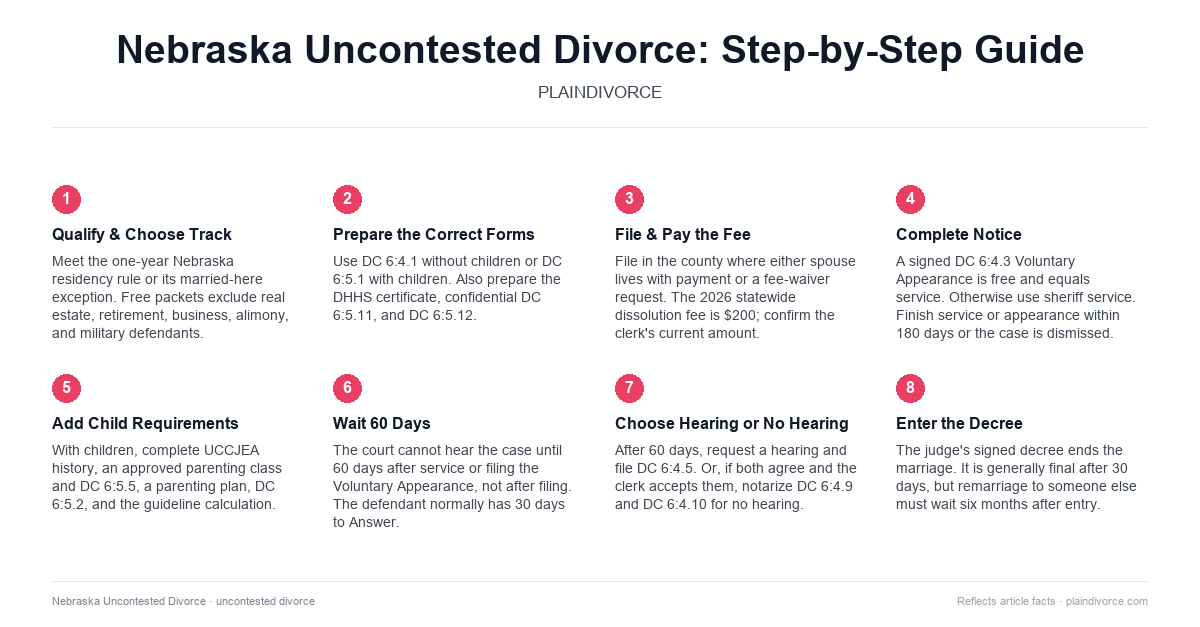
1. What Uncontested and Simple Divorce Mean in Nebraska
Nebraska calls divorce dissolution of marriage. A district court judge ends the marriage by signing a Decree of Dissolution of Marriage. Your case is uncontested when both spouses agree the marriage is irretrievably broken and neither is asking the judge to settle a dispute about property, debts, alimony, custody, parenting time, or child support.
Simple Divorce is the Nebraska Judicial Branch’s own label for its two free self-help packets, Simple Divorce – No Children and Simple Divorce – With Children. These are not a separate case type. They are the standard dissolution process with plain-language instructions and the state court forms attached.
What the Simple Divorce packets exclude
The court’s own instructions say, in capital letters, not to use these forms unless your case clears every item below. This is the most important eligibility screen in Nebraska, and it is stricter than “we agree on everything.”
The Simple Divorce packets are NOT for you if any of these apply:
- You own real estate — a house, land, or a rental.
- Either spouse has a pension or retirement plan through a current or former employer, including a 401(k) or a public employee plan.
- Either spouse will ask for alimony.
- Either spouse runs an ongoing business.
- You cannot agree on who pays which debt.
- The spouse who will be the defendant is in the military — both complaint forms make you swear the defendant is not a member of the Armed Forces, and the court urges anyone with a service member on either side to talk to a lawyer because the Servicemembers Civil Relief Act changes how service and default work.
A house or a 401(k) does not make your divorce contested. It makes it too complex for the free packet. You can still settle everything by agreement — you will need decree language the packet does not provide, and a retirement account usually needs a separate qualified domestic relations order to divide it.
2. Who Qualifies: Residency, Grounds, and Fit
2.1 The one-year residency rule is jurisdictional
Under Neb. Rev. Stat. § 42-349, you cannot bring a dissolution action in Nebraska unless one of these is true:
- You or your spouse has actually lived in Nebraska for at least one year before the complaint is filed, with a bona fide intention of making Nebraska a permanent home; or
- The marriage was solemnized in Nebraska and either party has resided in Nebraska from the time of the marriage to the filing of the complaint — no one-year wait in that case.
This is jurisdictional, not procedural. A Nebraska district court has no authority to grant your divorce if neither test is met, no matter how completely you and your spouse agree. A member of the U.S. armed forces continuously stationed at a Nebraska base or installation for one year is deemed a Nebraska resident for this purpose. You file in the district court of the county where you or your spouse lives.
2.2 The only ground: the marriage is irretrievably broken
Nebraska is a no-fault state. Under § 42-361, the judge makes one finding: whether the marriage is irretrievably broken. When both spouses swear that it is, and both certify they made every reasonable effort to reconcile, that finding is straightforward. You do not plead adultery, cruelty, or abandonment, and doing so gains you nothing.
2.3 Is your case a practical fit for DIY?
- Both of you want the divorce and can exchange paperwork without conflict.
- You have disclosed your finances to each other honestly and completely.
- If you have children under 19, you agree on custody and parenting time, and both of you will complete a parenting education course.
- No one is being pressured, threatened, or misled.
- Your case clears the exclusion list in Section 1.
3. Step by Step: The Nebraska Uncontested Divorce Process
Nebraska runs two parallel form sets. Pick your track before you download anything, because the complaint and decree numbers differ.
| Document | No children under 19 | With children under 19 |
|---|---|---|
| Complaint for Dissolution of Marriage (Nebraska) | DC 6:4.1 | DC 6:5.1 |
| Decree of Dissolution (Nebraska template) | DC 6:4.6 | DC 6:5.3 |
| Answer & Counterclaim (defendant, optional) | DC 9:1 | DC 10:1 |
| Voluntary Appearance form (Nebraska DC 6:4.3) | DC 6:4.3 | DC 6:4.3 |
| Confidential forms (both required) | DC 6:5.11 + DC 6:5.12 | DC 6:5.11 + DC 6:5.12 |
| Vital statistics | DHHS Certificate of Dissolution (worksheet HHS-73) | DHHS Certificate of Dissolution (worksheet HHS-73) |
Download the current PDFs from the Nebraska Judicial Branch’s court forms library and the vital-statistics worksheet from the Department of Health and Human Services. Check the revision date in the form footer against what the clerk expects.
Step 1 — File the opening documents together
One spouse (the plaintiff) opens the case. Nebraska clerks expect all of these at the counter, plus payment or a fee-waiver request:
- Complaint for Dissolution of Marriage — DC 6:4.1 (no children) or DC 6:5.1 (with children). The with-children complaint is signed in front of a notary; the current no-children complaint is signed under penalty of perjury without a notary. Read your form’s signature block before you go.
- Vital Statistics Certificate of Dissolution of Marriage — completed from the DHHS worksheet (HHS-73). This is a DHHS vital-records form, not a “DC” court form, which is why filers miss it. Nebraska law makes completing it a prerequisite to the final decree. Write “unknown” in any box you genuinely cannot fill after trying.
- Confidential Employment and Health Insurance Information (DC 6:5.11).
- Social Security, Gender, Birth Date(s) (DC 6:5.12).
DC 6:5.11 and DC 6:5.12 are two separate confidential forms, and both are required in both tracks — children or no children. Most states fold this data into one sheet; Nebraska does not. These forms stay out of the public record, which is why your Social Security number must never appear on the complaint itself. Self-represented filers also give the court an email address under Nebraska Court Rule § 2-208 (or check the box explaining why they cannot), and must file a Change of Contact Information form if it changes.
If you cannot afford the fee, file the Affidavit and Application to Proceed In Forma Pauperis (DC 6:7.1) with the proposed Order (DC 6:7.2). Your case is not considered filed until the judge grants the waiver or you pay.
Step 2 — Use the Voluntary Appearance to skip service fees
You must formally notify your spouse that the case exists. You have three options; the first is free and fastest.
- Voluntary Appearance (DC 6:4.3). Give your spouse the form and a copy of the complaint. Your spouse signs, and either of you files it with the clerk. Under § 25-516.01, a voluntary appearance is the legal equivalent of service. Cost: nothing.
- Praecipe for Summons (DC 6:4.4). The sheriff serves your spouse. You pay the sheriff’s fee in advance by money order, in your spouse’s county if they live elsewhere.
- Service by publication. A last resort when your spouse cannot be found. With publication service the court can end the marriage but generally cannot award alimony, and in a case with children it may not be able to order child support.
Hard deadline: 180 days to complete service
If your spouse is not properly served — and no signed Voluntary Appearance is filed — within 180 days of the day you file the complaint, the action is dismissed by operation of law under § 25-217. The dismissal is without prejudice and takes effect the day after the 180 days run, but you start over, filing fee included. Filing the complaint alone preserves nothing.
Step 3 — The 60-day clock starts from service, not filing
Neb. Rev. Stat. § 42-363 is one sentence: no suit for divorce shall be heard or tried until 60 days after perfection of service of process. Nebraska courts treat this waiting period as jurisdictional — a decree that rests on evidence taken at a hearing held before the 60 days ran is void, even if the decree itself is signed later.
The date your complaint was filed does not matter to this clock. The start date is set this way:
- Voluntary Appearance: the 60 days begin the day after the signed form is filed with the clerk.
- Sheriff service: the day after the sheriff personally serves your spouse.
- Publication: the day after the notice last ran in the legal newspaper.
Separately, your spouse has 30 days after service (or after the Voluntary Appearance is filed) to file an Answer. In most agreed cases filing one is optional — but the defendant must file the Answer and Counterclaim (DC 9:1 or DC 10:1) to ask for a former name to be restored.
Step 4 — Draft the decree
In Nebraska the agreement generally goes into the decree rather than into a separate settlement agreement attached to it. Your Decree of Dissolution (DC 6:4.6 or DC 6:5.3) sets out the division of property and debts, any name restoration, and — in a case with children — custody, parenting time, and child support, with the parenting plan and the child support worksheet attached. Keep Social Security numbers, account numbers, and dates of birth out of it. Some counties also want a notarized property and liability statement; ask the clerk whether yours does.
Step 5 — Hearing, or no hearing
Two paths. On the hearing route, ask the clerk for a date once the 60 days have run, file a Notice of Hearing (DC 6:4.5), and mail a copy to your spouse. You testify under oath — briefly — and the court’s Instructions for Your Divorce Hearing (DC 6:4) reads like a script you can follow. Bring completed copies of the decree. Or you skip the courtroom entirely, which is Section 4.
4. Skipping the Final Hearing Under Section 42-361(3)
This is the most underused provision in Nebraska self-help divorce. Section 42-361(3) lets the court enter a decree with no hearing, 60 days or more after service, when every one of these is true:
- Both parties waive the hearing requirement in writing.
- The court has a sufficient basis for subject-matter jurisdiction and personal jurisdiction over both parties.
- Both parties certify in writing that the marriage is irretrievably broken and that they made every reasonable effort to reconcile.
- All documents required by the court and by statute have been filed.
- The parties have a written agreement, signed by both under oath, resolving every issue raised by the pleadings.
Two forms carry this, and both are signed in front of a notary: DC 6:4.9 (Plaintiff’s Request for Dissolution of Marriage/Divorce Decree Without Hearing) and DC 6:4.10 (the defendant’s version). Both apply to the with-children and no-children form sets. The current forms (revised 2026) list nine certifications; an Answer is not one of them, and neither the statute nor the forms require the defendant to have filed one. The statute says the court “may” enter the decree, so this is discretionary — ask your clerk directly whether your district accepts DC 6:4.9 and DC 6:4.10, and what it wants filed with them. If the answer is no, you take the hearing route.
5. If You Have Children: Disclosures, Classes, Parenting Plan, Support
A case with minor children can still be entirely uncontested. It carries extra requirements, and the judge reviews the paperwork more closely because the children’s best interests are the court’s responsibility, not yours to waive. “Minor” here means under 19 — Nebraska’s age of majority.
5.1 The complaint asks for UCCJEA custody history
The with-children complaint (DC 6:5.1) has a section that trips up people who treat it as a fill-in-the-blank form. Under the Uniform Child Custody Jurisdiction and Enforcement Act, you must state:
- Every address each child has lived at for the last five years, and the name and current address of each person the child lived with.
- Whether you have been a party or a witness in any other case about custody of or parenting time with these children.
- Whether you know of any other proceeding that could affect this action — including domestic violence, protection orders, termination of parental rights, and adoptions.
- The names and addresses of anyone other than the two of you who has physical custody of the children or claims custody or parenting-time rights.
Answer these in full. A blank or “n/a” where the form expects a five-year history is a common reason a child-custody complaint comes back.
5.2 Parenting education the court must order
Neb. Rev. Stat. § 43-2928 says the court shall order all parties to a Parenting Act proceeding to attend a basic-level parenting education course — both parents, not just the filer. The court may delay or waive it for good cause, and may order a second-level course where abuse, neglect, or unresolved conflict is identified.
- Use a provider from the State Court Administrator’s approved list. A course that is not on the list does not count.
- File the Certificate of Completion of Parenting Education Course (DC 6:5.5), with the provider’s paperwork, before the final hearing.
- Book the class the week you file. It is the requirement most likely to be sitting unfinished when everything else is ready.
5.3 A parenting plan that meets the statute
You must produce a written parenting plan, and it is attached to and incorporated into the decree. Picking the right custody label is only the start. Section 43-2929 requires the plan to cover:
- Legal custody and physical custody of each child.
- A parenting-time, visitation, or access schedule detailed enough to be enforced — including holidays, birthdays, school vacations, and telephone or electronic contact.
- Where the child is on weekdays, weekends, and specific dates through the year; times and places for transfers; and who handles transportation.
- How day-to-day and major decisions get made, and a remediation process for future disputes and modifications.
- Provisions for the safety of everyone involved, provisions to keep the child in school and progressing, and a duty to keep each other informed of address changes.
The court publishes three template plans — joint legal and joint physical (DC 6:5.37), joint legal and sole physical (DC 6:5.38), and sole legal and sole physical (DC 6:5.39). Treat a template as a starting point you complete for your family, not a box that is automatically compliant. If you file no plan, the judge writes one, and it will fit your family less well than yours.
5.4 Child support: the worksheet, the payment center, the decree terms
Nebraska sets support under the Nebraska Child Support Guidelines. You file a Financial Affidavit for Child Support (DC 6:5.2) and bring a completed guideline calculation to the hearing. A worksheet showing that calculation is attached to the decree.
The guidelines are a rebuttable presumption under § 42-364.16 — presumed to be in the child’s best interests unless a party produces enough evidence to rebut it. A judge can reject a support figure the two of you agreed on if it departs from the guideline number without a stated basis. Joint physical custody changes the calculation, sometimes substantially.
The child-support decree (DC 6:5.3) is not just a dollar amount. Its standard provisions:
- Payments go to the Nebraska Child Support Payment Center, P.O. Box 82600, Lincoln, NE 68501-2600 — not directly between parents.
- Support ends the first day of the month after the child turns 19, marries, is emancipated, or dies, or on further court order.
- One parent provides health insurance for the children; the decree splits the first $250 per child per year of medical costs and a stated percentage of anything above that, plus a percentage of work-related childcare.
- If support runs a month behind, income withholding applies, and the paying parent can be ordered into court to explain.
- Both parents must keep the clerk updated on address, phone, employer, and health-insurance information until any support judgment is paid in full. Failure is punishable by contempt.
6. How Long a Nebraska Uncontested Divorce Takes
The floor is the 60-day statutory waiting period. On top of that, you wait for the court to schedule a hearing or to review a no-hearing request, and — in a case with children — for parenting education to be done. Realistically that is a few months for a clean filing, longer if paperwork bounces or the docket is busy. The exact pace depends on your county and its calendar; the clerk can tell you the current wait for a hearing date.
The Nebraska timeline, in order
- Before day one: one full year of Nebraska residency (or married here and resident since).
- Day 0: file the complaint, the vital statistics certificate, DC 6:5.11 and DC 6:5.12, and pay or request a waiver.
- Day 0–180: complete service or file the Voluntary Appearance. Miss this and the case is dismissed by operation of law.
- Clock starts: the day after service or the day after the Voluntary Appearance is filed.
- +30 days: the defendant’s deadline to file an Answer (optional in most agreed cases).
- +60 days: the earliest the case may be heard, or the earliest a no-hearing decree may be entered under § 42-361(3).
- Decree entered: the marriage is dissolved.
- +30 days after the decree: the decree is final and operative for most purposes (an appeal within 30 days that challenges the irretrievable-breakdown finding delays that).
- +6 months after the decree: the earliest either of you may marry someone other than each other, and the point the health-insurance-continuation rule keys to.
The six-month remarriage rule
This one catches people, so state it flatly. Under Neb. Rev. Stat. § 42-372.01, for purposes of remarriage to anyone other than your former spouse, the decree does not become final until six months after it is entered, or on the death of one party, whichever comes first. You cannot marry someone new anywhere in the world until that six months has passed. The same six-month mark governs continuation of health insurance coverage.
When the decree is final
The judge’s signature ends the marriage. For most other purposes — enforcing the property and debt terms, for example — the decree becomes final and operative 30 days after it is entered under § 42-372.01. A decree is appealable as soon as it is entered; if someone appeals within 30 days and challenges the finding that the marriage is irretrievably broken, finality of the decree is delayed until that appeal is resolved. How you file taxes for the year is a separate, federal question — ask a tax professional or check IRS guidance rather than assuming.
7. What an Uncontested Divorce Costs in Nebraska
The single number you can count on is the district court filing fee. The Nebraska Judicial Branch’s Filing Fees and Court Costs schedule, effective July 1, 2026, lists $200 for a dissolution of marriage — that bundles a mediation fund fee and a child-abuse-prevention fee on top of the general civil charges. Some county pages still show older totals in the $158–$164 range, so confirm the exact amount and who the check is payable to with your county clerk before you go. Never mail cash. If you cannot afford it, ask the judge to waive fees with DC 6:7.1 and DC 6:7.2.
| Item | Typical cost | Can you avoid it? |
|---|---|---|
| District court filing fee (dissolution) | About $200 — confirm with your clerk | Only with a granted fee waiver (DC 6:7.1 / DC 6:7.2) |
| Sheriff service | Set by county; paid in advance by money order | Yes — use the Voluntary Appearance (DC 6:4.3) |
| Notary | Varies; many banks and libraries notarize free for customers | Not for forms that must be notarized (the with-children complaint, DC 6:4.9 / DC 6:4.10) |
| Certified copies of the decree | A small per-copy fee set by the clerk | No — get at least one; you need it to change your name or a title |
| Parenting education course | Set by the provider; each parent pays their own | No, in a case with children (unless the court waives it) |
| Publication service | Newspaper rates | Only relevant if your spouse cannot be found |
The Voluntary Appearance is the biggest lever you control. It removes the sheriff’s fee entirely and starts the 60-day clock the day after it is filed, instead of whenever a deputy happens to catch your spouse at home.
8. Mistakes That Get Nebraska Filings Rejected or Delayed
- Filing one confidential form instead of two. DC 6:5.11 and DC 6:5.12 are separate documents. Sending one leaves your filing incomplete.
- Forgetting the vital statistics certificate. It comes from the DHHS worksheet, not the court’s forms page, so people never find it. Nebraska law makes it a prerequisite to the decree.
- Assuming the 60 days runs from the filing date. It runs from service or the Voluntary Appearance. Filing early and serving late wastes the gap.
- Letting the 180-day service deadline pass. Dismissal by operation of law, and you pay the filing fee again.
- Using the free packet with a house, a retirement account, a business, or an alimony request. The court’s instructions exclude all of these.
- Leaving the UCCJEA history blank. The with-children complaint needs the full five-year address history for each child and the other custody-proceeding disclosures.
- Taking a parenting class that is not court-approved. Check the State Court Administrator’s list before you pay.
- Showing up without a completed child support calculation. Parents are expected to arrive with the guideline math done, alongside DC 6:5.2.
- Putting Social Security numbers, account numbers, or birthdates in the public decree. Local rules bar that data from the public record.
- Not asking for name restoration in the right document. The plaintiff requests it in the complaint; the defendant must file the Answer and Counterclaim. Adding it after the decree means a separate name-change case.
9. County Notes: Douglas, Lancaster, and Sarpy
Every Nebraska district court has its own local rules, and the Judicial Branch warns that ignoring them can stop you from finishing your case. Nebraska’s three largest counties sit in three different judicial districts.
Douglas County (Omaha) — Fourth Judicial District
- The district court runs its own site with local affidavits and procedures; check it in addition to the statewide forms.
- Local Rule 4-3, as amended through April 22, 2026, keeps Social Security numbers, account numbers, dates of birth, and vehicle identification numbers out of any publicly filed document, and requires real estate to be described by legal description as well as street address.
- Evidence on temporary support generally comes in by affidavit, capped at 10 pages, with the moving party’s affidavits due 48 hours before the hearing and responses 24 hours before — with a carve-out for a self-represented party who needs to testify live.
- Douglas County uses child support referees for many support matters; you have 14 days to file exceptions to a referee’s report.
Lancaster County (Lincoln) — Third Judicial District
- Lancaster County District Court publishes its own pro se divorce packet, separate from the statewide forms; paper copies are at the Clerk of the District Court, 575 S. 10th Street, 3rd Floor, Lincoln.
- The Third Judicial District’s local rules include appendix forms — a pretrial memorandum, a proposed balance sheet, a holiday parenting-time schedule — that the district publishes for use in its courts. Ask the clerk which apply to an agreed case.
Sarpy County (Papillion) — Second Judicial District
- The Second Judicial District covers Sarpy and Cass counties.
- Sarpy has a large Offutt Air Force Base population. If the spouse to be served is active-duty, you cannot use the statewide complaint forms, and if either spouse is a service member the court urges you to consult a lawyer — the Servicemembers Civil Relief Act changes how default and service work.
In any county, three questions to the clerk save weeks: Do you accept DC 6:4.9 and DC 6:4.10 for a decree without hearing? Do you have a local property statement form? How do I get a hearing date? Clerks cannot give legal advice, but they can answer all three.
10. When a DIY Divorce Is the Wrong Call
Do not file on your own if there is abuse, intimidation, or coercion; if you suspect hidden assets or have never seen the full financial picture; if the spouse to be served is in the military; if you own real estate or a business, or either of you has a pension or retirement account; if there is real disagreement about custody; or if immigration status, taxes, or means-tested benefits are in play.
Two middle options sit between full representation and going it alone. Limited scope representation lets you hire a Nebraska attorney for one piece of the case — reviewing your decree, say — rather than the whole thing. And Legal Aid of Nebraska runs a free guided-interview tool that assembles the same forms and that the Judicial Branch recommends over the plain PDFs.
11. Where a Self-Help Divorce Kit Fits In
Nebraska’s free materials are genuinely good. What they do not do is tell you what happens in what order, which document triggers which deadline, or what your specific county expects. That sequencing is where DIY filers lose months:
- Choosing the right track and the right complaint — DC 6:4.1 or DC 6:5.1
- Filing the opening documents together, including the DHHS vital statistics certificate
- Using the Voluntary Appearance to eliminate service costs and start the clock on your schedule
- Deciding early whether you are taking the § 42-361(3) no-hearing route, and lining up DC 6:4.9 and DC 6:4.10
- Getting parenting education booked in week one and DC 6:5.5 filed before it holds anything up
- Writing a decree whose terms are complete, internally consistent, and free of confidential data
A kit is not legal advice and does not replace a lawyer when you need one. For couples who genuinely agree, it removes the guesswork that causes rejected filings.
Download Our Nebraska Uncontested Divorce Self-Help Kit
12. Frequently Asked Questions
What is the residency requirement for divorce in Nebraska?
You or your spouse must have actually lived in Nebraska for at least one year before the complaint is filed, with the intent to make Nebraska a permanent home. There is one alternative: if the marriage was solemnized in Nebraska and either party has lived here continuously from the marriage to the filing, the one-year wait does not apply. A service member stationed continuously at a Nebraska base for a year counts as a resident. The rule is jurisdictional, so the court cannot grant the divorce without it.
How long does an uncontested divorce take in Nebraska?
At least 60 days — the statutory waiting period, which runs from the day after service or the day after the Voluntary Appearance is filed, not from the filing of the complaint. After that you wait for the court to schedule a hearing or review a no-hearing request, and for parenting education in a case with children. A clean, fully agreed case is often done in a few months; the exact time depends on your county’s calendar.
What does it cost to file for divorce in Nebraska?
The statewide Filing Fees and Court Costs schedule effective July 1, 2026 lists about $200 for a dissolution of marriage. A few county pages still show older totals near $160, so confirm the current figure and the payee with your county clerk. Sheriff service, notary fees, certified copies, and parenting education are separate and depend on where you file and which provider you use. If you cannot afford the fee, file DC 6:7.1 and DC 6:7.2 to ask the judge to waive it.
Can I get divorced in Nebraska without going to court?
Yes, under Neb. Rev. Stat. § 42-361(3). Sixty days or more after service, the court may enter your decree without a hearing if both of you waive the hearing in writing, both certify the marriage is irretrievably broken and that you tried to reconcile, all required documents are on file, and you have a written agreement signed by both of you under oath resolving every issue. You file notarized Forms DC 6:4.9 and DC 6:4.10. Because the statute says the court “may,” confirm with your clerk that your district accepts them.
What is a Voluntary Appearance?
The Voluntary Appearance form (Nebraska DC 6:4.3) is a document the defendant spouse signs to acknowledge the case and accept notice of it. Once it is filed with the clerk, it is the legal equivalent of formal service under § 25-516.01 — so there is no sheriff fee — and the 60-day waiting period and the 30-day Answer period both start the day after it is filed. It does not waive any of the defendant’s rights in the case; it only handles notice.
Do both spouses have to sign the divorce papers?
No. One spouse files the complaint. Your spouse’s cooperation is what makes the case uncontested, and signing the Voluntary Appearance saves service fees — but a divorce can proceed without that signature through sheriff service or, as a last resort, publication. A no-hearing decree does require both signatures, on the written agreement and on DC 6:4.9 and DC 6:4.10.
How soon can I remarry after a Nebraska divorce?
Six months after the decree is entered, under Neb. Rev. Stat. § 42-372.01, unless you are remarrying your former spouse or the other party has died. This applies no matter where in the world the new marriage takes place. The same six-month mark is when the health-insurance-continuation rule keys in.
When is my Nebraska divorce final?
The marriage ends when the judge signs the decree. For most other purposes the decree becomes final and operative 30 days after it is entered, under § 42-372.01. A decree can be appealed as soon as it is entered; an appeal within 30 days that challenges whether the marriage is irretrievably broken delays finality until the appeal is decided. Remarriage to a new partner and health-insurance continuation have their own six-month rule. How you file taxes is a federal question for a tax professional.
Do we both have to take a parenting class?
Yes. Neb. Rev. Stat. § 43-2928 directs the court to order all parties to a Parenting Act proceeding to attend a basic-level parenting education course, and it must be from the State Court Administrator’s approved provider list. The court can delay or waive it for good cause. File the Certificate of Completion (DC 6:5.5), with the provider’s paperwork, before the final hearing.
We own a house. Can we still do this ourselves?
Not with the free Simple Divorce packet — the court’s instructions exclude real estate outright, along with pensions, retirement plans, businesses, and alimony requests. Your case can still be fully agreed; it just needs decree language the packet does not supply, and a retirement account typically needs a separate qualified domestic relations order to divide it without tax consequences.
Can I get my former name back?
Yes, at no extra cost — but you must ask in the right document. The plaintiff requests it in the complaint; the defendant requests it by filing the Answer and Counterclaim (DC 9:1 or DC 10:1). Asking after the decree is signed means a separate name-change case. Order a certified copy of the decree; the Social Security Administration, the DMV, and your bank will each generally want one.
What if my spouse ignores the paperwork?
Your spouse is not required to file an Answer. If they were properly served and do nothing, the case can still proceed after the 60 days. What you cannot let slide is service itself: if no service is completed and no Voluntary Appearance is filed within 180 days of filing the complaint, the case is dismissed by operation of law and you start over.
13. Your Filing Checklist
- Confirm one of you meets the one-year residency rule under § 42-349 (or the in-state-marriage alternative).
- Check your case against the exclusion list: no real estate, no pension or retirement plan, no business, no alimony request, and the spouse to be served is not in the military.
- Pick your track and download the right complaint — DC 6:4.1 or DC 6:5.1.
- File the opening documents together: complaint, vital statistics certificate, DC 6:5.11, DC 6:5.12 — with the fee or a waiver request.
- Get the Voluntary Appearance (DC 6:4.3) signed and filed. Note that date; the 60 days start the next day.
- With children: complete the UCCJEA history on the complaint, book an approved parenting class this week, then file DC 6:5.5.
- With children: prepare a statute-compliant parenting plan, DC 6:5.2, and a completed guideline child support calculation.
- Draft the decree — DC 6:4.6 or DC 6:5.3 — with no Social Security numbers, account numbers, or birthdates in it.
- Decide hearing vs. no hearing, and call the clerk to confirm what your county accepts.
- After the decree: order a certified copy, and calendar the 30-day and six-month dates.
PlainDivorce is not a law firm and this is not legal advice. This guide is general information about the uncontested divorce process in Nebraska. Statutes, court forms, fees, and local rules change — verify the current versions with the Nebraska Judicial Branch and your county clerk, and talk to a licensed Nebraska family-law attorney about your situation.
Last reviewed September 2026 against Neb. Rev. Stat. §§ 25-217, 25-516.01, 42-349, 42-353, 42-361, 42-363, 42-364.16, 42-372, 42-372.01, 43-2928, and 43-2929; the Nebraska Judicial Branch Filing Fees and Court Costs schedule (effective July 1, 2026); Douglas County Local Rule 4-3 (amended through April 22, 2026); and Nebraska State Court Forms DC 6:4.1 (Rev. 05/2026), DC 6:5.1 (Rev. 03/2022), DC 6:5.3 (Rev. 05/2020), and DC 6:4.9 (Rev. 05/2026). Confirm current forms, fees, and local procedure with your Clerk of the District Court before filing.
Sources and local rules can change. Use this guide as a plain-English organizer, then verify the current filing requirements with the official court or government source for your jurisdiction.

About Harry D
Expert contributor at PlainDivorce, helping Canadians and American navigate simple uncontested divorces with clarity and confidence.