Uncontested Divorce in Nevada: The Joint Petition Guide (2026)
An uncontested divorce in Nevada is one where both spouses agree the marriage is over and have already settled every term — property, debts, spousal support, and any child issues. When you agree, the fastest route is a Joint Petition for Divorce under the summary procedure in NRS 125.181–125.184. Both spouses file together as co-petitioners, so there is normally no service of process: no sheriff, no process server, no response deadline.
The speed comes from the paperwork being clean. A missing cover sheet, a defective resident-witness affidavit, an un-notarized petition, or a skipped decree-submission step can leave your case sitting for weeks. This guide covers who qualifies under the seven summary-decree conditions, which Nevada Joint Petition for Divorce forms you need, the Resident Witness Affidavit Nevada requirements that trip up most DIY filers, what it costs in Clark and Washoe Counties, and the administrative steps that stall otherwise-simple cases.
If one spouse has lived in Nevada for at least six weeks, a third-party resident witness will sign a sworn statement about it, and you agree on everything, you can file a joint petition for a $299 filing fee in Clark County or $284 in Washoe County, and there is no statutory waiting period past the six weeks. The two things that go wrong: an incomplete or un-notarized packet, and forgetting the step that routes your proposed decree to a judge. The trade-off for the speed is that the summary procedure requires you to waive your right to appeal and to written notice that the decree was entered.
- Residency: one spouse must live in Nevada for at least 6 weeks before filing (NRS 125.020), with a narrow exception if the cause arose in the county while both spouses were domiciled there.
- Proof of residency: a third party — not either spouse — signs an Affidavit of Resident Witness under penalty of perjury.
- Grounds: incompatibility, or living separate and apart for 1 year without cohabitation. Nevada is no-fault.
- Path: a joint petition is the summary procedure and avoids service; an agreed complaint is the fallback when you cannot meet all seven conditions.
- Notarization: the current statewide Joint Petition must be signed by both spouses in front of a notary.
- Cost: $299 filing fee in Clark County, $284 in Washoe County. Other charges (e-filing upload, certified copies) are county- and portal-specific.
- Trade-off: you waive appeal, written notice of entry, findings of fact, and a new-trial motion.
Last reviewed: September 2026. Court fees, forms, and local procedures change — verify current requirements with your district court clerk before filing.
1. What Counts as an Uncontested Divorce in Nevada
A Nevada divorce is “uncontested” when both spouses agree the marriage should end and have already settled every material term: property, debts, spousal support, and — if there are children — legal and physical custody, parenting time, child support, and health coverage. Nothing is left open for a judge to decide.
Nevada gives agreeing couples two ways to get there, and the choice drives your cost and timeline more than anything else.
Joint petition vs. complaint at a glance
| Joint Petition (summary decree) | Complaint for Divorce | |
|---|---|---|
| Who files | Both spouses together, as co-petitioners | One spouse, as plaintiff |
| Service of process | Not required | Required, unless the other spouse signs an acceptance or waiver of service |
| Response deadline | None | Yes — the other spouse has a set window to answer |
| Signing | Both spouses sign the petition before a notary | Plaintiff verifies the complaint; defendant’s acceptance/waiver is usually notarized |
| Rights waived | Appeal, written notice of entry, findings of fact, new-trial motion | None automatically |
| Best for | Couples who fully agree, can both sign, and meet all seven NRS 125.181 conditions | One spouse is unreachable or unwilling to sign, or a summary-decree condition is not met |
Either way, the document that ends your marriage is a Decree of Divorce. You are not divorced when you file. You are divorced when a judge signs the decree and the clerk enters it in the record with a file stamp.
2. Do You Qualify? Residency, Grounds, and the Summary-Decree Checklist
Nevada’s 6-week residency rule (and the one exception)
Under NRS 125.020, a Nevada district court generally cannot grant a divorce unless one spouse has been a Nevada resident for at least 6 weeks before the case is filed. Six weeks means 42 days of actual physical presence in the state — not a mailing address, not a plan to move. This is the route nearly everyone uses.
The statute opens with a narrow exception: the residency requirement does not apply if “the cause of action accrued within the county while the plaintiff and defendant were actually domiciled therein.” In plain terms, if the grounds for the divorce arose in a Nevada county while both spouses were genuinely living there, the six-week clock is not the gatekeeper. Most couples still rely on the six-week rule and the resident-witness affidavit because it is simpler to prove.
Which county do you file in?
NRS 125.020 lets you file in the district court of any county where the cause arose, where either spouse resides or can be found, where you last lived together, or where the resident spouse has lived for six weeks before filing. In practice, most couples file where the resident spouse lives — the Eighth Judicial District Court for Clark County (Las Vegas) or the Second Judicial District Court for Washoe County (Reno). County procedures and form titles differ, so pick your county first and use that court’s joint-petition packet.
Grounds: Nevada is a no-fault state
You do not have to prove anyone did anything wrong. Under NRS 125.010, the grounds used in nearly every agreed case are:
- Incompatibility — the marriage cannot be repaired. This is the default choice, and it is the ground pre-printed on the statewide Joint Petition form.
- Living separate and apart for 1 year without cohabitation. (A third ground, insanity existing for two years, is rarely used.)
The seven conditions for a summary decree (NRS 125.181)
A joint petition is Nevada’s summary procedure. The current statewide Joint Petition forms open by certifying, under oath, “that every condition of NRS 125.181 has been met.” So all seven of these must be true when you file:
- One spouse meets the NRS 125.020 jurisdiction requirement.
- You are incompatible, or you have lived separate and apart for 1 year without cohabitation.
- There are no minor children of the relationship and the wife is not pregnant to her knowledge — or you have a signed agreement covering custody and the amount and manner of child support.
- There is no community or joint property — or you have a signed agreement dividing property and debts, plus any deeds, titles, or bills of sale needed to carry it out.
- You both waive spousal support — or you have a signed agreement setting the amount and manner of support.
- You both waive your rights to written notice of entry of the decree, to appeal, to request findings of fact and conclusions of law, and to move for a new trial.
- You both want the court to enter a decree of divorce.
If a condition does not fit — say the property split is not finalized, or one of you will not waive the appeal right — the joint petition is not available. You can still get an agreed divorce, but it proceeds as a Complaint for Divorce with a signed acceptance or waiver of service. Ask your district court’s self-help center or clerk which packet applies to your situation.
3. Resident Witness Affidavit: Nevada Requirements
Nevada does not take your word for residency. NRS 125.182 requires an affidavit corroborating residency to accompany the joint petition. Counties call the form an Affidavit of Resident Witness or a Declaration of Resident Witness. Getting it wrong is one of the more common reasons a Nevada DIY packet is rejected, so it is worth getting exactly right.
The witness must be someone other than either spouse. On the statewide Nevada Supreme Court form, the witness signs a declaration under penalty of perjury (NRS 53.045) — there is no notary block on that form — and states all of the following:
- They are over 18 and competent to testify from personal knowledge.
- They live in Nevada, at a stated address, and intend to stay for the foreseeable future.
- They personally know the spouse lives at a stated Nevada address and has been physically living in Nevada on a daily basis for at least six weeks before filing.
- The date the spouse’s physical residence in Nevada began.
- Roughly how many times per week they see that spouse, and how they know them.
- That the spouse is a bona fide Nevada resident.
A landlord, roommate, neighbor, coworker, or close friend who actually sees you regularly can sign. The form asks how often the witness sees you and how they know you, so the witness needs real, current contact with the resident spouse — not a one-time acquaintance.
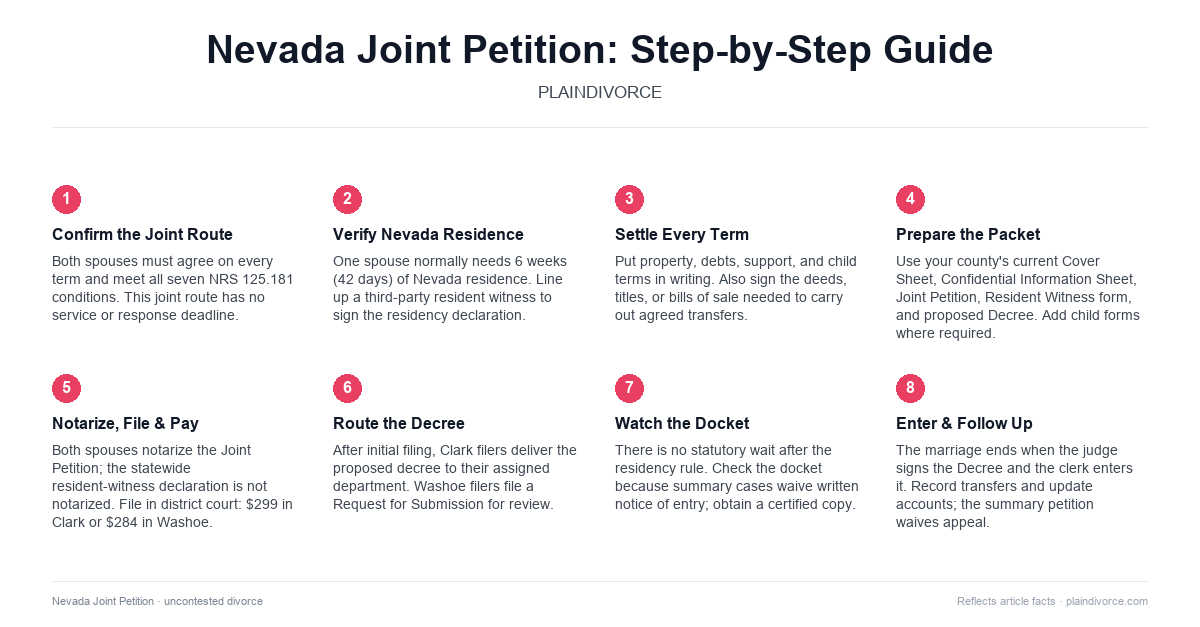
4. Nevada Joint Petition for Divorce Forms: Step-by-Step
County procedures vary. Use this as the map, and your local district court’s joint-petition packet as the turn-by-turn directions.
Step 1 — Confirm eligibility and line up the witness
Check the 6-week residency, run through the seven NRS 125.181 conditions, and identify a resident witness who can truthfully sign.
Step 2 — Put the whole agreement in writing
Every asset, every debt, every schedule. Nevada allows two approaches: write the terms directly into the joint petition, or sign a separate marital settlement agreement and attach it to the petition as an exhibit. Either works — what fails is leaving something to figure out later.
Do not stop at listing who gets what. Condition #4 requires that you also sign the deeds, certificates of title, and bills of sale needed to actually transfer things. A decree saying you get the truck does not retitle the truck.
Step 3 — Prepare your Nevada Joint Petition for Divorce forms
Pull the current versions from your district court or the Nevada Supreme Court Self-Help Center. A typical no-children packet includes:
- Family Court Cover Sheet — the data form that opens the case.
- Confidential Information Sheet (NV) — filed as its own separate document so Social Security numbers, dates of birth, and other private identifiers stay out of the public record. When e-filing, upload it as a standalone PDF under its own filing code, not merged into the petition.
- Joint Petition for Divorce (No Children, or the With Children / UCCJEA version), signed by both spouses and notarized.
- Affidavit / Declaration of Resident Witness — see Section 3.
- Decree of Divorce — your proposed final order for the judge to sign, matching the petition.
NRS 125.182 also requires the petition to state the date and place of the marriage, both mailing addresses, whether there are minor children or a pregnancy, and whether a spouse wants a maiden or former name restored. If you have minor children, the packet grows substantially — see Section 5.
Step 4 — Sign and notarize
The current statewide Joint Petition carries a verification for each spouse with a notarial acknowledgment. Both spouses must sign the petition in front of a notary. Do not sign it at the kitchen table and mail it in — an un-notarized petition gets handed back. The resident-witness form, by contrast, is signed under penalty of perjury and needs no notary on the statewide version. Bring photo ID to the notary; many banks and shipping stores notarize for a few dollars.
A word on the Decree of Divorce Nevada template you found online
Search for a Decree of Divorce Nevada template and you will get plenty of generic fill-in-the-blank documents. Use them carefully. The decree is not a form you submit for approval — it is the order you are asking a judge to sign, and it has to match your petition line for line. Two rules:
- Start from your county’s version, not a generic one. Nevada publishes a Joint Petition Decree (No Children) and a Joint Petition Decree (With Children); Clark and Washoe have their own caption and department formatting. A decree formatted for the wrong court can be rejected.
- Reconcile it against the petition before filing. If the petition waives spousal support and the decree is silent, or the petition awards the house and the decree does not say how title transfers, the judge will not sign it.
Step 5 — File and pay
File with the district court clerk in your county, in person or through the county’s e-filing system, and pay the filing fee — $299 in Clark County, $284 in Washoe County. Clark’s self-help instructions add about $3.50 to upload the initial packet when you e-file, and tell you not to e-file the proposed decree with the initial documents — that comes in the next step. Washoe requires e-filing through eFlex, and both spouses need a free eFlex account. If you cannot afford the fee, ask the clerk about an Application to Proceed in Forma Pauperis (fee waiver).
Step 6 — Route the decree to a judge
Filing the petition does not automatically put your proposed decree on a judge’s desk. In both major counties you have to take one more step, and the mechanism differs:
- Clark County: after the initial filing, deliver the proposed decree to your assigned department — in person, by mail, or by email to that department’s inbox. Look up your department number on the court’s case portal.
- Washoe County: the joint-petition packet includes a Request for Submission that you file to tell the court the file is complete and ask the judge to review the decree.
Step 7 — Get the file-stamped decree
You are divorced when the judge signs the Decree of Divorce and the clerk enters it. Because a summary proceeding waives written notice of entry, check the docket yourself rather than waiting for mail. In Clark County, if the court returns the filed decree to only one spouse, that spouse must mail a copy to the other and file a Certificate of Mailing. Order at least one certified copy — you will need it for name changes, Social Security, retirement plans, benefits, and remarriage.
Get the Nevada Joint Petition Checklist & Kit
5. Special Issues When You Have Children
You can still file jointly with minor children, but the form is bigger and the judge has an independent duty to protect the children’s best interests regardless of what you two agreed. The statewide form is titled the Joint Petition for Divorce and UCCJEA Declaration (With Children), and it asks for a lot:
- UCCJEA declaration: each child’s address history for the last 5 years, any other custody or protection-order cases, and anyone outside the two parents who could claim custody or visitation. If the children have not lived in Nevada for the past six months, the court may not be able to enter custody orders.
- Legal and physical custody plus a parenting timeshare and holiday schedule attached as an exhibit. Spell out the weekly schedule, holidays, school breaks, and how exchanges happen. Vague plans get bounced back.
- Child support worksheet: you must attach a completed Child Support Guidelines Worksheet. If either parent’s gross monthly income is over $6,000, you use the Nevada Child Support Guidelines online calculator and attach that worksheet instead. You must run the calculation even if you agree that no one will pay support. As a rough sense of scale, the guideline base is 16% of one parent’s gross monthly income for one child, 22% for two, 26% for three, and 28% for four, with a low-income schedule below about $1,995/month — but the worksheet governs.
- Medical support: the petition requires medical, dental, and vision coverage for the children (Medicaid or private insurance), and it splits uncovered costs — copays, deductibles, unreimbursed expenses — with a 30-day rule for exchanging bills and reimbursing.
- Child care, arrears, public assistance, and the tax exemption each have their own section. If either parent has received public assistance, you generally cannot waive back child support without notifying the State.
- Income withholding: Nevada child-support orders generally carry an income-withholding provision unless a statutory good-cause or written-agreement exception applies.
Parenting-education classes (Clark County’s COPE seminar) and mediation are local and court-ordered, not a statewide requirement — Clark orders mediation only when custody is in dispute. If either parent may relocate out of state later, the decree carries statutory relocation-notice language; a future move may require the other parent’s written consent or a court petition, depending on the custody order.
6. How Long It Takes
Nevada has no statutory cooling-off period for joint petitions beyond the 6-week residency requirement. Once you file a clean packet and complete the decree-submission step, the timeline is driven by your county’s caseload and how promptly the assigned department reviews the decree — often a few weeks, sometimes a couple of months.
- What makes it fast: a complete packet, a valid resident-witness affidavit, a notarized petition, consistent names and dates across every form, and prompt submission of the proposed decree for review.
- What causes delays: missing cover sheet, un-notarized petition, defective resident-witness affidavit, terms that conflict between the petition and the proposed decree, unsigned pages, and skipping the submission step.
- The complaint route: add time for service (or a signed waiver) and the response window before anything else can happen.
One consistency check worth doing before you file: read the petition and the proposed decree side by side. If the decree says one thing about the 401(k) and the petition says another, the judge will not sign either.
7. What It Costs (Clark and Washoe County Fees)
| Item | Clark County (8th JD) | Washoe County (2nd JD) |
|---|---|---|
| Complaint or Joint Petition for Divorce (filing fee) | $299 | $284 |
| Answer / first appearance (complaint route only) | $217 | $202 |
| E-filing upload | About $3.50 to upload the initial packet | Through eFlex — check the portal |
| Certifying a copy prepared by the clerk | $3 | $3 |
| Page copies | $0.50 per page | $0.50 per page |
| First motion to modify/enforce a joint-petition decree | +$129 surcharge (NRS 19.0333) | Confirm with the clerk |
| Fee waiver available? | Yes — Application to Proceed in Forma Pauperis | Yes — Application to Proceed in Forma Pauperis |
The filing fee is the main cost. Notarization, printing, and certified copies add small amounts on top. Numbers above come from each court’s published fee schedule (Clark’s effective October 1, 2019; Washoe’s effective September 30, 2025). You will see other totals quoted online that bundle in estimated e-filing, copy, and processing charges — and because filing fees are set by statute and can change with a legislative session, confirm the current amount with your county clerk before you pay.
Where the real savings are: the joint petition itself. Filing together removes service of the initiating pleading, so there are no process-server fees, and you avoid the separate answer/appearance fee entirely. Note the flip side in the table: reopening a decree that started as a joint petition carries an extra surcharge in Clark County, which is one more reason to get the terms right the first time.
8. After the Decree: What People Forget to Do
The decree ends the marriage. It does not automatically retitle property or update accounts. Work through this list once you have your file-stamped copy:
- Order certified copies — at least two. Most agencies will not accept a plain printout.
- Confirm the mailing step. In Clark County, if only one of you received the filed decree, that spouse mails a copy to the other and files a Certificate of Mailing.
- Name restoration: if you elected it in the petition, the decree is your proof — update Social Security first, then your driver’s license, passport, and banks. NRS 125.130 lets the court restore a former name in the decree for just and reasonable cause, so if you asked for it but the decree left it out, ask the court about correcting the decree; a standalone name-change petition is the fallback.
- Record deeds for any real estate transferred, with the county recorder.
- Retitle vehicles at the DMV.
- Split retirement accounts. Dividing a 401(k) or pension usually requires a separate qualified domestic relations order (QDRO) that the plan administrator accepts. The decree alone is often not enough.
- Update beneficiaries on life insurance, retirement accounts, and payable-on-death designations.
- Separate joint debts and accounts. A decree assigning a credit card to your ex does not remove your name from the creditor’s contract.
- Sort out health insurance and check your tax filing status for the year.
9. When DIY Is the Wrong Call
Self-help forms save real money, and for a lot of couples they are the right tool. They are not right when the situation is not actually equal or simple. Talk to an attorney or a legal aid organization before signing anything if:
- There is domestic violence, threats, stalking, or any safety concern.
- One spouse controls the money or the information, and the other cannot negotiate freely.
- You are being pressured to sign quickly.
- There is a real dispute about the children, relocation, or jurisdiction.
- You have complex assets — a business, multiple properties, pensions, stock compensation — and you are not sure what is fair.
- Immigration status, disability benefits, military benefits, or significant taxes are in play.
- The agreement looks very one-sided, or you do not fully understand what you are giving up. This matters more in a summary proceeding, where you are also waiving your right to appeal.
A single consultation is far cheaper than reopening a decree. Nevada’s court self-help centers and legal aid organizations also provide free assistance to self-represented filers.
10. Where a Self-Help Kit Fits In
Nevada’s official self-help centers give you the forms for free, and you should use them. What they do not do is walk you through the sequencing — which is exactly where DIY filers lose weeks. The things that stall Nevada cases are the resident-witness affidavit, the cover sheet and Confidential Information Sheet, the notary step on the petition, and the submission step that routes your decree to a judge.
Our Nevada kit sits on top of the official forms and helps you:
- Decide between a joint petition and an agreed complaint, and confirm you meet all seven summary-decree conditions.
- Meet the Resident Witness Affidavit Nevada requirements the first time, with a witness script and a checklist.
- Assemble your Nevada Joint Petition for Divorce forms — including the cover sheet and the Confidential Information Sheet — into a complete, internally consistent, properly notarized packet so the clerk does not hand it back.
- Track the submission step so your decree actually reaches a judge — and know what to ask the clerk if it does not.
- Work the post-decree list: certified copies, the Certificate of Mailing, name restoration, deeds, titles, and beneficiaries.
Download the Nevada Uncontested Divorce Self-Help Kit
11. Nevada Uncontested Divorce FAQ
What is an uncontested or simple divorce in Nevada?
It is a divorce where both spouses agree the marriage should end and have settled every major term — property, debts, spousal support, and any child issues — so a judge can approve a complete packet without a contested process. When you also meet the seven conditions in NRS 125.181, you file it as a Joint Petition for Divorce under Nevada’s summary procedure (NRS 125.181–125.184).
How long do I have to live in Nevada before filing?
Six weeks — 42 days of actual physical presence — by at least one spouse before filing, under NRS 125.020, corroborated by a third-party resident witness. The statute has one narrow exception: the six-week rule does not apply if the cause of action arose in the county while both spouses were actually domiciled there. Most couples use the six-week route because it is easier to prove.
Does the Joint Petition have to be notarized?
Yes. The current statewide Joint Petition for Divorce contains a verification for each spouse with a notarial acknowledgment, so both spouses must sign it in front of a notary. The Affidavit of Resident Witness is different — the statewide form is a declaration signed under penalty of perjury (NRS 53.045) and has no notary block. Always match your own county’s current forms.
Where do I get Nevada Joint Petition for Divorce forms?
Free from official sources: the Nevada Supreme Court Self-Help Center for statewide forms, or your district court’s own joint-petition packet. Clark County filers use the Family Law Self-Help Center’s “Filing for Divorce Together” materials; Washoe County filers use the Second Judicial District Court’s Resource Center packets. Always download fresh copies — courts revise forms, and an outdated version can be rejected.
What is the Confidential Information Sheet, and do I have to file it?
The Confidential Information Sheet (NV) captures private identifiers — Social Security numbers, dates of birth, and similar data — so they stay out of the public case file. Nevada’s statewide forms and the Clark County self-help center both require it, filed as its own separate document alongside the petition, not attached to it. If you are e-filing, upload it as a standalone PDF under its own filing code. There are separate no-children and with-children versions.
Who can be my resident witness?
Any Nevada resident over 18 who is not you or your spouse, who lives in Nevada and intends to stay, and who has personal knowledge that you have been physically present in Nevada daily for at least six weeks — plus the date that residence began and roughly how often they see you. Landlords, roommates, neighbors, coworkers, and close friends who see you regularly are typical.
Do we have to go to court?
Usually not. Most joint-petition cases are decided on the paperwork after you route the proposed decree to the assigned department (Clark) or file a Request for Submission (Washoe). County procedures vary, so follow your court’s joint-petition instructions.
How fast is it after we file?
There is no statutory waiting period past the 6-week residency rule. With a complete, notarized packet and the submission step done, an agreed case is often finished in a few weeks to a couple of months, depending on the county’s caseload. Incomplete packets and a skipped submission step are the main causes of multi-week delays.
How much does an uncontested divorce cost in Nevada?
The published filing fee for a complaint or joint petition for divorce is $299 in Clark County and $284 in Washoe County. Clark adds about $3.50 to upload the initial e-filing. Notarization, certified copies, and page copies are small extra amounts, and other charges are county- and portal-specific. Fee waivers exist for low-income filers. Confirm current fees with your clerk.
Can we file jointly if we have children?
Yes, as long as you have a signed agreement covering custody and the amount and manner of child support. You use the Joint Petition for Divorce and UCCJEA Declaration (With Children), attach a completed child support guidelines worksheet (or the online-calculator worksheet if a parent earns over $6,000/month), and calculate support even if you agree no one will pay. The judge reviews the child provisions independently.
Can I appeal a summary decree if I change my mind?
No. NRS 125.181 requires both spouses to waive the rights to appeal, to written notice of entry, to findings of fact and conclusions of law, and to move for a new trial. Before the decree is entered you can revoke the joint petition by filing a notice with the clerk (NRS 125.183). After entry, changing a signed decree generally requires an action to set it aside for fraud, duress, accident, or mistake (NRS 125.184) — a much higher bar. Get the terms right before you sign.
What if my spouse won’t sign?
Then a joint petition is not available. You file a Complaint for Divorce and complete service of process (or your spouse signs an acceptance or waiver of service). It is slower and costs more, but it does not require your spouse’s cooperation to start.
Can I get my former name back?
Yes — elect it in the petition. NRS 125.182 requires the petition to state whether a spouse wants a maiden or former name restored, and NRS 125.130 lets the court order the restoration in the decree for just and reasonable cause. If you asked for it but the decree omitted it, ask the court about correcting the decree; otherwise a standalone name change is a separate process.
Can we file online?
In Nevada’s larger counties, yes. Washoe County requires e-filing through eFlex, and both spouses need a free account. Clark County accepts e-filed self-represented family cases, with about a $3.50 charge to upload the initial packet and a rule not to e-file the decree at the initial filing. Check your county’s system before you rely on it.
Official Sources
- NRS Chapter 125 — Dissolution of Marriage (residency at 125.020; grounds at 125.010; summary proceeding at 125.181–125.184; name restoration at 125.130)
- NRS Chapter 125B — Support of Children
- Eighth Judicial District Court (Clark County) — Official Filing Fees
- Second Judicial District Court (Washoe County) — Filing Fee Schedule
- Clark County Family Law Self-Help Center — Parenting Class (COPE) and Mediation
- Nevada Supreme Court Self-Help Center — statewide divorce forms, including the Joint Petition, Affidavit of Resident Witness, Family Cover Sheet, Confidential Information Sheet, and Child Support Worksheet (referenced in plain text; download current versions directly from the court)
Sources and local rules can change. Use this guide as a plain-English organizer, then verify the current filing requirements with the official court or government source for your jurisdiction.

About Harry D
Expert contributor at PlainDivorce, helping Canadians and American navigate simple uncontested divorces with clarity and confidence.