Uncontested Divorce in New Brunswick: Joint Petition (Form 72B) and the Trial Record
An uncontested divorce in New Brunswick is a divorce that neither spouse opposes and that a judge can grant on paperwork alone, based on your sworn written evidence rather than a hearing. You file a petition, wait for a federal clearance check, then submit an organized package called the Trial Record (Uncontested). If you qualify to file together, the Joint Petition for Divorce (Form 72B) is usually the fastest and cheapest route because it removes the step of serving your spouse.
One catch trips up a lot of people: the forms depend on where you live. Six judicial districts use Rule 72 forms (72A or 72B). Saint John and Moncton use a different form entirely (Form 81A) and have no joint option. This guide covers who qualifies, the exact New Brunswick divorce forms and their numbers, the step-by-step filing sequence, realistic timelines, current costs, and where a self-help kit fits.
TL;DR
- Who it is for: spouses who agree the marriage is over, meet the one-year residency rule, and have already settled (or are not asking the court to decide) parenting, support, and property.
- Which form: in the Bathurst, Campbellton, Edmundston, Fredericton, Miramichi, and Woodstock districts you file a Joint Petition for Divorce (Form 72B) together or a sole Petition for Divorce (Form 72A). In Saint John and Moncton you file Form 81A and there is no joint option.
- The core package: file the petition, wait for the federal Clearance Certificate from the Central Registry of Divorce Proceedings in Ottawa, then prepare and file the Trial Record (Uncontested) built around your sworn Affidavit of Evidence.
- Cost: $100 to file the petition, a separate $10 federal Central Registry charge per application, and $7 for the final Certificate of Divorce (Form 72O). A fee waiver exists only in narrow, certified circumstances.
- Timeline: no official province-wide figure. Component estimates from the public self-help service: about 2–3 weeks to get your stamped filing back, 2–3 months for the Clearance Certificate, and 4–6 weeks for the judgment after a complete Trial Record — then a 31-day appeal period before the divorce takes effect.
- Get help if: there is family violence, coercion, hidden assets, a real dispute over children or property, or cross-border issues. A DIY filing is the wrong tool for those.
1. What Is an Uncontested (Simple) Divorce in New Brunswick?
An uncontested divorce in New Brunswick — often called a “simple divorce” — generally means all three of these are true:
- one or both spouses start a divorce case;
- the other spouse does not oppose it (no Answer is filed to turn it into a fight); and
- parenting, support, and property and debt are already resolved — usually by a separation agreement or an earlier order — or you are not asking the court to decide those issues in this file.
In an uncontested case, a judge can grant the divorce by reviewing a written court package instead of holding a hearing. That package is the Trial Record (Uncontested), and it is built around your sworn Affidavit of Evidence — the document that stands in for your testimony.
A joint filing does not have to leave everything out. A Joint Petition for Divorce (Form 72B) can ask for the divorce plus relief both spouses consent to (for example, parenting terms or a support amount you agree on). What makes a case “uncontested” is the absence of a dispute for the court to resolve, not the absence of any claims.
2. Which Court Handles Divorce in New Brunswick?
Divorce in New Brunswick is handled by the Court of King’s Bench (Family Division). The divorce itself is granted under the federal Divorce Act, but the forms, filing steps, and terminology are set by the provincial Rules of Court — and, as you will see, they differ depending on your judicial district. There is no separate “divorce court” and no way to get divorced without going through this court.
3. Who Qualifies for an Uncontested Divorce in New Brunswick?
One-year residency requirement
To file for divorce in New Brunswick, you or your spouse must have been habitually resident in the province for at least one year immediately before the case starts (Divorce Act, s. 3(1)). Only one of you needs to meet it. “Habitually resident” means New Brunswick is genuinely your home base, not just a mailing address.
Grounds: breakdown of the marriage
Under the Divorce Act, the only ground for divorce is breakdown of the marriage, which you prove one of three ways (s. 8):
- One year of separation — you have lived separate and apart for at least one year, and that year must be complete by the time the judge decides. You can file before the year is up, but the divorce will not be granted until it has run.
- Adultery by the other spouse.
- Physical or mental cruelty that makes continued cohabitation intolerable.
Almost every uncontested divorce uses the one-year separation route because it needs no blame and no proof beyond your own sworn statement. A short attempt to reconcile does not reset the clock: under s. 8(3), resuming cohabitation for up to 90 days total with reconciliation as the goal does not interrupt the separation period.
When your case is a strong fit for an uncontested divorce
- You meet the one-year residency rule.
- You can show marriage breakdown (usually one year of separation by the time the judge grants the divorce).
- You both want the divorce, or at least your spouse will not oppose it.
- Parenting, support, and property and debt are settled (ideally in a written separation agreement), or you are not asking the court to decide them here.
- If you have children, child support is set at a guideline-appropriate amount and you can explain how you got there.
If there is family violence, fear, coercion, hidden assets, or a genuine disagreement about children, support, or property, get legal advice before relying on a DIY uncontested approach.
Download Our New Brunswick Uncontested Divorce (Dissolution) Self-Help Kit
4. New Brunswick Divorce Forms: 72A, 72B, 81A and the Trial Record
New Brunswick uses numbered forms under Rule 72, and Rule 81 for two judicial districts (see below). Use the current fillable version of each form — the official New Brunswick divorce forms (the PDF versions used province-wide) are published on the Court of King’s Bench Family Division forms page. Do not link straight to a saved copy or an old packet; forms are amended periodically. Here are the forms DIY filers see most often.
| Form | What it is | When you use it |
|---|---|---|
| Form 72A | Petition for Divorce (sole) | One spouse files alone in Bathurst, Campbellton, Edmundston, Fredericton, Miramichi, or Woodstock. |
| Form 72B | Joint Petition for Divorce | Both spouses file together in those same six districts. Usually removes the need to serve. |
| Form 81A | Application | Any divorce started in the Saint John or Moncton judicial district. No joint version. |
| Form 72D / 72F | Answer / Answer and Counter-Petition | Filed only if a spouse opposes the divorce or makes their own claims. Filing one ends the “uncontested” track. |
| Form 72J | Financial Statement | Required whenever the petition claims child support, spousal support, or a division of property (details below). |
| Form 72K + Form 47B | Request for Divorce + Certificate of Readiness | Filed inside the Trial Record to ask the court to grant the divorce. |
| Form 72L | Agreement Not to Appeal | One of the conditions if you ask the court to make the divorce effective before day 31 (it is not automatic — see Step 8). |
| Form 72M | Divorce Judgment | The judgment ending the marriage. The Registrar prepares, signs, and enters it — you do not draft it. |
| Form 72N | Divorce Judgment (early effective date) | Issued instead of 72M only when the court has ordered an earlier effective date. |
| Form 72O | Certificate of Divorce | Proof the divorce is final; request it after the appeal period. Often needed to remarry. |
Note on “Form 72S.” Older guides refer to a “Divorce Judgment Form 72S.” That form has been repealed. The current ordinary judgment is Form 72M, and Form 72N is used only for an early effective date. If a template or article tells you to prepare a Form 72S, it is out of date.
Saint John and Moncton: Form 81A, with no joint option
This is the detail most general guides miss. If you live in the Saint John or Moncton judicial district, you do not use Form 72A or 72B. Divorce there is started with Form 81A (Application) under Rule 81, and there is no joint application — each spouse’s divorce proceeds as an individual application. Rule 81 also runs through a case-management process (a triage coordinator meeting and, sometimes, case conferences or a short hearing), so follow the directions your registry gives you. If you are not sure which judicial district you fall under, ask the registry before you start your paperwork; filing the wrong form causes delay.
The Trial Record (Uncontested)
The Trial Record is not a single numbered form. It is a bound, indexed package the court reviews to grant the divorce on the documents. Under Rule 72.18, it must contain, among other things:
- an index;
- the original Petition or Joint Petition and, for sole filings, proof of service;
- all pleadings in the case;
- the certified Central Divorce Registry report (the Clearance Certificate);
- any order extending time or permitting substituted service;
- any Financial Statements, income information, or written agreements that apply;
- the sworn Affidavit of Evidence and any supporting affidavits; and
- the documents listed in Rule 47.06, including the Certificate of Readiness (Form 47B) and the Request for Divorce (Form 72K).
You do not include a draft Divorce Judgment — the Registrar prepares Form 72M after the judge is satisfied. Because local registries can have their own assembly and tab requirements, ask for the current Trial Record checklist for your district and follow it exactly.
Do you need a Financial Statement (Form 72J)?
If your Rule 72 petition or joint petition claims child support, spousal support, or a division of property, you must file a Financial Statement (Form 72J) plus the applicable income information (Rule 72.04(6) and Rule 72.14). Under the Rule 81 route in Saint John and Moncton, Form 72J and income information are required for a child-support claim, and Form 72J for other support claims (Rule 81.08). A narrow exception can apply where the spouses have already agreed on the relief, so confirm with the registry whether it fits your file. If your petition asks only for the divorce and nothing financial, Form 72J is usually not required.
Property warning even if you claim nothing. If you are not asking the court to divide property, your Affidavit of Evidence must confirm you understand that an application to divide property under the Marital Property Act generally cannot be made more than 60 days after the divorce takes effect (with a limited exception). Do not treat “leave property out” as a decision you can revisit indefinitely.
5. Step-by-Step: The Uncontested Divorce Process in New Brunswick
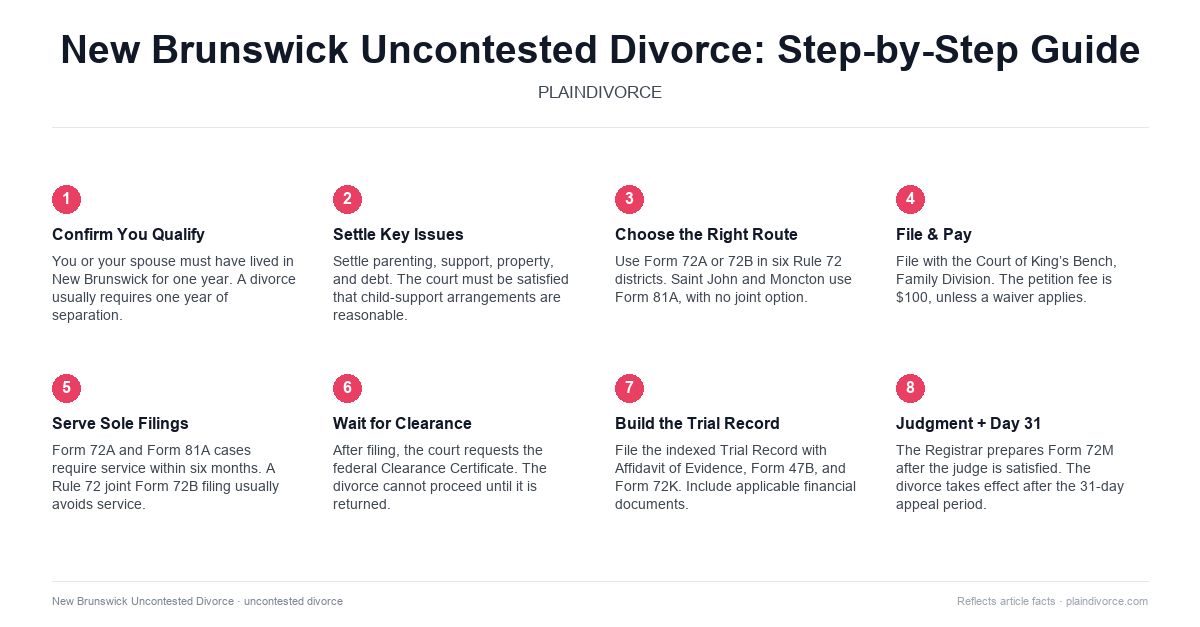
The exact paperwork depends on your judicial district, whether you file jointly or alone, and whether you have children. Most uncontested New Brunswick divorces follow this overall shape:
- Joint filing (Bathurst, Campbellton, Edmundston, Fredericton, Miramichi, Woodstock): both spouses file together → Form 72B, usually no service.
- Sole filing (same six districts): one spouse starts the case → Form 72A, service required.
- Saint John or Moncton: every filing starts with Form 81A; there is no joint option, and service is required.
Step 1: Confirm you qualify
- Confirm the one-year New Brunswick residency rule (you or your spouse).
- Confirm your ground — almost always one year of separation, complete by the time the judge decides.
- Confirm your judicial district, which fixes whether you file Form 72A/72B or Form 81A.
Step 2: Settle children, support, and property in writing
Even in an uncontested divorce, the court scrutinizes child support (see Section 6). Put your arrangements in a written separation agreement covering parenting, child support, spousal support if any, and the division of property and debt. If your petition makes a financial claim, prepare Form 72J and income information now. If it does not, make sure you understand the 60-day Marital Property Act deadline before you decide to leave property out.
Step 3: Choose your filing route (Form 72A, 72B, or 81A)
- Joint filing (six Rule 72 districts): start with the Joint Petition for Divorce (Form 72B) — usually the most efficient route because it avoids service.
- Sole filing (six Rule 72 districts): start with the Petition for Divorce (Form 72A).
- Saint John or Moncton: start with an Application (Form 81A).
Step 4: File your petition and open a court file
File the completed petition or application with the registry for the Court of King’s Bench (Family Division) and pay the $100 filing fee (unless a waiver applies). The registry returns a stamped copy with your court file number — the public self-help service estimates about 2–3 weeks.
Step 5: Serve your spouse (sole filings)
If you filed a sole Petition for Divorce (Form 72A) or an Application (Form 81A), you must serve your spouse within six months of filing (Rule 72.06). You cannot serve the documents yourself — use another adult, a process server, or prepaid mail/courier. Service by mail or courier is effective only when you get back a signed acknowledgement (Form 18A) or the carrier’s delivery confirmation. You then file an Affidavit of Service. If you filed a Joint Petition (Form 72B), service is normally not required because you are both applicants.
Step 6: The “Ottawa wait” for the Clearance Certificate
After you file, the court applies to the federal Central Registry of Divorce Proceedings in Ottawa for a Clearance Certificate confirming no other divorce proceeding is pending between you and your spouse. You cannot complete your Trial Record until the certified report is on file — the court will return an incomplete record. Processing has commonly taken 2–3 months, though it varies. Use the wait to prepare your Trial Record documents, and call the registry to check whether clearance has arrived.
Step 7: Prepare and file the Trial Record (Uncontested)
Once the Clearance Certificate is on file, assemble the Trial Record (Uncontested) as described in Section 4 — index, petition and proof of service, pleadings, the certified Central Divorce Registry report, any financial documents, your sworn Affidavit of Evidence, and the Rule 47.06 documents (Form 47B and Form 72K).
Watch the clock. Your Affidavit of Evidence must be sworn before a Commissioner of Oaths or notary — it cannot be signed at home — and the Trial Record must be filed within 5 days of swearing it for a sole filing, or 14 days for a joint filing, unless the judge allows a longer period (Rule 72.18).
Practical tip: uncontested files stall over small gaps — a missing attachment, an unsigned page, an inconsistent date, missing proof of service, or an unexplained child-support figure. Treat this as a checklist project and aim for a clean, complete filing the first time.
Step 8: Divorce Judgment (Form 72M) and the 31-day appeal period
If the record is complete and the judge is satisfied (including that reasonable child-support arrangements are in place), the Registrar prepares, signs, and enters the Divorce Judgment (Form 72M).
Under the Divorce Act (s. 12(1)), the divorce takes effect on the 31st day after the judgment, unless an appeal is filed. An earlier effective date is possible but not automatic: the court must find special circumstances and both spouses must undertake that no appeal will be taken (s. 12(2)). Filing an Agreement Not to Appeal (Form 72L) is one of those conditions — it does not by itself shorten the period. If the court orders an early date, the judgment is issued as Form 72N. Once the divorce is effective, you can request a Certificate of Divorce (Form 72O) for $7.
6. Divorce With Children: Child Support Is a Hard Gate
If you have children of the marriage, the court is required to check child support before it grants the divorce. Under Divorce Act s. 11(1)(b), the judge must be satisfied that reasonable arrangements have been made for the support of the children, having regard to the Federal Child Support Guidelines, and must stay (hold back) the divorce until those arrangements are made. This is mandatory, not discretionary.
Your paperwork should clearly show:
- the parenting schedule — where the children live and when they are with each parent;
- the payor’s income and the guideline table amount, plus any section 7 special or extraordinary expenses; and
- if the amount differs from the table figure, a clear explanation of why it is still reasonable.
If support looks low or unexplained, expect the judge to hold the divorce until you fix it — often by filing better income information or an amended agreement.
7. How Long Does an Uncontested Divorce Take in New Brunswick?
There is no official province-wide timeline, and it varies with registry workload and your district. The public self-help service publishes these component estimates:
| Stage | Rough estimate |
|---|---|
| Prepare documents and complete forms | Days to weeks (up to you) |
| Registry returns your stamped petition with a court file number | About 2–3 weeks |
| Serve your spouse (sole filings) | Within 6 months of filing; do it early |
| Federal Clearance Certificate | Commonly 2–3 months |
| File Trial Record after swearing the Affidavit of Evidence | 5 days (sole) or 14 days (joint), unless the judge extends |
| Judge review and Divorce Judgment after a complete Trial Record | Commonly about 4–6 weeks |
| Appeal period before the divorce is effective | 31 days after the judgment |
Add those up and a clean, cooperative uncontested divorce commonly lands somewhere in the range of roughly four to eight months from filing to a final Divorce Judgment. Treat that as an expectation, not a promise — a joint Form 72B filing with a complete first submission is the fastest path, and any missing item resets you to the back of the review queue.
8. What Does an Uncontested Divorce Cost in New Brunswick?
The court charges are modest and set by regulation. As of August 2026:
| Item | Fee |
|---|---|
| Filing a Petition for Divorce (72A), Joint Petition (72B), or Application (81A) | $100 |
| Federal Central Registry of Divorce Proceedings charge (per application, for the clearance search) | $10 |
| Filing an Answer (72D) or Answer and Counter-Petition (72F) | $20 (only if contested) |
| Certificate of Divorce (Form 72O) | $7 |
Other likely out-of-pocket costs: a process server for a sole filing (often $75–$150), Commissioner of Oaths or notary fees to swear affidavits, printing and courier costs for the Trial Record, and a replacement marriage certificate if you cannot find yours. Always confirm current amounts and accepted payment methods with your registry.
Fee waiver — narrow and conditional. New Brunswick does not offer a general hardship waiver you can simply apply for. Under Rule 72.24(2), the fee is waived only if either (a) a lawyer certifies that they are providing the legal services without payment and that the fee would cause hardship, and files a Certificate of Solicitor (Form 72FF) with the document, or (b) you receive assistance under the Family Income Security Act. The Rule 81 equivalent is Form 81K. If cost is a barrier, ask a legal clinic or Legal Aid about eligibility.
Money-saving tip: where a Joint Petition for Divorce (Form 72B) is available, filing together avoids service costs entirely.
9. When DIY Is Not the Right Call
Get legal advice — even a single consultation — before filing if:
- there is family violence, coercion, or fear;
- there are real parenting disagreements or child-safety concerns;
- assets are complex — a business, pensions, multiple properties, or significant debt;
- you suspect hidden income or assets; or
- immigration, tax, or cross-border issues raise the stakes.
A cheap divorce turns expensive fast if someone signs an unfair agreement or gives up a right they did not know they had — and the Marital Property Act 60-day clock means some of those rights disappear shortly after the divorce is effective.
10. Where a Self-Help Divorce Kit Fits
If your case is genuinely uncontested and you are comfortable managing paperwork, a New Brunswick-specific self-help kit helps you:
- identify your judicial district and the right route (Form 72A, 72B, or 81A);
- build a clean Trial Record (Uncontested) that matches Rule 72.18;
- avoid the common missing-item mistakes (signatures, exhibits, dates, proof of service, income information); and
- track timing — the Clearance Certificate wait, the 5/14-day affidavit deadline, judge review, and the 31-day appeal period.
PlainDivorce is not a law firm. A kit is an information and organization tool, not legal advice, and it does not replace the official court forms or your registry’s current instructions.
Get the New Brunswick Uncontested Divorce Self-Help Kit
11. New Brunswick Uncontested Divorce FAQ
What is an uncontested or simple divorce in New Brunswick?
It is a divorce that the other spouse does not oppose and that leaves no dispute for the court to resolve about parenting, support, or property. The judge grants it by reviewing a written package — the Trial Record (Uncontested), built around your sworn Affidavit of Evidence — instead of holding a hearing. It runs through the Court of King’s Bench (Family Division) under the federal Divorce Act.
What is the difference between Form 72A and Form 72B?
Form 72A is the Petition for Divorce used when one spouse files alone. Form 72B is the Joint Petition for Divorce used when both spouses file together. Both apply in the Bathurst, Campbellton, Edmundston, Fredericton, Miramichi, and Woodstock judicial districts. Filing jointly with Form 72B is usually smoother and cheaper because it removes the requirement to serve your spouse.
I live in Saint John or Moncton — do I use Form 72B?
No. In the Saint John and Moncton judicial districts, divorce is started with Form 81A (Application) under Rule 81, not Form 72A or 72B, and there is no joint application option. The Rule 81 process also includes case management, so follow the steps your registry gives you. If you are unsure which district you are in, confirm with the registry before filing.
What happened to the Divorce Judgment Form 72S?
The Divorce Judgment Form 72S that older New Brunswick guides mention has been repealed. The current ordinary judgment is Form 72M, which the Registrar prepares, signs, and enters after the judge is satisfied. Form 72N is used only when the court has ordered the divorce to take effect before the 31st day. If a template tells you to draft a Form 72S, it is out of date.
Do I need a Financial Statement (Form 72J)?
Yes, if your petition or application claims child support, spousal support, or a division of property — then Form 72J plus income information is required (Rule 72.04(6), Rule 72.14; Rule 81.08 for Saint John and Moncton). A limited exception can apply where the spouses have already agreed on the relief. If you are asking only for the divorce and nothing financial, Form 72J is usually not needed. Confirm with the registry if you are unsure.
What is the Affidavit of Evidence in a New Brunswick divorce?
The Affidavit of Evidence is your sworn written testimony — it sets out the marriage date, the separation date, your grounds, and the arrangements for any children. In New Brunswick it must be sworn before a Commissioner of Oaths or notary; you cannot just sign it at home. Filing it inside the Trial Record is what lets a judge grant the divorce without a hearing. The Trial Record must be filed within 5 days of swearing it for a sole filing, or 14 days for a joint filing, unless the judge allows longer.
How much does a New Brunswick divorce cost?
The provincial court fee to file a Petition for Divorce, Joint Petition, or Application is $100. The federal Central Registry of Divorce Proceedings charges a separate $10 per application for the clearance search. The final Certificate of Divorce (Form 72O) is $7. Budget extra for a process server (sole filings), notary fees, and printing. A fee waiver is available only with a lawyer’s certification of hardship or if you receive Family Income Security Act assistance.
When is the divorce final?
After the Divorce Judgment (Form 72M) is entered, the divorce takes effect on the 31st day, unless an appeal is filed (Divorce Act s. 12). An earlier date is possible only if the court finds special circumstances and both spouses undertake not to appeal; the judgment is then issued as Form 72N. Filing an Agreement Not to Appeal (Form 72L) is a condition for asking, not an automatic shortcut. Once the divorce is effective, request a Certificate of Divorce (Form 72O) as your official proof.
Last reviewed August 2026 against the federal Divorce Act, the New Brunswick Rules of Court (Rule 72), the province’s divorce court-fee schedule, the federal Central Registry of Divorce Proceedings information page, and the public Doing Your Own Divorce guide. PlainDivorce is not a law firm and this is not legal advice. Rules, forms, and fees change — verify the current version with your local registry and consult a New Brunswick family lawyer about your situation.
Sources and local rules can change. Use this guide as a plain-English organizer, then verify the current filing requirements with the official court or government source for your jurisdiction.

About Harry D
Expert contributor at PlainDivorce, helping Canadians and American navigate simple uncontested divorces with clarity and confidence.