Uncontested Divorce in New Hampshire: The Joint Petition Guide (2026)
An uncontested divorce in New Hampshire is one where both spouses agree the marriage is over and have settled every term — property, debts, alimony, and any child issues — so a judge has nothing left to decide. When you agree, the cleanest route is a Joint Petition for Divorce (NH form NHJB-2058-F) filed together in the Circuit Court – Family Division. Filing jointly avoids formal service of process: no sheriff, no certified mail, no response deadline.
The speed comes from the paperwork being complete and consistent. This guide covers who qualifies, the NH Circuit Court Family Division forms people get stuck on, the Rule 1.25-A disclosure step that stalls friendly cases, how New Hampshire lets many agreed couples finish without a hearing, what it costs, and how a DIY approach or self-help kit fits in.
If New Hampshire has jurisdiction, you both sign a notarized Joint Petition for Divorce (NHJB-2058-F), you exchange the Rule 1.25-A financial documents, and you file a signed agreement (or a decree that spells out every term), the Family Division can grant the divorce — often without a court appearance.
- Court: New Hampshire Circuit Court – Family Division.
- Jurisdiction (RSA 458:5): both spouses domiciled in NH when the case starts; or the filing spouse is domiciled here and the other is personally served in state; or the filing spouse has been domiciled in NH for the year before filing.
- Ground: no-fault — irreconcilable differences causing the irremediable breakdown of the marriage (RSA 458:7-a).
- Filing path: a Joint Petition (NHJB-2058-F) avoids service; an individual Petition for Divorce (NHJB-2057-F) must be served under RSA 458:9.
- Signatures: each spouse signs the Joint Petition under oath before a notarial officer.
- Disclosure: Rule 1.25-A documents are exchanged within 45 days of filing a joint petition; the Financial Affidavit (NHJB-2065-F) is also filed with the court.
- Hearing: under Family Division Rule 2.22 the court can issue an uncontested decree with no hearing and no appearance when both parties waive attendance in writing and the paperwork is clear.
- Fee: $280 to file, plus $2 when the case involves parental rights and responsibilities ($282 with minor children).
- Children: Parenting Plan, Uniform Support Order, guidelines worksheet, First Appearance, and the 4-hour Child Impact Program ($85).
Last reviewed: September 2026. New Hampshire court rules, forms, and fees change — confirm current requirements with the New Hampshire Judicial Branch before you file.
1. What Counts as an Uncontested Divorce in New Hampshire
New Hampshire has no separate case type called a “simple” or “uncontested” divorce. People use those words to describe a no-fault case where both spouses agree the marriage should end and have resolved everything a judge would otherwise decide: dividing property and debt, alimony, and — if there are children — the parenting schedule, decision-making, and child support.
One point trips people up. You can file a Joint Petition for Divorce with your spouse even if you have not settled everything yet — the New Hampshire courts say so directly. The Joint Petition is a filing choice, not proof of a complete deal. Your case is truly “uncontested” only once the remaining terms are in writing, either as a signed agreement or as the exact terms of your proposed decree.
Key idea: uncontested is less about being “easy” and more about being complete. The Family Division still expects correct forms, full financial disclosure, and workable parenting, support, and property terms, even when both spouses agree.
Joint Petition vs. individual Petition for Divorce
| Joint Petition for Divorce (NHJB-2058-F) | Petition for Divorce (NHJB-2057-F) | |
|---|---|---|
| Who files | Both spouses together, as co-petitioners | One spouse, as petitioner |
| Service of process | Not required — no further notice needed (RSA 458:9) | Required — the other spouse picks up the papers at court, or is served by certified mail or sheriff |
| Response deadline | None | The other spouse files an appearance and may respond |
| Signatures | Each spouse signs under oath before a notarial officer | Petitioner signs under oath; respondent may file an appearance/acceptance |
| Best when | Both spouses agree to divorce and will both sign and cooperate | One spouse will not participate, or cannot be located easily |
Either way, the order that ends your marriage is the Final Decree on Divorce or Legal Separation (NHJB-2071-F). You are not divorced when you file; you are divorced when a judge signs the decree.
2. Who Qualifies: Residency, Grounds, and What Uncontested Really Means
Residency and jurisdiction (RSA 458:5)
Before the Family Division can grant a divorce, the court needs jurisdiction. Under RSA 458:5, a New Hampshire court can hear the case in any of three situations:
- Both spouses are domiciled in New Hampshire when the action is commenced; or
- The filing spouse is domiciled in New Hampshire and the other spouse is personally served with process within the state; or
- The filing spouse has been domiciled in New Hampshire for the one year immediately before the action is commenced.
“Domiciled” means New Hampshire is your permanent home, not just where you are staying. If your situation involves a recent move, an out-of-state spouse, military service, or an overseas marriage, get advice about whether New Hampshire is the right forum — it is cheaper than a rejected filing.
The no-fault ground: irreconcilable differences
Nearly every uncontested divorce in New Hampshire is filed on the no-fault ground of irreconcilable differences that have caused the irremediable breakdown of the marriage, a ground in effect since 2005 (RSA 458:7-a). Neither spouse has to prove the other did anything wrong, and the court can grant the divorce on the parties’ written agreement or brief testimony. New Hampshire also keeps fault grounds in RSA 458:7 (such as adultery or extreme cruelty); whether to use one is a case-specific decision to discuss with a lawyer, and it is rare in a genuinely agreed case.
When an uncontested divorce is (and isn’t) a fit
An uncontested path tends to work when:
- You both agree the marriage should end and will both sign the paperwork.
- You can cooperate on documents and deadlines, including the Rule 1.25-A exchange.
- You can reach workable terms on property and debt and, if applicable, parenting and support.
It may not be safe or realistic if there is domestic violence, coercion, hidden assets, or a real dispute about children or finances. In those situations, talk to a lawyer before signing anything.
3. Key NH Circuit Court Family Division Forms
The forms fall into three groups: the documents that open the case, the financial and parenting documents, and the documents that let the court finalize it. Download the current version of each from the New Hampshire Judicial Branch — form numbers and revision dates change.
Case-opening forms
- Joint Petition for Divorce (NHJB-2058-F) — used when both spouses file together as co-petitioners. Each spouse signs it under oath before a notarial officer. If you have minor children, this form also collects the custody-jurisdiction (UCCJEA) information the court needs, so you usually do not file a separate UCCJEA affidavit.
- Petition for Divorce (NHJB-2057-F) — the individual version, used when one spouse files alone.
- Personal Data Sheet (NHJB-2077-F) — a confidential case-opening form that keeps identifiers like Social Security numbers and dates of birth off the public record. It is filed with the petition.
Financial and parenting forms
- Financial Affidavit (NHJB-2065-F) — a sworn statement of each spouse’s income, expenses, assets, and debts, signed before a notarial officer. Each spouse completes and files their own, with a copy served on the other party. The court cannot approve a final agreement without current affidavits.
- Parenting Plan (NHJB-2064-F) — required when the couple has minor children; it sets the schedule, decision-making, holidays, and communication rules.
- Uniform Support Order (NHJB-2066-FP) and the Child Support Guidelines Worksheet (NHJB-2101-FP) — used to set child support. There is also an e-file-only version of the support order.
- Uniform Alimony Order (NHJB-3058-F) — a separate order, used only when alimony is part of the case. Do not confuse it with the child-support order.
Finalization forms
- Final Decree on Divorce or Legal Separation (NHJB-2071-F) — the proposed final order the judge signs. If you have been searching for a “Decree on Divorce NH template,” this official form is the template, and its terms must match your agreement exactly. (A Temporary Decree (NHJB-2072-F) exists for interim orders before the case is done.)
- Vital Statistics form — a separate state report that must be filed before the case can be finalized (see Step 8).
- Checklist for Rule 1.25-A Mandatory Disclosure (NHJB-3248-F) — a tracking and cover-sheet tool for the financial exchange; you keep it rather than file it unless the court orders otherwise.
For the current versions of all of these, use the New Hampshire Judicial Branch’s official Family Division forms list rather than a copy from a third-party site.
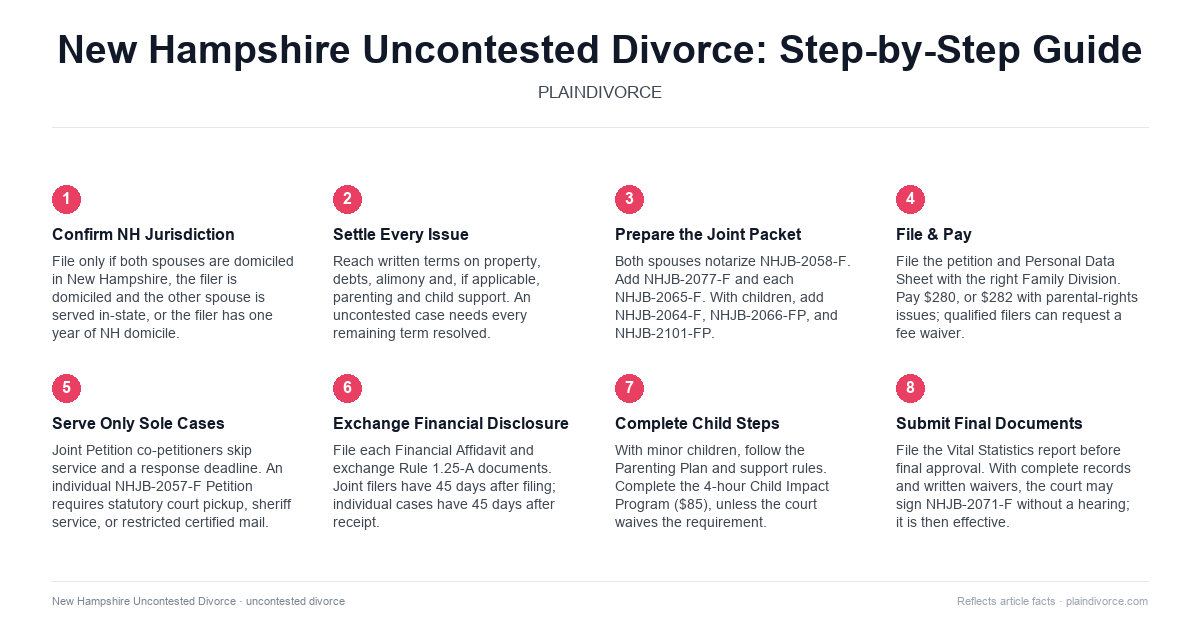
4. Step-by-Step: How to File for Divorce in NH Without a Lawyer
Every case is different, and local practice varies, but most uncontested New Hampshire divorces follow this path. Learning how to file for divorce in NH without a lawyer mostly comes down to picking the right filing path, completing the Financial Affidavit and disclosures correctly, and filing a complete packet the first time.
Step 1 – Confirm New Hampshire has jurisdiction
Check that your situation fits one of the three RSA 458:5 alternatives above, and identify the Family Division location that serves where you live.
Step 2 – Reach agreement on the real-life terms
Put workable terms in writing for:
- Property and debt — bank accounts, vehicles, credit cards, retirement accounts, and the home. New Hampshire divides marital property equitably and presumes an equal split is fair unless the court finds otherwise (RSA 458:16-a).
- Alimony — the amount and duration, or a clear statement that neither spouse will pay.
- Children, if any — parenting schedule, decision-making, health insurance, and child support.
Step 3 – Prepare the forms and the disclosures
For a joint filing you will typically prepare the Joint Petition for Divorce (NHJB-2058-F), the Personal Data Sheet (NHJB-2077-F), each spouse’s Financial Affidavit (NHJB-2065-F), and — with children — the Parenting Plan (NHJB-2064-F), Uniform Support Order (NHJB-2066-FP), and guidelines worksheet (NHJB-2101-FP). Start gathering the Rule 1.25-A documents now (see Section 5); it is the most common delay point in New Hampshire, even in friendly cases.
Step 4 – File with the Family Division
File the petition and Personal Data Sheet at the correct Family Division location, pay the filing fee (or file a motion to waive it if you qualify), and save your docket number for everything that follows.
Step 5 – Service (only if one spouse files alone)
A Joint Petition needs no service — both spouses have already signed and filed. If one spouse files an individual Petition for Divorce, the other must be notified. Under RSA 458:9, that spouse can pick up the papers at the court, or be served by a sheriff at home within 25 days after the filer receives the orders of notice, or by certified mail (restricted delivery, return receipt, addressee only) mailed within 7 days after the filer receives the orders of notice. The return receipt is then filed with the court. The statute has separate procedures for an out-of-state or unknown-address spouse.
Step 6 – First Appearance (cases with children)
When there are minor children, the court schedules a First Appearance session after a joint petition is filed (or after an individual petition is served). A judge or master explains the process and covers the Child Impact Program, parenting plans, mediation, guardians ad litem, and child support, and the next step gets a date. Bring your calendar.
Step 7 – Finalization, with or without a hearing
New Hampshire does not always require a final hearing in an agreed case. Under Family Division Rule 2.22, the court can issue an uncontested decree without a hearing and without either party present when all required documents are filed, both parties waive attendance in writing, and the court is satisfied the documents are clear and complete. If the paperwork is not clear, or the court has questions, it can schedule a short uncontested hearing (sometimes handled as an offer of proof). Either way, in an uncontested case with a permanent agreement, the decree is effective on the date the judge signs it, unless the court says otherwise (Rule 2.29).
Step 8 – The Vital Statistics form
New Hampshire requires a separate Vital Statistics form that registers the divorce with the state. Under Family Division Rule 2.25, the petitioner (or one of the joint petitioners) must file a completed, typed report before the case is heard on the merits or a final agreement is approved. It is required for the divorce to be final, and it is different from the decree. After the divorce, you request certified copies of the decree from the court (form NHJB-2205-F).
5. Rule 1.25-A Mandatory Initial Disclosure
The single biggest reason a friendly New Hampshire case slows down is missed disclosure under Family Division Rule 1.25-A. This rule makes both parties exchange specific financial documents early — not just fill out a Financial Affidavit.
What you exchange under Rule 1.25-A
The core items include:
- A current Financial Affidavit with the monthly-expense schedule;
- The last three years of federal and state tax returns, with schedules, W-2s, and 1099s;
- Your four most recent pay stubs plus the prior year’s year-end stub;
- Statements for bank, investment, retirement, and pension accounts, and statements for debts;
- Documents showing the value of a business or real estate, where relevant.
You file the Financial Affidavit with the court and give a copy to your spouse. The rest is exchanged directly with your spouse, not filed. You may redact all but the last four digits of account numbers and Social Security numbers. If your information changes materially, you must promptly update the other party. The Checklist for Rule 1.25-A Mandatory Disclosure (NHJB-3248-F) helps you track what you sent and when, and doubles as a cover sheet; keep a copy for your records and do not file it unless the court orders you to.
Rule 1.25-A deadlines
- Joint petition: exchange within 45 days of the filing date.
- Individual petition: within 45 days after the other spouse receives the petition.
- If a hearing other than the First Appearance is scheduled sooner, the documents are due 10 days before that hearing.
Parties can agree in writing to exchange fewer documents, but you still must file an accurate Financial Affidavit and affirm under oath that you complied with the rule.
What happens if you skip it
There is no automatic “pause” button, but the consequences are real. Under Rule 1.25-A(D) the court can bar a non-complying party from presenting financial evidence, let the other party estimate that party’s finances, and order the non-complying party to pay the other side’s costs of chasing the information. If you genuinely cannot get a document, you file a sworn Statement of Unavailability; if your spouse will not disclose, you file a Motion to Compel.
6. When You Have Minor Children
You can have an uncontested divorce with children in New Hampshire, but the court has an independent duty to protect the children, so it reviews the parenting and support terms on their own merits.
Parenting Plan and the First Appearance
Every case with minor children needs a Parenting Plan (NHJB-2064-F) covering the residential schedule, holidays and vacations, decision-making, and how the parents will communicate. Expect the First Appearance session described in Step 6, where the court walks you through the Child Impact Program, parenting plans, mediation, and child support before your next date.
Child support in New Hampshire
Child support runs through the RSA 458-C guidelines, which apply in every child-support case. You calculate the guideline amount on the worksheet even if you agree on a number. To order a different amount, the court must make a written or on-the-record finding that the guideline result would be unjust or inappropriate. Two details self-represented parents miss:
- Medical support: each parent has a presumptive obligation equal to 4% of that parent’s gross income toward the children’s medical costs, unless the court makes a different supported finding.
- Income assignment: support orders generally include wage withholding under RSA 458-B. It can be suspended only by a court-approved written agreement or a good-cause finding.
The Child Impact Program
New Hampshire law (RSA 458-D) requires parents in a divorce or parenting case to complete a 4-hour Child Impact Program. The provider fee is $85, paid to the provider, and you can ask the provider about a fee reduction if you cannot afford it. Register as soon as possible and no later than 45 days after service on the respondent; you are expected to have registered or finished before the First Appearance, and the court needs the completion certificate in the file before final orders. The requirement can be waived for a parent who is incarcerated, has already taken the program, is in a Title IV-D child-support enforcement action, or shows good cause (the statute ties good cause to issues like domestic violence, transportation, or childcare). In domestic-violence cases, parents attend separate sessions.
Get the New Hampshire Uncontested Divorce Self-Help Kit
7. How Long an Uncontested Divorce Takes in New Hampshire
There is no fixed timeline, and it depends on the court location, whether children are involved, whether service is needed, and how complete your filing is. New Hampshire has no statutory waiting period for a no-fault divorce, and Rule 2.22 lets many agreed couples finish “on the papers” without a hearing date to wait for. What actually drives the clock:
- Speeds it up: a complete Joint Petition packet, consistent numbers across forms, the Rule 1.25-A exchange done on time, and written waivers of the final hearing.
- Slows it down: incomplete disclosures, an unclear Parenting Plan, a decree whose terms do not match the agreement, rejected forms, or a pending Child Impact Program certificate.
Treat the case like a checklist project: gather documents early, keep copies of what you exchanged, and file a complete packet the first time.
8. What an Uncontested Divorce Costs
| Cost | Amount | Notes |
|---|---|---|
| Filing fee — no minor children | $280 | Original marital entry fee |
| Filing fee — with minor children | $282 | $280 plus a $2 parental-rights fee |
| Child Impact Program | $85 per parent | Paid to the provider; fee reduction may be available |
| Service (individual petition only) | Varies | Sheriff or certified-mail costs; $0 with a Joint Petition |
| Notary, copies, certified decree copies | Small, varies | Certified copies requested on NHJB-2205-F |
The Family Division may waive a filing fee for good cause if you qualify financially; file a motion to waive fees and let the court decide — there is no guaranteed outcome. Fees and program costs change, so confirm the current numbers with the court and the provider.
9. When a DIY Divorce Is the Wrong Call
A DIY uncontested divorce can work well, but not in every situation. Get legal advice if:
- There is domestic violence, stalking, coercion, or fear.
- You suspect hidden income or assets, or dishonesty about finances.
- You have complex assets — a business, multiple properties, large retirement or pension accounts — and you are not sure what you are giving up.
- There is a real dispute about parenting, relocation, or a child’s safety.
- Immigration status, taxes, or benefits could be seriously affected by the terms.
A common middle ground is limited-scope help: you do the legwork and pay a New Hampshire attorney for a focused consultation or a document review before you sign.
10. Where a Self-Help Divorce Kit Fits In
New Hampshire publishes the official forms for free, but self-represented filers still get stuck on which forms apply, staying organized under Rule 1.25-A, and matching the decree to the agreement. A New Hampshire uncontested divorce self-help kit (like PlainDivorce’s) is built to help you:
- Choose the filing path — usually the Joint Petition for Divorce (NHJB-2058-F) — and understand what it saves you.
- Stay organized with checklists for the Personal Data Sheet, each Financial Affidavit, the Rule 1.25-A exchange, and the parenting and support documents.
- Track the common hard stops — the Rule 1.25-A deadline, the Vital Statistics form, and the Child Impact Program certificate.
- Draft a decree whose terms line up with your agreement, so the court is not sending it back.
Download the New Hampshire Uncontested Divorce Self-Help Kit
11. New Hampshire Uncontested Divorce FAQ
What is an uncontested or simple divorce in New Hampshire?
It is a no-fault divorce where both spouses agree the marriage should end and have settled every term a judge would otherwise decide — property, debt, alimony, and, if applicable, parenting and child support. New Hampshire has no separate “simple divorce” case type. Even when you agree, the Family Division still requires correct forms, sworn Financial Affidavits, and the Rule 1.25-A financial exchange.
What is the Joint Petition for Divorce, and which NH form is it?
The statewide Joint Petition for Divorce is NH form NHJB-2058-F (older guides that say NHJB-2051-F are out of date). Both spouses sign it under oath before a notarial officer and file it together as co-petitioners. Filing jointly means no formal service of process. You can file a Joint Petition even if you have not resolved every issue yet, but the case is only “uncontested” once the remaining terms are in writing.
Do we have to serve papers if we file a Joint Petition?
No. When both spouses sign and file the Joint Petition as co-petitioners, no further service or notice is required under RSA 458:9. Service only comes into play when one spouse files an individual Petition for Divorce — then the other spouse must pick up the papers at court or be served by sheriff or certified mail within the statutory deadlines.
Can I file for divorce in NH without a lawyer?
Yes. Many people handle an uncontested divorce in New Hampshire on their own using the official Circuit Court Family Division forms. The work is picking the right filing path (usually the Joint Petition), completing each Financial Affidavit and the Rule 1.25-A disclosures correctly, and filing a complete packet. Consider a limited-scope consultation if anything about property, support, or parenting is unclear.
Do I have to go to court for an uncontested divorce in New Hampshire?
Often not. Family Division Rule 2.22 lets the court grant an uncontested divorce without a hearing and without either party present, as long as all required documents are filed, both parties waive attendance in writing, and the court finds the paperwork clear. If something is unclear or missing, the court can set a brief uncontested hearing. Cases with children add a First Appearance session.
What is Rule 1.25-A, and why does it matter?
Rule 1.25-A is the Family Division’s mandatory initial disclosure rule. Both parties must exchange specific financial documents — tax returns, pay stubs, and account and debt statements — not just complete a Financial Affidavit. For a joint petition the exchange is due within 45 days of filing. Missed disclosure is the most common reason friendly cases stall, and the court can sanction a party who does not comply.
How much does an uncontested divorce cost in New Hampshire?
The Circuit Court filing fee is $280, or $282 when the case involves parental rights and responsibilities. Add the $85 Child Impact Program fee per parent when there are children, plus small costs for notarization, copies, and certified copies of the decree. Service costs apply only if you file an individual petition. The court may waive a filing fee for good cause.
Do parents have to take a class in New Hampshire divorce cases?
Usually. Under RSA 458-D, parents in a divorce or parenting case must complete the 4-hour Child Impact Program ($85 provider fee), and the court needs the completion certificate before final orders. Register within 45 days after service on the respondent. The requirement can be waived for a parent who is incarcerated, has already attended, is in a IV-D support enforcement action, or shows good cause.
Official Sources
- New Hampshire Circuit Court – Family Division (divorce and parenting overview)
- Mandatory Initial Disclosures – Rule 1.25-A (New Hampshire Judicial Branch)
- Child Impact Program (New Hampshire Judicial Branch)
- Rules of the Circuit Court – Family Division (Rule 1.3 fees; Rule 2.22 uncontested final hearing; Rule 2.25 vital statistics; Rule 2.29 effective dates)
- RSA 458 – Annulment, Divorce and Separation (residency at 458:5; grounds at 458:7 and 458:7-a; notice/service at 458:9; property at 458:16-a)
- RSA 458-C – Child Support Guidelines
- RSA 458-B – Enforcement of Child and Spousal Support (income assignment)
- RSA 458-D – Impact of Divorce and Separation on Children (Child Impact Program)
- New Hampshire Judicial Branch official Family Division forms list — for the current Joint Petition for Divorce (NHJB-2058-F), Personal Data Sheet (NHJB-2077-F), Financial Affidavit (NHJB-2065-F), Parenting Plan (NHJB-2064-F), Uniform Support Order (NHJB-2066-FP), and Final Decree (NHJB-2071-F). Download current versions directly from the court.
Not legal advice. This guide is general information and does not create a lawyer–client relationship. New Hampshire forms, fees, and procedures change — always confirm current requirements with the New Hampshire Judicial Branch or a licensed New Hampshire attorney before you file.
Sources and local rules can change. Use this guide as a plain-English organizer, then verify the current filing requirements with the official court or government source for your jurisdiction.

About Harry D
Expert contributor at PlainDivorce, helping Canadians and American navigate simple uncontested divorces with clarity and confidence.