Uncontested Divorce in New Jersey: A Plain-English Guide to the CIS, the Complaint, and the Default Judgment Path
An uncontested divorce in New Jersey is one where you and your spouse do not fight in court over the grounds, the money, or the kids. You file a Complaint for Divorce in the Superior Court of New Jersey, Chancery Division, Family Part; your spouse either agrees, files a limited Appearance, or does nothing; and a judge can grant the divorce on the papers without a hearing. The hard part is rarely the decision to skip a lawyer — it is finishing the paperwork the Family Part requires, starting with the Case Information Statement.
This guide walks through both versions of “uncontested” that actually happen in New Jersey — the cooperative case and the default case — and shows where the Complaint, the Marital Settlement Agreement, the Case Information Statement (CIS, form CN 10482), and the Request to Enter Default fit. It reflects the New Jersey Judiciary’s current self-represented divorce instructions and Directive #01-25 (effective March 19, 2025), which governs how default and uncontested judgments are entered without a court appearance.
TL;DR
Two things decide how smoothly a New Jersey uncontested divorce goes, and neither is the decision to skip a lawyer: getting the Case Information Statement right, and following the default track all the way to the certification package instead of stopping when default is entered.
- “Form 1D” is not a New Jersey court form. It is the label Legal Services of New Jersey uses for its own no-fault template. What you actually file is the Complaint for Divorce — there is no AOC form by that number.
- Default entered is not divorced. It is a docket checkpoint. The Final Judgment still requires the CN 12620 certification package — proof of service, the proposed Judgment, a non-military affidavit, and a support worksheet where children are involved.
- The 20-day Notice of Proposed Final Judgment clock runs before the judge’s review, not before default entry. And a written, executed property settlement agreement removes the requirement entirely — that is the built-in exception under Rule 5:5-10.
- The Appearance is the response cooperative couples miss. A spouse who does not contest the divorce but wants to be heard on custody, support, or property files an Appearance ($175), not an Answer — which keeps the case uncontested and out of default.
- Both spouses file a CIS (CN 10482) whenever custody, parenting time, child support, alimony, or equitable distribution is in issue — due within 20 days after the Answer or Appearance. The form itself warns that skipping it can get your pleadings dismissed.
- The CIS wants attachments, not summaries: your three most recent pay stubs and your latest federal and state returns with W-2s. Build the budget pages from 24 months of actual bank and card statements — most CIS problems are estimates that contradict the documents stapled to the same form.
- Leaving out the Confidential Litigant Information Sheet (CN 10486) triggers a deficiency notice. It has been required with every initial dissolution Complaint and every response since November 2024.
- Irreconcilable differences has two halves — six months of breakdown and no reasonable prospect of reconciliation — and the six months must be satisfied before you file. There is no waiting period after filing.
- One year of New Jersey residency, with exactly one exception. Adultery is the only ground with no minimum period. And there is no “county where we last lived together” venue option — file where you or your spouse currently lives.
- Serve within 60 days of filing and file proof. If your spouse will sign an Acknowledgment of Service, you skip the sheriff or process-server fee altogether.
- The $25 Parents’ Education Program fee is triggered by the issue, not the child. It applies when custody, parenting time, or support is actually in issue — and the court will not refer a party where a domestic-violence restraining order is in place.
- New Jersey issues no divorce certificate from vital records. Your proof is a certified copy of the Judgment from the Superior Court Clerk — order at least two.
1. What Is an Uncontested or Simple Divorce in New Jersey?
New Jersey has no separate “simple divorce” form or track. Every divorce runs through the Superior Court of New Jersey, Chancery Division, Family Part. “Uncontested” just describes a case that never becomes a real dispute. In practice it takes one of two shapes:
- Cooperative uncontested: one spouse files the Complaint for Divorce, the other spouse takes part — usually by filing an Appearance rather than a contested Answer — and the couple hands the judge a signed settlement.
- Default: one spouse files and properly serves the papers, and the other spouse never responds. The filing spouse then asks the court to enter default and, after a few more steps, seeks a Final Judgment of Divorce by default.
Both paths can end without anyone standing in front of a judge. Under the Judiciary’s current instructions, a default or uncontested divorce can be granted “on the papers” — you submit a certification instead of testifying — although a judge can still schedule a short hearing if something needs clarifying.
Terminology note — “Form 1D”: Searches for Complaint for Divorce NJ Form 1D lead to the Legal Services of New Jersey (LSNJ) self-help divorce packet, which labels its no-fault complaint template “Form 1D.” That is an LSNJ label, not an official New Jersey Judiciary or Administrative Office of the Courts form number. The document you actually file is the Complaint for Divorce.
2. Who Qualifies: Residency, Venue, and Grounds
2.1 Residency requirement
Under N.J.S.A. 2A:34-10, at least one spouse must have been a bona fide resident of New Jersey for the one year immediately before the Complaint is filed. The only exception is adultery: on that ground alone there is no minimum period — a spouse simply has to have been a New Jersey resident when the cause of action arose and still be one at filing. For every other ground, plan on the full year.
2.2 Which county you file in (venue)
New Jersey court rules set venue by where the plaintiff was living when the grounds arose; if the plaintiff was not in New Jersey then, it is the county where the defendant was living; and if neither spouse was in New Jersey then, it is the county where the plaintiff lives when the case starts. For most self-represented filers this comes down to a simple instruction from the Judiciary: file in the Family Division of the county where you or your spouse currently lives. There is no “county where we last lived together” option.
2.3 Grounds for divorce in plain English
New Jersey has both fault and no-fault grounds. Uncontested DIY cases almost always use one of the two no-fault grounds:
- Irreconcilable differences: differences that have caused the breakdown of the marriage for at least six months before filing, with no reasonable prospect of reconciliation. Both parts of that sentence have to be true, and you certify to them in the Complaint.
- Separation: you and your spouse have lived apart, in different homes, for at least 18 consecutive months, with no reasonable prospect of reconciliation.
Irreconcilable differences is the more common choice because it does not require you to have moved out.
2.4 When your case is a good fit for an uncontested divorce
- You both accept the marriage is over and can keep communication civil.
- You can exchange honest financial information without a fight.
- You agree — or have no serious disagreement — on parenting, support, and dividing assets and debts.
- You can track deadlines and follow the Family Part’s document requirements.
2.5 When an uncontested divorce may not work well
- Domestic violence, coercion, or any safety concern.
- Hidden assets, unclear income, or one spouse who controls all the money and information.
- Complex property — a business, multiple properties, stock options, pensions that need a Qualified Domestic Relations Order.
- Real disputes about custody, support, or property division.
If any of these apply, you may still be able to divorce, but a fully DIY approach carries more risk. A limited-scope consultation is worth the money.
3. The New Jersey Case Information Statement (CIS): The Hardest Part of Many DIY Divorces
If you remember one New Jersey-specific term from this guide, make it the Family Part Case Information Statement — form CN 10482, currently revised August 2025 and effective September 1, 2025. It is a sworn, line-by-line picture of your finances, and self-represented filers lose more time here than anywhere else.
3.1 When the CIS is required
Both spouses must file a CIS whenever custody, parenting time, child support, alimony, or equitable distribution is an issue in the case. A childless couple with nothing to divide and no support claim may not need one; almost everyone else does. When it is required, you file it within 20 days after the Answer or Appearance, and the form warns that not filing it can lead to your pleadings being dismissed.
3.2 What the CIS asks for
- Income from every source, plus pay deductions and benefits
- A “joint marital lifestyle” budget and your current monthly budget (housing, utilities, food, transportation, insurance, debt payments, children’s expenses)
- Every asset and debt — bank and retirement accounts, real estate, vehicles, credit cards, loans — with values
- Support already being paid, and any special claims such as a college-contribution request
3.3 Documents you must attach
Following New Jersey Case Information Statement instructions means attaching, not summarizing:
- Your three most recent pay stubs
- Your most recent federal and state tax returns, with W-2s and any 1099s
- Documentation for any college or post-secondary contribution you are asking for (tuition invoices, proof of enrollment, financial-aid records)
Pro tip: Base the monthly-expense pages on real records — checkbook registers, bank statements, and credit-card statements from the past 24 months — not memory. Most CIS problems come from estimates that do not match the documents attached to the same form. Where a number truly is an estimate, label it as one.
A structured self-help kit earns its keep here: it gives you the checklists, the document list, and worked examples of how the pages are usually completed, without turning your case into a lawyer-run matter. If your finances are genuinely complex or disputed, get advice on the CIS specifically.
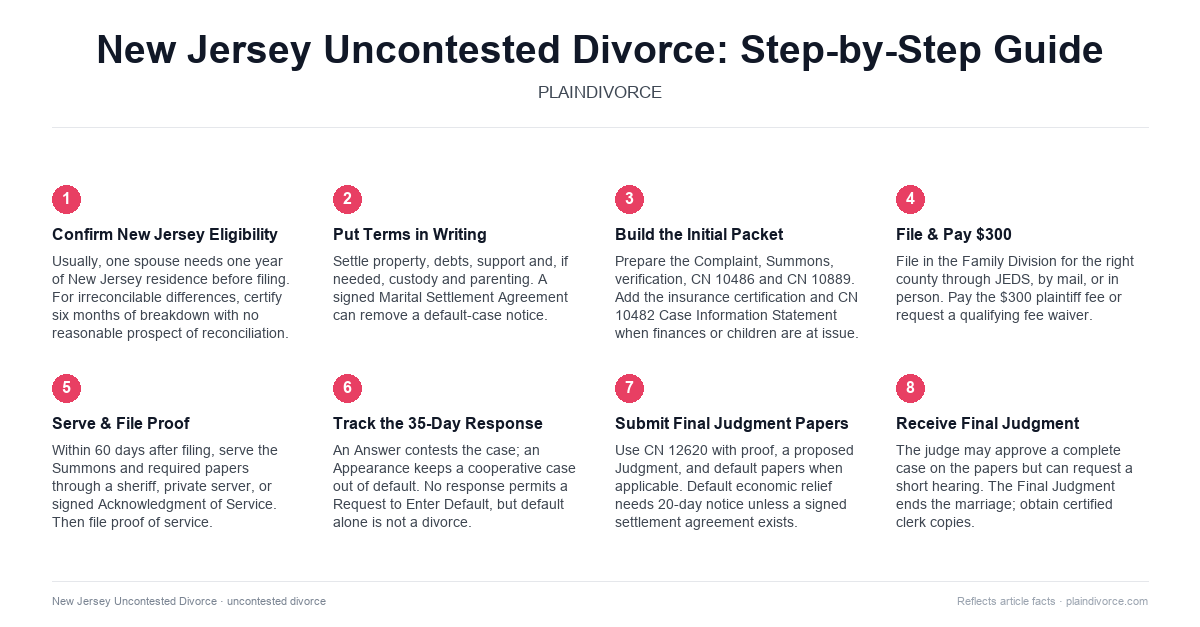
4. Step-by-Step: Filing, Service, the 35-Day Answer Period, and Default
Here is a plain-English map of a typical Family Part divorce. Filing methods and some local details vary by vicinage, so confirm the current NJ Courts instructions for your county before you file.
Step 1 — Confirm eligibility (residency + grounds)
- Confirm the one-year New Jersey residency requirement is met.
- Confirm you can certify to a no-fault ground — usually irreconcilable differences (six months, no reasonable prospect of reconciliation).
- Confirm you can locate your spouse for service, or learn what alternate service options exist if you cannot.
Step 2 — Put your agreement in writing (the MSA)
In an uncontested New Jersey divorce, your terms go into a Marital Settlement Agreement (MSA), also called a Property Settlement Agreement. It covers property and debt division, spousal support, and — if you have children — custody, parenting time, and child support. If you start from a Marital Settlement Agreement New Jersey template, check that every term matches what you and your spouse actually agreed to and is consistent with the numbers on your CIS. A signed, executed MSA also matters procedurally: it is the exception that removes the extra “Notice of Proposed Final Judgment” step in a default case (see Step 7).
Step 3 — Prepare the initial filing package
DIY filings get delayed when the Complaint arrives without the documents that are supposed to travel with it. The clerk can issue a deficiency notice or reject the filing. The Judiciary’s self-represented divorce instructions list these as the pieces of a dissolution filing package:
- Complaint for Divorce (the “Form 1D” some LSNJ materials refer to)
- Summons
- Certification of Verification and Non-Collusion
- Confidential Litigant Information Sheet, CN 10486 — required with every initial dissolution Complaint and every response since November 2024; leaving it out triggers a deficiency notice
- Self-Represented Litigant Complementary Dispute Resolution (CDR) Certification, CN 10889
- Certification of Insurance Coverage (Rule 5:4-2(f))
- Family Part Case Information Statement, CN 10482 — when custody, parenting time, support, alimony, or equitable distribution is in issue
- Marital Settlement Agreement — if you already have signed terms
Step 4 — File your papers
You file with the Family Division in your county and pay the $300 plaintiff filing fee (a fee waiver is available if you qualify). Self-represented filers generally have two concrete options: upload the required documents through JEDS (the Judiciary Electronic Document Submission portal), or mail or hand-deliver the originals and copies as the instructions direct. Any county-specific submission rule should be confirmed with that vicinage.
Step 5 — Serve your spouse and file proof
Service is what gives the court authority over the other spouse. New Jersey tells the plaintiff to serve the defendant with the Summons and all required documents within 60 days after filing, then file proof of service with the court. Service is normally done by the county sheriff or a private process server; if your spouse will sign, an Acknowledgment of Service can avoid the cost. If you cannot find your spouse, ask the court about substituted or alternate service before the 60 days run out.
Step 6 — The 35-day response window
After being served, the defendant has 35 days to respond. There are three responses, and the middle one is the one cooperative couples miss:
- Answer (or Answer and Counterclaim) — the defendant contests one or more issues. This makes the case contested.
- Appearance — the defendant does not contest the divorce but wants to be heard on custody, parenting time, support, alimony, or property division. This keeps a cooperative case uncontested and out of default. A defendant who files an Appearance pays a $175 filing fee (plus $25 if the parenting program applies).
- No response — the plaintiff can then file a Request to Enter Default. Default entry updates the docket and unlocks the final step, but on its own it is not a divorce.
Default Reality Check
“Default entered” is a checkpoint, not the finish line. If money or children are involved, you still have to give your spouse a Notice of Proposed Final Judgment and file the certification package before a judge can sign a Final Judgment of Divorce.
Step 7 — Ask for the Final Judgment (the certification package)
Whether your case is cooperative or a default, you finish it by asking for a divorce without a court appearance under Directive #01-25 (effective March 19, 2025) using the Certification in Support of Judgment of Divorce/Dissolution, CN 12620. The package generally includes:
- The CN 12620 certification
- Proof of service of the Complaint
- The Request to Enter Default (default cases)
- Your signed settlement agreement, if any
- A proposed Judgment of Divorce (plus the Name Change Addendum, CN 13146, if a spouse is resuming a former name)
- A Non-Military Service affidavit with proof of your search — a required item for a default judgment, so the court can honor the federal Servicemembers Civil Relief Act
- A child support guidelines worksheet if there are children under 18, and a Uniform Summary Support Order if support will be paid through Probation
- A Notice of Proposed Final Judgment — but only in the situation below
The Notice of Proposed Final Judgment (Rule 5:5-10): after a default, if you are asking the court for equitable distribution, alimony, child support, counsel fees, or other economic relief, you must serve your spouse a written notice that specifies the relief you want, usually with a CIS attached, at least 20 days before the hearing or the judge’s review. The clock runs before that final step, not before default is entered. If you have a written, executed property settlement agreement, you do not need this notice at all — that is the built-in exception.
Local practice varies, so confirm your vicinage’s checklist for exactly what goes in the request and how it must be delivered.
Step 8 — Final Judgment of Divorce and proof
Once the judge is satisfied that jurisdiction, service, the default requirements (if any), the finances, and any children’s arrangements are in order, the court enters a Final Judgment of Divorce that ends the marriage. A judge can still ask for a brief appearance if something is unclear.
New Jersey does not issue a separate “divorce certificate” from vital records. Your proof of divorce is a certified copy of the Judgment from the Superior Court Clerk — order a couple of copies for a name change, remarriage, or updating records.
5. Special Issues When You Have Children
When minor children are involved, the Family Part reviews the arrangements against the child’s best interests, even in an uncontested case. Your MSA and proposed judgment need to address:
- Legal custody (decision-making) and a specific parenting-time schedule
- Child support set with the New Jersey Child Support Guidelines worksheet; any agreed departure from the guideline number has to state the reason
- Health insurance for the children and how unreimbursed medical costs and childcare are split
- How support is paid: income withholding is the default, routed through the New Jersey Family Support Payment Center, unless your judgment sets out an agreed alternative and the court approves it
Parents’ Education Program: under N.J.S.A. 2A:34-12.5, when custody, parenting time, or support of a minor child is an issue, each party must attend a separate session of the Parents’ Education Program and pay a $25 registration fee. Completion is generally required before the court enters judgment. The court will not refer a party where a domestic-violence restraining order is in place, and it can exempt a party for good cause. The fee is tied to that custody/parenting/support trigger — it is not automatic just because a couple has a child.
If your situation involves safety concerns, a planned relocation, a child with special needs, or high-conflict co-parenting, get legal advice before you finalize terms.
6. How Long Does an Uncontested Divorce Take in New Jersey?
There is no fixed waiting period after filing, but four things shape the timeline:
- The six-month irreconcilable-differences period (or 18 months for the separation ground) has to be satisfied before you file.
- How fast you complete accurate paperwork — the CIS is usually the bottleneck.
- Service, then the 35-day response window, then (in a default) the 20-day Notice of Proposed Final Judgment period.
- Your county’s processing time for uncontested and default judgments.
Many cooperative cases finish within a few months of filing. The most common source of extra delay is a default case where the filer stops after the Request to Enter Default and never files the CN 12620 certification package.
7. What Does an Uncontested Divorce Cost in New Jersey?
| Cost | Typical amount | Notes |
|---|---|---|
| Plaintiff filing fee (Complaint) | $300 | Fee waiver available for low-income filers |
| Parents’ Education Program | $25 per party | Only when custody, parenting time, or child support is in issue |
| Defendant filing fee (Answer or Appearance) | $175 (+ $25 program fee if it applies) | None if the defendant does not respond |
| Service of process | Sheriff or private process server fee | Avoided if your spouse signs an Acknowledgment of Service |
| Certified copies of the Judgment | Per-copy clerk fee | Order at least two |
| Notary | Small per-signature fee | Some sworn documents |
| Optional mediation or limited-scope attorney review | Varies | Useful for one sticking point |
So a cooperative no-children divorce can cost as little as the $300 filing fee plus copies; a case with children and contested service runs higher. Always confirm current fees with NJ Courts, since they change.
8. When a DIY Divorce Might Not Be Right for You
DIY should never mean unsafe or uninformed. Get professional help if:
- There is domestic violence, intimidation, coercion, or fear.
- You suspect hidden assets or manipulated income.
- You cannot complete the CIS accurately because the finances are complex or one spouse holds all the records.
- You feel pressured to sign an agreement you do not fully understand.
- You expect ongoing conflict over the children or support.
Even a single consultation, or a limited-scope engagement to review your MSA and CIS, can prevent an expensive problem later.
9. Where a Self-Help Kit Fits
A New Jersey uncontested divorce is paperwork-heavy. A self-help kit is most useful when it helps you do two things well:
- Handle the CIS with confidence: organize the financial records, understand what each part is asking, and avoid the omissions that cause dismissals and re-filings.
- Stay on the procedural rails: file the initial package → serve within 60 days and file proof → track the 35-day response window → and, if it becomes a default, file the CN 12620 certification package (with the Notice of Proposed Final Judgment and non-military proof when they apply).
PlainDivorce kits are built for self-represented people who want structure — checklists, sequencing, and examples of typical wording and formatting. They do not replace legal advice and do not guarantee an outcome.
Download Our New Jersey Uncontested Divorce Self-Help Kit10. FAQ
What is the Case Information Statement (CIS) in New Jersey?
The Family Part Case Information Statement (form CN 10482, revised August 2025) is a sworn financial disclosure listing your income, monthly budget, assets, and debts. Both spouses must file one whenever custody, parenting time, child support, alimony, or equitable distribution is an issue. When required, it is due within 20 days after the Answer or Appearance, with your three most recent pay stubs and latest tax returns attached.
How long does an uncontested divorce take in New Jersey?
There is no mandatory waiting period after filing, but the six-month irreconcilable-differences period must be met before you file, and the defendant has 35 days to respond. If the case goes by default, add a 20-day Notice of Proposed Final Judgment period where it applies. Many cooperative cases finish within a few months; court backlog and paperwork accuracy drive the rest.
What is a Complaint for Divorce, and is it “Form 1D”?
The Complaint for Divorce is the document that starts your case; in a no-fault case it states irreconcilable differences. “Form 1D” is the label Legal Services of New Jersey uses for its no-fault complaint template — it is not an official New Jersey Judiciary form number. What you file is simply the Complaint for Divorce, together with a Summons and the required certifications.
Do I have to go to court for a New Jersey divorce?
Often not. Under Directive #01-25, a default or uncontested divorce can be granted “on the papers”: you file the CN 12620 certification and a proposed Judgment instead of testifying. A judge can still schedule a brief hearing if the finances or a parenting plan need clarifying, so treat a possible appearance as optional-but-possible, not ruled out.
Is a “Request to Enter Default” enough to be divorced in New Jersey?
No. Entering default is a docket step. To get the Final Judgment you still file the CN 12620 certification package — proof of service, the proposed Judgment, a non-military affidavit, a child support worksheet if there are minor children, and, where you are seeking economic relief, a Notice of Proposed Final Judgment served at least 20 days before the hearing. A signed property settlement agreement removes that notice step.
How much does it cost to file for divorce in New Jersey?
The plaintiff’s filing fee is $300, with a fee waiver for low-income filers. If custody, parenting time, or child support is in issue, each party also pays a $25 Parents’ Education Program fee. A defendant who files an Answer or Appearance pays $175 (plus $25 if the program applies). Add service, certified copies, and notary costs, which vary.
What are the residency and grounds rules for a New Jersey divorce?
At least one spouse must have been a bona fide New Jersey resident for the one year before filing (adultery is the only ground without a minimum period). For no-fault, you certify either that irreconcilable differences have broken down the marriage for at least six months with no reasonable prospect of reconciliation, or that you have lived apart for at least 18 consecutive months.
11. Final Thoughts and Next Steps
For the simplest possible uncontested divorce in New Jersey, focus on the two things that actually decide how smoothly it goes:
- Financial disclosure (the CIS): complete it from documents, attach what the form requires, and file it on time.
- Procedure (service and default): serve within 60 days and file proof; if your spouse does not respond, follow the CN 12620 package all the way through the Final Judgment — default entry alone is not a divorce.
Practical next steps:
- Confirm the one-year residency and your no-fault ground.
- Gather pay stubs, tax returns, and account and debt statements before you open the CIS.
- Write down your agreement in an MSA, especially if you have children or shared property.
- Check your county’s current NJ Courts instructions for filing, service, and the default/uncontested judgment process.
- If custody, parenting time, or support is in issue, plan for the Parents’ Education Program requirement and the $25 fee.
PlainDivorce is not a law firm, and this guide is legal information, not legal advice. If you are unsure about your rights, your safety, or whether your agreement is fair, speak with a qualified New Jersey family law attorney.
Sources and local rules can change. Use this guide as a plain-English organizer, then verify the current filing requirements with the official court or government source for your jurisdiction.

About Harry D
Expert contributor at PlainDivorce, helping Canadians and American navigate simple uncontested divorces with clarity and confidence.