Uncontested Divorce in New Mexico: A Plain-English Guide to the 4A-Series Forms
An uncontested divorce in New Mexico is a dissolution of marriage where you and your spouse agree on every issue and file all of the required, signed 4A-Series forms together. There is no fault to prove, no separation period, and no statutory waiting clock. When the paperwork is complete, a district judge can sign your Final Decree without a hearing.
This guide explains what a “simple” or uncontested divorce in New Mexico actually involves: who can file, the exact New Mexico divorce forms in the 4A series, how an agreed case moves through the district court, realistic timelines and costs, and where a do-it-yourself approach with clear instructions fits.
TL;DR
New Mexico is unusually forgiving on timing and unusually strict on assembly. There is no fault to prove, no separation period, and no cooling-off clock — but an uncontested filing means the entire signed packet crosses the clerk’s counter in one trip.
- Uncontested here is not “file now, settle later.” The forms define it as every required document “completed and signed by both parties, for filing at the same time.” Petition-then-serve-then-settle is the contested track.
- Because of that, there is usually no summons to serve at all — which also means no process server fee.
- The 30-day figure people quote is not a waiting period. It is the response window in a contested case and the point a non-responding spouse can be defaulted. It does not apply to an agreed filing.
- Do not file Form 4A-101. The Information Sheet says so on its face — the clerk key-enters it for case management and it never becomes part of the public file. Spouses can submit one shared sheet, it does not get served, and it should not be used in a domestic violence case.
- Residency is six months plus domicile. Domicile is the place you treat as your permanent home — being physically present for six months is not automatically enough.
- Both spouses sign the Final Decree itself under penalty of perjury, confirming they are giving up the right to a trial and are not acting under duress. That is not the same as merely signing the settlement agreement.
- A Marital Settlement Agreement is required in every dissolution, notarized — even with no property to divide.
- But the MSA does not cover the children. Custody and support live in separate mandatory orders, 4A-302 and 4A-303, in any case with a minor child or a child under 19 still in high school full time.
- Joint legal custody means shared major decisions — nothing more. It does not imply equal parenting time or an equal split of expenses.
- The child support worksheet must be signed and attached, and the court awards the worksheet figure unless you affirmatively request a deviation, explain it, and the judge approves.
- Judicial approval does not bind your creditors. A lender can still pursue whoever is on the loan. And the decree alone does not move a house (you need a signed, recorded deed), a vehicle (MVD), or a retirement account (usually a QDRO).
- Grabbing the wrong decree gets the packet sent back. 4A-305 is the no-children version; 4A-306 is the one that adopts your settlement, custody, and support orders in a child case.
- $137 to file, cash or money order, with Form 4-222 (Application for Free Process) available if you cannot afford it.
1. What an Uncontested Divorce Means in New Mexico
New Mexico calls the case a dissolution of marriage. The courts do not have a separate “simple divorce” track. People use “simple” or “uncontested” to describe a case where the spouses agree on everything a judge needs to decide.
The statewide Domestic Relations Forms (the “4A-Series,” approved by the New Mexico Supreme Court) define an uncontested divorce proceeding precisely: the parties are in complete agreement on property, debts, spousal support, and — if they have children — custody, time sharing, and child support, and they present every required form, “completed and signed by both parties, for filing at the same time.” That last part matters. An uncontested filing is not a petition you serve and settle later; it is a full, signed package delivered to the clerk in one trip.
New Mexico is a no-fault state. Divorce can be granted on incompatibility, cruel and inhuman treatment, adultery, or abandonment, but almost every agreed case uses incompatibility. The current Petition asks the court to find that “a state of incompatibility and irreconcilable differences exists and the parties are not likely to reconcile” — no one has to prove wrongdoing.
There is no mandatory separation period and no statutory cooling-off period in New Mexico. You do not have to live apart first, and the law sets no minimum number of days before a judge can sign an agreed decree.
2. Do You Qualify? Residency, Venue, and Fit
Residency and domicile
To file, at least one spouse must have resided in New Mexico for at least six months immediately before filing and must have a New Mexico domicile as defined by Section 40-4-5 NMSA 1978. Domicile means more than being physically present — it is the place you treat as your permanent home. Special rules apply to service members stationed in the state. If your case involves a recent move or out-of-state ties, get advice before filing.
Which court to file in
File in the district court of the county where either spouse resides. New Mexico has 13 judicial districts. Each district must accept the statewide 4A-Series forms, though districts can set their own administrative procedures for things like extra copies or how a temporary order is issued.
When an uncontested divorce is a good fit
- Both spouses accept that the marriage is over.
- You can exchange financial information honestly and completely.
- You agree on how to divide property and debts.
- If you have children, you agree on legal custody, a timesharing schedule, and child support that matches the state guideline worksheet.
- Both spouses will sign every form and meet the court’s deadlines.
If you cannot get to full agreement, the case is contested — even if it is friendly — and you would start with a Petition and summons, then work toward a settlement or a hearing.
3. The Uncontested 4A-Series Packet
The New Mexico divorce forms in the 4A series for an uncontested case depend on one thing: whether you have minor children (or a child under 19 still attending high school full time).
No minor children — four forms
- Form 4A-101 — Domestic Relations Information Sheet
- Form 4A-102 — Petition for Dissolution of Marriage (without children)
- Form 4A-301 — Marital Settlement Agreement
- Form 4A-305 — Final Decree of Dissolution of Marriage (without children)
With minor children — six forms
- Form 4A-101 — Domestic Relations Information Sheet
- Form 4A-103 — Petition for Dissolution of Marriage (with children)
- Form 4A-301 — Marital Settlement Agreement
- Form 4A-302 — Custody Plan and Order
- Form 4A-303 — Child Support Obligation and Order, with a signed child support worksheet attached
- Form 4A-306 — Final Decree of Dissolution of Marriage (with children)
| Form | What it does | Needed when |
|---|---|---|
| 4A-101 | Case-management information sheet (addresses, dates of birth, Social Security numbers) | Every case |
| 4A-102 / 4A-103 | Petition that formally asks for the divorce | 4A-102 without children; 4A-103 with children |
| 4A-301 | Marital Settlement Agreement — property, debts, cash payment, spousal support | Every case |
| 4A-302 | Custody Plan and Order — legal custody and the parenting/timesharing plan | Cases with children |
| 4A-303 | Child Support Obligation and Order — guideline support, health insurance, wage withholding | Cases with children |
| 4A-305 / 4A-306 | Final Decree the judge signs to end the marriage | 4A-305 without children; 4A-306 with children |
About Form 4A-101: it is required in every domestic relations case, but it is not a filed court document. The form itself says “DO NOT FILE THE INFORMATION SHEET” — the clerk key-enters the data for case management and it does not become part of the public file. In an uncontested case the spouses can submit one shared Information Sheet, and it does not have to be served. Do not use it in a domestic violence case.
New Mexico’s statewide forms are the official ones every district must accept. This guide names them so you know what a complete packet looks like; download the current versions from the New Mexico Courts self-help materials or use a prepared kit.
4. Step by Step: How an Agreed New Mexico Divorce Moves
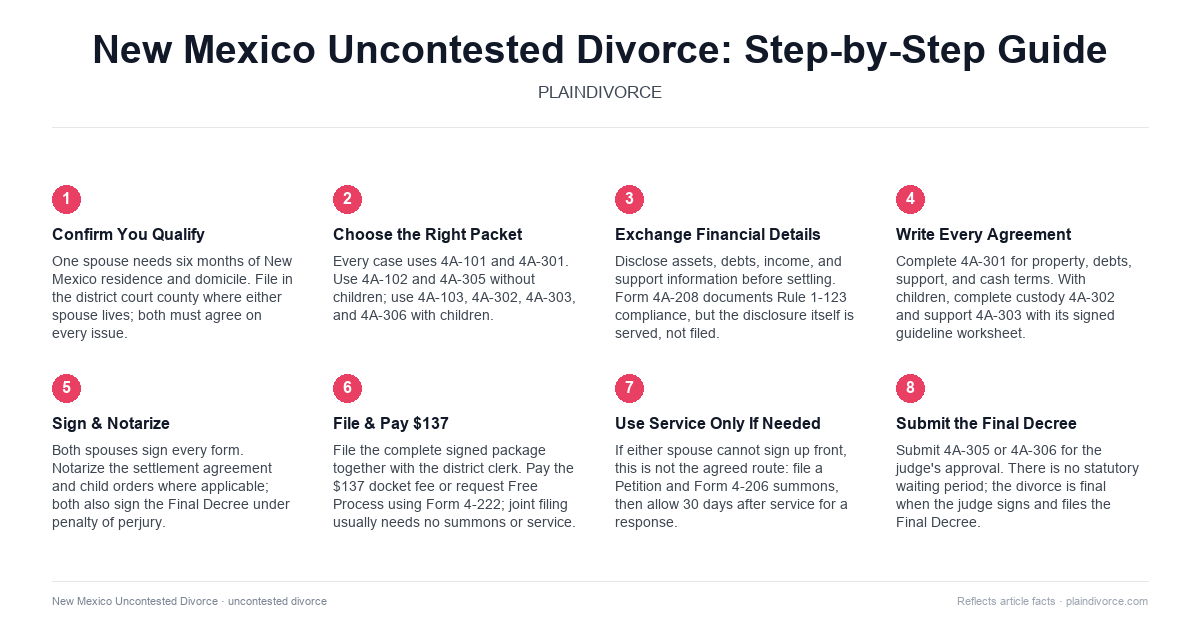
Step 1 — Reach a complete written agreement
Before you touch the decree, settle every issue and put it in the Marital Settlement Agreement (Form 4A-301), plus the Custody Plan and Order (4A-302) and Child Support Obligation and Order (4A-303) if you have children. The numbers and terms in these documents must match your Petition and your Final Decree exactly.
Step 2 — Complete and sign every form in the packet
Both spouses sign. The Marital Settlement Agreement, and (in a child case) the custody and child support orders, are signed under oath before a notary. In an agreed decree, both parties sign the Final Decree itself under penalty of perjury, confirming that they are giving up the right to a trial, that no one is acting under duress, and that the written terms are their full agreement.
Step 3 — File the whole package and pay the fee
Take the original plus two copies of each form to the district court clerk in the correct county and pay the filing fee (see Section 8). Because every signed form is filed together, there is usually no summons to serve — the “Petition, summons, service” sequence belongs to contested cases.
Step 4 — Submit the Final Decree to the judge
Once the signed Marital Settlement Agreement (and custody and child support orders) are on file, you submit the completed Final Decree (Form 4A-305 or 4A-306) to the judge for approval. Per the state instructions, “the Court may sign the Final Decree of Dissolution of Marriage without further notice, or it may order you and the other party to appear for a hearing.” Many agreed cases are signed on the papers.
Step 5 — The judge signs; the divorce is final
Your divorce is final when the judge signs and files the Final Decree, not before. At that point the Marital Settlement Agreement and any custody and child support orders become enforceable court orders.
If you can’t file everything at once
When one spouse won’t sign up front, you start a contested case: file Form 4A-101, the Petition (4A-102 or 4A-103), and a Form 4-206 summons. The clerk may also issue a Temporary Domestic Order (Form 4A-201), which restricts big moves involving children, property, bank and retirement accounts, insurance, and debt while the case is pending — it binds the petitioner when the case is filed and the other spouse when served. It is not a protective order. The other spouse then has 30 days after service to file a response (Form 4A-104). If they never respond, you can ask for a default (Form 4A-310). A friendly but not-yet-signed case can still settle later using the same 4A-301, 4A-302, 4A-303, and decree forms.
5. Financial Disclosure and the Marital Settlement Agreement (4A-301)
Rule 1-123 disclosure
New Mexico’s Rule 1-123 requires each spouse to give the other a financial disclosure in any case that divides property or debt or sets support. In a contested filing, that disclosure is due within 45 days after the Petition is served. Parties can agree to a different arrangement, or ask the court to order one, and in a fully agreed case the exchange happens as you build the settlement. The disclosures are served on each other, not filed; Form 4A-208 is the notice that documents compliance.
What the Marital Settlement Agreement covers
A Marital Settlement Agreement is required in every dissolution. Follow the New Mexico Marital Settlement Agreement (4A-301) instructions closely; the form walks through:
- Personal property, the marital home, other real property, bank and investment accounts, retirement plans, and vehicles
- Debts, credit cards, and how you will handle joint tax returns
- Any equalizing cash payment from one spouse to the other, which becomes a judgment in the decree
- Spousal support — a set amount and duration, modifiable or non-modifiable, or none
When you sign, you swear under penalty of perjury that you have disclosed all assets and debts known to you and that your spouse is relying on that disclosure. A few practical limits: the agreement does not bind your creditors even after the judge approves it, so a lender can still pursue whoever is on the loan. Transferring a house needs a signed, recorded deed; vehicles and mobile homes go through the Motor Vehicle Division; and splitting a pension or 401(k) usually needs a separate Qualified Domestic Relations Order (QDRO).
6. If You Have Children: Custody (4A-302) and Child Support (4A-303)
When there is a minor child — or a child under 19 attending high school full time — the court must be satisfied the plan serves the best interests of the child, even if both parents agree. Two orders are required, not optional.
Custody Plan and Order (Form 4A-302)
- Legal custody: sole or joint. Joint legal custody means sharing major decisions — it does not mean equal parenting time or an equal split of expenses.
- Parenting/timesharing schedule: the weekly pattern, holidays, school breaks, vacations, transportation, and exchanges.
- Decision-making and dispute steps: how you will resolve disagreements about the children.
Both parents verify the plan under oath and have their signatures notarized.
Child Support Obligation and Order (Form 4A-303)
- Guideline worksheet: you must complete and attach a signed child support worksheet under Section 40-4-11.1 NMSA 1978. The court awards the worksheet amount unless you request a deviation, explain why, and the judge approves it.
- Health and dental insurance: the order says which parent covers the children and how uninsured costs are split by income share.
- Wage withholding: required unless the parents show good cause and set up an approved alternative, and mandatory if the children receive public assistance. Withheld payments run through the state Child Support Enforcement Division; Form 4A-304 is the Wage Withholding Order.
- Annual exchange: once a year either parent can require an exchange of tax returns, W-2s, and related income records.
- Duration: support generally runs until the youngest child turns 18 — or graduates high school or turns 19, whichever comes first, if the child is still enrolled at 18.
Your case with children ends with the Final Decree (Form 4A-306), which adopts and incorporates the Marital Settlement Agreement, the Custody Plan and Order, and the Child Support Obligation and Order by reference. Using the “without children” decree (4A-305) in a case with children will get it sent back.
7. How Long Does an Uncontested Divorce Take in New Mexico?
There is no fixed timeframe, because New Mexico sets no waiting period for divorce. How fast an uncontested divorce in New Mexico finishes depends on:
- Whether you filed everything together. A complete, signed packet can go to the judge right away; a Petition-and-service case has to wait out the 30-day response window first.
- Whether the judge wants a hearing. An agreed decree “may be signed without further notice,” or the court may set a short hearing.
- District processing time and how cleanly your forms are completed.
Common delays: a missing or inconsistent Marital Settlement Agreement, an incomplete child support worksheet, or submitting the wrong decree (4A-305 vs. 4A-306).
8. What an Uncontested Divorce Costs
- Court filing fee: $137 to open a domestic relations (divorce) case. This is the statewide statutory docket fee; see, for example, the Second Judicial District Court fee schedule. Pay it in cash or money order when the case is opened.
- Fee waiver: if you cannot afford the fee, file an Application for Free Process (Form 4-222) asking the court to waive or reduce it.
- Service costs: only if you use a Petition and summons and need a private process server or certified mail — avoided entirely when you file a fully signed packet.
- Copies, certified copies, and notary fees: small charges that vary by district (for example, $0.35 per page and $1.50 per certified document in the Second Judicial District).
9. When a DIY Divorce Is Not the Right Call
A do-it-yourself uncontested divorce is built for cooperative, straightforward situations. It may be the wrong approach if any of these apply:
- Domestic violence, threats, or safety concerns. Safety comes first, and service, mediation, and disclosure choices should not be collapsed into a “cooperative checklist.” Legal help may be essential.
- A heavy power imbalance — one spouse controls the money or the documents.
- Hidden assets or unclear income.
- Complex property — a business, multiple properties, or significant retirement or tax issues.
- High-conflict disputes about the children or a planned relocation.
- Pressure to sign quickly without understanding the consequences.
PlainDivorce.com can help you understand the process and the paperwork, but it cannot tell you what is “fair” in your case. If you are unsure, talk with a New Mexico family law attorney or a legal aid clinic before signing final documents.
10. Where a Self-Help Divorce Kit Fits
Even an uncontested case has predictable places people get stuck. A structured self-help kit is most useful when it keeps the whole 4A-Series packet aligned:
- Including the Domestic Relations Information Sheet (4A-101) and knowing it is submitted, not filed
- Choosing the right petition: 4A-102 (no children) vs. 4A-103 (with children)
- Keeping the Marital Settlement Agreement (4A-301) consistent with the Petition and decree
- Completing both child forms — 4A-302 and 4A-303 with the signed guideline worksheet — in a case with children
- Submitting the correct Final Decree of Dissolution (4A-305 without children, 4A-306 with children)
Download Our New Mexico Uncontested Divorce Self-Help Kit
11. Frequently Asked Questions
What is an uncontested divorce in New Mexico?
It is a dissolution of marriage where the spouses fully agree on property, debts, spousal support, and — if they have children — custody, timesharing, and child support, and they file every required 4A-Series form signed by both parties at the same time. Because there is nothing for the judge to decide, an agreed Final Decree can often be signed without a hearing.
Is there a waiting period for divorce in New Mexico?
No. New Mexico has no separation requirement and no statutory cooling-off period before a judge can sign an agreed decree. The 30-day figure people mention is the time a served spouse has to file a response in a contested case, and the point after which a non-responding spouse can be defaulted — not a wait that applies to every divorce.
What forms do I need for an uncontested New Mexico divorce?
Without children: Form 4A-101 (Information Sheet), Form 4A-102 (Petition), Form 4A-301 (Marital Settlement Agreement), and Form 4A-305 (Final Decree). With children, add Form 4A-103 instead of 4A-102, Form 4A-302 (Custody Plan and Order), Form 4A-303 (Child Support Obligation and Order) with a signed worksheet, and Form 4A-306 instead of 4A-305.
Do we have to go to court for an uncontested divorce?
Often not. The New Mexico instructions say the court “may sign the Final Decree of Dissolution of Marriage without further notice, or it may order you and the other party to appear for a hearing.” Whether a hearing is set depends on the judge and the district. The divorce is final only when the judge signs and files the decree.
What is the residency requirement to file for divorce in New Mexico?
At least one spouse must have resided in New Mexico for at least six months immediately before filing and have a New Mexico domicile — a permanent home in the state, not just a temporary stay. File in the district court of the county where either spouse lives. Special rules apply to military members.
Which final decree do we use, 4A-305 or 4A-306?
Use Form 4A-305 if you have no minor children and no child under 19 attending high school. Use Form 4A-306 if you do; it adopts your Marital Settlement Agreement, Custody Plan and Order, and Child Support Obligation and Order. Both spouses sign the agreed decree under penalty of perjury, waiving the right to a trial.
What is the Marital Settlement Agreement (Form 4A-301)?
It is the required, notarized contract that divides property and debts and sets any cash payment or spousal support. It does not cover custody or child support — those are separate orders (4A-302 and 4A-303) in a case with children. Signing it is a sworn statement that you have disclosed all assets and debts known to you. Court approval does not release you from debts your creditors can still collect.
How much does it cost to file for divorce in New Mexico?
The court filing fee to open a domestic relations case is $137, paid in cash or money order. If you cannot afford it, file an Application for Free Process (Form 4-222) to ask for a waiver or reduction. Copies, certified copies, notary fees, and any service costs are extra and vary by district.
12. Final Thoughts and Next Steps
Even a friendly divorce is hard. The good news is that New Mexico gives cooperating spouses a clean path: agree on everything, complete the standardized 4A-Series forms, and file them together so a judge can approve an uncontested divorce in New Mexico — frequently without a court appearance.
Before you file:
- Confirm the residency and domicile rule and file in the county where either spouse lives.
- Make sure you truly agree on property, debts, support, and (if applicable) children — and exchange full financial information.
- Use the right petition (4A-102 or 4A-103) and, in a child case, complete both 4A-302 and 4A-303 with the guideline worksheet.
- Submit the correct final decree: 4A-305 (no children) or 4A-306 (with children).
PlainDivorce.com provides organized legal information and DIY tools for an uncontested divorce in New Mexico. We are not a law firm, and nothing here is legal advice. Always verify the current forms, fees, and local procedures with your district court or the New Mexico Courts website before filing.
Sources and local rules can change. Use this guide as a plain-English organizer, then verify the current filing requirements with the official court or government source for your jurisdiction.

About Harry D
Expert contributor at PlainDivorce, helping Canadians and American navigate simple uncontested divorces with clarity and confidence.