Uncontested Divorce in New York: A Plain-English Guide to the UD and Joint Divorce Packets
An uncontested divorce in New York is a divorce where your spouse agrees, does not respond after being served, or files jointly with you, so a Supreme Court judge can decide the case on the paperwork without a trial. You start by buying an Index Number for $210, then file a standardized packet of forms. Total court filing fees run at least $335. Most uncontested cases are granted without either spouse setting foot in a courtroom.
This guide explains how the process works from start to finish: who qualifies, which court hears the case, the New York Uncontested Divorce Packet forms (the UD-series) and the newer Joint Divorce forms, the key steps and deadlines, realistic timelines and costs, and where a do-it-yourself approach makes sense. We keep the language plain and flag the 2025-2026 rule changes that older guides miss.
TL;DR
New York’s uncontested divorce is packet-driven, not adversarial. What stalls cases is almost never a dispute — it is an incomplete or internally inconsistent packet, or a deadline nobody realized was running.
- “Uncontested” does not mean “both spouses agreed.” A spouse who is properly served and simply never answers produces an uncontested case too — which is why the UD packet works even when your spouse won’t cooperate.
- The fees come in two stages, and that split is what surprises people. $210 for the Index Number when you commence, then $125 at calendaring ($95 RJI + $30 Note of Issue) — at least $335 total, months apart.
- You can no longer pick a convenient county. Since CPLR 515 took effect February 19, 2025, you file where a spouse or a minor child of the marriage actually lives.
- The Automatic Orders bind you the moment the case starts — no selling, borrowing against, or gifting property, and no changing insurance or beneficiaries. A 2025 amendment adds a 10-day duty to tell your spouse about any tax lien, foreclosure, bankruptcy, or lawsuit threatening the marital estate.
- No-fault is not self-executing. Swearing to the six-month breakdown makes the divorce unopposable, but the judge cannot sign until every economic issue plus custody and parenting time is resolved and written into the judgment.
- Most UD forms no longer need a notary — after the CPLR 2106 amendments they are signed as affirmations under penalty of perjury. The exception matters: a settlement or separation agreement is a matrimonial agreement and still must be signed before a notary.
- How your spouse responds sets your next date. Signed Affirmation of Defendant (UD-7) means you can calendar immediately; a default means waiting 40 days from the date of service — not from filing. A Notice of Appearance makes the case contested.
- Service has a 120-day window under CPLR 306-b, and the server must be 18 or older, not a party, and a New York resident if serving inside the state.
- The Joint Divorce Program is a one-way door. Available statewide since January 15, 2025, with no summons to serve — but you cannot switch into it once a Summons or Summons and Complaint has been filed.
- Two different child ages do two different jobs. “Children of the marriage” means under 21 (New York’s support age). “Minor children” means under 18 — that is what triggers RJI Addendum 840M.
- UD-4 is for religious ceremonies only. The Removal of Barriers to Remarriage form applies under DRL § 253 when clergy solemnized the marriage — skip it entirely after a civil ceremony.
- “On the papers” is the norm, not a guarantee. Where you are seeking maintenance, custody, visitation, or a property division, the court may still set a hearing even with a signed agreement in hand.
- The judge’s signature does not end the marriage. You are divorced when the County Clerk enters the judgment. Serving the Notice of Entry (UD-14) afterward starts the appeal clock — it is not what finalizes anything.
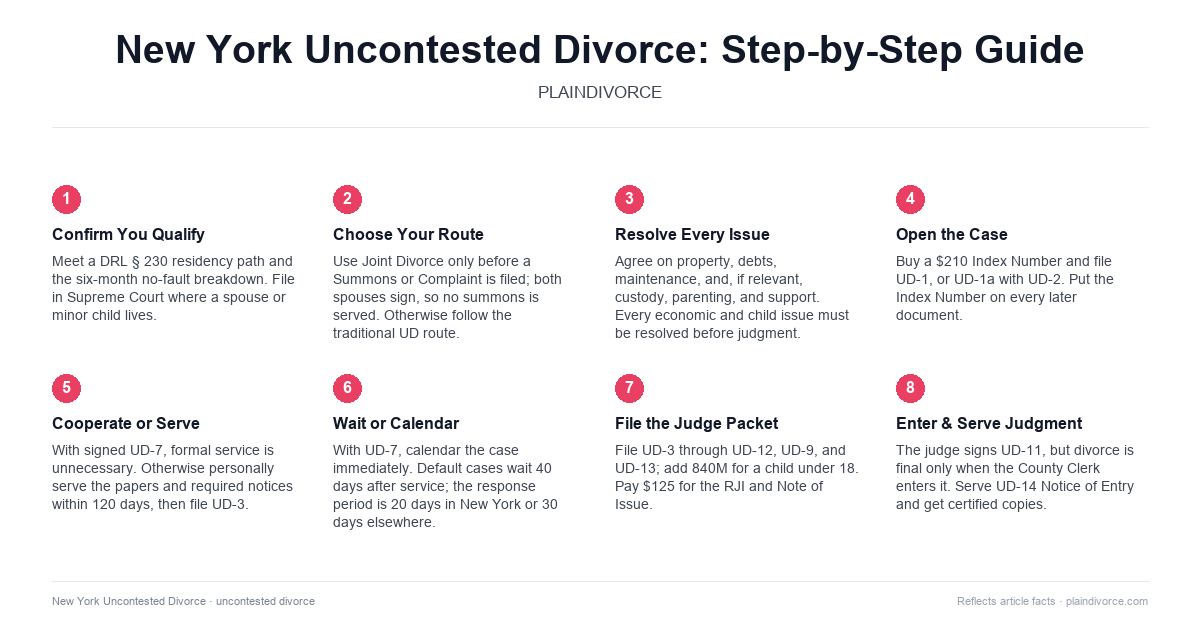
1. What an Uncontested Divorce Means in New York
New York does not have a separate “simple divorce” court track. People use “simple” or “uncontested” to describe a case the judge can grant on the papers. The New York courts define a divorce as uncontested when any one of these is true:
- The other spouse (the Defendant) signs the Affirmation of Defendant (Form UD-7), agreeing to the divorce and asking the court for nothing; or
- The Defendant is properly served and then defaults by not responding at all; or
- The spouses have a written settlement agreement and the Defendant signs the papers agreeing to the divorce; or
- The spouses file jointly using the Joint Divorce forms on the no-fault ground.
So an uncontested divorce is not only a case where both spouses have signed off on every detail. A served spouse who simply never answers also produces an uncontested case. What every route has in common is that nothing is left for the judge to fight over: the economic and parenting issues are either settled by the spouses or decided by the court and written into the judgment.
By contrast, a contested divorce is one where the Defendant appears and disputes something — the divorce itself, custody, support, or how property is divided. Contested cases mean court appearances, motion practice, and usually lawyers on both sides. If your spouse decides to fight after you have started, the uncontested packet no longer fits.
2. Who Qualifies: Residency, Grounds, and Venue
Every New York divorce, contested or not, has to clear two gates: a residency rule under Domestic Relations Law § 230 and a legal ground under Domestic Relations Law § 170. You must also file in the right county.
2.1 New York residency requirements
You only need to meet one of these, and you must meet it on the day the case is commenced. The current Uncontested Divorce Instructions list four paths:
- Two-year residency: you or your spouse has lived in New York continuously for at least two years before the case starts; or
- One-year residency plus a marriage tie: you or your spouse has lived in New York continuously for at least one year, and either the marriage ceremony took place in New York or you lived in New York together as a married couple; or
- One-year residency plus grounds in New York: you or your spouse has lived in New York continuously for at least one year, and the events that are the grounds for the divorce happened in New York; or
- Both spouses are New York residents on the day the case starts and the grounds for the divorce arose in New York (no minimum length of residence).
If your case involves a recent move to or from New York, confirm which rule applies with the Supreme Court Clerk or a New York attorney before you spend money on an Index Number.
2.2 Grounds: New York’s no-fault option
New York has seven grounds for divorce. Older fault grounds (cruelty, abandonment, adultery, imprisonment) still exist, and so do the two separation grounds — living apart under a separation judgment or a written separation agreement, which Chapter 673 of the Laws of 2025 shortened from one year to six months effective in the March 1, 2026 forms. But almost every uncontested case uses the no-fault ground in DRL § 170(7):
- The relationship has broken down irretrievably for at least six months, and
- One spouse states this under oath in the divorce papers.
No-fault is not automatic. The court will not sign a judgment until every economic issue — dividing property, spousal maintenance, child support, and counsel or expert fees — plus custody and parenting time for any children is resolved by the spouses or decided by the court and written into the judgment. Once the issues are settled and one spouse has sworn to the six-month breakdown, the divorce must be granted and cannot be opposed.
2.3 Which county you file in (this changed in 2025)
Since CPLR 515 took effect on February 19, 2025, a divorce must be filed in a county where one of the spouses — or a minor child of the marriage — actually lives, unless one of those addresses is confidential or under a protective order. You can no longer pick a random county for convenience. The case is heard in the Supreme Court of that county, and the County Clerk’s Office handles the filing and the fees.
2.4 The Automatic Orders kick in the moment you file
As soon as the case starts (and once the Defendant is served), both spouses are bound by New York’s Automatic Orders under DRL § 236(B)(2)(b) until the Judgment of Divorce is entered. In plain terms, neither spouse may sell, give away, or borrow against property, cancel or change insurance and beneficiaries, or run up unusual debt without the other’s written consent or a court order. A 2025 amendment (Chapter 535) adds a duty to tell your spouse, within 10 days, about any tax lien, foreclosure, bankruptcy, or lawsuit that could hurt the marital estate.
2.5 When uncontested or DIY may not be a good fit
An uncontested divorce is built for cooperative, straightforward situations. Treat these as reasons to get confidential legal or safety advice before filing — not as automatic bars:
- Domestic violence, threats, stalking, or coercive control. The packet directs survivors who need address confidentiality to ask the Supreme Court Clerk for instructions before filling out any form.
- One spouse controls the money or the documents and the other cannot verify what exists.
- A business, multiple properties, or significant retirement assets.
- Suspected hidden income, debt, or assets.
- Immigration timing concerns, serious tax problems, bankruptcy, or complex debt.
- Real disagreement about the children’s safety or where they will live.
3. Two Paths: the UD Packet vs. the Joint Divorce Program
New York now offers two do-it-yourself routes for an agreed divorce. Choosing the right one up front saves weeks.
The Uncontested Divorce Packet (UD-series)
This is the traditional route. One spouse is the Plaintiff and files first; the other is the Defendant and either signs the Affirmation of Defendant or is served and defaults. It works whether or not your spouse will actively cooperate, and it is the route you must use if you have children under 21 and want to build the papers yourself on paper. New York also runs a free online DIY (Do-It-Yourself) Uncontested Divorce Program that assembles the papers for filers with no children under 21 whose marriage has been over for at least six months.
The Uncontested Joint Divorce Program
Available in every New York county since January 15, 2025 (forms last revised March 1, 2026), the Joint Divorce Program lets spouses who both want the divorce file together instead of one suing the other. To use it, you must use the no-fault ground and agree on finances, property, and — if you have children under 21 — custody, parenting time, and support. There is no summons to serve, because both spouses sign a combined Summons with Notice and Notice of Appearance. Children under 21 are allowed; there is a separate “with children” forms packet. You cannot switch into the Joint Divorce Program once you have already filed a Summons or a Summons and Complaint.
| Uncontested Divorce Packet (UD) | Joint Divorce Program (JD) | |
|---|---|---|
| Who files | One spouse (Plaintiff) sues the other (Defendant) | Both spouses file together |
| Service | Required unless Defendant signs the Affirmation of Defendant | None — both sign a combined summons and appearance |
| Spouse won’t cooperate | Works (serve, then default) | Not an option — both must sign |
| Children under 21 | Allowed (paper packet) | Allowed (“with children” packet) |
| Ground | Any of the seven; usually no-fault | No-fault only |
| Core forms | UD-1/UD-1a through UD-15, UCS-111 | JD-1 through JD-6, plus RJI and UCS-111 |
| Court fees | $210 Index Number + $125 (RJI + Note of Issue) | Same: $210 + $125 |
The rest of this guide follows the UD packet, because it is the route most self-represented New Yorkers use and the one that covers a non-cooperative or missing spouse.
4. The New York Uncontested Divorce Packet Forms (UD-Series)
New York’s Unified Court System publishes a standardized UD-series packet, revised March 1, 2026. Form codes matter because filers search them directly when they get stuck. Here is what a complete packet contains and what each key form does.
The core UD-series forms
- Three required notices served with the summons in every case: Notice of Automatic Orders, Notice of Guideline Maintenance, and Notice Concerning Continuation of Health Care Coverage
- UD-1 — Summons with Notice, or UD-1a — Summons plus UD-2 — Verified Complaint
- UD-3 — Affirmation of Service (proof the papers were delivered)
- UD-4 / UD-4a — Sworn Statement of Removal of Barriers to Remarriage and its proof of service (religious ceremonies only)
- UD-5 — Affirmation of Regularity
- UD-6 — Sworn Affirmation of Plaintiff (formerly the “Affidavit of Plaintiff”)
- UD-7 — Affirmation of Defendant (only if the Defendant signs it)
- UD-8(1) / UD-8(2) / UD-8(3) — income, maintenance, and child-support worksheets, as applicable
- UD-9 — Note of Issue
- UD-10 — Findings of Fact and Conclusions of Law
- UD-11 — Judgment of Divorce (the order the judge signs)
- UD-12 — Part 130 Certification
- UD-13 — Request for Judicial Intervention (RJI), plus Addendum 840M if any child is under 18
- UD-14 / UD-15 — Notice of Entry and Affirmation of Service of the Judgment
- UCS-111 — Child Support Summary Form (where there is a child support order)
- Certificate of Dissolution of Marriage and a stamped, self-addressed postcard
This is a map, not the full list. The exact set depends on whether you have children, how the Defendant responds, and your county’s filing method. Use the current official packet and follow the Supreme Court Clerk’s instructions.
“Affirmation” vs. “affidavit.” After CPLR 2106 was amended (Chapter 559, Laws of 2023, and Chapter 564, Laws of 2025), most UD forms are now signed as affirmations — a signed statement under penalty of perjury, no notary needed. Notarized affidavits are still accepted. The one exception: a settlement or separation agreement is a matrimonial agreement and must still be signed before a notary.
Sworn Affirmation of Plaintiff (UD-6). This is your testimony. It tells the judge the facts of the marriage, confirms the residency rule and the six-month no-fault breakdown, and restates the settlement terms. Follow the current UD-6 instructions line by line — the judge relies on it to grant the divorce without a hearing, and mistakes here are a leading reason packets come back.
UD-4, Removal of Barriers to Remarriage. Required under DRL § 253 only when the marriage was solemnized by clergy or a religious officiant — that is, a religious ceremony. Skip it entirely if you had a civil ceremony, or if the Defendant signs Form UD-7 and checks Box 6b.
Accuracy tip. Names, dates, and addresses must match across the whole packet. The court publishes a “Top 20 Most Common Mistakes” list for uncontested filings; small inconsistencies between forms are on it.
5. Step by Step: How an Uncontested Divorce Moves
Details vary by county, but the path is consistent. New York is packet-driven: an incomplete or inconsistent packet is the usual reason a case stalls, not the divorce being “contested.”
Step 1 — Confirm you qualify
Check three things before you print anything: you meet a § 230 residency rule; you have a ground (usually the six-month no-fault breakdown); and you and your spouse have resolved — or are ready to have the court decide — property, debts, support, and children. If any answer is “not sure,” get reliable information first.
Step 2 — Settle children, support, and property
The court wants clear, workable terms, in a written agreement or spelled out in your papers:
- Custody and decision-making: who makes major decisions, and where the children live.
- Parenting time: a real schedule, including holidays and school breaks.
- Child support: the guideline amount, health insurance, and how unreimbursed medical costs are split.
- Spousal maintenance: whether it applies and, if so, the amount and duration.
- Property and debts: the home, vehicles, bank and retirement accounts, and liabilities.
“We’ll decide later” language gets a packet rejected. Be specific now.
Step 3 — Buy the Index Number and file the starting papers
Take your Summons with Notice (UD-1), or your Summons (UD-1a) and Verified Complaint (UD-2), to the County Clerk’s Office and buy an Index Number for $210. That opens the case and creates the number that must appear on every later document. Some counties allow or require e-filing through NYSCEF — check your county’s status first.
Step 4 — Give the papers to your spouse
You have two options:
- If your spouse will cooperate: hand or mail them the papers plus the Affirmation of Defendant (UD-7). When they sign and return it, no formal service is needed and you can move straight to calendaring.
- If you are not sure they will cooperate: the Defendant must be personally served. Someone 18 or older who is not a party to the case delivers the summons — along with the three required notices and, if you have children under 21, the Child Support Standards Chart. Inside New York, the server must be a New York resident; outside New York, the server must be authorized under that place’s law. Service must be completed within 120 days of filing (CPLR 306-b). The server then completes the Affirmation of Service (UD-3).
Step 5 — The response window and the 40-day wait
A served spouse has 20 days to respond if served in New York, or 30 days if served outside New York. What matters for moving forward is how they respond:
- Signs the Affirmation of Defendant (UD-7): the case is uncontested and can be placed on the court calendar immediately.
- Does nothing (defaults): the case is uncontested, but you must wait 40 days from the date of service before you can put it on the calendar.
- Files a Notice of Appearance: the case is now contested. Consider talking to a lawyer.
Step 6 — Calendar the case for the judge
“Calendaring” means the papers are ready for a judge to review. You assemble the full packet — UD-3 through UD-12, plus UD-7 only if the Defendant signed it — and file it with the County Clerk’s Office along with:
- Note of Issue (UD-9) — three copies
- Request for Judicial Intervention (UD-13), plus Addendum 840M if a child is under 18
- Certificate of Dissolution of Marriage, the postcard, and — where there is a child support order — UCS-111
The Note of Issue and the RJI are required statewide in the paper packet — they are not optional local add-ons, though a county can ask for extra items on top. You pay the combined $125 fee at this stage.
The packet timeline at a glance
- Buy the Index Number ($210) and file the summons
- Get the papers to the Defendant — UD-7 signed, or personal service within 120 days
- Wait — calendar immediately if UD-7 is signed; otherwise 40 days from the date of service
- File the full packet with the Note of Issue, RJI, and (if applicable) child-support forms, and pay $125
- Judge review — the judge signs, requests corrections, or (for maintenance, custody, visitation, or property) may set a hearing
- Judgment of Divorce (UD-11) is signed, then entered by the County Clerk
- Serve the judgment on your spouse with a Notice of Entry (UD-14)
County submission steps vary — always follow your Supreme Court Clerk’s current instructions.
Most uncontested packets are decided on the papers. But if you are asking for maintenance, custody, visitation, or a property division, the court may still require a hearing, even with a prior agreement or order. In some cases the court will also direct you to serve the unsigned judgment on the Defendant with a Notice of Settlement so they can object before the judge signs.
Step 7 — The Judgment of Divorce and your proof
If the judge approves the packet, they sign the Judgment of Divorce (UD-11). Your divorce is final when that judgment is signed by the judge and then entered (recorded and date-stamped) by the County Clerk — not at signing alone. After entry, you serve a copy of the judgment with a Notice of Entry (UD-14) on your former spouse; that step starts the appeal clock but is not what ends the marriage. Get a certified copy of the judgment (usually about $4 to $10) — you will need it for records, agencies, name changes, and remarriage.
6. Special Rules When You Have Children Under 21
New York parents support their children until age 21, so “children of the marriage” in the packet means anyone under 21. “Minor children” means under 18 — that is the trigger for the RJI Addendum 840M. Having children does not block an uncontested divorce, but the judge reviews the paperwork more closely and must be satisfied it serves the children’s best interests, even when both parents agree.
In a case with children, expect to file:
- A clear custody and parenting-time arrangement.
- The Child Support Worksheet (UD-8(3)) using New York’s Child Support Standards Act formula. As of March 1, 2026 the combined parental income cap for the formula is $193,000. Any amount below the guideline needs written reasons the judge approves.
- UCS-111 (Child Support Summary Form) wherever there is a child support order.
- Health insurance details and how unreimbursed medical costs are shared.
- An Income Withholding Order. Under DRL § 240, the court must issue an immediate withholding order with every support order unless child support services apply or the court makes a written good-cause finding (or the parents have a written alternative).
- Depending on the case: UD-8a (Support Collection Unit Information Sheet), UD-8b (Qualified Medical Child Support Order), the Addendum to RJI (840M), and the NYS Case Registry form.
Vague parenting terms, or terms that look unfair to the children, can be sent back for changes before the judge signs. For the current child-support numbers, see the New York State Child Support program’s guidelines information.
7. How Long Does an Uncontested Divorce Take in New York?
There is no statewide timeline, and the courts publish no average. Your case moves as fast as its slowest link:
- How quickly you prepare and correct the forms.
- Whether your spouse signs the Affirmation of Defendant (calendar now) or defaults (wait 40 days from service).
- How busy your county’s Supreme Court is.
- Whether the judge requests corrections or sets a hearing.
The most common self-inflicted delays: an incomplete or inconsistent settlement, a missing child-support worksheet or UCS-111, names and dates that don’t match between forms, or filing before the 40-day wait has run. The marriage is legally over only once the Judgment of Divorce is signed and entered by the County Clerk.
8. What an Uncontested Divorce Costs in New York
New York splits the court fees into two stages, which is what confuses DIY filers.
Stage 1 — the Index Number. The NY divorce Index Number cost is $210 (CPLR 8018). You pay it when you commence the case; it creates the case number for every later document.
Stage 2 — calendaring. When you file the packet for the judge, you pay a combined $125: $95 for the Request for Judicial Intervention plus $30 for the Note of Issue in the New York divorce packet (CPLR 8020). The court’s own guidance says an uncontested divorce costs “at least $335” in filing fees.
Court fee snapshot
- $210 — Index Number (to commence the case)
- $125 — Request for Judicial Intervention ($95) + Note of Issue ($30), paid at calendaring
- $35 — to file a separation or settlement agreement with the County Clerk, if you have one
- ~$4-$10 — certified copy of the Judgment of Divorce
Not included: process server fees, copies, postage, and any notary fees for the settlement agreement.
Fee waiver. If you cannot afford the fees, the Plaintiff can file an Affirmation in Support of Application for Waiver of Court Costs, Fees and Expenses together with a proposed Order for Waiver of Court Costs, Fees and Expenses. A granted waiver covers court and filing fees only — not a lawyer, copies, notary, transportation, mailing, or process-server costs. You can check the current statewide fee amounts on the New York Courts filing-fee schedule.
9. When a DIY Divorce Might Not Be Right for You
DIY saves money in a genuinely straightforward case. Get legal advice, and maybe representation, if any of these apply:
- A history of domestic violence, threats, stalking, or coercive control.
- You suspect hidden bank accounts, retirement funds, income, or business interests.
- You own a business, multiple homes, or high-value investments.
- Serious tax problems or bankruptcy for either spouse.
- Immigration status that could turn on the timing of the divorce.
- Real disagreement about custody, relocation, or the children’s safety.
- You feel pressured to sign an agreement you do not fully understand.
Even one consultation with a New York family-law attorney or a legal aid clinic can prevent an expensive mistake — a waived pension share, an unenforceable parenting clause, or a rejected packet.
10. Where a Self-Help Divorce Kit Fits
If your situation is truly uncontested, the hard part in New York is the paperwork volume, not the law. A good self-help kit is most valuable when it keeps the whole New York Uncontested Divorce Packet consistent and complete:
- Choosing the right route — UD packet vs. Joint Divorce — before you file anything.
- Organizing information about your children, income, property, and debts.
- Understanding how the UD-series forms fit together and why each one matters.
- Tracking the deadlines that trip people up: 120-day service, the 40-day wait, and the Note of Issue and RJI at calendaring.
- Keeping names, dates, and figures identical across every form.
PlainDivorce.com focuses on uncontested divorces only. Our goal is to give self-represented New Yorkers clear, practical tools for a simple divorce — without turning it into a full-scale legal project. Even with a kit, you remain responsible for confirming that your forms and fees match the latest official requirements and for deciding whether you need independent legal advice.
11. Frequently Asked Questions
What forms are in the New York Uncontested Divorce Packet?
The packet is the UD-series, revised March 1, 2026. It includes three notices served with the summons, the Summons with Notice (UD-1) or Summons and Verified Complaint (UD-1a and UD-2), the Affirmation of Service (UD-3), the Affirmation of Regularity (UD-5), the Sworn Affirmation of Plaintiff (UD-6), the Affirmation of Defendant (UD-7) if signed, income and child-support worksheets (UD-8 series), the Note of Issue (UD-9), Findings of Fact (UD-10), Judgment of Divorce (UD-11), Part 130 Certification (UD-12), the RJI (UD-13), and, where there is a child support order, UCS-111.
How much does an uncontested divorce cost in NY?
The court’s own guidance says at least $335 in filing fees: $210 for the Index Number when you commence the case, plus a combined $125 at calendaring ($95 Request for Judicial Intervention + $30 Note of Issue). Filing a settlement agreement adds $35, and a certified copy of the judgment is roughly $4 to $10. If you cannot pay, the Plaintiff can apply for a waiver of court costs, fees, and expenses.
What is the Sworn Affirmation of Plaintiff (UD-6)?
Form UD-6, formerly called the Affidavit of Plaintiff, is your sworn statement to the court. It sets out the facts of the marriage, confirms the residency rule you meet and the six-month no-fault breakdown, and restates your settlement terms. Because there is no trial, the judge relies on the UD-6 to grant the divorce, so follow the current UD-6 instructions carefully — errors here are a common reason packets are returned.
Do I have to go to court for an uncontested divorce in New York?
Usually not. Most uncontested packets are decided “on the papers” without either spouse appearing. However, if you are asking for spousal maintenance, custody, visitation, or a division of property, the court may require a hearing even when both spouses agree. The judge can also ask for corrections before signing. There is no statewide guarantee of a desk-only process.
What is the residency requirement for a New York divorce?
You must meet one DRL § 230 rule on the day the case starts: either spouse lived in New York for two continuous years; or one continuous year plus the marriage was performed in New York or you lived here as a married couple; or one continuous year plus the grounds arose in New York; or both spouses are New York residents and the grounds arose in New York. You then file in a county where a spouse or a minor child lives.
What is the Note of Issue in a New York divorce?
The Note of Issue (Form UD-9) is the paper that tells the court your case is ready for a judge to review — it “calendars” the case. In an uncontested divorce you file it with the Request for Judicial Intervention and the rest of the packet, and pay a combined $125 fee. Both the Note of Issue and the RJI are required statewide in the paper packet, not optional local items.
How long after I file is my New York divorce final?
There is no fixed period. If your spouse signs the Affirmation of Defendant you can calendar the case right away; if they default, you wait 40 days from the date of service before calendaring. After that, timing depends on your county’s caseload and whether the judge wants corrections or a hearing. The divorce is final only when the Judgment of Divorce is signed by the judge and entered by the County Clerk.
Can my spouse and I file for divorce together in New York?
Yes. Since January 15, 2025, the statewide Uncontested Joint Divorce Program lets spouses who both want the divorce file together using the JD-series forms, on the no-fault ground, when they agree on finances, property, and any child issues. There is no summons to serve. Children under 21 are allowed. You cannot use it if a Summons or Summons and Complaint has already been filed.
12. Final Thoughts and Next Steps
An uncontested divorce in New York feels heavy mostly because it is packet-driven. But the path is predictable: confirm residency and a ground, resolve the money and the children, assemble a consistent packet, respect the 120-day service window and the 40-day wait, and file the Note of Issue and RJI so a judge can review it — usually without a court appearance.
Before you file:
- Decide between the UD packet and the Joint Divorce Program.
- Confirm your § 230 residency rule and file in a county where a spouse or minor child lives.
- Make sure you truly agree on property, debts, support, and children — and remember the Automatic Orders are already in effect.
- Use the current March 1, 2026 forms and keep every name, date, and figure identical across them.
PlainDivorce.com provides organized legal information and DIY tools for an uncontested divorce in New York. We are not a law firm, and nothing here is legal advice. Always verify the current forms, fees, and local procedures with your Supreme Court Clerk or the New York Courts website — and see the What’s New in Matrimonial Legislation, Court Rules, and Forms page for the latest changes — before you file.
Sources and local rules can change. Use this guide as a plain-English organizer, then verify the current filing requirements with the official court or government source for your jurisdiction.

About Harry D
Expert contributor at PlainDivorce, helping Canadians and American navigate simple uncontested divorces with clarity and confidence.