Uncontested / Simple Divorce in Newfoundland and Labrador: A Plain English Guide
If you and your spouse agree the marriage is over and you want to avoid a drawn out court fight, an uncontested divorce in Newfoundland and Labrador is often the cleanest path.
But here’s the big local “insider” detail: in Newfoundland and Labrador, you usually don’t start a divorce with a “petition.” In the Supreme Court of Newfoundland and Labrador, you typically start with an Originating Application (or a Joint Originating Application if you file together). Later, you finalize the case with an Application for Judgment, often called a Desk Application, so a judge can grant the Divorce Judgment without a hearing.
Important disclaimer: PlainDivorce is not a law firm and does not provide legal advice. This article is general legal information only. Court rules, forms, and fees change. Always confirm details with official court resources or a Newfoundland and Labrador family lawyer or legal clinic before you act.
Table of Contents
- 1. What is an uncontested or “simple” divorce in Newfoundland and Labrador?
- 2. Who qualifies for an uncontested divorce in Newfoundland and Labrador?
- 3. Step by step overview (Originating Application → Desk Application)
- 4. Special issues when you have children
- 5. How long does an uncontested divorce take in NL?
- 6. What does an uncontested divorce cost in NL?
- 7. When a DIY divorce might not be right for you
- 8. Where a self-help divorce kit fits into the process
- 9. FAQ
- 10. Final thoughts and next steps
1. What is an uncontested or “simple” divorce in Newfoundland and Labrador?
In Newfoundland and Labrador, a divorce is granted under Canada’s Divorce Act, but the procedure runs through the Supreme Court of Newfoundland and Labrador (often the Family Division in larger centres).
An uncontested divorce generally means:
- One spouse files a sole Originating Application and the other spouse does not file a response to oppose it, or
- Both spouses file together using a Joint Originating Application, showing the court you’re cooperating.
Either way, the goal is the same: you want a judge to grant a Divorce Judgment based on paperwork, without a contested hearing.
Plain English translation: “Simple divorce” usually means you’re mainly asking the court to end the marriage, and you’ve already resolved the practical issues (children, support, and property) in a separation agreement or existing court orders.
Uncontested vs. contested
A contested divorce is where someone disputes the divorce or asks the court to decide unresolved issues (parenting, support, property). Contested cases are slower and often require legal advice.
An uncontested divorce is where the court mainly checks: jurisdiction and residency, separation and grounds, and (if you have children) reasonable child support arrangements, then grants the Divorce Judgment on the file.
2. Who qualifies for an uncontested divorce in Newfoundland and Labrador?
Residency
In most cases, at least one spouse must have lived in Newfoundland and Labrador for at least 12 consecutive months immediately before applying for divorce.
Grounds for divorce
Most DIY uncontested divorces rely on one-year separation (“separate and apart”). You can often start paperwork before the year is up, but the divorce generally can’t be granted until you’ve been separated for the required time.
When an uncontested approach is a good fit
- You and your spouse agree the marriage is over.
- You can rely on one-year separation.
- Parenting and support issues are already settled (or you have no children and no support claims).
- Property and debt division is already resolved (usually in a separation agreement).
- No one intends to fight the case by filing a response or counterclaims.
When an uncontested divorce may not be appropriate
- Family violence, coercive control, or serious safety concerns.
- Major disagreements about children, support, or property.
- Complex assets (businesses, major pensions, multiple properties) or suspected hidden assets.
- Immigration or cross border issues where timing or wording matters.
If any of the above applies, you may still end up divorced, but it’s a strong sign you should get legal advice before trying to DIY the process.
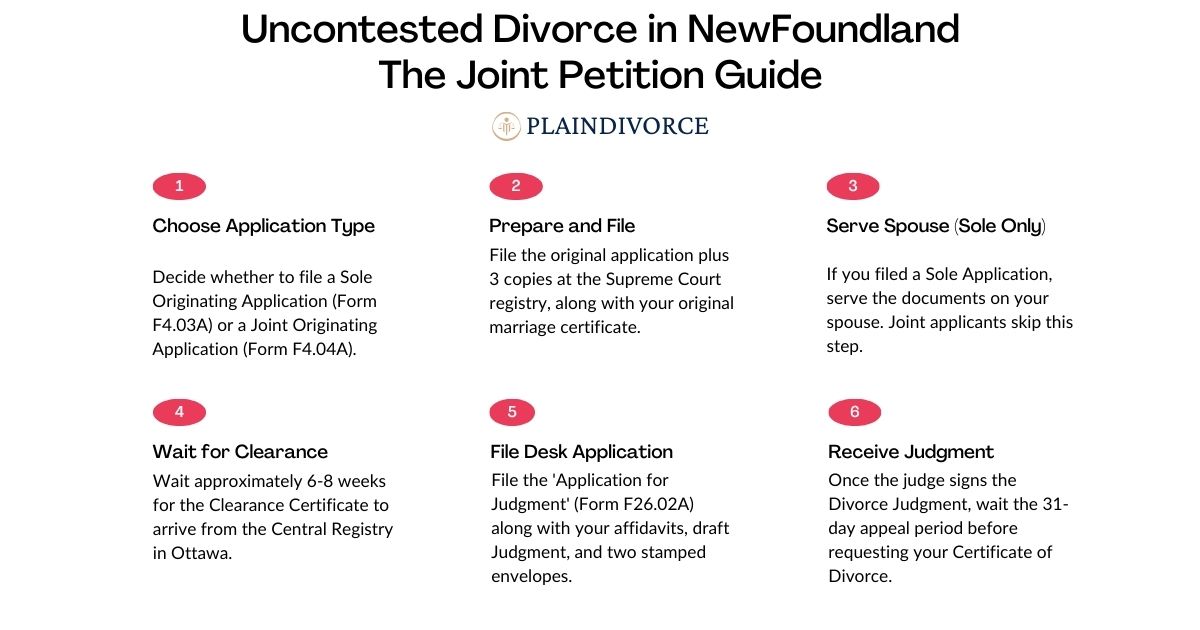
3. Step by step overview (Originating Application → Desk Application)
This is the big picture path most uncontested divorces follow in Newfoundland and Labrador. The exact documents can vary depending on whether you’re filing sole or jointly, and whether there are children or support claims.
Step 1 – Choose: Sole Originating Application or Joint Originating Application
Joint Originating Application is usually the smoothest path if you both agree and can sign together. It can reduce friction because you generally avoid formal service of process.
Sole Originating Application is used when only one spouse starts the case (even if the other spouse won’t fight it). This usually means you must properly serve the documents, then wait to see if a response is filed.
Step 2 – Prepare the “start” document (Form F4.03A or F4.04A)
In Newfoundland and Labrador, you must use the specific “F-Code” forms found in the Family Law Rules. Using an old form or the wrong code is a common reason a registry clerk returns a DIY file.
- Originating Application (Form F4.03A): Use this if you are filing alone (sole application).
- Joint Originating Application (Form F4.04A): Use this if you are filing together (joint application).
- Response (Form F6.02A): The form your spouse files if they wish to contest the divorce (sole cases).
- Application for Judgment (Form F26.02A): The desk application form used to request the divorce without a hearing.
- Divorce Judgment (Form F26.03A): The draft judgment for the judge to sign.
- Financial Statement (Form F10.02A): Commonly required if you are asking for spousal support or child support that differs from the table amount (or if you need to prove income for a support issue).
You’ll also gather key supporting documents such as your original marriage certificate and basic details about children and support (if applicable).
Step 3 – The “1 Original + 3 Copies” rule
The Supreme Court of NL is strict about paper protocol. When you go to the registry to file your Originating Application (sole or joint), you generally must bring:
- The original: signed (and where required, sworn or affirmed).
- 3 copies: the court keeps the original and one copy, and stamps and returns two copies to you (one for your records, one for service or your spouse).
- Original marriage certificate: the registry typically will not accept a photocopy.
The “Ottawa wait”: After you file your Originating Application, the court registry sends a request to Ottawa (Central Registry of Divorce Proceedings) for a Clearance Certificate. This commonly takes 6 to 8 weeks. You generally cannot file your Application for Judgment (the desk application stage) until this certificate has arrived at the court.
Step 4 – Service (sole cases) or skip service (joint cases)
If you filed jointly: both spouses are applicants, so service is usually not part of the workflow.
If you filed alone: you usually must serve the other spouse according to the court rules. If the other spouse wants to oppose, they can file a Response (Form F6.02A). If they do nothing, your case can proceed as uncontested.
Step 5 – (If needed) interim relief before the divorce is finalized
Sometimes people need a temporary order while the divorce is pending, for example temporary support or a temporary parenting arrangement. That’s often described as interim relief. If you need interim relief, your file can become more complicated and you may want legal advice early.
Step 6 – Convert the case into a “Desk Application” using an Application for Judgment (Form F26.02A)
This is the key no hearing move in NL: once your file is ready to be finalized (and uncontested, with the Clearance Certificate on file), you typically file an Application for Judgment (Form F26.02A), often called a Desk Application. This asks the judge to review the paperwork and grant the divorce without an in person hearing.
Your desk package usually includes sworn evidence confirming the marriage details, separation date, residency, and (if you have children) reasonable child support arrangements, along with a draft Divorce Judgment (Form F26.03A) for the judge to sign.
Hard stop: the stamped envelope requirement
When you file your Application for Judgment (Form F26.02A), the registry typically requires two stamped, self addressed envelopes, one addressed to you and one addressed to your spouse. The court uses these to mail the Divorce Judgment. If you forget them, your filing may be rejected or delayed.
Step 7 – Receive the Divorce Judgment, then wait for it to take effect
If everything is in order, a judge grants the Divorce Judgment.
Important timing point: in most cases, a divorce takes effect on the 31st day after the judgment is granted (unless the court orders otherwise). After it takes effect, you can request a Certificate of Divorce as official proof of the effective date.
Quick forms checklist (plain text)
- F4.03A or F4.04A
- F6.02A (if applicable)
- F26.02A
- F26.03A
- Certificate of Divorce
4. Special issues when you have children
Even in an uncontested divorce, the court must be satisfied that reasonable child support arrangements are in place. If your child support setup is unclear or far below guideline expectations without explanation, it can delay the desk review.
- A clear parenting plan (schedule, decision making, holidays).
- Child support that aligns with the Child Support Guidelines (or a clear explanation if it differs).
- Basic income information that supports the child support amount.
If you are asking for spousal support or child support different from the table amount, a Financial Statement (Form F10.02A) is commonly required.
5. How long does an uncontested divorce take in NL?
Think in layers:
- Separation layer: most couples rely on one-year separation before the divorce can be granted.
- Court processing layer: the time to prepare, file, (serve if needed), wait for the Clearance Certificate, and submit the desk application package depends on how organized you are and how busy the registry is.
- 31-day layer: after the Divorce Judgment is granted, the divorce usually becomes effective 31 days later.
Many delays in DIY cases come from incomplete forms, missing attachments, missing envelopes, missing copy counts, or unclear child support details, not from the concept of uncontested itself.
6. What does an uncontested divorce cost in NL?
Below is the current fee breakdown based on the court fee table you provided. Fees can change, so always confirm with the registry before you file.
| Step | Fee |
|---|---|
| 1. Originating Application for Divorce (includes $10.00 Central Registry of Divorce Proceedings fee) | $130.00 |
| 2. Divorce Judgment / Corollary Relief Judgment (desk application stage) | $60.00 |
| 3. Divorce Certificate | $20.00 |
The stamped envelope requirement: When you file your Application for Judgment (Form F26.02A), the registry typically requires two stamped envelopes, one addressed to you and one addressed to your spouse, so the court can mail the final Divorce Judgment. If you forget them, your filing may be rejected or delayed.
Other common cost categories include service costs (sole cases), commissioner or notary fees for swearing affidavits (the fee table you provided lists $10.00 for witnessing an affidavit), replacing an original marriage certificate if you don’t have one, and optional legal advice for reviewing a separation agreement.
7. When a DIY divorce might not be right for you
DIY is usually not a good idea when safety, power imbalance, or complex finances are involved. Get legal help (even limited scope help) if there is violence, intimidation, hidden assets, serious disputes about children, or major immigration or cross border consequences.
8. Where a self-help divorce kit fits into the process
If your case is truly uncontested and you’re comfortable with paperwork, a self-help kit can help you stay organized and avoid common rejection issues (missing signatures, wrong dates, missing documents, missing copies, missing envelopes, inconsistent information).
PlainDivorce kits (when available for NL) are designed to provide structure, checklists, and plain English guidance, but they do not replace the official court forms or legal advice.
Download Our Newfoundland and Labrador Uncontested Divorce Self-Help Kit
9. FAQ
What is an uncontested or simple divorce in Newfoundland and Labrador?
It’s a divorce where the spouses aren’t fighting in court, and the judge can grant the divorce based on written evidence. In NL, this often means starting with an Originating Application (sole or joint) and finalizing with an Application for Judgment (a desk application) to obtain a Divorce Judgment.
Why is “Joint Originating Application” such a big deal?
Because it’s the court recognized way for couples to file together. When you file jointly, you usually avoid the service step that exists in sole applications, which can save time, stress, and process server costs.
When am I legally divorced?
In most cases, the divorce takes effect on the 31st day after the Divorce Judgment is granted. After that date, you can request a Certificate of Divorce as proof.
10. Final thoughts and next steps
If you’re organized, your case is genuinely uncontested, and you can use the correct local language and forms, an NL uncontested divorce can often be handled mostly on paper.
Next steps:
- Confirm you meet the NL residency requirement and your separation timeline.
- Finalize your separation agreement (especially for children, support, and property).
- Decide: sole Originating Application (Form F4.03A) or Joint Originating Application (Form F4.04A).
- Prepare the file with the correct copy count (1 original + 3 copies) and the original marriage certificate.
- Wait for the Clearance Certificate to arrive at the court, then finalize with an Application for Judgment (Form F26.02A) and include two stamped envelopes.
- After the Divorce Judgment is granted, calendar the 31-day effective date and then request your Certificate of Divorce.
Final reminder: This guide is legal information only, not legal advice. If something feels unsafe, unfair, or unusually complex, talk to a Newfoundland and Labrador family lawyer or legal clinic before you file.

About Harry D
Expert contributor at PlainDivorce, helping Canadians and American navigate simple uncontested divorces with clarity and confidence.