Uncontested Divorce in Newfoundland and Labrador: Forms, Fees, and Timeline
An uncontested divorce in Newfoundland and Labrador is one where you and your spouse agree the marriage is over and don’t ask the court to fight over anything, so a judge can grant it on the paperwork. You start with an Originating Application (sole or joint) in the Supreme Court of Newfoundland and Labrador and finish with an Application for Judgment. Court fees are $190 to file and get the judgment, plus one year of separation in most cases.
Here’s the local detail most guides miss: in this province you don’t file a “petition.” You begin with an Originating Application, or a Joint Originating Application for Divorce NL if you file together, and you finalize with an Application for Judgment NL divorce filing so a judge can review the file and grant the Divorce Judgment without anyone attending court.
TL;DR
- File a sole Originating Application (Form F4.03A), or a Joint Originating Application (Form F4.04A) if you and your spouse apply together.
- Attach your original marriage certificate and, for a joint application, a signed agreement or consent order covering any parenting, support, and property claims.
- File 1 original plus 3 copies for a sole application, or 1 original plus 2 copies for a joint application.
- Wait for the court to receive the Clearance Certificate from the federal divorce registry (the court estimates about 3–6 weeks).
- Finalize with an Application for Judgment (Form F26.02A) — the desk step — plus the $60 fee, a draft Divorce Judgment, and two self-addressed stamped envelopes.
- Budget $190 in Supreme Court of NL divorce fees ($130 to file, $60 for the judgment); add $20 later only if you request a Certificate of Divorce.
- Your divorce takes effect on the 31st day after the judgment.
1. What counts as an uncontested divorce in Newfoundland and Labrador?
Every divorce in Canada is granted under the federal Divorce Act, but the paperwork runs through the Supreme Court of Newfoundland and Labrador. An uncontested divorce in Newfoundland and Labrador generally means one of two things:
- One spouse files a sole Originating Application and the other spouse, after being served, does not file a Response; or
- Both spouses file together as co-applicants using a Joint Originating Application.
Either route ends the same way: you file an Application for Judgment and ask a judge to grant the Divorce Judgment on the written record, without a hearing. The judge still has to decide the application and, where there are children, must be satisfied that reasonable child support arrangements are in place — “uncontested” speeds the process up, it doesn’t remove the court’s review.
Uncontested vs. contested
A contested divorce is one where a spouse disputes the divorce itself or asks the court to decide unresolved parenting, support, or property issues. Those cases move slowly and usually need legal advice. In an uncontested case, the court is mainly confirming jurisdiction, residency, the one-year separation, the absence of collusion, and — if there are children — child support. If your spouse files a Response challenging the grounds for divorce, the matter becomes contested and you cannot proceed by default.
Which court handles your divorce
The Supreme Court has two divisions. The Family Division sits in St. John’s and Corner Brook and has exclusive family jurisdiction in the areas it serves. Everywhere else in the province, the General Division handles family matters, sitting in St. John’s, Grand Bank, Gander, Grand Falls-Windsor, Corner Brook, and Happy Valley-Goose Bay. The Joint Originating Application form tells you which court location to file in based on where your matter is heard (and, if children are involved, where they live). You can read the court’s own overview on the About the Court page.
2. Do you qualify? Residency, grounds, and separation
Residency
Under the Divorce Act, the court has jurisdiction only if at least one spouse has been habitually resident in Newfoundland and Labrador for at least one year immediately before the application is filed. You confirm this on Schedule 1 of the application form.
Grounds and the one-year separation rule
The only ground for divorce is breakdown of the marriage, which the Divorce Act says is established by one of three things: the spouses have lived separate and apart for at least one year, or one spouse committed adultery, or one spouse treated the other with physical or mental cruelty. Almost every DIY uncontested divorce relies on one year’s separation, because adultery and cruelty have to be proven.
You can file the Originating Application before the full year of separation has passed, but you cannot file the Application for Judgment — the step that actually gets you divorced — until the year is complete. A reconciliation attempt totalling up to 90 days does not restart the separation clock. There must also have been no collusion (no arrangement to deceive the court).
When an uncontested divorce fits
- You both agree the marriage is over and neither of you will contest it.
- You can rely on one year’s separation.
- Parenting and support are settled (or you have no children and no support claims).
- Property and debt are divided, usually in a written separation agreement.
When it may not be appropriate
- Family violence, coercive control, or safety concerns.
- Real disagreement about children, support, or property.
- Complex finances — a business, a significant pension, several properties, or suspected hidden assets.
- Immigration or cross-border issues where timing or wording matters.
If any of these apply, get legal advice — even a limited-scope consultation — before you try to do the process yourself.
3. The forms you’ll use
Newfoundland and Labrador’s family forms use an “F-code” system under the Supreme Court Family Rules (the forms are still headed Rules of the Supreme Court, 1986). Using an outdated version or the wrong code is one of the most common reasons a registry clerk returns a self-prepared file.
| Form | What it does | Who uses it |
|---|---|---|
| F4.03A — Originating Application | Starts a sole (one-spouse) application | Sole applicant |
| F4.04A — Joint Originating Application | Starts a joint application; no service needed | Both spouses as co-applicants |
| F8.03A — Affidavit of Service | Proves the other spouse was served | Sole applicant (completed by the server) |
| F6.02A — Response | Filed by a spouse who wants to contest | Respondent (sole cases only) |
| F6.06A — Notice of Default | Confirms no Response was filed in time | Sole applicant |
| F26.02A — Application for Judgment | The desk application asking for the divorce without a hearing | Applicant or co-applicants |
| F26.03A — Divorce Judgment | The draft judgment the judge signs (file 2 extra copies) | Applicant or co-applicants |
| F10.02A — Financial Statement | Income and expense disclosure for support claims | Anyone claiming support or an off-guideline amount |
| Request for a Certificate of Divorce | Requests official proof of the divorce (optional, $20) | Either spouse, after the divorce is effective |
You’ll also gather supporting documents: your original Certificate of Marriage or Registration of Marriage, an original or certified copy of any separation agreement or consent order, and basic income and parenting details if you have children.
4. Step by step: Originating Application to Application for Judgment
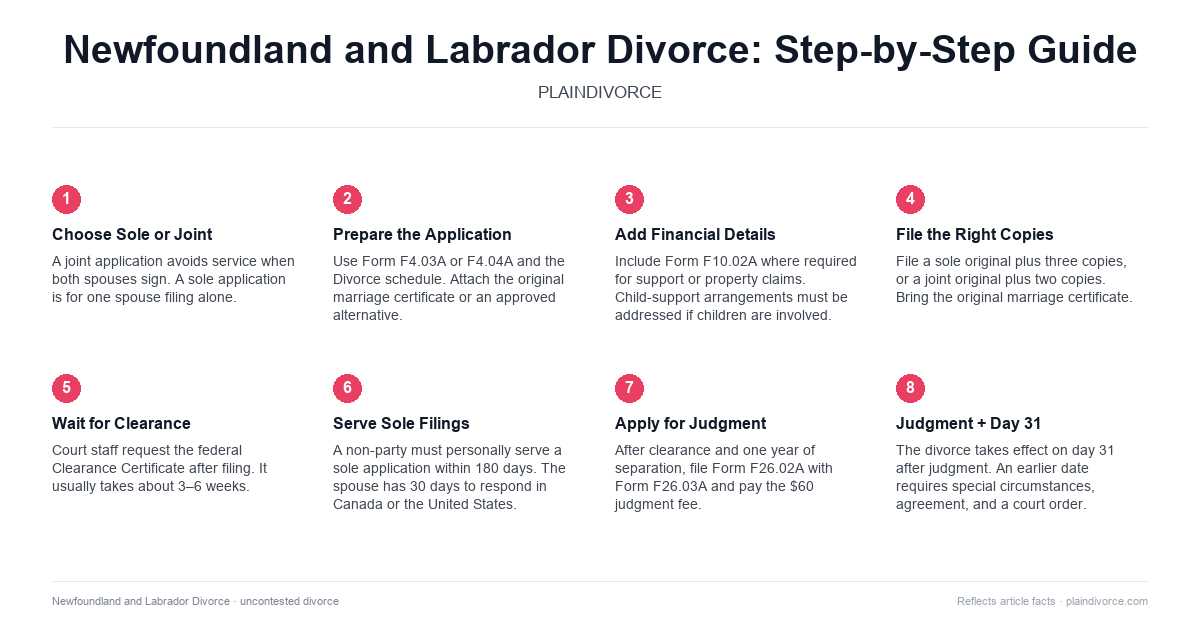
Step 1 — Choose sole or joint
A Joint Originating Application for Divorce NL is usually the smoothest route when you both agree and can sign together: all co-applicants sign the filed application, so there is no service step. If you file jointly and are also asking for parenting, support, or property orders, you must attach a signed agreement or consent order (Forms F34.02A/F34.02B) and complete the relevant schedules. A sole Originating Application is for when only one spouse starts the case — even a cooperative spouse who won’t fight it — and it requires formal service.
Step 2 — Prepare the application (Form F4.03A or F4.04A)
Complete every page and the Divorce schedule, which asks you to confirm the marriage breakdown, the residency requirement, that the original marriage certificate is attached, and that there has been no collusion. If your marriage certificate is not in English or French, attach a translation and the translator’s affidavit. If you were married outside Canada and genuinely cannot obtain the certificate, you make a separate interim application (Form F16.03A) for an order dispensing with it. When you’re seeking relief under the Divorce Act, each applicant (and any lawyer) also signs a certificate confirming awareness of the parenting and disclosure duties in sections 7.1–7.7 of the Act.
Step 3 — File the correct number of copies
The court is strict about paper. When you file:
- Sole application: the signed, sworn original plus 3 copies.
- Joint application: the signed, sworn original plus 2 copies.
- The original marriage certificate — the registry will not accept a plain photocopy.
You swear or affirm the application in front of a commissioner of oaths, notary, justice of the peace, or lawyer; registry staff are commissioners of oaths and can witness it when you file. The court charges $10 to witness an affidavit.
Step 4 — The federal clearance check
After you file, court staff request a Clearance Certificate from the Central Registry of Divorce Proceedings in Ottawa, which checks that no other divorce proceeding is already pending between you and your spouse. The court’s own guidance says this usually takes about 3–6 weeks, and suggests you call the court after that window to confirm the certificate has arrived. You generally can’t file the Application for Judgment until it has. Ask your filing registry for its current estimate and plan around it.
Step 5 — Service (sole cases) or skip it (joint cases)
Joint applications: because both spouses signed, there is no service.
Sole applications: an adult who is not you must personally hand-deliver the application to your spouse, and you have 180 days from filing to do it. Your spouse then has 30 days to file a Response (60 days if served outside Canada or the United States). The person who served the documents completes an Affidavit of Service (Form F8.03A), sworn with the server present. If no Response is filed in time, you file a Notice of Default (Form F6.06A) and the case proceeds as uncontested.
Step 6 — The Application for Judgment (Form F26.02A)
This is the key no-hearing move. Once the year of separation is complete and the Clearance Certificate is on file, you file the Application for Judgment NL divorce package. It includes:
- Form F26.02A with its Part E affidavit setting out the marriage, separation, residency, and (if you have children) child support details. In a joint application, each co-applicant completes a Part E.
- A reference to the documents already on file (marriage certificate, agreement, any financial statements).
- A draft Divorce Judgment (Form F26.03A) plus 2 extra copies.
- The $60 Divorce Judgment fee.
- Two self-addressed, stamped envelopes — one for each spouse — so the court can mail the judgment. Missing envelopes are a common cause of rejected filings.
You don’t have to serve a copy of the Application for Judgment on the other spouse unless they filed a Demand for Notice (Form F6.04A). The judge reviews the file and can ask for anything else needed to decide the application.
Step 7 — The Divorce Judgment and the 31-day wait
If everything is in order, the judge grants the Divorce Judgment and the court mails it to both spouses. Under the Divorce Act, the divorce takes effect on the 31st day after the judgment is granted. You can shorten this only with a Request for Earlier Date for a Divorce Judgment: it needs reasons, both spouses’ agreement, both spouses’ written undertaking not to appeal, and a court order (the Act requires “special circumstances”).
Once the divorce is effective, you can ask for a Certificate of Divorce ($20) as official proof — it is not issued automatically. Submit that request at least 30 days before you need the certificate, for example if you plan to remarry.
5. Children, support, and financial statements
Even in an uncontested divorce, a judge will not grant the divorce until satisfied that reasonable arrangements have been made for child support, having regard to the Federal Child Support Guidelines. On the application you give the children’s details, the support arrangement, and both parents’ annual incomes. Parenting arrangements are assessed on the child’s best interests.
A Financial Statement (Form F10.02A) is required when you are:
- claiming spousal, partner, parental, or dependant support;
- claiming special or extraordinary expenses for a child;
- asking for child support that differs from the table amount because of shared parenting time (40% or more each), a child who is 19 or older, a payor earning over $150,000, or an undue-hardship claim.
A straightforward, agreed table-amount child support arrangement with incomes disclosed on the schedule usually doesn’t need a separate F10.02A — but if your numbers are unclear or well below the guideline amount without explanation, expect the desk review to take longer.
6. Where to get the Newfoundland divorce forms PDF
The current Newfoundland divorce forms PDF versions — F4.03A, F4.04A, F6.02A, F6.06A, F8.03A, F26.02A, F26.03A, F10.02A and the rest — are published by the Supreme Court of Newfoundland and Labrador on its official family forms list, in both PDF and Word. Always download a fresh copy rather than reusing an old file, because the court updates form revisions periodically and a superseded version can get your filing bounced.
The court also publishes a plain-language handout, Divorce Only – What to Expect Next, that walks through service, the clearance check, and the Application for Judgment. It reflects Family Division practice; if you file at another registry, confirm the local filing logistics with that court.
A Newfoundland and Labrador uncontested divorce kit pairs those official forms with step-by-step instructions and checklists so you fill them in once, in the right order.
7. How long does an uncontested divorce take in NL?
Think in three layers:
- Separation layer: the one-year separation must be complete before you can file the Application for Judgment.
- Court processing layer: preparing and filing the application, serving it (sole cases), and waiting for the Clearance Certificate (the court estimates about 3–6 weeks), then filing the desk package. How fast this goes depends on how complete your paperwork is and how busy the registry is.
- 31-day layer: the divorce becomes effective 31 days after the judgment.
In practice, most of the friction in self-prepared cases comes from fixable paperwork problems — missing signatures, the wrong copy count, no marriage certificate, missing envelopes, or unclear child support details — rather than from anything about being “uncontested.” Treat that as practical advice, not an official statistic.
8. Supreme Court of NL divorce fees
Here are the current Supreme Court of NL divorce fees from the court’s published Court Service Fees schedule. Fees change, so confirm with the registry before you file.
| Step | Fee |
|---|---|
| Originating Application for Divorce (includes the $10 Central Registry of Divorce Proceedings fee) | $130.00 |
| Divorce Judgment / Corollary Relief Judgment (the desk application stage) | $60.00 |
| Subtotal to get divorced | $190.00 |
| Certificate of Divorce (optional, requested later) | $20.00 |
| Witnessing an affidavit (per affidavit) | $10.00 |
Other possible costs: a process server or someone to serve documents in a sole case, commissioner or notary fees if you don’t swear documents at the registry, replacing a lost marriage certificate through Vital Statistics, and optional legal advice to review a separation agreement. Remember the two self-addressed, stamped envelopes you must include with the Application for Judgment.
9. When a DIY divorce isn’t the right call
Doing it yourself is a poor fit when safety, a power imbalance, or complex finances are in play. Get legal help — even limited-scope help — if there is violence or intimidation, suspected hidden assets, a serious dispute about the children, or significant immigration or cross-border consequences. A short consultation early can prevent problems that are expensive to fix later.
10. Where a self-help divorce kit fits
If your case is genuinely uncontested and you’re comfortable with paperwork, a self-help kit keeps you organized and helps you avoid the usual rejection triggers: missing signatures, wrong dates, missing documents, wrong copy counts, missing envelopes, and inconsistent information across forms.
PlainDivorce kits give you structure, checklists, and plain-English guidance. They don’t replace the official court forms or legal advice, and they don’t remove the court’s review — they make the process you already have to follow easier to get right the first time.
Download Our Newfoundland and Labrador Uncontested Divorce Self-Help Kit
11. FAQ
What is an uncontested divorce in Newfoundland and Labrador?
It’s a divorce where the spouses aren’t asking the court to resolve a dispute, so a judge can grant it on the written record without a hearing. You start with an Originating Application — sole or joint — and finalize with an Application for Judgment. The court still reviews jurisdiction, residency, the one-year separation, and any child support before granting the Divorce Judgment.
What’s the difference between a sole and a joint Originating Application?
A sole Originating Application (Form F4.03A) is filed by one spouse and must be personally served on the other, who then has 30 days to respond. A Joint Originating Application for Divorce NL (Form F4.04A) is signed by both spouses as co-applicants, so there is no service step. The joint route is faster and cheaper when you both agree, but every family-law claim in it has to be settled and backed by a signed agreement or consent order.
How much are the Supreme Court of NL divorce fees?
The listed court fees are $130 to file the Originating Application for Divorce (that includes the $10 federal registry fee) and $60 for the Divorce Judgment — $190 in total to get divorced. A Certificate of Divorce costs another $20 if you request one later, and the court charges $10 to witness an affidavit. Service costs and notary fees, if any, are extra.
How long does an uncontested divorce take in NL?
You need a full year of separation before you can file the Application for Judgment. On top of that, allow a few weeks for filing and service, plus the court’s estimate of about 3–6 weeks for the federal Clearance Certificate, then the desk review. After the judge grants the Divorce Judgment, the divorce becomes effective 31 days later.
When is my divorce final in Newfoundland and Labrador?
Your divorce takes effect on the 31st day after the judge grants the Divorce Judgment, under the federal Divorce Act. After that date you are legally divorced and free to remarry, and you can request a Certificate of Divorce as proof. An earlier effective date is possible only if both spouses agree, both undertake not to appeal, and the court orders it for special circumstances.
Do I need a lawyer for an uncontested divorce in NL?
Not necessarily. Many people complete an uncontested divorce on their own using the court’s official forms. A lawyer or legal clinic is still worth consulting if you have children, support claims, property to divide, or any doubt about whether your case is truly uncontested — a short review can catch problems before they cause delays.
What if my spouse doesn’t respond after being served?
If your spouse was properly served and files no Response within 30 days (60 days if served outside Canada or the United States), you file a Notice of Default (Form F6.06A). Your sole application then proceeds as uncontested and you can move on to the Application for Judgment. You’ll need the Affidavit of Service on file to show the court that service was done correctly.
Where do I get the Newfoundland divorce forms PDF?
Download them from the Supreme Court of Newfoundland and Labrador’s official family forms list, which publishes every current F-code form in PDF and Word. Use a freshly downloaded copy each time, since the court updates form revisions periodically. A PlainDivorce kit bundles the same official forms with instructions so you don’t have to hunt for each one.
12. Final thoughts and next steps
If you’re organized, your case is genuinely uncontested, and you use the current local forms, an uncontested divorce in Newfoundland and Labrador can usually be handled on paper.
- Confirm the one-year residency requirement and your separation date.
- Finalize your separation agreement, especially for children, support, and property.
- Decide: sole Originating Application (F4.03A) or Joint Originating Application (F4.04A).
- Prepare the file with the right copy count (3 copies sole, 2 joint) and the original marriage certificate.
- After the Clearance Certificate arrives, file the Application for Judgment (F26.02A) with the draft Divorce Judgment plus 2 copies, the $60 fee, and two stamped envelopes.
- Calendar the 31-day effective date, then request a Certificate of Divorce at least 30 days before you need it.
For current forms, fees, and procedure, rely on the Supreme Court of Newfoundland and Labrador’s official family forms list and its Court Service Fees schedule, and read the federal Divorce Act for the residency, separation, and effective-date rules. When you’re ready to prepare the paperwork, the PlainDivorce NL uncontested divorce kit keeps every step in order.
Final reminder: this guide is legal information, not legal advice. If anything about your situation feels unsafe, unfair, or unusually complex, talk to a Newfoundland and Labrador family lawyer or legal clinic before you file.
Sources and local rules can change. Use this guide as a plain-English organizer, then verify the current filing requirements with the official court or government source for your jurisdiction.

About Harry D
Expert contributor at PlainDivorce, helping Canadians and American navigate simple uncontested divorces with clarity and confidence.