Uncontested Divorce in North Carolina: A Plain-English Guide to Absolute Divorce
An uncontested divorce in North Carolina is an Absolute Divorce that ends the marriage without a fight over the divorce itself. You qualify once you and your spouse have lived in separate homes for more than one year, one of you has lived in North Carolina for at least six months, and one spouse intended the separation to be permanent. You do not need your spouse to agree, sign, or show up — only to be given proper legal notice.
This guide walks through how the process actually works in 2026: what a “simple divorce” means here, who qualifies, and every step from the Complaint for Absolute Divorce and Civil Summons (AOC-CV-100) through service, the clerk-or-judge decision, and the final Judgment for Absolute Divorce in NC. It also flags the one mistake that costs self-represented filers the most money, and shows where a do-it-yourself divorce kit fits in.
Everything below is based on North Carolina statutes and the Judicial Branch’s published guidance. PlainDivorce is not a law firm, and this is legal information, not legal advice. Court rules, forms, and fees change, and your situation may need advice from a North Carolina family lawyer or a legal aid office.
The North Carolina trap: rights you can lose at the final divorce
Do not rush to finalize your Absolute Divorce if you still need a court to decide property division (equitable distribution) or alimony.
- Under G.S. 50-11, once the Judgment for Absolute Divorce is entered, an equitable-distribution claim you never filed is destroyed. An alimony claim is lost too — unless it was already pending when the judgment was entered, or already ordered by a court.
- A signed Separation Agreement can settle property and support by contract, but signing one does not by itself preserve a later court equitable-distribution claim.
If property or support is unresolved, get legal advice — and file any claim you need — before the divorce is final.
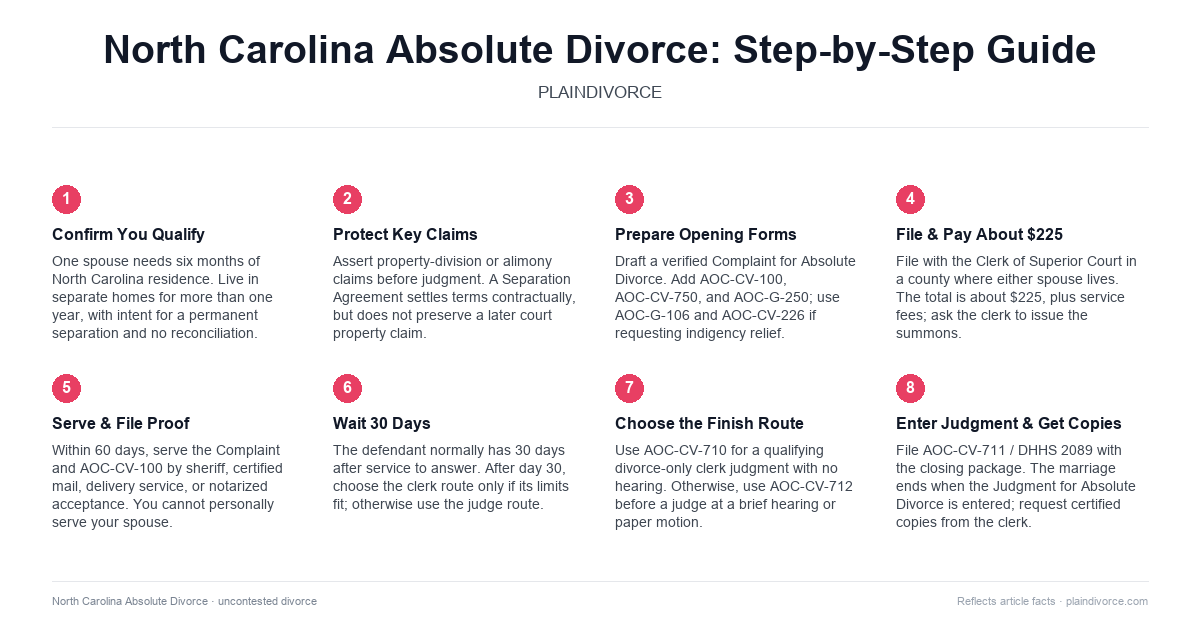
1. North Carolina Absolute Divorce at a glance
In North Carolina, the court order that ends a marriage is an Absolute Divorce. There is no separate “uncontested divorce” case type — “uncontested” just describes a case where the other spouse does not fight the divorce. Here is the shape of a typical no-children, divorce-only case.
| What you are asking for | An Absolute Divorce on the ground of one year’s separation (G.S. 50-6) |
| Residency | The plaintiff or the defendant has lived in North Carolina for at least 6 months before filing |
| Separation | Living in separate homes for more than one year, with at least one spouse intending it to be permanent, and no resumption of the marriage since |
| Where you file | District Court Division, with the Clerk of Superior Court, in the county where either spouse resides (G.S. 50-3) |
| Opening forms | Complaint for Absolute Divorce (verified), Civil Summons (AOC-CV-100), Domestic Civil Action Cover Sheet (AOC-CV-750), Servicemembers Civil Relief Act Declaration (AOC-G-250) |
| Filing cost | About $225 total ($130 General Court of Justice fee + $16 facilities + $4 courthouse technology + $75 divorce cost), plus service fees |
| Response window | The defendant has 30 days after service to answer |
| How it ends | A Judgment for Absolute Divorce signed by the clerk (no hearing, on AOC-CV-710) or by a judge (brief hearing or paper motion, on AOC-CV-712) |
| Closing vital-records form | Certificate of Absolute Divorce or Annulment (AOC-CV-711 / DHHS 2089) — filed with the judgment, not at the start |
| The #1 safety rule | Protect any equitable distribution or alimony claim before the divorce is final |
The Administrative Office of the Courts does not publish a single statewide “Complaint for Absolute Divorce” form. It publishes the summons, cover sheet, servicemembers declaration, and judgment forms; the complaint itself has to be drafted — which is exactly what a good Complaint for Absolute Divorce NC template gives you. The state’s free eCourts Guide & File tool now supports Absolute Divorce in all 100 counties and builds the forms from an online interview.
2. What an uncontested or simple divorce means in North Carolina
North Carolina law calls the decree that legally ends a marriage an Absolute Divorce. The statutes do not create an “uncontested” or “simple” category, but those words describe how most self-represented cases run.
An uncontested Absolute Divorce is one where the defendant, after being properly served, does one of the following:
- Files nothing at all (a default), or
- Files a written admission of the complaint, or a written waiver of the right to answer, or
- Signs a notarized Acceptance of Service and does not contest the divorce.
Important: your spouse’s cooperation is not a legal requirement. If you meet the residency, separation, and grounds rules and you give proper legal notice, you can obtain an Absolute Divorce even if your spouse never signs, never appears, and never responds. Cooperation just makes the case faster and cheaper.
A simple divorce usually means a divorce-only case: you ask the court for the Judgment for Absolute Divorce and nothing else. Property division, alimony, custody, and child support are handled separately — by a written Separation Agreement, by claims filed before the divorce, or in their own court cases.
Vocabulary note: North Carolina also has a Divorce from Bed and Board, which despite the name is a fault-based, court-ordered separation — not a divorce that ends the marriage. Almost everyone searching for a “simple divorce” wants an Absolute Divorce.
3. Who qualifies for an uncontested divorce in North Carolina
To get any Absolute Divorce in North Carolina you must meet three rules: residency, separation, and grounds. For the case to stay uncontested, the other spouse also has to not actively oppose the divorce.
3.1 Residency: six months
At least one spouse must have lived in North Carolina for six months immediately before the complaint is filed (G.S. 50-6, G.S. 50-8). It can be either the plaintiff or the defendant. If the filing spouse lives outside North Carolina, personal-jurisdiction and venue limits apply — follow the Judicial Branch’s guidance for out-of-state situations before you file.
3.2 Separation and grounds: the date of separation is everything
The standard ground is one year’s separation. To meet it, all of the following must be true:
- You and your spouse have lived in separate residences — not just separate bedrooms — continuously for more than one year.
- When the separation began, at least one spouse intended it to be permanent.
- You have not resumed the marital relationship since. Under G.S. 52-10.2, that means voluntarily renewing the husband-and-wife relationship, judged from the totality of the circumstances. Isolated incidents of sexual intercourse do not restart the one-year clock.
Because the complaint has to show the parties were apart for more than a year, most people file on or after one year and one day. Fix your date of separation in your mind and state it the same way in every document — it is the single fact the whole case turns on.
There is one narrow alternative ground — incurable insanity (G.S. 50-5.1) — which requires the spouses to have lived separate and apart for three consecutive years because of one spouse’s incurable insanity, plus institutional confinement or a prior adjudication of insanity and an examination by two qualified physicians. Almost every self-represented filer uses the one-year separation ground instead.
3.3 When a divorce-only case is a good fit
An uncontested, divorce-only approach tends to work when:
- You clearly meet the six-month residency and more-than-one-year separation rules.
- You can state a clear date of separation and you are not still living together as spouses.
- Both spouses accept the marriage is over and the defendant is unlikely to contest it.
- You are not asking the judge to decide custody, support, or property inside the divorce case.
- Property and support are either already settled in a written, notarized Separation Agreement (or existing orders), or you have already filed the claims you need to protect.
3.4 When it may not work
Think hard before going DIY if:
- There is domestic violence, intimidation, or coercive control.
- You do not have a full picture of your spouse’s income, debts, or assets.
- Custody, support, or property issues are unresolved.
- There are businesses, pensions, large retirement accounts, or immigration issues in play.
In those cases, get at least a consultation with a North Carolina family lawyer or a legal aid office first.
4. Step-by-step: the uncontested Absolute Divorce process
Counties run local scheduling differently, so always follow your clerk’s current instructions. Here is the usual path for an uncontested Absolute Divorce.
Step 1 — Confirm eligibility and gather your facts
- Either spouse has lived in North Carolina for at least six months.
- You have lived in separate homes for more than one year, with intent that it be permanent, and have not reconciled.
Write down your date of marriage, date of separation, both current addresses, and the name and age of every minor child of the marriage. G.S. 50-8 requires the complaint to state each child’s name and age, or to state that there are none.
Step 2 — Protect equitable distribution and alimony first
This is the hard stop in a North Carolina DIY divorce. Before the Absolute Divorce is final:
- If you want a court to divide property — a house, home equity, a pension, a 401(k) — the equitable-distribution claim must be asserted before the divorce judgment. Once the judgment is entered, an unasserted claim is gone (G.S. 50-11). The only narrow exception: a defendant served only by publication who never appeared has six months after the judgment to move for equitable distribution.
- If alimony may be an issue, a claim that is already pending when the judgment is entered survives the divorce; a claim you never filed does not.
- A written Separation Agreement can settle these issues by contract. To be valid it must be in writing, signed by both spouses, and acknowledged before a notary. It resolves things contractually — it does not preserve a later court equitable-distribution claim.
If any of this is unresolved, talk to a lawyer before you file.
Step 3 — Prepare the filing package
For a typical uncontested case, the opening package is:
- Complaint for Absolute Divorce — the pleading that starts the case. It must be verified (signed under oath before a notary) and must allege the six-month residency, the separation facts, and the name and age of each minor child (or that there are none).
- Civil Summons (AOC-CV-100) — the notice that a lawsuit has been filed. Read the AOC-CV-100 instructions on the form: it tells the defendant they have 30 days to respond and where to file.
- Domestic Civil Action Cover Sheet (AOC-CV-750) — the required intake sheet; the clerk can reject a filing that arrives without it.
- Servicemembers Civil Relief Act Declaration (AOC-G-250) — the military-status form (formerly titled an “affidavit”). The court cannot enter judgment against a defendant who has not appeared until this is on file.
- If you cannot afford the fee: a Petition to Proceed as an Indigent (AOC-G-106) with a Civil Affidavit of Indigency (AOC-CV-226).
The Certificate of Absolute Divorce or Annulment (AOC-CV-711 / DHHS 2089) and the proposed Judgment for Absolute Divorce come later, with the closing package — not at filing. Use the most current form versions; the AOC updates them regularly (for example, AOC-CV-100 and AOC-CV-750 carry recent revision dates, and AOC-G-250 was revised in 2024).
Step 4 — File in the correct county
File with the Clerk of Superior Court in the county where either spouse resides (G.S. 50-3). Pay the roughly $225 filing cost. The clerk stamps your documents, opens a “CVD” file number, and keeps the originals — including the white copy of the summons. Keep stamped copies for yourself.
Step 5 — Serve your spouse and file the right proof
The summons is issued when you file. The defendant must be served with the complaint and the Civil Summons (AOC-CV-100). Personal or substituted service has to be completed within 60 days of the summons being issued; if that lapses, you get an endorsement or an alias-and-pluries summons. Under Rule 4, your options are:
- Sheriff in the defendant’s county — $30 fee. The deputy completes the Return of Service on the summons.
- Certified or registered mail, return receipt requested — you can mail it yourself, then file an Affidavit of Service by Registered/Certified Mail/Designated Delivery Service (AOC-CV-105) with the signed receipt attached.
- Designated delivery service (for example FedEx) with a delivery receipt.
- Acceptance of Service — the defendant signs a notarized acceptance and files it.
- Service by publication — only when the defendant genuinely cannot be found with due diligence. Get help before trying this.
You cannot personally hand the papers to your spouse — a party is not allowed to make personal delivery. The proof you file depends on the method you used. Service mistakes are a frequent reason uncontested cases stall, so double-check what your clerk wants in the file.
Step 6 — Wait out the response window, then pick your finish line
The summons directs the defendant to answer within 30 days after service. A Rule 12 motion or a court order can change that deadline. In most uncontested cases the defendant files nothing. Once the 30 days pass, G.S. 50-10 gives you two ways to finish:
| Route | Judgment before the clerk (AOC-CV-710) | Judgment before a judge (AOC-CV-712) |
| Hearing? | No hearing — the clerk reviews the file and signs | A brief hearing where you testify, or a paper motion decided on affidavits and verified pleadings (Rule 56) |
| Available when | You seek only the Absolute Divorce (plus optional name resumption); the defendant defaulted, admitted the complaint, or waived the right to answer; and the defendant is not a minor or incompetent | Any uncontested case; required if the clerk route does not fit |
| Timing | File on day 31 or later after service | Hearing set at least 30 days after service |
There is no statewide form literally called a “Motion for Summary Judgment for Absolute Divorce” — the paper route is simply a Rule 56 motion handled by a judge. Ask your clerk which route your county uses in practice.
Step 7 — Judgment for Absolute Divorce and certified copies
When everything checks out, the clerk or judge signs the Judgment for Absolute Divorce and the Certificate of Absolute Divorce or Annulment (AOC-CV-711 / DHHS 2089) is completed for vital records. Once the judgment is entered, your marriage is legally over. Ask the clerk for certified copies — you will need them for a name change, remarriage, and updating financial and government records.
5. Special issues when you have children
Minor children do not block an uncontested Absolute Divorce, and — unlike equitable distribution and alimony — divorce does not cut off custody or child support. Those claims can be brought or modified before or after the divorce. Still, you want a clear plan.
- Custody is decided on the child’s best interests. A later custody case can change the arrangement if the best-interests analysis supports it.
- Child support: if a court order is entered, the judge applies the presumptive North Carolina Child Support Guidelines (an income-shares model, presumptive where the parents’ combined annual gross income is $480,000 or less), using Worksheet A, B, or C (form AOC-A-162). A deviation from the guideline amount requires written findings. New orders generally include immediate income withholding, and the court must order health-insurance coverage for the child when it is available at a reasonable cost. The guidelines took effect January 1, 2023 and are under review in 2026 — confirm the current version.
- Modification: child support can be changed on a substantial change of circumstances, or when the current amount no longer meets the child’s reasonable needs.
If there are serious disagreements about the children, or any history of abuse, a DIY simple divorce is not the right path. Get legal advice and use local safety-planning resources.
6. How long an uncontested divorce takes in North Carolina
Two clocks matter:
- The separation period: more than one year of living in separate homes before the court can grant an Absolute Divorce. This is the long part, and it cannot be shortened.
- Court processing: from filing to the signed judgment. Realistically you are looking at the 30-day response window plus the time to serve your spouse, get on the clerk’s or a judge’s list, and have the judgment signed. When the separation year is already behind you and the paperwork is clean, many uncontested cases finish within a couple of months of filing; a missed service step or a court backlog adds time.
7. What an uncontested divorce costs
Confirm current amounts with your county clerk, but the typical costs are:
- Filing cost — about $225 total. Under G.S. 7A-305 that is a $130 General Court of Justice fee, a $16 facilities fee, and a $4 courthouse-technology fee, plus a $75 divorce cost. (It is not a $150 filing fee plus $75.)
- Service — sheriff $30. Under G.S. 7A-311 that is one $30 charge for each civil-process item, with a single charge when several papers are served on one person at the same time. Certified mail and designated delivery have their own postage/courier costs.
- Name resumption — $10 per person. Under G.S. 50-12 the $10 is assessed against each person who asks to resume a former name, whether you request it in the complaint (so it goes into the decree) or apply to the clerk after the divorce.
- Other costs: notary fees, photocopies, postage, travel, and certified copies of the judgment.
- Fee waiver: file the Petition to Proceed as an Indigent (AOC-G-106) if you cannot afford the costs.
A straightforward divorce-only case, done mostly on your own with reliable instructions, generally costs a fraction of a contested divorce where attorneys litigate custody, support, and property.
8. When a DIY divorce is not right for you
A do-it-yourself uncontested Absolute Divorce works well when both spouses cooperate and the facts are simple. Reconsider it if:
- There is domestic violence, threats, or a serious power imbalance.
- One spouse controls or hides the finances.
- There are complex assets — a business, multiple properties, large retirement accounts.
- You are unsure whether you need a court to decide property division or support.
- There are immigration, military, disability, or tax issues the divorce could affect.
Even one consultation with a North Carolina family lawyer or legal aid office can save you from an expensive, hard-to-undo mistake.
9. Where a self-help divorce kit fits in
Plenty of people can handle a simple North Carolina divorce themselves — but the forms and the county-by-county steps are easy to get wrong. The state’s free eCourts Guide & File tool is a good starting point for the AOC forms. A self-help kit goes further, and typically helps you:
- See the whole path — from the date of separation through to the Judgment for Absolute Divorce in NC.
- Assemble the right documents — a Complaint for Absolute Divorce NC template, the Civil Summons (AOC-CV-100), the Domestic Civil Action Cover Sheet (AOC-CV-750), and the Servicemembers Civil Relief Act Declaration (AOC-G-250).
- Fill out the paperwork cleanly, with plain-English explanations and examples.
- Stay organized with checklists for filing, service, and the clerk-or-judge finish line.
- Avoid the big mistake — finalizing before protecting an equitable-distribution or alimony claim.
PlainDivorce sells downloadable DIY kits for uncontested divorce. They are built for self-represented people who want to save money and keep control of their case while still having structured guidance. Our kits provide legal information and document help, not legal advice, and using one does not create a lawyer-client relationship. You stay responsible for your decisions and for confirming current rules and forms with the court.
Download Our North Carolina Uncontested Divorce Self-Help Kit
10. Final thoughts and next steps
North Carolina’s uncontested Absolute Divorce process is built so that organized, self-represented people can get through it. Before you file, do four things:
- Confirm the six-month residency and more-than-one-year separation requirements, and lock in your date of separation.
- Make sure you are not about to lose an equitable-distribution or alimony claim by finalizing too early.
- Build the opening package — verified Complaint, AOC-CV-100, AOC-CV-750, AOC-G-250 — using current form versions.
- Plan your service method and your finish line (clerk on AOC-CV-710, or judge on AOC-CV-712) with your county clerk.
Two authoritative places to check details as you go: the North Carolina Judicial Branch’s Separation and Divorce help topic, and the statutes in Chapter 50 of the General Statutes.
Finally, remember that PlainDivorce is not a law firm. This guide and our self-help materials are legal information only, not legal advice. Rules, forms, and fees change — confirm the current details with the North Carolina Judicial Branch, your clerk of court, or a North Carolina lawyer before you file.
11. Frequently asked questions
What is an uncontested or simple divorce in North Carolina?
North Carolina calls the decree that ends a marriage an Absolute Divorce. “Uncontested” means the defendant does not fight the divorce after being properly served — they default, admit the complaint, waive the right to answer, or sign a notarized Acceptance of Service. “Simple divorce” usually means a divorce-only case, where property, alimony, custody, and support are handled in a Separation Agreement or separate cases rather than inside the divorce complaint.
How long do I have to be separated in North Carolina?
You must live in separate residences continuously for more than one year, with at least one spouse intending the separation to be permanent when it began, and without resuming the marital relationship since. Because the complaint has to show more than a year, most people file on or after one year and one day. Isolated incidents of sexual intercourse do not restart the clock, but voluntarily moving back in together does.
Do I have to go to court for an uncontested divorce in North Carolina?
Not always. If you ask only for the Absolute Divorce (plus an optional name change), the defendant defaulted or waived the right to answer, and the defendant is an adult and competent, the clerk can sign the Judgment for Absolute Divorce Before the Clerk (AOC-CV-710) with no hearing. Otherwise a judge signs it — after a short hearing where you testify, or on a paper motion decided from affidavits and verified pleadings. Practice varies by county, so ask your clerk.
What forms do I need for an Absolute Divorce in NC?
To open the case: a verified Complaint for Absolute Divorce, the Civil Summons (AOC-CV-100), the Domestic Civil Action Cover Sheet (AOC-CV-750), and the Servicemembers Civil Relief Act Declaration (AOC-G-250). To finish: proof of service, the Judgment for Absolute Divorce (AOC-CV-710 before the clerk or AOC-CV-712 before a judge), and the Certificate of Absolute Divorce or Annulment (AOC-CV-711 / DHHS 2089). There is no single statewide complaint form, so the complaint itself must be drafted from a template.
What is the Civil Summons (AOC-CV-100)?
The Civil Summons is the form that formally notifies your spouse a divorce action has been filed. It is issued by the clerk when you file and must be served on the defendant together with the complaint. The AOC-CV-100 instructions state that the defendant has 30 days after service to serve a written answer and file it with the Clerk of Superior Court. You cannot hand it to your spouse yourself — use the sheriff, certified mail, a designated delivery service, or a notarized Acceptance of Service.
What is the biggest mistake people make in a North Carolina simple divorce?
Finalizing the Absolute Divorce before protecting a claim for equitable distribution or alimony. Under G.S. 50-11, an unasserted equitable-distribution claim is destroyed once the divorce judgment is entered, and an alimony claim is lost unless it was already pending or already ordered. If you plan to “split the retirement account later” or “sort out support later,” file the claim — or sign a valid Separation Agreement — before the divorce is final.
How much does it cost to file for divorce in North Carolina?
About $225 total to file — a $130 General Court of Justice fee, $16 facilities fee, $4 courthouse-technology fee, and a $75 divorce cost (G.S. 7A-305). Add a $30 sheriff fee if you serve that way, and $10 per person to resume a former name. If you cannot afford the costs, file a Petition to Proceed as an Indigent (AOC-G-106). Confirm current amounts with your clerk.
Does an uncontested divorce affect custody or child support?
No — unlike equitable distribution and alimony, an Absolute Divorce does not cut off custody or child-support claims. They can be filed or modified before or after the divorce. If a support order is entered, the court uses the presumptive North Carolina Child Support Guidelines and worksheets (AOC-A-162), generally with immediate income withholding and a health-insurance order. Custody is always decided on the child’s best interests.
Sources and local rules can change. Use this guide as a plain-English organizer, then verify the current filing requirements with the official court or government source for your jurisdiction.

About Harry D
Expert contributor at PlainDivorce, helping Canadians and American navigate simple uncontested divorces with clarity and confidence.