Uncontested Divorce in North Dakota: A Step-by-Step Guide to Filing Together
An uncontested divorce in North Dakota is one where you and your spouse agree, in writing, on every issue — property, debts, support, and any parenting terms — and file a complete stipulated packet together in State District Court. There is no waiting period, the filing fee is a flat $160, and if the paperwork is complete the judge often grants the divorce on the documents without a hearing.
The North Dakota Legal Self Help Center calls this route “Filing for Divorce Together.” Instead of one spouse serving the other through a sheriff, the two of you assemble and sign the forms first, and the other spouse signs an Admission of Service to start the case. This guide walks through who qualifies, the exact forms, the filing sequence, how child cases differ, timelines, and costs — using the same terminology you will see on the North Dakota divorce forms.
TL;DR
If you and your spouse agree on everything, North Dakota lets you skip the fight entirely: complete a “Filing for Divorce Together” packet, have your spouse sign an Admission of Service, file it, and the judge usually signs off on the paperwork alone.
- Cost: a flat $160 filing fee (waivable), no service fee, ~$20 for a certified copy of the judgment.
- Waiting period: none. Your timeline depends on how fast you finish the forms and your court’s caseload.
- Who qualifies: the Plaintiff must have lived in North Dakota six months, the grounds are irreconcilable differences, and every item on your packet’s eligibility checklist must be true.
- What you file: one of two packets — no children or with children — built around a signed Settlement Agreement (Stipulation) and a confidential Exhibit A property-and-debt listing.
- Service is easy: the Defendant signs an Admission of Service, which officially starts the case. No sheriff, no process server.
- Hearing: usually none, thanks to the Affidavit of Proof — but the judge can still order one, especially if a form has blanks.
- With kids: you must complete a Parenting Plan and the Child Support Guidelines calculation before anyone signs. No calculation, no divorce.
- You’re final only when the clerk enters the signed Judgment — then serve the Notice of Entry of Judgment within 14 days.
- Get a lawyer if: there’s abuse or a protection order, hidden assets, a business or pension (QDRO), a deploying service member, or a related case in another state or tribal court.
1. North Dakota Uncontested Divorce at a Glance
- Where you file: North Dakota State District Court, in the county where the Defendant lives (or, if the Defendant does not live in North Dakota, the county where the Plaintiff lives).
- The agreed route: Both spouses complete a “Filing for Divorce Together” packet — one version for cases with no children, one for cases with children — and file it as a finished set.
- Residency: The Plaintiff must in good faith have been a North Dakota resident for the six months before the case starts — or, failing that, for the six months before the decree is entered.
- Grounds: Irreconcilable differences (no-fault). The Self Help Center has no forms for fault-based divorce.
- How you record the deal: A written Settlement Agreement (Stipulation), plus a confidential property-and-debt listing and, in child cases, a Parenting Plan.
- How service works: The Defendant signs an Admission of Service, which officially starts the case — no sheriff or process server needed when both spouses cooperate.
- The document the judge signs: Findings of Fact, Conclusions of Law, and Order for Judgment, followed by a separate Judgment that the clerk enters (files).
- Hearing: Often none. An Affidavit of Proof lets the packet be decided on the papers, but the judge or judicial referee may still require a hearing.
- Filing fee: $160 statewide (fee waiver available).
- Waiting period: None by statute. The real limiter is assembling a complete, correctly signed packet.
2. What “Uncontested” (Stipulated) Divorce Means in North Dakota
An uncontested divorce is one where you and your spouse agree on every issue in the case, so the court does not have to hold a trial to decide anything. In North Dakota court materials this is described as filing “together” or with a full stipulation — a written agreement signed by both spouses.
North Dakota does not create a separate “simple divorce” category in the statutes. When people say “simple,” they mean a case that can be finished with a complete Settlement Agreement (Stipulation) and the matching supporting forms. The North Dakota Court System puts it plainly: if spouses “agree in writing on absolutely everything,” they complete the paperwork together, file it, and “the divorce is generally granted quickly and without a hearing.”
There are two ways to get divorced in North Dakota. The first is the agreed route described in this guide. The second is the contested route: one spouse files a Summons and Complaint, serves it, and the other spouse has 21 days to answer. If the spouses cannot settle every issue, the court schedules a trial. The agreed packets exist to keep cooperative couples out of that process entirely.
3. Do You Qualify? Residency, Grounds, and the Packet Checklists
3.1 Residency requirement
Under N.D.C.C. § 14-05-17, the Plaintiff must “in good faith” have been a North Dakota resident for the six months immediately preceding commencement of the action. If the Plaintiff has not lived here that long yet, a divorce may still be granted if the Plaintiff in good faith has been a resident for the six months immediately preceding entry of the decree. In practice, at least one spouse needs a genuine six-month North Dakota residency by the time the judgment is signed.
3.2 Grounds for divorce
North Dakota law (N.D.C.C. § 14-05-03) lists seven causes for divorce, including several fault grounds. For a no-fault case you use irreconcilable differences, which N.D.C.C. § 14-05-09.1 defines as “those grounds which are determined by the court to be substantial reasons for not continuing the marriage and which make it appear that the marriage should be dissolved.” You do not have to prove anyone did anything wrong. The Legal Self Help Center does not offer forms or instructions for fault-based divorce.
3.3 The packet checklists (both must be satisfied fully)
Agreement alone does not make the self-help packet available. Each packet has its own eligibility list, and every item must be true.
“File for Divorce Together — No Children” — every answer must be “yes”:
- The spouses are currently in communication with each other.
- The spouses agree on all issues and can put the agreement in writing.
- The spouses have no minor or dependent children and are not expecting a child of the marriage.
- The spouse listed as Plaintiff has lived in North Dakota for the last six months.
- This is the only legal action pending between the spouses regarding this marriage.
“Filing for Divorce Together — With Children” — every statement must be true:
- The spouses are currently in communication with each other.
- The spouses agree on all issues; both sign the Settlement Agreement, the property-and-debt listing, and the Parenting Plan.
- The spouse listed as Plaintiff has lived in North Dakota for the last six months.
- All of the minor children have lived in North Dakota with a spouse for at least the past six months or since birth; or North Dakota was the children’s home state within the past six months and one spouse still lives here.
- This is the only legal action in North Dakota, any other state, or any tribe between the spouses regarding the marriage or the children.
- The reason for the divorce is irreconcilable differences (no-fault by either spouse).
- Neither spouse is currently in the military, or a spouse is in the military but not deploying or deployed.
- There is no domestic-violence protection order or disorderly-conduct restraining order in effect between the spouses.
If any item does not fit, you cannot use that packet. You may need the “Start a Divorce on Your Own” materials, different documents, or a lawyer. Remember that the Self Help Center’s forms are not official court forms and no judge is required to accept them.
4. The Two “Filing for Divorce Together” Packets and Their Forms
The two packets share a structure but the form list and the form numbers differ, so always work from a single packet start to finish. The current instruction booklets are revised July 2025 (no children) and April 2026 (with children).
| Purpose | No-Children packet | With-Children packet |
|---|---|---|
| Summons | Form 1 | Form 1 |
| Complaint | Form 2 | Form 2 |
| Settlement Agreement (Stipulation) | Form 3 | Form 3 |
| Confidential property, debt, and value listing (Exhibit A) | Form 4 | Form 4 |
| Parenting Plan (Exhibit B) | — (not applicable) | Form 5 |
| Confidential Information Form | Form 9 | Form 6 |
| Admission of Service | Form 5 | Form 7 |
| Affidavit of Proof for Stipulated Judgment | Form 6 | Form 8 |
| Findings of Fact, Conclusions of Law, and Order for Judgment (proposed) | Form 7 | Form 9 |
| Judgment (proposed) | Form 8 | Form 10 |
| Notice of Entry of Judgment (after the divorce is granted) | Form 10 | Form 11 |
A few points that trip people up:
- The “Confidential Information Form” has no universal number. It is Form 9 in the no-children packet and Form 6 in the with-children packet. It carries the sensitive identifiers (Social Security numbers and the like) that are kept out of the public documents.
- There is no separate “Financial Affidavit” in either packet. Your finances are documented by the Settlement Agreement and the confidential property-and-debt listing (Exhibit A), and in child cases by the child-support calculations. The term “Financial Affidavit” appears in North Dakota only as part of the fee-waiver form, the Petition for Order Waiving Fees and Financial Affidavit.
- Exhibit A is a confidential court record. Under N.D.C.C. § 14-05-24.3, the property-and-debt listing filed with the court is not open to the public.
- If you divide a pension or retirement plan, a separate Qualified Domestic Relations Order (QDRO) is needed. The Self Help Center has no QDRO forms; talk to the plan administrator and a lawyer.
5. Step-by-Step: How an Uncontested North Dakota Divorce Works
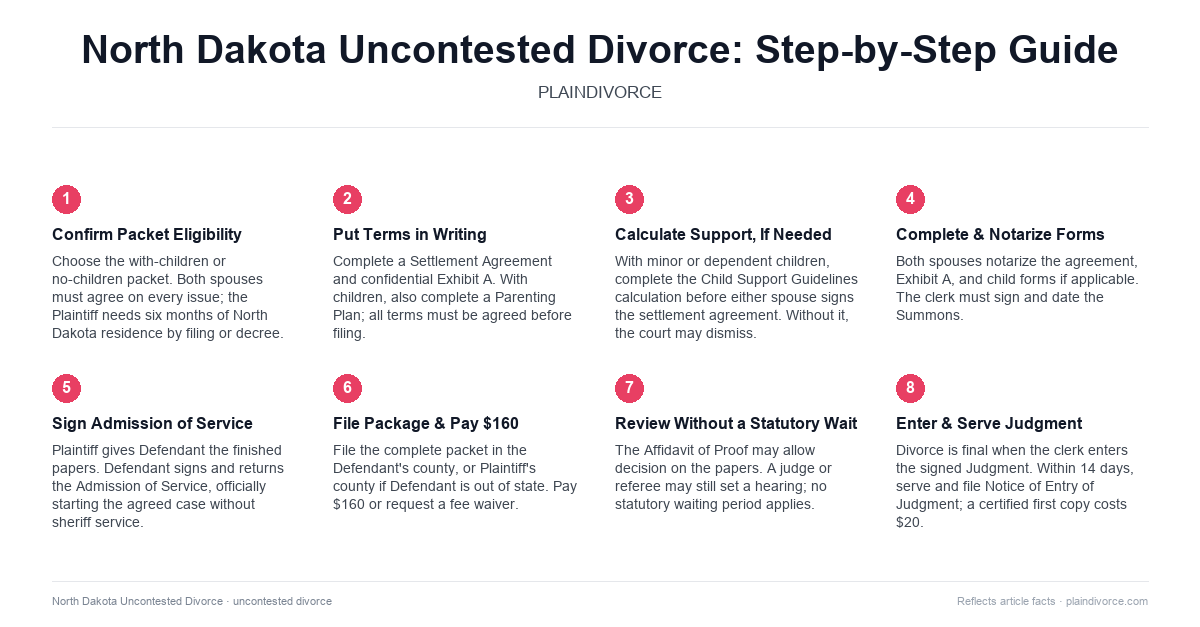
Unlike a contested case, the agreed packet is finished before anything is filed. Here is the order of operations.
Step 1 — Pick the correct packet and confirm eligibility
Choose the no-children or with-children packet and check every eligibility item in Section 3. Decide which spouse will be the Plaintiff (that spouse must meet the six-month residency).
Step 2 — Reach a full written agreement
Work through the Settlement Agreement (Stipulation), the Exhibit A property-and-debt listing, and — in child cases — the Parenting Plan. If you cannot agree on every paragraph of those forms, you cannot use the packet. Property and debts must be divided equitably under N.D.C.C. § 14-05-24.
Step 3 — In child cases, run the child support calculation now
You must complete the North Dakota Child Support Guidelines calculation before either spouse signs the Settlement Agreement, unless a court already ordered support. See Section 7 for the rules.
Step 4 — Complete every form and sign in front of a notary or clerk
Fill in every paragraph — blanks can get your packet rejected or trigger a hearing to explain them. Then handle signatures:
- Both spouses sign the Settlement Agreement, the Exhibit A listing, the Parenting Plan (child cases), and the Confidential Information Form — each in front of a notary public or clerk of court.
- The Plaintiff signs the Affidavit of Proof for Stipulated Judgment in front of a notary or clerk.
- The clerk of court signs and dates the Summons — it is not valid otherwise.
Step 5 — Give the Defendant the completed forms; Defendant signs the Admission of Service
The Plaintiff delivers copies of the completed packet to the Defendant. The Defendant fills out, dates, and signs the Admission of Service and returns the original to the Plaintiff. Signing it is what officially starts the divorce case — this replaces sheriff or process-server service.
Step 6 — File the whole packet with the Clerk of District Court and pay $160
File in the North Dakota county where the Defendant lives (or where the Plaintiff lives if the Defendant is out of state). Pay the $160 filing fee, or file a Petition for Order Waiving Fees and Financial Affidavit if you cannot afford it — a judge decides the waiver. In child cases where a listed child has an approved application for child-support services or receives state assistance, you must also serve the packet on North Dakota Child Support (call and ask who to serve).
Step 7 — The judge reviews the packet (usually without a hearing)
The packet is designed to be decided on the Affidavit of Proof alone, but the judge or judicial referee may still set a hearing — for example if a form has blanks or the agreement raises questions. If a hearing is ordered and you do not attend, the divorce may not be granted.
Step 8 — Judgment is entered, then you serve the Notice of Entry of Judgment
The judge signs the Findings of Fact, Conclusions of Law, and Order for Judgment, and the clerk then enters (files) the separate Judgment. Your divorce is final only after the signed, dated Judgment is entered. In the with-children packet, the Plaintiff must serve a Notice of Entry of Judgment on the Defendant within 14 days after the judgment is entered, then file it with proof of service. The no-children packet has the same 14-day Notice step. You can order certified copies of the judgment from the clerk for $20 for the first copy.
6. The Admission of Service Shortcut and How Service Really Works Here
Service is the step that stalls do-it-yourself divorces in many states. North Dakota’s agreed packets are built to avoid it. Because the spouses complete the forms together, the Defendant already has the paperwork — all that is left is to acknowledge receipt.
- Cooperative spouse: The Defendant signs the Admission of Service. No sheriff, no process server, and the case is officially underway.
- Spouse who will not sign: You are outside the agreed packet. You would file on your own and arrange sheriff or private service (fees apply), and the case becomes a contested-track matter.
- Spouse who cannot be located: Alternative service (such as by publication) may be possible, but it is technical, must follow the North Dakota Rules of Civil Procedure, and again is not the agreed-packet route.
Parents, note: in a with-children case, once the Defendant signs the Admission of Service, neither parent may take the children out of North Dakota without the other parent’s written permission or a court order (short temporary trips excepted). Violating that provision can be contempt of court.
7. Divorces With Children: Parenting Plan and Child Support Rules
You can still file together when you have children, but the court looks harder at the terms, and two requirements are strict.
7.1 A Parenting Plan is required
The with-children packet includes a Parenting Plan (Form 5) that both parents sign before a notary or clerk. It must be based on the children’s best interests and cover residential responsibility (custody), parenting time (visitation), decision-making responsibility, child support and income information, and medical coverage including health-insurance premiums, copays, and deductibles.
7.2 You must calculate child support — even if you agree on a number
North Dakota requires the Child Support Guidelines calculation in every case with minor or dependent children, using the calculator maintained by the Child Support Division of North Dakota Health and Human Services. Key rules:
- No calculation, no divorce. If you file without the calculations, the court will make you complete them or dismiss the case.
- You cannot use the packet if you do not want to establish support at all, or if you agreed to an amount different from what the calculator produces. A deviation requires proving one of the limited exceptions and that it serves the children’s best interests (N.D.C.C. § 14-09-09.7; N.D. Admin. Code § 75-02-04.1-09).
- Equal residential responsibility: calculate an amount for each parent. Primary residential responsibility (one parent more than half the time): calculate for the parent with less than half.
7.3 What a North Dakota support order has to contain
By statute, a child-support order must:
- Route payments through the State Disbursement Unit (N.D.C.C. § 14-09-08.1), with the parties keeping the SDU updated on address and employer changes.
- Provide for the child’s health-insurance coverage, assigned to whichever parent can obtain it most cost-effectively (N.D.C.C. § 14-09-08.10).
- State the obligor’s net income and how it was calculated (N.D. Admin. Code § 75-02-04.1-02), and, for any deviation, identify the presumptively correct guideline amount (N.D.C.C. § 14-09-09.7).
- Address income withholding — at minimum a statement that a delinquency triggers a withholding order (N.D.C.C. § 14-09-09.12) — and advise the parties of their right to request a support review (N.D.C.C. § 14-09-08.9).
7.4 When the with-children packet is off the table
You cannot use it if a domestic-violence protection order or disorderly-conduct restraining order is in effect between the spouses, if there is a related case in another state or tribe, or if a service member is deploying. In those situations, talk to a lawyer.
8. How Long an Uncontested Divorce Takes in North Dakota
North Dakota has no statutory waiting or cooling-off period, so there is no fixed minimum. The North Dakota Court System says only that when spouses “correctly file every document the court needs,” the divorce “is generally granted quickly and without a hearing.” What actually drives your timeline:
- How long it takes the two of you to finish and sign every form.
- In child cases, completing the child-support calculation before signing.
- Whether the clerk accepts the packet on the first try (blanks and mismatches cause returns).
- Your court’s caseload, and whether the judge decides to hold a hearing.
A clean, complete packet with a signed Admission of Service is the fastest path North Dakota offers.
9. What an Uncontested Divorce Costs in North Dakota
| Cost | Amount | Notes |
|---|---|---|
| District Court filing fee | $160 | Flat statewide fee to file a petition for divorce, annulment, or separation (N.D.C.C. § 27-05.2-03). Waivable by court order. |
| Service | $0 with an Admission of Service | Sheriff or private process-server fees apply only if you leave the agreed route. |
| Notary | Often $0–$10 per signature | Free if you sign in front of the clerk of court. |
| Certified copy of the judgment | $20 first copy | Lesser fee for additional copies ordered at the same time. |
| Other | Varies | Copies, postage, and — if you divide a retirement plan — a QDRO prepared with professional help. |
If your spouse signs the Admission of Service and you file a clean, complete stipulated packet, a North Dakota uncontested divorce is far cheaper than a contested case, where attorney fees alone typically run into the thousands.
10. When to Skip DIY and Talk to a Lawyer
Get legal advice before filing anything if:
- There is domestic violence, threats, stalking, or coercive control — or any protection order or disorderly-conduct restraining order between the spouses (which bars the with-children packet).
- You suspect hidden assets, hidden debts, or financial pressure.
- You own a business, have a pension or complex retirement accounts, or expect a QDRO.
- There is a real dispute about the children, relocation, or safety, or a related case in another state or on tribal land.
- A spouse is a service member who is deploying or deployed.
- You feel pressured to sign an agreement you do not fully understand.
For safety planning and advocacy, the North Dakota Domestic & Sexual Violence Coalition can connect you with local centers.
11. Where a Self-Help Divorce Kit Fits
Even an agreed North Dakota divorce has a dozen forms, packet-specific numbering, notary steps, and a strict filing order. A North Dakota self-help divorce kit keeps the sequence straight, explains how the Settlement Agreement, Exhibit A, Parenting Plan, Affidavit of Proof, and proposed Findings and Judgment fit together, and flags the common rejection points — blanks, missing child-support calculations, and the 14-day Notice of Entry of Judgment.
Get the North Dakota Uncontested Divorce Self-Help Kit12. Final Checklist and Next Steps
- Confirm at least one spouse meets the six-month North Dakota residency (N.D.C.C. § 14-05-17).
- Run the eligibility checklist for the no-children or with-children packet — every item must fit.
- Write a complete Settlement Agreement (Stipulation), consistent with your Exhibit A property-and-debt listing.
- In child cases, finish the Child Support Guidelines calculation and the Parenting Plan before anyone signs.
- Sign the Settlement Agreement, Exhibit A, Parenting Plan, Confidential Information Form, and Affidavit of Proof in front of a notary or clerk.
- Have the Defendant sign the Admission of Service, then file the full packet in the correct county with the $160 fee.
- After the Judgment is entered, serve the Notice of Entry of Judgment within 14 days and order certified copies.
For the statutes behind this process, see N.D.C.C. Chapter 14-05 (divorce) and Chapter 14-09 (custody and child support), the North Dakota Court Fee Schedule, and North Dakota Child Support. The North Dakota Legal Self Help Center’s divorce pages at ndcourts.gov host the current packets and instructions.
13. Frequently Asked Questions
What is an uncontested divorce in North Dakota?
It is a divorce where you and your spouse agree on every issue — property, debts, support, and any parenting terms — and file a complete stipulated packet together in State District Court. North Dakota calls this “Filing for Divorce Together.” Your agreement is written as a Settlement Agreement (Stipulation), and when the packet is complete the judge usually grants the divorce on the documents without a hearing.
Is there a waiting period for divorce in North Dakota?
No. North Dakota has no statutory cooling-off or waiting period. The practical timeline depends on how quickly you both complete and sign the forms, whether the clerk accepts the packet, the court’s caseload, and whether the judge decides to hold a hearing. At least one spouse must still meet the six-month residency requirement by the time the decree is entered.
What is an Admission of Service in a North Dakota divorce?
It is a form the Defendant spouse completes and signs to confirm they received copies of the completed divorce forms. In the agreed packets, the Defendant’s signed Admission of Service is what officially starts the case, so a cooperative couple avoids sheriff or private process-server fees entirely. If your spouse will not sign it, you are no longer on the agreed-packet route.
Is there a Financial Affidavit in a North Dakota divorce?
Not as a required disclosure form in the stipulated packets. Your finances are captured by the Settlement Agreement and the confidential “Exhibit A” property, debt, and value listing, plus the child-support calculations in child cases. In North Dakota, “Financial Affidavit” is part of the fee-waiver form — the Petition for Order Waiving Fees and Financial Affidavit — not a standard divorce filing.
What is the “Findings of Fact, Conclusions of Law, and Order for Judgment”?
It is the document the judge or judicial referee signs to decide the divorce, built from your Settlement Agreement. It states the findings, the legal conclusions, and the order. A separate Judgment is then entered (filed) by the clerk, and your divorce is final only once that signed, dated Judgment is entered — not when the Findings are signed.
Do we have to go to a hearing for an uncontested divorce in North Dakota?
Often not. The stipulated packet uses an Affidavit of Proof so it can be decided on the papers. But the judge or judicial referee may still require a hearing — for example if a form is incomplete or the agreement raises a question. If a hearing is set and you do not attend, the divorce may not be granted.
How much does an uncontested divorce cost in North Dakota?
The District Court filing fee is a flat $160 statewide, and a judge can waive it for filers who cannot afford it. With an Admission of Service there is no service fee. Expect small costs for notarization (free at the clerk’s office), copies, and certified copies of the judgment ($20 for the first). Dividing a retirement plan adds the cost of a QDRO.
Can we use the “Filing for Divorce Together” packet if we have children?
Yes, using the with-children packet, if you meet its eligibility list and you complete a Parenting Plan and the North Dakota Child Support Guidelines calculation. You cannot use it if you do not want to establish child support, if you agreed to an amount different from the calculator without a proven deviation, or if a protection order or disorderly-conduct restraining order is in effect between you.
Sources and local rules can change. Use this guide as a plain-English organizer, then verify the current filing requirements with the official court or government source for your jurisdiction.

About Harry D
Expert contributor at PlainDivorce, helping Canadians and American navigate simple uncontested divorces with clarity and confidence.