Uncontested / Simple Divorce in the Northwest Territories: A Plain English Guide to Desk Divorce (Form 1, Form 7, Form 12/13)
An uncontested divorce in the Northwest Territories is one where you and your spouse agree the marriage is over — and it can often be granted as a Desk Divorce: a paperwork-based decision, without either of you appearing in court.
The NWT process is form-driven and rule-specific. Filing the correct Divorce Rules forms — including the right affidavit for your filing type — and requesting judgment the right way is what moves a file to a judge’s desk instead of stalling in the registry.
TL;DR: Uncontested Divorce in Northwest Territories
- What it is: An uncontested divorce in Northwest Territories is a low-conflict case the Supreme Court of the Northwest Territories can often decide as a Desk Divorce — on the papers, without a hearing.
- Who qualifies: One spouse (or both) must have lived in the NWT for at least a year, and you’re usually relying on one year of separation.
- Filing path: A Joint Petition for Divorce (Form 7) if you’re filing together (separation ground only), or a sole Petition for Divorce (Form 1) if one spouse files first.
- Core paperwork: Sworn evidence is required before a judge will grant a Desk Divorce — a Form 12 affidavit for a sole petition or a Form 13 affidavit for a joint petition (they are not the same form), plus a Request for Divorce, Form 11, once your file is ready for judgment. Every NWT divorce form is a free download from the courts website.
- Timeline and cost: Expect the one-year separation clock, plus a 31-day appeal period after judgment. The current Supreme Court filing fee is $165 — confirm it with the registry before you file, since fee schedules do change.
- Not legal advice: PlainDivorce is not a law firm — this is general information, not legal advice.
1. What is an uncontested or “simple” divorce in the Northwest Territories?
A divorce is the court decision that legally ends a marriage. In the NWT, divorces are handled by the Supreme Court of the Northwest Territories under Canada’s Divorce Act and the territory’s own Divorce Rules. This guide focuses specifically on an uncontested divorce in Northwest Territories: cases where both spouses are on the same page and the court’s main job is simply to grant the divorce.
An uncontested divorce generally means:
- one spouse starts the case and the other spouse does not oppose it by filing a response, or
- both spouses start the case together by filing jointly, showing the court you are cooperating from day one.
When people say “simple divorce,” they usually mean a low-conflict file where you are mainly asking the court to grant the divorce, not asking a judge to referee ongoing disputes. In many uncontested files, a judge can decide the case entirely on sworn documents — a Desk Divorce — instead of requiring anyone to appear.
Download Our Northwest Territories Uncontested Divorce (Dissolution) Self-Help Kit
PlainDivorce is not a law firm. This article is general legal information, not legal advice for your situation.
2. Who qualifies for an uncontested divorce in the NWT?
Not every case qualifies for an uncontested divorce in Northwest Territories. Two things matter most: meeting the residency rule, and having a ground for divorce the court will accept.
Residency requirement
Under Canada’s Divorce Act residency rule, the Supreme Court of the Northwest Territories can generally grant a divorce if you or your spouse has been ordinarily resident in the Northwest Territories for at least one year immediately before starting the case.
Grounds for divorce (breakdown of the marriage)
Most uncontested divorces rely on one year of separation (living separate and apart). The Divorce Act’s grounds for divorce measure that year up to the determination of the divorce proceeding, not just up to the day you filed — so you can start your case once you and your spouse are already living separate and apart, even if the full year isn’t finished yet, provided it will be complete by the time a judge signs off. It’s worth knowing why one-year separation dominates: on the official Joint Petition for Divorce (Form 7), separation is the only ground the form allows, and Rule 14 permits a joint petition only where no other relief is claimed except by consent. Adultery and cruelty can only be pleaded on a sole Petition for Divorce (Form 1). So if you and your spouse want to file together, one-year separation isn’t just the simplest option — it’s the required one.
When your case is a good fit for uncontested or Desk Divorce
- You meet the residency rule.
- You can rely on one year of separation (or will have reached one year by the time the judge grants the divorce).
- You and your spouse agree the marriage is over.
- Parenting, support, and property issues are already settled in an agreement or prior orders (or you are not asking the court to decide them in this file).
- Your spouse will cooperate, or at least not oppose the case.
If there is family violence, fear, coercion, hidden assets, or major disagreement about children, support, or property, get legal advice before trying to DIY an uncontested divorce.
3. Key NWT forms and terms (Form 1, Form 7, Form 11, 12, 13)
Generic Canadian divorce guides often use “statement of claim” terminology borrowed from other provinces — you may even see people search for a “Joint Statement of Claim for Divorce” when what they actually need is NWT-specific paperwork. The Northwest Territories doesn’t use that term at all. Here, the process runs on the territory’s own Divorce Rules forms, and the cooperative filing option is called the Joint Petition for Divorce (Form 7) — never a statement of claim. These are the forms that control the flow of an uncontested file:
- Petition for Divorce (Form 1): the standard starting form if one spouse files alone (sole).
- Joint Petition for Divorce (Form 7): the cooperative option where you file together (this avoids service, since both spouses are already petitioners). Only available on the separation ground.
- Affidavit of the Applicant, sole petition (Form 12): the sworn evidence a sole petitioner files under Rule 20(5) before the court can grant a Desk Divorce — it covers the marriage, grounds, collusion and condonation denials, child arrangements, and financial-statement verification.
- Affidavit for a joint petition (Form 13): a separate, shorter sworn form required under Rule 21(2) for joint petitioners — it verifies the accuracy of the joint petition rather than repeating every element of Form 12. Form 12 and Form 13 are not interchangeable, even though the current court-forms download page files both under the same “Affidavit of the Applicant” title; the governing Rules assign them different numbers and different content.
- Request for Divorce (Form 11): the document that formally asks the court to decide your case on affidavit evidence, without an oral hearing. Both sole petitioners (Rule 20(4)(a)) and joint petitioners (Rule 21(1)(a)) file the same Form 11.
- Corollary Relief Order (Form 16): the order a judge signs alongside the divorce for matters the Divorce Act treats as corollary relief — child support, spousal support, and parenting arrangements. A claim to divide property is a separate territorial-law matter, not corollary relief under the federal Act, even though both can be resolved in the same filing.
- Request for a Certificate of Divorce (Form 17): the request you file after the divorce takes effect, if you need official proof (the Clerk then issues the certificate itself, Form 18).
NWT forms checklist (plain text): Start by choosing your filing path: Form 1, Petition for Divorce (sole filing) or Form 7, Joint Petition for Divorce (joint filing). Next, prepare the matching affidavit — Form 12 for a sole petition or Form 13 for a joint petition — plus a Corollary Relief Order if you’re asking the court to deal with support or parenting. When your file is ready for judgment, file the Request for Divorce, Form 11, together with five copies of your proposed judgment and, if the other party is self-represented, a stamped envelope addressed to them. After the divorce is granted, submit a Request for a Certificate of Divorce, Form 17, if you need official proof for records, ID updates, remarriage, or benefits. Every one of these Northwest Territories divorce forms is a free PDF download from the Courts of the Northwest Territories website — always grab the current version before you file, since forms are updated periodically.
Sole vs. joint petition at a glance
| Feature | Sole Petition (Form 1) | Joint Petition (Form 7) |
|---|---|---|
| Grounds allowed | Separation, adultery, or cruelty | Separation only (Rule 14) |
| Service required | Yes — on the other spouse | No — both spouses are petitioners |
| Response deadline | 25 days (served in NWT) / 30 days (elsewhere in Canada) / court-set (outside Canada) | Not applicable |
| Affidavit for Desk Divorce | Form 12 (Rule 20(5)) | Form 13 (Rule 21(2)) |
| Request for judgment | Form 11 + Form 12 + 5 copies of proposed judgment + stamped envelope if respondent is unrepresented (Rule 20(4)) | Form 11 + Form 13 + 5 copies of proposed judgment + stamped envelope for any unrepresented party (Rule 21(1)) |
| Best fit | Spouse won’t sign jointly, or you’re relying on adultery/cruelty | Both spouses cooperate and agree on separation as the ground |
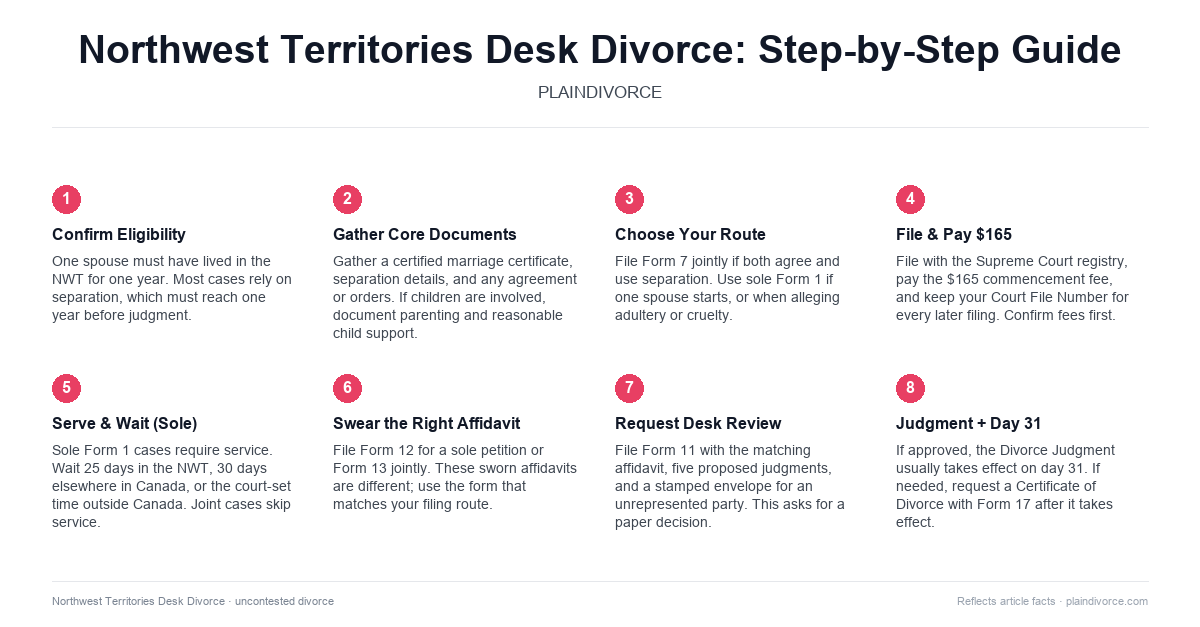
4. Step by step: NWT uncontested divorce process (Desk Divorce workflow)
This is a high-level roadmap for how many uncontested divorces move through the Supreme Court of the Northwest Territories. Always follow current registry instructions for your exact requirements.
Process Flow Overview
Joint Petition Path (Uncontested / Both Spouses File Together)
- Both spouses agree on everything (property, support, and children if applicable).
- Prepare and sign the joint petition (Form 7) and the Form 13 affidavit.
- File together with the court clerk.
- Complete required items (disclosures / parenting program) if your registry requires them.
- Wait out the one-year separation period, if it isn’t already complete.
- File the Request for Divorce (Form 11) with Form 13, five copies of the proposed judgment, and a stamped envelope for any party without a lawyer.
- Judge reviews and signs the Divorce Judgment.
- Request a Certificate of Divorce (Form 17) if you need proof later.
Sole Petition Path (One Spouse Files First)
- One spouse files the Petition for Divorce (Form 1); the other spouse is the respondent.
- File with the clerk and receive the Court File Number and stamped copies.
- Serve the other spouse using an approved method.
- Response stage: the respondent files an Answer, Counter Petition, or Demand of Notice, or does nothing — if they neither respond nor consent, the petitioner can note them in default (Rule 20(10)) before proceeding.
- Exchange required disclosures (financial and parenting disclosures if applicable).
- File the Request for Divorce (Form 11) with Form 12, five copies of the proposed judgment, and a stamped envelope if the respondent is unrepresented.
- Judge reviews and signs the Divorce Judgment, or directs a hearing if the file isn’t ready to decide on the papers.
- Request a Certificate of Divorce (Form 17) if you need proof later.
Step 1 – Choose your route: Joint Petition (Form 7) or Petition (Form 1)
- Joint Petition (Form 7): Usually the cleanest path if you can cooperate. Avoids service since both spouses are petitioners. Only available on the ground of one-year separation, with any other relief sought by consent.
- Sole Petition (Form 1): Used when your spouse won’t sign a joint filing, or when you’re relying on adultery or cruelty rather than separation. This route requires service and waiting for the response deadline.
Step 2 – Gather your core documents
- Proof of marriage: attach a certified copy of your marriage certificate as an exhibit to your affidavit; if a certified copy genuinely can’t be obtained, the Rules allow proving the marriage by solemn form instead.
- Basic details about the marriage and separation (dates, places, addresses).
- If children are involved: clear information about parenting arrangements and child support.
- Any separation agreement or existing orders you plan to rely on.
Step 3 – File your Petition (Form 1) or Joint Petition (Form 7)
File your documents with the registry, pay the court fee, and get your Court File Number. Keep that number safe — you will need it for every later step.
Step 4 – Service (sole cases only) and waiting for the response deadline
If you filed a sole Petition (Form 1), you must serve your spouse according to the rules and then wait for the response deadline: 25 days if served in the NWT, 30 days if served elsewhere in Canada, or the time set out in the Order of Service if served outside Canada. If your spouse disputes the petition, they file an Answer; if they want to make their own claims, they attach a Counter Petition. If neither an Answer, a Counter Petition, nor a Demand of Notice is filed and the deadline passes, you can move the file toward a Desk Divorce; if a Demand of Notice was filed but the respondent won’t consent to proceeding without a hearing, the petitioner can note them in default and ask a judge in chambers to proceed anyway.
If you filed a Joint Petition, service isn’t required because you are both petitioners.
Step 5 – File the sworn evidence (Form 12 or Form 13)
For a Desk Divorce, the court needs sworn evidence confirming the key facts. A sole petitioner files a Form 12 affidavit, covering the marriage, residency, grounds, a denial of collusion, condonation/connivance explanations where relevant, child arrangements, and financial-statement verification. A joint petitioner files the shorter Form 13 affidavit, verifying the accuracy of the joint petition itself. These are two distinct forms under the Rules, not one form with different labels — use the one that matches how you filed.
Step 6 – The desk-divorce trigger: Request for Divorce (Form 11) and the draft judgment package
This is where many DIY files stall: the court does not automatically move your file onto a judge’s desk. Under the NWT Divorce Rules, both sole and joint petitioners trigger a Desk Divorce review by filing a complete package with the clerk — not just the affidavit.
- File the Request for Divorce (Form 11): asks the court to decide the case on affidavit evidence, without an oral hearing.
- Include your affidavit: Form 12 (sole) or Form 13 (joint), as filed in Step 5.
- Attach five copies of the proposed Divorce Judgment (and any corollary relief order) for the judge to review and sign.
- Include a stamped, addressed envelope for any party who does not have a lawyer, so the registry can mail back the signed judgment.
Once the clerk places the materials before a judge, the judge can grant the judgment as requested, direct the parties to appear in chambers, ask for further evidence, or send the case to trial if it isn’t actually uncontested.
Step 7 – Receive the Divorce Judgment, then wait for it to take effect
If everything is complete and the judge is satisfied — including that reasonable child support arrangements are in place where there are children — the court grants a Divorce Judgment.
31-day appeal period: under the Divorce Act’s effective-date rule, the divorce generally becomes legally effective on the 31st day after the Divorce Judgment is granted. If an appeal is filed and still pending when day 31 arrives, the effective date is pushed back until the appeal period on that decision runs out; if both spouses waive their appeal rights and the court finds special circumstances, it can order the divorce effective earlier. Neither spouse is free to remarry until the judgment takes effect. After it takes effect, you can request a Certificate of Divorce (Form 17 request, Form 18 certificate) if you need proof — often required for remarriage.
5. Special issues when you have children
Having children does not prevent an uncontested divorce, but it increases the court’s scrutiny and can add required documents.
- Parenting plan clarity: clearly explain where the children live and when they see each parent.
- Child support: show that child support is reasonable under the applicable guidelines, or clearly explain why it differs. The Divorce Act requires the court to be satisfied that reasonable arrangements are in place before it grants the divorce — if support looks too low without a proper explanation, the judge can delay granting the divorce until the issue is corrected.
- Corollary relief vs. property: child support, spousal support, and parenting arrangements are “corollary relief” under the Divorce Act and are captured in the Corollary Relief Order (Form 16). Dividing property or debts is a separate matter under territorial family-property law — it can often be dealt with in the same court file, but it isn’t governed by the same federal rules as corollary relief.
- Parental duties certificate: where there are children of the marriage, the petition (Form 1 or Form 7) requires you — and, in a joint filing, both spouses — to sign a certificate confirming you understand your duties under the Divorce Act: acting in the child’s best interests, protecting them from conflict, considering out-of-court dispute resolution where appropriate, and giving the court complete and accurate information.
- Possible parenting course requirement: some jurisdictions run a Parenting After Separation program. Confirm with the NWT registry whether any parenting program applies to your case and what proof, if any, must be filed.
6. How long does an uncontested divorce take in the NWT?
Timing for an uncontested divorce in Northwest Territories depends on (1) how close you are to the one-year separation mark, (2) whether you file jointly or solely, and (3) whether your paperwork is complete the first time.
- Separation: most people rely on one year of separation, measured to the date the divorce is determined, not just to the filing date.
- Sole cases: the 25/30-day service and response window adds real time, especially with remote logistics between communities.
- Desk review: once your Form 11 request and matching affidavit (Form 12 or 13) are filed with the full judgment package, processing time depends on court workload and completeness.
- After judgment: the divorce is usually effective after the 31-day appeal period, longer if an appeal is pending.
NWT timeline (plain text): File (joint or sole) → Service (sole filings only; skip if joint) → Affidavit (Form 12 or 13) and Request for Divorce (Form 11) filed with the judgment package → Divorce Judgment granted (judge signs) → Day 31: divorce becomes effective (unless an appeal is pending or the court orders an earlier date).
7. What does an uncontested divorce cost?
The current Supreme Court of the Northwest Territories divorce fee is $165 to commence a divorce petition, under the territory’s Court Services Fees Regulations. An additional certified or sealed copy of a document (for example, an extra certificate of divorce) costs $15 per copy after the first. Fee schedules can be amended, so confirm the current amount with the registry before you file.
- Court filing fee: $165 to commence the petition (sole or joint), payable as directed by the registry.
- Service costs: typically only in sole filings, if you use a process server.
- Commissioner or notary fees: for swearing affidavits.
- Extra certified copies: $15 per copy after the first.
- Document costs: proof of marriage, printing, courier, and mailing.
Cost saver in the NWT: filing a Joint Petition avoids service costs and the logistical burden of serving documents across communities.
8. When a DIY divorce might not be right for you
Consider getting legal advice (even limited-scope help) if there is family violence, coercion, hidden assets, serious parenting conflict, complex property or pensions, or immigration and cross-border consequences. DIY paperwork isn’t worth it if your safety or long-term financial future is at risk. Getting it right matters more than finishing an uncontested divorce in Northwest Territories quickly.
9. Where a self-help divorce kit fits into the process
If your uncontested divorce in Northwest Territories is genuinely low-conflict and you’re comfortable handling paperwork, a territory-specific self-help kit can help you stay organized and avoid common rejection issues (missing signatures, missing attachments, inconsistent dates, using the wrong affidavit for your filing type, or filing an incomplete Form 11 request package).
- Know when to use Petition for Divorce (Form 1) vs Joint Petition for Divorce (Form 7).
- Use checklists to file the correct affidavit — Form 12 for a sole petition, Form 13 for a joint petition.
- Don’t forget the procedural trigger — the Request for Divorce, Form 11, with five copies of the proposed judgment — that moves the file to a judge.
- Track key timing, including the 31-day appeal period after the Divorce Judgment.
Download Our Northwest Territories Uncontested Divorce Self-Help Kit
PlainDivorce is not a law firm. A kit is an information and organization tool, not legal advice, and you must still follow current court forms and registry instructions.
10. FAQ
What is an uncontested or simple divorce in the Northwest Territories?
It’s a divorce where nobody is fighting the case in court. In many NWT uncontested files, a judge can grant the divorce on the paperwork alone — a Desk Divorce — using a sworn affidavit (Form 12 for a sole petitioner, Form 13 for a joint petitioner) and a formal request step, the Request for Divorce, Form 11.
What is Form 1 in the NWT divorce process?
Form 1 is the Petition for Divorce used when one spouse files alone (sole filing) in the Supreme Court of the Northwest Territories.
What is the Joint Petition form number in the NWT?
The Joint Petition for Divorce is Form 7 under the NWT Divorce Rules. It can only be used where the ground for divorce is one year of separation, and any other relief must be sought by consent.
Is the affidavit form different for a joint filing than a sole filing?
Yes. A sole Petition (Form 1) requires a Form 12 affidavit under Rule 20(5). A Joint Petition (Form 7) requires a different, shorter Form 13 affidavit under Rule 21(2). They are separate forms with different required content, not one form with relabeled parties — even though the court’s download page currently titles both PDFs “Affidavit of the Applicant.”
What form do I file to get a Desk Divorce without a hearing?
File a Request for Divorce, Form 11, along with your affidavit (Form 12 or Form 13), five copies of the proposed Divorce Judgment, and a stamped envelope for any self-represented party. This is the step that actually puts your file in front of a judge for a paper-based decision.
Where can I find Northwest Territories divorce forms as PDFs?
All current NWT Supreme Court divorce forms — the Petition for Divorce (Form 1), Joint Petition for Divorce (Form 7), the affidavits (Form 12 and Form 13), the Request for Divorce (Form 11), the Corollary Relief Order (Form 16), and the Certificate of Divorce documents (Forms 17 and 18) — are published as free PDF downloads on the Courts of the Northwest Territories’ official forms page. Always download the current version before you file, since forms are updated from time to time.
How much are Supreme Court of NWT divorce fees?
Under the current Court Services Fees Regulations, the fee to commence a Supreme Court divorce petition is $165, and an additional certified copy of a document costs $15. Confirm the current amount and accepted payment method with the registry before you file, since fee schedules can be amended.
When am I legally divorced after the judge signs?
In most cases, the divorce becomes effective on the 31st day after the Divorce Judgment is granted. If an appeal is still pending on day 31, the effective date is delayed until that appeal period expires; if both spouses waive their appeal rights, the court can order an earlier effective date in special circumstances. Neither spouse is free to remarry until the judgment takes effect. After it takes effect, you can request a Certificate of Divorce if you need proof.
11. Final thoughts and next steps
If you are organized, your case is genuinely uncontested, and you use the NWT-specific forms and terminology — including the correct affidavit for how you filed — an uncontested divorce in Northwest Territories can often be handled as a Desk Divorce, without traveling for a hearing.
Next steps:
- Confirm residency and separation timing.
- Finalize your separation agreement (especially for children, support, and property).
- Decide: Petition for Divorce (Form 1) vs Joint Petition for Divorce (Form 7) — remember Form 7 requires separation as the ground.
- File through the registry, pay the $165 fee, and keep your Court File Number.
- Prepare the correct sworn evidence: Form 12 for a sole petition, Form 13 for a joint petition.
- File the Request for Divorce (Form 11) with the full judgment package when your file is ready for judgment.
- After judgment, calendar the 31-day effective date and request your Certificate of Divorce (Form 17) if needed.
Final reminder: this guide is legal information only, not legal advice, and it reflects the NWT Divorce Rules and fee schedule as confirmed in 2026. If something feels unsafe, unfair, or unusually complex — or if the registry’s current forms conflict with anything above — speak with a Northwest Territories family lawyer, a legal clinic, or the Supreme Court registry before filing.
Sources and local rules can change. Use this guide as a plain-English organizer, then verify the current filing requirements with the official court or government source for your jurisdiction.

About Harry D
Expert contributor at PlainDivorce, helping Canadians and American navigate simple uncontested divorces with clarity and confidence.