Uncontested Divorce in Nova Scotia: Forms, Costs, and the Step-by-Step Process
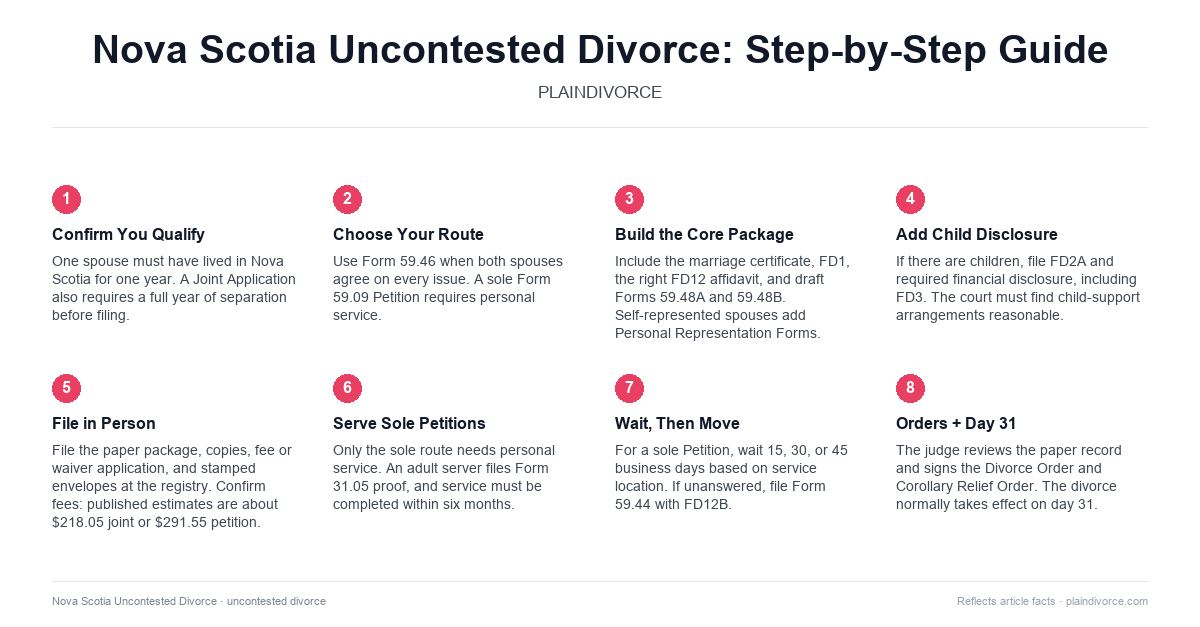
An uncontested divorce in Nova Scotia is one where you and your spouse agree the marriage is over and no one asks a judge to hold a trial, so the divorce can be granted on the paperwork. You file in the Supreme Court of Nova Scotia, either together with a Joint Application for Divorce (Form 59.46) or alone with a Petition for Divorce (Form 59.09). Most cases rely on one year of separation, and every Nova Scotia divorce ends with both a Divorce Order and a Corollary Relief Order.
Here is the local detail that keeps a do-it-yourself filing from bouncing back at the registry: the two routes need different forms. The Joint Application (Form 59.46) skips personal service and goes straight to a judge once the package is complete. The sole Petition route requires you to serve your spouse and then file a separate Uncontested Motion for Divorce — the step Nova Scotia courts use to convert an unanswered petition into a file a judge can decide without a trial (Form 59.44). Knowing which route needs which form is half the battle.
TL;DR
- File together: the Joint Application for Divorce Form 59.46 — both spouses apply, no service, no separate motion. Only available after a full year of separation and only if you agree on everything.
- File alone: Petition for Divorce (Form 59.09), then personally serve your spouse, then — if no Answer is filed — the Uncontested Motion for Divorce Nova Scotia courts require (Form 59.44).
- Sworn evidence: the Affidavit Supporting Uncontested Divorce — Form FD12A for a Joint Application, Form FD12B for a Petition.
- Every divorce files a draft Divorce Order (Form 59.48A) and a draft Corollary Relief Order (Form 59.48B), in the filing package — not at the end.
- Children of the marriage: add the Parenting Statement (Form FD2A) and the required financial disclosure (Form FD3 and, in some cases, FD4, FD6, FD7).
- Court fees: the Nova Scotia Family Law site lists about $218.05 for a Joint Application and $291.55 for a Petition (the Petition figure includes the $10 federal registration fee), stated as current as of August 2021 — confirm the amount for your filing date.
- Effective date: the divorce generally takes effect on the 31st day after the judge signs the Divorce Order.
1. What is an uncontested (or “simple”) divorce in Nova Scotia?
Every divorce in Canada is granted under the federal Divorce Act, but the process and forms are run provincially. In Nova Scotia, divorces are granted by the Supreme Court of Nova Scotia — the Family Division in the areas it serves (Halifax Regional Municipality, Cape Breton Regional Municipality, and several other counties), and the general Supreme Court elsewhere in the province.
An uncontested divorce in Nova Scotia generally means all of the following:
- both spouses accept that the marriage has broken down (most commonly by living separate and apart for one year);
- no one is asking a judge to hold a trial to settle a dispute; and
- parenting, child support, spousal support, and property and debt are already settled — in a written agreement, a consent order, or simply because there is nothing to divide.
People say “simple divorce” for this kind of cooperative, paperwork-driven case. But the court does not grant a divorce just because both spouses agree. You still file the correct Nova Scotia forms, give sworn evidence, and satisfy the judge on jurisdiction, residency, the separation period, the absence of collusion, and — if there are children — that reasonable child-support arrangements are in place. Only then does a judge sign the Divorce Order (Form 59.48A) and the Corollary Relief Order (Form 59.48B).
The three ways to start a divorce
Nova Scotia’s Civil Procedure Rule 59 recognizes three ways to begin a divorce:
- Petition for Divorce (Form 59.09) — one spouse files and personally serves the other. Used when a case may be contested, but also the route for a cooperative spouse who simply can’t file jointly.
- Joint Application for Divorce (Form 59.46) — both spouses file together as co-applicants. No service. Only for fully agreed cases, and only after the one-year separation has already elapsed.
- Application for Divorce by Written Agreement (Form 59.45) — one spouse files, but both sign the supporting documents. It relies on a signed separation agreement that resolves every issue.
This guide focuses on the Joint Application and the sole Petition, because they are the two routes most DIY filers weigh against each other. The written-agreement route (Form 59.45) is a genuine third option if you have a full separation agreement but can’t both sign a Joint Application — the forms and evidence are similar, using the Affidavit Supporting an Uncontested Divorce (Form FD12).
Download Our Nova Scotia Uncontested Divorce (Dissolution) Self-Help Kit
2. Who qualifies for an uncontested divorce in Nova Scotia?
Residency requirement
At least one spouse must have been habitually resident in Nova Scotia for at least one year immediately before the divorce proceeding starts. This is a rule in the federal Divorce Act (section 3), so it applies whether you file jointly or alone. You state your residency in the application, and the court can ask for proof.
Grounds and the one-year separation rule
Canada has one legal ground for divorce: breakdown of the marriage. Under section 8 of the Divorce Act, you establish it in one of three ways — living separate and apart for at least one year, adultery, or physical or mental cruelty that makes living together intolerable. Almost every uncontested case uses one-year separation, because it is the cleanest to prove on paper and doesn’t require anyone to make allegations against the other spouse.
Two practical points from the same section:
- You can be “separate and apart” while still living under the same roof, if at least one of you intended the marriage to be over and you stopped functioning as a couple.
- A reconciliation attempt of up to 90 days (or several attempts adding up to 90 days) does not restart the one-year clock.
For a Joint Application specifically, the full year of separation has to be complete before you file — you cannot file jointly in anticipation of hitting the one-year mark. A sole Petition can be started earlier, but the divorce still can’t be granted until the year is up.
When an uncontested divorce is a good fit
- You are legally married and can produce the right proof of marriage (see the forms section below).
- At least one of you meets the one-year Nova Scotia residency rule.
- You have been separated a year, or will be by the time a judge reviews the file.
- Parenting, child support, spousal support, and property and debt are all settled or genuinely not in dispute.
- You can prepare consistent, complete paperwork — the single biggest cause of DIY delay.
When it isn’t a fit
If there is family violence, coercion or a serious power imbalance, hidden assets, unresolved parenting conflict, or complex finances (a business, multiple properties, large pensions), get legal advice before relying on a DIY uncontested filing. A low-cost divorce is not a bargain if it costs you safety or long-term financial security.
3. The Nova Scotia divorce forms you’ll use
Nova Scotia divorce paperwork uses rule-based form numbers (the “59.” series from Civil Procedure Rule 59) and “FD” numbers for the family disclosure and parenting forms. Using the exact current form for your route and situation is what keeps the registry from sending your package back.
| Form | Name | When you use it |
|---|---|---|
| 59.09 | Petition for Divorce | Starts a sole (one-spouse) divorce; must be personally served. |
| 59.46 | Joint Application for Divorce | Starts a divorce filed by both spouses together; no service. |
| 59.45 | Application for Divorce by Written Agreement | One spouse files, both sign, backed by a full separation agreement. |
| 59.44 | Uncontested Motion for a Divorce | Petition route only, after service and no Answer — asks a judge to decide the file without a trial. |
| FD1 | Statement of Contact Information and Circumstances | Every divorce; your contact and service details. |
| FD12A | Affidavit Supporting an Uncontested Divorce (Joint Application) | Your sworn evidence on the Joint Application route. |
| FD12B | Affidavit Supporting an Uncontested Divorce (Petition) | Your sworn evidence on the sole Petition route. |
| FD12 | Affidavit Supporting an Uncontested Divorce (by Written Agreement) | The affidavit for the Form 59.45 route. |
| FD2A | Parenting Statement | When there are children of the marriage; filed with the application, one per spouse. |
| FD3 | Statement of Income | Child-support payer, and both spouses in several situations (see section 5). |
| FD4 | Statement of Special or Extraordinary Expenses | When section 7 expenses (child care, health, activities, post-secondary) are claimed. |
| FD6 | Statement of Expenses | Non-table child support, undue hardship, or a spousal-support claim. |
| FD7 | Statement of Property | When either spouse seeks a division of property, debt, or a pension. |
| FD11 | Waiver of Financial Statements | Only if the divorce is uncontested, there are no children of the marriage, and you agree on all support and property issues. |
| Personal Representation Form | — | Each spouse who files without a lawyer, on any route. |
| 31.05 | Affidavit of Service | Petition route; sworn by the person who served your spouse. |
| 59.48A | Divorce Order | Draft filed with your package; signed by the judge to grant the divorce. |
| 59.48B | Corollary Relief Order | Draft filed with your package; required in every Nova Scotia divorce. |
| 59.49 | Certificate of Divorce | Requested later; the proof of divorce you use to remarry. |
The one correction most guides get wrong: the Corollary Relief Order (Form 59.48B) is required for every Nova Scotia divorce — including cases with no children, no support, and nothing to divide. It is not an “if needed” form. And the draft Divorce Order and draft Corollary Relief Order both go in the filing package (with the Joint Application, or with the Petition finalization package), not filed separately after a judge approves the case.
Plain-text checklist. Every uncontested case uses Form 59.46 or Form 59.09 (your route), plus FD1, the correct FD12 affidavit variant, a Personal Representation Form for each self-represented spouse, and draft Forms 59.48A and 59.48B. Add FD2A plus disclosure (FD3, and sometimes FD4/FD6/FD7) if there are children of the marriage. Only the Petition route also files Form 59.44 and an Affidavit of Service (Form 31.05).
4. Step by step: Joint Application vs. sole Petition
Below is a plain-English overview of both routes. Always follow the current court instructions for your exact situation, and expect the registry to want several copies of each form.
Before you file: three things that cause rejections
- Proof of marriage. If you were married in Nova Scotia, you need the long-form marriage certificate from Nova Scotia Vital Statistics — not the wallet-size card. If you were married outside Nova Scotia, you need the certificate from that jurisdiction, plus a certified English translation if it is not in English. Order it early; certificates can take weeks. You can start a Nova Scotia certificate request through Access Nova Scotia’s marriage certificate service.
- Children of the marriage. Don’t assume your affidavit covers it. Children trigger a separate Parenting Statement (FD2A) and financial disclosure — see section 5.
- Filing logistics. Forms are filed in person, on paper — you cannot file online. Print on plain white letter-size paper, single-sided. The Joint Application package and the Petition finalization package each need two stamped, self-addressed envelopes for each spouse.
Route A: Joint Application for Divorce (Form 59.46)
- Step 1 — Confirm eligibility. Residency met, the full year of separation already complete, and agreement on all issues: parenting, child support, spousal support, and property and debt division.
- Step 2 — Build the package. The Joint Application (Form 59.46), proof of marriage, Form FD1, your sworn Form FD12A affidavit (both spouses sign, with any agreement or consent order attached), a Personal Representation Form for each unrepresented spouse, and a draft Divorce Order (59.48A) and draft Corollary Relief Order (59.48B).
- Step 3 — Handle disclosure. If there are children of the marriage, include the Parenting Statement (FD2A) and child-support disclosure (FD3, and FD4/FD6 if special expenses or non-table support apply). If there are no children of the marriage and you agree on all support and property issues, you can file a Waiver of Financial Statements (FD11) instead — but a judge can still ask for financial information.
- Step 4 — File in person. Bring the printed package, the filing fee (or a fee-waiver application), the required copies, and the stamped self-addressed envelopes to the registry.
- Step 5 — Judicial review. Once the file is complete, it goes to a judge for a paper (chambers) review. No separate Uncontested Motion is filed on this route.
- Step 6 — Orders signed. If satisfied, the judge signs the Divorce Order (59.48A) and the Corollary Relief Order (59.48B). The divorce takes effect on the 31st day afterward.
Route B: Sole Petition for Divorce (Form 59.09) + service + Uncontested Motion (Form 59.44)
If you file alone, you start with a Petition for Divorce (Form 59.09). This is where DIY filers most often get stuck: service has strict rules, the deadlines matter, and there is a second package to prepare later.
- Step 1 — File the Petition. The Petition (Form 59.09) with proof of marriage, Form FD1, a Personal Representation Form, and — if there are children of the marriage — the Parenting Statement (FD2A) and disclosure.
- Step 2 — Serve your spouse. Service must be personal. You cannot serve your own spouse. The server must be an adult 19 or older who can read and write (a process server is safest), or the spouse’s lawyer if the lawyer agrees to accept service. Service must be completed within six months of filing, or you lose the filing and the fee.
- Step 3 — File proof of service. The server swears the Affidavit of Service (Form 31.05), which is then filed. If your spouse can’t be located, file a motion for substituted service and let a judge approve another method.
- Step 4 — Wait out the Answer period. Your spouse has 15 business days to file an Answer if served in Nova Scotia, 30 business days if served elsewhere in Canada, and 45 business days if served outside Canada. A late Answer needs the court’s permission. If no Answer is filed, the divorce is uncontested.
- Step 5 — File the finalization package. This is the Uncontested Motion for a Divorce (Form 59.44), your sworn Form FD12B affidavit, a draft Divorce Order (59.48A) and draft Corollary Relief Order (59.48B), the required disclosure, and two stamped self-addressed envelopes for each spouse.
- Step 6 — Orders signed. A judge reviews the paper record and, if satisfied, signs the Divorce Order and Corollary Relief Order.
Route C: Application for Divorce by Written Agreement (Form 59.45)
If you have a complete signed separation agreement but can’t both sign a Joint Application, one spouse can file Form 59.45 while both sign the supporting documents, including the Affidavit Supporting an Uncontested Divorce (Form FD12). Like the Joint Application, it needs the full year of separation and agreement on every issue, and it avoids personal service. The draft 59.48A and 59.48B orders and the disclosure rules apply the same way.
Practical takeaway: if you and your spouse can cooperate on paperwork, the Joint Application (or the written-agreement route) is usually procedurally simpler — it skips personal service and the separate Uncontested Motion. It does not guarantee a faster result: the court does not promise processing times, and even a correctly filed uncontested divorce can take several months depending on registry and judicial workload.
5. If you have children: parenting statements and financial disclosure
Even in an uncontested divorce, a judge must be satisfied there are reasonable arrangements for child support (measured against the Child Support Guidelines) and a clear picture of the parenting plan. Missing or under-explained child-support information is one of the most common reasons a Nova Scotia judge holds up an otherwise agreed divorce.
Who counts as a “child of the marriage”
A child of the marriage is a child who is under 19, or who is 19 or older but still financially dependent because of full-time schooling, illness, or disability. An adult child who is 19+ and independent is not a child of the marriage. Don’t assume the “under 19” line settles it — a dependent 19-year-old in university can still require a Parenting Statement and disclosure.
The Parenting Statement (FD2A)
When there are children of the marriage, each spouse files a standalone Parenting Statement (Form FD2A) — separate from the affidavit, and filed with the application, not saved for the end. It sets out where the children live, the schedule, and how major decisions are made. Submit the affidavit without the Parenting Statement and the registry can refuse the file or send it back for corrections.
Financial disclosure: FD3 and the rest
- FD3 (Statement of Income) — the spouse who will pay child support files it, with income attachments.
- Both spouses file FD3 when there is shared or split parenting, the proposed child support is below the guideline table amount, there are dependent children but the parties agree no child support is payable, there are section 7 special or extraordinary expenses, or spousal support is claimed.
- FD4 covers special or extraordinary expenses; FD6 (Statement of Expenses) supports non-table support, undue hardship, or spousal support; FD7 (Statement of Property) is required from both spouses when anyone seeks a division of property, debt, or a pension.
If child support looks missing or unreasonably low without a clear, guideline-based explanation, a judge can delay the divorce until it is fixed — see the Divorce Act, section 11.
6. How long does an uncontested divorce take in Nova Scotia?
There is no official processing-time promise. Plan around three separate stretches of time:
- Separation period: the one year of living separate and apart. For a Joint Application, this must already be finished before you file.
- Court processing: varies with registry and judicial workload and whether your package is complete. The Nova Scotia courts caution that even a correctly filed uncontested divorce can take many months to finalize.
- 31-day period: under section 12 of the Divorce Act, the divorce takes effect on the 31st day after the Divorce Order is signed, once the appeal window closes. A court can set an earlier effective date only in special circumstances, and only if both spouses agree and give written undertakings not to appeal.
The Joint Application route removes two steps that add time to a sole Petition — personal service and the separate Uncontested Motion — but “no service, no motion” is a procedural saving, not a guaranteed speed-up. Clean, consistent paperwork is what actually shortens the wait.
7. What does an uncontested divorce cost in Nova Scotia?
Court fees are set under Nova Scotia’s Costs and Fees Act regulations and are reviewed periodically. The figures below are the amounts published on the Nova Scotia Family Law site, stated as current as of August 2021 — treat them as a planning estimate and confirm the current amount with the registry.
| Item | Fee (planning estimate) |
|---|---|
| Joint Application for Divorce (or Application by Written Agreement) | ~$218.05 |
| Petition for Divorce | ~$291.55 — includes the $10 Government of Canada divorce-registration fee |
| Uncontested Motion for a Divorce (Petition route) | May carry a further motion fee — confirm with the registry |
| Commissioner / notary to swear each affidavit | ~$19.95 per document |
| Certificate of Divorce (Form 59.49), requested later | Small fee — confirm current amount |
Note on “law stamps.” Older Nova Scotia guidance mentions a $25-plus-HST law stamp on a divorce petition. Law-stamp requirements were repealed effective April 1, 2026 (Nova Scotia Barristers’ Society notice), so you should not be charged one now. If a cost list you’re reading still shows a law stamp, it’s out of date.
Other common costs: a process server for a sole Petition, printing and postage, and ordering the correct long-form marriage certificate. Nova Scotia offers a fee waiver for applicants who meet the income test — but note that a granted waiver does not waive the $10 federal divorce-registration fee. Check the fee-waiver route on the costs of filing for divorce page before assuming you can’t afford to file.
8. Where to get the Nova Scotia divorce forms (PDF)
Every form named in this guide is available as a free Nova Scotia divorce forms PDF. The official sources are the Nova Scotia Courts website (courts.ns.ca) and the Legal Information Society of Nova Scotia’s family law site (nsfamilylaw.ca), which publishes route-by-route document lists for the Joint Application and for each Petition step. Download the interactive PDFs, because they carry built-in guidance, then print them single-sided.
The free forms are the same ones a lawyer or a kit uses — what they don’t give you is the sequencing: which affidavit variant matches your route, which disclosure forms your situation triggers, and what goes in each package. That’s the gap a Nova Scotia self-help kit is built to close.
9. When a DIY divorce might not be right for you
A DIY uncontested divorce in Nova Scotia is usually a poor choice if there is family violence, intimidation, a serious power imbalance, hidden assets, complex pensions or property, or unresolved parenting conflict. Talk to a Nova Scotia family lawyer or a legal clinic first — Nova Scotia Legal Aid and the Legal Information Society of Nova Scotia both offer starting points. A low-cost divorce is not worth trading away safety or long-term financial stability.
10. Where a self-help divorce kit fits
If your case is genuinely uncontested and you’re comfortable with paperwork, a Nova Scotia-specific kit helps you avoid the common DIY failures: the wrong affidavit variant, a missing Corollary Relief Order draft, skipped disclosure, the wrong proof of marriage, and filing (or not filing) the Uncontested Motion for the wrong route.
A strong Nova Scotia kit is built to help you:
- choose the right route — Joint Application (59.46), sole Petition (59.09), or Written Agreement (59.45);
- assemble the full package, including FD1, the correct FD12 variant, the Personal Representation Form, and the draft 59.48A and 59.48B orders;
- handle children’s forms — FD2A plus the right disclosure (FD3, FD4, FD6, FD7);
- get service right on a sole Petition, and file the Uncontested Motion for Divorce (59.44) at the right time — or skip it entirely on the joint route.
Download Our Nova Scotia Uncontested Divorce (Dissolution) Self-Help Kit
11. FAQ
What is an uncontested divorce in Nova Scotia?
It’s a divorce where the spouses are not asking a judge to resolve a dispute at trial. In Nova Scotia you complete it by choosing a filing route (Joint Application Form 59.46, sole Petition Form 59.09, or Written Agreement Form 59.45), giving sworn evidence in the correct Affidavit Supporting an Uncontested Divorce (FD12A or FD12B), and filing the required supporting and disclosure forms so a judge can sign the Divorce Order (Form 59.48A) and Corollary Relief Order (Form 59.48B) on the paper record.
What is a Joint Application for Divorce (Form 59.46)?
It’s a divorce application both spouses file together as co-applicants. Because you both consent from the start, there is no personal service and no separate Uncontested Motion — the file goes straight to a judge once it’s complete. It’s available only after a full year of separation has already elapsed and only if you agree on every issue: parenting, child support, spousal support, and property and debt.
What forms do I need for a divorce in Nova Scotia?
Every uncontested case uses Form 59.46 or Form 59.09, the Statement of Contact Information (FD1), the matching Affidavit Supporting an Uncontested Divorce (FD12A for joint, FD12B for petition), a Personal Representation Form for each self-represented spouse, and draft orders 59.48A and 59.48B. Children of the marriage add the Parenting Statement (FD2A) and disclosure (FD3, and sometimes FD4, FD6, FD7). The Petition route also uses the Uncontested Motion (Form 59.44) and an Affidavit of Service (Form 31.05).
Do I need to file an Uncontested Motion for Divorce if nobody is contesting?
It depends on your route. On a Joint Application (Form 59.46), no — you’ve both consented from the start, so once the package is complete the file goes straight to a judge. On a sole Petition (Form 59.09), yes — even if your spouse never files an Answer, the court won’t pick the file up on its own. You file the Uncontested Motion for a Divorce (Form 59.44) to ask a judge to decide it without a trial.
How much does it cost to file for divorce in Nova Scotia?
The Nova Scotia Family Law site lists roughly $218.05 for a Joint Application and $291.55 for a Petition (the Petition amount includes the $10 federal divorce-registration fee), stated as current as of August 2021 — confirm the amount for your filing date. Add about $19.95 to swear each affidavit, plus a process server for a sole Petition. Nova Scotia law stamps were repealed effective April 1, 2026, so there is no longer a law-stamp charge. A fee waiver is available on an income test but does not waive the $10 federal fee.
Do I have to go to court for an uncontested divorce in Nova Scotia?
Usually not. In a typical uncontested case a judge reviews the file in chambers and signs the orders without anyone appearing. On the Joint Application route the completed package goes straight to that review; on the Petition route you get there by filing the Uncontested Motion for a Divorce (Form 59.44) with your affidavit and draft orders. A judge can still ask for more information or, rarely, a brief appearance.
Do I really need the long-form marriage certificate?
If you were married in Nova Scotia, yes — the court requires the long-form marriage certificate from Nova Scotia Vital Statistics, not the wallet-size card. If you were married in another province or country, you need that jurisdiction’s marriage certificate, together with a certified English translation if it isn’t in English. Order it early, because certificates can take several weeks to arrive and a missing one will hold up your filing.
What document actually ends the marriage?
A judge signs a Divorce Order (Form 59.48A), and Nova Scotia also issues a Corollary Relief Order (Form 59.48B) in every divorce. The divorce becomes effective on the 31st day after the Divorce Order is signed. The Certificate of Divorce (Form 59.49) is a separate document you request afterward; it’s the conclusive proof of divorce you’ll usually need in order to remarry.
12. Final thoughts and next steps
For the smoothest uncontested divorce in Nova Scotia, keep these registry realities front of mind:
- Match forms to route. Joint Application: Form 59.46 + FD12A, no service, no motion. Sole Petition: Form 59.09 + FD12B + service + the Uncontested Motion (Form 59.44).
- Every divorce files both draft orders — the Divorce Order (59.48A) and the Corollary Relief Order (59.48B) — in the package, not at the end.
- Bring the right proof of marriage: the Nova Scotia long-form certificate, or the out-of-province certificate plus a certified translation.
- Children of the marriage (under 19, or 19+ and dependent) mean a Parenting Statement (FD2A) and disclosure (FD3, and sometimes FD4/FD6/FD7), filed with the application.
- File in person, on paper, single-sided, with several copies and two stamped self-addressed envelopes per spouse.
This guide is legal information, not legal advice. If anything about your situation feels unsafe, unfair, or unusually complex, talk to a Nova Scotia family lawyer or a legal clinic before you file.
Get the Nova Scotia Uncontested Divorce (Dissolution) Self-Help Kit
Sources and local rules can change. Use this guide as a plain-English organizer, then verify the current filing requirements with the official court or government source for your jurisdiction.

About Harry D
Expert contributor at PlainDivorce, helping Canadians and American navigate simple uncontested divorces with clarity and confidence.