Uncontested Divorce in Nunavut: The Petition for Divorce (Form 1), Joint Petition (Form 7), and Desk Divorce
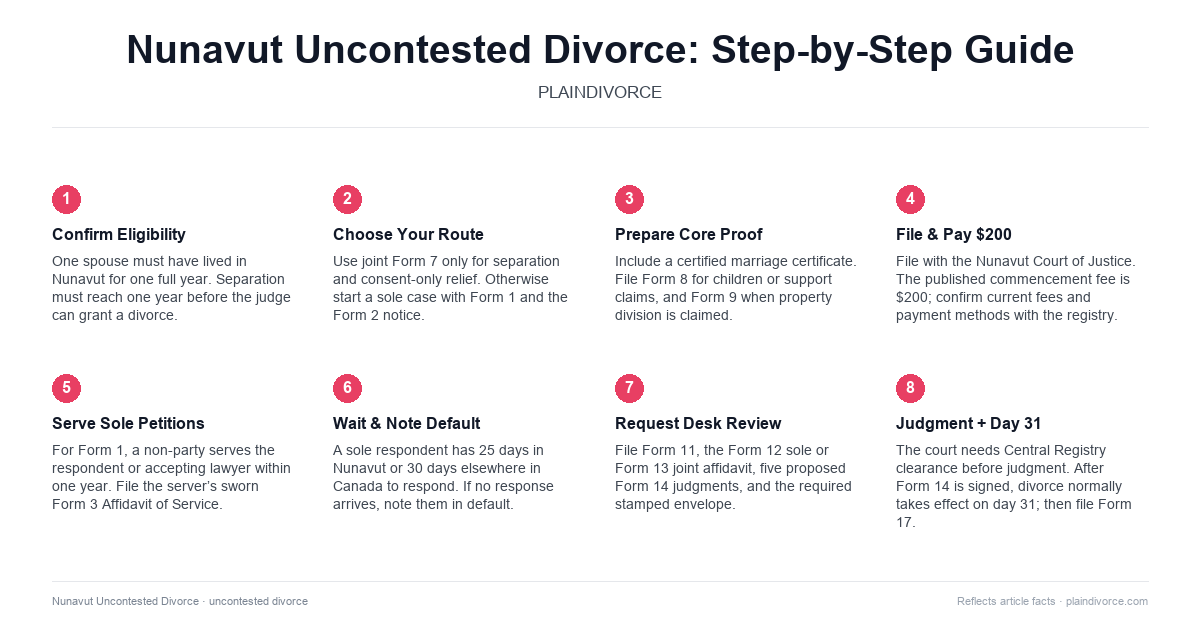
An uncontested divorce in Nunavut is a divorce the Nunavut Court of Justice can grant on the paperwork alone, because neither spouse is asking a judge to decide a fight. Cooperative spouses who are divorcing on the ground of a one-year separation can file a Joint Petition for Divorce (Form 7) together and never serve each other. Otherwise, one spouse files a Petition for Divorce (Form 1), serves it, and the case proceeds undefended when the other spouse files nothing. Either way, a judge can review sworn affidavits in chambers and sign the Divorce Judgment without a hearing, and the divorce takes effect on the 31st day afterward.
TL;DR: an uncontested divorce in Nunavut at a glance
- Two starting forms. A sole Petition for Divorce (Form 1), with a Notice to Respondent (Form 2) attached, that is served on your spouse; or a Joint Petition for Divorce (Form 7) signed by both spouses, which needs no service.
- “Joint Statement of Claim for Divorce” is outdated for Nunavut. The old Nunavut Divorce Rules (R-094-94) were repealed. Under the current Nunavut Divorce Rules (R-015-2021), the starting documents are Form 1 and Form 7, and there is no “Form 142 Statement of Claim.”
- The joint route has limits. Form 7 is only available when you are divorcing on the one-year separation ground and any support, property, or parenting order is by consent. Fault grounds and genuine disputes use Form 1.
- The “desk divorce” package. You file a Request for Divorce (Without Oral Hearing) (Form 11), the sworn Affidavit of the Applicant (Form 12) for a sole petition or Form 13 for a joint petition, five copies of the proposed judgment, and a stamped envelope. For a sole petition you first note the respondent in default.
- Nunavut Court of Justice divorce fees are published: $200 to start the petition, $15 for the certificate of divorce, and $1 per page to file by fax or email. Confirm current amounts and payment methods with the registry (867-975-6100).
- After the judge signs the judgment, the divorce is final on the 31st day; then you file a Request for a Certificate of Divorce (Form 17).
1. What is an uncontested (simple) divorce in Nunavut?
A divorce is the court process that legally ends a marriage. In Nunavut, divorces go through the Nunavut Court of Justice under Canada’s federal Divorce Act and the territory’s Nunavut Divorce Rules (R-015-2021). An uncontested divorce in Nunavut — some people call it a “simple divorce” — means all three of the following are true:
- one spouse files and the other does not oppose it, or both spouses file together;
- there is no live dispute over children, support, or property that a judge has to decide; and
- a judge can grant the divorce on the written record — sworn affidavit evidence — without an in-person hearing.
Agreeing is not enough on its own. The court still needs the correct current Nunavut forms, properly sworn evidence, proof that reasonable child-support arrangements are in place, and a judge’s decision. What “uncontested” buys you is the ability to skip the hearing, not the paperwork.
Download our Nunavut Uncontested Divorce Self-Help Kit
2. Form 1, Form 7, and the outdated “Joint Statement of Claim”
If you have searched for a Joint Statement of Claim for Divorce in Nunavut, or a “Form 142 Statement of Claim,” those terms are out of date. The old Nunavut Divorce Rules (N.W.T.Reg. R-094-94) were repealed and replaced by the Nunavut Divorce Rules, R-015-2021. Under the current rules there are two ways to start:
- Petition for Divorce (Form 1) — the initiating document when one spouse files. A Notice to Respondent (Form 2) is printed on the front or attached to it, and the Clerk signs and seals the petition to “issue” it (Rule 7).
- Joint Petition for Divorce (Form 7) — both spouses sign as co-petitioners and file together. A joint petition does not have to be served on anyone (Rule 14(2)).
The joint route is narrower than it looks. Rule 14(1) allows a Form 7 joint petition only when the spouses are seeking the divorce on the ground of marriage breakdown established by one year of living separate and apart (paragraph 8(2)(a) of the Divorce Act), and where any other order — support, property division, or parenting — is made only by consent. If you want the divorce on the basis of adultery or cruelty, or any relief is actually in dispute, you use the sole Petition for Divorce (Form 1) instead.
3. Who qualifies for an uncontested divorce in Nunavut?
Residency requirement
The Nunavut Court of Justice has jurisdiction to hear your divorce only if at least one spouse has been habitually resident in Nunavut for the full year immediately before the proceeding is commenced (Divorce Act, section 3). This is a jurisdictional rule, not a formality: your Form 12 or Form 13 affidavit has to state the residence facts, and the judge must be satisfied of them before granting the divorce.
Grounds and the one-year separation clock
Canada has one ground for divorce: breakdown of the marriage. You prove it one of three ways — one year of separation, adultery, or physical or mental cruelty. Almost every uncontested divorce uses the one-year separation basis, because it needs no proof of fault and suits a paperwork-driven process.
- You can file before the year of separation is complete, but a judge cannot grant the divorce until you have been separated for one full year immediately before the decision.
- A reconciliation attempt totalling up to 90 days does not reset the clock (Divorce Act, section 8(3)). Longer than that, and the year usually starts over.
- You can be “separated” while living under the same roof if you have stopped living as a couple — but be ready to explain the arrangement in your affidavit.
When your case is a good fit for uncontested
- At least one spouse meets the one-year Nunavut residency rule.
- You can rely on one year of separation, or will reach it before the judge decides.
- Children, support, and property are either already resolved in a written agreement or order, or you both consent to what the court is being asked to do.
- You can prepare clear, consistent paperwork with every required attachment — including a certified marriage certificate.
4. The current Nunavut divorce forms (Form 1 to Form 18)
These form numbers come from the Schedule to the Nunavut Divorce Rules (R-015-2021). The Nunavut Court of Justice publishes the official fillable versions; ask the registry for the current form set rather than relying on a copy from an older guide. When people search “Nunavut divorce forms PDF,” this is the set they are looking for.
| Form | Name | When you use it |
|---|---|---|
| Form 1 | Petition for Divorce | Starts a sole divorce proceeding. |
| Form 2 | Notice to Respondent | Attached to Form 1; tells the respondent how and when to respond. |
| Form 3 | Affidavit of Service | Sworn by the person who served the petition (sole route only). |
| Form 4 / 5 / 6 | Answer / Answer and Counter Petition / Demand of Notice | Filed by a respondent who opposes, seeks their own relief, or just wants notice. None of these appears in a truly uncontested file. |
| Form 7 | Joint Petition for Divorce | Starts a joint proceeding; no service required. |
| Form 8 | Financial Statement | Required if there are children of the marriage, or anyone is claiming support (Rule 17). |
| Form 9 | Statement of Property | Required whenever a claim for division of property is made (Rule 17). |
| Form 11 | Request for Divorce (Without Oral Hearing) | Asks the court to decide the file on affidavit evidence — the “desk divorce” request. |
| Form 12 | Affidavit of the Applicant | The sworn evidence for a sole petition. This is the “Affidavit of Applicant” in a NU divorce. |
| Form 13 | Affidavit (Joint Petition) | The sworn evidence for a joint petition; each petitioner swears their own when a Form 8 or Form 9 is filed. |
| Form 14 | Divorce Judgment (Without Oral Evidence) | The judgment a judge signs on the desk-review track. |
| Form 15 / 16 | Divorce Judgment (other) / Parenting and Child Support Order | Form 15 is the judgment when the case is decided other than on the desk track; Form 16 is a stand-alone parenting and support order. |
| Form 17 / 18 | Request for a Certificate of Divorce / Certificate of Divorce | You file Form 17 after the divorce takes effect; the Clerk issues the Form 18 certificate as proof. |
Plain-English checklist for an uncontested file: Form 1 (or Form 7 if joint); Form 2 and Form 3 for a sole filing; Form 8 and/or Form 9 if disclosure is required; Form 11; the Form 12 or Form 13 affidavit; five copies of the draft Form 14 judgment; a stamped envelope for any party without a lawyer; and, once the judgment takes effect, Form 17 for your certificate.
5. Step by step: joint route, sole route, and desk divorce
Follow the current Nunavut Court of Justice instructions and forms for your situation. Below is the practical shape of each route.
Route A: Joint Petition for Divorce (Form 7)
If you can cooperate and you meet the Rule 14 limits (separation ground, any other relief by consent), filing jointly is the cleanest route in Nunavut because it removes service entirely — a real saving when spouses live in different communities.
- Confirm eligibility: one year’s Nunavut residency, one year’s separation (or nearly), and nothing that needs a contested hearing.
- Complete and file the Joint Petition (Form 7) with the Clerk, signed by both spouses, together with a certified copy of your marriage certificate.
- File disclosure if it applies: a Financial Statement (Form 8) from each petitioner if there are children of the marriage or a support claim, and a Statement of Property (Form 9) from each petitioner if property division is claimed (Rule 17(3)–(4)).
- Prepare the sworn evidence: the Affidavit (Form 13). If a Form 8 or Form 9 is filed, each petitioner swears a separate Form 13 (Rule 21(3)).
- File the desk-review package: a Request for Divorce (Without Oral Hearing) (Form 11), the Form 13 affidavit(s), five copies of the proposed Divorce Judgment and any order, and a stamped envelope for any party without a lawyer (Rule 21).
- Wait for the judge’s decision. If everything is in order, the judge signs the Divorce Judgment (Form 14) in chambers.
Route B: Sole Petition for Divorce (Form 1) plus service
If you file alone, the extra work is service and noting the respondent in default. Service problems are a common reason DIY files stall.
- Complete and file the Petition for Divorce (Form 1), with the Notice to Respondent (Form 2) on the front, plus your certified marriage certificate. The Clerk signs and seals it.
- Serve your spouse within one year of the petition being issued (Rule 8). Service must be done by an adult who is not you, either on the respondent personally or on the respondent’s lawyer if the lawyer accepts service (Rule 9). No court order for service is needed if it happens in Canada.
- File the Affidavit of Service (Form 3), sworn by the person who served the documents.
- Wait out the response window. An Answer, Counter Petition, or Demand of Notice is due within 25 days if the respondent was served in Nunavut, 30 days if served elsewhere in Canada, or a time the court sets if served outside Canada (Rule 12).
- Note the respondent in default if nothing is filed (Rule 20(1)), then prepare the Affidavit of the Applicant (Form 12) and any required Form 8 / Form 9.
- File the desk-review package: Form 11, the Form 12 affidavit, five copies of the proposed Divorce Judgment, and a stamped envelope addressed to the respondent if they have no lawyer (Rule 20(4)).
- The judge reviews the file and, if satisfied, signs the Divorce Judgment (Form 14).
How the desk divorce (affidavit review) works
A “desk divorce” means a judge reviews your file in chambers on the strength of sworn affidavits instead of holding a hearing. You ask for that route with Form 11. Your Form 12 (sole) or Form 13 (joint) affidavit has to do real work — under Rule 20(5) the deponent must, among other things:
- identify the parties and give the respondent’s latest known address;
- prove the marriage by attaching a certified copy of the marriage certificate (or explain why one cannot be obtained);
- attest to one year’s habitual residence in Nunavut immediately before the petition was issued;
- state the grounds, deny collusion, and deny or explain condonation and connivance if a fault ground is used;
- detail the child-care and child-support arrangements and verify any financial statement or statement of property; and
- deny any realistic possibility of reconciliation and confirm the petition’s facts are accurate.
Form 11 does not guarantee a paperwork-only result. Once the materials are before a judge, Rule 20(8) lets the judge grant the judgment, direct that further evidence be filed, require the parties or their lawyers to appear in chambers, or send the case to a trial on oral evidence. A complete, internally consistent package is what keeps you on the paperwork track.
6. If you have children: support and disclosure are not optional
When there are children of the marriage, the court has a statutory duty before it can grant the divorce: under section 11(1)(b) of the Divorce Act, the judge must be satisfied that reasonable arrangements have been made for the support of the children, having regard to the applicable child-support guidelines. If they are not satisfied, they must stay (pause) the divorce until proper arrangements are made. This is a hard bar, not a preference.
In practice the judge will look for:
- Parenting arrangements: where the children live, the parenting-time schedule, and how major decisions are made.
- Child support that matches the numbers: a table amount consistent with the Federal Child Support Guidelines Nunavut table for the payor’s income, plus a fair split of special or extraordinary expenses — or a clear, supported explanation if the amount is different.
- Financial disclosure: a Financial Statement (Form 8) with income documents, so the support figure is grounded in evidence.
Remember that Form 8 is triggered by either children of the marriage or a support claim — you can need it even if you and your spouse fully agree on the amount. A Statement of Property (Form 9) is a separate requirement that applies whenever property division is claimed.
7. How long does an uncontested divorce take in Nunavut?
There is no published service standard for Nunavut divorces, but the timeline has predictable parts:
- The one-year separation: usually the longest stretch, and it has to be complete before the judge grants the divorce.
- Filing and (for a sole petition) service: a joint petition skips service; a sole petition adds the time to arrange personal service and wait out the 25- or 30-day response window.
- Central Registry clearance: every Canadian divorce is registered with the federal Central Registry of Divorce Proceedings, and the court cannot grant the divorce until a clearance certificate confirms there is no competing filing. This commonly adds a few weeks.
- Desk review: depends on the court’s workload and whether your Form 11 package is complete and consistent the first time.
After the judge signs the judgment, the divorce takes effect on the 31st day (Divorce Act, section 12(1)). Two wrinkles: the court can order an earlier effective date if both spouses agree and undertake not to appeal, and a pending appeal pushes the date out. Once the divorce takes effect it is final and cannot be appealed. Only then can you file Form 17 to get your Certificate of Divorce (Form 18) — the document you will need to remarry.
8. Nunavut Court of Justice divorce fees: what does it cost?
Nunavut court fees are set by the Court Fees Regulations (R-042-2021) under the Judicature Act, and are paid to the Clerk when you file. The current published amounts for a divorce:
| Service | Fee |
|---|---|
| Commencing the action — filing a Petition for Divorce or Joint Petition for Divorce (Schedule A, item 1) | $200 |
| Issuing a Certificate of Divorce (Schedule A, item 8) | $15 |
| Certified copy of a document (Schedule A, item 9) | $15 |
| Receiving a document for filing by fax or email, per page, on top of any filing fee (Schedule A, item 12) | $1 / page |
| Filing a defence containing a counterclaim — only if the case stops being uncontested (Schedule A, item 2) | $100 |
So a straightforward uncontested divorce runs about $215 in court fees ($200 to file plus $15 for the certificate), before any per-page fax or email charges and the cost of a certified marriage certificate from the province or territory where you married. Fees can change, so confirm the current schedule and accepted payment methods with the registry before you file.
If cost is a barrier: under section 13 of the regulations a judge can order the fees waived, in full or in part, and under section 14 a person receiving legal aid pays no Clerk or Sheriff fees. There is no general “fee deferral” program. Ask the registry how to apply for a waiver, and contact the Legal Services Board of Nunavut about legal-aid eligibility (the Family Law Line, 1-866-606-9400, gives legal information but does not itself decide eligibility).
9. Language rights and where to get help
Nunavut’s Official Languages Act makes English, French, and the Inuit Language (Inuktut — that is, Inuktitut and Inuinnaqtun) official languages that may be used in court proceedings (section 8(1)). A party or witness in a civil proceeding is entitled to request and receive interpretation in their Official Language of choice, and to be told about that right (section 8(3)). If you need interpretation or help dealing with the registry, ask as early as possible so it can be arranged.
Registry and support contacts:
- Nunavut Court of Justice registry, Iqaluit — 867-975-6100, toll-free 1-866-286-0546. See the court’s hours and location page. Contact the registry to confirm how to file from your community, how many copies to bring, and how to pay.
- Legal Services Board of Nunavut / Family Law Line — 1-866-606-9400 for family-law information; regional legal-aid clinics in Iqaluit, Rankin Inlet, and Cambridge Bay.
- Kamatsiaqtut Nunavut Helpline — 1-800-265-3333 (local 867-979-3333), 24 hours a day, 7 days a week, for confidential support and referrals.
10. When a DIY divorce might not be right for you
Handling your own uncontested divorce is usually a poor idea if there is family violence, coercive control, fear, hidden assets, serious conflict over the children, or complex finances such as a business, several properties, or significant pensions. In those situations, even one focused consultation with a family lawyer can prevent costly mistakes that are hard to undo.
If you are experiencing family violence, Nunavut’s Family Abuse Intervention Act allows for emergency protection orders that are separate from the divorce process; contact your community’s justice outreach worker or the RCMP if you are in immediate danger. A protection order is about safety and does not by itself decide parenting or divorce. The Kamatsiaqtut Nunavut Helpline (1-800-265-3333) is available 24 hours a day for support and referrals.
11. Where a self-help divorce kit fits into the process
If your case is a genuine uncontested divorce in Nunavut, a Nunavut-specific kit makes the paperwork more manageable by keeping you in the current terminology and organized through the desk-divorce steps. A good kit helps you:
- start with the right document — Petition for Divorce (Form 1) or Joint Petition (Form 7) — and know which one your situation allows;
- handle service and the Affidavit of Service (Form 3) correctly on the sole route;
- prepare a clear Affidavit of the Applicant (Form 12) or joint Form 13 that covers everything Rule 20(5) requires;
- assemble the Form 11 desk package — affidavit, five copies of the judgment, stamped envelope — and the disclosure (Form 8, and Form 9 if property is in play); and
- track the finish line: Central Registry clearance, the Divorce Judgment, the 31-day wait, and the Request for a Certificate of Divorce (Form 17).
Download our Nunavut Uncontested Divorce Self-Help Kit
PlainDivorce is not a law firm. A kit is an information and organization tool, not legal advice, and you must still confirm you are using the current forms, fees, and registry instructions from the Nunavut Court of Justice.
12. FAQ
What is an uncontested divorce in Nunavut?
It is a divorce the Nunavut Court of Justice can grant without a trial or hearing, because neither spouse is asking a judge to resolve a dispute over children, support, or property. Once you file a Request for Divorce (Without Oral Hearing) (Form 11) with a sworn affidavit (Form 12 for a sole petition, Form 13 for a joint petition), a judge can review the file in chambers and sign the Divorce Judgment.
Is there still a “Joint Statement of Claim for Divorce” in Nunavut?
No. The old Nunavut Divorce Rules were repealed. Under the current Nunavut Divorce Rules (R-015-2021), a joint filing is the Joint Petition for Divorce (Form 7), and a sole filing is the Petition for Divorce (Form 1). There is no “Statement of Claim (Form 142).” The joint route is available only when you are divorcing on the one-year separation ground and any other relief is by consent.
Do I have to go to court for an uncontested divorce in Nunavut?
Usually not. Most uncontested files are decided on affidavit evidence after you file Form 11. But filing Form 11 does not guarantee it: under Rule 20(8) the judge can grant the divorce, ask for more evidence, require a chambers appearance, or direct a trial on oral evidence. A complete, consistent package is what keeps the case on the paperwork track.
What forms do I need for a divorce in Nunavut?
For a sole filing: Petition for Divorce (Form 1) with Notice to Respondent (Form 2), Affidavit of Service (Form 3), Affidavit of the Applicant (Form 12), Request for Divorce Without Oral Hearing (Form 11), a draft Divorce Judgment (Form 14), and later a Request for a Certificate of Divorce (Form 17). A joint filing swaps Form 7 for Forms 1–3 and uses Form 13 instead of Form 12. Add a Financial Statement (Form 8) if there are children or a support claim, and a Statement of Property (Form 9) if property division is claimed.
How much does it cost to file for divorce in Nunavut?
The Court Fees Regulations (R-042-2021) set the fee to commence a petition at $200 and the fee to issue a certificate of divorce at $15, so court fees for a simple uncontested divorce are about $215. Filing a document by fax or email costs an extra $1 per page. A judge can waive fees in full or in part, and legal-aid clients pay none. Confirm current amounts with the registry (867-975-6100).
Do I need a Financial Statement (Form 8) if we agree on child support?
Usually yes. Under Rule 17, a Financial Statement (Form 8) is required if there are children of the marriage or if anyone is claiming support — agreement on the amount does not remove the requirement. The court still has to be satisfied the support arrangement is reasonable and consistent with the Federal Child Support Guidelines, and it needs income evidence to check that. Follow the registry’s direction for your situation.
How long after the judgment is the divorce final?
A divorce normally takes effect on the 31st day after the judge signs the judgment (Divorce Act, section 12). The court can set an earlier date if both spouses agree and undertake not to appeal, and a pending appeal delays it. Once the divorce takes effect it is final and cannot be appealed, and you can file Form 17 for your Certificate of Divorce.
Can I use Inuktitut in a Nunavut divorce?
Yes. Under Nunavut’s Official Languages Act, English, French, and the Inuit Language (Inuktut) may all be used in court proceedings. A party or witness in a civil proceeding is entitled to request and receive interpretation in their Official Language of choice, and to be told about that right. Ask the registry early so interpretation can be arranged.
13. Final thoughts and next steps
For the smoothest uncontested divorce in Nunavut, focus on four things:
- Use the current forms. Petition for Divorce (Form 1) or Joint Petition for Divorce (Form 7) under the Nunavut Divorce Rules (R-015-2021) — not a “Statement of Claim.”
- Match the route to your facts. Form 7 only fits a no-fault, consent-only case; everything else is Form 1 plus service and noting in default.
- Build a complete desk package. Form 11, a Rule 20(5)-compliant affidavit, five copies of the judgment, a stamped envelope, and any Form 8 / Form 9.
- Plan for children and disclosure. The court must be satisfied child support is reasonable and Guideline-based before it can grant the divorce.
This guide is legal information, not legal advice. If anything about your situation feels unsafe, unfair, or unusually complex, talk to a Nunavut family lawyer or legal clinic before you file.
Sources and local rules can change. Use this guide as a plain-English organizer, then verify the current filing requirements with the official court or government source for your jurisdiction.
About Harry D
Expert contributor at PlainDivorce, helping Canadians and American navigate simple uncontested divorces with clarity and confidence.