Uncontested Divorce in Ohio: A Plain-English Guide to Dissolution of Marriage
An uncontested divorce in Ohio almost always means a Dissolution of Marriage: both spouses agree on every issue in writing first, file a joint petition, and appear together at one short hearing 30 to 90 days later. There is no lawsuit and no one is “served.” At least one spouse must have lived in Ohio for six months, you file a Petition (Form 17) with a signed Separation Agreement (Form 19), and if the judge approves the agreement the marriage ends the day the decree is signed and filed.
This guide covers how an Ohio dissolution works start to finish: who qualifies, the exact Ohio Dissolution of Marriage forms, the filing sequence, the 30-to-90-day hearing rule and its exceptions, how child cases differ, timelines, and costs — using the same form numbers and court terms you will see on the paperwork. It also explains how a true uncontested divorce (a one-spouse complaint that later settles) differs from a dissolution, so you pick the right track.
TL;DR
In Ohio, an “uncontested divorce” is usually a Dissolution of Marriage: you agree on everything in writing first, file a joint petition, and both show up at one short hearing 30 to 90 days later. Nobody sues anybody and nobody gets served.
- Who qualifies: one spouse must have lived in Ohio six months (R.C. 3105.62), you both consent to the county, and you agree on every issue — property, debts, spousal support, and any parenting terms.
- No grounds needed: dissolution is agreement-based. You are not alleging fault or even incompatibility.
- Core forms: Form 17 (Petition + waiver of service), Form 19 (Separation Agreement), Affidavit 1 (income/expenses), Affidavit 2 (property/debt), and a proposed Form 18 decree.
- With kids, add: Affidavit 3, Affidavit 4, a child support computation, and a Parenting Plan (Form 21) or Shared Parenting Plan (Form 20). You must run the guideline math even if you already agree on a number.
- Financial disclosure is required. Willfully hiding an asset can cost you three times its value.
- The hearing is mandatory: both spouses appear, 30 to 90 days after filing (R.C. 3105.64), and each confirms under oath that they signed voluntarily and still want it. If one backs out, the case is dismissed unless it’s converted to a divorce.
- Cost: no statewide fee — each county sets its own, commonly $150–$350 plus surcharges. Waivers available. No service fees.
- You’re divorced the day the judge signs the decree and it’s filed with the clerk — not at the hearing.
- Choose a divorce filing instead if cooperation is shaky or you need temporary support or exclusive use of the home while you negotiate. And get a lawyer if there’s abuse, hidden assets, a business or pension, or a real dispute about the children.
1. Ohio Uncontested Divorce (Dissolution) at a Glance
- The route: Dissolution of Marriage — a joint petition both spouses sign after agreeing on everything. It is not a lawsuit and there is no “plaintiff” suing a “defendant.”
- Where you file: the Court of Common Pleas in an Ohio county you both consent to. About a dozen counties (Cuyahoga, Franklin, Hamilton, Montgomery, Summit, Lucas, Stark, Butler, and others) have a separate Domestic Relations Division; elsewhere the General Division hears it.
- Residency: one spouse must have been an Ohio resident for six months immediately before filing (R.C. 3105.62).
- Grounds: none to prove. Dissolution is agreement-based; you are not alleging fault or even incompatibility.
- Core forms: Petition for Dissolution (Uniform Domestic Relations Form 17), Separation Agreement (Form 19), Affidavit 1 (basic information, income, expenses) and Affidavit 2 (property and debt), and a proposed Judgment Entry — Decree of Dissolution (Form 18).
- With children: add Affidavit 3 (Parenting Proceeding Affidavit), Affidavit 4 (Health Insurance Affidavit), a completed child support computation, and either a Shared Parenting Plan (Form 20) or a Parenting Plan (Form 21).
- Service: none. Form 17 includes a waiver of service of summons that both spouses sign.
- Hearing: mandatory. Both spouses appear not less than 30 and not more than 90 days after filing (R.C. 3105.64) and each confirms under oath that they signed voluntarily, are satisfied with the agreement, and want the dissolution.
- Filing fee: set by each county, commonly about $150 to $350 plus statutory surcharges. Fee waivers are available.
- When it’s final: only when the judge signs the decree and it is filed with the clerk.
2. Dissolution vs. Divorce: Ohio’s Two Paths
Ohio has two ways to legally end a marriage, and the difference matters for your paperwork and timeline.
- Dissolution of Marriage is Ohio’s joint, agreement-first procedure. You settle every issue, both sign the petition and Separation Agreement, file them together, and attend one hearing. Nobody is served and there are no “grounds.”
- Divorce is a civil lawsuit. One spouse files a Complaint alleging a ground (incompatibility, living separate and apart for one year, or a fault ground), serves the other spouse, and the other spouse has 28 days to answer. A divorce can still finish as an uncontested divorce if the spouses reach a full written settlement — but it stays a one-party case with its own service, answer period, and local scheduling.
| Feature | Dissolution | Uncontested (settled) divorce |
|---|---|---|
| How it starts | Joint petition both spouses sign | One spouse files a Complaint |
| Grounds | None | Must allege a statutory ground |
| Service of process | Waived on Form 17 | Required (waiver or acceptance possible) |
| Agreement | Signed and attached before filing | Can be reached any time before the final hearing |
| Mandatory hearing | Yes — both spouses, 30 to 90 days after filing | Usually one hearing; timing set by local rule |
| If someone backs out | Court dismisses unless it is converted to divorce | Case proceeds as a contested divorce |
Rule of thumb: if you already agree on everything and both spouses will cooperate through a hearing date, dissolution is the cleaner path. If cooperation is shaky, or you need court-ordered temporary support or exclusive use of the home while you finish negotiating, an uncontested divorce filing gives you those tools because it is a live lawsuit from day one. Either spouse can also convert a pending dissolution into a divorce before the decree by filing a motion that states a ground, with no additional court fee (R.C. 3105.65).
3. Do You Qualify? Residency, Venue, Agreement, and the Pregnancy Rule
3.1 State residency
For a dissolution, R.C. 3105.62 requires that one spouse “have been a resident of the state for at least six months immediately before filing the petition.” Form 17 asks you to check whether Petitioner 1, Petitioner 2, or both meet that six months. For a divorce, the residency rule sits in R.C. 3105.03 and applies to the spouse who files. If either of you recently moved to Ohio, wait until the six months is clearly met before you prepare a packet.
3.2 Which county (venue)
Venue is governed by Ohio Civil Rule 3. In a divorce, Civ.R. 3(C)(9) normally lets the plaintiff file where they have lived for at least 90 days. In a dissolution, Form 17 has both petitioners consent to venue, and the 90-day county element can be waived by that consent — so a couple can usually file in the county where either spouse lives. If neither of you has a clear 90-day county, call the clerk in the county you want to use and ask whether they accept consent-to-venue dissolutions. Do not assume the office is called “Domestic Relations” — in most Ohio counties the General Division of the Court of Common Pleas handles these cases.
3.3 Full written agreement (the real gatekeeper)
A dissolution only works if you and your spouse agree, in writing, on every issue the court has to decide. Under R.C. 3105.63 the Separation Agreement must provide for:
- Division of all property (marital and separate) and all debts;
- Spousal support — the amount and duration, or a clear statement that neither spouse pays it, plus whether the court keeps power to modify;
- If you have minor or disabled children: the allocation of parental rights and responsibilities, the residential parent and legal custodian, child support, and parenting time — set out in an attached Parenting Plan (Form 21) or Shared Parenting Plan (Form 20).
The agreement is not just a private contract. It is submitted to the judge for approval, the parties can amend it before or during the hearing, and once approved it is incorporated into the decree and becomes enforceable as a court order. Because it can affect support and long-term finances for years, have a lawyer review it before you sign if anything about the split is unclear or lopsided.
3.4 The pregnancy rule
Form 17 asks you to state whether a spouse is pregnant, and Ohio Legal Help advises that “if you or your spouse are pregnant, you usually can’t get a dissolution” — you generally wait until the baby is born so parentage, custody, and support can be decided. If a pregnancy is involved, ask the court how it wants you to proceed.
3.5 When dissolution is a poor fit
Skip the DIY route if there is domestic violence or coercion, hidden or unknown assets, a business or a pension that needs valuing, immigration or bankruptcy exposure, or any real disagreement about the children or support. See Section 10.
4. The Ohio Dissolution of Marriage Forms
Ohio uses statewide Uniform Domestic Relations Forms approved by the Supreme Court of Ohio. Most were amended June 1, 2021; the two parenting plans were updated in 2024. Your county can require extra local cover sheets, so always check the county’s dissolution checklist too.
| Form | Title | What it does |
|---|---|---|
| Form 17 | Petition for Dissolution of Marriage and Waiver of Service of Summons | Starts the case. Both spouses sign; it also waives service. Includes residency, venue consent, pregnancy disclosure, children, military status, and name-restoration requests. |
| Form 19 | Separation Agreement | The full written settlement: property, debts, spousal support, and (for child cases) a reference to the attached parenting plan. Each spouse signs before a notary (a notarized acknowledgment, not a sworn oath). |
| Affidavit 1 | Affidavit of Basic Information, Income, and Expenses | Standardized financial disclosure — sworn before a notary. |
| Affidavit 2 | Affidavit of Property and Debt | Standardized asset and debt disclosure — sworn before a notary. |
| Affidavit 3 | Parenting Proceeding Affidavit | Required by law in any case involving custody or parenting time (R.C. 3127.23). Lists the children’s residences and any other custody cases. |
| Affidavit 4 | Health Insurance Affidavit | Discloses health coverage available for the children; used to set child support. Local rules decide when it is filed. |
| Form 20 | Shared Parenting Plan | Attach for a shared-parenting (joint) arrangement. |
| Form 21 | Parenting Plan | Attach when one parent is the residential parent and legal custodian. |
| Form 18 | Judgment Entry — Decree of Dissolution of Marriage | The statewide decree the judge signs. Many courts also want a locally formatted proposed entry — ask the clerk. |
Reading Form 17 correctly
Form 17 does double duty. It is the petition and the waiver of service of summons in one document. By signing it, both petitioners state they are over 18, are not under any legal disability, consent to venue, and give up the right to be formally served through the clerk. Because it is a joint filing, you are not paying a sheriff or process server the way you would in a divorce. Item 8 requires you to attach Form 20 or Form 21 if you have children; item 10 is where a spouse asks to be restored to a former name.
The financial disclosure affidavits are not optional
Contrary to a common myth, Ohio does have a standardized financial disclosure: Affidavit 1 and Affidavit 2. Form 19 itself says each spouse must complete a financial disclosure affidavit that “fully and accurately lists and values” all property, debts, income, and expenses, review the other’s affidavit, and file it in the court’s confidential Family File (Sup.R. 44(C)(2)(h)) no later than the day the agreement is filed. Form 19 also warns that a spouse’s willful failure to disclose can let the court award the other spouse three times the value of the hidden item. Check each affidavit before you sign — you sign in front of the notary, not before.
5. Step by Step: How an Uncontested Divorce in Ohio Works
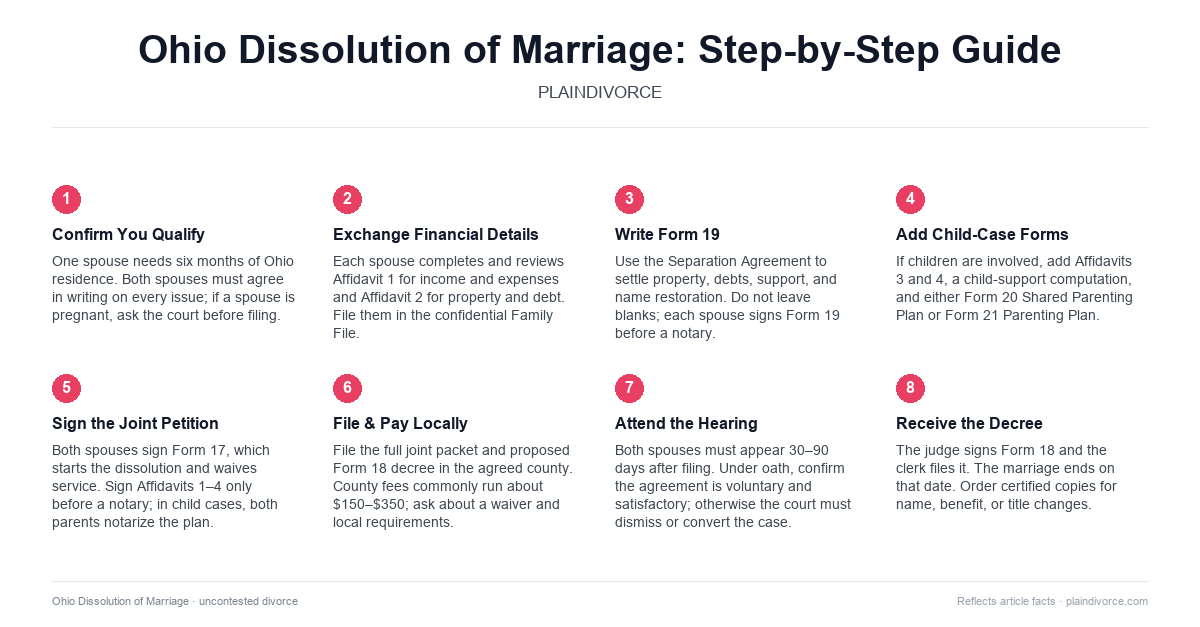
Step 1 — Confirm the basics
Check the six-month Ohio residency, decide which county you will consent to, and confirm you can agree on every issue. If a pregnancy is involved, contact the court first.
Step 2 — Exchange full financial information
Each spouse completes Affidavit 1 and Affidavit 2 and shares them. Gather pay records, tax returns, bank and retirement statements, mortgage and loan balances, and vehicle titles. You cannot fairly divide what you have not listed and valued.
Step 3 — Build the Separation Agreement (Form 19)
Work through Form 19 paragraph by paragraph: real estate, vehicles, household goods, financial accounts, investments, business interests, retirement plans, life insurance, debts, spousal support, and name restoration. If you divide a pension or 401(k), the agreement names who prepares the QDRO or DOPO and requires it to be submitted within 90 days after the final hearing. Leave no blanks — an unanswered item invites a rejection or a follow-up hearing.
Step 4 — In child cases, do the parenting plan and child support math now
Complete Form 20 or Form 21, Affidavit 3, Affidavit 4, and a full child support computation using the Ohio basic child support schedule and worksheet (see Section 7). The support figure and health-care terms go into the parenting plan and the decree.
Step 5 — Sign everything correctly
- Both spouses sign Form 17.
- Both spouses sign Form 19, each before a notary, who takes a separate acknowledgment for each party.
- Affidavits 1–4 are sworn — do not sign until the notary is present.
- Both parents sign the parenting plan (Form 20 or 21) before a notary.
Step 6 — File with the Clerk of Courts
File the full packet in the county you consented to, pay the filing fee (or file a poverty affidavit to ask for a waiver), and ask the clerk exactly what your county needs next — a proposed decree in the local format, a hearing request form, a parenting class registration, or additional cover sheets.
Step 7 — Attend the final hearing (both spouses)
The court sets a hearing 30 to 90 days after filing. Both spouses attend. The judge or magistrate confirms under oath that you each signed voluntarily, understand the agreement, are satisfied with it, and still want the dissolution. If a spouse no longer agrees and neither converts the case to a divorce, the court must dismiss the petition (R.C. 3105.65).
Step 8 — Decree is signed, then get certified copies
If the judge approves the agreement, they sign the Judgment Entry — Decree of Dissolution of Marriage (Form 18) and it is filed with the clerk. Your marriage ends on that date — not at the hearing. Order certified copies from the clerk for name changes, benefits updates, and title transfers. Form 19 gives each spouse 30 days after the entry is filed to transfer titled property.
6. The 30-to-90-Day Hearing Window (and Its Exceptions)
The rule that trips people up sits in R.C. 3105.64(A): in an ordinary dissolution, both spouses must appear before the court not less than 30 nor more than 90 days after the petition is filed. Plan the filing date around both spouses’ availability for that window.
Filing date → wait at least 30 days → hearing by day 90 → judge signs Form 18 → decree filed = divorced
The 90-day cap is not absolute. R.C. 3105.64 itself allows different timing in two situations:
- A divorce converted to a dissolution under R.C. 3105.08 more than 30 days after the original divorce petition — the appearance can happen at conversion or within 90 days after it.
- A dissolution that follows a completed collaborative family law process (R.C. 3105.41 to 3105.54) — the appearance can occur at any time that is not more than 90 days after the petition is filed.
If your hearing is not set inside the window, contact the clerk to ask what your county needs to schedule it. Separately, if minor children are involved, R.C. 3105.091 lets the court order conciliation or family counseling, and the case cannot be decided until that is finished and reported.
7. Dissolutions With Children: Parenting Plan and Child Support
7.1 The parenting plan and Affidavit 3
Every child case needs an attached Parenting Plan (Form 21) or Shared Parenting Plan (Form 20) covering decision-making, the residential parent and legal custodian, a parenting-time schedule (including holidays and transportation), and how the parents will handle disputes. Affidavit 3 is required by law: its instructions state it “must be filed and served with any Complaint, Petition or Motion regarding the allocation of parental rights and responsibilities, parenting time, custody, or visitation,” and each parent has a continuing duty to tell the court about any other custody proceeding.
7.2 You must calculate child support — even if you agree on a number
A court setting child support has to run the calculation using the statewide basic child support schedule and the applicable worksheet (R.C. 3119.02). If the parents want an amount that differs from the guideline figure, the court must make specific written findings that the guideline amount would be unjust or inappropriate and that a deviation is in the child’s best interest (R.C. 3119.22). “We already agreed on $X” is not enough on its own.
7.3 What an Ohio child support order must include
- Health-care coverage and cash medical support — the order allocates who insures the children and how uninsured costs are split (R.C. 3119.30). Affidavit 4 feeds this.
- Payment routing — support generally runs through income withholding and Ohio Child Support Payment Central / the county Child Support Enforcement Agency (CSEA), not informal direct payment (R.C. 3121.02, R.C. 3121.44). Form 19 notes a 2% processing charge on support routed through the state.
- A withholding notice — the order states that a missed payment triggers automatic wage withholding.
Some counties or their CSEA ask parents to submit an Application for Child Support Services (JFS 07076) to open the payment case. This is a local/CSEA intake step, not a statewide filing requirement — confirm with your county whether it is needed. Some courts also require a parenting education class before the decree.
8. How Long an Uncontested Divorce Takes in Ohio
- Dissolution: the hearing falls in the 30-to-90-day window after filing, so most complete dissolutions finish in roughly one to three months once the packet is filed — plus however long you take to negotiate and assemble it first.
- Uncontested (settled) divorce: usually longer, because it adds service (or a signed waiver), a 28-day answer period, and your county’s own scheduling queue.
Delays almost always come from the same handful of things: a missing or unsigned affidavit, blanks left in Form 19, a child support worksheet that was not completed, a parenting class not finished, or a Separation Agreement that has to be revised after filing. A complete, correctly notarized packet is the fastest path Ohio offers.
9. What an Uncontested Divorce Costs in Ohio
There is no statewide filing fee. Each county’s Court of Common Pleas sets its own deposit, and the number often differs for cases with and without children. A few examples of published figures:
| County | Dissolution filing fee / deposit |
|---|---|
| Franklin | About $225 for an action for dissolution |
| Cuyahoga | About $200 with children / $150 without (effective March 1, 2024) |
| Typical statewide range | Roughly $150–$350, plus statutory surcharges |
Confirm your own county’s current amount with its Clerk of Courts. Other costs can include:
- Notary fees for the four affidavits and both acknowledgments on Form 19 (often free at the courthouse or your bank).
- Parenting class fee where the court orders one.
- Certified copies of the decree after it is filed.
- QDRO/DOPO preparation if you divide a retirement plan — usually done by a specialist.
A dissolution avoids service-of-process fees and, if you both stay cooperative, keeps you out of the attorney-fee spiral of a contested case. A fee waiver (poverty affidavit) is available if you cannot afford the filing fee.
10. When to Skip DIY and Talk to a Lawyer
Get legal advice before you sign or file anything if there is:
- Domestic violence, threats, or coercive control — a dissolution requires both spouses to negotiate as equals and appear together in court.
- Hidden income or assets, or a spouse who will not exchange financial information.
- A business, professional practice, or significant retirement accounts that need valuing or a QDRO.
- Real disagreement about the children, relocation, or support.
- Immigration, bankruptcy, or tax complications.
- Pressure to sign an agreement you do not fully understand.
For safety planning and referrals, the Ohio Domestic Violence Network can connect you with your local shelter and legal advocacy program.
11. Where a Self-Help Divorce Kit Fits
Even an agreed Ohio dissolution has nine or more forms, four notarized affidavits, a multi-page Separation Agreement, packet-specific rules for children, and county add-ons. A good Ohio dissolution / uncontested divorce kit helps you:
- Decide between dissolution and an uncontested divorce filing;
- Work through property, debt, support, and parenting decisions before they go into Form 19;
- Assemble the affidavit stack (Affidavits 1–4) and the right parenting plan without missing one;
- Follow the filing order and hit the 30-to-90-day hearing window cleanly.
Always pair any self-help materials with your county court’s current dissolution checklist, since local rules add documents beyond the statewide forms.
12. Final Checklist and Next Steps
- Confirm one spouse’s six-month Ohio residency (R.C. 3105.62) and pick the county you will both consent to.
- Exchange completed Affidavit 1 and Affidavit 2 and review each other’s.
- Draft a complete Separation Agreement (Form 19) with no blanks.
- For children: finish the child support worksheet, Affidavit 3, Affidavit 4, and Form 20 or 21.
- Sign Form 17 and Form 19; swear the affidavits before a notary.
- File the packet with a proposed Form 18 decree, pay the county fee (or request a waiver), and ask the clerk what else your county needs.
- Both spouses attend the hearing 30 to 90 days later; order certified copies once the decree is filed.
For the law behind this process, see R.C. 3105.62 (residency), R.C. 3105.64 (hearing timing), and R.C. 3105.65 (approval, dismissal, and conversion), plus the plain-language overview at Ohio Legal Help. The Supreme Court of Ohio publishes the current Uniform Domestic Relations Forms; your county Clerk of Courts posts the local dissolution checklist and fee schedule.
13. Frequently Asked Questions
What is the difference between divorce and dissolution in Ohio?
A dissolution is a joint filing: both spouses agree on everything, sign the Petition (Form 17) and Separation Agreement (Form 19) before filing, waive service, and appear together at a hearing 30 to 90 days later. A divorce is a lawsuit — one spouse files a Complaint alleging a ground, serves the other, and the other has 28 days to answer. A divorce can still settle and become an uncontested divorce, but it keeps its own service and scheduling steps.
What forms do I need for an Ohio dissolution?
The core set is the Petition for Dissolution (Form 17), the Separation Agreement (Form 19), Affidavit 1 (basic information, income, expenses), Affidavit 2 (property and debt), and a proposed Judgment Entry — Decree of Dissolution (Form 18). Cases with children add Affidavit 3, Affidavit 4, a child support computation, and a Parenting Plan (Form 21) or Shared Parenting Plan (Form 20). Your county may require extra local forms.
Is the dissolution decree Form 15 or Form 18?
It is Form 18, the “Judgment Entry — Decree of Dissolution of Marriage.” People often search for the Judgment Entry Decree of Dissolution as “Form 15,” but Form 15 is actually the Decree of Divorce With Children — a different case type. For a dissolution, use Form 18, and ask your court whether it also wants a proposed entry in a local format.
Do I have to go to court for a dissolution in Ohio?
Yes. Both spouses must appear at the final hearing. The judge or magistrate places you under oath and confirms that each of you signed the Separation Agreement voluntarily, understands it, is satisfied with its terms, and still wants the marriage dissolved. If a spouse says no and neither converts the case to a divorce, the court must dismiss the petition.
How long does an uncontested divorce in Ohio take?
For a dissolution, the hearing must be held between 30 and 90 days after you file, so a complete packet usually finishes in one to three months after filing. Two statutory exceptions allow different timing: a divorce converted to a dissolution, and a dissolution that follows a completed collaborative family law process. A settled divorce generally takes longer because of service and the answer period.
How much does a dissolution cost in Ohio?
There is no statewide fee. Each county sets its own filing deposit — for example, about $225 in Franklin County and about $150–$200 in Cuyahoga County — commonly in the $150–$350 range plus statutory surcharges. Add notary fees, any parenting-class fee, certified copies, and QDRO preparation if you divide retirement. Fee waivers are available for filers who cannot afford the cost.
Can I get a dissolution if my spouse is pregnant?
Usually not. Form 17 asks whether a spouse is pregnant, and Ohio Legal Help advises waiting until the baby is born so the court can address parentage, custody, and child support. If a pregnancy is involved, ask the court how it wants you to proceed before you file.
Do we still have to calculate child support if we already agree on an amount?
Yes. Ohio requires the court to run the guideline calculation using the statewide basic child support schedule and worksheet (R.C. 3119.02). If you want a different number, the court has to make specific written findings that the guideline amount would be unjust or inappropriate and that the deviation serves the child’s best interest (R.C. 3119.22). The order must also cover health coverage and route payments through withholding and the state.
Sources and local rules can change. Use this guide as a plain-English organizer, then verify the current filing requirements with the official court or government source for your jurisdiction.

About Harry D
Expert contributor at PlainDivorce, helping Canadians and American navigate simple uncontested divorces with clarity and confidence.