Uncontested Divorce in Oklahoma: A Plain-English Guide to the Waiver Route
An uncontested divorce in Oklahoma is a dissolution of marriage in which you and your spouse agree on everything — property, debts, support, and any parenting terms — so there is nothing for a judge to decide but whether to sign the decree. One spouse files a verified Petition for Dissolution of Marriage in the county District Court on the no-fault ground of incompatibility, and in a cooperative case the other spouse signs an entry of appearance and waiver of summons instead of being formally served. The court cannot finalize a case with minor children for at least 90 days after filing; a case with no minor children can be heard once the petition has been on file 10 days.
This guide walks through the whole process in everyday language: who can file, the documents involved, how service and the waiver work, the Oklahoma divorce waiting period with a child versus without, what changes when you have children, how long it takes, and what it costs — using the statutes and court rules that actually control each step.
TL;DR
An Oklahoma uncontested divorce is a dissolution of marriage where you agree on everything up front. One spouse files a verified petition on the no-fault ground of incompatibility, and instead of being served, the other spouse signs an entry of appearance and waiver of summons — the “waiver divorce.”
- Who qualifies: one spouse must have been an Oklahoma resident in good faith for six months (43 O.S. § 102). File in the county where the petitioner has lived 30 days, or where the respondent lives (§ 103).
- The waiting period is the headline: with no minor children, the case can be heard once the petition has been on file 10 days. With minor children, the court cannot issue a final order for 90 days (§ 107.1) — waivable only for good cause with no objection.
- Waiver timing trap: the waiver cannot be signed until at least one day after the petition is filed, and must be witnessed or notarized (Rule 8). The court also can’t award more than the petition asks for — so spell out the full agreed outcome in it.
- No statewide forms. Oklahoma publishes no uniform divorce packet; each District Court has its own local rules and cover sheets. Call your county clerk before you draft.
- Financial disclosure is mandatory, not optional: two years of tax returns, two months of pay stubs, six months of bank statements, insurance, child-care, and all debts, within 30 days (§ 110). An automatic temporary injunction also kicks in on filing.
- With kids, add: a mandatory parenting class (no final custody order until it’s done), a parenting plan, a judge-signed child support computation form, a support order summary, and a UCCJEA affidavit. Guideline support controls even if you already agreed on a number.
- Cost: a $183 statutory base fee plus county assessments — roughly $183 to $233. Fee waiver available via a pauper’s affidavit. No service fees if you use a waiver.
- You’re divorced when the judge signs the decree and it’s filed. But you cannot remarry anyone but your ex in Oklahoma for six months (§ 123) — a violation can be charged as bigamy.
- Get a lawyer if there’s abuse or coercion, hidden assets, a business or pension, or a real dispute about the children. A respondent is never required to sign a waiver.
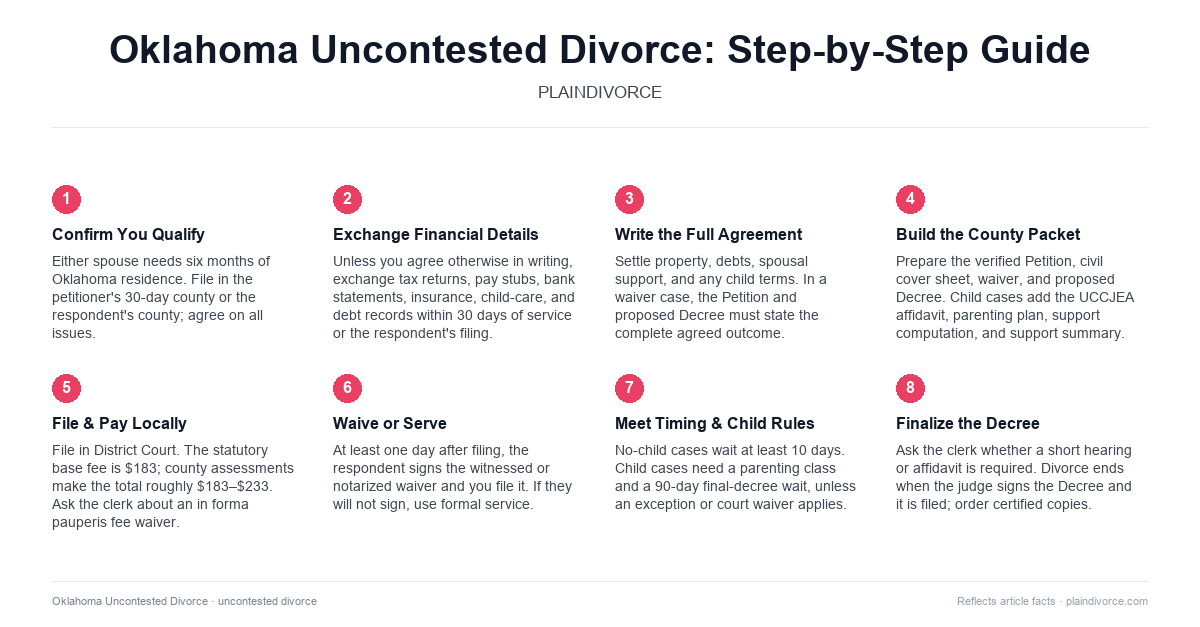
1. Oklahoma Uncontested Divorce at a Glance
- Case name: a dissolution of marriage. Oklahoma statutes use “divorce” and “dissolution of marriage” to mean the same thing (43 O.S. § 105).
- Where you file: the District Court in the county where the petitioner has lived for the last 30 days, or where the respondent lives (43 O.S. § 103).
- Residency: the petitioner or the respondent must have been an actual, good-faith Oklahoma resident for six months before filing (43 O.S. § 102).
- Ground: almost always incompatibility — a no-fault ground. You do not prove cheating or cruelty.
- Starting document: a Petition for Dissolution of Marriage, verified by the petitioner’s affidavit.
- Service: in a cooperative case, the respondent signs an entry of appearance and waiver of summons — the “waiver divorce.” It cannot be signed until at least one day after the petition is filed (Rule 8, Rules for District Courts).
- Waiting period — no minor children: the case cannot be heard on its merits until the petition has been on file 10 days (Rule 8).
- Waiting period — with minor children: the court cannot issue a final order for at least 90 days from the filing date, waivable only for good cause and with no objection (43 O.S. § 107.1). A merits hearing also cannot happen until the petition has been on file 30 days (Rule 8).
- Parenting class: mandatory for an incompatibility divorce with a child under 18 (43 O.S. § 107.2).
- Filing fee: a statutory base of $183 plus local court assessments — roughly $183 to $233 depending on the county (28 O.S. § 152).
- Final document: the Decree of Dissolution of Marriage. The marriage ends when the judge signs it and it is filed.
2. What a “Waiver Divorce” Really Means in Oklahoma
After a petition is filed, the court needs proof that the other spouse knows about the case. In an uncontested divorce in Oklahoma, that usually happens through a waiver rather than a process server.
- Waiver route (the “waiver divorce”): the respondent signs an entry of appearance and waiver of summons. This tells the court the respondent has received the petition, is appearing in the case, and gives up the right to formal service. Under Rule 8 of the Rules for District Courts, that document must be in writing, must be signed and witnessed or notarized at least one day after the petition is filed, and must be filed in the case. When a waiver is used, the court cannot grant more than the petition asks for unless the respondent also consents in writing — so the petition has to spell out the full agreed outcome.
- Formal service: if the respondent will not sign a waiver, the clerk issues a summons on filing and it is served the way any civil case is served (43 O.S. § 105; 12 O.S. § 2004) — by the sheriff, a licensed process server, or a person the court specially appoints, with mail or publication only under the conditions the statute allows.
These are not statewide fill-in forms. Oklahoma’s Supreme Court does not publish a uniform divorce packet. “Petition for Dissolution of Marriage,” “entry of appearance and waiver of summons,” and “Decree of Dissolution of Marriage” are the standard titles of the documents, and county clerks and legal-aid programs publish their own versions. Search terms like Oklahoma divorce forms waiver of service and Petition for Dissolution of Marriage OK template will turn up county packets and commercial forms — always check the wording against your county’s current local rules.
A respondent never has to sign. Signing a waiver — and especially signing an agreed decree at the same time — gives up real rights. If you are the respondent and anything about the agreement is unclear or one-sided, have a lawyer review it first.
The automatic temporary injunction
The moment a dissolution petition is filed and the respondent is served or signs a waiver, an automatic temporary injunction takes effect against both spouses (43 O.S. § 110). It restrains both of you from transferring or hiding marital property outside the ordinary course of life, taking money out of retirement accounts, changing insurance policies or beneficiary designations, and disturbing the peace of the other spouse or the children. It is printed as an “Automatic Temporary Injunction Notice” attached to the summons and petition, and both spouses can jointly waive it by signing the check box on the notice.
3. Who Qualifies: Residency, Venue, and Agreement
Residency
Under 43 O.S. § 102, either the petitioner or the respondent must have been an actual resident, in good faith, of Oklahoma for six months immediately before the petition is filed. A person who has lived on a U.S. army post or military reservation in Oklahoma for six months meets the requirement the same way. If either of you recently moved to Oklahoma, wait until the six months is clearly met before filing.
Which county (venue)
43 O.S. § 103 puts venue in the county where the petitioner has resided for the 30 days immediately before filing, or the county where the respondent resides. The chief judge of the judicial district can assign the case for trial to another county in the district, and the statute has change-of-venue and inconvenient-forum provisions if circumstances change. If you are unsure which county fits, call that county’s District Court clerk before you file.
A complete agreement (what makes it “uncontested”)
A case stays uncontested only if you and your spouse agree on every issue the court has to resolve:
- Both spouses want the marriage to end.
- Division of property and debts. Oklahoma is not a community-property state; the decree confirms each spouse’s separate property and divides jointly acquired marital property in a way the court finds just and reasonable (43 O.S. § 121).
- Spousal support (alimony) — yes or no, and if yes, the amount and duration.
- If you have minor children: custody and parenting time and child support calculated on the state guidelines (see Section 7).
- Both spouses will exchange honest financial information — which Oklahoma law requires regardless of how friendly the case is (see Section 5, Step 2).
Agreement narrows the fight, but it does not remove the court’s job: the judge still has to enter a legally compliant decree, and any child-support or custody terms remain subject to Oklahoma law and the court’s review.
When an uncontested divorce may be a poor fit
- There has been domestic violence, threats, stalking, or coercion.
- One spouse controls the finances and the other cannot verify what exists.
- You have high-value or complex assets — a business, large retirement or pension accounts, farm or ranch property, multiple properties.
- There are real disputes or safety concerns about the children.
- There are significant immigration, tax, or bankruptcy issues.
In those situations, talk with an Oklahoma family-law attorney or a legal-aid office before you sign anything, even if you still hope to keep the case cooperative.
4. The Documents in an Uncontested Oklahoma Divorce
There is no statewide checklist, but a cooperative Oklahoma case almost always uses documents with these titles. Your county clerk can tell you the exact local versions and any extra cover sheets.
| Document | What it does |
|---|---|
| Petition for Dissolution of Marriage | Starts the case. Must be verified by the petitioner’s affidavit, state whether there are minor children, and (in a waiver case) lay out the full agreed outcome, because the court cannot exceed what the petition requests (43 O.S. § 105; Rule 8). |
| Civil cover sheet | A short case-identification sheet the Supreme Court requires for every district-court filing. Some counties, such as Tulsa, also require their own domestic-relations cover sheet. |
| Summons / Automatic Temporary Injunction Notice | Issued by the clerk on filing. The ATI notice is attached to the summons and petition (43 O.S. § 110). |
| Entry of Appearance and Waiver of Summons | The core “waiver divorce” document — signed by the respondent at least one day after filing, witnessed or notarized, and filed in the case (Rule 8). |
| Decree of Dissolution of Marriage | The final judgment the judge signs. It divides property and debts, addresses support and name restoration, and (in a child case) sets custody, parenting time, and child support. |
| Child support computation form (child cases) | Must be signed by the judge and incorporated into every order that sets or modifies child support (43 O.S. § 120). |
| Support order summary (child cases) | In a non-IV-D case the pro se filer or attorney must present this with the decree — no support order is signed without it — and it goes to the state Central Case Registry after signing (43 O.S. § 120). |
| UCCJEA affidavit (child cases) | Each party’s first pleading or an attached affidavit must give, under oath, the child’s address, five-year residence history, and any other custody proceedings (43 O.S. § 551-209). |
| Parenting plan (child cases) | Sets decision-making, the parenting-time schedule, holidays, exchanges, and communication. Format varies by county. |
Name restoration: if a spouse’s last name changed because of the marriage, the decree “shall restore” the maiden or former name on request (43 O.S. § 121) — ask for it in the petition and the decree.
5. Step-by-Step: The Oklahoma Uncontested Divorce Process
Step 1 – Confirm eligibility and the waiver route
Check the six-month Oklahoma residency, pick the right county under § 103, and confirm the case is genuinely cooperative. Decide whether the respondent will sign an entry of appearance and waiver of summons or whether you will need formal service.
Step 2 – Exchange financial information (this is required)
Oklahoma does not have a statewide “financial affidavit,” but the automatic temporary injunction (43 O.S. § 110) requires a real exchange. Unless both spouses agree otherwise in writing, each spouse must give the other, within 30 days of the earlier of service or the respondent’s first filing:
- Federal and state tax returns for the past two years, with W-2s, 1099s, K-1s, and supporting schedules;
- The two most recent months of pay stubs from each employer;
- Six months of statements for every bank account;
- Documentation of available health-insurance cost and coverage, and of work- or education-related child-care costs;
- Documentation of all debts, with current balances and payment terms.
You cannot fairly divide what you have not listed and valued, so do this thoroughly even in the friendliest case.
Step 3 – Reach a full written agreement
Work out complete terms on property, debts, spousal support, and — if you have children — custody, parenting time, and guideline child support. In a waiver case, these terms have to be reflected in the petition and the proposed decree, because the court cannot award more than the petition requests without the respondent’s written consent.
Step 4 – Prepare the documents
Draft the verified Petition for Dissolution of Marriage, the civil cover sheet (plus any county domestic cover sheet), the entry of appearance and waiver, and a proposed Decree of Dissolution of Marriage. For a child case, add the parenting plan, the child support computation form, the support order summary, and the UCCJEA affidavit.
Step 5 – File with the District Court
File in the correct county. The clerk assigns a case number, issues the summons with the ATI notice, and collects the filing fee. Many counties will not open the case without the civil cover sheet, so do not skip it. If you cannot afford the fee, ask the clerk about an in forma pauperis (pauper’s) affidavit; the court can waive fees and costs on a satisfactory showing (28 O.S. § 152).
Step 6 – Complete the waiver (or formal service)
At least one day after filing, the respondent signs the entry of appearance and waiver of summons in front of a witness or notary, and it is filed in the case. If the respondent will not sign, arrange service through the sheriff or a licensed process server.
Step 7 – Clear the waiting period and any parenting class
Track the timing rules in Section 6. In a case with minor children, make sure any required parenting class certificate is filed before you ask the court to finalize.
Step 8 – Finalize the decree
Many Oklahoma courts finalize an uncontested case at a short hearing where the petitioner testifies under oath that the residency is met, the marriage is incompatible, and the agreement was signed voluntarily; some courts will enter the decree on affidavit without an appearance. Practice varies by county and judge — ask the clerk what yours requires. When the judge signs the Decree of Dissolution of Marriage and it is filed, the marriage is legally over. Order certified copies from the clerk for name changes, benefits, and title transfers.
6. The Oklahoma Divorce Waiting Period: With a Child vs. Without
This is the number-one timing question, and the rules come from two different places — not from a single “10 vs. 90” statute.
| Situation | Rule | Authority |
|---|---|---|
| No minor children | The case cannot be heard on its merits until the petition has been on file 10 days (except in an emergency). | Rule 8, Rules for District Courts |
| Minor children — hearing | No merits hearing until the petition has been on file 30 days (except in an emergency). | Rule 8 |
| Minor children — final order | The court cannot issue a final order for at least 90 days from the filing date. The 90 days may be waived only for good cause shown and with no objection by either party. | 43 O.S. § 107.1 |
So a no-children waiver divorce can, in principle, be finalized shortly after the 10-day mark once the paperwork is complete and the judge’s docket allows. A case with minor children carries the full 90-day bar on the final decree — that is the Oklahoma divorce waiting period with a child to build your plan around.
The narrow exceptions. Section 107.1 also says the 90-day rule does not apply to divorces filed on certain fault grounds (abandonment for a year, extreme cruelty, habitual drunkenness, imprisonment for a felony, and a few others), and it lets the court finalize early if the spouses voluntarily attend marital or family counseling and the court finds reconciliation is unlikely. An ordinary agreed incompatibility divorce with children is not on the exceptions list, so plan on the full 90 days unless the judge waives it.
Remarriage timing. Oklahoma has a real post-decree restriction: under 43 O.S. § 123, neither spouse may marry anyone other than the former spouse in Oklahoma within six months of the decree (or cohabit in Oklahoma with such a person during that period if the marriage happened elsewhere). A violation can be charged as felony bigamy or adultery, and a too-soon marriage is a ground for annulment (§ 126). If an appeal is filed, the restriction runs until 30 days after the appeal is decided.
7. Extra Requirements When You Have Minor Children
An uncontested divorce with children is still doable, but it adds paperwork and court review. The judge must be satisfied that the decree protects the children and that child support meets the guidelines.
The parenting class
For a divorce based on incompatibility, filed on or after November 1, 2014, where a child under 18 is involved, 43 O.S. § 107.2 says the adult parties shall attend an educational program on the impact of divorce on children. A certificate of completion is filed with the court. The statute says the program should be finished before the temporary order or within 45 days of one, and — the part that stops cases cold — “a final disposition of child custody shall not be granted until the parties complete the program.” The court can waive attendance for good cause, expressly including domestic violence, stalking, or harassment during the marriage, and each judicial district may have its own program rules. The provider fee is set by statute at $10 to $60 and can be waived if you use a free qualified program.
Parenting plan and custody
Your agreement should clearly cover legal custody and decision-making, a parenting-time schedule, holidays, exchanges, communication, and how you will handle future changes. Oklahoma also requires the UCCJEA information — the child’s current address, everywhere the child has lived in the last five years and with whom, and any other custody cases — in your first pleading or an attached affidavit (43 O.S. § 551-209). The court can pause the case if it is missing.
Child support
- Guidelines control. The guideline amount, based on both parents’ gross income and the number of children, is a rebuttable presumption of the correct figure (43 O.S. § 118–119). “We already agreed on a number” is not enough on its own — a different amount requires the court’s written deviation findings.
- The computation form is mandatory. A child support computation form must be signed by the judge and made part of the decree (43 O.S. § 120). In a non-IV-D case you also present a support order summary with the decree — the judge will not sign the support order without it — and it is sent to the state Central Case Registry.
- Medical support. The order must address health-care coverage for the children; when no reasonable plan is available, the court orders cash medical support capped at the lesser of the pro rata actual cost or 5% of the obligor’s gross monthly income (43 O.S. § 118F).
- Income assignment. In a divorce child-support case, the court shall order immediate income (wage) withholding — regardless of whether payments are behind — unless it finds good cause not to or the parents put a written alternative arrangement in place (43 O.S. § 115). Agreeing to pay directly does not automatically remove this.
8. How Long an Uncontested Divorce Takes in Oklahoma
There are two clocks: the legal minimum and your county’s docket.
- No minor children: the legal floor is the 10-day Rule 8 period. Real timelines depend on how fast your paperwork is complete and when the court can hear or sign the case — often a few weeks to a couple of months.
- With minor children: the 90-day bar on the final order (§ 107.1) plus the parenting class and child-support paperwork make several months a realistic expectation.
The common delay causes are the same everywhere: incomplete or unsigned documents, a missing notarization on the waiver, a missing parenting-class certificate, an incomplete child-support computation, and waiting for a hearing date. A complete, correctly signed packet is the fastest path Oklahoma offers.
9. What an Uncontested Divorce Costs in Oklahoma
The statutory base filing fee is $183 (28 O.S. § 152). Counties add local assessments — law library, court fund, courthouse security, dispute-mediation, and similar — so the real total runs roughly $183 to $233. Examples as of 2026: about $224 in Oklahoma County and about $233 in Tulsa County; Harmon and Harper counties sit at the $183 floor. Always confirm the current number with your county court clerk.
- Service costs — roughly $25–$75 — only if you cannot use a waiver.
- Notary fees for the waiver and any sworn documents (often free at a bank or the courthouse).
- Parenting class in a child case — a statutory $10–$60 provider fee, waivable for a free qualified program.
- Certified copies of the decree.
- QDRO preparation if you divide a retirement plan — usually done by a specialist.
A waiver keeps a cooperative case out of service fees and, if both spouses stay cooperative, out of the attorney-fee spiral of a contested case. If you genuinely cannot afford the filing fee, file an in forma pauperis affidavit and ask the court to waive fees and costs.
10. When DIY Is the Wrong Call
A do-it-yourself uncontested divorce is not right for every case. Get legal advice before you sign or file anything if there is domestic violence, coercion, or pressure to sign; hidden income or assets, or a spouse who will not exchange financial information; a business, professional practice, pension, or large retirement account that needs valuing or a QDRO; a real disagreement about the children, relocation, or support; or immigration, bankruptcy, or tax exposure.
Even a single limited-scope consultation can keep you from signing an agreement you will regret. For safety planning and referrals, the Legal Aid Services of Oklahoma divorce guide links to local help.
11. Where a Self-Help Divorce Kit Fits
Because Oklahoma has no statewide form set, the hardest part of a DIY case is assembling documents that match your county’s local rules and the statutes above. A structured Oklahoma uncontested divorce kit sits between going it completely alone and hiring a lawyer. A good one helps you:
- Start from a clear Petition for Dissolution of Marriage template built for Oklahoma and understand how the entry of appearance and waiver of summons works;
- Build a complete agreement and a proposed Decree of Dissolution of Marriage with nothing left blank;
- Assemble the child-case documents — parenting plan, child support computation form, support order summary, UCCJEA affidavit — without missing one;
- Stay organized with checklists, and plan around the 10-day rule, the 90-day rule for cases with children, and the parenting class.
Always pair any self-help materials with your county District Court’s current local rules and checklist, since counties add documents and steps beyond the statutes.
12. Final Checklist and Next Steps
- Confirm one spouse’s six-month Oklahoma residency (§ 102) and the correct county (§ 103).
- Agree on all terms — property, debts, support, and children — and put them in the petition and proposed decree.
- Exchange the § 110 financial documents (tax returns, pay stubs, bank statements, insurance, child-care, debts).
- File the verified petition with the civil cover sheet (and any county domestic cover sheet); pay $183–$233 or file an in forma pauperis affidavit.
- Have the respondent sign the entry of appearance and waiver at least one day after filing, witnessed or notarized, and file it — or complete formal service.
- For children: finish the parenting class and file the certificate; complete the child support computation form, support order summary, UCCJEA affidavit, and parenting plan.
- Clear the waiting period (10 days / 90 days with children), then finalize the Decree of Dissolution of Marriage and order certified copies.
For the law behind this process, see 43 O.S. § 102 (residency), § 107.1 (the 90-day rule for cases with children), § 107.2 (parenting class), § 110 (automatic temporary injunction and disclosure), and Rule 8 of the Rules for District Courts (the 10-day rule and waiver execution), plus the plain-language overview from Legal Aid Services of Oklahoma. Your county District Court clerk posts the local rules, cover sheets, and current fee schedule.
Again, this guide is legal information only, not legal advice for your situation. Confirm the details with your local court or a qualified Oklahoma attorney if you are unsure about your rights or obligations.
13. Frequently Asked Questions
What is the divorce waiting period in Oklahoma with a child versus without?
With minor children, the court cannot issue a final order for at least 90 days from the date the petition is filed (43 O.S. § 107.1), and it cannot hold a merits hearing until the petition has been on file 30 days. With no minor children, there is no 90-day rule — the case just cannot be heard on its merits until the petition has been on file 10 days (Rule 8 of the Rules for District Courts). The 90-day period can be waived only for good cause and with no objection from either spouse.
What forms do I need for an uncontested divorce in Oklahoma?
Oklahoma has no statewide fill-in packet. A cooperative case uses a verified Petition for Dissolution of Marriage, a civil cover sheet, the entry of appearance and waiver of summons, and a proposed Decree of Dissolution of Marriage. A case with children adds a parenting plan, a judge-signed child support computation form, a support order summary, and a UCCJEA affidavit. County clerks and legal-aid programs publish their own versions, so check the wording against your county’s local rules.
What is the entry of appearance and waiver of summons?
It is a document the respondent signs to appear in the case and give up the right to formal service — the heart of a “waiver divorce.” Under Rule 8, it must be in writing, signed and witnessed or notarized at least one day after the petition is filed, and filed in the case. When a waiver is used, the court cannot grant more than the petition requests unless the respondent also consents in writing. A respondent is never required to sign one.
Do I have to go to court for an uncontested divorce in Oklahoma?
Often, but not always. Many Oklahoma District Courts finalize an uncontested case at a brief hearing where the petitioner testifies to residency, the ground of incompatibility, and that the agreement was voluntary. Some courts will enter the decree on affidavit with no appearance. It depends on the county and the judge, so ask the court clerk what your case needs.
How much does an uncontested divorce cost in Oklahoma?
The statutory base filing fee is $183 (28 O.S. § 152); county assessments bring the real total to roughly $183 to $233 — about $224 in Oklahoma County and about $233 in Tulsa County as of 2026. Add service costs only if you cannot use a waiver, a $10–$60 parenting-class fee in child cases, notary fees, certified copies, and QDRO preparation if you divide retirement. A fee waiver is available through an in forma pauperis affidavit.
Do we have to take a parenting class?
Yes, in most child cases. For an incompatibility divorce filed on or after November 1, 2014 involving a child under 18, both parents must complete an educational program on the impact of divorce on children (43 O.S. § 107.2). The certificate is filed with the court, and a final custody disposition will not be granted until the class is done. The court can waive it for good cause, including domestic violence, stalking, or harassment.
Do we still have to calculate child support if we already agree on an amount?
Yes. Oklahoma’s guideline amount is a rebuttable presumption of the correct figure, and a judge-signed child support computation form must be part of any order that sets support (43 O.S. § 120). If you want a different number, the court has to make written findings supporting the deviation. The order must also address health-care coverage, and the court will generally order immediate income withholding unless it finds good cause otherwise or you have a written alternative arrangement.
How soon can I remarry after an Oklahoma divorce?
Not for six months if you plan to marry someone other than your former spouse in Oklahoma. Under 43 O.S. § 123 that six-month bar runs from the date of the decree, a violation can be prosecuted as bigamy, and a marriage entered too soon can be annulled. Remarrying your former spouse is not restricted. If an appeal is filed, the bar lasts until 30 days after the appeal is resolved.
Sources and local rules can change. Use this guide as a plain-English organizer, then verify the current filing requirements with the official court or government source for your jurisdiction.

About Harry D
Expert contributor at PlainDivorce, helping Canadians and American navigate simple uncontested divorces with clarity and confidence.