Uncontested Divorce in Ontario: Form 8A, Form 36, Form 25A, and the Step-by-Step Process
An uncontested divorce in Ontario is a divorce that a judge grants on the paperwork alone, without a trial, because no one is asking the court to resolve a fight. You get there one of two ways: a joint application, where you and your spouse file together and agree on everything, or a simple (sole) application, where one spouse files, the only claim is the divorce itself, and it becomes uncontested when the other spouse does not file an Answer. Either way, only the Superior Court of Justice (or its Family Court branch) can make the order, mandatory court fees total about $669, and the divorce is final on the 31st day after the judge signs it.
The part that trips up do-it-yourself filers is the paper handling. Ontario courts can reject or delay a file that is missing a mandatory form, missing a required attachment, or not assembled the way the Family Law Rules expect — and the required forms change depending on whether you file jointly or solely, whether children are involved, and whether you ask for support. This guide walks through the Ontario Desk Divorce forms — the Application for Divorce Form 8A, the Affidavit for Divorce Form 36, the Divorce Order Form 25A, and the supporting forms — and the exact sequence for each route.
TL;DR
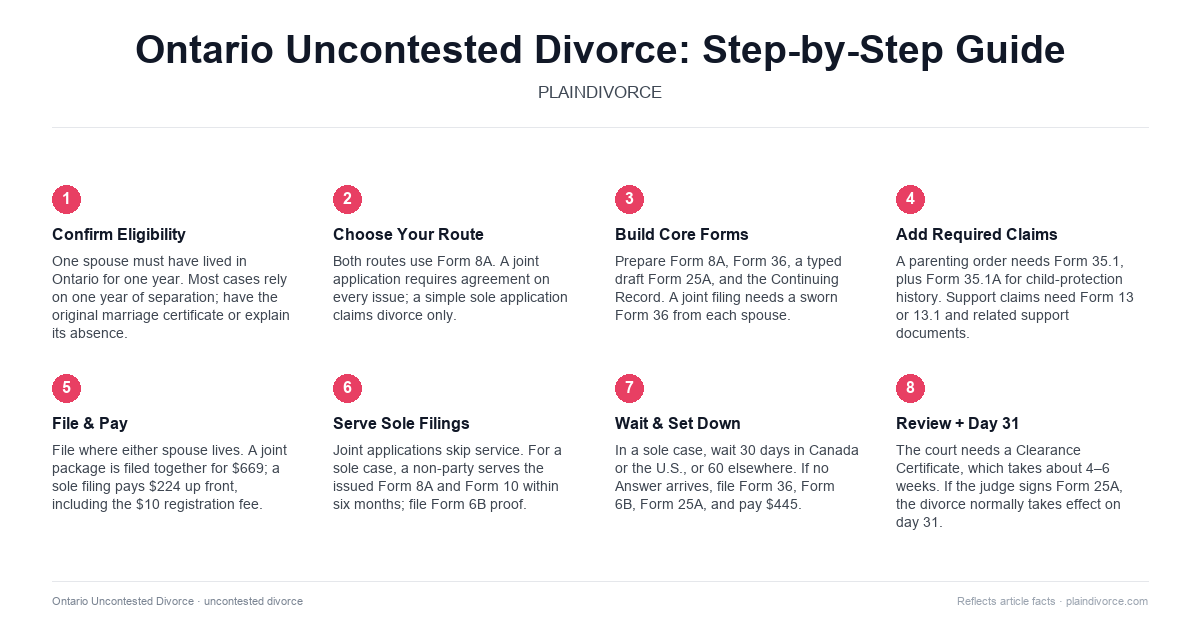
- Two routes. A joint application (Form 8A signed by both spouses, agreement on all issues) files everything at once with no service. A simple/sole application (Form 8A, divorce as the only claim) is filed, served on your spouse, and becomes uncontested if no Answer is filed within 30 days (60 if served outside Canada or the U.S.).
- Core forms: Form 8A: Application (Divorce), Form 36: Affidavit for Divorce (one per spouse on a joint application), and a typed draft Form 25A: Divorce Order. Sole applications also need Form 6B: Affidavit of Service.
- Children: a parenting-time or decision-making claim needs Form 35.1 (and Form 35.1A if there is child-protection history); a support claim adds Form 13 or 13.1, a draft Support Deduction Order, and a Support Deduction Order Information Form.
- Court fees: $214 to file the application + $10 federal Registration of Divorce Proceedings + $445 to place it on the list for hearing = $669. A Certificate of Divorce is $25.
- Timing: the federal Clearance Certificate step alone takes 4–6 weeks; the divorce takes effect on the 31st day after the Divorce Order is signed.
- This is general legal information, not legal advice — see the full disclaimer above and below.
1. What is an uncontested (or “simple”) divorce in Ontario?
Every divorce in Canada is granted under the federal Divorce Act, but the process and forms are run by the province. In Ontario, a divorce can be made only by the Superior Court of Justice or the Family Court branch of the Superior Court of Justice. Even when nothing is in dispute, a judge still has to be satisfied that the legal requirements are met and the paperwork is complete before signing the order.
An uncontested divorce in Ontario just means the court does not have to decide a contested issue at a hearing or trial. In practice that covers two different filing routes, and people (and search engines) use “simple divorce” loosely for both.
Simple (sole) application vs. joint application
- Joint application (Form 8A). You and your spouse apply together as joint applicants. You use this when you both agree to the divorce and agree on every other family law issue — parenting, child support, spousal support, and property. There is no one to serve.
- Simple application (Form 8A), also called a sole application. One spouse files, and the only claim is the divorce itself. You use this route when you can’t file jointly — including when you and your spouse don’t agree on other issues, or simply aren’t cooperating — as long as you are not asking the divorce court to decide those other issues. You serve your spouse, and if they don’t file an Answer (Form 10), the case proceeds undefended as an uncontested divorce.
This is the correction most DIY guides get wrong: an uncontested divorce does not require the spouses to agree. A simple application is specifically the route for cases where the parties “can’t agree and the only claim being made is for divorce” — it becomes uncontested because no one contests it, not because everyone consents. If you need the court to order parenting, support, or a property division, that is a general application (Form 8), a different and more involved process that is outside the scope of this guide. For the official overview, see Ontario’s Guide to Procedures in Family Court.
Download Our Ontario Uncontested Divorce (Dissolution) Self-Help Kit
2. Who qualifies for an uncontested divorce in Ontario?
Residency: the one-year rule
Under section 3 of the Divorce Act, an Ontario court can hear a divorce only if you or your spouse has been habitually resident in Ontario for at least one year immediately before the case is started. (“Habitually resident” is the current wording; older guides say “ordinarily resident” — the 2019 amendments changed the term, not the meaning.) You state your residency in the Form 8A, and the court can ask for proof.
Grounds and the one-year separation rule
Canada has one legal ground for divorce: breakdown of the marriage. Under section 8 of the Divorce Act, you establish breakdown in one of three ways — living separate and apart for at least one year, adultery, or physical or mental cruelty that makes living together intolerable. Almost every uncontested divorce uses one-year separation, because adultery and cruelty require you to prove specific misconduct and usually invite a dispute.
Two statutory details on the separation ground matter for a Desk Divorce:
- The spouses must have lived separate and apart for at least one year immediately before the divorce is determined, and must have been living separate and apart when the case was started. You can start a sole application before the year is up, but the divorce can’t be granted until it is.
- A reconciliation attempt of up to 90 days total (one period or several added together), entered into mainly to try to reconcile, does not restart the one-year clock.
For a joint application, the practical expectation is that the full year of separation is already complete when you file, because both spouses are swearing to the breakdown at the outset.
When your case is a good fit for an uncontested or simple divorce
- You are legally married and can produce the original Marriage Certificate or Marriage Registration Certificate (or explain in Form 36 why you can’t).
- You or your spouse meets the one-year Ontario residency rule.
- You have been separated a year, or will have been by the time a judge reviews the file.
- Parenting, child support, spousal support, and property are already settled (often in a separation agreement), or you are simply not asking the divorce court to decide them.
When it isn’t a fit
If there is active conflict about children, support, or property, family violence, or a serious power imbalance, it may not be a true uncontested case. Asking the divorce court to decide those issues turns it into a general application, and you should get legal advice before filing.
3. The Ontario divorce forms you’ll use (Form 8A, Form 36, Form 25A, and the rest)
Ontario DIY divorce paperwork is full of form numbers. Knowing the Ontario Desk Divorce forms by name — and what each one does — is what prevents the most common registry rejections. On every form, write your names exactly as they appear on your marriage certificate.
| Form | Name | When you use it |
|---|---|---|
| 8A | Application (Divorce) | Starts every uncontested divorce, as a joint application (both spouses sign) or a simple/sole application. File 3 copies. |
| 10 | Answer | A blank copy is served with a sole application; the responding spouse files it only if they contest. If none is filed, the case is uncontested. |
| 36 | Affidavit for Divorce | Your sworn evidence for a Desk Divorce. One per spouse on a joint application. Sworn before a commissioner (free at family court offices). |
| 6B | Affidavit of Service | Sole applications only — sworn by the person who served your spouse, then filed. |
| 25A | Divorce Order | The order the judge signs. You prepare a typed (never handwritten) draft. File 3 copies (4 on a joint application that asks for support). |
| 35.1 | Affidavit (decision-making responsibility, parenting time, contact) | Required when you ask the court for a parenting order. Filed with the application or answer. |
| 35.1A | Affidavit (child protection information) | Added to Form 35.1 when a party or child has been in a child-protection case or involved with a children’s aid society. |
| 13 / 13.1 | Financial Statement (Support Claims) / (Property and Support Claims) | When the divorce order will include child or spousal support (13.1 if there is also a property or debt claim). |
| Draft Support Deduction Order + Support Deduction Order Information Form | — | Filed with any support claim. |
| 36B | Certificate of Divorce | Requested after the divorce is effective, if you need official proof (for example, to remarry). $25. |
| Continuing Record + Table of Contents | — | The organized file the applicant starts and keeps updated as documents are filed. |
The marriage certificate
The court will not grant your divorce without your original Marriage Certificate or Marriage Registration Certificate, unless your Form 36 explains why you can’t get one. You can file it with the Form 8A or later with the Form 36. If you were married in Ontario and lost it, order a replacement from ServiceOntario or the Office of the Registrar General. If you were married elsewhere in Canada, order that province or territory’s certificate. If the certificate is not in English or French, you must have it translated by a certified translator and file both the certificate and the translation. If you were married outside Canada, you also need proof of any previous divorce or of the death of a previous spouse.
Registration of Divorce Proceedings (the Clearance Certificate)
This is not a form you fill out and file. When the clerk issues your application, the court electronically sends the information to the federal Department of Justice’s Central Registry of Divorce Proceedings in Ottawa, which checks that no duplicate divorce case has been started anywhere in Canada and returns a Clearance Certificate. The court cannot grant your divorce until it has that certificate, and the process can take 4 to 6 weeks. Your only involvement is paying the $10 Registration of Divorce Proceedings fee when you file.
Always use the current Ontario forms and the Ministry of the Attorney General’s simple-divorce and joint-divorce application checklists, published at ontariocourtforms.on.ca, because form versions and package contents change.
4. What “Desk Divorce” means in Ontario
“Desk Divorce” is an informal term (Ontario’s official materials just call it a “simple” or “joint” divorce application and say “a judge reviews your divorce application”). It describes an uncontested divorce where a judge reviews your file in chambers — on the paper record — and signs the Divorce Order without you attending a hearing. Because there is no hearing, your result depends entirely on the quality and completeness of your paperwork.
The document that carries the weight is the Affidavit for Divorce (Form 36). It is your sworn evidence that the legal requirements are met — the marriage, the residency, the date and fact of separation, the arrangements for any children. People searching for Affidavit for Divorce Form 36 instructions are usually at the exact point where the file becomes a Desk Divorce package. Get Form 36 right and the rest of the review is usually routine.
How the flow differs by route:
- Joint application: you file the Form 8A, both Form 36 affidavits, and the draft Form 25A together. There is no one to serve and no separate waiting period, so once the file is complete and the Clearance Certificate is back, it goes to a judge.
- Simple (sole) application: you file the Form 8A first, serve your spouse, and wait out their 30- or 60-day response period. Only then do you file the Form 36, the Affidavit of Service (Form 6B), and the draft Form 25A, and pay the $445 fee to place the application on the list for hearing.
5. Step by step: joint application vs. sole application
Both routes are built around the same core Ontario Desk Divorce forms — the Application for Divorce Form 8A, the Affidavit for Divorce Form 36, and the Divorce Order Form 25A. This is a high-level overview, not a substitute for the official checklists.
Before you file: choose the court and the route
- Court location. You must usually file in the municipality where either you or your spouse lives (or where the children live, if the application asks for a parenting order). This is a residence rule about where you file — it is not the one-year Divorce Act residency test, which is separate.
- In person or online. You can file a divorce application (including a joint divorce application) online through the Ontario government’s filing service, or on paper at a family court office.
- Copies and envelopes. The checklists ask for 3 copies of Form 8A, 3 copies of Form 25A (4 on a joint application seeking support), and two business-sized envelopes (9½” × 4⅛”), each stamped with sufficient postage, addressed one to each spouse.
Route A: Joint application (Form 8A)
- Step 1 — Confirm eligibility. Residency met, the year of separation complete, and full agreement on parenting, child support, spousal support, and property.
- Step 2 — Build the package. The Form 8A signed and dated by both spouses; a Form 36 from each spouse, each sworn before a commissioner; the original marriage certificate; the typed draft Form 25A; and the Continuing Record and Table of Contents.
- Step 3 — Add anything beyond “divorce only.” A parenting order needs Form 35.1 (and Form 35.1A if there is child-protection history). A support order needs Form 13 or 13.1, a draft Support Deduction Order, and a Support Deduction Order Information Form — and 4 copies of Form 25A. Attach any separation agreement or minutes of settlement.
- Step 4 — File and pay. File everything at once and pay the full $669 ($214 + $10 + $445), or apply for a fee waiver. The clerk issues the application and the court sends the registration to the Central Registry.
- Step 5 — Judicial review. Once the Clearance Certificate is back and the file is complete, a judge reviews it in chambers. There is no service and no separate “setting down” step on this route.
- Step 6 — Order signed. If the judge grants the divorce, both spouses receive the signed Divorce Order by mail. It takes effect on the 31st day.
Route B: Simple (sole) application (Form 8A) + service + list for hearing
- Step 1 — File the application. File 3 copies of the Form 8A (divorce as the only claim), start your Continuing Record, and pay $224 ($214 + the $10 registration fee). The clerk issues the application — assigns a file number, signs, dates, and seals it — and the court sends the registration to the Central Registry.
- Step 2 — Serve your spouse. You cannot serve the documents yourself. A friend or family member over 18, or a process server, must give your spouse a copy of the issued Form 8A, the Continuing Record and Table of Contents, and a blank Form 10: Answer. Serve as soon as possible and no later than 6 months after the application was issued.
- Step 3 — File proof of service. The person who served your spouse swears Form 6B: Affidavit of Service, which is then filed.
- Step 4 — Wait out the response period. Your spouse has 30 days to serve and file an Answer if served in Canada or the United States, or 60 days if served elsewhere. If they file a Form 10: Answer, the case is no longer uncontested and different steps apply. If they don’t, you move on.
- Step 5 — Place the application on the list for hearing. File the Form 36: Affidavit for Divorce, the Form 6B, the original marriage certificate (if not filed at Step 1), the typed draft Form 25A (3 copies), the two stamped envelopes, and — for a marriage outside Canada — proof of any prior divorce or death of a previous spouse. Pay the $445 fee. Court staff commonly call this “setting the matter down.”
- Step 6 — Judicial review and order. After the Clearance Certificate is received, the clerk gives the file to a judge. If everything is complete and reasonable, the judge signs the Divorce Order without a hearing. If information is missing, you’ll be directed to fix or add to the file first.
The draft-order trap
On either route, the court does not write your Divorce Order for you. You must submit a typed draft Form 25A that sets out exactly the orders you want, in a form a judge can sign. Registries routinely reject handwritten or unclear drafts. Bring the required number of clean copies and the stamped return envelopes so the signed order can be mailed back to each spouse.
6. If you have children: Form 35.1, support, and the reasonable-arrangements bar
Children add two things a judge must be satisfied about before granting the divorce: a workable parenting arrangement, and reasonable arrangements for child support.
The child-support bar
Under section 11 of the Divorce Act, the court has a duty to satisfy itself that reasonable arrangements have been made for the support of any children of the marriage, having regard to the Federal Child Support Guidelines — and to stay (hold up) the divorce until those arrangements are made. The same section requires the court to satisfy itself there has been no collusion. Even in a Desk Divorce, a judge can delay signing if the child-support figure is missing, or is below the Guidelines table amount without a clear explanation.
The Form 35.1 requirement
If you ask the court for a parenting order — decision-making responsibility, parenting time, or contact — you must file Form 35.1: Affidavit (decision-making responsibility, parenting time, contact) at the same time as the application or answer. You cannot just mention the children in your Form 36. Additional requirements:
- Form 35.1A is added when you, the other party, or a child has been involved in a child-protection court case or with a children’s aid society.
- A non-parent asking for decision-making responsibility must also provide a recent police records check (or proof that one was requested).
- The clerk must refuse a filing that is missing the required Rule 35.1 material, so a missing Form 35.1 is a true hard stop.
Many uncontested divorces make no parenting or support claim in the divorce case itself — the arrangements already live in a separation agreement or an earlier order. In that situation you don’t file Form 35.1, but your Form 36 still has to show the judge that reasonable child-support arrangements exist.
If the divorce order itself will include support
When you want the Divorce Order to include child or spousal support, add the financial package: Form 13 (Financial Statement (Support Claims)), or Form 13.1 if there is also a property or debt claim; a draft Support Deduction Order; and a Support Deduction Order Information Form. File 4 copies of Form 25A instead of 3. Leaving these out is a common reason a support-seeking file is sent back.
7. How long does an uncontested divorce take in Ontario?
There is no official province-wide processing-time promise. Plan around three separate stretches of time:
- The one-year separation. Most Ontario divorces rely on this ground, and the divorce can’t be granted until the year is complete.
- Court processing. This varies by courthouse and workload, and delays are common when forms are incomplete or the file isn’t assembled correctly. The one firm number is the federal Clearance Certificate step, which takes about 4 to 6 weeks on its own. On a sole application, add the 30- or 60-day response period and the time to arrange service.
- The 31-day period. Under section 12 of the Divorce Act, the divorce takes effect on the 31st day after the Divorce Order is signed. A court can order an earlier effective date only in special circumstances, and only if both spouses agree and undertake not to appeal; a pending appeal pushes the effective date back.
The joint route removes two of the slowest steps — service and the response period — but “no service” is a structural saving, not a guaranteed speed-up. Clean, complete, consistent paperwork is what actually shortens the wait.
8. What does an uncontested divorce cost in Ontario?
Ontario court fees are set by regulation under the Administration of Justice Act (O. Reg. 293/92 for the Superior Court of Justice, O. Reg. 417/95 for the Family Court branch). For divorce they are usually split into two payments.
| Fee | Amount | When it’s paid |
|---|---|---|
| File (issue) the Application (Divorce) | $214 | When you file the Form 8A |
| Registration of Divorce Proceedings (federal) | $10 | With the Form 8A |
| Place the application on the list for hearing | $445 | Sole application: when you file Form 36. Joint application: with the rest of the package. |
| Mandatory court fees total | $669 | — |
| Certificate of Divorce (optional) | $25 | After the divorce is effective, if you need proof |
On a joint application you typically pay the whole $669 at once; on a sole application you pay $224 up front and the $445 when you set the matter down. Fees change — confirm the current amounts on Ontario’s family court fees page or with your court office before you file.
Fee waivers
Ontario has a court fee waiver for people who can’t afford the fees. You qualify automatically if your only income is Ontario Works, ODSP, Old Age Security with the Guaranteed Income Supplement, the War Veterans Allowance, or CPP benefits, or if you have a Legal Aid Ontario certificate. Otherwise it’s an income-and-assets test: gross annual household income below a threshold that rises with household size (as of 2026, roughly $33,100 for one person up to $80,200 for five or more), liquid assets under $2,800, and net worth under $11,100. Eligibility is not automatic just because income is low.
Two limits to know: a waiver covers most court fees but not the $10 federal Registration of Divorce Proceedings fee (a narrow exception applies for someone on legal aid whose provincial fee is waived), and you can apply for the waiver at either payment stage.
Other possible costs
- Service (sole applications): a process server or courier.
- Swearing affidavits: free at family court offices; a notary or paralegal charges a small fee.
- Documents: replacing a lost marriage certificate, certified translation, printing, and postage for the return envelopes.
- Optional legal advice: often worth it to review a separation agreement or spot a risk before you file.
9. When a DIY divorce might not be right for you
A DIY uncontested divorce in Ontario can save a lot on legal fees, but it is risky if there are safety concerns, a serious power imbalance, hidden assets, complex finances (a business, major pensions, multiple properties), or unresolved parenting conflict. In those situations, even one appointment with a family lawyer or a community legal clinic can prevent expensive long-term damage. Legal Aid Ontario and the Law Society Referral Service (a free 30-minute consultation) are starting points.
10. Where a self-help divorce kit fits into the process
If your case is a true uncontested divorce in Ontario, an Ontario-specific kit helps most with the assembly details that cause registry rejections:
- choosing the right route — joint application vs. simple/sole application — and starting correctly with Form 8A: Application (Divorce);
- building the sworn evidence properly in the Affidavit for Divorce (Form 36);
- getting service and the Affidavit of Service (Form 6B) right on a sole application, and respecting the 6-month service window and the 30/60-day response period;
- not missing child-related requirements like Form 35.1, Form 35.1A, or the support package (Form 13/13.1 and the Support Deduction Order documents);
- organizing the Continuing Record with a proper Table of Contents; and
- finishing with a judge-ready typed Divorce Order (Form 25A) and the right number of copies and stamped envelopes.
Download Our Ontario Uncontested Divorce (Dissolution) Self-Help Kit
PlainDivorce is not a law firm. A kit is an organization and information tool, not legal advice, and you must still confirm you are using the current Ontario forms, rules, and fees.
11. FAQ
What is an uncontested (or simple) divorce in Ontario?
It’s a divorce the Superior Court of Justice grants on the paper record, without a trial, because no one contests it. It covers two routes: a joint application, where both spouses apply together and agree on everything, and a simple (sole) application, where one spouse files with divorce as the only claim and the case proceeds undefended when the other spouse files no Answer. A judge still has to be satisfied that residency, the one-year separation, the absence of collusion, and any child-support arrangements are in order.
What is the difference between a simple application and a joint application?
Both use Form 8A. A joint application is filed by both spouses together and is for cases where you agree on the divorce and all related issues — there is no service and no separate motion. A simple (sole) application is filed by one spouse when the only claim is the divorce and you can’t file jointly, including when you don’t agree on other things. You serve your spouse and, if no Answer is filed, the divorce proceeds as uncontested. Agreement is not required for a simple application; a lack of opposition is.
What is Form 8A: Application (Divorce)?
Form 8A is the document that starts an uncontested divorce in Ontario — the form people search for as “Application for Divorce Form 8A.” It can be filed as a joint application (signed and dated by both spouses) or a simple/sole application (one spouse, divorce as the only claim). You file 3 copies. It is not the same as Form 8, the general application used when you also ask the court to decide parenting, support, or property.
What is the Affidavit for Divorce (Form 36)?
Form 36 is your sworn evidence in a Desk Divorce. It sets out the facts a judge needs — the marriage, residency, the date and fact of separation, and the arrangements for any children — so the divorce can be decided on paper without you testifying. You swear or affirm it before a commissioner for taking affidavits, free at any family court office. On a joint application, each spouse completes and swears their own Form 36.
What is Form 25A, and why do I have to draft it myself?
Form 25A is the Divorce Order — the order the judge signs to end the marriage. In an uncontested divorce the court does not draft it for you: you submit a typed (never handwritten) draft setting out exactly the orders you want, and if the judge agrees, they sign and date it. Bring 3 clean copies (4 if you’re asking for child or spousal support) plus stamped return envelopes so the signed order can be mailed to each spouse.
What form do I need when children are involved?
If you ask the court for a parenting order — decision-making responsibility, parenting time, or contact — you must file Form 35.1 with your application or answer, plus Form 35.1A if there is any child-protection history, and a police records check if a non-parent seeks decision-making responsibility. The clerk must refuse a filing that’s missing this material. If the divorce order will also include child or spousal support, add Form 13 or 13.1, a draft Support Deduction Order, and a Support Deduction Order Information Form.
How much does an uncontested divorce cost in Ontario?
Mandatory court fees total about $669: $214 to file the application, $10 for the federal Registration of Divorce Proceedings, and $445 to place the application on the list for hearing. A Certificate of Divorce is an extra $25. A fee waiver can cover most of these if you meet the income and asset test, but it does not waive the $10 federal fee. Add service costs on a sole application, and any charge for a certified translation or a replacement marriage certificate.
When is the divorce actually final?
The divorce takes effect on the 31st day after the judge signs the Divorce Order, once the appeal window closes. A court can set an earlier effective date only in special circumstances and only if both spouses agree and undertake not to appeal; a pending appeal delays it. After the divorce is effective you can request a Certificate of Divorce ($25) as official proof — you’ll usually need it to remarry.
12. Final thoughts and next steps
For the smoothest uncontested divorce in Ontario, keep these registry realities front of mind:
- Know your route. Joint application: Form 8A signed by both, both Form 36s, draft Form 25A, filed together, no service. Simple/sole application: Form 8A, serve your spouse, wait out 30/60 days, then Form 36 + Form 6B + draft Form 25A and the $445 fee.
- Use the correct court and form names: the Superior Court of Justice, the Application for Divorce Form 8A, the Affidavit for Divorce Form 36, and the Divorce Order Form 25A.
- File where either spouse lives, and bring the original marriage certificate (with a certified translation if it isn’t in English or French).
- Treat Form 35.1 as a hard stop if you ask for a parenting order, and don’t forget the support package (Form 13/13.1 and the Support Deduction Order documents) if the order will include support.
- Respect the paper handling: the Continuing Record with a Table of Contents, the required copies, the two stamped envelopes, and a typed draft order.
- Build in time for the 4–6 week Clearance Certificate step and the 31-day period after the order is signed.
This guide is legal information only, not legal advice. If you have safety concerns, complex finances, or unresolved parenting and support issues, speak with an Ontario family lawyer or a community legal clinic before filing.
Get the Ontario Uncontested Divorce (Dissolution) Self-Help Kit
Sources and local rules can change. Use this guide as a plain-English organizer, then verify the current filing requirements with the official court or government source for your jurisdiction.

About Harry D
Expert contributor at PlainDivorce, helping Canadians and American navigate simple uncontested divorces with clarity and confidence.