Uncontested Divorce in Pennsylvania: The Mutual Consent (3301(c)(1)) Guide for 2026
An uncontested divorce in Pennsylvania usually means a mutual consent divorce under Section 3301(c)(1) of the Divorce Code: both spouses agree the marriage is irretrievably broken, and both sign an Affidavit of Consent once at least 90 days have passed since the divorce complaint was served. There is no trial. If you also settle property, debts, and any alimony claim before the decree, a cooperative couple can often finish in roughly four to six months.
This guide covers the 3301(c)(1) route step by step: residency and venue, the PA divorce waiting period of 90 days, the Affidavit of Consent PA divorce form, the Waiver of Notice versus the Notice of Intention path, and Praecipe to Transmit Record instructions. It also flags the money and children issues that a consent divorce does not resolve on its own.
TL;DR
In Pennsylvania, an uncontested divorce means mutual consent under § 3301(c)(1): both spouses agree the marriage is irretrievably broken and each signs an Affidavit of Consent once 90 days have passed. No trial, and usually no court appearance — but the timing rules are strict and the economic claims are the part people get wrong.
- Who qualifies: one spouse must have been a Pennsylvania resident for six months before filing (23 Pa.C.S. § 3104). File in either spouse’s county Court of Common Pleas, through the Prothonotary.
- The 90 days runs from SERVICE, not filing. This is the single biggest DIY mistake. Filing the complaint and sitting on service does not advance your clock — write down the exact service date.
- The 30-day rule: each Affidavit of Consent must be filed within 30 days of the date it’s signed. Sign too early and it’s invalid; wait too long to file and you redo it. Once filed, it can only be withdrawn by court order.
- The notice step: either both spouses sign a Waiver of Notice (fastest), or you serve a Notice of Intention with a blank counter-affidavit and wait 20 days.
- Settle the money first. Equitable distribution, alimony, counsel fees, and costs must be raised and resolved before the decree. A claim you never raised is generally lost for good once the decree is signed.
- The Praecipe to Transmit Record is what sends the file to a judge. It must list every consent, waiver, and notice document with its filing date, and you pick the outcome: plain decree, decree incorporating your settlement agreement, bifurcated decree, or an order approving grounds.
- Children are separate. The divorce case does not set custody or child support. Support goes through your county’s Domestic Relations Section; custody follows its own procedure.
- Cost: no statewide fee — each county sets its own, commonly a few hundred dollars, plus a second fee for the Praecipe and per-count fees for economic claims. (Montgomery County: $314.50 + $54.00 as of January 1, 2026.) Fee waivers available in forma pauperis.
- Realistic timeline: the 90 days is a floor, not a finish line. A clean cooperative case runs about four to six months.
- If your spouse won’t sign, you cannot force a 3301(c)(1) divorce — your fallback is the one-year separation route under § 3301(d).
1. What an Uncontested Divorce in Pennsylvania Actually Is (3301(c)(1))
“Uncontested divorce” is an everyday phrase, not a legal category. In Pennsylvania, the agreement-based no-fault route it usually points to is mutual consent divorce under 23 Pa.C.S. § 3301(c)(1). In that process:
- Both spouses agree the marriage is irretrievably broken, and
- After the waiting period, each spouse signs and files an Affidavit of Consent so a judge can sign the Divorce Decree without a hearing.
Pennsylvania’s other no-fault path is a one-year separation divorce under § 3301(d). The one-year period applies when the separation began on or after December 5, 2016; separations that began earlier require two years. The separation route is what you fall back to when a spouse will not sign a consent affidavit, and it is generally slower and more contested.
There is one narrow exception worth knowing. Under § 3301(c)(2), a spouse’s consent is presumed when that spouse has been convicted of committing a personal injury crime against the spouse seeking the divorce. That situation has its own affidavit and counter-affidavit procedure and is outside the scope of this guide, which covers standard § 3301(c)(1) mutual consent.
2. Do You Qualify? Residency, Venue, and Cooperation
2.1 Residency requirement
Under 23 Pa.C.S. § 3104, at least one spouse must have been a bona fide resident of Pennsylvania for at least six months immediately before the divorce complaint is filed. Only one spouse needs to meet it, and the other spouse can live anywhere.
2.2 Which county you file in (venue)
A Pennsylvania divorce action can generally be brought in the county where either the plaintiff or the defendant lives, or in a county the parties agree to in a writing attached to the complaint (or by both participating there). Custody has its own venue rules. Because local intake forms, privacy documents, and mandatory e-filing vary widely, always pull your county’s current divorce instructions before you prepare anything.
2.3 The real test for 3301(c)(1): cooperation and follow-through
Mutual consent works only if both spouses actually sign the required documents on schedule. If your spouse will not sign the Affidavit of Consent, you cannot force a 3301(c)(1) divorce; you would move to the § 3301(d) one-year separation route instead.
You are usually a good fit for a straightforward mutual consent divorce if:
- One of you meets the six-month residency requirement.
- You both want the marriage to end and will keep signing paperwork.
- You can agree in writing on property, debts, and any alimony question, and
- If you have children, you either have a workable custody plan or understand that support and custody are handled separately (see Section 7).
3. The 90-Day Waiting Period (and the 30-Day Filing Rule)
The defining feature of a Pennsylvania mutual consent divorce is the mandatory 90-day period before the case can move toward a decree. Two timing rules trip up DIY filers:
- The 90 days runs from service, not filing. The statute measures 90 days from “commencement of the action,” but the procedural rule and the official form require each Affidavit of Consent to be signed 90 days or more after the divorce complaint was served on the other spouse. Filing the complaint and then sitting on service does not advance your clock.
- Each Affidavit of Consent must be filed within 30 days of the date it is signed. Sign it too early and it is invalid; sign it and then wait too long to file, and you have to redo it. Once filed, an Affidavit of Consent can only be withdrawn by court order.
Example: you file on March 1 but your spouse is not served until March 20. The earliest either of you can sign an Affidavit of Consent is June 18 (90 days after March 20), and each signed affidavit must reach the Prothonotary within 30 days of signing.
The 90 days is a floor, not a finish line. After it passes you still have to file the consent affidavits, clear the notice/waiver step, resolve or dispose of any economic claims, and file the Praecipe to Transmit Record. Court processing, service problems, and county backlog routinely add weeks. A realistic estimate for a clean, cooperative case is about four to six months.
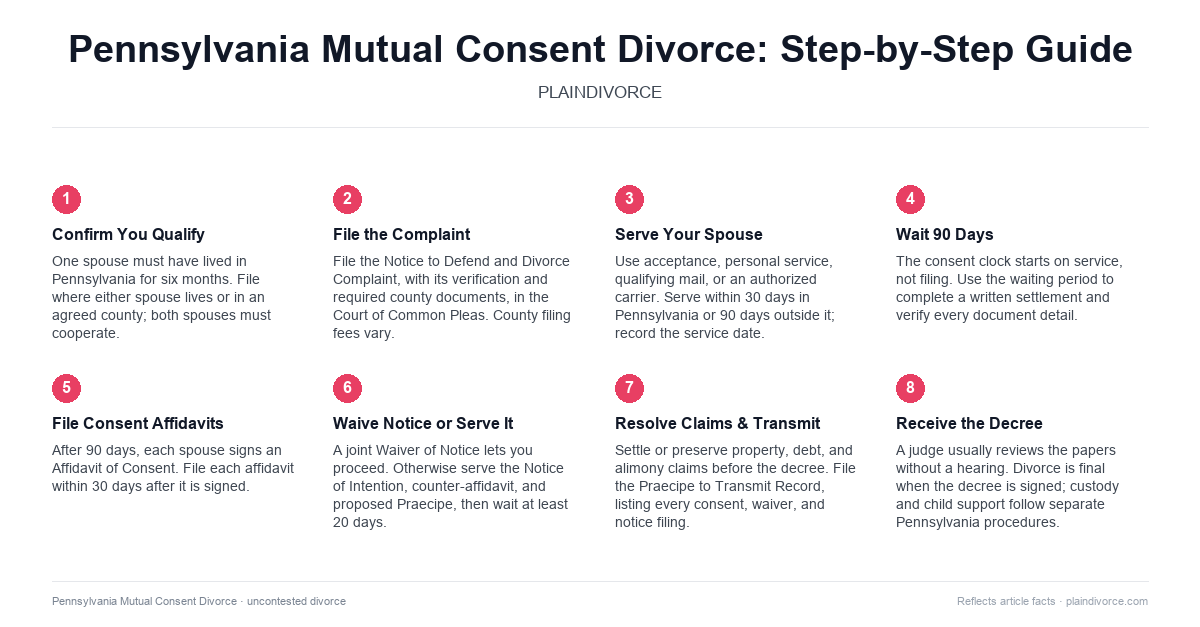
4. Step-by-Step: The Mutual Consent Divorce Process
County procedures differ, but a typical Pennsylvania 3301(c)(1) case runs like this.
Step 1 – Prepare and file the Notice to Defend and Divorce Complaint
The initiating document is a Complaint in Divorce (not a “petition”), filed in the Court of Common Pleas for your county through the filing office, usually called the Prothonotary. The prescribed no-fault complaint must begin with the “Notice to Defend and Claim Rights” pages, and the complaint itself ends with a verification signed under penalty of law (18 Pa.C.S. § 4904) rather than a notarized jurat. Counties commonly add their own intake sheet, confidential information form, and e-filing steps.
Counseling notice: the complaint and notice tell your spouse that marriage counseling is available. Under 23 Pa.C.S. § 3302, in a mutual consent case a party may request up to three counseling sessions within the 90 days after the action is commenced. Counseling cannot be forced on a spouse who has a protection-from-abuse order or who was the victim of a personal injury crime by the other spouse.
Step 2 – Serve your spouse the correct way (this starts the 90-day clock)
Original process in a divorce may be served by the sheriff or any competent adult (personal handoff), by mail meeting the rule’s certified/restricted-delivery plus ordinary-mail conditions, by an authorized commercial carrier, or by the defendant signing an acceptance of service. When both spouses cooperate, acceptance of service is the simplest option. Service is due within 30 days of filing for a defendant inside Pennsylvania and within 90 days for a defendant outside Pennsylvania; if that window closes, you reinstate the complaint by praecipe and try again. Record the exact date of service, because everything downstream counts from it.
Step 3 – Wait at least 90 days from the date of service
Use the wait to line up your written settlement, confirm every name, date, and address matches across documents, and calendar the “90 days after service” date. Nothing about the consent stage can be signed before it.
Step 4 – Both spouses sign and file Affidavits of Consent
After the 90 days, each spouse signs an Affidavit of Consent confirming the marriage is irretrievably broken and that they consent to the divorce. The affidavit records both the service date and the signing date. File each one within 30 days of signing. This is the heart of the mutual consent process and the most-searched Pennsylvania divorce form.
Step 5 – Handle the notice step: Waiver of Notice or Notice of Intention
Before the case goes to a judge, the other spouse is entitled to notice that you intend to ask for the decree. There are two ways through:
- Waiver of Notice (full name: Waiver of Notice of Intention to File the Praecipe to Transmit Record). If both spouses sign and file a waiver, you skip the waiting step and can move straight to the Praecipe.
- Notice of Intention to File the Praecipe to Transmit Record. If the spouses do not both sign waivers, the filing spouse must serve a Notice of Intention together with a blank 3301(c)(1) Counter-Affidavit and a proposed Praecipe, then wait at least 20 days before filing the Praecipe. The counter-affidavit lets the other spouse object or raise economic claims; the notice itself warns that returning a counter-affidavit alone does not preserve alimony or property claims.
Step 6 – File the Praecipe to Transmit Record
The Praecipe to Transmit Record is the document that tells the Prothonotary to assemble the file and send it to a judge for the decree. Follow the Praecipe to Transmit Record instructions in your county packet exactly: the praecipe must list every consent, waiver, and notice document already on file, with the date each was filed, and you select the outcome you are asking for. The current statewide praecipe offers separate options for:
- a Divorce Decree (no economic claims, or all resolved);
- a Divorce Decree that incorporates a marital settlement agreement;
- a bifurcated decree that ends the marriage now but keeps the court’s jurisdiction over unresolved economic claims; or
- an order approving the grounds for divorce when economic claims are still open (the decree itself is then deferred).
Step 7 – Receive the Divorce Decree
If the paperwork is complete and consistent and any economic claims are resolved, withdrawn, or properly dealt with, a judge signs the Divorce Decree, usually without a hearing, and it is mailed to both parties. Order a certified copy or two; agencies that ask for proof of divorce (for a name change, benefits, refinancing, or remarriage) set their own documentation rules.
5. The Pennsylvania Divorce Forms You Will Use
Pennsylvania’s Unified Judicial System publishes a self-represented 3301(c)(1) form set. County packets can add to it, so treat this as the core list, not the whole checklist:
- Self-Represented Party Entry of Appearance – tells the court you are handling the case without a lawyer.
- Notice to Defend and Divorce Complaint – the mandatory notice pages plus the complaint, ending with a verification under penalty of law.
- Affidavit of Consent – signed by each spouse 90+ days after service, filed within 30 days of signing.
- Waiver of Notice – optional shortcut when both spouses sign it.
- Notice of Intention to File the Praecipe to Transmit Record and the 3301(c)(1) Counter-Affidavit – used instead of the waiver when only one spouse is driving the filing.
- Certificate of Service and, where required, an Affidavit of Non-Military Service.
- Praecipe to Reinstate the Complaint – if you miss the service window.
- Praecipe to Transmit Record – the trigger for judicial review.
- Divorce Decree and, if a spouse is resuming a former name, a Notice of Intention to Resume Prior Surname.
Verification, not notarization. The statewide 3301(c)(1) forms are signed under a penalty-of-law verification, not before a notary. Some counties still ask for notarized or extra local documents, so check your county instructions rather than assuming either way.
No statewide “vital statistics” form. Pennsylvania eliminated the old individual divorce-registration form years ago; the Prothonotary now sends the Department of Health a monthly statistical summary instead. If a county packet references a local vital-statistics sheet, follow that county’s current instructions, but there is no statewide “Form 240” you need to chase down.
6. Settle Money and Property Before the Decree
This is the part DIY filers most often get wrong. A mutual consent divorce ends the marriage; it does not automatically divide anything. Claims for equitable distribution of property and debt, alimony, counsel fees, and costs must be raised in the divorce (in the complaint, an answer, or the counter-affidavit) and resolved before the decree is entered. Once the decree is signed, an economic claim you never raised is generally lost for good.
For an uncontested case, the clean approach is a written marital settlement agreement that divides assets and debts, addresses retirement accounts, and states whether either spouse waives alimony. You then ask the Praecipe to enter a decree that incorporates the agreement. If claims are genuinely unresolved when you file the Praecipe, expect the judge to enter an order approving grounds and defer the decree, or a bifurcated decree that keeps jurisdiction over the open issues.
7. Children: Custody and Child Support Are Separate
You can complete a mutual consent divorce with children, but the divorce case does not set custody or child support.
- Child support (and spousal support or APL) is pursued as a separate action through your county’s Domestic Relations Section, not inside the divorce complaint. Support is calculated under Pennsylvania’s statewide child support guidelines, which are based on both parents’ net incomes and the number of children.
- Every support order must address medical/health-insurance coverage for the children, and orders generally include immediate income withholding unless a listed good-cause exception or a written alternative agreement applies. Payments usually route through the Pennsylvania State Collection and Disbursement Unit (PA SCDU).
- Custody follows Pennsylvania’s custody procedure and can be resolved by a written parenting agreement filed with the court, or through a separate custody action, before or after the divorce.
If there is any conflict, safety risk, or serious disagreement about parenting time or support, talk to a family law attorney or legal aid before relying on a DIY approach.
8. What an Uncontested Divorce Costs in Pennsylvania
Pennsylvania has no statewide divorce filing fee. Each county’s Prothonotary sets its own schedule, and the fee is paid when you file the complaint. Plan for these buckets:
- Complaint filing fee – county-specific, commonly a few hundred dollars.
- A second fee to file the Praecipe to Transmit Record in many counties.
- Extra “count” fees if the complaint also raises equitable distribution, alimony, or other claims.
- Service costs – sheriff or process-server fees, or certified-mail postage.
- Certified copies of the decree.
Example (Montgomery County, fee schedule effective January 1, 2026): filing a Divorce Complaint costs $314.50, with a further $54.00 to file the Praecipe to Transmit Record and roughly $70–$82 per extra count (for example, equitable distribution or custody). Your county may be higher or lower, so confirm the current schedule with your Prothonotary right before filing.
If money is tight, ask your county about a fee waiver by filing to proceed in forma pauperis; eligibility is based on income and household size.
9. When a DIY Divorce Is Not the Right Call
A cheap divorce is not a win if it leaves you exposed. Get legal advice, or step away from DIY, if:
- There is domestic violence, coercion, intimidation, or a serious power imbalance.
- You suspect hidden income or assets, or you do not fully understand the family finances.
- There is complex property: a business, a pension or large retirement accounts, or multiple properties.
- You and your spouse disagree about custody or support.
- There are significant immigration, tax, or benefits consequences.
10. Where a Self-Help Divorce Kit Fits In
If your case truly fits 3301(c)(1) mutual consent, a self-help kit keeps you organized through the Pennsylvania-specific steps that cause the most delays: correct service, the 90-days-from-service timing, the 30-day affidavit filing window, the notice or waiver choice, and a complete Praecipe to Transmit Record.
A good kit helps you:
- Follow one clear roadmap: file → serve → wait 90 days from service → consent → notice/waiver → praecipe → decree.
- Use checklists so you do not miss the Notice to Defend cover pages or a required verification.
- Keep names, dates, and service details consistent across every document.
- Remember to raise and resolve economic claims before the decree.
A kit is not a substitute for a lawyer and cannot cover every unusual situation, but for a standard mutual consent case it reduces guesswork and helps you avoid the paperwork mistakes that send filings back.
11. Final Checklist and Next Steps
- Confirm one spouse meets the six-month residency rule and choose the right county.
- File a complete Notice to Defend and Divorce Complaint with the verification and any county intake forms.
- Complete service within the deadline and write down the date of service.
- Calendar the 90-days-after-service date; then have both spouses sign Affidavits of Consent and file each within 30 days.
- Sign a Waiver of Notice, or serve the Notice of Intention with a counter-affidavit and wait 20 days.
- Put your property and debt deal in a written settlement agreement and raise every economic claim before the decree.
- File the Praecipe to Transmit Record, listing every consent document and its filing date.
- Handle child support and custody through the Domestic Relations Section and custody procedure.
PlainDivorce.com is not a law firm and cannot give legal advice. If you have questions about fairness, safety, or your rights, a Pennsylvania family law attorney or your county legal aid office is the right next step.
12. Frequently Asked Questions
What is a Section 3301(c)(1) mutual consent divorce in Pennsylvania?
It is Pennsylvania’s agreement-based no-fault divorce. Both spouses state the marriage is irretrievably broken and each files an Affidavit of Consent once at least 90 days have passed since the divorce complaint was served. If the couple also resolves property, debt, and alimony claims, a judge can sign the decree without a hearing. It is the process most people mean by an “uncontested divorce in Pennsylvania.”
Does the 90-day waiting period start when I file?
No. The Affidavit of Consent must be signed 90 days or more after the divorce complaint is served on your spouse, and then filed within 30 days of signing. Filing the complaint without completing service does not start your clock, so serve promptly and record the exact date of service.
What is the Affidavit of Consent PA divorce form?
It is the document each spouse signs to consent to a 3301(c)(1) divorce and confirm the marriage is irretrievably broken. It records the service date and the signing date, is signed under penalty of law rather than before a notary, must be filed within 30 days of signing, and can only be withdrawn later by court order.
What is the Praecipe to Transmit Record, and what do the instructions require?
The Praecipe to Transmit Record tells the Prothonotary to send the case file to a judge for the decree. The instructions require you to list every consent, waiver, and notice document already filed, with each filing date, and to select the outcome: a plain decree, a decree incorporating a settlement agreement, a bifurcated decree, or an order approving grounds when economic claims are still open.
Do I have to go to court for a mutual consent divorce?
Usually no. If both spouses sign the Affidavit of Consent, the notice or waiver step is done, economic claims are resolved, and the Praecipe is filed correctly, the judge typically signs the decree on the papers and it is mailed to both parties. Contested economic issues or paperwork errors can still trigger a conference or hearing.
How long does an uncontested divorce take in Pennsylvania?
The absolute minimum is 90 days from the date of service, but that is only the earliest the consent stage can begin. Adding service, the consent and notice steps, settlement, the Praecipe, and county processing, a clean and cooperative case usually takes about four to six months.
What if my spouse will not sign the Affidavit of Consent?
You cannot force a 3301(c)(1) divorce. Your fallback is a no-fault divorce under Section 3301(d) based on living separate and apart for one year (two years if the separation began before December 5, 2016). A narrow exception under Section 3301(c)(2) presumes consent when the other spouse was convicted of a personal injury crime against you.
Does the divorce set child support and custody?
No. Child support runs as a separate case through your county’s Domestic Relations Section under Pennsylvania’s statewide guidelines, usually with income withholding and payment through PA SCDU. Custody follows custody procedure and can be settled by a written parenting agreement or a separate custody action. Neither is decided by filing the divorce complaint.
How much does it cost to file?
There is no statewide fee; each county’s Prothonotary sets its own. As an example, Montgomery County charges $314.50 to file the Divorce Complaint and $54.00 to file the Praecipe to Transmit Record as of January 1, 2026, plus per-count fees for economic claims. Fee waivers are available in forma pauperis based on income.
Sources and further reading: Pennsylvania Divorce Code, 23 Pa.C.S. Chapter 33 (grounds for divorce and counseling) and 23 Pa.C.S. § 3104 (jurisdiction and the six-month residency rule); Pennsylvania Rules of Civil Procedure Rule 1920.42 (affidavits, notice, and praecipe) and Rule 1930.4 (service of original process); the Pennsylvania Child Support Program; and your county Prothonotary’s current fee schedule, e.g. Montgomery County. Verify all figures with the court before filing.
Sources and local rules can change. Use this guide as a plain-English organizer, then verify the current filing requirements with the official court or government source for your jurisdiction.

About Harry D
Expert contributor at PlainDivorce, helping Canadians and American navigate simple uncontested divorces with clarity and confidence.