Uncontested Divorce in Prince Edward Island: Form 70A*, the Form 70B Trap, and the Desk Divorce Process
An uncontested divorce in Prince Edward Island is a divorce the court grants on the paperwork alone, without a hearing, because no one is asking a judge to decide a fight. Cooperative couples file a Joint Petition for Divorce (Form 70A*) together with no respondent to serve; otherwise one spouse files a Petition for Divorce (Form 70A) and the case becomes uncontested when the other spouse files no Answer. Either way, only the Supreme Court of Prince Edward Island (Family Section) can make the order under Canada’s Divorce Act and PEI’s Rule 70, the court filing fee is $100, and the divorce takes effect on the 31st day after the judge signs it.
Important disclaimer: PlainDivorce is not a law firm and does not give legal advice. This is general legal information only. Court rules, forms, and fees change and registry practices vary. Confirm the current requirements with the Supreme Court of Prince Edward Island registry where you will file, or with a PEI family lawyer or legal clinic, before you act.
TL;DR: uncontested divorce in PEI at a glance
- Two routes. A Joint Petition for Divorce (Form 70A*), signed by both spouses and filed without a respondent, or a sole Petition for Divorce (Form 70A) that is served on your spouse and proceeds undefended if no Answer (Form 70D) is filed.
- The Form 70B trap. If you searched “Joint Petition for Divorce Form 70B,” that is a mix-up. Form 70B is the Counterpetition — a response-style pleading a respondent uses to bring their own claims. It is not a joint-filing form.
- The sworn evidence. A desk-divorce file is decided on the Petitioner’s Affidavit on Motion for Judgment (Form 70P) (or the Respondent’s Affidavit, Form 70Q). PEI’s Rule 70 says “petitioner,” not “applicant,” so an “Affidavit of Applicant PEI divorce” search points you to Form 70P.
- The document the judge signs is the Divorce Judgment (Form 70S). A search for “Divorce Judgment Form 70O” is off by one form: Form 70O is the Requisition to Note Default and Notice of Motion for Judgment — it asks for judgment; it is not the judgment.
- Fees: $100 to file the petition, $10 for the federal Central Registry of Divorce Proceedings, and $35 for a PEI Vital Statistics marriage certificate. A joint filing has no respondent to serve.
- Children: a divorce judgment will not issue unless a birth certificate for every child of the marriage is filed, and a judge must be satisfied that reasonable child-support arrangements are in place.
- Timing: the one-year separation, then the court steps, then the divorce takes effect on the 31st day after judgment. Every current PEI divorce forms pdf is on the Courts of PEI forms page — always use the latest version.
- This is general legal information, not legal advice — see the full disclaimer above and below.
1. What is an uncontested or simple divorce in Prince Edward Island?
An uncontested divorce in Prince Edward Island is a divorce where the court does not have to resolve a dispute at a hearing or trial. “Simple divorce” is the everyday label people use for the same thing. Every divorce in Canada is granted under the federal Divorce Act, but the process and forms are provincial: in PEI the case runs through the Supreme Court of Prince Edward Island (Family Section) under Rule 70 (Divorce Actions) of the PEI Rules of Civil Procedure.
Rule 70.02(j) defines an uncontested action as one “in which the respondent has failed to deliver an answer or the answer has been withdrawn or struck out.” A joint petition is slightly different — there is no respondent at all, because both spouses file as petitioners. Both paths can usually finish as a desk divorce: under Rule 70.19, where the evidence is presented by affidavit, a judge “may grant a judgment without an appearance by a lawyer or the parties.”
This guide is specific to PEI — not generic Canadian divorce content — because PEI’s own Rule 70 forms and registry practices are what decide whether your file qualifies for a desk divorce.
2. The Joint Petition (Form 70A*) advantage and the Form 70B counterpetition trap
The single biggest PEI advantage for cooperative couples is filing a Joint Petition for Divorce. Under Rule 70.03(7), “spouses may commence a divorce action jointly without a respondent.” No one is served, and there is usually no Answer, no default step, and no service costs.
Critical warning: many DIY guides confuse the form numbers. Under Rule 70.06(2), Form 70B is a Counterpetition — the pleading a respondent files (inside a single “answer and counterpetition” document) to bring their own claims into someone else’s divorce action. If a couple files Form 70B thinking it is a “joint petition,” they have filed a response-style pleading with no petition to respond to, which creates confusion and delay. If you searched “Joint Petition for Divorce Form 70B” to get here, this is exactly the mix-up to avoid: 70B is not a joint-filing form.
The correct joint path is the Joint Petition for Divorce (Form 70A*) — the title the Courts of PEI forms registry uses for the joint variant of Form 70A. Both spouses sign it. A sole filing uses the plain Petition for Divorce (Form 70A).
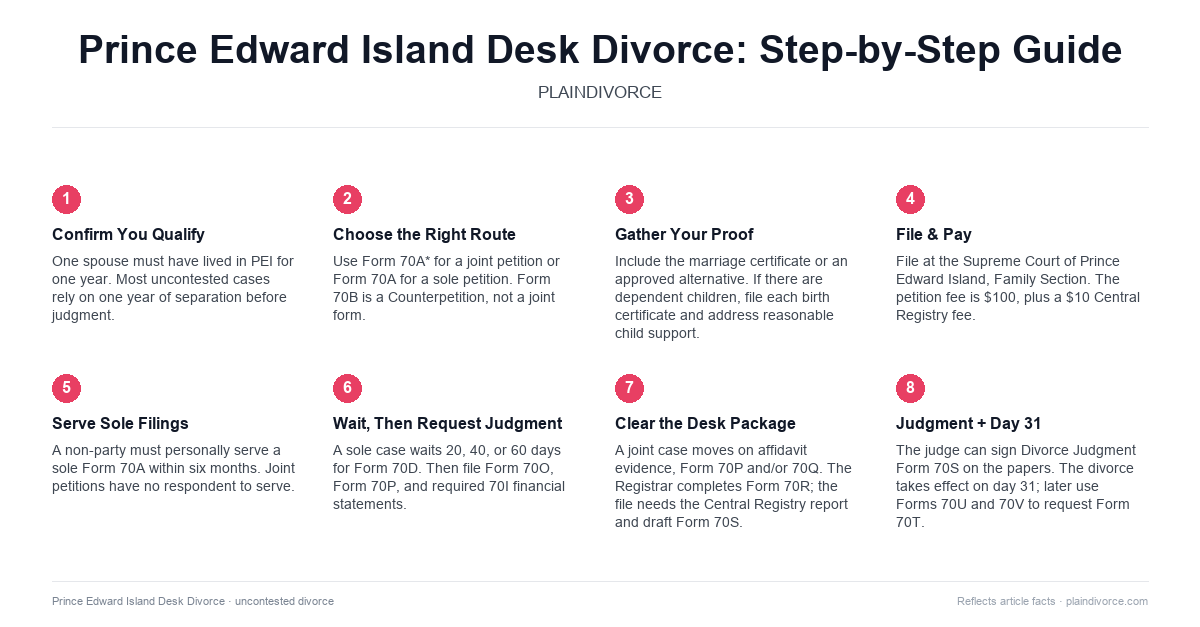
Process flow: Joint Petition (Form 70A*) or sole Petition (Form 70A) → service (sole cases only) → motion for judgment with affidavit evidence → desk-divorce review → Divorce Judgment (Form 70S).
Download Our Prince Edward Island Uncontested Divorce (Dissolution) Self-Help Kit
3. Who qualifies for an uncontested divorce in PEI?
Residency: the one-year rule
Under section 3 of the Divorce Act, a PEI court can hear a divorce only if you or your spouse has been habitually resident in Prince Edward Island for at least one year immediately before the case is started. If a divorce proceeding between the same spouses is already underway somewhere else, that can affect which court decides the case — the federal Central Registry (see section 7) exists to catch duplicate proceedings.
Grounds and the one-year separation rule
Canada has one legal ground for divorce: breakdown of the marriage. Under section 8 of the Divorce Act, you establish breakdown one of three ways — living separate and apart for at least one year, adultery, or physical or mental cruelty that makes continued cohabitation intolerable. Almost every uncontested case relies on one-year separation, because adultery and cruelty require proof of specific conduct and usually invite a dispute.
Two statutory details on the separation ground matter for a desk divorce:
- You must have lived separate and apart for at least one year immediately before the divorce is determined, and have been living separate and apart when the petition was filed. You can start the case before the year is complete, but judgment can’t be granted until it is.
- A reconciliation attempt of up to 90 days total, entered into mainly to try to reconcile, does not restart the one-year clock.
When your case is a good fit for an uncontested or simple divorce
- At least one spouse meets the one-year PEI residency rule.
- You can rely on one-year separation (or will have reached it by the time a judge reviews the file).
- You can produce a marriage certificate from PEI Vital Statistics, or the equivalent from the jurisdiction where you married (or explain in the affidavit why it is impossible to get one).
- There is no live dispute that would need a contested hearing, and any parenting and child-support arrangements are settled and reasonable.
4. PEI divorce forms: the Rule 70 form stack
These PEI form names and numbers are the “authority signals” that separate a truly local guide from generic Canadian content. Every form and rule number below comes from Rule 70 of the PEI Rules of Civil Procedure and the Courts of PEI forms registry.
- Petition for Divorce (Form 70A): the originating document for a sole (one-spouse) filing.
- Joint Petition for Divorce (Form 70A*): the cooperative version, signed by both spouses and filed without a respondent. Each spouse signs a declaration, which includes confirming awareness of the parenting duties in sections 7.1 to 7.5 of the Divorce Act.
- Counterpetition (Form 70B): not a joint form. Used when a respondent brings their own claims into the case; it travels inside a single “answer and counterpetition” document. A common DIY mistake.
- Answer (Form 70D): the response a respondent files to oppose something in the petition. (This is also why calling “70D” a financial statement is wrong.)
- Notice of Intent to Defend (Form 70H): a respondent who intends to defend can file this within the time to answer, which buys an extra 10 days to deliver the Answer.
- Financial Statements (70I series): Form 70I(A) Statement of Income, Form 70I(B) Statement of Expenses, Form 70I(C) Statement of Special or Extraordinary Expenses (childcare, medical or dental beyond insurance, tutoring, extracurriculars), and Form 70I(D) Statement of Property — filed where a judge directs, or where support or a property division is in issue.
- Waiver of Financial Statements (Form 70J): under Rule 70.14(3), both spouses can waive financial statements for a claim for support under the Divorce Act (child or spousal). The waiver is not available for a claim under PEI’s Family Law Act, and it does not override any financial information a judge directs to be filed.
- Requisition to Note Default and Notice of Motion for Judgment (Form 70O): the “move the file forward” document in a sole uncontested case — it notes a non-responding spouse in default and asks for judgment. If you searched “Divorce Judgment Form 70O,” this is the form that requests judgment; the judgment itself is Form 70S.
- Petitioner’s Affidavit on Motion for Judgment (Form 70P): the sworn evidence for a desk divorce. Rule 70.19(5) sets out what it must cover (see section 9). Searchers looking for an “Affidavit of Applicant PEI divorce” are using “applicant” terminology from other provinces — PEI’s Rule 70 says “petitioner,” so Form 70P is the document you want.
- Respondent’s Affidavit on Motion for Judgment (Form 70Q): the equivalent sworn evidence from the other spouse, used on a joint or consent finish.
- Registrar’s Certificate (Form 70R): before the motion goes to a judge, the registrar examines the notice of motion, the evidence, and the draft judgment and completes this certificate (Rule 70.19(12)). It is part of the judgment package.
- Divorce Judgment (Form 70S): the final judgment the judge signs to grant the divorce.
- Certificate of Divorce (Form 70T): official proof of the divorce, often needed to remarry. It is issued after the divorce takes effect, once you file a Requisition (Form 70U) with a supporting Affidavit (Form 70V).
Forms checklist (sole, uncontested): Form 70A + marriage certificate (or equivalent) + proof of service + Form 70O + Form 70P + any required 70I financial statements + draft Form 70S + Form 70R (completed by the registrar) → later, Form 70U / 70V to request Form 70T. Joint: Form 70A* + marriage certificate + a notice of motion for judgment + Form 70P (and/or Form 70Q) + Form 70R + draft Form 70S. Your exact stack varies with children, support, and property, so confirm the judgment package with the registry.
Note: every current, official PEI divorce forms pdf is posted on the Courts of PEI forms page (search “Courts of PEI forms”). Always download the latest version and confirm registry instructions before filing. The procedural detail behind these forms is in Rule 70 of the PEI Rules of Civil Procedure.
5. Step by step: joint vs. sole, and the desk divorce finish
Below is a plain-English overview of a typical uncontested path through the Supreme Court of Prince Edward Island (Family Section). Service methods and supporting documents depend on your situation.
Step 1 — Choose joint or sole (this choice drives everything else)
- Joint Petition for Divorce (Form 70A*): best when you can cooperate. No respondent, no service, usually no Answer and no default step.
- Petition for Divorce (Form 70A): used when only one spouse files. This requires personal service on your spouse (or a court-approved alternative under Rule 16) and proof of service, generally within six months of the petition being issued.
Step 2 — Gather your proof (marriage certificate, birth certificates, translations)
Under Rule 70.03(2), a certificate of the marriage from Vital Statistics (PEI), or the equivalent from another jurisdiction, must be filed before the petition is issued, unless the petition states that it is impossible to obtain one. PEI’s practice direction on uncontested divorces adds detail:
- If the marriage certificate is not signed by PEI’s Director of Vital Statistics, the petitioner’s affidavit must identify it (title, date, place, and issuing office) and confirm its particulars, and the original or a notarized copy must be filed.
- If you have children of the marriage, a birth certificate for each child (or a notarized copy) must be filed. A divorce judgment will not be issued without them.
- If the marriage certificate or any child’s birth certificate is in a language other than English or French, a certified translation must be filed with the original (or notarized copy).
The sworn evidence itself is the Petitioner’s Affidavit on Motion for Judgment (Form 70P) — or Form 70Q from the other spouse on a joint or consent finish.
Step 3 — File at the court registry and keep your file number
Divorce actions are filed with the Supreme Court of Prince Edward Island (Family Section). The main registry is at the Sir Louis Henry Davies Law Courts, 42 Water Street, PO Box 2000, Charlottetown, PE C1A 7N8 (902-368-6000). Confirm with the registrar which office should receive your filing, pay the $100 filing fee, and keep your stamped copies and file number.
Step 4 — Serve your spouse (sole cases only) and wait out the response period
If you filed a sole Petition (Form 70A), someone other than you must serve your spouse personally (or by a court-approved alternative), and you then file proof of service. Serving the petition yourself, or missing the six-month window, are two of the most common DIY stumbles.
Your spouse’s time to deliver an Answer (Form 70D) under Rule 70.07 is:
- 20 days if served in Prince Edward Island;
- 40 days if served elsewhere in Canada or in the United States;
- 60 days if served anywhere else.
A timely Notice of Intent to Defend (Form 70H) adds 10 days to that. Only after the deadline passes with no Answer can a sole petitioner ask the registrar to note the respondent in default.
Step 5 — Move the file to judgment (the desk divorce)
- Sole case. Once the response time has passed with no Answer, the petitioner files the Requisition to Note Default and Notice of Motion for Judgment (Form 70O), together with the Petitioner’s Affidavit (Form 70P) and any required 70I financial statements.
- Joint case. There is no respondent to note in default. The file moves to judgment on a notice of motion for judgment supported by affidavit evidence (Form 70P and/or Form 70Q). PEI’s practice direction lists a consent-judgment package as a notice of motion for judgment, the petitioner’s or respondent’s affidavit, and the Registrar’s Certificate, “unless the court directs otherwise” — so confirm the exact package with the registry.
- Both routes. Before the motion goes to a judge, the registrar reviews the notice of motion, the evidence, and the draft Divorce Judgment (Form 70S), and completes the Registrar’s Certificate (Form 70R). Under Rule 70.18, the file must also contain the marriage certificate and the Central Registry report before the motion can be heard.
Step 6 — Judge signs the Divorce Judgment, then you track the 31-day period
If the paperwork is complete and any child-support arrangements are reasonable, a judge can issue the Divorce Judgment (Form 70S) on the papers, with no appearance. Under section 12 of the Divorce Act, the divorce takes effect on the 31st day after the day the judgment is rendered. A court can order an earlier effective date only in special circumstances and only if both spouses agree and undertake not to appeal; a pending appeal changes the rule.
After the divorce takes effect, you can file a Requisition (Form 70U) with a supporting Affidavit (Form 70V) — sworn after the divorce took effect — stating that no appeal is pending (or any appeal was abandoned or dismissed) and that no order extending the appeal time is outstanding. The registrar searches the court records and, if all is in order, issues the Certificate of Divorce (Form 70T).
6. Special issues when you have children
If you have children of the marriage, the court’s focus is their best interests and their support. Two things can hold up an otherwise clean file.
- Birth certificates are mandatory. The petition must name and give the birth date of every child of the marriage (Rule 70.16(2)), and PEI’s practice direction goes further: a divorce judgment will not be issued unless a birth certificate for every dependent child is filed, so the deputy registrar can confirm the names and dates on the judgment match.
- Child support is a hard bar. Under section 11(1)(b) of the Divorce Act, the court must “satisfy itself that reasonable arrangements have been made for the support of any children of the marriage, having regard to the applicable guidelines” — the Federal Child Support Guidelines — and must stay the granting of the divorce until those arrangements are made. Even in a desk divorce, a judge will hold the file if the support figure is missing or is below the Guidelines table amount without a clear explanation.
- Financial disclosure may be required. In child-related files the court can direct the 70I series: 70I(A) Income, 70I(B) Expenses, 70I(C) Special or Extraordinary Expenses, and 70I(D) Property.
Many uncontested divorces make no parenting or support claim in the divorce case itself — the arrangements already live in a separation agreement or an earlier order. Even then, your Form 70P still has to show the judge that reasonable child-support arrangements exist.
7. How long does an uncontested divorce take in PEI?
There is no published province-wide processing-time promise for PEI, so treat any “it takes X months” claim with caution. Plan around these stretches instead:
- The one-year separation. The most common ground; the divorce can’t be granted until the year is complete.
- The Central Registry report. When the petition is filed, the court registers it with the federal Central Registry of Divorce Proceedings, which checks for a competing proceeding between the same spouses. Under Rule 70.18, the Registry’s certificate or report must be in the file before a motion for judgment can be heard.
- Court processing. This depends on registry workload and on whether your documents are complete and consistent. On a sole file, add the 20/40/60-day response period and the time to arrange service.
- The 31-day period. After the Divorce Judgment is signed, the divorce takes effect on the 31st day.
A clean, complete, cooperative joint file is the fastest version of this process. For current timing, ask the registry when you file.
8. What does an uncontested divorce cost in PEI? (real fee numbers)
The core cost of an uncontested divorce in Prince Edward Island is the court’s own fee schedule plus two document fees. Court fees are set by regulation and can change, so confirm the current amounts before you pay.
| Cost | Amount | Notes |
|---|---|---|
| Petition for Divorce filing fee (Family Section) | $100 | Set by the PEI Court Fees Act Fees Regulations |
| Central Registry of Divorce Proceedings fee (federal) | $10 | $10 per application; waived for a legal-aid applicant whose provincial filing fee is also waived |
| PEI Vital Statistics marriage certificate | $35 | Only if the certificate comes from PEI; a certificate from another jurisdiction costs whatever that office charges |
| Filing an Answer (sole cases, if your spouse responds) | $50 | Same $50 whether or not the Answer includes a counterpetition |
| Service (sole cases) | Varies | A process server’s fee is set by the provider, not the court |
| Swearing, translation, printing, copying | Varies | Commissioner or notary fees for affidavits; certified translation of any non-English/French certificate |
PEI’s Family Section fee schedule does not list a separate fee for the Certificate of Divorce (Form 70T). Confirm the current figures against the PEI Court Fees Act Fees Regulations and the PEI Vital Statistics service fees page.
Cost saver in PEI: filing jointly (Form 70A*) means there is no respondent to serve, which removes the process-server cost and the service-related delays. A joint file can still carry affidavit-swearing, certificate, translation, and copying costs.
9. Common reasons uncontested files stall or get rejected
Rule 70.19(5) spells out what the Petitioner’s Affidavit on Motion for Judgment (Form 70P) must cover. Most desk-divorce delays trace back to one of these gaps:
- Missing marriage or birth certificates: the court can’t proceed without the marriage certificate (or an affidavit explaining why it’s impossible to get), and it won’t issue a judgment without a birth certificate for every child of the marriage.
- Unclear separation dates: the affidavit must show you lived separate and apart for at least a year before judgment, and were already separated when the case started.
- No reconciliation / no collusion statement: Form 70P must give the court enough to satisfy itself there is no reasonable possibility of reconciliation, and must state there is no agreement or arrangement to deceive the court.
- Incomplete parenting or support details: vague information about parenting time, decision-making, or child-support amounts is one of the most common reasons a judge sends a file back.
- No property-claim statement: a petitioner who is not claiming a division of property must confirm that they do not wish to claim it now and understand the claim may be barred after the divorce.
- No respondent address: the affidavit must give the respondent’s last known address and say how it is known.
- Service problems: serving the petition yourself, missing the six-month service window, or failing to file proof of service.
- Equalization claimed by default: if you ask for an equalization of family property and the respondent doesn’t answer, PEI’s practice direction says a hearing will generally still be required, with detailed valuation evidence and a Form 70I(D).
10. When a DIY divorce might not be right for you
A DIY uncontested divorce in Prince Edward Island can save a lot on legal fees, but it is a poor fit if there are safety concerns, a serious power imbalance, hidden assets, complex finances (a business, pensions, multiple properties), or unresolved disagreements about children or support. In those situations, even one appointment with a PEI family lawyer or a legal clinic can prevent long-term harm. Contact the Community Legal Information service or the PEI branch of Legal Aid as a starting point.
11. Where a self-help divorce kit fits into the process
If your case is a true uncontested divorce in Prince Edward Island, a PEI-focused self-help kit is most valuable for keeping your file desk-divorce ready:
- choosing the correct starting path — Form 70A (sole) vs. Form 70A* (joint) — and steering clear of the Form 70B counterpetition trap;
- organizing your sworn evidence in Form 70P (and Form 70Q), with the right 70I-series statements if support or property is involved;
- assembling the mandatory attachments — marriage certificate, a birth certificate for every child, and certified translations where needed;
- preventing the common delays in section 9 (missing signatures, inconsistent dates, unclear children or support information); and
- understanding the finish line: the Registrar’s Certificate (Form 70R), the Divorce Judgment (Form 70S), the 31-day period, and requesting proof (Form 70T) if you need it.
Download Our Prince Edward Island Uncontested Divorce (Dissolution) Self-Help Kit
PlainDivorce is not a law firm. A kit is an organization and information tool, not legal advice, and you must still confirm you are using current PEI forms, rules, and fees.
12. FAQ
What is an uncontested or simple divorce in Prince Edward Island?
It is a divorce the Supreme Court of Prince Edward Island (Family Section) grants without a contested hearing or trial. Spouses either file a Joint Petition for Divorce (Form 70A*) together, or one spouse files a sole Petition for Divorce (Form 70A) and the case proceeds undefended when the other files no Answer. Many PEI cases are then decided as a desk divorce on sworn documents. A judge still has to be satisfied about residency, the one-year separation, the absence of collusion, and any child-support arrangements.
Is there a “Joint Petition for Divorce Form 70B” in PEI?
No. The joint filing form is Form 70A*, the Joint Petition for Divorce, signed by both spouses and filed without a respondent. Form 70B is the Counterpetition — a response-style pleading a respondent uses to bring their own claims into an existing divorce action, filed inside a single “answer and counterpetition” document. Filing Form 70B when you mean to file jointly is a common and costly mistake.
What is the “Affidavit of Applicant” for a PEI divorce?
PEI’s Rule 70 uses the word “petitioner,” not “applicant,” so there is no “Affidavit of Applicant.” The sworn evidence for a desk divorce is the Petitioner’s Affidavit on Motion for Judgment (Form 70P), or the Respondent’s Affidavit (Form 70Q) from the other spouse. Rule 70.19(5) sets out what Form 70P must cover, including the grounds, the separation dates, parenting and support details, a no-collusion statement, and the respondent’s last known address.
What is the final document the judge signs in PEI — is it Form 70O?
The final document is the Divorce Judgment (Form 70S). Form 70O is the Requisition to Note Default and Notice of Motion for Judgment — it is the paperwork that requests judgment in a sole, uncontested case, not the judgment itself. After the divorce takes effect you can request a Certificate of Divorce (Form 70T) as official proof, using Form 70U and a Form 70V affidavit.
When is the divorce effective?
Under section 12 of the Divorce Act, the divorce takes effect on the 31st day after the day the Divorce Judgment is rendered, once the appeal window closes. A court can order an earlier effective date only in special circumstances and only if both spouses agree and undertake not to appeal. A pending appeal delays the effective date.
How much does an uncontested divorce actually cost in PEI?
The court filing fee for a Petition for Divorce is $100, the federal Central Registry of Divorce Proceedings fee is $10 per application, and a PEI Vital Statistics marriage certificate is $35. Beyond that, a sole case adds a process server’s fee, and any file may have affidavit-swearing, certified-translation, printing, and copying costs. A joint petition has no respondent to serve. Fees are set by regulation and can change, so confirm the current amounts before you pay.
Do I have to file my children’s birth certificates?
Yes. The petition must name every child of the marriage and give their birth dates, and PEI’s practice direction on uncontested divorces states that a divorce judgment will not be issued unless a birth certificate (or a notarized copy) for every dependent child is filed. If a certificate is in a language other than English or French, a certified translation must be filed with it. The court also must be satisfied that reasonable child-support arrangements are in place before granting the divorce.
Why would an uncontested file still get delayed?
Most delays come from gaps in the Form 70P affidavit or missing attachments: no marriage certificate, missing child birth certificates, unclear separation dates, vague parenting or support details, no property-claim statement, no respondent address, or service errors on a sole file. Section 9 lists the most common causes so you can head them off.
13. Final thoughts and next steps
For the smoothest uncontested divorce in Prince Edward Island, keep these PEI-specific realities front of mind:
- Use the correct court: the Supreme Court of Prince Edward Island (Family Section), under Rule 70.
- Know the form numbers: Form 70A* is the joint petition; Form 70B is a counterpetition; Form 70P (or 70Q) is the sworn evidence; Form 70O requests judgment; Form 70S is the judgment; Form 70R is the Registrar’s Certificate.
- Make the file desk-divorce ready: clear sworn evidence, the marriage certificate, a birth certificate for every child, certified translations where needed, and complete child-support information.
- Budget realistically: $100 petition fee, $10 Central Registry fee, $35 marriage certificate, plus service costs on a sole file.
- Plan for the finish line: the Registrar’s Certificate, the Divorce Judgment (Form 70S), the 31-day period, and Form 70U / 70V to request the Certificate of Divorce (Form 70T) if you need proof.
This guide is legal information only, not legal advice. If you have safety concerns, complex assets, or unresolved parenting or support issues, speak with a PEI family lawyer or legal clinic before filing.
Get the Prince Edward Island Uncontested Divorce (Dissolution) Self-Help Kit
Sources and local rules can change. Use this guide as a plain-English organizer, then verify the current filing requirements with the official court or government source for your jurisdiction.

About Harry D
Expert contributor at PlainDivorce, helping Canadians and American navigate simple uncontested divorces with clarity and confidence.