Uncontested Divorce in Puerto Rico: A Plain-English (Bilingual) Guide for 2026
An uncontested divorce in Puerto Rico is one where you and your spouse agree to end the marriage and settle every issue in writing, so the judge only has to review and approve your deal. For cooperative couples the usual court path is Divorcio por Consentimiento Mutuo (Divorce by Mutual Consent): a joint, sworn petition plus a written Estipulación (stipulation) covering children, support, and property. At least one spouse must have lived in Puerto Rico continuously for one year before filing, and the current court fee is $78 in sellos de rentas internas.
This guide explains how that process actually works, translates the Spanish legal terms you will meet, and flags the four things people most often get wrong: the residency rule, the required forms, when the divorce becomes final, and the special role of the Abogado-Notario (Attorney-Notary).
TL;DR
Puerto Rico’s agreed divorce is Divorcio por Consentimiento Mutuo: a joint sworn petition plus a written Estipulación covering children, support, and property. The whole system runs in Spanish, and it has a few structural quirks that don’t exist on the mainland.
- One-year residency, no shortcut. At least one spouse must have lived in Puerto Rico continuously for a full year before filing. The Civil Code’s narrow exceptions apply only to an individual ruptura irreparable petition — they don’t help a recently arrived couple filing jointly.
- OAT 1484 is NOT the petition. This trips up almost everyone. It’s the Solicitud de Señalamiento de Vista — the request to schedule your hearing. The actual petition is OAT 1470–1473, picked by whether you have children and whether you have property.
- The judge can reject your agreement. If the Estipulación gives one spouse an unfair advantage, the court will refuse it and can dismiss the petition until you fix it.
- Support means PIPE. Whenever child or spousal support is involved, each spouse files an OAT 435 PIPE financial form. A missing or inconsistent PIPE is a top reason cases stall.
- Both spouses file in person at the Secretaría del Tribunal, and the fee is $78 in sellos de rentas internas ($90 for an individual ruptura irreparable filing).
- Skipping the hearing is narrow. A resolución sumaria requires a joint request, agreement on assets and debts, no minor children in common, and no child needing support — and the judge can still order a hearing anyway.
- You’re still married for 30 days after the Sentencia is notified and filed — unless both spouses expressly waive the review terms, which makes it immediate.
- A notary here is a lawyer. The Abogado-Notario route (Escritura Pública) is final the moment you sign — no 30-day wait — but it’s a professional-services process, requires separate counsel for each spouse when minor children are involved, and is unavailable if any party has a declared legal incapacity.
- Real estate in the agreement means legal representation is required, not optional.
- Everything is in Spanish. There are no official English OAT forms — what you file must be in Spanish.
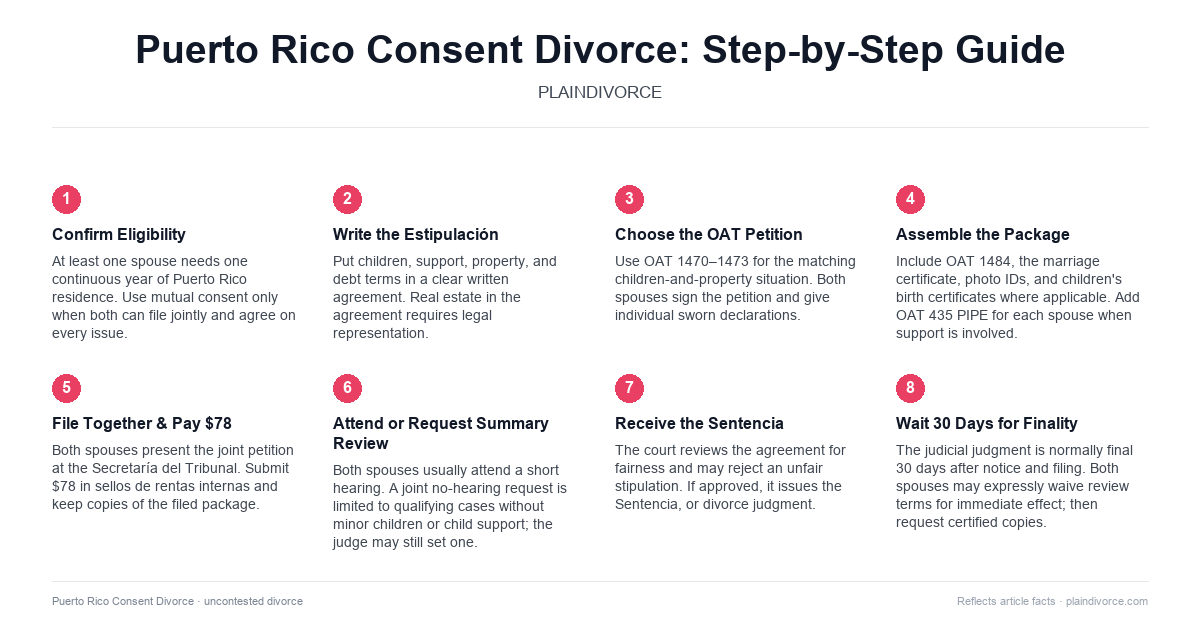
1. What Counts as an Uncontested Divorce in Puerto Rico?
You will rarely see the English phrase “uncontested divorce” on Puerto Rico paperwork. Under the 2020 Civil Code, cooperative cases run through one of two no-fault concepts:
- Divorcio por Consentimiento Mutuo (Divorce by Mutual Consent): both spouses agree and file one joint petition together with their written agreements.
- Divorcio por Ruptura Irreparable (Irreparable Breakdown): the marriage cannot be repaired. This can be filed as a joint petition or as an individual petition by one spouse. An individual petition still has to be served on the other spouse, who then has 30 days to respond; if they do not, the court enters an anotación de rebeldía (default) and still holds a hearing.
For a truly “simple” case, the mutual consent track is usually the most straightforward court path: you are not asking a judge to decide a fight. You submit a sworn joint petition and a written Estipulación covering children (if any), support, and property and debts, and the court reviews it before issuing a Sentencia (Judgment). Once the court approves your stipulations, they become a binding contract between you and your spouse.
One caution built into Puerto Rico divorce laws on mutual consent: the court is not required to accept your agreement. If a judge finds the stipulations give one spouse an unfair advantage over the other, the court will refuse the agreement and can dismiss the petition until you fix it.
2. Who Qualifies: Residency and Grounds
2.1 The one-year residency requirement
A core Divorcio por Consentimiento Mutuo requirement is residency: at least one spouse must have lived in Puerto Rico continuously and without interruption for one year immediately before the joint petition is filed. For a mutual consent case, treat this as a hard rule with no shortcut.
The Civil Code does contain narrow exceptions to a durational-residency requirement, but they apply to an individual ruptura irreparable petition where the ground for the divorce arose in Puerto Rico. They do not let a recently arrived couple skip the year for a joint petition. If you just moved to the island, confirm your eligibility with the court before you prepare anything.
2.2 Grounds you will actually use
For cooperative couples, the two plain-English options are:
- Consentimiento Mutuo: you both agree to end the marriage and present your stipulations together.
- Ruptura Irreparable (joint): you both agree the marriage cannot be repaired but do not want to negotiate a full property and support agreement up front.
This guide focuses on the mutual consent track because it is the one most English-speaking readers are looking for and the one a self-help kit supports best.
3. Step-by-Step: Divorcio por Consentimiento Mutuo
Most mutual consent cases follow this flow in the Tribunal de Primera Instancia (Court of First Instance).
Step 1 – Confirm you are truly “mutual consent”
- Both of you agree the marriage should end.
- You can reach written agreements about children, support, and property and debts (or confirm there is nothing to divide).
- No one is being pressured or intimidated. Safety comes first.
Step 2 – Prepare your Estipulación (the agreement)
The Estipulación is the heart of the case. A workable Estipulación de Divorcio Puerto Rico template should spell out:
- Patria potestad (parental authority) and custodia (custody), plus a parenting-time schedule, if you have minor children
- Child support and, if applicable, spousal support: the amount, how often it is paid, and how it is paid
- Health insurance and how medical, school, and extraordinary expenses are shared
- Division of bienes gananciales (marital assets) and debts, or a statement that there is nothing to divide
If your agreement includes real estate (a house or land), the Judicial Branch says legal representation is required, not optional. Have a Puerto Rico attorney draft or review that part.
Step 3 – Complete the official OAT forms (form numbers matter)
The Judicial Branch publishes the official petition forms (OAT). Which mutual consent petition you use depends on whether you have children and whether you have marital property to divide:
- OAT 1470: Petición de Divorcio por Consentimiento (sin Hijos y sin Bienes)
- OAT 1471: Petición de Divorcio por Consentimiento (sin Hijos y con Bienes)
- OAT 1472: Petición de Divorcio por Consentimiento (con Hijos y sin Bienes)
- OAT 1473: Petición de Divorcio por Consentimiento (con Hijos y con Bienes)
These four petition forms are the current Rev. Marzo 2021 versions. Each one is a sworn document: both spouses sign, and each spouse gives an individual juramento (sworn declaration) before a court official or a notary. The petition also asks whether either spouse is pregnant.
About “Petición de Divorcio OAT 1484 english translation”: people search this expecting OAT 1484 to be the petition. It is not. OAT 1484 is the “Solicitud de Señalamiento de Vista” — the request that the court schedule your hearing — and it is one of the required filing documents in a judicial mutual consent case, not an optional extra. The actual petition is one of OAT 1470–1473, and its English name is simply “Petition for Divorce by Consent.”
Step 4 – Assemble the required document package
For a judicial mutual consent filing, the Judicial Branch’s required package is:
- The sworn petition with your stipulations (one of OAT 1470–1473)
- OAT 1484 (Solicitud de Señalamiento de Vista)
- A copy of the Marriage Certificate (Certificado de Matrimonio)
- If you have children, a copy of each child’s Birth Certificate (Certificado de Nacimiento)
- If applicable, the PIPE: Planilla de Información Personal y Económica (OAT 435) for each spouse — required whenever there is child support or spousal support (the current PIPE is Rev. Marzo 2025)
- If applicable, a copy of your capitulaciones matrimoniales (prenuptial/marital agreement)
- A valid photo ID for each spouse
Certified vs. plain copy: the official list says “copia” (copy). There is no statewide rule requiring certified copies, but practice can vary by courthouse, so ask your local Secretaría del Tribunal before you file if you want to be sure.
Step 5 – File with both spouses present and pay the $78 sellos
A mutual consent petition is presented by both spouses at the court’s filing office (Secretaría del Tribunal). You submit sellos de rentas internas (internal-revenue stamps) totaling $78.00 for the filing.
Step 6 – Court review: a short hearing, or a resolución sumaria
Usually the court holds a short hearing in mutual consent cases, and both spouses must attend. The judge asks questions to confirm the agreements were made freely and voluntarily, with no coercion, and that any children are protected.
The Civil Code also allows a resolución sumaria — a decision without a hearing — but only on the joint request of both spouses and only when all of these are true:
- the divorce is by joint petition;
- you agree how to divide the marital assets and debts (or otherwise regulate your finances);
- you have no children in common, or any children in common are adults; and
- no child needs support during the dissolution process.
If you have minor children, you generally cannot skip the hearing. Even when you qualify, the judge keeps discretion to schedule a hearing anyway. The OAT petition forms have a checkbox to request the resolución sumaria; you can also ask by motion later.
Step 7 – Sentencia, then the 30-day finality window
If everything is in order, the court issues a Sentencia (Judgment). A judicial divorce judgment becomes final and firm 30 calendar days after it is notified to the parties and filed. During those 30 days you are still legally married and cannot remarry.
In a joint petition, the spouses can expressly waive the review terms, which makes the judgment effective immediately. Once the judgment is final, request certified copies for your records, name-change steps, or any agency that needs proof of divorce.
4. English ↔ Spanish: The Terms That Make Puerto Rico Divorce “Click”
This is the language map that helps English speakers use Puerto Rico’s official, Spanish-only resources:
| English (what you search) | Spanish (what you see on forms and in court) | Plain meaning |
|---|---|---|
| Mutual consent divorce | Divorcio por Consentimiento Mutuo | You both agree and file one joint petition |
| Irreparable breakdown | Ruptura Irreparable | The marriage cannot be repaired |
| Divorce petition | Petición de Divorcio (por consentimiento) | The document that starts the case (OAT 1470–1473) |
| Request to schedule the hearing | Solicitud de Señalamiento de Vista (OAT 1484) | Asks the court to set your hearing date |
| Stipulation / settlement agreement | Estipulación | Your written agreement on children, support, and property |
| Financial disclosure form | PIPE — Planilla de Información Personal y Económica (OAT 435) | Each spouse’s sworn financial profile, required when support is involved |
| Judgment / decree | Sentencia (Sentencia de Divorcio) | The final court judgment ending the marriage |
| Default | Anotación de Rebeldía | Entered when a served spouse does not respond in time |
| Court of First Instance | Tribunal de Primera Instancia | The trial-level court where divorces are filed |
| Attorney-Notary | Abogado-Notario | In Puerto Rico, a notary is a licensed attorney with notarial authority |
| Filing fees (stamps) | Sellos de Rentas Internas | Internal-revenue stamps you buy to pay the court fee |
5. Court Filing vs. the Notarial Route (Abogado-Notario)
This is a major difference from most U.S. states. Puerto Rico has a civil-law notary system, and a notary is an attorney with notarial authority — the Abogado-Notario. Puerto Rico also allows Divorcio en Sede Notarial: an uncontested divorce executed through an Escritura Pública (public deed) instead of a court proceeding.
What the notarial route actually requires:
- The divorce is prepared and authorized by an Abogado-Notario in a public deed reflecting both spouses’ consent.
- If you have common minor children, the stipulation covering custody, patria potestad, support, filial relations, and hogar seguro (safe home) must be prepared and certified by a separate legal representative for each spouse.
- If any party has a declared legal incapacity, the notarial route is not available — the case must go to the Court of First Instance (Civil Code Art. 475).
- A notarial divorce by public deed is final when the parties sign. There is no 30-day wait like the judicial route.
Spouses can also sign a “bare” notarial divorce that only declares the irreparable rupture, without a full property or parenting agreement. If you do that and you have minor children or property to divide, you still have to bring a separate court action for those pieces. Either way, the notarial route is a professional-services process, not a walk-in DIY stamp.
6. Special Issues When You Have Children
When there are minor children, the court centers the child’s best interests. Even in a mutual consent case, your Estipulación should clearly address:
- Where the children live and how parenting time and holidays work
- How major decisions (education, medical, religious) get made
- Child support: the amount, the schedule, and the payment method
- Health insurance and how medical and school expenses are split
How child support gets paid: OAT 1472 and OAT 1473 require the OAT 435 PIPE for both parties and let you route payments through the Administración para el Sustento de Menores (ASUME), through an Orden de Retención de Ingresos en el Origen (ORIO) (wage withholding), or directly between the parties. Missing or inconsistent PIPE forms are a common reason a case with children stalls.
If you cannot agree on the children, the case is no longer “simple.” Get legal help before you sign or file anything.
7. How Long Does an Uncontested Divorce Take in Puerto Rico?
There is no guaranteed timeline. In a cooperative case, your timing usually depends on:
- How fast you finish complete, consistent paperwork — especially the Estipulación and any PIPE forms
- Whether the court sets a hearing or grants a resolución sumaria
- The court’s calendar in your region
- Whether the judge asks for corrections or more documents
- The 30-day finality window after the Sentencia, unless you both waive it
The most common delay in “simple” cases is incomplete or inconsistent documents: missing attachments, vague agreements, or names and dates that do not match across forms.
8. Costs to Expect
| Item | Typical cost | Notes |
|---|---|---|
| Mutual consent court filing (sellos de rentas internas) | $78.00 | Same $78 applies to a joint ruptura irreparable filing |
| Individual ruptura irreparable filing | $90.00 | One spouse files and serves the other; fees can change |
| Marriage certificate copy | Small per-copy fee | From the Registro Demográfico (Demographic Registry) |
| Children’s birth certificate copies | Small per-copy fee | One per child, if you have children |
| Certified copies of the Sentencia | Small per-copy fee | Ordered after the judgment is final |
| Attorney or Abogado-Notario | Varies | Required for real estate in the agreement, the notarial route, or any dispute |
| Translation help | Varies | Official forms and filings are in Spanish |
Always verify the current fees and accepted payment methods with official court sources right before you file.
9. Where a Self-Help Divorce Kit Fits
Puerto Rico’s official forms are in Spanish, which is the main barrier for English speakers. A good self-help kit helps you:
- Understand each step with bilingual explanations that keep the Spanish legal terms next to plain English
- Organize your documents and draft a bilingual Estipulación de Divorcio Puerto Rico template you adapt to your own facts
- Avoid the mistakes that trigger court rejections and delays, like a missing PIPE (OAT 435) or an OAT 1484 left out of the packet
- Recognize when you need a Puerto Rico attorney — real estate in the agreement, a support dispute, a person with an incapacity, or the notarial route
A kit does not replace legal advice, and it cannot file for you. It gives cooperative couples a clear, bilingual path through a Spanish-only system.
Download Our Puerto Rico Uncontested Divorce Self-Help Kit10. Frequently Asked Questions
What is Divorcio por Consentimiento Mutuo?
It is Puerto Rico’s no-fault divorce by mutual consent. Both spouses file one joint, sworn petition (OAT 1470–1473) plus a written Estipulación resolving children, support, and property. At least one spouse must have lived in Puerto Rico continuously for one year before filing. The court reviews the agreement, usually holds a short hearing, and then issues a Sentencia.
Are Puerto Rico divorce forms available in English?
No. The official OAT forms from the Rama Judicial (Judicial Branch) are in Spanish, and you file in Spanish. English-language guides and bilingual kits help you understand and complete them, but the documents that go to the court must be in Spanish.
What is the Estipulación?
The Estipulación is the sworn written agreement at the center of a mutual consent divorce. It covers custody and patria potestad, parenting time, child and spousal support, health insurance, and how you divide marital assets and debts. Once the court approves it, it is a binding contract. The judge can reject an agreement that gives one spouse an unfair advantage.
Is OAT 1484 the divorce petition?
No. OAT 1484 is the “Solicitud de Señalamiento de Vista,” the request that the court schedule your hearing. It is one of the required documents in a judicial mutual consent filing, but the petition itself is one of OAT 1470 through OAT 1473, matched to whether you have children and marital property.
Do I need a lawyer to notarize divorce papers in Puerto Rico?
Often, yes. In Puerto Rico a notary is an Abogado-Notario, a licensed attorney with notarial authority; a mainland U.S. notary public cannot perform the same function. Court clerks (Secretarios) can also administer the sworn declarations on the OAT petition. The full notarial divorce (Escritura Pública) must be done by an Abogado-Notario.
How much does an uncontested divorce in Puerto Rico cost?
The court filing fee for a mutual consent divorce is $78 in sellos de rentas internas (also $78 for a joint ruptura irreparable; $90 for an individual ruptura irreparable). Add small fees for certificate copies and certified copies of the Sentencia, plus attorney, notary, or translation costs if you use them. Confirm current amounts with the court before filing.
When is a Puerto Rico divorce final?
A judicial divorce judgment becomes final and firm 30 calendar days after it is notified and filed, and you cannot remarry during that window. In a joint petition, both spouses can expressly waive the review terms so the judgment takes effect immediately. A notarial divorce by public deed is final when the parties sign.
Can we skip the court hearing?
Sometimes. A resolución sumaria (no hearing) is available only on both spouses’ joint request when it is a joint petition, you agree on dividing assets and debts, you have no minor children in common (or only adult children), and no child needs support during the process. The judge can still order a hearing. Parents of minor children generally cannot skip it.
11. Final Thoughts and Next Steps
For cooperative couples, Divorcio por Consentimiento Mutuo is often the simplest court path — especially once you understand the Spanish terms and prepare a clear Estipulación with the right attachments. An uncontested divorce in Puerto Rico still runs through a formal, Spanish-language process with its own residency rule, form set, and finality window, so preparation is what keeps it moving.
Next steps most people take:
- Confirm the one-year residency for at least one spouse
- Decide whether you fit consentimiento mutuo or a joint ruptura irreparable
- Write and finalize your Estipulación (get a lawyer for any real estate)
- Use the current OAT petition (OAT 1470–1473), OAT 1484, and the OAT 435 PIPE when support is involved
- Gather the certificate copies and valid photo IDs
- Verify the $78 fee and the exact filing steps with the court office before you submit
For the official rules, see the Poder Judicial de Puerto Rico divorce information page and the 2020 Civil Code of Puerto Rico (Ley 55-2020). For child support, see ASUME.
Finally: PlainDivorce is not a law firm and cannot give legal advice. If anything feels unsafe, unfair, or confusing — especially involving children, property, or pressure — talk to a Puerto Rico family-law attorney before you sign or file anything.
Sources and local rules can change. Use this guide as a plain-English organizer, then verify the current filing requirements with the official court or government source for your jurisdiction.

About Harry D
Expert contributor at PlainDivorce, helping Canadians and American navigate simple uncontested divorces with clarity and confidence.